Sensory symptoms
TERMINOLOGIES
• Words used to characterize sensory
  disturbance.
PARESTHESIAS
Typically refers to tingling or pins and needles
 sensation but may include a wide variety of
 other abnormal sensation, except pain.
DYSESTHESIAS
It is a more generalized term which denote all
 types of abnormal sensations including painful
 ones, regardless of whether a stimulus is
 evident.
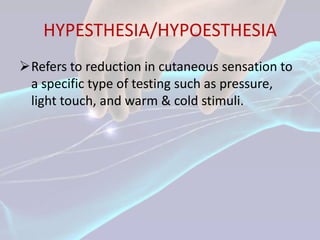
HYPESTHESIA/HYPOESTHESIA
Refers to reduction in cutaneous sensation to
 a specific type of testing such as pressure,
 light touch, and warm & cold stimuli.
ANESTHESIA
Refers to complete absence of skin sensation
 to the same stimuli plus pinprick.
HYPALGESIA OR ANALGESIA
This refers to reduced or absent pain
 perception (nociception) , such as perception
 of the pricking quality elicited by a pain.
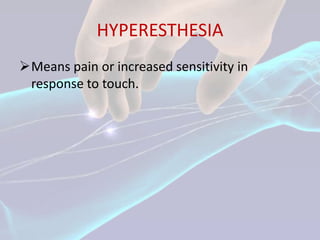
HYPERESTHESIA
Means pain or increased sensitivity in
 response to touch.
ALLODYNIA
Describes the situation in which a non painful
 stimulus once perceived is experienced as
 painful even excruciating.
Eg: elicitation of a painful stimuli by
 application of vibrating tuning fork
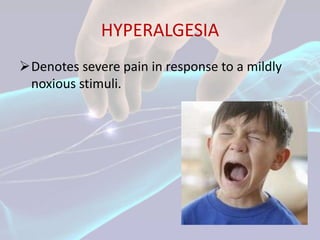
HYPERALGESIA
Denotes severe pain in response to a mildly
 noxious stimuli.
HYPERPATHIA
It is a broad term which encompasses all the
 phenomena described by hyperesthesia,
 allodynia, & hyperalgesia.
With hyperpathia the threshold for a sensory
 stimulus s increased and perception is
 delayed, but once felt , is unduly painful.
Disorders of deep sensation arising from muscle
spindles, tendons,& joints, affect propriocepton.

•Manifestation include (particularly when eyes
closed or in dark)
Imbalance
clumsiness of precision movement sensory
Unsteadiness of gait.                 ataxia
other findings on examination usually include
reduced or absent joint position & vibratory
sensibility and absent deep tendon reflex in the
affected limbs.

Romber’s sign is positive - which means the
patient sways markedly of topples when asked to
stand with feet close together and eyes closed.

In severe state of deafferentiation involving deep
sensation, the patient cannot walk or stand or even
sit unsupported.
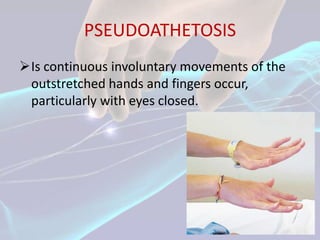
PSEUDOATHETOSIS
Is continuous involuntary movements of the
 outstretched hands and fingers occur,
 particularly with eyes closed.
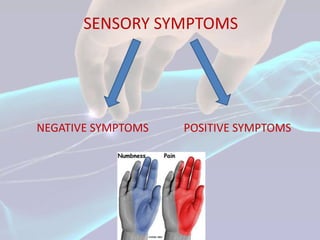
SENSORY SYMPTOMS


NEGATIVE SYMPTOMS   POSITIVE SYMPTOMS
POSITIVE SYMPTOMS….

• The prototypical positive symptom is tingling,
  that is pins and needle sensation.
• Other positive symptoms include altered
  sensations that are described as
     Pricking
     Band like
     Lightening like shooting feeling (lancinations)
     aching
Cont…
.
     Knifelike
     Twisting
     Drawing
     Pulling
     Tightening
     Burning
     Searing
     Electrical
     Or raw feelings
Positive symptoms usually results from impulses
                          .
 generated at sites of lowered threshold or
 heightened excitability, along a peripheral or
 central sensory pathway.

The nature and severity of the abnormal
 sensation depend on the-
  Number
  Rate
  Timing
  Distribution of ectopic impulses, and
  Type and function of the nervous tissue from which
   they arise.
Since positive symptoms represents excessive
                        .
 activity of sensory pathways- they are not
 represented as sensory loss on examination
Negative symptoms…..
• Negative symptoms represents loss of sensory
  functions and are characterized by diminished
  or absent feeling.
• It is often experienced as numbness.
• It is estimated that at least half half the
  afferent axons innervating a given site are lost
  or functionless before a sensory deficit can be
  demonstrated by clinical examination.
The threshold of sensory symptoms varies
 with how rapidly function is lost in sensory
 nerve fibre.

If the rate of loss is low-lack of cutaneous
 feelings may be unnoticed by the patient -and
 difficult to demonstrate on examination, even
 though few sensory fibers are functioning.
If rate of loss is rapid- both positive and
 negative phenomenon are easily identified.
Thank u……

Terminologies in sensory symptoms

  • 1.
  • 2.
    TERMINOLOGIES • Words usedto characterize sensory disturbance.
  • 3.
    PARESTHESIAS Typically refers totingling or pins and needles sensation but may include a wide variety of other abnormal sensation, except pain.
  • 4.
    DYSESTHESIAS It is amore generalized term which denote all types of abnormal sensations including painful ones, regardless of whether a stimulus is evident.
  • 5.
    HYPESTHESIA/HYPOESTHESIA Refers to reductionin cutaneous sensation to a specific type of testing such as pressure, light touch, and warm & cold stimuli.
  • 6.
    ANESTHESIA Refers to completeabsence of skin sensation to the same stimuli plus pinprick.
  • 7.
    HYPALGESIA OR ANALGESIA Thisrefers to reduced or absent pain perception (nociception) , such as perception of the pricking quality elicited by a pain.
  • 8.
    HYPERESTHESIA Means pain orincreased sensitivity in response to touch.
  • 9.
    ALLODYNIA Describes the situationin which a non painful stimulus once perceived is experienced as painful even excruciating. Eg: elicitation of a painful stimuli by application of vibrating tuning fork
  • 10.
    HYPERALGESIA Denotes severe painin response to a mildly noxious stimuli.
  • 11.
    HYPERPATHIA It is abroad term which encompasses all the phenomena described by hyperesthesia, allodynia, & hyperalgesia. With hyperpathia the threshold for a sensory stimulus s increased and perception is delayed, but once felt , is unduly painful.
  • 12.
    Disorders of deepsensation arising from muscle spindles, tendons,& joints, affect propriocepton. •Manifestation include (particularly when eyes closed or in dark) Imbalance clumsiness of precision movement sensory Unsteadiness of gait. ataxia
  • 13.
    other findings onexamination usually include reduced or absent joint position & vibratory sensibility and absent deep tendon reflex in the affected limbs. Romber’s sign is positive - which means the patient sways markedly of topples when asked to stand with feet close together and eyes closed. In severe state of deafferentiation involving deep sensation, the patient cannot walk or stand or even sit unsupported.
  • 14.
    PSEUDOATHETOSIS Is continuous involuntarymovements of the outstretched hands and fingers occur, particularly with eyes closed.
  • 15.
  • 16.
    POSITIVE SYMPTOMS…. • Theprototypical positive symptom is tingling, that is pins and needle sensation. • Other positive symptoms include altered sensations that are described as  Pricking  Band like  Lightening like shooting feeling (lancinations)  aching
  • 17.
    Cont… .  Knifelike  Twisting  Drawing  Pulling  Tightening  Burning  Searing  Electrical  Or raw feelings
  • 18.
    Positive symptoms usuallyresults from impulses . generated at sites of lowered threshold or heightened excitability, along a peripheral or central sensory pathway. The nature and severity of the abnormal sensation depend on the- Number Rate Timing Distribution of ectopic impulses, and Type and function of the nervous tissue from which they arise.
  • 19.
    Since positive symptomsrepresents excessive . activity of sensory pathways- they are not represented as sensory loss on examination
  • 20.
    Negative symptoms….. • Negativesymptoms represents loss of sensory functions and are characterized by diminished or absent feeling. • It is often experienced as numbness. • It is estimated that at least half half the afferent axons innervating a given site are lost or functionless before a sensory deficit can be demonstrated by clinical examination.
  • 21.
    The threshold ofsensory symptoms varies with how rapidly function is lost in sensory nerve fibre. If the rate of loss is low-lack of cutaneous feelings may be unnoticed by the patient -and difficult to demonstrate on examination, even though few sensory fibers are functioning.
  • 22.
    If rate ofloss is rapid- both positive and negative phenomenon are easily identified.
  • 23.