VARICOCELE
NORMAL ANATOMYOF
         PAMPINIFORM PLEXUS
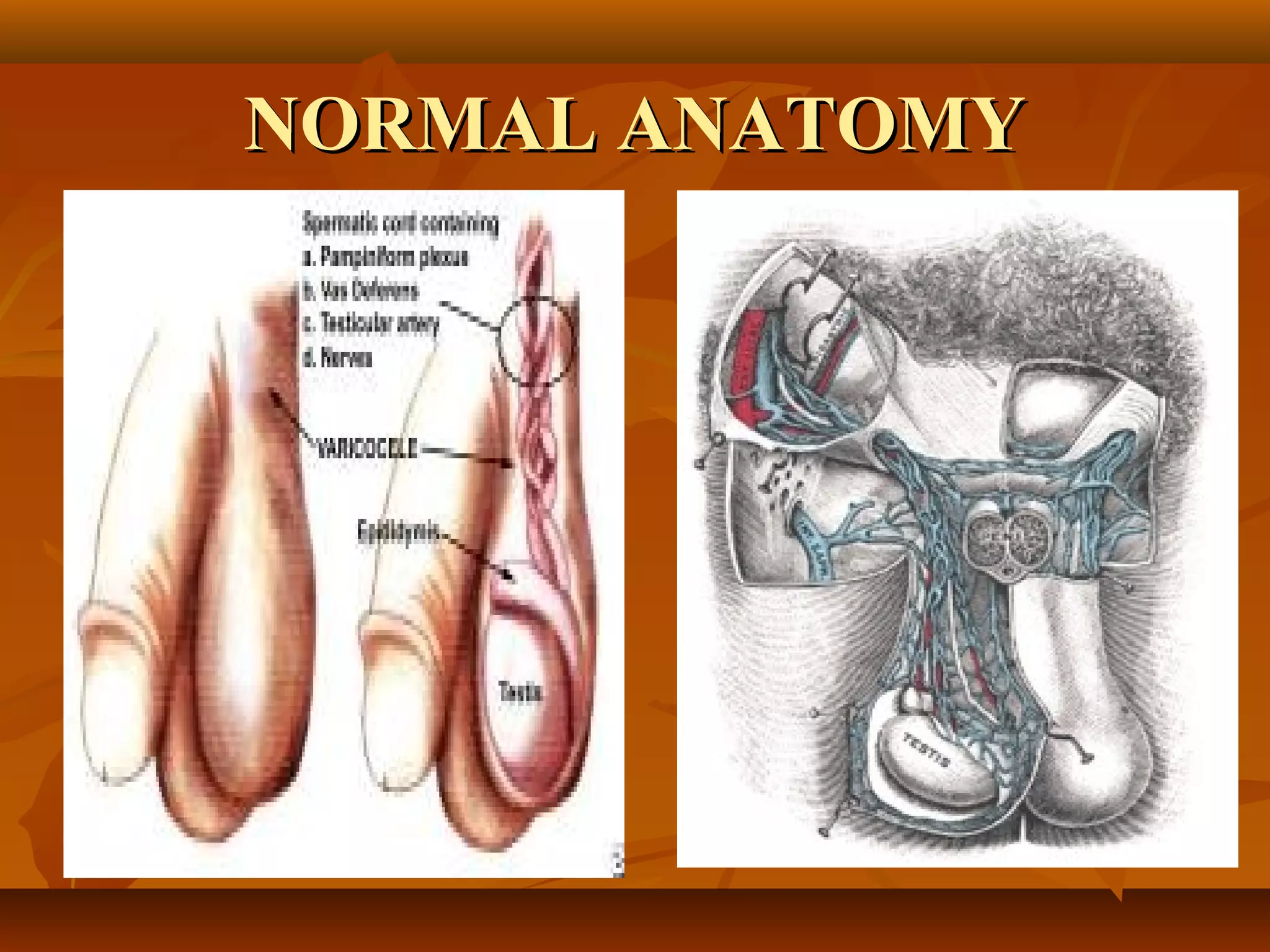
   Union of multiple spermatic veins frm back of testis
    and epididymis.
   Ascend along cord infront of the ductus deferens
    below the superficial inguinal ring.They unite to form
    3-4 veins--inguinal canal—enter abdo thru deep
    ring--forms 2 veins which unite—testicular vein--
    IVC—acute.
   Drain from testes,epididymis and vas deferens-drain
    into spermatic veins
   Left spermatic vein drains into renal vein and right
    spermatic into inferior vena cava and then into the rt
    renal vein.
NORMAL ANATOMY
What is varicocele?
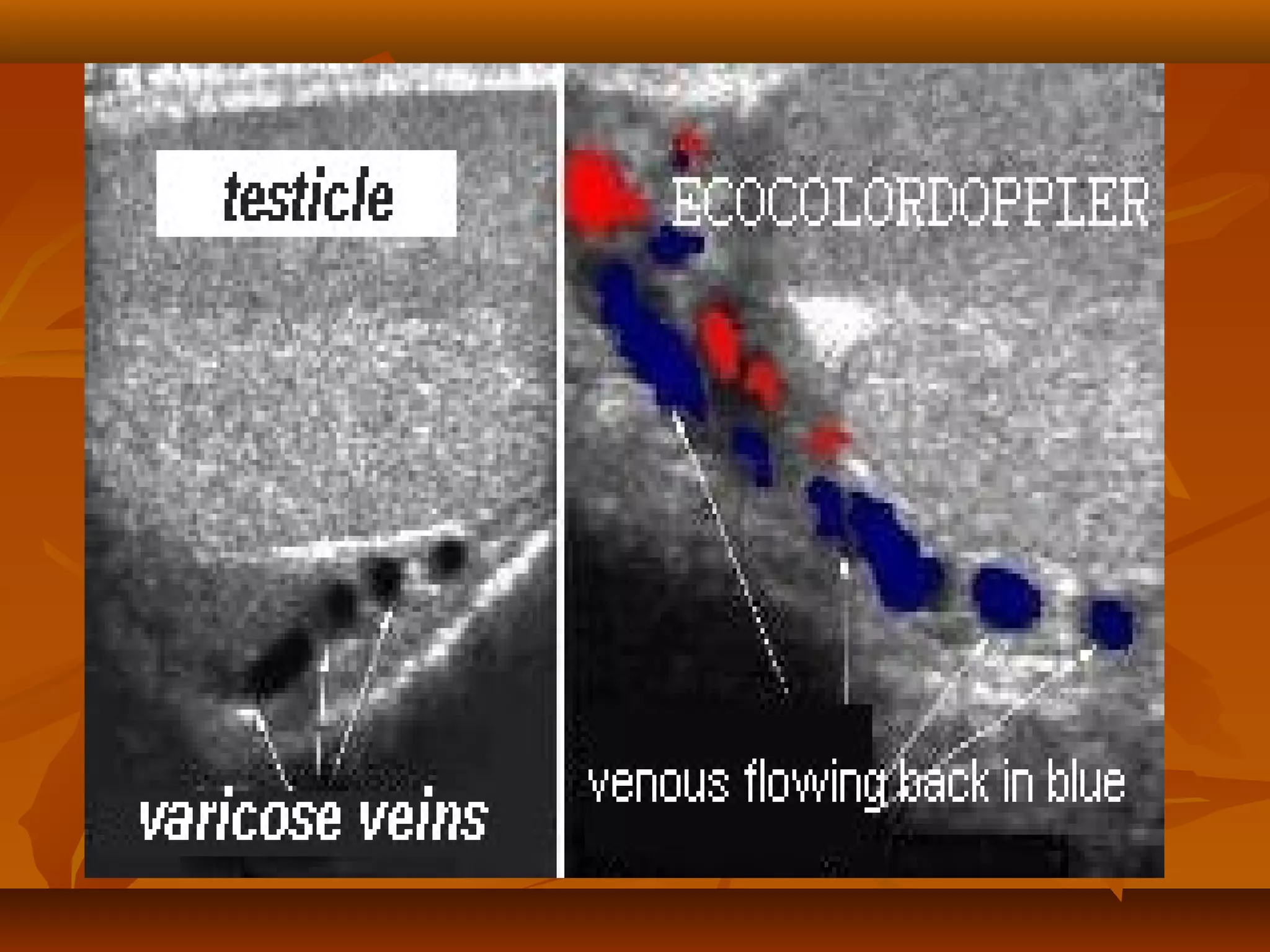
   Dilatation and tortuosity of the pampiniform
    plexus and so also of the testicular veins.
   Seen commonly in men aged 15-30yrs and
    rarely after 40yrs.
   Occur in 15-20% of all males and 40% of all
    infertile males.
   Normal small vessels of plexus- 0.5-1.5mm.
    Diameter greater than 2mm- Varicocele.
   Seen commonly on the left side –5 reasons.
             -longer
             -enters at right angle to the renal vein
             -left testicular artery arching over it
            -a loaded sigmoid colon.
            - compressed b/w the aorta and SMA.
Aetiology and types
   1.IDIOPATHIC/PRIMARY – due to
    incompetency of valves. 98% occur on the left
    side.
   2.SECONDARY- pelvic or abdominal mass.
                  - L renal cell carcinoma with
    tumor thrombus in left vein.
                  -Nutcracker syndrome- SMA
    compressing left vein. Common conditions-
    RCC, Retroperitoneal fibrosis or adhesions.
CLINICAL FEATURES
   Swelling
   Dragging /aching pain in the groin and
    scrotum
   “ bag of worms” feeling
   Scrotum on the affected side hangs down.
   On lying down,it gets reduced.
   Bow sign- hold varicocele b/w thumb and
    fingers,patient is asked to bow-reduced in size.
   Cough impulse present
   Long standing cases- affected side testis is
    reduced in size and softer.
   Fertility problems.
Varicocele and subfertility
   Altered heat exchange mechanism due to
    stagnation- hyperthermia-inhibition of
    spermatogenesis.
   Increased temperature-increased metabolic
    activity-depletion of glycogen storage-injury
    of parenchyma of testis-oligospermia.
   Hypoxia, Leydig cell dysfunction-low
    testosterone.
   Maturation arrest-poor spermatogenesis.
INVESTIGATIONS
 Venous doppler of the scrotum and groin-
               -standing/ valsalva’s manouevre.
 U/S abdomen to look for kidney tumours.
 Semen analysis
GRADING
   1.SMALL         - identified only by bearing
                                  down i.e, an
    increase in abdominal pressure.

   2.MODERATE - identified by palpation w/o
    bearing down.
   3.LARGE           - easily identifed by
    inspection alone.
   4.SEVERELY TORTUOUS.
INDICATIONS FOR SURGERY
   American Urological Society recommends that
    varicocele treatment should be offered to the
    male partner of a couple attempting to
    conceive when all of the following are present.
   A varicocele is palpable.
   The couple has documented infertility.
   The female has normal fertility or potentially
    correctable infertility.
   The male partner has one or more abnormal
    semen parameters or sperm function test
    results.
   The indications in adolescents- presence of
    significant testicular asymmetry (>20%)
    demonstrated on serial examinations, testicular
    pain, and abnormal semen analysis results.
    Very large varicoceles may also be repaired;
    however, in the absence of atrophy, this
    indication is relative and controversial .
TREATMENT
 3 SURGICAL AND 1 NON SURGICAL
    PROCEDURE.

 VARICOCELECTOMY-
    The most common approaches are
   inguinal (groin)-easier and safer.
   retroperitoneal (abdominal)
   infrainguinal/subinguinal (below the groin),
   suprainguinal extraperitonial( Palomo’s operation),
   Scrotal approach- grade 4.
   Done in GA or
    spinal.
   2-3 inch incision.
   Ligate the offending
    veins.
   Avoid strenuous
    exercise for several
    days after surgery.
   Apply scrotal
    support.
Complications
   20% chance of recurrence.
   5% chance of hydrocele
   Damage to testicular artery.
   Infection.
   hematoma
2. MICRODISSECTION
 Microsurgery (also called microsurgical ligation)
  smaller incision is made.
 Cut the skin and fatty tissue. Because muscle is not
  cut-less pain and faster recovery.
 The doctor identifies the varicoceles (swollen veins)
  through an operating microscope. Large varicoceles
  are cut and stapled closed. Smaller varicoceles are cut
  and stitched shut.
 Takes less than an hour and recovery time is short.

 Higher success rate,fewer complications,smaller scar.
3.LAPROSCOPY
   Similar to conventional surgery. Incision made
    on abdomen.
   High ligations required.
   Larger incision or more retraction needed.
   Complications more- testicular artery injuryy
    and hydrocele.
IV. Coil Embolization, Radiologic
     Balloon Occlusion or Radiologic
               Ablation
   Non-surgical procedure.
   Steel coil or silicone balloon catheter is
    introduced into a vein below the groin through
    a nick in the skin.
   Passed under X-ray guidance.
   Tiny metal coils or other embolizing agents
    introduced through the catheter.
   No stitches needed.
   Patient can go back in 24hrs.
   Lower rates of complications.

   Disadv- less effective, higher recurrence(5-
    11%), danger that the coil could migrate to the
    heart and cause death .
CONTRAINDICATIONS
   Subclinical varicocele in an infertile person-
    controversial.
   discovery of a varicocele at the time of
    vasectomy or vasectomy reversal-relative
    contraindication to immediate repair.
   A 6-month delayed repair is recommended -to
    allow the development of collateral vessels to
    decrease the chance of vascular compromise to
    the testicle.
Varicocele

Varicocele

  • 1.
  • 2.
    NORMAL ANATOMYOF PAMPINIFORM PLEXUS  Union of multiple spermatic veins frm back of testis and epididymis.  Ascend along cord infront of the ductus deferens below the superficial inguinal ring.They unite to form 3-4 veins--inguinal canal—enter abdo thru deep ring--forms 2 veins which unite—testicular vein-- IVC—acute.  Drain from testes,epididymis and vas deferens-drain into spermatic veins  Left spermatic vein drains into renal vein and right spermatic into inferior vena cava and then into the rt renal vein.
  • 3.
  • 4.
    What is varicocele?  Dilatation and tortuosity of the pampiniform plexus and so also of the testicular veins.  Seen commonly in men aged 15-30yrs and rarely after 40yrs.  Occur in 15-20% of all males and 40% of all infertile males.  Normal small vessels of plexus- 0.5-1.5mm. Diameter greater than 2mm- Varicocele.
  • 5.
    Seen commonly on the left side –5 reasons. -longer -enters at right angle to the renal vein -left testicular artery arching over it -a loaded sigmoid colon. - compressed b/w the aorta and SMA.
  • 6.
    Aetiology and types  1.IDIOPATHIC/PRIMARY – due to incompetency of valves. 98% occur on the left side.  2.SECONDARY- pelvic or abdominal mass. - L renal cell carcinoma with tumor thrombus in left vein. -Nutcracker syndrome- SMA compressing left vein. Common conditions- RCC, Retroperitoneal fibrosis or adhesions.
  • 7.
    CLINICAL FEATURES  Swelling  Dragging /aching pain in the groin and scrotum  “ bag of worms” feeling  Scrotum on the affected side hangs down.  On lying down,it gets reduced.  Bow sign- hold varicocele b/w thumb and fingers,patient is asked to bow-reduced in size.
  • 8.
    Cough impulse present  Long standing cases- affected side testis is reduced in size and softer.  Fertility problems.
  • 9.
    Varicocele and subfertility  Altered heat exchange mechanism due to stagnation- hyperthermia-inhibition of spermatogenesis.  Increased temperature-increased metabolic activity-depletion of glycogen storage-injury of parenchyma of testis-oligospermia.  Hypoxia, Leydig cell dysfunction-low testosterone.  Maturation arrest-poor spermatogenesis.
  • 10.
    INVESTIGATIONS  Venous dopplerof the scrotum and groin- -standing/ valsalva’s manouevre.  U/S abdomen to look for kidney tumours.  Semen analysis
  • 13.
    GRADING  1.SMALL - identified only by bearing down i.e, an increase in abdominal pressure.  2.MODERATE - identified by palpation w/o bearing down.  3.LARGE - easily identifed by inspection alone.  4.SEVERELY TORTUOUS.
  • 14.
    INDICATIONS FOR SURGERY  American Urological Society recommends that varicocele treatment should be offered to the male partner of a couple attempting to conceive when all of the following are present.  A varicocele is palpable.  The couple has documented infertility.  The female has normal fertility or potentially correctable infertility.  The male partner has one or more abnormal semen parameters or sperm function test results.
  • 15.
    The indications in adolescents- presence of significant testicular asymmetry (>20%) demonstrated on serial examinations, testicular pain, and abnormal semen analysis results. Very large varicoceles may also be repaired; however, in the absence of atrophy, this indication is relative and controversial .
  • 16.
    TREATMENT  3 SURGICALAND 1 NON SURGICAL PROCEDURE.  VARICOCELECTOMY- The most common approaches are  inguinal (groin)-easier and safer.  retroperitoneal (abdominal)  infrainguinal/subinguinal (below the groin),  suprainguinal extraperitonial( Palomo’s operation),  Scrotal approach- grade 4.
  • 17.
    Done in GA or spinal.  2-3 inch incision.  Ligate the offending veins.  Avoid strenuous exercise for several days after surgery.  Apply scrotal support.
  • 18.
    Complications  20% chance of recurrence.  5% chance of hydrocele  Damage to testicular artery.  Infection.  hematoma
  • 19.
    2. MICRODISSECTION  Microsurgery(also called microsurgical ligation) smaller incision is made.  Cut the skin and fatty tissue. Because muscle is not cut-less pain and faster recovery.  The doctor identifies the varicoceles (swollen veins) through an operating microscope. Large varicoceles are cut and stapled closed. Smaller varicoceles are cut and stitched shut.  Takes less than an hour and recovery time is short.  Higher success rate,fewer complications,smaller scar.
  • 20.
    3.LAPROSCOPY  Similar to conventional surgery. Incision made on abdomen.  High ligations required.  Larger incision or more retraction needed.  Complications more- testicular artery injuryy and hydrocele.
  • 21.
    IV. Coil Embolization,Radiologic Balloon Occlusion or Radiologic Ablation  Non-surgical procedure.  Steel coil or silicone balloon catheter is introduced into a vein below the groin through a nick in the skin.  Passed under X-ray guidance.  Tiny metal coils or other embolizing agents introduced through the catheter.
  • 22.
    No stitches needed.  Patient can go back in 24hrs.  Lower rates of complications.  Disadv- less effective, higher recurrence(5- 11%), danger that the coil could migrate to the heart and cause death .
  • 25.
    CONTRAINDICATIONS  Subclinical varicocele in an infertile person- controversial.  discovery of a varicocele at the time of vasectomy or vasectomy reversal-relative contraindication to immediate repair.  A 6-month delayed repair is recommended -to allow the development of collateral vessels to decrease the chance of vascular compromise to the testicle.