Basic Principles of
Hand Examination
Ahmed Atef, Msc, MRCS
Plastic & Reconstructive Surgery Department
Mataria Teaching Hospital
History
Personal history
• Age
• Handedness
• Occupation
• Smoking
Ask About Injury Details
• Mechanism (crush, sharp, etc.)
• Position of hand at injury
• Time of occurrence
• Previous history of similar injuries
History
• Ask about: diabetes, cardiac, pulmonary, or renal
disease
• Prior surgical history
Examination of the Hand
• Inspection
• Palpation
• Range of motion
• Muscle and Tendon Function.
• Neurological testing
• Vascular assessment
• Stability testing
• Special testing
Inspection
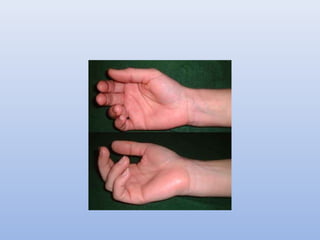
Good exposure and Compare
• Normal fingers cascade
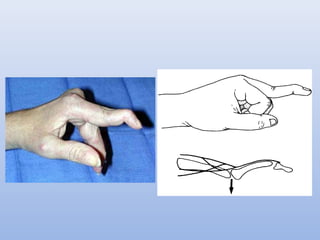
• Deformity
• Muscular atrophy
• Swelling
• Wounds or scars
• Trophic changes
Palpation
• Warmth?
• Dryness?
– Anhydrosis= nerve damage
Palpation
• Thenar Eminence
Atrophy seen in carpal tunnel syndrome
• Hypothenar Eminance
Atrophy with ulnar nerve compression
• Palmar Aponeurosis
Dupuytren’s Contracture
• Finger flexor sheath
palapable nodule
Range of motion
• Active range of motion
and against resistance.
• Passive range of motion
• Bliateral comparison
for stiffness
Range of motion
• Flexion/extension at MCP, PIP, DIP
– Tight fist and open
• ABDuction/ADDuction at MCP
– Spread fingers apart and then back together
Neurological Testing
• Sensory
– Light touch – pin prick
– Two-point
descrimination
• Motor
– Median
– Ulnar
– Radial
Neurological Testing
Neurologic Testing
• Median nerve
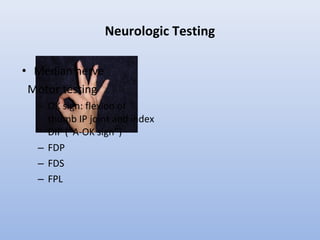
Motor testing
– OK sign: flexion of
thumb IP joint and index
DIP (“A-OK sign”)
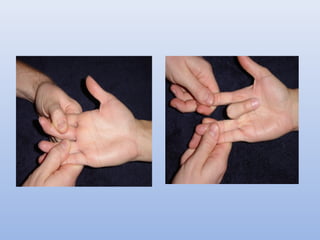
– FDP
– FDS
– FPL
Neurological Testing
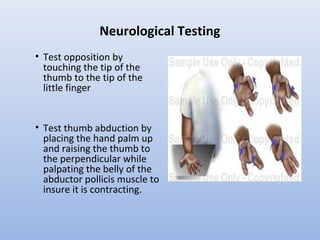
• Test opposition by
touching the tip of the
thumb to the tip of the
little finger
• Test thumb abduction by
placing the hand palm up
and raising the thumb to
the perpendicular while
palpating the belly of the
abductor pollicis muscle to
insure it is contracting.
Neurological Testing
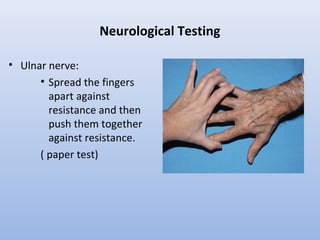
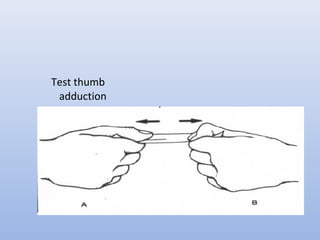
• Ulnar nerve:
• Spread the fingers
apart against
resistance and then
push them together
against resistance.
( paper test)
• Test the
hypothenar muscle,
extend the fingers
and then move the
fifth finger away
from the others
Test thumb
adduction
Froment’s sign
Neurological Testing
• Radial nerve:
• Extend the fingers and wrist.
Vascular Assessment
• Pulse
• Colour.
• Capillary refill.
• Temperature.
• Pin prick.
• Allen’s test
Skeleton assessment
• Swelling
• Deformity
• Tenderness
• Abnormal range of movement
(decreased or increased)
Stability Testing
• Ulnar collateral
ligaments
• Radial collateral
ligaments
Special tests
• Finklestein’s test
(deQuervain’s tendinitis)
• Phalen`s test
• Tinel’s Sign
To Summarize
• History.
• Inspection (, deformity, atrophy, swelling, scars)
• Palpation (confirm inspection)
• Range of motion
• Muscle and tendon Function.
• Neurological testing (sensory & motor)
• Vascular assessment
• Stability testing
• Special testing
Thank You

Hand examination

Editor's Notes

  • #21 Motor Testing The median nerve is responsible for pronation of the forearm, wrist flexion, flexion of the thumb IP joint, and flexion of the DIP joint to the index finger as well as for opposition of the thumb. Resistive testing of thumb IP flexion best isolates median nerve function. The uInar nerve is responsible for flexion of the DIP joint to the ring and little finger. It innervates most of the intrinsic muscles of the hand, which provides grip strength and the ability to abduct and adduct the fingers. The radial nerve is responsible for wrist and finger extension. It is important to note that even in the presence of a complete radial nerve palsy, the fingers can be extended by the uInar innervated intrinsic muscles. Therefore, testing for radial nerve function must be performed with the wrist and MP joints supported in extension, which eliminates the effect of the intrinsics. Testing the ability to give the OK sign is a quick, easy way to test the function of all three nerves (Fig. 16). At this point in the examination, test for the integrity of the tendons to the hand and wrist. Begin with resistive testing of wrist flexion and extension followed by radial and uInar deviation. In the hand, test the integrity of the FDP by having the patient bend at the DIP joint of each finger while holding the MP and PIP joints in full extension. The FDS to each finger is tested by having the patient bend at the PIP joint while holding the other fingers extended (Fig. 17). At the thumb, test the FPL by resistive testing at the thumb IP joint. The intrinsic tendons are tested by resistive testing of finger abduction and adduction.
  • #31 Stability Testing There are certain joints in the upper extremity that are prone to injury and subsequent instability. Careful attention should be given to these joints as part of a routine examination. The elbow should be examined for both varus instability (laxity of the lateral ligaments) and valgus instability (laxity of the medial ligaments). One hand is placed on the patient's humerus as a post, and the elbow is stressed laterally and medially in both the fully extended position and in 30' of flexion. Excessive opening of the joint or reproduction of pain is noted. Instability of the DRUJ is confirmed by pain at the site and a prominence of the ulna head dorsally as compared to the other side. With the patient's arm in a pronated position, the examiner should press on the uInar head and note the amount of ballotment as it reduces into the radius. At the wrist, instability can occur either between bones of the carpus (dissociative) or between carpal rows (nondissociative). The most common intercarpal instability is between the scaphoid and lunate, which is confirmed by pain in the scapholunate region and with a positive Watson test (see Special Tests). Lunotriquetral instability is characterized by pain over the ligament between the lunate and triquetrurn and with a positive shuck test (see Special Tests). For the small joints of the hand, stability testing is performed by stabilizing the proximal bone and placing medial and lateral stress on the bone distal to the joint in question. Gamekeepers or skier's thumb is an injury of the uInar collateral ligament of the thumb MP joint. Opening of the thumb MP joint to lateral stress on the proximal phalanx is diagnostic (Fig. 18).