Presented by-
Dr Nikhil Ahuja
SOMATOSENSORY SYSTEM
1
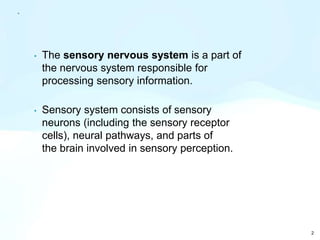
• The sensory nervous system is a part of
the nervous system responsible for
processing sensory information.
• Sensory system consists of sensory
neurons (including the sensory receptor
cells), neural pathways, and parts of
the brain involved in sensory perception.
.
2
• Modalities of sensation
• Receptors and peripheral neurons
• Dermatomes
• Sensory Tracts
• Somatosensory area
• Method of Examination
• Patterns of Sensory loss
Contents
3
SENSATION
Cutaneous Cortical Special
1. Pain 1 Tactile sensation 1 Taste
2. Temperature 2 Two point discrimination 2 Vision
3. Pressure 3 Stereognosis, 3 Hearing
4. Crude touch 4 Graphesthesia 4 Smell
5. Fine touch
6. Vibration
7. Position sense
5
SENSORY PATHWAY
• 1. CUTANEOUS AFFRENT INNERVATION
• 2. SENSORY DERMATOMES / PERIPHERAL
NERVES
• 3. SENSORY TRACTS
• 4. SENSORY CORTEX
6
1.Cutaneous Afferent Innervation
It is subserved by
1. Nociceptors (naked nerve endings) - pain
2. Mechanoceptors (encapsulated terminals)
a. Pacinian corpuscles -vibration & pressure sense
b. Meissner’s corpuscles and hair follicle receptors
fine and light touch
c. Merkel’s cells- pressure and texture
d. Ruffini’s endings - touch and pressure
3. For propioception – muscle spindle
Golgi tendon organs
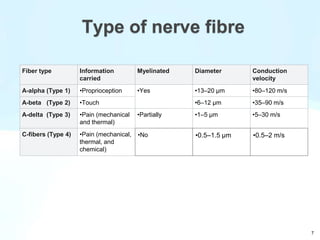
Fiber type Information
carried
Myelinated Diameter Conduction
velocity
A-alpha (Type 1) •Proprioception •Yes •13–20 μm •80–120 m/s
A-beta (Type 2) •Touch •6–12 μm •35–90 m/s
A-delta (Type 3) •Pain (mechanical
and thermal)
•Partially •1–5 μm •5–30 m/s
C-fibers (Type 4) •Pain (mechanical,
thermal, and
chemical)
•No •0.5–1.5 μm •0.5–2 m/s
Type of nerve fibre
7
8
2. Sensory Dermatomes
• Dermatomes are areas of cutaneous innervation that
are supplied by a single spinal nerve or cord level (with
the exception of cranial nerves 5th)
• Testing touch or sensory perception in these areas can
be used to localize lesions of the spinal cord to a specific
cord level or spinal nerve
.
9
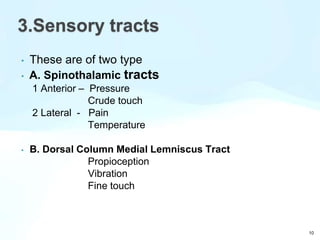
• These are of two type
• A. Spinothalamic tracts
1 Anterior – Pressure
Crude touch
2 Lateral - Pain
Temperature
• B. Dorsal Column Medial Lemniscus Tract
Propioception
Vibration
Fine touch
3.Sensory tracts
10
•
The 3rd order neurons take the sensory info to the
postcentral gyrus of the parietal lobe throgh
Posterior limb of internal capsule
•
The 2" order neurons synapse with the third order
neurons in the thalamus
•
The 2 order neurons cross the midline in medulla
oblongata and ascend in medial lemniscus
• in medulla they synapse with 2" order neurons in nucleus
gracilis and cuneatus
•
The I order neurons ascend up through the faciculi
gracilis and cuneatus ipsilaterally
•
axons of sensory neurons enter the spinal cord at dorsal
horn.
• Receptor of touch , vibration and propioception
Dorsal Column Pathway:
11
• The 3 order neurons take the sensory info to the
sensory cortex through the posterior limb of internal
capsule
• Then in the thalamus 2" order neurons synapse with
the third order neurons
• The 2 order neurons ascend up through the medulla
oblongata , posterior part of pons and tegmentum of
the brainstems
• The 2 order neurons ascend 2-3 segment then cross
midline in the spinal cord
• The I order neurons synapse with the 2nd order
neurons in dorsal root
• axons of sensory neurons enter the spinal cord at
Dorsal horn.
• Fibre from nociceptors and thermoreceptors
Spinothalamic tracts
12
Arrangement of Sensory Fibres in
spinal cord
13
• The somatic sensory cortex in humans, which is located
in the parietal lobe, comprises four distinct regions, or
fields, known as Brodmann's areas 3a, 3b, 1, and 2.
• Primary somatic sensory cortex (3,1,2)
Differentiates intensity and type of stimulus
Determines stimulus localization
• Secondary somatosensory cortex (5,7)
Recognition of stimuli
Interpretation of stimuli
4. Somatosensory area
14
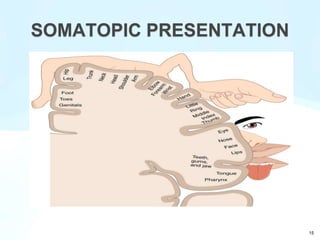
SOMATOPIC PRESENTATION
15
Preliminary screening
Choose a part of patient’s body which is expected to be
normal (from history) and touch him precisely.
Ask him
a. if he can feel anything
b. what is that he can feel
c. if it is sharp or blunt
Later do detailed analysis always moving from impaired
to normal sensation.
Method of Examination
16
• A small piece of cotton wool is used. After similar
preliminary screening, tell the patient to shut his eyes and
to say ‘yes’ if he feels anything.
• Cotton wool is shaped to a point and the skin is
touched lightly, testing again in dermatome areas
and mapping out abnormalities.
Touch
17
• Pain -Tested using a sharp pin with a rounded head.
Same preliminary screening is adopted.
• Deep Pain -Tested by firm squeezing over muscles
(usually calf muscle) and tendons. Patient is asked to
indicate when the pressure becomes painful and the
examiner gauges whether the force applied is painful in
normal people
PAIN
18
Preliminary Screening -
Patient can compare the temperature of a cold object
such as a tuning fork in the main sensory areas of the
body.
After this, use test tubes containing hot water (44oC)
and cold water (30oC).
Temperature
19
• Ideally tested with the vibrating tuning fork with a
frequency of 128 Hz because it’s vibrations stay longer
than higher frequency tuning fork.
• Only the stem of the tuning fork should be touched and
not the prongs
• Tuning fork is struck and placed on bony points starting
peripherally at the terminal phalanx, then
successively over medial or lateral malleoli, tibial
tuberosity, anterior superior iliac spine, ribs or costal
margin, lower end of radius, elbow and clavicle
Vibration Sense
20
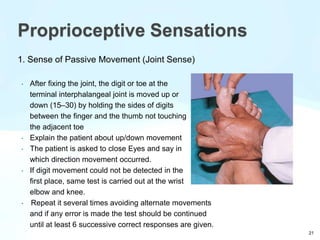
1. Sense of Passive Movement (Joint Sense)
• After fixing the joint, the digit or toe at the
terminal interphalangeal joint is moved up or
down (15–30) by holding the sides of digits
between the finger and the thumb not touching
the adjacent toe
• Explain the patient about up/down movement
• The patient is asked to close Eyes and say in
which direction movement occurred.
• If digit movement could not be detected in the
first place, same test is carried out at the wrist
elbow and knee.
• Repeat it several times avoiding alternate movements
and if any error is made the test should be continued
until at least 6 successive correct responses are given.
Proprioceptive Sensations
21
2 Position Sense –
1. Patient’s eye should remain closed
2. Place the patient’s arm in a particular position
then move it away and
ask him to replace it himself
and then to place the opposite limb in a similar position.
3 Romberg’s Test for Position Sense
Patient stands upright with the feet together and eyes closed
Where there is a proprioceptive or vestibular deficit, balance is
impaired only when the eyes are closed, and the patient may fall if not
caught.
Minimal lesions can be demonstrated by asking the patient to stand on
his toes with the eyes closed.
.
22
• Cortical sensations should be tested only if primary
modalities of sensations are intact
• If these sensation are impaired it indicate lesion in
somatosensory area
I. Point Localisation (Tactile Localisation)
• Ability of the patient to localise accurately the point touched
• Patient’s eye should remain closed
• he is asked to indicate the point touched by examinar fingertips or
blunt point with his own fingers
Cortical Sensations
23
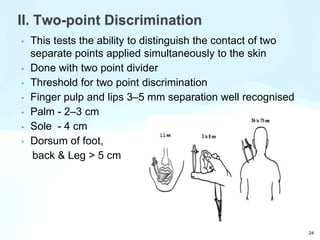
• This tests the ability to distinguish the contact of two
separate points applied simultaneously to the skin
• Done with two point divider
• Threshold for two point discrimination
• Finger pulp and lips 3–5 mm separation well recognised
• Palm - 2–3 cm
• Sole - 4 cm
• Dorsum of foot,
back & Leg > 5 cm
II. Two-point Discrimination
24
• It is the ability to recognize an object purely from the feel
of its shape and size
• Test objects must be familiar,
easily identifiable and large
enough for a weak hand to
feel. Like pen, pencil, key
or mobile
III. Stereognosis
25
• Ability to recognize letters or numbers or diagrams written
on the skin with a blunt point.
• Patient closes his eyes and
letters, numbers or shape
are traced out on the palm,
anterior forearm, thigh or
lower leg.
• Clear figures like 8, 3, and 5
should be used
IV. Graphaesthesia
26
PATTERNS OF SENSORY LOSS
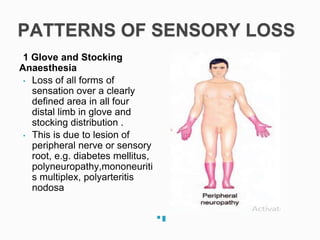
1 Glove and Stocking
Anaesthesia
• Loss of all forms of
sensation over a clearly
defined area in all four
distal limb in glove and
stocking distribution .
• This is due to lesion of
peripheral nerve or sensory
root, e.g. diabetes mellitus,
polyneuropathy,mononeuriti
s multiplex, polyarteritis
nodosa
28
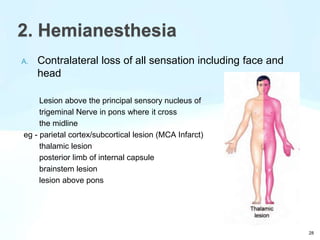
2. Hemianesthesia
A. Contralateral loss of all sensation including face and
head
Lesion above the principal sensory nucleus of
trigeminal Nerve in pons where it cross
the midline
eg - parietal cortex/subcortical lesion (MCA Infarct)
thalamic lesion
posterior limb of internal capsule
brainstem lesion
lesion above pons
29
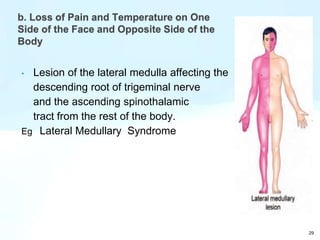
b. Loss of Pain and Temperature on One
Side of the Face and Opposite Side of the
Body
• Lesion of the lateral medulla affecting the
descending root of trigeminal nerve
and the ascending spinothalamic
tract from the rest of the body.
Eg Lateral Medullary Syndrome
30
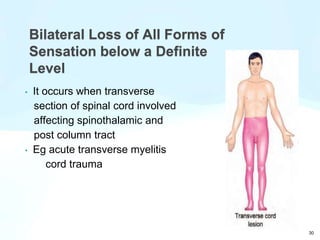
Bilateral Loss of All Forms of
Sensation below a Definite
Level
• It occurs when transverse
section of spinal cord involved
affecting spinothalamic and
post column tract
• Eg acute transverse myelitis
cord trauma
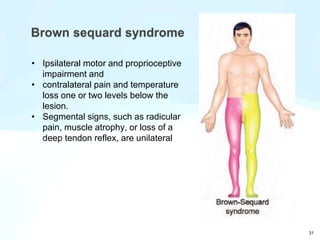
Brown sequard syndrome
31
• Ipsilateral motor and proprioceptive
impairment and
• contralateral pain and temperature
loss one or two levels below the
lesion.
• Segmental signs, such as radicular
pain, muscle atrophy, or loss of a
deep tendon reflex, are unilateral
Central cord lesion
32
• This syndrome results from selective damage of
a. gray matter nerve cells
b. crossing spinothalamic tracts
surrounding central canal
• In the cervical cord, the central cord syndrome
produces arm weakness out of proportion to leg
weakness and a “dissociated” sensory loss,
meaning loss of pain and temperature sensations
over the shoulders, lower neck, and upper trunk
(cape distribution), in contrast to preservation of light
touch, joint position, and vibration sense in these
regions.
• syringomyelia, and intrinsic cord tumors are the
main causes
.
Sacral sparing
33
• Sacral sparing refers to preservation
of pin prick and temperature
sensation in sacral dermatomes (S3,
4, 5) in the presence of sensory loss
at a higher level.
• This is dependable sign of intrinsic
cord compression damaging inner
most fibres of spinothalamic tracts
while sparing those placed more
laterally which subserve sacral
sensation.
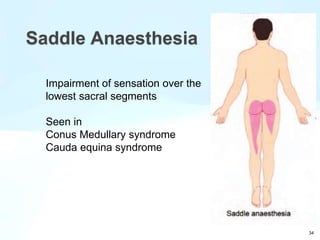
Saddle Anaesthesia
34
Impairment of sensation over the
lowest sacral segments
Seen in
Conus Medullary syndrome
Cauda equina syndrome
• .
THANK YOU
35

SENSORY SYSTEM WITH PATHWAYS AND CLINICAL EXAMINATION

  • 1.
    Presented by- Dr NikhilAhuja SOMATOSENSORY SYSTEM 1
  • 2.
    • The sensorynervous system is a part of the nervous system responsible for processing sensory information. • Sensory system consists of sensory neurons (including the sensory receptor cells), neural pathways, and parts of the brain involved in sensory perception. . 2
  • 3.
    • Modalities ofsensation • Receptors and peripheral neurons • Dermatomes • Sensory Tracts • Somatosensory area • Method of Examination • Patterns of Sensory loss Contents 3
  • 4.
    SENSATION Cutaneous Cortical Special 1.Pain 1 Tactile sensation 1 Taste 2. Temperature 2 Two point discrimination 2 Vision 3. Pressure 3 Stereognosis, 3 Hearing 4. Crude touch 4 Graphesthesia 4 Smell 5. Fine touch 6. Vibration 7. Position sense
  • 5.
    5 SENSORY PATHWAY • 1.CUTANEOUS AFFRENT INNERVATION • 2. SENSORY DERMATOMES / PERIPHERAL NERVES • 3. SENSORY TRACTS • 4. SENSORY CORTEX
  • 6.
    6 1.Cutaneous Afferent Innervation Itis subserved by 1. Nociceptors (naked nerve endings) - pain 2. Mechanoceptors (encapsulated terminals) a. Pacinian corpuscles -vibration & pressure sense b. Meissner’s corpuscles and hair follicle receptors fine and light touch c. Merkel’s cells- pressure and texture d. Ruffini’s endings - touch and pressure 3. For propioception – muscle spindle Golgi tendon organs
  • 7.
    Fiber type Information carried MyelinatedDiameter Conduction velocity A-alpha (Type 1) •Proprioception •Yes •13–20 μm •80–120 m/s A-beta (Type 2) •Touch •6–12 μm •35–90 m/s A-delta (Type 3) •Pain (mechanical and thermal) •Partially •1–5 μm •5–30 m/s C-fibers (Type 4) •Pain (mechanical, thermal, and chemical) •No •0.5–1.5 μm •0.5–2 m/s Type of nerve fibre 7
  • 8.
    8 2. Sensory Dermatomes •Dermatomes are areas of cutaneous innervation that are supplied by a single spinal nerve or cord level (with the exception of cranial nerves 5th) • Testing touch or sensory perception in these areas can be used to localize lesions of the spinal cord to a specific cord level or spinal nerve
  • 9.
  • 10.
    • These areof two type • A. Spinothalamic tracts 1 Anterior – Pressure Crude touch 2 Lateral - Pain Temperature • B. Dorsal Column Medial Lemniscus Tract Propioception Vibration Fine touch 3.Sensory tracts 10
  • 11.
    • The 3rd orderneurons take the sensory info to the postcentral gyrus of the parietal lobe throgh Posterior limb of internal capsule • The 2" order neurons synapse with the third order neurons in the thalamus • The 2 order neurons cross the midline in medulla oblongata and ascend in medial lemniscus • in medulla they synapse with 2" order neurons in nucleus gracilis and cuneatus • The I order neurons ascend up through the faciculi gracilis and cuneatus ipsilaterally • axons of sensory neurons enter the spinal cord at dorsal horn. • Receptor of touch , vibration and propioception Dorsal Column Pathway: 11
  • 12.
    • The 3order neurons take the sensory info to the sensory cortex through the posterior limb of internal capsule • Then in the thalamus 2" order neurons synapse with the third order neurons • The 2 order neurons ascend up through the medulla oblongata , posterior part of pons and tegmentum of the brainstems • The 2 order neurons ascend 2-3 segment then cross midline in the spinal cord • The I order neurons synapse with the 2nd order neurons in dorsal root • axons of sensory neurons enter the spinal cord at Dorsal horn. • Fibre from nociceptors and thermoreceptors Spinothalamic tracts 12
  • 13.
    Arrangement of SensoryFibres in spinal cord 13
  • 14.
    • The somaticsensory cortex in humans, which is located in the parietal lobe, comprises four distinct regions, or fields, known as Brodmann's areas 3a, 3b, 1, and 2. • Primary somatic sensory cortex (3,1,2) Differentiates intensity and type of stimulus Determines stimulus localization • Secondary somatosensory cortex (5,7) Recognition of stimuli Interpretation of stimuli 4. Somatosensory area 14
  • 15.
  • 16.
    Preliminary screening Choose apart of patient’s body which is expected to be normal (from history) and touch him precisely. Ask him a. if he can feel anything b. what is that he can feel c. if it is sharp or blunt Later do detailed analysis always moving from impaired to normal sensation. Method of Examination 16
  • 17.
    • A smallpiece of cotton wool is used. After similar preliminary screening, tell the patient to shut his eyes and to say ‘yes’ if he feels anything. • Cotton wool is shaped to a point and the skin is touched lightly, testing again in dermatome areas and mapping out abnormalities. Touch 17
  • 18.
    • Pain -Testedusing a sharp pin with a rounded head. Same preliminary screening is adopted. • Deep Pain -Tested by firm squeezing over muscles (usually calf muscle) and tendons. Patient is asked to indicate when the pressure becomes painful and the examiner gauges whether the force applied is painful in normal people PAIN 18
  • 19.
    Preliminary Screening - Patientcan compare the temperature of a cold object such as a tuning fork in the main sensory areas of the body. After this, use test tubes containing hot water (44oC) and cold water (30oC). Temperature 19
  • 20.
    • Ideally testedwith the vibrating tuning fork with a frequency of 128 Hz because it’s vibrations stay longer than higher frequency tuning fork. • Only the stem of the tuning fork should be touched and not the prongs • Tuning fork is struck and placed on bony points starting peripherally at the terminal phalanx, then successively over medial or lateral malleoli, tibial tuberosity, anterior superior iliac spine, ribs or costal margin, lower end of radius, elbow and clavicle Vibration Sense 20
  • 21.
    1. Sense ofPassive Movement (Joint Sense) • After fixing the joint, the digit or toe at the terminal interphalangeal joint is moved up or down (15–30) by holding the sides of digits between the finger and the thumb not touching the adjacent toe • Explain the patient about up/down movement • The patient is asked to close Eyes and say in which direction movement occurred. • If digit movement could not be detected in the first place, same test is carried out at the wrist elbow and knee. • Repeat it several times avoiding alternate movements and if any error is made the test should be continued until at least 6 successive correct responses are given. Proprioceptive Sensations 21
  • 22.
    2 Position Sense– 1. Patient’s eye should remain closed 2. Place the patient’s arm in a particular position then move it away and ask him to replace it himself and then to place the opposite limb in a similar position. 3 Romberg’s Test for Position Sense Patient stands upright with the feet together and eyes closed Where there is a proprioceptive or vestibular deficit, balance is impaired only when the eyes are closed, and the patient may fall if not caught. Minimal lesions can be demonstrated by asking the patient to stand on his toes with the eyes closed. . 22
  • 23.
    • Cortical sensationsshould be tested only if primary modalities of sensations are intact • If these sensation are impaired it indicate lesion in somatosensory area I. Point Localisation (Tactile Localisation) • Ability of the patient to localise accurately the point touched • Patient’s eye should remain closed • he is asked to indicate the point touched by examinar fingertips or blunt point with his own fingers Cortical Sensations 23
  • 24.
    • This teststhe ability to distinguish the contact of two separate points applied simultaneously to the skin • Done with two point divider • Threshold for two point discrimination • Finger pulp and lips 3–5 mm separation well recognised • Palm - 2–3 cm • Sole - 4 cm • Dorsum of foot, back & Leg > 5 cm II. Two-point Discrimination 24
  • 25.
    • It isthe ability to recognize an object purely from the feel of its shape and size • Test objects must be familiar, easily identifiable and large enough for a weak hand to feel. Like pen, pencil, key or mobile III. Stereognosis 25
  • 26.
    • Ability torecognize letters or numbers or diagrams written on the skin with a blunt point. • Patient closes his eyes and letters, numbers or shape are traced out on the palm, anterior forearm, thigh or lower leg. • Clear figures like 8, 3, and 5 should be used IV. Graphaesthesia 26
  • 27.
    PATTERNS OF SENSORYLOSS 1 Glove and Stocking Anaesthesia • Loss of all forms of sensation over a clearly defined area in all four distal limb in glove and stocking distribution . • This is due to lesion of peripheral nerve or sensory root, e.g. diabetes mellitus, polyneuropathy,mononeuriti s multiplex, polyarteritis nodosa
  • 28.
    28 2. Hemianesthesia A. Contralateralloss of all sensation including face and head Lesion above the principal sensory nucleus of trigeminal Nerve in pons where it cross the midline eg - parietal cortex/subcortical lesion (MCA Infarct) thalamic lesion posterior limb of internal capsule brainstem lesion lesion above pons
  • 29.
    29 b. Loss ofPain and Temperature on One Side of the Face and Opposite Side of the Body • Lesion of the lateral medulla affecting the descending root of trigeminal nerve and the ascending spinothalamic tract from the rest of the body. Eg Lateral Medullary Syndrome
  • 30.
    30 Bilateral Loss ofAll Forms of Sensation below a Definite Level • It occurs when transverse section of spinal cord involved affecting spinothalamic and post column tract • Eg acute transverse myelitis cord trauma
  • 31.
    Brown sequard syndrome 31 •Ipsilateral motor and proprioceptive impairment and • contralateral pain and temperature loss one or two levels below the lesion. • Segmental signs, such as radicular pain, muscle atrophy, or loss of a deep tendon reflex, are unilateral
  • 32.
    Central cord lesion 32 •This syndrome results from selective damage of a. gray matter nerve cells b. crossing spinothalamic tracts surrounding central canal • In the cervical cord, the central cord syndrome produces arm weakness out of proportion to leg weakness and a “dissociated” sensory loss, meaning loss of pain and temperature sensations over the shoulders, lower neck, and upper trunk (cape distribution), in contrast to preservation of light touch, joint position, and vibration sense in these regions. • syringomyelia, and intrinsic cord tumors are the main causes .
  • 33.
    Sacral sparing 33 • Sacralsparing refers to preservation of pin prick and temperature sensation in sacral dermatomes (S3, 4, 5) in the presence of sensory loss at a higher level. • This is dependable sign of intrinsic cord compression damaging inner most fibres of spinothalamic tracts while sparing those placed more laterally which subserve sacral sensation.
  • 34.
    Saddle Anaesthesia 34 Impairment ofsensation over the lowest sacral segments Seen in Conus Medullary syndrome Cauda equina syndrome
  • 35.