CEREBELLAR DISORDERS
STUDENT : DR MEDINI S
GUIDE : DR SACHIN
HOSAKATTI
HEADINGS
• ANATOMY
• CONNECTIONS
• FUNCTIONS
• DISTURBANCES
ANATOMY
INTRODUCTION
• CEREBELLUM (LATIN) –
little brain
• Weight = 150 gm
• Location – posterior cranial
fossa
• Situated in the posterior cranial
fossa & covered superiorly by
the tentorium cerebelli.
• largest part of the hindbrain
(10% of total wt) and lies
posterior to the 4th ventricle, the
pons, and the medulla .
• It consists of two cerebellar
hemispheres joined by a narrow
median vermis.
• It has three symmetrical bundles of
nerve fibers called the superior,
middle, and inferior cerebellar
peduncles.
• Superior peduncle connects with
mid brain
• Middle peduncle connects with
pons
• Inferior peduncle connect with
medulla
• The cerebellum is divided
into three main lobes: the
anterior lobe, the posterior
lobe, and the
flocculonodular lobe.
• The anterior lobe may be
seen on the superior
surface.
• It is separated from the
posterior lobe by a wide V-
shaped fissure called the
primary fissure.
Three Parts-
Cerebellar hemispheres
• Appendicular coordination
Vermis
• Connection between hemispheres
• Gait and axial function
Flocculonodular lobe
• Paired lateral flocculi with
midline nodulus
• Eye movements & balance
Cerebellar tonsils- small, rounded lobules on inferior aspects of cerebellar
hemispheres, just above the foramen magnum
PHYLOGENETIC DIVISIONS
 Flocculonodular Lobe
• ArchiCerebellum
 Anterior Lobe
• PaleoCerebellum
 Posterior Lobe
 NeoCerebellum
 Middle divisions of
vermis and their lateral
extensions.
ANATOMICAL SUBDIVISIONS OF
CEREBELLUM
VestibuloCerebellum
SpinoCerebellum
PontoCerebellum
Ventral Spinocerebellar tract
Dorsal Spinocerebellar tract
 Same as the flocculonodular
lobe
 Proprioceptive fibers from the
Vestibular nuclei
 Functions
◦ Eye movement
◦ Gross balance and orientation in
space
Vestibulocerebellum
Flocculonodular Lobe
 Connections are to
 Afferent
◦ Labyrinths
◦ Vestibular centers
◦ Spinal cord
◦ Brainstem
◦ Reticular formation
◦ Olivary bodies
 Efferent
◦ Vestibular nuclei
◦ Vestibulospinal tract
◦ Reticular formation
 The manifestations are
difficult to separate from
invariably involved
vestibular findings.
 Isolated FN lobe dysfunction is
usually seen in children in-
 Ependymomas
 Medulloblastomas
Spino/Paleocerebellum
(evolved when extremity control was not a concern)
 Anterior and part of Posterior
Vermis (and paravermal
cortex)
 Proprioceptive fibers from muscles
and tendons of limbs
 Functions
◦ Influence posture,
◦ muscle tone,
◦ axial muscle control,
◦ locomotion
 Dorsal Spinocerebellar Tract
from lower limbs
 Ventral Spinocerebellar tract
from upper limbs
Paleocerebellum
 Afferent connections
◦ Anterior spinocerebellar tract
◦ Trigeminocerebellar fibers
◦ Input from vestibular nucleus
◦ Corticocerebellar fibers
 Efferent connections
◦ Vestibular nucleus
◦ Brainstem
◦ Spinal cord
Pontocerebellum
 Roughly the same as
neocerebellum
 Afferent from pontine nucleus
and brachium pontis
 Coordination of skilled
movements initiated at cerebral
cortical levels
Neocerebellum
 Afferent connections
◦ Corticopontine/corticopontocerebellar
fibers
◦ Spinocerebellar fibers (few)
 Efferent connections
◦ Tored nucleus
◦ To thalamus
◦ To cerebral cortex
via Dentate Nucleus
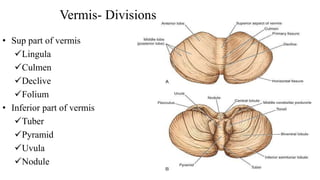
Vermis- Divisions
• Sup part of vermis
Lingula
Culmen
Declive
Folium
• Inferior part of vermis
Tuber
Pyramid
Uvula
Nodule
CEREBELLUM
Structure of cerebellum
 Cerebellum is a composite of
◦ White matter core
◦ Grey matter thin cortex
◦ Cerebellar nuclei- deep grey matter structures
 Nuclei
◦ Dentate nucleus
◦ Emboliform nucleus Nucleus
◦ Globose nucleus interpositus
◦ Fastigial nucleus
Cerebellar Cortex
• 3 Layers:
– Granular
– Purkinje
– Molecular
• 5 Cell types:
– Basket, stellate, Purkinje, granule, and Golgi
PHYSIOLOGY
Ascending Fibres:
• Mossy
– Diffuse projections through granule cells to multiple Purkinje cells
• Climbing
– Terminal fibers of olivocerebellar tracts, multiple synaptic contacts per
Purkinje cell
PHYSIOLOGY
Descending Fibres:
• Purkinje Fibres
o Project from Purkinje cells in Purkinje layer to deep cerebellar
nuclei, inhibitory
• Deep nuclei then send excitatory signals to their efferent connections
DEEP NUCLEI OF
CEREBELLUM
• Dentate nucleus
• Emboliform nucleus
• Globus nucleus
• Fastigial nucleus
Functional Anatomy
Organized into Midline, Intermediate and lateral zones
o Midline - project to fastigial nuclei
o Intermediate - project to nucleus interposed
o Lateral - project to dentate
 Therefore, motor control of the cerebellum is by
connection with
◦ Motor cortex
◦ Brainstem nuclei
◦ Descending motor pathways
Functions of Deep Nuclei
Dentate Nucleus Fastigial Nucleus
 Receives fibers from-
◦ Premotor cortex.
◦ Supplementary motor
cortex.
 Initiate volitional
movements.
 Inactivation of dentate
nucleus-delayed initiation of
such movement.
 Controls antigravity
muscles and other
muscle synergies in
standing and walking.
Nuclei Interpositus
 Cerebrocortical projections via
pontocerebellar system.
 Spinocerebellar
projections
◦ Information from Golgi tendon
organs, muscle spindles, cutaneous
afferents, subcutaneous interneurons.
◦ Fires when movement has
started.
◦ Dampens physiological tremors-
Intention tremorsif interrupted
Blood supply
• Posterior inferior
cerebellar artery
• Anterior inferior
cerebellar artery
• Branch of basilar
artery
• Superior cerebellar
artery
Vascular Supply
• PICA
– From intracranial vertebral artery, supplies the lateral medullary tegmentum,
inferior cerebellar peduncle, the ipsilateral portion of the inferior vermis, and the
inferior surface of the cerebellar hemisphere
• AICA
– above the origin of the basilar artery, supplies the anterior petrosal surface of the
cerebellar hemisphere, flocculus, lower portion of the middle cerebellar peduncle,
and lateral pontomedullary tegmentum
• SCA
– distal segment of the basilar artery just below the terminal bifurcation into the
paired PCAs, and supplies the upper surface of the cerebellar hemisphere,
ipsilateral portion of the superior vermis, most of the dentate nucleus, upper
portion of the middle cerebellar peduncle, superior cerebellar peduncle, and
lateral pontine tegmentum
CEREBELLAR
PEDUNCLES
Superior Cerebellar Peduncle
 Brachium
Conjunctivum
 Principally efferent
 Chief efferent fibres
◦ Dentatorubral
◦ Dentatothalamic
 Also
◦ Anterior
spinocerebellar
◦ Cerebellovestibular
tract
 Afferent fibres include
◦ The ventral spinocerebellar tract transmits proprioceptive and
exteroceptive information from levels below the midthoracic
cord.
◦ The tectocerebellar tract, arising in the superior and inferior
colliculi carries auditory and visual information.
◦ The trigeminocerebellar tract carries proprioceptive fibers from
the mesencephalon and tactile information from the chief
sensory nucleus of the trigeminal nerve.
◦ The cerulocerebellar tract carries fibers from the nucleus
ceruleus.
 Efferent fibers include
◦ The dentatorubral tract carries output to the contralateral
red nucleus. Many of the fibers ending in this nucleus are
branches of the larger dentatothalamic tract.
◦ The dentatothalamic tract transmits output to the
contralateral ventrolateral nucleus of the thalamus.
Middle Cerebellar Peduncle
 Brachium Pontis
 Greatest peduncle
 Traversed by
pontocerebellar tracts
 Connects cerebral cortices
to C/L cerebellar
hemisphere
 Pontocerebellar (corticopontocerebellar) tract arises
in the contralateral pontine gray matter and transmits
impulses from the cerebral cortex to the intermediate
and lateral zones of the cerebellum.
Inferior Cerebellar Peduncle
 Posterior spinocerebellar tract, originates from posterior
nucleus. Carries proprioceptive and exteroceptive information
from trunk and I/L lower limbs.
 The cuneocerebellar tract, originating in the external arcuate
nucleus transmits proprioceptive information from the upper
extremity and neck.
 The olivocerebellar tract carries somatosensory information
from the contralateral inferior olivary nuclei.
 The vestibulocerebellar tract transmits information from vestibular
receptors on both sides of the body.
 The reticulocerebellar tract arises in the lateral reticular and
paramedian nuclei of the medulla.
 The arcuatocerebellar tract arises from the arcuate nuclei of the
medulla oblongata.
 The trigeminocerebellar tract arises from the spinal and main sensory
nuclei of the trigeminal nerve.
Fibres entering and leaving through cerebellar
peduncles
Superior cerebellar peduncle
A. Fibres entering the cerebellum
1. Ventral spino-cerebellar tract
2. Tecto-cerebellar fibres
3. Rubro-cerebellar fibres
4. Trigemino-cerebellar fibres
5. Hypothalamo-cerebellar fibres
B. Fibres leaving the cerebellum
1. Cerebello-rubral fibres
2. Cerebello-thalamic fibres
3. Cerebello-reticular fibres
4. Cerebello-olivary fibres
5. Cerebello-nuclear fibres
6. Some fibres to hypothalamus
and thalamus
Superior cerebellarpeduncle
Middle cerebellar peduncle
Pontocerebellar fibres
Inferior cerebellar peduncle
A. Fibres entering cerebellum
1.Posterior spino cerebellar tract
2.Cuneo-cerebellar tract
3.Olivo-cerebellar fibres
4.Reticulo-cerebellar fibres
5.Vestibulo-cerebellar fibres
6.Anterior external arcuate fibres
7.Trigemino-cerebellar fibres
B. Fibres Leaving the cerebellum
1.Cerebello-olivary fibres
2.Cerebello-vestibular fibres
3.Cerebello spinal and cerebello reticular fibres
Middle cerebellarpeduncle
Inferior cerebellar peduncle
Functional organization of cerebellar
hemispheres
• Cerebrocerebellum: Motor planning and
coordination
• Spinocerebellum: Control of ongoing
body and limb movements
• Vestibulocerebellum: Posture, balance,
eye movements
Somatotopic maps of the body surface in the cerebellum
• Sensory inputs remain
topographically mapped
• Nearby cerebellar areas
control adjacent body parts
Functional organization of cerebellar outputs
Functional organization of the major ascending outputs from the
cerebellum
 Outputs of deep cerebellar nuclei:
– Exit the cerebellum through the
superior cerebellar peduncle
– Project direct to subcortical targets
– Through the thalamus to motor
cortex
Summary of efferent projections from the
cerebellum
• Ascending:
– Back to motor and premotor cortex
• Descending:
– Superior colliculus: eye movements
– Reticular formation: planning/correcting movement
– Vestibular nuclei: balance
Stroke Syndromes
PICA (40%)
•Proximal (usually in vertebral arteries)
•Wallenberg syndrome
•Distal:
•Medial branch occlusion will cause acute vertigo and
truncal ataxia
•Lateral branch occlusion :unsteadiness, limb ataxia, and
dysmetria without dysarthria
Stroke Syndromes
AICA (5%)
• Prominent vertigo, nausea, vomiting, and nystagmus (vestibular nuclei)
• Ipsilateral facial hypalgesia and thermoanesthesia, and corneal
hypesthesia (trigeminal spinal nucleus and tract)
• Ipsilateral Horner syndrome
• Contralateral trunk and extremity hypalgesia and thermoanesthesia
(lateral spinothalamic tract).
• Ipsilateral ataxia and asynergia (middle cerebellar peduncle and
cerebellum).
• Ipsilateral deafness and facial paralysis (lateral pontomedullary
tegmentum).
Stroke Syndromes
SCA (35%)
• Vertigo and vomiting (vestibular nuclei and connections)
• Nystagmus (MLF and cerebellar pathways)
• Ipsilateral Horner syndrome
• Ipsilateral ataxia and asynergia (superior cerebellar peduncle and
cerebellum)
• Ipsilateral intention tremor (dentate nucleus and superior cerebellar
peduncle)
• Contralateral trunk and extremity hypalgesia and thermoanesthesia
(lateral spinothalamic)
• Contralateral hearing impairment (crossed fibers of the lateral
lemniscus)
• Contralateral fourth nerve palsy (pontine tectum)
Stroke Syndromes
• Watershed (20%)
– Etiologies: focal hypoperfusion secondary to occlusive disease in
vertibobasilar vessels, emboli, intercranial atheroma, global
hypoperfusion
– Physical findings variable
Stroke Syndromes
• PICA vs SCA
– SCA has less frequent vertigo and H/A, both with gait disturbance
– SCA typically more benign clinically
• Always need to be aware of possible herniation (tonsillar or
transtentorial) with cerebellar stroke
CLINICAL MANIFESTATIONS
ATAXIA
• Ataxia is the cardinal sign of cerebellar disease;
• Varying degrees of dyssynergia, dysmetria, lack of agonist-antagonist
coordination, and tremor.
• Ataxia may affect the limbs, the trunk, or the gait.
Dyssynergia
• Cerebellar disease impairs the normal control mechanisms that organize
and regulate the contractions of the different participating muscles and
muscle groups to insure smooth, properly coordinated movement.
• Lack of speed and skill
• Lack of integration of the components decomposition of movement
the act is broken down into its component parts and carried out in
a jerky, erratic, awkward, disorganized manner.
• multijoint movements co-ordination is impaired
Dysmetria
• Dysmetria refers to errors in judging distance and gauging the distance,
speed, power, and direction of movement.
• Cerebellar dysfunction leads to loss of the normal collaboration between
agonist and antagonist.
• This results in hypermetria ie, over shooting(more common) or
hypometria ie, fail to reach the target.
• Electromyographic studies have shown that dysmetria is associated
with abnormalities of the timing and force of antagonist contraction
necessary to decelerate the movement.
Agonist-Antagonist Coordination
• A disturbance in reciprocal innervation results in a loss of the ability to
stop the contraction of the agonists and rapidly contract the antagonists
to control and regulate movement.
• In patients with cerebellar deficits attempting to make rapid, voluntary
movements, the first agonist burst is frequently prolonged, the
acceleration time is longer than normal, and the acceleration time may
exceed the deceleration time.
• Impairment of the ability to carry out successive movements and to stop
one act and follow it immediately by its diametric opposite causes
dysdiadochokinesia, loss of checking movements, and the rebound
phenomenon.
• Inability to rapidly reverse an action also causes impairment of the check
response, producing the Holmes rebound phenomenon
Tremor
• The most common type of cerebellar tremor is an intention
(active, kinetic, or terminal) tremor that is not present at rest but
becomes evident on purposeful movement.
• Involves the proximal muscles.
• In severe cases, cerebellar tremor may involve not only the
extremities but also the head or even the entire body.
Hypotonia
• Decrease in the tonic output of the cerebellar nuclei, causing loss of
cerebellar facilitation to the motor cortex.
• The muscles are flabby and assume unnatural attitudes; the parts of the
body can be moved passively into positions of extreme flexion or
extension.
• Stretch reflexes are normal or diminished
• Occasionally, the tendon reflexes are “pendular.”
• Pendular reflexes are caused by muscle hypotonicity and the lack of
normal checking of the reflex response.
Dysarthria
• Articulation may be slow, ataxic, slurred, drawling, jerky, or explosive in
type because of dyssynergy of the muscles of phonation.
• A scanning type of dysarthria is particularly characteristic of cerebellar
disease .
Nystagmus
• Indicates involvement of vestibulocerebellar pathways.
.
• Cerebellar disease may cause gaze paretic nystagmus.
• The patient is unable to sustain eccentric gaze and requires repeated
saccades to gaze laterally.
• With a lesion of one hemisphere, the eyes at rest may be deviated 10 to
30 degrees toward the unaffected side.
Other ocular motility disorders include
• Square-wave jerks, macro square-wave jerks
• Occular dysmetria
• opsoclonus
CLINICAL FINDING SENSORY ATAXIA CEREBELLAR ATAXIA
Loss of vibration and
position sense
+
Areflexia +
Nystagmus +
Hypotonia + +
Ataxia much worse with
eyes closed
+
Past pointing +
APPROACH TO ATAXIA
Ataxia can arise from disorders of:
• Cerebellum (most common)
• Sensory pathways (Sensory Ataxia)
• Posterior columns, dorsal root ganglia, peripheral nerves
• Frontal lobe lesions via fronto-cerebellar associative fibers
• Extra pyramidal system
• Vestibular system
Sensory ataxia
1. loss of distal joint, position sense,
2. absence of associated cerebellar signs such as dysarthria or
nystagmus,
3. loss of tendon reflexes, and
4. the corrective effects of vision on sensory ataxia.
5. Romberg sign
Frontal lobe ataxia
• Frontal lobe ataxia refers to disturbed coordination due to
dysfunction of the contralateral frontal lobe
• May resemble the deficits due to abnormalities of the ipsilateral
cerebellar hemisphere
Vestibular ataxia
• ataxia associated with vestibular nerve or labyrinthine disease
results in a disorder of gait
• associated with a significant degree of dizziness, light-
headedness, or the perception of movement
Cerebellar ataxia
CEREBELLAR DISEASES IN
CHILDHOOD
1.Congenital lesions
CHIARI MALFORMATION
• Displacement of the tonsils
and posterior cerebellar vermis
through the foramen magnum
• Compression of
spinomedullary junction
DANDY WALKER SYNDROME
• Ballooning of posterior half of
4th ventricle
• Lack of patency of foramen of
magendie
• Posterior cerebellar vermis is
aplastic
• Hydrocephalus due to
obstruction can develop
2. Metabolic disorders
1) Metachromatic leucodystrophy
2) Refsums syndrome
3) Maple syrup urine disease
4) Hartnup ‘s disease
3. Infectious disorders
• Acute viral encephalitis
• Infectious mononucleosis
• Chicken pox cerebellitis
4. Degenerative
disorders
• Friedreich’s ataxia
• Other inherited cerebellar
ataxia-
1.Olivpontocerebellar ataxia
2. Dentatorubrothalamic
degeneration
5. Tumors
• Medulloblastoma
• Astrocytoma
CEREBELLAR DISEASES IN
THE ADULT
ACQUIRED ATAXIA
• HYPOTHYROIDISM
• TOXIC CAUSES
• INFECTIOUS AND TRANSMISSIBLE DISEASES
• AUTOIMMUNE CAUSES
TOXIC CAUSES
1.ALCOHOL
• direct toxic action of alcohol and associated vitamin deficiency
–B1.
• Progressive truncal ataxia with gait disturbances of cerebellar
type
• Imaging- anterior superior vermian atrophy
2.CHEMOTHERAPEUTIC AGENTS-5FU and Cytosine arabinoside
3.HEAVY METALS- Organic mercury poisoning and lead poisoning,
bismuth and lithium toxicity
4.SOLVENTS- spray paint and paint thinners such as toluene
5. ANTICONVULSANT-most commonly phenytoin
INFECTIOUS AND TRANSMISSIBLE DISEASES
1.Brainstem encephalitis/
BICKERSTAFF syndrome
ataxia
ophthalmopegia lower
CN palsy
2.HIV infection- lymphoma, PML,
chronic meningeal infection ,
toxoplasmosis
3. Creutzfeld Jakob disease
4.CNS Whipple disease
AUTOIMMUNE CAUSES
1.Paraneoplastic cerebellar degeneration
-rapidly progressive pancerebellar syndrome
MRI-atrophy of entire cerebellum
CSF- mononuclear pleocytosis
2. Ataxia and anti glutamic acid decarboxylase antibodies
3. Ataxia and gluten sensitivity
4.Superficial siderosis
INHERITED CEREBELLAR DISEASES
• Most of the cerebellar ataxias begin in middle age
• 3 major groups
1. Friedreich’s ataxia
2. Dominant inherited ataxia
3. Recessively inherited ataxia
FRIEDREICH’S ATAXIA
• Familial
• Inherited as recessive with incidence of 1:100,000
• Classic form and genetically determined vit E deficiency
syndrome
• Age of onset is constant and ranges from 8 to 16 years
• 9q13
• Mutant gene frataxin
• Expanded GAA repeats in >95% of patients
• CLINICAL FEATURES
• In childhood a high arched foot with hammer toes may be
found- Friedreich’s foot
• Scoliosis
• Cerebellar component-dysarthria and ataxia, nystagmus
uncommon
• ECG- inverted T waves and ventricular hypetrophy
• Degeneration of peripheral nerves- Areflexia
• Damage to corticospinal pathway- extensor plantar
• Cardiac pathology (90%) consists of myocytic hypertrophy
and fibrosis, focal vascular fibromuscular dysplasia
• A high incidence 20% of Diabetes mellitus is seen in
association with insulin resistance and pancreatic beta cell
dysfunction.
Management
• Vitamin E therapy for Vit E deficient form of disease
• IDEBENONE a free radical scavenger can improve cardiac
hypertrophy
image
Pes cavus
DOMINANT INHERITED ATAXIA
• Many variants of dominant inherited ataxia of LATE onset with
varied clinical picture are identified
• Now named as Spinocerebellar ataxia.
• SCA 1 to 40
SCA
• CAG triplet repeat expansions in various genes
• SCA 1 to 40
• CAG encodes Glutamine
• Polyglutamine proteins ataxins toxic to neurons
neuronal loss and gliosis
SCA 1
• OPCA
• Onset- early to middle adult life
• s/s- cerebellar, extrapyramidal and dementia in late stages
• Pathology- marked shrinkage in the ventral half of pons, olivary
eminence of medulla and cerebellar atrophy
SCA3- MACHADO JOSEPH DISEASE
• Types I, II and III
• Mean age of onset is 25 years
• Neurologic deficits invariably
progress to death within 15 years
of onset
• SPARING OF INFERIOR
OLIVES DISTINGUISHES MJD
from other dominant ataxia
SCA7
• Disorder is distinguished
from other SCA by retinal
pigmentary degeneration
Common features of SCA
• Ataxia of gait is universal
• At first there is pyramidal signs, increased reflexes and spasticity
• Later reflexes disappear to be replaced by cerebellar hypotonia
• Dysphagia and dysarthria early
• Sphincter disturbances occur early
• Extrapyramidal symptoms and dementia occur late in the course leading
to disability
• Time course is variable
• Some cases progress to death within 1 to 2 years of onset
• MRI- diagnostic demonstrating atrophy of pons and cerebellum
RECESSIVE INHERITED ATAXIA
• Metabolic and childhood ataxia
• Wilson’s disease
• Refsum’s syndrome
METABOLIC CEREBELLAR DISEASE
• PURKINJE CELL LOSS
• ALCOHOL is the commonest cause leading to reversible
ataxia during acute intoxication
• severe acute irreversible ataxia in Wernicke’s encephlopathy
• CO poisoning and acute hyperthermia may produce acute
destruction of cerebellar cortex
• Anticonvulsant drugs case acute reversible ataxia
NEOPLASM
Metastatic malignant disease
• From lungs, breast, large bowel
• Directly to cerebellum via paravertebral venous plexus up the
spine and into the posterior fossa
Primary tumor
• Rare
• Benign hemangioblastoma
• Excellent prognosis
MULTIPLE SCLEROSIS
• Cerebellar signs in MS are common
• Lesions in brainstem cerebellar pathways
• INO, long tract signs and pyramidal signs are seen
REFERENCES
1. Harrison’s Principles of internal medicine, 20th edition
2. Bradley’s neurology in clinical practice, 7th edition
3. John Patten, Neurological differential diagnosis, 2nd edition
4. DeJong’s neurological examination, 7th edition
THANK YOU

Cerebellar disorders

  • 1.
    CEREBELLAR DISORDERS STUDENT :DR MEDINI S GUIDE : DR SACHIN HOSAKATTI
  • 2.
    HEADINGS • ANATOMY • CONNECTIONS •FUNCTIONS • DISTURBANCES
  • 3.
    ANATOMY INTRODUCTION • CEREBELLUM (LATIN)– little brain • Weight = 150 gm • Location – posterior cranial fossa
  • 4.
    • Situated inthe posterior cranial fossa & covered superiorly by the tentorium cerebelli. • largest part of the hindbrain (10% of total wt) and lies posterior to the 4th ventricle, the pons, and the medulla . • It consists of two cerebellar hemispheres joined by a narrow median vermis.
  • 5.
    • It hasthree symmetrical bundles of nerve fibers called the superior, middle, and inferior cerebellar peduncles. • Superior peduncle connects with mid brain • Middle peduncle connects with pons • Inferior peduncle connect with medulla
  • 6.
    • The cerebellumis divided into three main lobes: the anterior lobe, the posterior lobe, and the flocculonodular lobe. • The anterior lobe may be seen on the superior surface. • It is separated from the posterior lobe by a wide V- shaped fissure called the primary fissure.
  • 7.
    Three Parts- Cerebellar hemispheres •Appendicular coordination Vermis • Connection between hemispheres • Gait and axial function Flocculonodular lobe • Paired lateral flocculi with midline nodulus • Eye movements & balance Cerebellar tonsils- small, rounded lobules on inferior aspects of cerebellar hemispheres, just above the foramen magnum
  • 8.
    PHYLOGENETIC DIVISIONS  FlocculonodularLobe • ArchiCerebellum  Anterior Lobe • PaleoCerebellum  Posterior Lobe  NeoCerebellum  Middle divisions of vermis and their lateral extensions.
  • 9.
  • 10.
     Same asthe flocculonodular lobe  Proprioceptive fibers from the Vestibular nuclei  Functions ◦ Eye movement ◦ Gross balance and orientation in space Vestibulocerebellum
  • 11.
    Flocculonodular Lobe  Connectionsare to  Afferent ◦ Labyrinths ◦ Vestibular centers ◦ Spinal cord ◦ Brainstem ◦ Reticular formation ◦ Olivary bodies  Efferent ◦ Vestibular nuclei ◦ Vestibulospinal tract ◦ Reticular formation  The manifestations are difficult to separate from invariably involved vestibular findings.  Isolated FN lobe dysfunction is usually seen in children in-  Ependymomas  Medulloblastomas
  • 12.
    Spino/Paleocerebellum (evolved when extremitycontrol was not a concern)  Anterior and part of Posterior Vermis (and paravermal cortex)  Proprioceptive fibers from muscles and tendons of limbs  Functions ◦ Influence posture, ◦ muscle tone, ◦ axial muscle control, ◦ locomotion  Dorsal Spinocerebellar Tract from lower limbs  Ventral Spinocerebellar tract from upper limbs
  • 13.
    Paleocerebellum  Afferent connections ◦Anterior spinocerebellar tract ◦ Trigeminocerebellar fibers ◦ Input from vestibular nucleus ◦ Corticocerebellar fibers  Efferent connections ◦ Vestibular nucleus ◦ Brainstem ◦ Spinal cord
  • 14.
    Pontocerebellum  Roughly thesame as neocerebellum  Afferent from pontine nucleus and brachium pontis  Coordination of skilled movements initiated at cerebral cortical levels
  • 15.
    Neocerebellum  Afferent connections ◦Corticopontine/corticopontocerebellar fibers ◦ Spinocerebellar fibers (few)  Efferent connections ◦ Tored nucleus ◦ To thalamus ◦ To cerebral cortex via Dentate Nucleus
  • 16.
    Vermis- Divisions • Suppart of vermis Lingula Culmen Declive Folium • Inferior part of vermis Tuber Pyramid Uvula Nodule
  • 17.
  • 18.
    Structure of cerebellum Cerebellum is a composite of ◦ White matter core ◦ Grey matter thin cortex ◦ Cerebellar nuclei- deep grey matter structures  Nuclei ◦ Dentate nucleus ◦ Emboliform nucleus Nucleus ◦ Globose nucleus interpositus ◦ Fastigial nucleus
  • 19.
    Cerebellar Cortex • 3Layers: – Granular – Purkinje – Molecular • 5 Cell types: – Basket, stellate, Purkinje, granule, and Golgi
  • 22.
    PHYSIOLOGY Ascending Fibres: • Mossy –Diffuse projections through granule cells to multiple Purkinje cells • Climbing – Terminal fibers of olivocerebellar tracts, multiple synaptic contacts per Purkinje cell
  • 23.
    PHYSIOLOGY Descending Fibres: • PurkinjeFibres o Project from Purkinje cells in Purkinje layer to deep cerebellar nuclei, inhibitory • Deep nuclei then send excitatory signals to their efferent connections
  • 25.
    DEEP NUCLEI OF CEREBELLUM •Dentate nucleus • Emboliform nucleus • Globus nucleus • Fastigial nucleus
  • 27.
    Functional Anatomy Organized intoMidline, Intermediate and lateral zones o Midline - project to fastigial nuclei o Intermediate - project to nucleus interposed o Lateral - project to dentate
  • 29.
     Therefore, motorcontrol of the cerebellum is by connection with ◦ Motor cortex ◦ Brainstem nuclei ◦ Descending motor pathways
  • 30.
    Functions of DeepNuclei Dentate Nucleus Fastigial Nucleus  Receives fibers from- ◦ Premotor cortex. ◦ Supplementary motor cortex.  Initiate volitional movements.  Inactivation of dentate nucleus-delayed initiation of such movement.  Controls antigravity muscles and other muscle synergies in standing and walking.
  • 31.
    Nuclei Interpositus  Cerebrocorticalprojections via pontocerebellar system.  Spinocerebellar projections ◦ Information from Golgi tendon organs, muscle spindles, cutaneous afferents, subcutaneous interneurons. ◦ Fires when movement has started. ◦ Dampens physiological tremors- Intention tremorsif interrupted
  • 32.
    Blood supply • Posteriorinferior cerebellar artery • Anterior inferior cerebellar artery • Branch of basilar artery • Superior cerebellar artery
  • 33.
    Vascular Supply • PICA –From intracranial vertebral artery, supplies the lateral medullary tegmentum, inferior cerebellar peduncle, the ipsilateral portion of the inferior vermis, and the inferior surface of the cerebellar hemisphere • AICA – above the origin of the basilar artery, supplies the anterior petrosal surface of the cerebellar hemisphere, flocculus, lower portion of the middle cerebellar peduncle, and lateral pontomedullary tegmentum • SCA – distal segment of the basilar artery just below the terminal bifurcation into the paired PCAs, and supplies the upper surface of the cerebellar hemisphere, ipsilateral portion of the superior vermis, most of the dentate nucleus, upper portion of the middle cerebellar peduncle, superior cerebellar peduncle, and lateral pontine tegmentum
  • 37.
  • 38.
    Superior Cerebellar Peduncle Brachium Conjunctivum  Principally efferent  Chief efferent fibres ◦ Dentatorubral ◦ Dentatothalamic  Also ◦ Anterior spinocerebellar ◦ Cerebellovestibular tract
  • 39.
     Afferent fibresinclude ◦ The ventral spinocerebellar tract transmits proprioceptive and exteroceptive information from levels below the midthoracic cord. ◦ The tectocerebellar tract, arising in the superior and inferior colliculi carries auditory and visual information. ◦ The trigeminocerebellar tract carries proprioceptive fibers from the mesencephalon and tactile information from the chief sensory nucleus of the trigeminal nerve. ◦ The cerulocerebellar tract carries fibers from the nucleus ceruleus.
  • 40.
     Efferent fibersinclude ◦ The dentatorubral tract carries output to the contralateral red nucleus. Many of the fibers ending in this nucleus are branches of the larger dentatothalamic tract. ◦ The dentatothalamic tract transmits output to the contralateral ventrolateral nucleus of the thalamus.
  • 41.
    Middle Cerebellar Peduncle Brachium Pontis  Greatest peduncle  Traversed by pontocerebellar tracts  Connects cerebral cortices to C/L cerebellar hemisphere
  • 42.
     Pontocerebellar (corticopontocerebellar)tract arises in the contralateral pontine gray matter and transmits impulses from the cerebral cortex to the intermediate and lateral zones of the cerebellum.
  • 43.
  • 44.
     Posterior spinocerebellartract, originates from posterior nucleus. Carries proprioceptive and exteroceptive information from trunk and I/L lower limbs.  The cuneocerebellar tract, originating in the external arcuate nucleus transmits proprioceptive information from the upper extremity and neck.  The olivocerebellar tract carries somatosensory information from the contralateral inferior olivary nuclei.
  • 45.
     The vestibulocerebellartract transmits information from vestibular receptors on both sides of the body.  The reticulocerebellar tract arises in the lateral reticular and paramedian nuclei of the medulla.  The arcuatocerebellar tract arises from the arcuate nuclei of the medulla oblongata.  The trigeminocerebellar tract arises from the spinal and main sensory nuclei of the trigeminal nerve.
  • 46.
    Fibres entering andleaving through cerebellar peduncles Superior cerebellar peduncle A. Fibres entering the cerebellum 1. Ventral spino-cerebellar tract 2. Tecto-cerebellar fibres 3. Rubro-cerebellar fibres 4. Trigemino-cerebellar fibres 5. Hypothalamo-cerebellar fibres B. Fibres leaving the cerebellum 1. Cerebello-rubral fibres 2. Cerebello-thalamic fibres 3. Cerebello-reticular fibres 4. Cerebello-olivary fibres 5. Cerebello-nuclear fibres 6. Some fibres to hypothalamus and thalamus Superior cerebellarpeduncle
  • 47.
    Middle cerebellar peduncle Pontocerebellarfibres Inferior cerebellar peduncle A. Fibres entering cerebellum 1.Posterior spino cerebellar tract 2.Cuneo-cerebellar tract 3.Olivo-cerebellar fibres 4.Reticulo-cerebellar fibres 5.Vestibulo-cerebellar fibres 6.Anterior external arcuate fibres 7.Trigemino-cerebellar fibres B. Fibres Leaving the cerebellum 1.Cerebello-olivary fibres 2.Cerebello-vestibular fibres 3.Cerebello spinal and cerebello reticular fibres Middle cerebellarpeduncle Inferior cerebellar peduncle
  • 48.
    Functional organization ofcerebellar hemispheres • Cerebrocerebellum: Motor planning and coordination • Spinocerebellum: Control of ongoing body and limb movements • Vestibulocerebellum: Posture, balance, eye movements
  • 49.
    Somatotopic maps ofthe body surface in the cerebellum • Sensory inputs remain topographically mapped • Nearby cerebellar areas control adjacent body parts
  • 50.
    Functional organization ofcerebellar outputs
  • 51.
    Functional organization ofthe major ascending outputs from the cerebellum  Outputs of deep cerebellar nuclei: – Exit the cerebellum through the superior cerebellar peduncle – Project direct to subcortical targets – Through the thalamus to motor cortex
  • 52.
    Summary of efferentprojections from the cerebellum • Ascending: – Back to motor and premotor cortex • Descending: – Superior colliculus: eye movements – Reticular formation: planning/correcting movement – Vestibular nuclei: balance
  • 53.
    Stroke Syndromes PICA (40%) •Proximal(usually in vertebral arteries) •Wallenberg syndrome •Distal: •Medial branch occlusion will cause acute vertigo and truncal ataxia •Lateral branch occlusion :unsteadiness, limb ataxia, and dysmetria without dysarthria
  • 54.
    Stroke Syndromes AICA (5%) •Prominent vertigo, nausea, vomiting, and nystagmus (vestibular nuclei) • Ipsilateral facial hypalgesia and thermoanesthesia, and corneal hypesthesia (trigeminal spinal nucleus and tract) • Ipsilateral Horner syndrome • Contralateral trunk and extremity hypalgesia and thermoanesthesia (lateral spinothalamic tract). • Ipsilateral ataxia and asynergia (middle cerebellar peduncle and cerebellum). • Ipsilateral deafness and facial paralysis (lateral pontomedullary tegmentum).
  • 55.
    Stroke Syndromes SCA (35%) •Vertigo and vomiting (vestibular nuclei and connections) • Nystagmus (MLF and cerebellar pathways) • Ipsilateral Horner syndrome • Ipsilateral ataxia and asynergia (superior cerebellar peduncle and cerebellum) • Ipsilateral intention tremor (dentate nucleus and superior cerebellar peduncle) • Contralateral trunk and extremity hypalgesia and thermoanesthesia (lateral spinothalamic) • Contralateral hearing impairment (crossed fibers of the lateral lemniscus) • Contralateral fourth nerve palsy (pontine tectum)
  • 56.
    Stroke Syndromes • Watershed(20%) – Etiologies: focal hypoperfusion secondary to occlusive disease in vertibobasilar vessels, emboli, intercranial atheroma, global hypoperfusion – Physical findings variable
  • 57.
    Stroke Syndromes • PICAvs SCA – SCA has less frequent vertigo and H/A, both with gait disturbance – SCA typically more benign clinically • Always need to be aware of possible herniation (tonsillar or transtentorial) with cerebellar stroke
  • 58.
  • 59.
    ATAXIA • Ataxia isthe cardinal sign of cerebellar disease; • Varying degrees of dyssynergia, dysmetria, lack of agonist-antagonist coordination, and tremor. • Ataxia may affect the limbs, the trunk, or the gait.
  • 60.
    Dyssynergia • Cerebellar diseaseimpairs the normal control mechanisms that organize and regulate the contractions of the different participating muscles and muscle groups to insure smooth, properly coordinated movement. • Lack of speed and skill • Lack of integration of the components decomposition of movement the act is broken down into its component parts and carried out in a jerky, erratic, awkward, disorganized manner. • multijoint movements co-ordination is impaired
  • 61.
    Dysmetria • Dysmetria refersto errors in judging distance and gauging the distance, speed, power, and direction of movement. • Cerebellar dysfunction leads to loss of the normal collaboration between agonist and antagonist. • This results in hypermetria ie, over shooting(more common) or hypometria ie, fail to reach the target.
  • 62.
    • Electromyographic studieshave shown that dysmetria is associated with abnormalities of the timing and force of antagonist contraction necessary to decelerate the movement.
  • 63.
    Agonist-Antagonist Coordination • Adisturbance in reciprocal innervation results in a loss of the ability to stop the contraction of the agonists and rapidly contract the antagonists to control and regulate movement. • In patients with cerebellar deficits attempting to make rapid, voluntary movements, the first agonist burst is frequently prolonged, the acceleration time is longer than normal, and the acceleration time may exceed the deceleration time.
  • 64.
    • Impairment ofthe ability to carry out successive movements and to stop one act and follow it immediately by its diametric opposite causes dysdiadochokinesia, loss of checking movements, and the rebound phenomenon. • Inability to rapidly reverse an action also causes impairment of the check response, producing the Holmes rebound phenomenon
  • 65.
    Tremor • The mostcommon type of cerebellar tremor is an intention (active, kinetic, or terminal) tremor that is not present at rest but becomes evident on purposeful movement. • Involves the proximal muscles. • In severe cases, cerebellar tremor may involve not only the extremities but also the head or even the entire body.
  • 66.
    Hypotonia • Decrease inthe tonic output of the cerebellar nuclei, causing loss of cerebellar facilitation to the motor cortex. • The muscles are flabby and assume unnatural attitudes; the parts of the body can be moved passively into positions of extreme flexion or extension. • Stretch reflexes are normal or diminished • Occasionally, the tendon reflexes are “pendular.” • Pendular reflexes are caused by muscle hypotonicity and the lack of normal checking of the reflex response.
  • 67.
    Dysarthria • Articulation maybe slow, ataxic, slurred, drawling, jerky, or explosive in type because of dyssynergy of the muscles of phonation. • A scanning type of dysarthria is particularly characteristic of cerebellar disease .
  • 68.
    Nystagmus • Indicates involvementof vestibulocerebellar pathways. . • Cerebellar disease may cause gaze paretic nystagmus. • The patient is unable to sustain eccentric gaze and requires repeated saccades to gaze laterally. • With a lesion of one hemisphere, the eyes at rest may be deviated 10 to 30 degrees toward the unaffected side.
  • 69.
    Other ocular motilitydisorders include • Square-wave jerks, macro square-wave jerks • Occular dysmetria • opsoclonus
  • 70.
    CLINICAL FINDING SENSORYATAXIA CEREBELLAR ATAXIA Loss of vibration and position sense + Areflexia + Nystagmus + Hypotonia + + Ataxia much worse with eyes closed + Past pointing +
  • 71.
    APPROACH TO ATAXIA Ataxiacan arise from disorders of: • Cerebellum (most common) • Sensory pathways (Sensory Ataxia) • Posterior columns, dorsal root ganglia, peripheral nerves • Frontal lobe lesions via fronto-cerebellar associative fibers • Extra pyramidal system • Vestibular system
  • 72.
    Sensory ataxia 1. lossof distal joint, position sense, 2. absence of associated cerebellar signs such as dysarthria or nystagmus, 3. loss of tendon reflexes, and 4. the corrective effects of vision on sensory ataxia. 5. Romberg sign
  • 73.
    Frontal lobe ataxia •Frontal lobe ataxia refers to disturbed coordination due to dysfunction of the contralateral frontal lobe • May resemble the deficits due to abnormalities of the ipsilateral cerebellar hemisphere
  • 74.
    Vestibular ataxia • ataxiaassociated with vestibular nerve or labyrinthine disease results in a disorder of gait • associated with a significant degree of dizziness, light- headedness, or the perception of movement
  • 75.
  • 76.
  • 77.
  • 78.
    CHIARI MALFORMATION • Displacementof the tonsils and posterior cerebellar vermis through the foramen magnum • Compression of spinomedullary junction
  • 79.
    DANDY WALKER SYNDROME •Ballooning of posterior half of 4th ventricle • Lack of patency of foramen of magendie • Posterior cerebellar vermis is aplastic • Hydrocephalus due to obstruction can develop
  • 80.
    2. Metabolic disorders 1)Metachromatic leucodystrophy 2) Refsums syndrome 3) Maple syrup urine disease 4) Hartnup ‘s disease
  • 81.
    3. Infectious disorders •Acute viral encephalitis • Infectious mononucleosis • Chicken pox cerebellitis
  • 82.
    4. Degenerative disorders • Friedreich’sataxia • Other inherited cerebellar ataxia- 1.Olivpontocerebellar ataxia 2. Dentatorubrothalamic degeneration 5. Tumors • Medulloblastoma • Astrocytoma
  • 83.
  • 84.
    ACQUIRED ATAXIA • HYPOTHYROIDISM •TOXIC CAUSES • INFECTIOUS AND TRANSMISSIBLE DISEASES • AUTOIMMUNE CAUSES
  • 85.
    TOXIC CAUSES 1.ALCOHOL • directtoxic action of alcohol and associated vitamin deficiency –B1. • Progressive truncal ataxia with gait disturbances of cerebellar type • Imaging- anterior superior vermian atrophy
  • 86.
    2.CHEMOTHERAPEUTIC AGENTS-5FU andCytosine arabinoside 3.HEAVY METALS- Organic mercury poisoning and lead poisoning, bismuth and lithium toxicity 4.SOLVENTS- spray paint and paint thinners such as toluene 5. ANTICONVULSANT-most commonly phenytoin
  • 87.
    INFECTIOUS AND TRANSMISSIBLEDISEASES 1.Brainstem encephalitis/ BICKERSTAFF syndrome ataxia ophthalmopegia lower CN palsy 2.HIV infection- lymphoma, PML, chronic meningeal infection , toxoplasmosis 3. Creutzfeld Jakob disease 4.CNS Whipple disease
  • 88.
    AUTOIMMUNE CAUSES 1.Paraneoplastic cerebellardegeneration -rapidly progressive pancerebellar syndrome MRI-atrophy of entire cerebellum CSF- mononuclear pleocytosis 2. Ataxia and anti glutamic acid decarboxylase antibodies 3. Ataxia and gluten sensitivity 4.Superficial siderosis
  • 89.
    INHERITED CEREBELLAR DISEASES •Most of the cerebellar ataxias begin in middle age • 3 major groups 1. Friedreich’s ataxia 2. Dominant inherited ataxia 3. Recessively inherited ataxia
  • 90.
    FRIEDREICH’S ATAXIA • Familial •Inherited as recessive with incidence of 1:100,000 • Classic form and genetically determined vit E deficiency syndrome • Age of onset is constant and ranges from 8 to 16 years • 9q13 • Mutant gene frataxin • Expanded GAA repeats in >95% of patients
  • 91.
    • CLINICAL FEATURES •In childhood a high arched foot with hammer toes may be found- Friedreich’s foot • Scoliosis • Cerebellar component-dysarthria and ataxia, nystagmus uncommon • ECG- inverted T waves and ventricular hypetrophy • Degeneration of peripheral nerves- Areflexia
  • 92.
    • Damage tocorticospinal pathway- extensor plantar • Cardiac pathology (90%) consists of myocytic hypertrophy and fibrosis, focal vascular fibromuscular dysplasia • A high incidence 20% of Diabetes mellitus is seen in association with insulin resistance and pancreatic beta cell dysfunction.
  • 93.
    Management • Vitamin Etherapy for Vit E deficient form of disease • IDEBENONE a free radical scavenger can improve cardiac hypertrophy
  • 94.
  • 95.
  • 96.
    DOMINANT INHERITED ATAXIA •Many variants of dominant inherited ataxia of LATE onset with varied clinical picture are identified • Now named as Spinocerebellar ataxia. • SCA 1 to 40
  • 97.
    SCA • CAG tripletrepeat expansions in various genes • SCA 1 to 40 • CAG encodes Glutamine • Polyglutamine proteins ataxins toxic to neurons neuronal loss and gliosis
  • 98.
    SCA 1 • OPCA •Onset- early to middle adult life • s/s- cerebellar, extrapyramidal and dementia in late stages • Pathology- marked shrinkage in the ventral half of pons, olivary eminence of medulla and cerebellar atrophy
  • 99.
    SCA3- MACHADO JOSEPHDISEASE • Types I, II and III • Mean age of onset is 25 years • Neurologic deficits invariably progress to death within 15 years of onset • SPARING OF INFERIOR OLIVES DISTINGUISHES MJD from other dominant ataxia
  • 101.
    SCA7 • Disorder isdistinguished from other SCA by retinal pigmentary degeneration
  • 102.
    Common features ofSCA • Ataxia of gait is universal • At first there is pyramidal signs, increased reflexes and spasticity • Later reflexes disappear to be replaced by cerebellar hypotonia • Dysphagia and dysarthria early • Sphincter disturbances occur early • Extrapyramidal symptoms and dementia occur late in the course leading to disability • Time course is variable • Some cases progress to death within 1 to 2 years of onset • MRI- diagnostic demonstrating atrophy of pons and cerebellum
  • 103.
    RECESSIVE INHERITED ATAXIA •Metabolic and childhood ataxia • Wilson’s disease • Refsum’s syndrome
  • 104.
    METABOLIC CEREBELLAR DISEASE •PURKINJE CELL LOSS • ALCOHOL is the commonest cause leading to reversible ataxia during acute intoxication • severe acute irreversible ataxia in Wernicke’s encephlopathy • CO poisoning and acute hyperthermia may produce acute destruction of cerebellar cortex • Anticonvulsant drugs case acute reversible ataxia
  • 105.
    NEOPLASM Metastatic malignant disease •From lungs, breast, large bowel • Directly to cerebellum via paravertebral venous plexus up the spine and into the posterior fossa Primary tumor • Rare • Benign hemangioblastoma • Excellent prognosis
  • 106.
    MULTIPLE SCLEROSIS • Cerebellarsigns in MS are common • Lesions in brainstem cerebellar pathways • INO, long tract signs and pyramidal signs are seen
  • 107.
    REFERENCES 1. Harrison’s Principlesof internal medicine, 20th edition 2. Bradley’s neurology in clinical practice, 7th edition 3. John Patten, Neurological differential diagnosis, 2nd edition 4. DeJong’s neurological examination, 7th edition
  • 108.