Sensory disturbances. Pain.
The I.M. Sechenov First Moscow State Medical University
Chair of nervous diseases
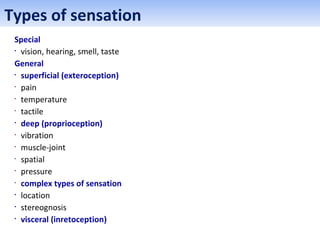
Special
• vision, hearing, smell, taste
General
• superficial (exteroception)
• pain
• temperature
• tactile
• deep (proprioception)
• vibration
• muscle-joint
• spatial
• pressure
• complex types of sensation
• location
• stereognosis
• visceral (inretoception)
Types of sensation
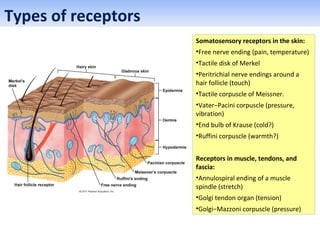
Types of receptors
Somatosensory receptors in the skin:
•Free nerve ending (pain, temperature)
•Tactile disk of Merkel
•Peritrichial nerve endings around a
hair follicle (touch)
•Tactile corpuscle of Meissner.
•Vater−Pacini corpuscle (pressure,
vibration)
•End bulb of Krause (cold?)
•Ruffini corpuscle (warmth?)
Receptors in muscle, tendons, and
fascia:
•Annulospiral ending of a muscle
spindle (stretch)
•Golgi tendon organ (tension)
•Golgi−Mazzoni corpuscle (pressure)
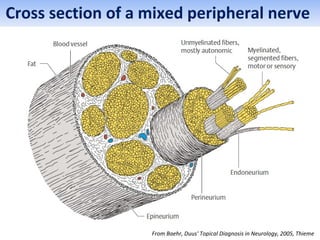
Cross section of a mixed peripheral nerve
From Baehr, Duus' Topical Diagnosis in Neurology, 2005, Thieme
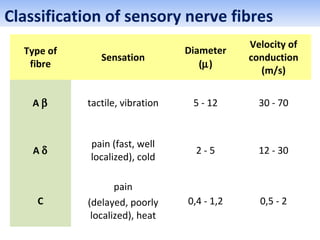
Classification of sensory nerve fibres
Type of
fibre
Sensation
Diameter
(µ)
Velocity of
conduction
(m/s)
А β tactile, vibration 5 - 12 30 - 70
А δ
pain (fast, well
localized), cold
2 - 5 12 - 30
С
pain
(delayed, poorly
localized), heat
0,4 - 1,2 0,5 - 2
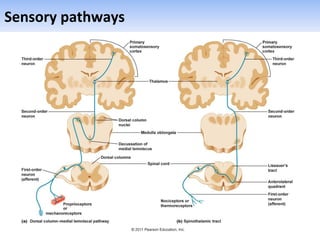
Sensory pathways
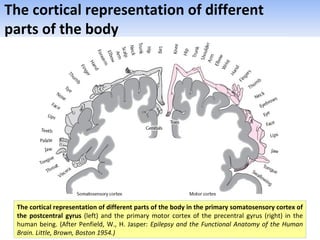
The cortical representation of different
parts of the body
The cortical representation of different parts of the body in the primary somatosensory cortex of
the postcentral gyrus (left) and the primary motor cortex of the precentral gyrus (right) in the
human being. (After Penfield, W., H. Jasper: Epilepsy and the Functional Anatomy of the Human
Brain. Little, Brown, Boston 1954.)
Sensory disturbances
• Hypoesthesia – decrease of sensation
• Hyperesthesia – increase of sensation
• Anaesthesia – loss of sensation
• Dysesthesia – abnormal sensation
• Paresthesia – sensation of tingling,
burning, pricking, or numbness of a
person's skin
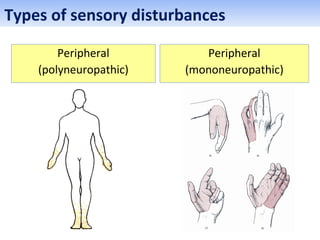
Peripheral
(polyneuropathic)
Peripheral
(mononeuropathic)
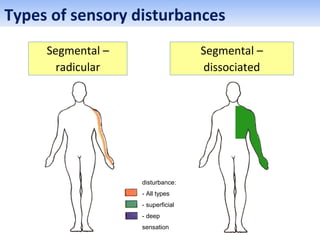
Types of sensory disturbances
Segmental –
radicular
Segmental –
dissociated
disturbance:
- All types
- superficial
- deep
sensation
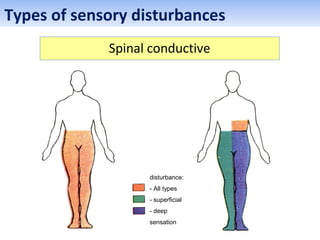
Types of sensory disturbances
Spinal conductive
Types of sensory disturbances
disturbance:
- All types
- superficial
- deep
sensation
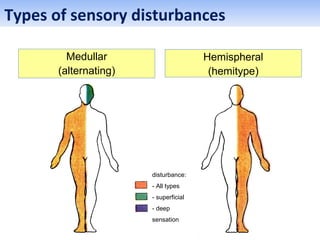
Medullar
(alternating)
Hemispheral
(hemitype)
disturbance:
- All types
- superficial
- deep
sensation
Types of sensory disturbances
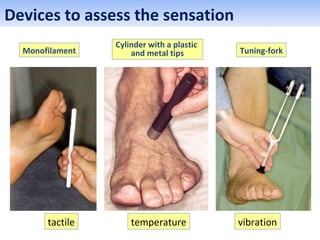
Monofilament
Cylinder with a plastic
and metal tips Tuning-fork
tactile temperature vibration
Devices to assess the sensation
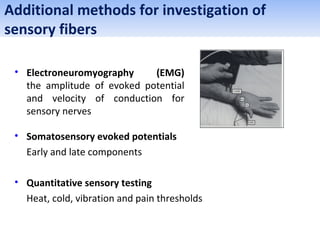
Additional methods for investigation of
sensory fibers
• Electroneuromyography (EMG)
the amplitude of evoked potential
and velocity of conduction for
sensory nerves
• Somatosensory evoked potentials
Early and late components
• Quantitative sensory testing
Heat, cold, vibration and pain thresholds
PainPain
An unpleasant sensory and emotional experience
associated with actual or potential tissue damage
or described in terms of such damage
International association for the study of pain, 1986
• Transient
short duration
• Acute
within a period of injury and healing
• Chronic
beyond the normal healing period
PainPain
• Local
• Referred
• Irradiating
Nociceptive
•is caused by stimulation of peripheral nerve fibers that respond
only to stimuli approaching or exceeding harmful intensity
(nociceptors); described as throbbing, aching, bursting
Neuropathic
•is caused by damage or disease affecting any part of the
nervous system involved in bodily feelings (the somatosensory
system); described as “burning,” “tingling,” “electrical,”
“stabbing,” or “pins and needles
Psychogenic
•is pain caused, increased, or prolonged by mental, emotional, or
behavioral factors
PainPain
Peripheral mechanisms of neuropathic pain
• Spontaneous ectopic activity
• Sensitization of pain receptors
• Pathological interaction of fibers (ephapse)
• Hypersensitivity to catecholamines
Central mechanisms of pain
• Central sensitization
• “Wind up” phenomenon
• Disinhibition
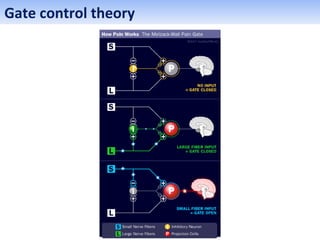
Gate control theory
Types of pain sensation disturbances
• Hypoalgesia – decrease of pain sensation
• Analgesia – loss of pain sensation
• Hyperalgesia – increase of pain sensation
• Hyperpathia - a painful syndrome characterized by an
abnormally painful reaction to a stimulus, especially a
repetitive stimulus, as well as an increased threshold
• Allodynia - a pain due to a stimulus which does not
normally provoke pain
• Anaesthesia dolorosa - is pain felt in an area (usually of
the face) which is completely numb to touch
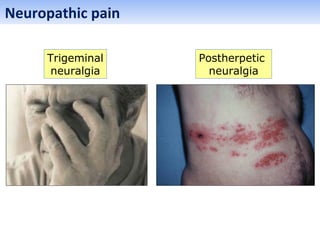
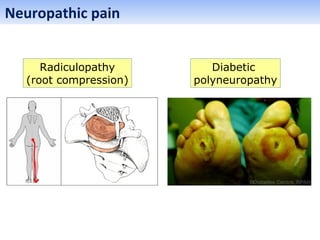
Neuropathic pain
Trigeminal
neuralgia
Postherpetic
neuralgia
Diabetic
polyneuropathy
Radiculopathy
(root compression)
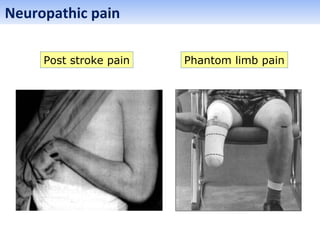
Neuropathic pain
Phantom limb painPost stroke pain
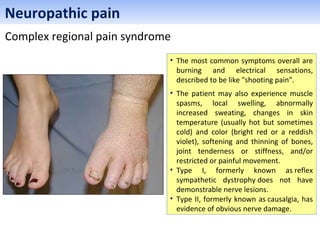
Neuropathic pain
Complex regional pain syndrome
Neuropathic pain
• The most common symptoms overall are
burning and electrical sensations,
described to be like "shooting pain".
• The patient may also experience muscle
spasms, local swelling, abnormally
increased sweating, changes in skin
temperature (usually hot but sometimes
cold) and color (bright red or a reddish
violet), softening and thinning of bones,
joint tenderness or stiffness, and/or
restricted or painful movement.
• Type I, formerly known as reflex
sympathetic dystrophy does not have
demonstrable nerve lesions.
• Type II, formerly known as causalgia, has
evidence of obvious nerve damage.
Diagnosis of pain
• Anamnesis
• Physical investigation
• Evaluation of pain intensity (VAS)
• Additional methods of investigation(MRI, EMG)
• Massage
• TENS
• Acupuncture
• Neurostimulation
• Neurosurgery
• Physiotherapy
• Biofeedback
• Psychotherapy
Non-pharmacological treatment of pain
• Local anesthetics
• NSAIDs
• Opiates
• Antidepressants
• Anticonvulsants
Pharmacological treatment of pain

Sensory disturbances

  • 1.
    Sensory disturbances. Pain. TheI.M. Sechenov First Moscow State Medical University Chair of nervous diseases
  • 2.
    Special • vision, hearing,smell, taste General • superficial (exteroception) • pain • temperature • tactile • deep (proprioception) • vibration • muscle-joint • spatial • pressure • complex types of sensation • location • stereognosis • visceral (inretoception) Types of sensation
  • 3.
    Types of receptors Somatosensoryreceptors in the skin: •Free nerve ending (pain, temperature) •Tactile disk of Merkel •Peritrichial nerve endings around a hair follicle (touch) •Tactile corpuscle of Meissner. •Vater−Pacini corpuscle (pressure, vibration) •End bulb of Krause (cold?) •Ruffini corpuscle (warmth?) Receptors in muscle, tendons, and fascia: •Annulospiral ending of a muscle spindle (stretch) •Golgi tendon organ (tension) •Golgi−Mazzoni corpuscle (pressure)
  • 4.
    Cross section ofa mixed peripheral nerve From Baehr, Duus' Topical Diagnosis in Neurology, 2005, Thieme
  • 5.
    Classification of sensorynerve fibres Type of fibre Sensation Diameter (µ) Velocity of conduction (m/s) А β tactile, vibration 5 - 12 30 - 70 А δ pain (fast, well localized), cold 2 - 5 12 - 30 С pain (delayed, poorly localized), heat 0,4 - 1,2 0,5 - 2
  • 6.
  • 7.
    The cortical representationof different parts of the body The cortical representation of different parts of the body in the primary somatosensory cortex of the postcentral gyrus (left) and the primary motor cortex of the precentral gyrus (right) in the human being. (After Penfield, W., H. Jasper: Epilepsy and the Functional Anatomy of the Human Brain. Little, Brown, Boston 1954.)
  • 8.
    Sensory disturbances • Hypoesthesia– decrease of sensation • Hyperesthesia – increase of sensation • Anaesthesia – loss of sensation • Dysesthesia – abnormal sensation • Paresthesia – sensation of tingling, burning, pricking, or numbness of a person's skin
  • 9.
  • 10.
    Segmental – radicular Segmental – dissociated disturbance: -All types - superficial - deep sensation Types of sensory disturbances
  • 11.
    Spinal conductive Types ofsensory disturbances disturbance: - All types - superficial - deep sensation
  • 12.
    Medullar (alternating) Hemispheral (hemitype) disturbance: - All types -superficial - deep sensation Types of sensory disturbances
  • 13.
    Monofilament Cylinder with aplastic and metal tips Tuning-fork tactile temperature vibration Devices to assess the sensation
  • 14.
    Additional methods forinvestigation of sensory fibers • Electroneuromyography (EMG) the amplitude of evoked potential and velocity of conduction for sensory nerves • Somatosensory evoked potentials Early and late components • Quantitative sensory testing Heat, cold, vibration and pain thresholds
  • 15.
    PainPain An unpleasant sensoryand emotional experience associated with actual or potential tissue damage or described in terms of such damage International association for the study of pain, 1986
  • 16.
    • Transient short duration •Acute within a period of injury and healing • Chronic beyond the normal healing period PainPain • Local • Referred • Irradiating
  • 17.
    Nociceptive •is caused bystimulation of peripheral nerve fibers that respond only to stimuli approaching or exceeding harmful intensity (nociceptors); described as throbbing, aching, bursting Neuropathic •is caused by damage or disease affecting any part of the nervous system involved in bodily feelings (the somatosensory system); described as “burning,” “tingling,” “electrical,” “stabbing,” or “pins and needles Psychogenic •is pain caused, increased, or prolonged by mental, emotional, or behavioral factors PainPain
  • 18.
    Peripheral mechanisms ofneuropathic pain • Spontaneous ectopic activity • Sensitization of pain receptors • Pathological interaction of fibers (ephapse) • Hypersensitivity to catecholamines
  • 19.
    Central mechanisms ofpain • Central sensitization • “Wind up” phenomenon • Disinhibition
  • 20.
  • 21.
    Types of painsensation disturbances • Hypoalgesia – decrease of pain sensation • Analgesia – loss of pain sensation • Hyperalgesia – increase of pain sensation • Hyperpathia - a painful syndrome characterized by an abnormally painful reaction to a stimulus, especially a repetitive stimulus, as well as an increased threshold • Allodynia - a pain due to a stimulus which does not normally provoke pain • Anaesthesia dolorosa - is pain felt in an area (usually of the face) which is completely numb to touch
  • 22.
  • 23.
  • 24.
    Phantom limb painPoststroke pain Neuropathic pain
  • 25.
    Complex regional painsyndrome Neuropathic pain • The most common symptoms overall are burning and electrical sensations, described to be like "shooting pain". • The patient may also experience muscle spasms, local swelling, abnormally increased sweating, changes in skin temperature (usually hot but sometimes cold) and color (bright red or a reddish violet), softening and thinning of bones, joint tenderness or stiffness, and/or restricted or painful movement. • Type I, formerly known as reflex sympathetic dystrophy does not have demonstrable nerve lesions. • Type II, formerly known as causalgia, has evidence of obvious nerve damage.
  • 26.
    Diagnosis of pain •Anamnesis • Physical investigation • Evaluation of pain intensity (VAS) • Additional methods of investigation(MRI, EMG)
  • 27.
    • Massage • TENS •Acupuncture • Neurostimulation • Neurosurgery • Physiotherapy • Biofeedback • Psychotherapy Non-pharmacological treatment of pain
  • 28.
    • Local anesthetics •NSAIDs • Opiates • Antidepressants • Anticonvulsants Pharmacological treatment of pain