Spermatocoele

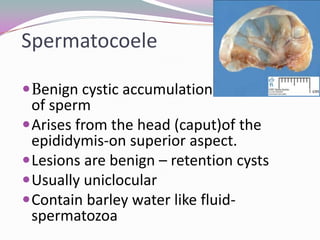
 Benign cystic accumulation
  of sperm
 Arises from the head (caput)of the
  epididymis-on superior aspect.
 Lesions are benign – retention cysts
 Usually uniclocular
 Contain barley water like fluid-
  spermatozoa
Sites

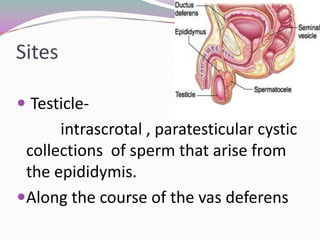
 Testicle-
      intrascrotal , paratesticular cystic
 collections of sperm that arise from
 the epididymis.
Along the course of the vas deferens
Aetiology
 remains undefined
 In a mouse model - occluded by
  agglutinated germ cells.
 Physical trauma, inflammation
     Epidydimal scarring      obstruction

                               spermatocoele
 In utero exposure to diethylstilbestrol (DES)
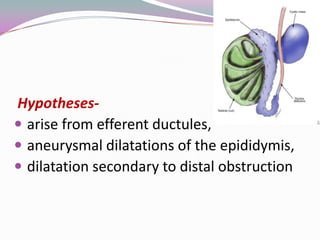
Hypotheses-
 arise from efferent ductules,
 aneurysmal dilatations of the epididymis,
 dilatation secondary to distal obstruction
Clinical features
Symptoms
 Typically asymptomatic
 Incidental findings examination
 Usually a painless mobile swelling
  posterosuperiorly
 Associated symptoms scrotal heaviness
  and dull discomfort
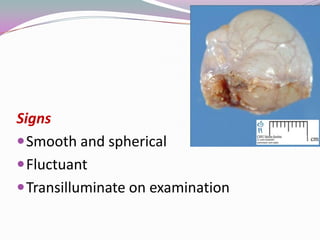
Signs
 Smooth and spherical
 Fluctuant
 Transilluminate on examination
Investigation
 Uncomplicated asymptomatic
  spermatocele no investigation needed
 If scrotal pain
       urine analysis to rule
  out epididymitis.
 FNAC-dead sperm
Ultrasonography
 Cystic lesions that arise from the epididymal
  head
 Less commonly- intratesticular lesion attached
  to the mediastinum testis.
 Hypoechoic with posterior acoustic
  enhancement and cannot be differentiated
  from an epididymal cyst .
 Occasionally, may have internal echoes within
  the cyst.
Scrotal USS - spermatocele visible to the left of a normal testis.
 Color Doppler
     -"falling snow" appearence (internal
  echoes moving away from the transducer)
 Histologic Findings
     -fibromuscular wall that is lined by
  cuboidal epithelium
Treatment
Medical Therapy
 No specific medical therapy .
 Oral analgesics
 If an underlying epididymitis - antibiotics
 Observation is usually used for
  simple, small asymptomatic
  spermatoceles.
Surgical Therapy


Spermatocelectomy
 The primary operative intervention
 Via a transscrotal approach
 Relative contraindications
      - Systemic anticoagulation
      -family incomplete
 Performed on an outpatient basis
 With either regional or general
  anesthesia
 Complication-
  infertility, hematoma, infection, swelling,
   recurrence, and pain.

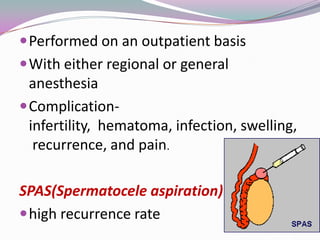
SPAS(Spermatocele aspiration)
 high recurrence rate
Intraoperative view of
                              spermatocele with adjacent
                              testicle and spermatic cord


Spermatocele after complete
excision
Sclerotherapy
 Alternative to excision
 Less effective.
 For men who have no desire for future
  paternity
 Sclerosing agent coaptation cyst walls
 Tetracycline, fibrin glue, phenol, sodium
  tetradecyl sulfate (STD)
 A 65% success rate is quoted

Complication

 chemical epididymitis          epididymal
 damage           infertility

 Bleeding, infection ,spermatocele
 recurrence,scrotal wall thickness.
DD
 Epididymal cyst- multilocular, contain
  clear fluid,brilliant transluminence is
  obtained
 Hydrocoele
 Varicocoele
 Complete inguinal
  hernia
Spermatocoele

Spermatocoele

  • 3.
    Spermatocoele  Benign cysticaccumulation of sperm  Arises from the head (caput)of the epididymis-on superior aspect.  Lesions are benign – retention cysts  Usually uniclocular  Contain barley water like fluid- spermatozoa
  • 4.
    Sites  Testicle- intrascrotal , paratesticular cystic collections of sperm that arise from the epididymis. Along the course of the vas deferens
  • 5.
    Aetiology  remains undefined In a mouse model - occluded by agglutinated germ cells.  Physical trauma, inflammation Epidydimal scarring obstruction spermatocoele  In utero exposure to diethylstilbestrol (DES)
  • 6.
    Hypotheses-  arise fromefferent ductules,  aneurysmal dilatations of the epididymis,  dilatation secondary to distal obstruction
  • 7.
    Clinical features Symptoms  Typicallyasymptomatic  Incidental findings examination  Usually a painless mobile swelling posterosuperiorly  Associated symptoms scrotal heaviness and dull discomfort
  • 8.
    Signs  Smooth andspherical  Fluctuant  Transilluminate on examination
  • 9.
    Investigation  Uncomplicated asymptomatic spermatocele no investigation needed  If scrotal pain urine analysis to rule out epididymitis.  FNAC-dead sperm
  • 10.
    Ultrasonography  Cystic lesionsthat arise from the epididymal head  Less commonly- intratesticular lesion attached to the mediastinum testis.  Hypoechoic with posterior acoustic enhancement and cannot be differentiated from an epididymal cyst .  Occasionally, may have internal echoes within the cyst.
  • 11.
    Scrotal USS -spermatocele visible to the left of a normal testis.
  • 13.
     Color Doppler -"falling snow" appearence (internal echoes moving away from the transducer)  Histologic Findings -fibromuscular wall that is lined by cuboidal epithelium
  • 15.
    Treatment Medical Therapy  Nospecific medical therapy .  Oral analgesics  If an underlying epididymitis - antibiotics  Observation is usually used for simple, small asymptomatic spermatoceles.
  • 16.
    Surgical Therapy Spermatocelectomy  Theprimary operative intervention  Via a transscrotal approach  Relative contraindications - Systemic anticoagulation -family incomplete
  • 17.
     Performed onan outpatient basis  With either regional or general anesthesia  Complication- infertility, hematoma, infection, swelling, recurrence, and pain. SPAS(Spermatocele aspiration)  high recurrence rate
  • 18.
    Intraoperative view of spermatocele with adjacent testicle and spermatic cord Spermatocele after complete excision
  • 19.
    Sclerotherapy  Alternative toexcision  Less effective.  For men who have no desire for future paternity  Sclerosing agent coaptation cyst walls  Tetracycline, fibrin glue, phenol, sodium tetradecyl sulfate (STD)
  • 20.
     A 65%success rate is quoted Complication  chemical epididymitis epididymal damage infertility  Bleeding, infection ,spermatocele recurrence,scrotal wall thickness.
  • 21.
    DD  Epididymal cyst-multilocular, contain clear fluid,brilliant transluminence is obtained  Hydrocoele  Varicocoele  Complete inguinal hernia