CONTRACTURE
By-physioworld
CONTENT-
1. CONTRACTURE
2. TYPES OF CONTRACTURE
3. WHY CONTRACTURE OCCURS?
4. THERAPY OF CONTRACTURE
by-physioworld 2
CONTRACTURE-
Contracture is defined as the adaptive shortening of the muscle-tendon unit and other soft tissues that
cross or surround a joint resulting in significant resistance to passive or active stretch and limitation of
ROM, which may compromise functional abilities.
◦ Types of Contracture
by-physioworld
ARTHROGENC
CONTRACTURE
MYOSTATIC
CONTRACTURE
PSEUDOMYOSTATIC
CONTRACTURE
FIBROTIC
CONTRACTURE
3
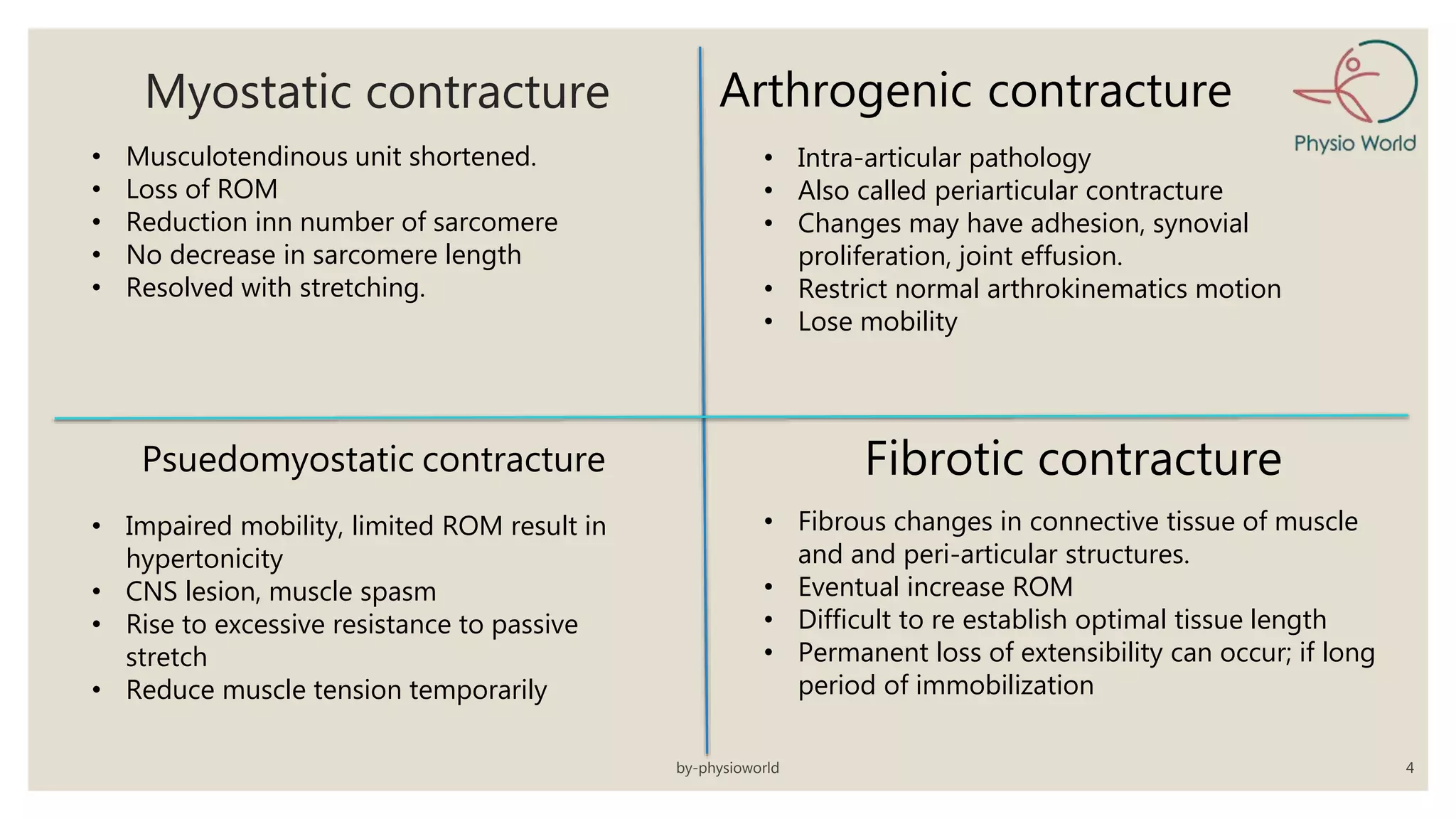
Myostatic contracture Arthrogenic contracture
• Intra-articular pathology
• Also called periarticular contracture
• Changes may have adhesion, synovial
proliferation, joint effusion.
• Restrict normal arthrokinematics motion
• Lose mobility
Psuedomyostatic contracture
• Impaired mobility, limited ROM result in
hypertonicity
• CNS lesion, muscle spasm
• Rise to excessive resistance to passive
stretch
• Reduce muscle tension temporarily
Fibrotic contracture
• Fibrous changes in connective tissue of muscle
and and peri-articular structures.
• Eventual increase ROM
• Difficult to re establish optimal tissue length
• Permanent loss of extensibility can occur; if long
period of immobilization
• Musculotendinous unit shortened.
• Loss of ROM
• Reduction inn number of sarcomere
• No decrease in sarcomere length
• Resolved with stretching.
by-physioworld 4
WHY CONTRACTURE OCCURS?
◦ Paralysis
◦ Muscular atrophy
◦ Muscular dystrophy
◦ Loss of strength
◦ Loss of muscle control
◦ Stiffness in tendon
by-physioworld 5
THERAPY OF CONTRACTURE
◦ Positioning- assessed by lying, sitting or
standing. Make is functional as possible to
prevent muscle shortening and will decrease pain.
◦ Heat- to decrease muscle pain and assist tissue
lengthening before stretching
◦ Stretching- use of splints or casts for prolong
stretch
◦ Massage- maintain tissue mobility and nutrition
◦ Manual techniques- joint mobilization used to
increase joint flexibility and decreases pain.
◦ Advice and support- orthotic device and
adaptive equipment
by-physioworld 6
by-physioworld
Thank you
The next video-
• Properties of tissue
LIKE
SHARE
COMMENT
SUBSCRIBE
7

Contracture

  • 1.
  • 2.
    CONTENT- 1. CONTRACTURE 2. TYPESOF CONTRACTURE 3. WHY CONTRACTURE OCCURS? 4. THERAPY OF CONTRACTURE by-physioworld 2
  • 3.
    CONTRACTURE- Contracture is definedas the adaptive shortening of the muscle-tendon unit and other soft tissues that cross or surround a joint resulting in significant resistance to passive or active stretch and limitation of ROM, which may compromise functional abilities. ◦ Types of Contracture by-physioworld ARTHROGENC CONTRACTURE MYOSTATIC CONTRACTURE PSEUDOMYOSTATIC CONTRACTURE FIBROTIC CONTRACTURE 3
  • 4.
    Myostatic contracture Arthrogeniccontracture • Intra-articular pathology • Also called periarticular contracture • Changes may have adhesion, synovial proliferation, joint effusion. • Restrict normal arthrokinematics motion • Lose mobility Psuedomyostatic contracture • Impaired mobility, limited ROM result in hypertonicity • CNS lesion, muscle spasm • Rise to excessive resistance to passive stretch • Reduce muscle tension temporarily Fibrotic contracture • Fibrous changes in connective tissue of muscle and and peri-articular structures. • Eventual increase ROM • Difficult to re establish optimal tissue length • Permanent loss of extensibility can occur; if long period of immobilization • Musculotendinous unit shortened. • Loss of ROM • Reduction inn number of sarcomere • No decrease in sarcomere length • Resolved with stretching. by-physioworld 4
  • 5.
    WHY CONTRACTURE OCCURS? ◦Paralysis ◦ Muscular atrophy ◦ Muscular dystrophy ◦ Loss of strength ◦ Loss of muscle control ◦ Stiffness in tendon by-physioworld 5
  • 6.
    THERAPY OF CONTRACTURE ◦Positioning- assessed by lying, sitting or standing. Make is functional as possible to prevent muscle shortening and will decrease pain. ◦ Heat- to decrease muscle pain and assist tissue lengthening before stretching ◦ Stretching- use of splints or casts for prolong stretch ◦ Massage- maintain tissue mobility and nutrition ◦ Manual techniques- joint mobilization used to increase joint flexibility and decreases pain. ◦ Advice and support- orthotic device and adaptive equipment by-physioworld 6
  • 7.
    by-physioworld Thank you The nextvideo- • Properties of tissue LIKE SHARE COMMENT SUBSCRIBE 7