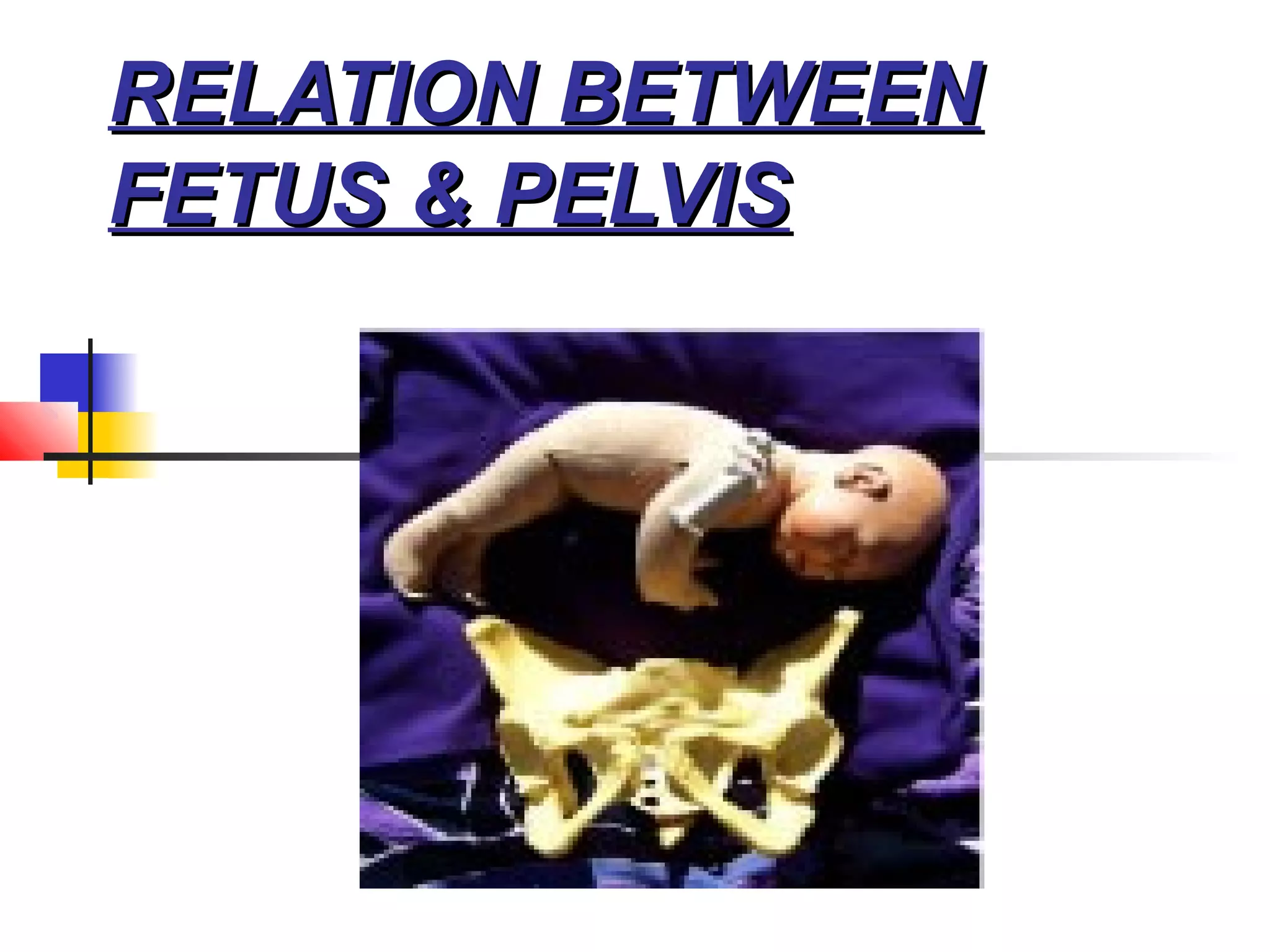
RELATION BETWEEN
FETUS & PELVIS
   LIE
   PRESENTATION
   PRESENTING PARTS
   ATTITUDE
   DENOMINATOR
   POSITION
   CEPHALIC PROMINENCE
   LIE
   The relationship b/w the long axis
    of fetal ovoid to the long axis of
    uterine ovoid

           LONGITUDINAL LIE

           TRANSVERSE LIE
           OBLIQUE LIE
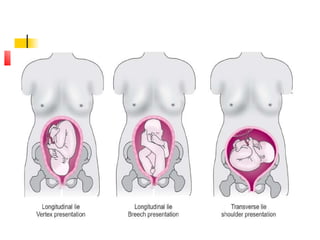
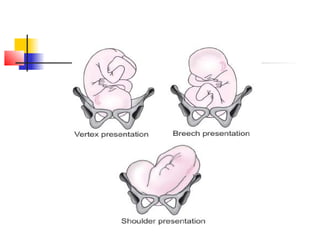
   PRESENTATION
   That part of the fetus that lies over
    the pelvic inlet & occupies the lower
    poles of the uterus
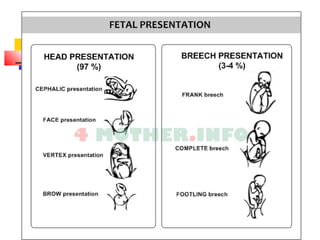
   3 presentation
              CEPHALIC
              PODALIC/BREECH
              SHOULDER
 PRESENTING PARTS
 The most dependant part of the fetus,

 which is felt first on vaginal
  examination
In cephalic presentation depending upon
  degree of flexion,
          vertex
          brow
          face
          deflexed head
   In breech presentation
   Flexed breech (fetal legs may be
    flexed)
   Extended breech (extended at
    knees)
   Footling breech (completely
    extended)
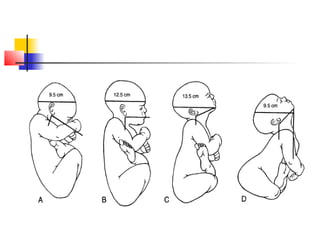
   ATTITUDE
   The relation of fetal parts to each
    other
   Main attitudes
          FLEXION
          EXTENSION
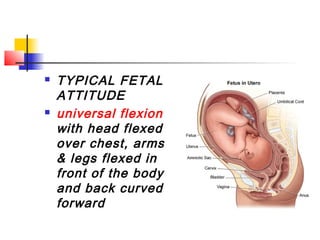
   TYPICAL FETAL
    ATTITUDE
   universal flexion
    with head flexed
    over chest, arms
    & legs flexed in
    front of the body
    and back curved
    forward
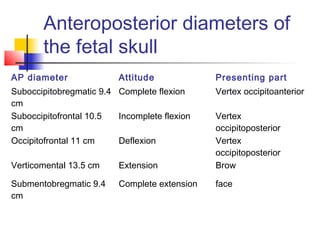
Anteroposterior diameters of
       the fetal skull
AP diameter              Attitude             Presenting part
Suboccipitobregmatic 9.4 Complete flexion     Vertex occipitoanterior
cm
Suboccipitofrontal 10.5  Incomplete flexion   Vertex
cm                                            occipitoposterior
Occipitofrontal 11 cm    Deflexion            Vertex
                                              occipitoposterior
Verticomental 13.5 cm    Extension            Brow

Submentobregmatic 9.4    Complete extension   face
cm
   DENOMINATOR
   An arbitrarily chosen point on the
    presenting part of the fetus which
    is used to describe the position.
Presentations of the fetus
Presentation               Attitude             Denominator
Cephalic

 vertex occipitoanterior   Flexion              Occiput

 vertex occipitoposterior Deflexion             occiput
 brow                      Extension            brow

 face                      Complete extension   Chin or mentum

Podalic or breech                               sacrum

shoulder                                        acromion
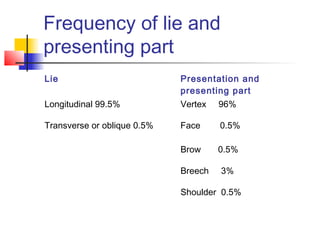
Frequency of lie and
presenting part
Lie                          Presentation and
                             presenting part
Longitudinal 99.5%           Vertex   96%

Transverse or oblique 0.5%   Face     0.5%

                             Brow     0.5%

                             Breech   3%

                             Shoulder 0.5%
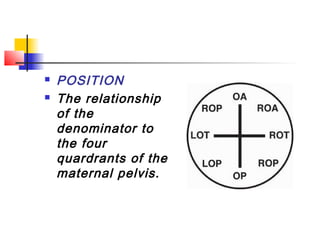
   POSITION
   The relationship
    of the
    denominator to
    the four
    quardrants of the
    maternal pelvis.
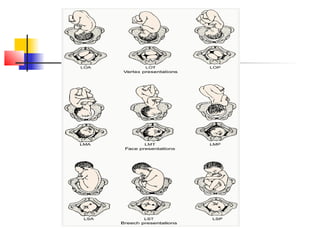
   In vertex presentation
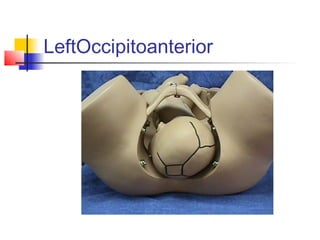
   Left occipitoanterior(common)
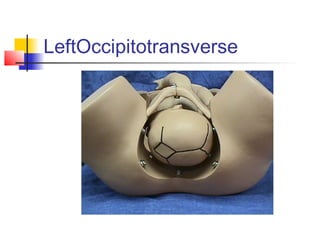
   Left occipitotransverse
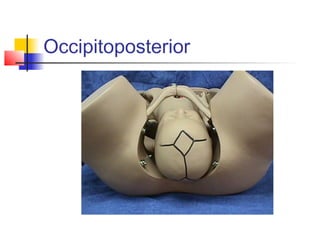
   Left occipitoposterior
   Right occipitoanterior
   Right occipitotransverse
   Right occipitoposterior
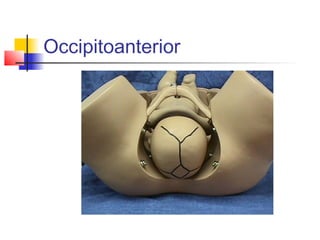
Occipitoanterior
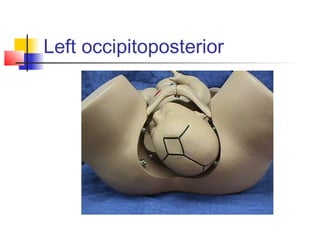
Left occipitoposterior
LeftOccipitoanterior
LeftOccipitotransverse
Occipitoposterior
   CEPHALIC PROMINENCE
   The most prominent part of the
    head palpable per abdomen
   Produced by flexion and
    extension of the head
   Vertex presentation (head well
    flexed)
        occiput is lower than sinciput
    (can be felt on the side opposite
    to the back)
   When the presenting part is face
    or brow (extension of head)
          sinciput is lower than
    occiput (can be felt on the same
    side of the back)
   Cephalic prominence can be
    palpated by the second pelvic
    grip
   When no cephalic prominence is
    felt, there is neither flexion nor
    extension and the attitude is one
    of deflexion . This is also called
    military position
   Longitudinal lie commoner –fetus
    being an ovoid accommodates itself
    easily along the long axis of the
    uterine ovoid
   Cephalic presentation commoner -the
    head being heavier and more
    compact , due to gravitation, comes to
    occupy lower pole and bulkier breech
    adapts to the fundus of uterus ,which
    is roomier
   MOULDING
   Cranial bones are connected by
    membrane and this allows
    considerable shifting or sliding of each
    bone to accommodate to the maternal
    pelvis.
   Frontal and occipital bone pass under
    parietal bone.
   Posterior parietal is subject to more
    pressure by the sacral promontory , it
    passes under anterior parietal.
MOULDING (conti…..)
Thus there is compression of the
 presenting diameter with compensatory
 bulging of the diameter at right angles
Eg: in occipitoanterior head is
 compressed in the presenting
 suboccipitobregmatic and elongated in
 the verticomental diameter .
   Moulding is assessed on vaginal
    examination at two sites
         parietal-parietal
         parietal-occipital
•   disappears a few hrs after birth
•   Protective mechanism & prevents the
    fetal brain from compression as long
    as it is not excessive or not rapid
   GRADING
   Grade 1 / +moulding
    :obliteration of suture line
   Grade 2 / ++moulding : reducible
    overlap
   Grade 3 /+++moulding:irreducible
    overlap (pathological )
   Clinical significance
   Some amount of moulding is beneficial
    and this is one of the factors which
    decide the success of a trial of labour
   Severe moulding can lead to
    intracranial haemorrhage
   The site of moulding gives information
    about the position of the head
Thank you

Relation between fetus & pelvis

  • 1.
  • 2.
    LIE  PRESENTATION  PRESENTING PARTS  ATTITUDE  DENOMINATOR  POSITION  CEPHALIC PROMINENCE
  • 3.
    LIE  The relationship b/w the long axis of fetal ovoid to the long axis of uterine ovoid LONGITUDINAL LIE TRANSVERSE LIE OBLIQUE LIE
  • 5.
    PRESENTATION  That part of the fetus that lies over the pelvic inlet & occupies the lower poles of the uterus  3 presentation CEPHALIC PODALIC/BREECH SHOULDER
  • 7.
     PRESENTING PARTS The most dependant part of the fetus, which is felt first on vaginal examination In cephalic presentation depending upon degree of flexion, vertex brow face deflexed head
  • 8.
    In breech presentation  Flexed breech (fetal legs may be flexed)  Extended breech (extended at knees)  Footling breech (completely extended)
  • 10.
    ATTITUDE  The relation of fetal parts to each other  Main attitudes FLEXION EXTENSION
  • 11.
    TYPICAL FETAL ATTITUDE  universal flexion with head flexed over chest, arms & legs flexed in front of the body and back curved forward
  • 12.
    Anteroposterior diameters of the fetal skull AP diameter Attitude Presenting part Suboccipitobregmatic 9.4 Complete flexion Vertex occipitoanterior cm Suboccipitofrontal 10.5 Incomplete flexion Vertex cm occipitoposterior Occipitofrontal 11 cm Deflexion Vertex occipitoposterior Verticomental 13.5 cm Extension Brow Submentobregmatic 9.4 Complete extension face cm
  • 14.
    DENOMINATOR  An arbitrarily chosen point on the presenting part of the fetus which is used to describe the position.
  • 15.
    Presentations of thefetus Presentation Attitude Denominator Cephalic vertex occipitoanterior Flexion Occiput vertex occipitoposterior Deflexion occiput brow Extension brow face Complete extension Chin or mentum Podalic or breech sacrum shoulder acromion
  • 16.
    Frequency of lieand presenting part Lie Presentation and presenting part Longitudinal 99.5% Vertex 96% Transverse or oblique 0.5% Face 0.5% Brow 0.5% Breech 3% Shoulder 0.5%
  • 17.
    POSITION  The relationship of the denominator to the four quardrants of the maternal pelvis.
  • 18.
    In vertex presentation  Left occipitoanterior(common)  Left occipitotransverse  Left occipitoposterior  Right occipitoanterior  Right occipitotransverse  Right occipitoposterior
  • 20.
  • 21.
  • 22.
  • 23.
  • 24.
  • 25.
    CEPHALIC PROMINENCE  The most prominent part of the head palpable per abdomen  Produced by flexion and extension of the head  Vertex presentation (head well flexed) occiput is lower than sinciput (can be felt on the side opposite to the back)
  • 26.
    When the presenting part is face or brow (extension of head) sinciput is lower than occiput (can be felt on the same side of the back)  Cephalic prominence can be palpated by the second pelvic grip
  • 27.
    When no cephalic prominence is felt, there is neither flexion nor extension and the attitude is one of deflexion . This is also called military position
  • 28.
    Longitudinal lie commoner –fetus being an ovoid accommodates itself easily along the long axis of the uterine ovoid  Cephalic presentation commoner -the head being heavier and more compact , due to gravitation, comes to occupy lower pole and bulkier breech adapts to the fundus of uterus ,which is roomier
  • 29.
    MOULDING  Cranial bones are connected by membrane and this allows considerable shifting or sliding of each bone to accommodate to the maternal pelvis.  Frontal and occipital bone pass under parietal bone.  Posterior parietal is subject to more pressure by the sacral promontory , it passes under anterior parietal.
  • 30.
    MOULDING (conti…..) Thus thereis compression of the presenting diameter with compensatory bulging of the diameter at right angles Eg: in occipitoanterior head is compressed in the presenting suboccipitobregmatic and elongated in the verticomental diameter .
  • 31.
    Moulding is assessed on vaginal examination at two sites parietal-parietal parietal-occipital • disappears a few hrs after birth • Protective mechanism & prevents the fetal brain from compression as long as it is not excessive or not rapid
  • 32.
    GRADING  Grade 1 / +moulding :obliteration of suture line  Grade 2 / ++moulding : reducible overlap  Grade 3 /+++moulding:irreducible overlap (pathological )
  • 33.
    Clinical significance  Some amount of moulding is beneficial and this is one of the factors which decide the success of a trial of labour  Severe moulding can lead to intracranial haemorrhage  The site of moulding gives information about the position of the head
  • 34.