SPEAKING SKILLS
TEACHING
?WHY
Teaching Speaking (TS)
•Speaking is the most important skill
among other skills
•judgment on a language learner and selfevaluation for himself is based on his
ability to speak.
•It is a tough job for teachers to engage
student to speak, because there are some
barriers and affective filters
•You can write or read or learn grammar
or listen individually but you can not
speak with your self so teaching speaking
needs more consideration
Reasons for poor speaking skills
•Lack of curriculum emphasis on speaking
skills
•Teachers 'limited English proficiency
•Class conditions do not favor oral
activities
•Limited opportunities outside of class to
practice
•Examination system does not emphasize
oral skills
?HOW
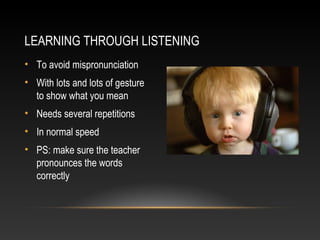
LEARNING THROUGH LISTENING
• To avoid mispronunciation
• With lots and lots of gesture
to show what you mean
• Needs several repetitions
• In normal speed
• PS: make sure the teacher
pronounces the words
correctly
ESTABLISHING ROUTINES
•

Greetings & responding to a greeting

Teacher
Good morning,
Good afternoon,
Hello,

children
everybody
boys and girls.

Students
Good morning,
Good afternoon,
Hello,

Miss/Mrs/Mr/Ms
(surname)
(first name)/teacher
e.g.:
T : Good morning. Is today Monday?
Ss: No
T : Or maybe Tuesday? Or Sunday?
Ss: No
T : oh I wish it was Sunday. Ok, what day is it today?
Ss: Thursday.
T : Yes, Thursday. Good.
• Short instruction:
Sit down
Be quiet, please.
Stand up, please.
Make a line/two lines/stand in two/three lines
Practice: list as many instruction as you can, and show your
friends how you would teach them.
USING ENGLISH IN THE WAY AS
CARETAKER TALKS
•

Both mother and teacher talk a lot more than the children do. e.g.

T: Take off your shoes. Yes, your shoes (showing her own shoes).
S: sus…sus
T: Yes, shoes.
•

They provide a secure an supportive environment which gives the children the
confidence to try out the language. e.g. (after listening to a story, the teacher and
students discuss what happened in the story)

T: She brings what? She brings? She brings?
S: Candies..
T: Yes, candies. Great.
ENCOURAGING ALL THE EFFORTS TO
MAKE STUDENTS SPEAK ENGLISH.
T: How do you say this in English? (holding a card)
S: …
T: Trou….trou…
S: Trousers
T: Yes, trousers. Good.
S1: What time is it?
S2: It’s nine…it’s past….(longer pause)
T : Go on…What time is it? Started by a quarter..
S2: It’s a quarter…quarter past…..
S3: past nine (his friend whispered)
S2: It’s a …quarter…past…nine
T : Great job!
LISTENING CAREFULLY WHEN THE STUDENTS SPEAK
AND NOT INTERRUPTING TO CORRECT SMALL
ERRORS
T: And on Monday, what did he eat?
S: He eated an apple.
T: You mean he ate an apple.
S: Yes
T: Now, what time is it?
S: It’s ten past nine o’clock.
T: Yes, it’s ten past NINE. Without o’clock.
S: It’s ten past nine.
INTRODUCING NEW VOCABULARIES
OR EXPRESSIONS
• Encourage students to repeat the new items
• Use pictures, sounds, touch and feel materials, puppets,
to support meaning
• Use gestures, movement, and actions
• Get students to color pictures of the new things they can
name
• Repeat new words as often as possible and use them on
context.
GETTING STUDENTS TO SPEAK
•

Games: surveying games, bandit and sheriff, shopping
games, …

•

Drilling: standing in circles then throw the ball to
question-answer each other, using pictures (from
books or cards), ask and answer questions in
pairs/groups, telephone game

•

Singing: We’re table number one, The finger song, Can
I have a pen?

•

Chanting: What time is it?,

•

Telling/retelling stories

Speaking Skills Teaching

  • 1.
  • 2.
  • 3.
    Teaching Speaking (TS) •Speakingis the most important skill among other skills •judgment on a language learner and selfevaluation for himself is based on his ability to speak. •It is a tough job for teachers to engage student to speak, because there are some barriers and affective filters •You can write or read or learn grammar or listen individually but you can not speak with your self so teaching speaking needs more consideration
  • 4.
    Reasons for poorspeaking skills •Lack of curriculum emphasis on speaking skills •Teachers 'limited English proficiency •Class conditions do not favor oral activities •Limited opportunities outside of class to practice •Examination system does not emphasize oral skills
  • 5.
  • 6.
    LEARNING THROUGH LISTENING •To avoid mispronunciation • With lots and lots of gesture to show what you mean • Needs several repetitions • In normal speed • PS: make sure the teacher pronounces the words correctly
  • 7.
    ESTABLISHING ROUTINES • Greetings &responding to a greeting Teacher Good morning, Good afternoon, Hello, children everybody boys and girls. Students Good morning, Good afternoon, Hello, Miss/Mrs/Mr/Ms (surname) (first name)/teacher
  • 8.
    e.g.: T : Goodmorning. Is today Monday? Ss: No T : Or maybe Tuesday? Or Sunday? Ss: No T : oh I wish it was Sunday. Ok, what day is it today? Ss: Thursday. T : Yes, Thursday. Good.
  • 9.
    • Short instruction: Sitdown Be quiet, please. Stand up, please. Make a line/two lines/stand in two/three lines Practice: list as many instruction as you can, and show your friends how you would teach them.
  • 10.
    USING ENGLISH INTHE WAY AS CARETAKER TALKS • Both mother and teacher talk a lot more than the children do. e.g. T: Take off your shoes. Yes, your shoes (showing her own shoes). S: sus…sus T: Yes, shoes. • They provide a secure an supportive environment which gives the children the confidence to try out the language. e.g. (after listening to a story, the teacher and students discuss what happened in the story) T: She brings what? She brings? She brings? S: Candies.. T: Yes, candies. Great.
  • 11.
    ENCOURAGING ALL THEEFFORTS TO MAKE STUDENTS SPEAK ENGLISH. T: How do you say this in English? (holding a card) S: … T: Trou….trou… S: Trousers T: Yes, trousers. Good. S1: What time is it? S2: It’s nine…it’s past….(longer pause) T : Go on…What time is it? Started by a quarter.. S2: It’s a quarter…quarter past….. S3: past nine (his friend whispered) S2: It’s a …quarter…past…nine T : Great job!
  • 12.
    LISTENING CAREFULLY WHENTHE STUDENTS SPEAK AND NOT INTERRUPTING TO CORRECT SMALL ERRORS T: And on Monday, what did he eat? S: He eated an apple. T: You mean he ate an apple. S: Yes T: Now, what time is it? S: It’s ten past nine o’clock. T: Yes, it’s ten past NINE. Without o’clock. S: It’s ten past nine.
  • 13.
    INTRODUCING NEW VOCABULARIES OREXPRESSIONS • Encourage students to repeat the new items • Use pictures, sounds, touch and feel materials, puppets, to support meaning • Use gestures, movement, and actions • Get students to color pictures of the new things they can name • Repeat new words as often as possible and use them on context.
  • 14.
    GETTING STUDENTS TOSPEAK • Games: surveying games, bandit and sheriff, shopping games, … • Drilling: standing in circles then throw the ball to question-answer each other, using pictures (from books or cards), ask and answer questions in pairs/groups, telephone game • Singing: We’re table number one, The finger song, Can I have a pen? • Chanting: What time is it?, • Telling/retelling stories