Teaching speaking in
classroom
Efforted by:
Abida Rehman
DAS , Foundation,
Pakistan
Table of
contents:
• What is “speaking”?
• Major speech types
• Speaking involves
• Linguistic elements
• Difficult aspects of speaking
• What is “teaching speaking”
• Skills of oral communication
• Phenomena effecting spoken abilities
• Characteristics and abilities of a good language teacher
• Principles and types of speaking
• Activities for teachers
• Frameworks for planning speaking lesson
• Lesson plan sample
• Suggestions for Teachers
• Activities for students
What is “speaking”?
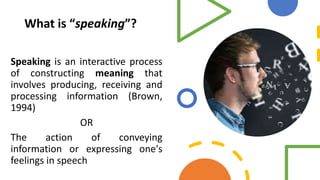
Speaking is an interactive process
of constructing meaning that
involves producing, receiving and
processing information (Brown,
1994)
OR
The action of conveying
information or expressing one's
feelings in speech
Major speech types
• •Interactions
• •Transactions
• •Performances
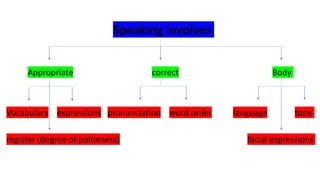
Speaking involves
Appropriate correct Body
Vocabulary expressions pronunciation word order language tone
register (degree of politeness) facial expressions
Some Linguistic terminologies/elements
involves in speaking:
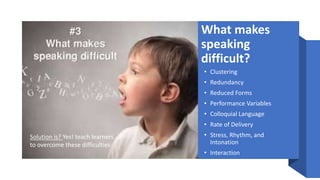
What makes
speaking
difficult?
• Clustering
• Redundancy
• Reduced Forms
• Performance Variables
• Colloquial Language
• Rate of Delivery
• Stress, Rhythm, and
Intonation
• Interaction
Solution is? Yes! teach learners
to overcome these difficulties
What Is "Teaching
Speaking"?
-An effective teaching
program which skilled
learners in Micro and
Macro ways of oral
communications
Prototypical
Micro skills of
oral
communication
chunks of languageProduce
oral differences (among the English phonemes and allophonic
variants)Produce
English stress patterns, rhythmic structure, and intonational contoursProduce
reduced forms of words and phrasesProduce
own oral production and use various strategic devicesMonitor
grammatical word classes, systems, word order, patterns, rules, and
elliptical formsUse
speech in natural constituents in appropriate phrases, pause groups,
breath groups, and sentencesProduce
Some important
Macro skills of
oral
communication
Use cohesive devices in spoken discourse
Accomplish appropriately communicative functions according to
situations
Use appropriate sociolinguistic features in face-to-face
conversations
Convey links and connections between events and communicate
such relation
Use facial features along with verbal language to convey meanings
Develop and use a battery of speaking strategies, such as
emphasizing key words and rephrasing etc.
Ability to produce language in real life or to use it as a means to do
other jobs
Normal phenomena affecting
spoken abilities of students:
that teacher should know………
Inference
ELL children may manifest interference or transfer from their first language (L1)
to English (L2). This means that a child may make an English error due to the
direct influence of an L1 structure.
Silent period:
When students are first exposed to a second language, frequently they focus
on listening and comprehension.
Code switching:
Many children who are ELLs also engage in a behavior known as code-
switching. This involves changing languages over phrases or sentences.
Language loss:
As they learn English, they lose skills and fluency in L1 if their L1 is not
reinforced and maintained.
Social and Academic Language:
Two years to acquire Basic Interpersonal Communication Skills (BICS).
Five to seven years to acquire Cognitive Academic Language Proficiency
(CALP) , or the context-reduced language of academics
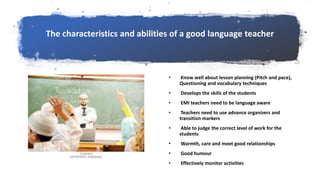
The characteristics and abilities of a good language teacher
• Know well about lesson planning (Pitch and pace),
Questioning and vocabulary techniques
• Develops the skills of the students
• EMI teachers need to be language aware
• Teachers need to use advance organizers and
transition markers
• Able to judge the correct level of work for the
students
• Warmth, care and meet good relationships
• Good humour
• Effectively monitor activities
Principles
(teaching
speaking
platform)
BEWARE OF THE
DIFFERENCE BETWEEN
SECOND LANGUAGE
AND FOREIGN
LANGUAGE LEARNING
CONTEXTS
GIVE STUDENTS
MAXIMUM LEVEL OF
PRACTICE WITH BOTH
FLUENCY AND
ACCURACY
PROVIDE
OPPORTUNITIES FOR
STUDENTS TO TALK BY
USING WORK OR PAIR
WORK AND LIMITING
TEACHER TALK
PLAN SPEAKING TASKS
THAT INVOLVE
NEGOTIATION FOR
MEANING
DESIGN CLASS ROOM
ACTIVITIES THAT
INVOLVES GUIDANCE
AND PRACTICE IN BOTH
TRANSACTIONAL AND
INTERACTIONAL
SPEAKING
ESL TEACHERS SHOULD
CREATE A CLASSROOM
ENVIRONMENT WHERE
STUDENTS HAVE REAL-
LIFE COMMUNICATION,
AUTHENTIC ACTIVITIES,
AND MEANINGFUL
TASKS THAT PROMOTE
ORAL LANGUAGE
THE MOTIVATION IS
HIGH WITH PROVISION
OF RELAXED
ENVIRONMENT
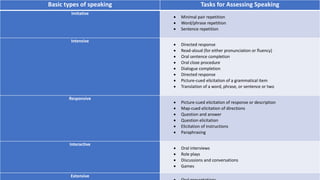
Basic types of speaking Tasks for Assessing Speaking
Imitative
 Minimal pair repetition
 Word/phrase repetition
 Sentence repetition
Intensive
 Directed response
 Read-aloud (for either pronunciation or fluency)
 Oral sentence completion
 Oral cloze procedure
 Dialogue completion
 Directed response
 Picture-cued elicitation of a grammatical item
 Translation of a word, phrase, or sentence or two
Responsive
 Picture-cued elicitation of response or description
 Map-cued elicitation of directions
 Question and answer
 Question elicitation
 Elicitation of instructions
 Paraphrasing
Interactive
 Oral interviews
 Role plays
 Discussions and conversations
 Games
Extensive
1) Activity for teachers: Speaking board game
Frameworks for
planning
speaking lesson:
PPP, EIF and ESA
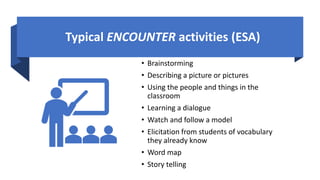
Typical ENCOUNTER activities (ESA)
• Brainstorming
• Describing a picture or pictures
• Using the people and things in the
classroom
• Learning a dialogue
• Watch and follow a model
• Elicitation from students of vocabulary
they already know
• Word map
• Story telling
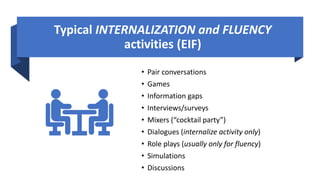
Typical INTERNALIZATION and FLUENCY
activities (EIF)
• Pair conversations
• Games
• Information gaps
• Interviews/surveys
• Mixers (“cocktail party”)
• Dialogues (internalize activity only)
• Role plays (usually only for fluency)
• Simulations
• Discussions
2) Activity for teachers (Pair work)
What are the steps you have to go through to teach someone to ride a bike?
Discuss with your partner and come up with a list of steps:
 Introduce learner to bike
 assess prior knowledge asks learner about parts of bike Encounter
 introduce key concepts
 model the task/skills for learner
 controlled practice – trainer holds bike while leaner rides
Internalization
 less controlled practice – trainer removes support gradually so learner can internalize
 learner rides bike with out support from trainer
 learner is given a task that demonstrates his/her ability such as: Fluency
Ride the bike to the store and buy two ice cream cones.
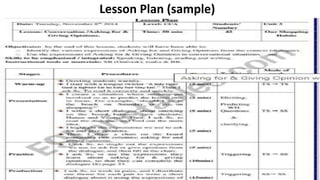
Lesson Plan (sample)
3) Activity for teachers:
(Instructed from teacher’s
guide)
Work with a partner:
a-Take turns to describe a family
celebration you remember well.
Think about:
-the place
-the people
-food and drink
-people's clothes
b-Do you think it is important for the
family members to meet on
important occasions? Give reasons.
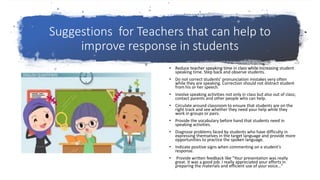
Suggestions for Teachers that can help to
improve response in students
• Reduce teacher speaking time in class while increasing student
speaking time. Step back and observe students.
• Do not correct students' pronunciation mistakes very often
while they are speaking. Correction should not distract student
from his or her speech.
• Involve speaking activities not only in class but also out of class;
contact parents and other people who can help.
• Circulate around classroom to ensure that students are on the
right track and see whether they need your help while they
work in groups or pairs.
• Provide the vocabulary before hand that students need in
speaking activities.
• Diagnose problems faced by students who have difficulty in
expressing themselves in the target language and provide more
opportunities to practice the spoken language.
• Indicate positive signs when commenting on a student's
response.
• Provide written feedback like "Your presentation was really
great. It was a good job. I really appreciated your efforts in
preparing the materials and efficient use of your voice…“
Exemplary
activities for
students:
(Note: start
from simpler
and move to
complex one
according to
level)
1) Playing cardsCards
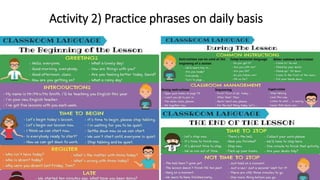
Activity 2) Practice phrases on daily basis
3) Video activity on
present simple:
https://en.islcollectiv
e.com/video-
lessons/present-
simple-pink-panther
4) Activity mentioned in DAS curriculum:
Broadway English (as an example)
Teaching speaking in classroom

Teaching speaking in classroom

  • 2.
    Teaching speaking in classroom Effortedby: Abida Rehman DAS , Foundation, Pakistan
  • 3.
    Table of contents: • Whatis “speaking”? • Major speech types • Speaking involves • Linguistic elements • Difficult aspects of speaking • What is “teaching speaking” • Skills of oral communication • Phenomena effecting spoken abilities • Characteristics and abilities of a good language teacher • Principles and types of speaking • Activities for teachers • Frameworks for planning speaking lesson • Lesson plan sample • Suggestions for Teachers • Activities for students
  • 4.
    What is “speaking”? Speakingis an interactive process of constructing meaning that involves producing, receiving and processing information (Brown, 1994) OR The action of conveying information or expressing one's feelings in speech
  • 5.
    Major speech types ••Interactions • •Transactions • •Performances
  • 6.
    Speaking involves Appropriate correctBody Vocabulary expressions pronunciation word order language tone register (degree of politeness) facial expressions
  • 7.
  • 8.
    What makes speaking difficult? • Clustering •Redundancy • Reduced Forms • Performance Variables • Colloquial Language • Rate of Delivery • Stress, Rhythm, and Intonation • Interaction Solution is? Yes! teach learners to overcome these difficulties
  • 9.
    What Is "Teaching Speaking"? -Aneffective teaching program which skilled learners in Micro and Macro ways of oral communications
  • 10.
    Prototypical Micro skills of oral communication chunksof languageProduce oral differences (among the English phonemes and allophonic variants)Produce English stress patterns, rhythmic structure, and intonational contoursProduce reduced forms of words and phrasesProduce own oral production and use various strategic devicesMonitor grammatical word classes, systems, word order, patterns, rules, and elliptical formsUse speech in natural constituents in appropriate phrases, pause groups, breath groups, and sentencesProduce
  • 11.
    Some important Macro skillsof oral communication Use cohesive devices in spoken discourse Accomplish appropriately communicative functions according to situations Use appropriate sociolinguistic features in face-to-face conversations Convey links and connections between events and communicate such relation Use facial features along with verbal language to convey meanings Develop and use a battery of speaking strategies, such as emphasizing key words and rephrasing etc. Ability to produce language in real life or to use it as a means to do other jobs
  • 12.
    Normal phenomena affecting spokenabilities of students: that teacher should know……… Inference ELL children may manifest interference or transfer from their first language (L1) to English (L2). This means that a child may make an English error due to the direct influence of an L1 structure. Silent period: When students are first exposed to a second language, frequently they focus on listening and comprehension. Code switching: Many children who are ELLs also engage in a behavior known as code- switching. This involves changing languages over phrases or sentences. Language loss: As they learn English, they lose skills and fluency in L1 if their L1 is not reinforced and maintained. Social and Academic Language: Two years to acquire Basic Interpersonal Communication Skills (BICS). Five to seven years to acquire Cognitive Academic Language Proficiency (CALP) , or the context-reduced language of academics
  • 13.
    The characteristics andabilities of a good language teacher • Know well about lesson planning (Pitch and pace), Questioning and vocabulary techniques • Develops the skills of the students • EMI teachers need to be language aware • Teachers need to use advance organizers and transition markers • Able to judge the correct level of work for the students • Warmth, care and meet good relationships • Good humour • Effectively monitor activities
  • 14.
    Principles (teaching speaking platform) BEWARE OF THE DIFFERENCEBETWEEN SECOND LANGUAGE AND FOREIGN LANGUAGE LEARNING CONTEXTS GIVE STUDENTS MAXIMUM LEVEL OF PRACTICE WITH BOTH FLUENCY AND ACCURACY PROVIDE OPPORTUNITIES FOR STUDENTS TO TALK BY USING WORK OR PAIR WORK AND LIMITING TEACHER TALK PLAN SPEAKING TASKS THAT INVOLVE NEGOTIATION FOR MEANING DESIGN CLASS ROOM ACTIVITIES THAT INVOLVES GUIDANCE AND PRACTICE IN BOTH TRANSACTIONAL AND INTERACTIONAL SPEAKING ESL TEACHERS SHOULD CREATE A CLASSROOM ENVIRONMENT WHERE STUDENTS HAVE REAL- LIFE COMMUNICATION, AUTHENTIC ACTIVITIES, AND MEANINGFUL TASKS THAT PROMOTE ORAL LANGUAGE THE MOTIVATION IS HIGH WITH PROVISION OF RELAXED ENVIRONMENT
  • 15.
    Basic types ofspeaking Tasks for Assessing Speaking Imitative  Minimal pair repetition  Word/phrase repetition  Sentence repetition Intensive  Directed response  Read-aloud (for either pronunciation or fluency)  Oral sentence completion  Oral cloze procedure  Dialogue completion  Directed response  Picture-cued elicitation of a grammatical item  Translation of a word, phrase, or sentence or two Responsive  Picture-cued elicitation of response or description  Map-cued elicitation of directions  Question and answer  Question elicitation  Elicitation of instructions  Paraphrasing Interactive  Oral interviews  Role plays  Discussions and conversations  Games Extensive
  • 16.
    1) Activity forteachers: Speaking board game
  • 17.
  • 18.
    Typical ENCOUNTER activities(ESA) • Brainstorming • Describing a picture or pictures • Using the people and things in the classroom • Learning a dialogue • Watch and follow a model • Elicitation from students of vocabulary they already know • Word map • Story telling
  • 19.
    Typical INTERNALIZATION andFLUENCY activities (EIF) • Pair conversations • Games • Information gaps • Interviews/surveys • Mixers (“cocktail party”) • Dialogues (internalize activity only) • Role plays (usually only for fluency) • Simulations • Discussions
  • 20.
    2) Activity forteachers (Pair work) What are the steps you have to go through to teach someone to ride a bike? Discuss with your partner and come up with a list of steps:  Introduce learner to bike  assess prior knowledge asks learner about parts of bike Encounter  introduce key concepts  model the task/skills for learner  controlled practice – trainer holds bike while leaner rides Internalization  less controlled practice – trainer removes support gradually so learner can internalize  learner rides bike with out support from trainer  learner is given a task that demonstrates his/her ability such as: Fluency Ride the bike to the store and buy two ice cream cones.
  • 21.
  • 22.
    3) Activity forteachers: (Instructed from teacher’s guide) Work with a partner: a-Take turns to describe a family celebration you remember well. Think about: -the place -the people -food and drink -people's clothes b-Do you think it is important for the family members to meet on important occasions? Give reasons.
  • 23.
    Suggestions for Teachersthat can help to improve response in students • Reduce teacher speaking time in class while increasing student speaking time. Step back and observe students. • Do not correct students' pronunciation mistakes very often while they are speaking. Correction should not distract student from his or her speech. • Involve speaking activities not only in class but also out of class; contact parents and other people who can help. • Circulate around classroom to ensure that students are on the right track and see whether they need your help while they work in groups or pairs. • Provide the vocabulary before hand that students need in speaking activities. • Diagnose problems faced by students who have difficulty in expressing themselves in the target language and provide more opportunities to practice the spoken language. • Indicate positive signs when commenting on a student's response. • Provide written feedback like "Your presentation was really great. It was a good job. I really appreciated your efforts in preparing the materials and efficient use of your voice…“
  • 24.
    Exemplary activities for students: (Note: start fromsimpler and move to complex one according to level) 1) Playing cardsCards
  • 25.
    Activity 2) Practicephrases on daily basis
  • 26.
    3) Video activityon present simple: https://en.islcollectiv e.com/video- lessons/present- simple-pink-panther
  • 27.
    4) Activity mentionedin DAS curriculum: Broadway English (as an example)