TEACHING
VOCABULARY
A presentation by:

Fawaz Hamad AlGhoraibi
Objectives
To establish the importance of teaching
new vocabulary, as well as the form,
and of showing how words are used in
context.
 To present techniques for showing the
meaning of new words.
 To show how to reinforce new
vocabulary by asking questions using
the new items.

The importance of teaching vocabulary items
1- to provide students with a tool that will allow them
to become independent readers.
2- to pronounce and understand new words they
encounter as they read.
3- to qualify them to communicate with their teacher in
English.
4- in reading, writing , and discussion lessons teachers
are required to introduce new vocabulary items .
Therefore, they have to have the sufficient skill to
present those new words.
The importance of teaching vocabulary items
5- the language consists of words and without
understanding those words , we lack the means of
understanding that language.
Certainly, once the problem of the vocabulary items
is solved , consequently a great deal of the
language teaching problems will be solved.
Introduction
Here are some techniques of teaching new words.
- Say the word clearly and write it on the board.
- Get the class to repeat it in chorus.
- Translate the word into Arabic.
- Ask the students to translate the word.
- Draw a picture to show what the word means.
- Give an English example to show how the word is
used.
- Ask questions using the new word.


Decide with the rest
of your team which
are the most useful
techniques.



Can you think of any
other techniques you
could use?
Rumble & Grumble


Rumble = ‫صوت الرعد‬

Grumble
Some people grumble about
everything. For example,
they grumble about the
weather. If it is sunny, they
say, ”It’s much too hot
today.” If it’s cool, they say,
“It’s very cold” They are
never satisfied.
Do you know what “grumble”
means in Arabic?

Which One Is better?
Having studied the two previous techniques,
consider these questions with your
colleagues:
- Which one is easier and clearer?
- Which one shows how the word is used in a
sentence?
- Which one encourages the student to listen
to the word being used?
- Finally, which one do you think is more
interesting?
Showing the Meaning of Words
I – Showing Meaning Visually
Seeing
The word is written on the chalkboard or a flash
card or a piece of paper.
How could you explain these words?


Watch – Window – Elbow



Tree – Tractor – Cow



Sneeze – Dig - Open
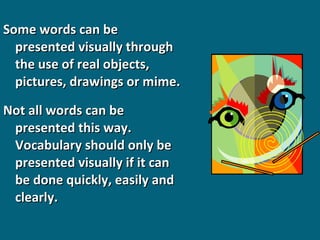
Some words can be
presented visually through
the use of real objects,
pictures, drawings or mime.
Not all words can be
presented this way.
Vocabulary should only be
presented visually if it can
be done quickly, easily and
clearly.
Discussing

after the word has been written
.It should be read aloud by the
teacher and by the children.
Showing the Meaning of Words
II – Giving Examples
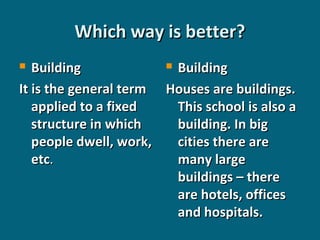
Which way is better?
 Building
Building
It is the general term Houses are buildings.
applied to a fixed
This school is also a
structure in which
building. In big
people dwell, work,
cities there are
etc.
many large
buildings – there
are hotels, offices
and hospitals.

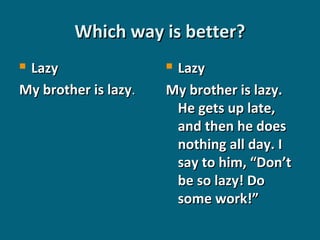
Which way is better?
Lazy
My brother is lazy.


Lazy
My brother is lazy.
He gets up late,
and then he does
nothing all day. I
say to him, “Don’t
be so lazy! Do
some work!”



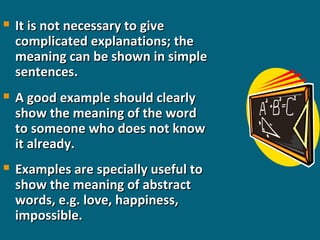
It is not necessary to give
complicated explanations; the
meaning can be shown in simple
sentences.



A good example should clearly
show the meaning of the word
to someone who does not know
it already.



Examples are specially useful to
show the meaning of abstract
words, e.g. love, happiness,
impossible.
Using
they are asked to use the word in
a sentence.
Showing the Meaning of Words
III – Guessing the Meaning from
Context
Try to guess the meaning of the
underlined words.


The children were bleebing all over
the ground.



A country girl was walking along the
snerd with a roggle of milk over her
head.


It is possible to guess the meaning
of many unknown words from
their context.



Asking the students to guess the
meaning of new words helps to
focus attention on them, and
makes them want to know what
the words mean.
Defining
It is a little bit hard for our students but they
may say the synonyms or the antonyms.
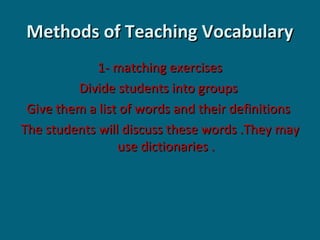
Methods of Teaching Vocabulary
1- matching exercises
Divide students into groups
Give them a list of words and their definitions
The students will discuss these words .They may
use dictionaries .
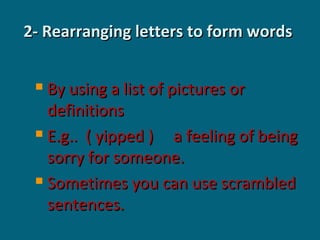
2- Rearranging letters to form words
By using a list of pictures or
definitions
 E.g.. ( yipped )
a feeling of being
sorry for someone.
 Sometimes you can use scrambled
sentences.

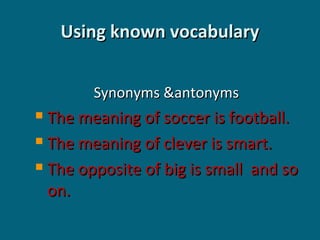
Using known vocabulary
Synonyms &antonyms

The meaning of soccer is football.
 The meaning of clever is smart.
 The opposite of big is small and so
on.

Carrying out the role of the student
teacher .


Ask students in advance to prepare
some items using illustrations to show
the meaning to their classmates and
give them marks for their work.
Combining Different
Techniques
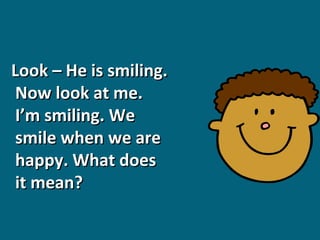
Look – He is smiling.
Now look at me.
I’m smiling. We
smile when we are
happy. What does
it mean?
In the previous example,
what are the different
techniques used to
explain the word
“smile”?
Picture on board (interesting
students remember it)
 Facial expression (gives meaning
clearly)
 Examples (show how ‘smile’ is
used as a verb)
 Translation (to make sure
everyone understands)

Working with your group, decide
exactly how you would present each of
the following words. If possible think
of a variety of techniques.
laugh

cheese

cold

wall
Using A New Word
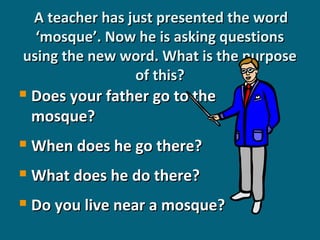
A teacher has just presented the word
‘mosque’. Now he is asking questions
using the new word. What is the purpose
of this?


Does your father go to the
mosque?



When does he go there?



What does he do there?



Do you live near a mosque?




These questions help the teacher
to be sure that students really
understand the word.
They give the students more
examples of how the word is
used, in a way that involves the
class.

Note:
These questions should be simple
and require only short answers.
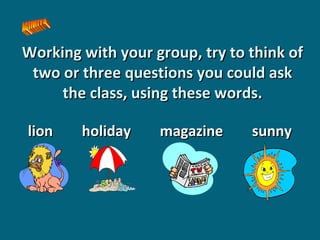
Working with your group, try to think of
two or three questions you could ask
the class, using these words.
lion

holiday

magazine

sunny
Vocabulary
Expansion
When students come
across a new word, they
are likely to be interested
in learning other related
words, and this presents a
natural opportunity for
vocabulary development.
This is sometimes called
“vocabulary expansion”.
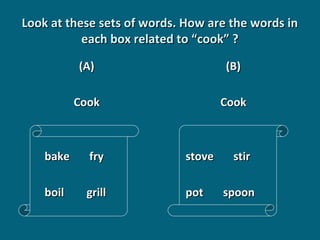
Look at these sets of words. How are the words in
each box related to “cook” ?
(A)

(B)

Cook

Cook

bake

fry

stove

boil

grill

pot

stir
spoon


The words in (A)
are synonyms:
they are words
of the same type
and have the
same general
meaning.



The words in (B)
are related by
context: they
might be all used
when talking about
cooking although
they are not
synonyms.
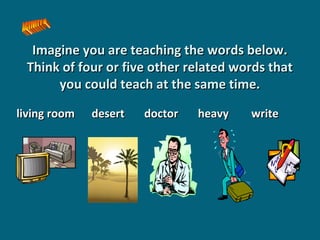
Imagine you are teaching the words below.
Think of four or five other related words that
you could teach at the same time.
living room

desert

doctor

heavy

write
Vocabulary Games

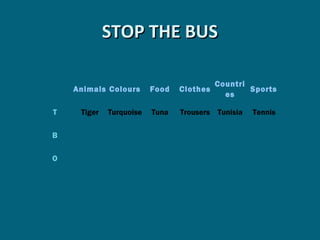
STOP THE BUS
 

Animals Colours

Countri
Sports
es

Food

Clothes
Trousers Tunisia

T

Tiger

Turquoise

Tuna

Tennis

B


O


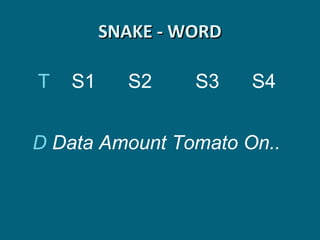
SNAKE - WORD
T

S1

S2

S3

S4

D Data Amount Tomato On..
Flash Games
Game 1

Game 2
Game 3

Game 4

Game 5
‫‪T E‬‬
‫‪he nd‬‬
‫‪Thank You for Your Participation‬‬

‫سبحانك اللهم وبحمدك ,‬
‫أشهد أن ل إله إل أنت ,‬
‫أستغفرك وأتوب إليك‬

Teaching vocabulary

  • 2.
  • 3.
    Objectives To establish theimportance of teaching new vocabulary, as well as the form, and of showing how words are used in context.  To present techniques for showing the meaning of new words.  To show how to reinforce new vocabulary by asking questions using the new items. 
  • 4.
    The importance ofteaching vocabulary items 1- to provide students with a tool that will allow them to become independent readers. 2- to pronounce and understand new words they encounter as they read. 3- to qualify them to communicate with their teacher in English. 4- in reading, writing , and discussion lessons teachers are required to introduce new vocabulary items . Therefore, they have to have the sufficient skill to present those new words.
  • 5.
    The importance ofteaching vocabulary items 5- the language consists of words and without understanding those words , we lack the means of understanding that language. Certainly, once the problem of the vocabulary items is solved , consequently a great deal of the language teaching problems will be solved.
  • 6.
    Introduction Here are sometechniques of teaching new words. - Say the word clearly and write it on the board. - Get the class to repeat it in chorus. - Translate the word into Arabic. - Ask the students to translate the word. - Draw a picture to show what the word means. - Give an English example to show how the word is used. - Ask questions using the new word.
  • 7.
     Decide with therest of your team which are the most useful techniques.  Can you think of any other techniques you could use?
  • 8.
    Rumble & Grumble  Rumble= ‫صوت الرعد‬ Grumble Some people grumble about everything. For example, they grumble about the weather. If it is sunny, they say, ”It’s much too hot today.” If it’s cool, they say, “It’s very cold” They are never satisfied. Do you know what “grumble” means in Arabic? 
  • 9.
    Which One Isbetter? Having studied the two previous techniques, consider these questions with your colleagues: - Which one is easier and clearer? - Which one shows how the word is used in a sentence? - Which one encourages the student to listen to the word being used? - Finally, which one do you think is more interesting?
  • 10.
    Showing the Meaningof Words I – Showing Meaning Visually
  • 11.
    Seeing The word iswritten on the chalkboard or a flash card or a piece of paper.
  • 12.
    How could youexplain these words?  Watch – Window – Elbow  Tree – Tractor – Cow  Sneeze – Dig - Open
  • 13.
    Some words canbe presented visually through the use of real objects, pictures, drawings or mime. Not all words can be presented this way. Vocabulary should only be presented visually if it can be done quickly, easily and clearly.
  • 14.
    Discussing after the wordhas been written .It should be read aloud by the teacher and by the children.
  • 15.
    Showing the Meaningof Words II – Giving Examples
  • 16.
    Which way isbetter?  Building Building It is the general term Houses are buildings. applied to a fixed This school is also a structure in which building. In big people dwell, work, cities there are etc. many large buildings – there are hotels, offices and hospitals. 
  • 17.
    Which way isbetter? Lazy My brother is lazy.  Lazy My brother is lazy. He gets up late, and then he does nothing all day. I say to him, “Don’t be so lazy! Do some work!” 
  • 18.
     It is notnecessary to give complicated explanations; the meaning can be shown in simple sentences.  A good example should clearly show the meaning of the word to someone who does not know it already.  Examples are specially useful to show the meaning of abstract words, e.g. love, happiness, impossible.
  • 19.
    Using they are askedto use the word in a sentence.
  • 20.
    Showing the Meaningof Words III – Guessing the Meaning from Context
  • 21.
    Try to guessthe meaning of the underlined words.  The children were bleebing all over the ground.  A country girl was walking along the snerd with a roggle of milk over her head.
  • 22.
     It is possibleto guess the meaning of many unknown words from their context.  Asking the students to guess the meaning of new words helps to focus attention on them, and makes them want to know what the words mean.
  • 23.
    Defining It is alittle bit hard for our students but they may say the synonyms or the antonyms.
  • 24.
    Methods of TeachingVocabulary 1- matching exercises Divide students into groups Give them a list of words and their definitions The students will discuss these words .They may use dictionaries .
  • 25.
    2- Rearranging lettersto form words By using a list of pictures or definitions  E.g.. ( yipped ) a feeling of being sorry for someone.  Sometimes you can use scrambled sentences. 
  • 26.
    Using known vocabulary Synonyms&antonyms The meaning of soccer is football.  The meaning of clever is smart.  The opposite of big is small and so on. 
  • 27.
    Carrying out therole of the student teacher .  Ask students in advance to prepare some items using illustrations to show the meaning to their classmates and give them marks for their work.
  • 28.
  • 29.
    Look – Heis smiling. Now look at me. I’m smiling. We smile when we are happy. What does it mean?
  • 30.
    In the previousexample, what are the different techniques used to explain the word “smile”?
  • 31.
    Picture on board(interesting students remember it)  Facial expression (gives meaning clearly)  Examples (show how ‘smile’ is used as a verb)  Translation (to make sure everyone understands) 
  • 32.
    Working with yourgroup, decide exactly how you would present each of the following words. If possible think of a variety of techniques. laugh cheese cold wall
  • 33.
  • 34.
    A teacher hasjust presented the word ‘mosque’. Now he is asking questions using the new word. What is the purpose of this?  Does your father go to the mosque?  When does he go there?  What does he do there?  Do you live near a mosque?
  • 35.
      These questions helpthe teacher to be sure that students really understand the word. They give the students more examples of how the word is used, in a way that involves the class. Note: These questions should be simple and require only short answers.
  • 36.
    Working with yourgroup, try to think of two or three questions you could ask the class, using these words. lion holiday magazine sunny
  • 37.
  • 38.
    When students come acrossa new word, they are likely to be interested in learning other related words, and this presents a natural opportunity for vocabulary development. This is sometimes called “vocabulary expansion”.
  • 39.
    Look at thesesets of words. How are the words in each box related to “cook” ? (A) (B) Cook Cook bake fry stove boil grill pot stir spoon
  • 40.
     The words in(A) are synonyms: they are words of the same type and have the same general meaning.  The words in (B) are related by context: they might be all used when talking about cooking although they are not synonyms.
  • 41.
    Imagine you areteaching the words below. Think of four or five other related words that you could teach at the same time. living room desert doctor heavy write
  • 42.
  • 43.
    STOP THE BUS   AnimalsColours Countri Sports es Food Clothes Trousers Tunisia T Tiger Turquoise Tuna Tennis B             O            
  • 44.
    SNAKE - WORD T S1 S2 S3 S4 DData Amount Tomato On..
  • 45.
    Flash Games Game 1 Game2 Game 3 Game 4 Game 5
  • 46.
    ‫‪T E‬‬ ‫‪he nd‬‬ ‫‪ThankYou for Your Participation‬‬ ‫سبحانك اللهم وبحمدك ,‬ ‫أشهد أن ل إله إل أنت ,‬ ‫أستغفرك وأتوب إليك‬