TEACHING SPEAKING
        By Aisyah Sunarwan
       Phone. 081541222622
email. aisyahsunarwan@gmail.com
Teaching Speaking
Issues for discussion:
1. Characteristics of spoken
   language
2. Principles for designing speaking
   activities
3. Using group work in speaking
   activities
4. Common types of speaking
   activities
What are the characteristics of
       spoken language?
• Speaking is a skill, just like
  swimming, driving a car, or playing
  ping-pong.
• Too often, in the traditional
  classroom, the learning of English
  has been relegated to linguistic s
  knowledge only.
Characteristics of
         spoken language
Spontaneity
• In most situations, people do not plan
  ahead of time what they are going to say.
• Spontaneous means full of false starts
  and repetitions incomplete sentences.
Time-constraint
  The     students      produce   unplanned
  utterances in real time
Designing speaking tasks
• One important consideration:
  Proficiency level of the students
  (challenging but not too difficult.)
• If the task is too easy or too difficult,
  the students may be demotivated.
Common characteristics in
  successful speaking tasks

• Maximum foreign talk
• Even participation
• High motivation
Using group work in speaking
               tasks
    Advantages of using group work
•   More opportunities
•   More motivation
•   More authenticity
•   Different levels
•   More cooperation
Type of speaking tasks
According to Littlewood, communicative
speaking activities can be divided into
two types: functional communication
activities, and social interaction
activities:
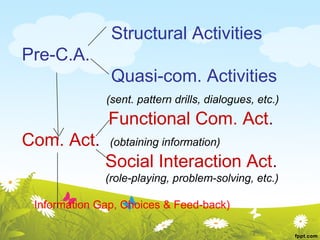
Structural Activities
Pre-C.A.
               Quasi-com. Activities
              (sent. pattern drills, dialogues, etc.)
               Functional Com. Act.
Com. Act.      (obtaining information)
              Social Interaction Act.
              (role-playing, problem-solving, etc.)

 Information Gap, Choices & Feed-back)
Some types of speaking
          activities

•   Information-gap activities
•   Dialogues and role-plays
•   Activities using pictures
•   Problem-solving activities
•   Other speaking activities
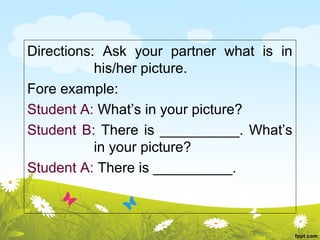
Directions: Ask your partner what is in
           his/her picture.
Fore example:
Student A: What’s in your picture?
Student B: There is __________. What’s
           in your picture?
Student A: There is __________.
Conclusion
The most important aspect of preparing students
to speak in real life is to give them as many
opportunities as possible to practise producing
unplanned, spontaneous and meaningful speech
under time pressure.
That’s all

Thank you!

how to teach speaking

  • 1.
    TEACHING SPEAKING By Aisyah Sunarwan Phone. 081541222622 email. aisyahsunarwan@gmail.com
  • 2.
    Teaching Speaking Issues fordiscussion: 1. Characteristics of spoken language 2. Principles for designing speaking activities 3. Using group work in speaking activities 4. Common types of speaking activities
  • 3.
    What are thecharacteristics of spoken language? • Speaking is a skill, just like swimming, driving a car, or playing ping-pong. • Too often, in the traditional classroom, the learning of English has been relegated to linguistic s knowledge only.
  • 4.
    Characteristics of spoken language Spontaneity • In most situations, people do not plan ahead of time what they are going to say. • Spontaneous means full of false starts and repetitions incomplete sentences. Time-constraint The students produce unplanned utterances in real time
  • 5.
    Designing speaking tasks •One important consideration: Proficiency level of the students (challenging but not too difficult.) • If the task is too easy or too difficult, the students may be demotivated.
  • 6.
    Common characteristics in successful speaking tasks • Maximum foreign talk • Even participation • High motivation
  • 7.
    Using group workin speaking tasks Advantages of using group work • More opportunities • More motivation • More authenticity • Different levels • More cooperation
  • 8.
    Type of speakingtasks According to Littlewood, communicative speaking activities can be divided into two types: functional communication activities, and social interaction activities:
  • 9.
    Structural Activities Pre-C.A. Quasi-com. Activities (sent. pattern drills, dialogues, etc.) Functional Com. Act. Com. Act. (obtaining information) Social Interaction Act. (role-playing, problem-solving, etc.) Information Gap, Choices & Feed-back)
  • 10.
    Some types ofspeaking activities • Information-gap activities • Dialogues and role-plays • Activities using pictures • Problem-solving activities • Other speaking activities
  • 11.
    Directions: Ask yourpartner what is in his/her picture. Fore example: Student A: What’s in your picture? Student B: There is __________. What’s in your picture? Student A: There is __________.
  • 12.
    Conclusion The most importantaspect of preparing students to speak in real life is to give them as many opportunities as possible to practise producing unplanned, spontaneous and meaningful speech under time pressure.
  • 13.