1.- TEACHINGYOUNG LEARNERS
1.1.- FIRST LANGUAGE-SECONDLANGUAGE
If we knowhowchildrenlearntheirmothertongue,we willhelpushow toteacha second
language.
 Babies:Theylistenalotof sounds,respondfamiliarvoices,associatesoundswithwhat
theycan understandandsee,begintouse language tointeractwithothers,etc.
 Young children:Theysaywhattheyhearand pickup the accent of those aroundthem.
CARETAKERTALK: Adultstalkwitha little childrentohelpthe developmentlanguage.
Thissituationisexactlythe same atschool whenYounglearnersare learningasecond
language.
HELPING CHILDREN LEARN A NEW LANGUAGE
1. Use Englishinclassforcommunication.
2. Use gestures,actionsandpicturestohelpchildrenunderstand.
3. Let childrenuse theirmothertongue forcommunication.
4. Recastin Englishwhatchildrensaytoyou intheirmothertongue.
5. AnswerchildreninEnglishasmuchaspossible.
6. Talk a lotin Englishtoyourpupils.
1.2.- STARTINGYOUR LESSONSIN ENGLISH
The most importantthingisto speakEnglishineachsituationbecause childrenare goingto
acquire Englishbetterandfaster.
We have to diferenciate twokindsof teachers:
 Classteacher:A classteacherteacheseverysubject.
 Specialistteacher:ThisteacheronlyteachesEnglish.Youworkwithpupilsof different
agesand levels.
FIRST ANDSECOND
LANGUAGE
YOUNG
CHILDREN
BABIES
HELPING CHILDREN LEARN A NEW LANGUAGE
Use English in class
for communication.
Use gestures, actions and
pictures to help children
understand.
Let children use
their mother
tongue for
communication
Answer children
in English as
much as posible.
Talk a lotin English
to yourpupils.
Recast in English what
children say to you in
their mother tongue.
GREETINGS ANDFORMS OFADDRESS
Whenyouarrive to your school,youshouldtosay:
 Good morningchildren!
 Helloboysandgirls!
 Good afternoon everybody!
Andyour studentsshouldanswerwithsimilarsentences,butwithalittle diference.
 Good morningteacher!
 Helloorgood afternoonMiss,Mrs, Mr, Ms (firstname orsurname).
CHECKINGATTENDANCE
 Let´s take the register.
 Let´s checkto see whoishere.
 Is everybodyhere?
 Who ismissing?
 Let´s countto see if everybodyishere.
GOOD MORNING CHILDREN!
HELLO BOYS AND GIRLS!
GOOD AFTERNOON EVERYBODY!
GOOD MORNING TEACHER!
HELLO MR HERRERA!
GOOD AFTERNOON, ÁLVARO!
WAYS OF STARTINGLESSONS
CHECK ATTENDANCE REARRANGETHE CLASSROOM
SINGA SONG DO QUESTION ROUTINES
TAKE THE REGISTER
PLAY A GAME
LET´S COUNT IF EVERYBODY IS
HERE! COUNT WITH ME!
CLASS TEACHER
SPECIALIST TEACHER
WEAR SOMETHING
SPECIAL DURING THE
LESSON
DO SOMETHING
DIFFERENT SO
THAT EVERYONE
KNOWS IT´S TIME
FOR ENGLISH
PUT UP A
PICTURE THAT
CHILDREN
ASSOCIATE WITH
ENGLISH
STAND IN A
DIFFERENT PLACE
1.3.- ORGANIZINGYOUR CLASSROOM
GET YOUR BOOKS AND
PENCILS OUT
PICK YOUR PENCILS UP
MOVE THE TABLES
BACK
TURN YOUR CHAIRS ROUND
TO FACE THE WALL CHART
PUT ALL YOUR THINGS AWAY!
CLOSE THE WINDOW BESIDE YOU!
PUT YOUR PENCILS DOWN!
TURN BACK TO FACE THE
FRONT!
LEAVE THESE TABLES HERE!
LEAVE THE
WINDOWS
OPEN!
1.4.- ENDING YOUR LESSONS
OK, THAT´S ALL FOR NOW!!
RIGHT. WE´VE NO TIME FOR
ANYTHING ELSE – DON´T DO ANY
MORE – WE DON´T HAVE ANY MORE
TIME TODAY!
OK, JUST ONE MORE TIME BEFORE
GOING OUT FOR A SHORT BREAK!
OK, NOW STOP! WE HAVEN´T ENOUGH
TIME TO FINISH THE MONSTER TODAY.
SO STAND UP…
OK, JUST ONE MORE TIME, AND THEN
THAT´S IT.
OK, PICK UP ALL YOUR THINGS, AND PUT
THE BOOKS IN THE CUPBOARD!
THAT´S ALL FOR TODAY. ON THE NEXT DAY,
THERE WILL BE MORE!
OK, CHILDREN, MAKE A LINE TO SAY GOODBYE,
FOLLOWING THE LEADER!!
OK, IT´S BREAK TIME. SO YOU CAN GO OUT TO PLAY.
BUT FIRST, LINE UP QUIETLY BY THE DOOR!
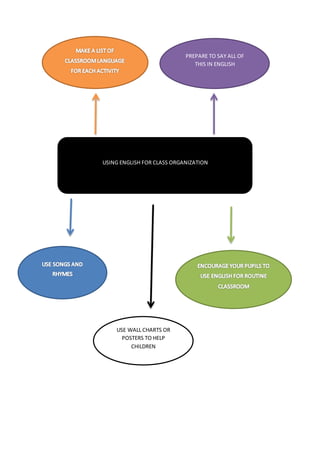
USING ENGLISH FOR CLASS ORGANIZATION
PREPARE TO SAY ALL OF
THIS IN ENGLISH
USE WALL CHARTS OR
POSTERS TO HELP
CHILDREN
INTRODUCE ENGLISH SLOWLY
WITH ENJOYABLE ACTIVITIES.
SUPPORT WHAT YOU SAY WITH
GESTURES, ACTIONS, MOVEMENTS
AND FACIAL EXPRESSION.
REPEATING FAMILIAT ACTIVITIES.
REPEAT IN ENGLISH WHAT THEY
SAY IN THEIR MOTHER TONGUE.
USE DRAWINGS AND PICTURES.
https://vocaroo.com/i/s0kzdu5kpAgH
https://vocaroo.com/i/s0J04vz2qzZv
https://vocaroo.com/i/s0qBUoT1Uz0p
https://vocaroo.com/i/s0rSj1zqiXtM
https://vocaroo.com/i/s12LYnacORn6
https://vocaroo.com/i/s1426rTsXqaS
https://vocaroo.com/i/s0YK2uySs2Qn
UNIT 2.- DEVELOPING SOCIALSKILLS
DEVELOPING SOCIAL SKILLS
CLASS ROUTINES
GREETINGS AND
GOODBYES
 PARTICIPATEIN A STORY
 NOT SHOUT
 IMPORTANCEOF SWITCHINGOFF
LIGTHS, THROWING PAPERIN THE
BIN AND OTHER GOOD MANNERS
 TRYING TO TIDY UP ANDHELP
 SAY GOOD MORNING,
AFTERNOON,HELLO,ETC.
 HOW ARE YOU? I´MFINE,
THANKYOU
PERSONAL HYGIENE
AND HEALTH
FEELINGS
 SWEETS = DECAY
 IMPORTANCEOF BALANCEDDIET
 RESPETING DININIGRULES
 EAT FRUIT
 PROTECTION FROMTHE SUN
 DRESS THEMSELVES
 DAILY ROUTINESABOUT HYGIENE
 EXPRESSLOVE FOR FAMILY
 EXPRESSFEELINGS: SAD,HAPPY,
SHY, ETC.
 PLAY DIFFERENTROLES AND
EXPRESSEMOTIONS
 VALUE THE FRIENDSHIP
 HAVEPOSITIVESELF-ESTEEM
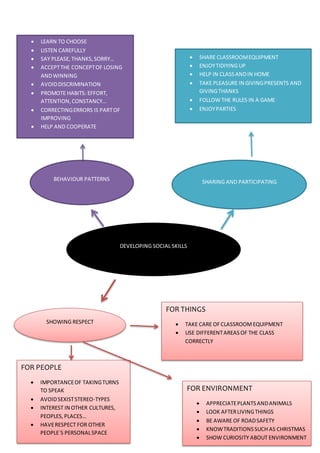
DEVELOPING SOCIAL SKILLS
BEHAVIOUR PATTERNS SHARING AND PARTICIPATING
 LEARN TO CHOOSE
 LISTEN CAREFULLY
 SAY PLEASE,THANKS,SORRY…
 ACCEPTTHE CONCEPTOF LOSING
ANDWINNING
 AVOIDDISCRIMINATION
 PROMOTE HABITS: EFFORT,
ATTENTION,CONSTANCY…
 CORRECTINGERRORS IS PARTOF
IMPROVING
 HELP AND COOPERATE
 SHARE CLASSROOMEQUIPMENT
 ENJOYTIDIYING UP
 HELP IN CLASSANDIN HOME
 TAKE PLEASURE IN GIVINGPRESENTS AND
GIVINGTHANKS
 FOLLOW THE RULES IN A GAME
 ENJOYPARTIES
SHOWING RESPECT
FOR PEOPLE
 IMPORTANCEOF TAKINGTURNS
TO SPEAK
 AVOIDSEXISTSTEREO-TYPES
 INTEREST IN OTHER CULTURES,
PEOPLES,PLACES…
 HAVERESPECT FOR OTHER
PEOPLE´S PERSONALSPACE
FOR ENVIRONMENT
 APPRECIATEPLANTSANDANIMALS
 LOOK AFTERLIVINGTHINGS
 BE AWARE OF ROADSAFETY
 KNOWTRADITIONSSUCH AS CHRISTMAS
 SHOW CURIOSITY ABOUT ENVIRONMENT
FOR THINGS
 TAKE CARE OFCLASSROOMEQUIPMENT
 USE DIFFERENTAREASOF THE CLASS
CORRECTLY
CLASSROOMMANAGEMENT
USING LOW-KEY MANAGEMENT TECHNIQUES
 Use the “one-minute-talk”
technique.
 Use proximity.
 Developagoodrelationship
withyourunwilling
students.
 Move aroundthe
classroom.
 Use gestures.
 Anticipate
misbehavior.
 Adoptthe steppingon
my lastnerve
technique.
 Explainthat
misbehaviorisa
harmful way.
 Make positive descriptionsof expectedbehaviors.
MAKE SMOOTH TRANSITIONS
Simplicity of directions
Consistency of
directions
Organization of
actions
Reinforcement of
behaviors
Exactness of
directions
AIDING STRUGGLING STRAGGLERS
 Try to findwhyyour
studentshave lackof
confidence,physical
fatigue,etc.
 Reassessthe needsof a
student.
 Reinforce partial
completions.
 Make a listof the
importance tasks.
 Offerindividual tutorials.
 Explainthatyouexpect.
 Encourage to helpeach
other.
 Keepparents informedof
your effortstohelpthe
straggler.
DEFUSING A POWER STRUGGLE
 Studentsshouldwrite ordrawhow
theyfeel.
 Studentsshouldwalkforalittle time
inorder to calmdown.
 Maintainproximity, eyecontactanda
calm voice whenspeakingtothe
student.
 Invite the studentto take air outside
classroomwithyou.
 Avoidmakingstatementsas“Iknow
how you feel”.
 Take time yourself whenyouare
angry.
UNIT 2.- LISTEN AND DO
2.1.- GIVING INSTRUCTIONS IN ENGLISH
You are an Englishteacher,soyouhave to give themthe instructionsinShakespeare´stongue.
Obviously, you can help with gestures and demonstrations.
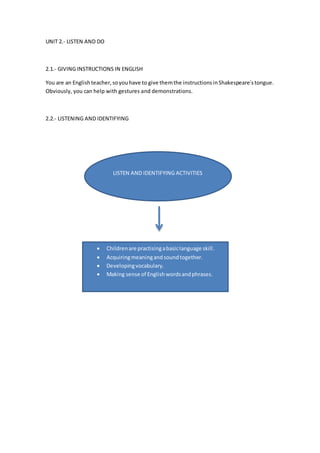
2.2.- LISTENING AND IDENTIFYING
LISTEN AND IDENTIFYING ACTIVITIES
 Childrenare practisingabasiclanguage skill.
 Acquiringmeaningandsoundtogether.
 Developingvocabulary.
 Making sense of Englishwordsandphrases.
For vocabularydevelopment youshoulduse the classroomandall the things that children can
see. Children can draw the objects.
For grammatical awareness you use these kind of activities for distinguishing singular and
plural and gender pronouns. It is useful to make pictures of a storybook.
2.3.- LISTENINGAND DOING,TOTAL PHISYCALRESPONSE
TPR iswhenchildrenfollowasequence of instructionsanddoingwhatthe teachersays.
The teachertellsthe pupilswhattodo,supportingwithactionsandgestures.
The pupils have tolistenthe instructionsandenjoydoingthe actions.
2.4.- LISTENINGAND PERFORMINGMIMING
Mimingismore complex thanTPRactivitiesbecausechildrenhave freedomtobe creative.
Childrenhave tobe familiarwiththe topicthatyouare goingto describe.Mime isgood
strategyfor readingstories.
Theycan work inan individualorgroupway. There are a lot of tasks thatyou can do withyour
studentsthroughmiming.
Physical breakchants:
 Use picturestohelpthe childrenrememberthe
meaningof the words.
 Use movementsandgesturestohelpthemenjoythe
chant.
 You can remove the pictureswhentheyunderstand
some words.
2.5.- LISTENINGAND RESPONDINGGAMES
Playinggamesbuttheyhave tolistencarefully.These gameshelp childrenhave funandmake
themlistenwhilethe teacherisspeaking.
Listeningandresponding:
 Explainthe game inyourmothertongue and afterthat inEnglish.
 Make the instructionsmore complex whentheyare improving.
 Finally,childrencangive the instructionsof the games.
UNIT 3.- LISTEN ANDMAKE
LISTEN AND MAKE
 Childrenhave to
make decisions.
 Theyhave more time
to think.
 Opportunityforcooperation
betweenlearners.
 Theyhave somethingto
take home at the endof
the class.
HOW TO PREPARE FOR LISTEN AND
MAKE ACTIVITIES
BEFORE THE LESSON
 Prepare the topic.
 Collectthe things
youneed.
 Clearup inEnglish
whatand howthey
have to make it.
 Thinkof gesturesand
actionthat will help
them.
 Think of thingsthattheyare
goingto say inSpanishand
recast commentsand
questionsinEnglish.
HOW TO SET UP LISTEN AND MAKE ACTIVITIES
 Introducingthe topic.
 Explainwhattheyare
goingto do or make.
Use gesturesand
actionsif you need.
 Repeatthe instructiontothe whole group,
small groupsand individual.
 Go around the classroom, reinforce the
instructionsandcommentwhattheyare doing
or makinginEnglish.
3.1.- LISTEN AND COLOUR
Theyare goingto do activitieswithcolours,sotheyhave to focusinwhat the teacherisexplain
about the activity and how to use the different colours and materials.
MAIN IDEAS:
 Comment positively on each child´s task.
 Use flashcards for colouring and they can use it for another game.
 Use drawings of living thigs, clothes, food which can be cut out.
 Finally, activities are going to be more challenging.
3.2.- LISTEN ANDDRAW
In these kindof activities,the teacherisgoingtogive themsome instructionsfordrawinga
specificpicture.Thustheyhave topayattentioninwhatwe are sayingandafterthat theyhave
to try to draw it.
Then,theyhave to compare theirpicturesandthe teachermustgo round andtalk to themin
Englishabouthowtheyhave done it.
3.3.- LISTEN ANDMAKE
There are a lotof thingsthatchildrencanmake inclass,such as greetingcars(Valentine´sday,
Christmas,Easter,Mother´sday,etc.).Alsotheycan make some specilal inaclassmate´s
birthday,Spain´sdayor UnitedKigdom´sday,etc.
SPEAKINGWITH SUPPORT
In thisunit,we are goingto see howstudentstryto speaksome English.
Teachershave to supportthem:
 By usingEnglishascaretakertalk.
 By listeningcarefullyandnotinterruptingthem.
 By encouraging tospeakinEnglish.
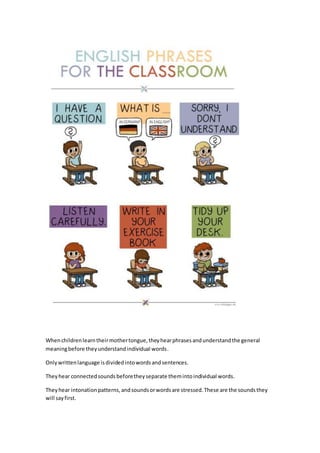
USING CLASSROOMPHRASES
Theyask you questions andtell youthingstheywantyoutoknow.
Theylearnexpressionswhichyouuse duringyourEnglishlesson.
Whenchildrenlearntheirmothertongue,theyhearphrasesandunderstandthe general
meaningbefore theyunderstandindividual words.
Onlywrittenlanguage isdividedintowordsandsentences.
Theyhear connectedsoundsbeforetheyseparate themintoindividual words.
Theyhear intonationpatterns,andsoundsorwordsare stressed.These are the soundsthey
will sayfirst.
SAYINGRHYMES ANDSINGINGSONGS TO PRACTICEPRONUNCIATION,STRESSAND
ENTONATION.
Childrenlikesingingandperforming,soourjobas a teacherisprovidedthemthese kindof
activitiesinordertolearna real English.
You can use chants, songs,rhymesinyourlesson:
 For enjoyment.
 As part of your teachingplan.
 As a change inactivity.
 To revise vocabulary.
 To connectwithnewor familiartopics.
 For drama and to practise punctuation.
A songor a rhyme should:
 Suityour pupilsage groupandtheirinterests.
 Match theirlevel of English.
 Have a catchy,easyto remembermelody.
Childrencansingandperforma song whentheyare familiarwiththe rhymes.Thiswouldbe a
goodgroup activityandtheywouldworktogether.
PRACTISINGNEWVOCABULARY
Whenyou introduce newvocabulary,youcan:
 Encourage themto repeatit.
 Use pictures,soundsandotherresources.
 Use gestures,movementsandactions.
 Repeatnewwordsas oftenasposible anduse themincontext.
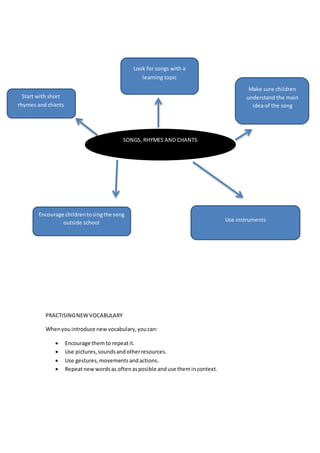
SONGS, RHYMES AND CHANTS
Start with short
rhymes and chants
Make sure children
understand the main
idea of the song
Encourage childrentosingthe song
outside school
Look for songs with a
learning topic
Use instruments
If your pupilscannotreadyettheyhave to rememberthe wordas a sound.
If theycan read,itis betterif theyfirstrememberthe soundof the wordandthen
learnthe spelling.
PLAYINGVOCABULARYGAMES
Guessinggamesandmemorygamesare useful tohelpchildrenbecomefamiliarwith
new vocabularyina enjoyable way.
Showchildrenhowtoplaythe game andgive instructionsinEnglish.
Use differentkindof games,butyouhave touse the same vocabulary.
Childrenhave touse the newphrasesandvocabularya lot,so youshouldprovide
themthe opportunitiestouse it.
PRACTISINGPRONUNCIATION OFNEWSOUNDS
Childrenacquire pronunciationandintonationnaturallybylisteningtoyou.
In the classroom:
1. You can put inorder picturesof wordswiththe same sound.
2. If the childrencanread, add the writtenwordunderneath.
3. Use actionsto helpchildren.

Teaching young learners

  • 1.
    1.- TEACHINGYOUNG LEARNERS 1.1.-FIRST LANGUAGE-SECONDLANGUAGE If we knowhowchildrenlearntheirmothertongue,we willhelpushow toteacha second language.  Babies:Theylistenalotof sounds,respondfamiliarvoices,associatesoundswithwhat theycan understandandsee,begintouse language tointeractwithothers,etc.  Young children:Theysaywhattheyhearand pickup the accent of those aroundthem. CARETAKERTALK: Adultstalkwitha little childrentohelpthe developmentlanguage. Thissituationisexactlythe same atschool whenYounglearnersare learningasecond language. HELPING CHILDREN LEARN A NEW LANGUAGE 1. Use Englishinclassforcommunication. 2. Use gestures,actionsandpicturestohelpchildrenunderstand. 3. Let childrenuse theirmothertongue forcommunication. 4. Recastin Englishwhatchildrensaytoyou intheirmothertongue. 5. AnswerchildreninEnglishasmuchaspossible. 6. Talk a lotin Englishtoyourpupils. 1.2.- STARTINGYOUR LESSONSIN ENGLISH The most importantthingisto speakEnglishineachsituationbecause childrenare goingto acquire Englishbetterandfaster. We have to diferenciate twokindsof teachers:  Classteacher:A classteacherteacheseverysubject.  Specialistteacher:ThisteacheronlyteachesEnglish.Youworkwithpupilsof different agesand levels.
  • 2.
    FIRST ANDSECOND LANGUAGE YOUNG CHILDREN BABIES HELPING CHILDRENLEARN A NEW LANGUAGE Use English in class for communication. Use gestures, actions and pictures to help children understand. Let children use their mother tongue for communication Answer children in English as much as posible. Talk a lotin English to yourpupils. Recast in English what children say to you in their mother tongue.
  • 3.
    GREETINGS ANDFORMS OFADDRESS Whenyouarriveto your school,youshouldtosay:  Good morningchildren!  Helloboysandgirls!  Good afternoon everybody! Andyour studentsshouldanswerwithsimilarsentences,butwithalittle diference.  Good morningteacher!  Helloorgood afternoonMiss,Mrs, Mr, Ms (firstname orsurname). CHECKINGATTENDANCE  Let´s take the register.  Let´s checkto see whoishere.  Is everybodyhere?  Who ismissing?  Let´s countto see if everybodyishere. GOOD MORNING CHILDREN! HELLO BOYS AND GIRLS! GOOD AFTERNOON EVERYBODY! GOOD MORNING TEACHER! HELLO MR HERRERA! GOOD AFTERNOON, ÁLVARO!
  • 4.
    WAYS OF STARTINGLESSONS CHECKATTENDANCE REARRANGETHE CLASSROOM SINGA SONG DO QUESTION ROUTINES TAKE THE REGISTER PLAY A GAME LET´S COUNT IF EVERYBODY IS HERE! COUNT WITH ME!
  • 5.
    CLASS TEACHER SPECIALIST TEACHER WEARSOMETHING SPECIAL DURING THE LESSON DO SOMETHING DIFFERENT SO THAT EVERYONE KNOWS IT´S TIME FOR ENGLISH PUT UP A PICTURE THAT CHILDREN ASSOCIATE WITH ENGLISH STAND IN A DIFFERENT PLACE
  • 6.
    1.3.- ORGANIZINGYOUR CLASSROOM GETYOUR BOOKS AND PENCILS OUT PICK YOUR PENCILS UP MOVE THE TABLES BACK TURN YOUR CHAIRS ROUND TO FACE THE WALL CHART PUT ALL YOUR THINGS AWAY! CLOSE THE WINDOW BESIDE YOU! PUT YOUR PENCILS DOWN! TURN BACK TO FACE THE FRONT! LEAVE THESE TABLES HERE! LEAVE THE WINDOWS OPEN!
  • 7.
    1.4.- ENDING YOURLESSONS OK, THAT´S ALL FOR NOW!! RIGHT. WE´VE NO TIME FOR ANYTHING ELSE – DON´T DO ANY MORE – WE DON´T HAVE ANY MORE TIME TODAY! OK, JUST ONE MORE TIME BEFORE GOING OUT FOR A SHORT BREAK! OK, NOW STOP! WE HAVEN´T ENOUGH TIME TO FINISH THE MONSTER TODAY. SO STAND UP… OK, JUST ONE MORE TIME, AND THEN THAT´S IT. OK, PICK UP ALL YOUR THINGS, AND PUT THE BOOKS IN THE CUPBOARD! THAT´S ALL FOR TODAY. ON THE NEXT DAY, THERE WILL BE MORE! OK, CHILDREN, MAKE A LINE TO SAY GOODBYE, FOLLOWING THE LEADER!! OK, IT´S BREAK TIME. SO YOU CAN GO OUT TO PLAY. BUT FIRST, LINE UP QUIETLY BY THE DOOR!
  • 8.
    USING ENGLISH FORCLASS ORGANIZATION PREPARE TO SAY ALL OF THIS IN ENGLISH USE WALL CHARTS OR POSTERS TO HELP CHILDREN
  • 9.
    INTRODUCE ENGLISH SLOWLY WITHENJOYABLE ACTIVITIES. SUPPORT WHAT YOU SAY WITH GESTURES, ACTIONS, MOVEMENTS AND FACIAL EXPRESSION. REPEATING FAMILIAT ACTIVITIES. REPEAT IN ENGLISH WHAT THEY SAY IN THEIR MOTHER TONGUE. USE DRAWINGS AND PICTURES.
  • 11.
  • 12.
    UNIT 2.- DEVELOPINGSOCIALSKILLS DEVELOPING SOCIAL SKILLS CLASS ROUTINES GREETINGS AND GOODBYES  PARTICIPATEIN A STORY  NOT SHOUT  IMPORTANCEOF SWITCHINGOFF LIGTHS, THROWING PAPERIN THE BIN AND OTHER GOOD MANNERS  TRYING TO TIDY UP ANDHELP  SAY GOOD MORNING, AFTERNOON,HELLO,ETC.  HOW ARE YOU? I´MFINE, THANKYOU PERSONAL HYGIENE AND HEALTH FEELINGS  SWEETS = DECAY  IMPORTANCEOF BALANCEDDIET  RESPETING DININIGRULES  EAT FRUIT  PROTECTION FROMTHE SUN  DRESS THEMSELVES  DAILY ROUTINESABOUT HYGIENE  EXPRESSLOVE FOR FAMILY  EXPRESSFEELINGS: SAD,HAPPY, SHY, ETC.  PLAY DIFFERENTROLES AND EXPRESSEMOTIONS  VALUE THE FRIENDSHIP  HAVEPOSITIVESELF-ESTEEM
  • 13.
    DEVELOPING SOCIAL SKILLS BEHAVIOURPATTERNS SHARING AND PARTICIPATING  LEARN TO CHOOSE  LISTEN CAREFULLY  SAY PLEASE,THANKS,SORRY…  ACCEPTTHE CONCEPTOF LOSING ANDWINNING  AVOIDDISCRIMINATION  PROMOTE HABITS: EFFORT, ATTENTION,CONSTANCY…  CORRECTINGERRORS IS PARTOF IMPROVING  HELP AND COOPERATE  SHARE CLASSROOMEQUIPMENT  ENJOYTIDIYING UP  HELP IN CLASSANDIN HOME  TAKE PLEASURE IN GIVINGPRESENTS AND GIVINGTHANKS  FOLLOW THE RULES IN A GAME  ENJOYPARTIES SHOWING RESPECT FOR PEOPLE  IMPORTANCEOF TAKINGTURNS TO SPEAK  AVOIDSEXISTSTEREO-TYPES  INTEREST IN OTHER CULTURES, PEOPLES,PLACES…  HAVERESPECT FOR OTHER PEOPLE´S PERSONALSPACE FOR ENVIRONMENT  APPRECIATEPLANTSANDANIMALS  LOOK AFTERLIVINGTHINGS  BE AWARE OF ROADSAFETY  KNOWTRADITIONSSUCH AS CHRISTMAS  SHOW CURIOSITY ABOUT ENVIRONMENT FOR THINGS  TAKE CARE OFCLASSROOMEQUIPMENT  USE DIFFERENTAREASOF THE CLASS CORRECTLY
  • 21.
    CLASSROOMMANAGEMENT USING LOW-KEY MANAGEMENTTECHNIQUES  Use the “one-minute-talk” technique.  Use proximity.  Developagoodrelationship withyourunwilling students.  Move aroundthe classroom.  Use gestures.  Anticipate misbehavior.  Adoptthe steppingon my lastnerve technique.  Explainthat misbehaviorisa harmful way.  Make positive descriptionsof expectedbehaviors.
  • 22.
    MAKE SMOOTH TRANSITIONS Simplicityof directions Consistency of directions Organization of actions Reinforcement of behaviors Exactness of directions AIDING STRUGGLING STRAGGLERS  Try to findwhyyour studentshave lackof confidence,physical fatigue,etc.  Reassessthe needsof a student.  Reinforce partial completions.  Make a listof the importance tasks.  Offerindividual tutorials.  Explainthatyouexpect.  Encourage to helpeach other.  Keepparents informedof your effortstohelpthe straggler.
  • 23.
    DEFUSING A POWERSTRUGGLE  Studentsshouldwrite ordrawhow theyfeel.  Studentsshouldwalkforalittle time inorder to calmdown.  Maintainproximity, eyecontactanda calm voice whenspeakingtothe student.  Invite the studentto take air outside classroomwithyou.  Avoidmakingstatementsas“Iknow how you feel”.  Take time yourself whenyouare angry.
  • 24.
    UNIT 2.- LISTENAND DO 2.1.- GIVING INSTRUCTIONS IN ENGLISH You are an Englishteacher,soyouhave to give themthe instructionsinShakespeare´stongue. Obviously, you can help with gestures and demonstrations. 2.2.- LISTENING AND IDENTIFYING LISTEN AND IDENTIFYING ACTIVITIES  Childrenare practisingabasiclanguage skill.  Acquiringmeaningandsoundtogether.  Developingvocabulary.  Making sense of Englishwordsandphrases.
  • 25.
    For vocabularydevelopment youshouldusethe classroomandall the things that children can see. Children can draw the objects. For grammatical awareness you use these kind of activities for distinguishing singular and plural and gender pronouns. It is useful to make pictures of a storybook. 2.3.- LISTENINGAND DOING,TOTAL PHISYCALRESPONSE TPR iswhenchildrenfollowasequence of instructionsanddoingwhatthe teachersays. The teachertellsthe pupilswhattodo,supportingwithactionsandgestures. The pupils have tolistenthe instructionsandenjoydoingthe actions. 2.4.- LISTENINGAND PERFORMINGMIMING Mimingismore complex thanTPRactivitiesbecausechildrenhave freedomtobe creative. Childrenhave tobe familiarwiththe topicthatyouare goingto describe.Mime isgood strategyfor readingstories. Theycan work inan individualorgroupway. There are a lot of tasks thatyou can do withyour studentsthroughmiming. Physical breakchants:  Use picturestohelpthe childrenrememberthe meaningof the words.  Use movementsandgesturestohelpthemenjoythe chant.  You can remove the pictureswhentheyunderstand some words.
  • 26.
    2.5.- LISTENINGAND RESPONDINGGAMES Playinggamesbuttheyhavetolistencarefully.These gameshelp childrenhave funandmake themlistenwhilethe teacherisspeaking. Listeningandresponding:  Explainthe game inyourmothertongue and afterthat inEnglish.  Make the instructionsmore complex whentheyare improving.  Finally,childrencangive the instructionsof the games. UNIT 3.- LISTEN ANDMAKE LISTEN AND MAKE  Childrenhave to make decisions.  Theyhave more time to think.  Opportunityforcooperation betweenlearners.  Theyhave somethingto take home at the endof the class.
  • 27.
    HOW TO PREPAREFOR LISTEN AND MAKE ACTIVITIES BEFORE THE LESSON  Prepare the topic.  Collectthe things youneed.  Clearup inEnglish whatand howthey have to make it.  Thinkof gesturesand actionthat will help them.  Think of thingsthattheyare goingto say inSpanishand recast commentsand questionsinEnglish. HOW TO SET UP LISTEN AND MAKE ACTIVITIES  Introducingthe topic.  Explainwhattheyare goingto do or make. Use gesturesand actionsif you need.  Repeatthe instructiontothe whole group, small groupsand individual.  Go around the classroom, reinforce the instructionsandcommentwhattheyare doing or makinginEnglish.
  • 28.
    3.1.- LISTEN ANDCOLOUR Theyare goingto do activitieswithcolours,sotheyhave to focusinwhat the teacherisexplain about the activity and how to use the different colours and materials. MAIN IDEAS:  Comment positively on each child´s task.  Use flashcards for colouring and they can use it for another game.  Use drawings of living thigs, clothes, food which can be cut out.  Finally, activities are going to be more challenging. 3.2.- LISTEN ANDDRAW In these kindof activities,the teacherisgoingtogive themsome instructionsfordrawinga specificpicture.Thustheyhave topayattentioninwhatwe are sayingandafterthat theyhave to try to draw it. Then,theyhave to compare theirpicturesandthe teachermustgo round andtalk to themin Englishabouthowtheyhave done it. 3.3.- LISTEN ANDMAKE There are a lotof thingsthatchildrencanmake inclass,such as greetingcars(Valentine´sday, Christmas,Easter,Mother´sday,etc.).Alsotheycan make some specilal inaclassmate´s birthday,Spain´sdayor UnitedKigdom´sday,etc.
  • 29.
    SPEAKINGWITH SUPPORT In thisunit,weare goingto see howstudentstryto speaksome English. Teachershave to supportthem:  By usingEnglishascaretakertalk.  By listeningcarefullyandnotinterruptingthem.  By encouraging tospeakinEnglish. USING CLASSROOMPHRASES Theyask you questions andtell youthingstheywantyoutoknow. Theylearnexpressionswhichyouuse duringyourEnglishlesson.
  • 30.
    Whenchildrenlearntheirmothertongue,theyhearphrasesandunderstandthe general meaningbefore theyunderstandindividualwords. Onlywrittenlanguage isdividedintowordsandsentences. Theyhear connectedsoundsbeforetheyseparate themintoindividual words. Theyhear intonationpatterns,andsoundsorwordsare stressed.These are the soundsthey will sayfirst.
  • 31.
    SAYINGRHYMES ANDSINGINGSONGS TOPRACTICEPRONUNCIATION,STRESSAND ENTONATION. Childrenlikesingingandperforming,soourjobas a teacherisprovidedthemthese kindof activitiesinordertolearna real English. You can use chants, songs,rhymesinyourlesson:  For enjoyment.  As part of your teachingplan.  As a change inactivity.  To revise vocabulary.  To connectwithnewor familiartopics.  For drama and to practise punctuation. A songor a rhyme should:  Suityour pupilsage groupandtheirinterests.  Match theirlevel of English.  Have a catchy,easyto remembermelody. Childrencansingandperforma song whentheyare familiarwiththe rhymes.Thiswouldbe a goodgroup activityandtheywouldworktogether.
  • 32.
    PRACTISINGNEWVOCABULARY Whenyou introduce newvocabulary,youcan: Encourage themto repeatit.  Use pictures,soundsandotherresources.  Use gestures,movementsandactions.  Repeatnewwordsas oftenasposible anduse themincontext. SONGS, RHYMES AND CHANTS Start with short rhymes and chants Make sure children understand the main idea of the song Encourage childrentosingthe song outside school Look for songs with a learning topic Use instruments
  • 33.
    If your pupilscannotreadyettheyhaveto rememberthe wordas a sound. If theycan read,itis betterif theyfirstrememberthe soundof the wordandthen learnthe spelling. PLAYINGVOCABULARYGAMES Guessinggamesandmemorygamesare useful tohelpchildrenbecomefamiliarwith new vocabularyina enjoyable way. Showchildrenhowtoplaythe game andgive instructionsinEnglish. Use differentkindof games,butyouhave touse the same vocabulary. Childrenhave touse the newphrasesandvocabularya lot,so youshouldprovide themthe opportunitiestouse it. PRACTISINGPRONUNCIATION OFNEWSOUNDS Childrenacquire pronunciationandintonationnaturallybylisteningtoyou. In the classroom: 1. You can put inorder picturesof wordswiththe same sound. 2. If the childrencanread, add the writtenwordunderneath. 3. Use actionsto helpchildren.