10. PLANNING FOR EFECTIVE USE
OF ENGLISH IN THE CLASSROOM
1. HELPING CHILDREN LEARN AND IMPROVE
2. USING YOUR COURSE BOOK
3. PLANNING YOUR LESSONS
INDEX
INTRODUCTION
• More English they hear, more English they
learn.
• New language in school is:
- Different from the subjects children learn
- Not just about learning facts and concepts,
it´s more
- It’s about communicating: being able to understand
and use the language to do things.
COMMUNICATION
IF YOU HAVE THE SAME MOTHER
TONGUE AS YOUR PUPILS…
Maintain your own PROFICIENCY in English.
Advantages:
- Same society as your pupils
- Ways their first language can help them
learn English.
RESPONSABLE TEACHERS They have to use English with
children
1. HELPING CHILDREN LEARN AND
IMPROVE
How can teacher helps pupils to improve their
use of English?
THERE ARE 2 APPROACHES
 Teachers, in their classes, only use English,
but they allow pupils to speak in their
mother tongue.
TEACHER = GOOD COMUNICATOR
PUPILS = INVOLVED IN THE LANGUAGE
 Teachers, in their classes, use mainly English,
but they give some explanations in pupil’s
mother tongue.
NOW, IT’S YOUR TURN
Which approach would you use?
Why?
ONLY ENGLISH
YOU SHOW YOUR PUPILS THAT:
- This new language is a form of expression.
- It can be used to communicate and it can be
fun.
- English show them other culture.
- Believes about people who use this
language.
WHEN? ALWAYS!
BEGIN YOUR CLASS
End your class During the class
HOW TO DO THINGS Sings songs
Commenting their work PLAY GAMES
EXPLAIN THOUGHTS
Introduce new topics
TALK ABOUT THEIR PERSONAL LIVES
HOW?
If you were an English teacher how can you
help your students to understand what you
say in English?
Divide the class in 6 groups and
exemplify
• Tone of voice
• Eye contact
• Gestures
• Facial expressions
• Pictures/diagrams
• Real things
• Using familiar
contexts and topics
• Rephrasing what
you say in as many
ways as you can
• Occasional use of
their mother
tongue
RESPONDING ONLY ENGLISH
Teacher responds always in English, and he/she shows pupils
that:
- You are listening
- You can do the same things in both
languages
- They should try and say more in English as
the teacher is doing.
- How to say in English what they say in
their own language
Ways to correct our pupils
• RECASTING
• REPHRASING
• CORRECTING
• Teacher repeats in English what
children say in their mother tongue.
• Teacher changes what the child said
in English into better English without
any negative comments.
• Teacher corrects directly English
errors.
NOW, LOOK AT THE EXAMPLES
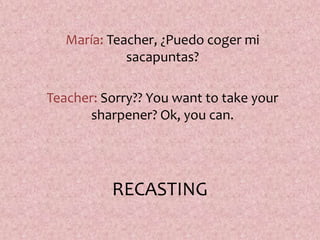
RECASTING
María: Teacher, ¿Puedo coger mi
sacapuntas?
Teacher: Sorry?? You want to take your
sharpener? Ok, you can.
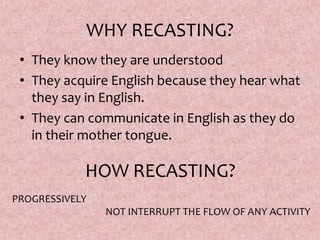
WHY RECASTING?
• They know they are understood
• They acquire English because they hear what
they say in English.
• They can communicate in English as they do
in their mother tongue.
HOW RECASTING?
PROGRESSIVELY
NOT INTERRUPT THE FLOW OF ANY ACTIVITY
María: can I take my rubber to sharpen my
pencil??
Teacher: Oh! You can take your sharpener to
sharpen your pencil
REPHRASING
WHY REPHRASING?
• It’s a way to evaluate communication.
• You encourage the child to continue
speaking, because what they say is not
perfect but they can communicate!
• Children improve as they hear the better
version.
• All children are listening too.
HOW?
WITHOUT COMMENTS ABOUT THE FORM OF LANGUAGE
REPEATING AND ADDING
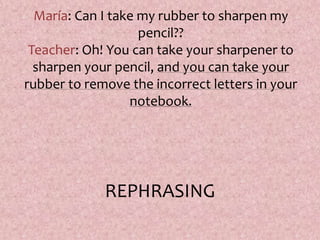
María: Can I take my rubber to sharpen my
pencil??
Teacher: Oh! You can take your sharpener to
sharpen your pencil, and you can take your
rubber to remove the incorrect letters in your
notebook.
REPHRASING
María: Can I take my rubber to sharpen my
pencil?
Teacher: No María, the rubber is not for
sharpening, you mean sharpener.
CORRECTING
WHY CORRECTING?
• Your pupils need to perform their work to a
wider audience.
• It helps the pupils to acquire English.
• You are correcting, so it´s clear you aren´t
changing what child has said.
• Your pupils obtain a meaning clearer
HOW?
WITHOUT CHANGING
WITH GOOD CORRECTION TECHNIQUES
REMEMBER!!
• REPHRASING :Teacher changes what the child said in English
into better English without any negatives comments.
• CORRECTING: Teacher corrects directly English errors.
• RECASTING: Teacher repeats in English what children say in
their mother tongue
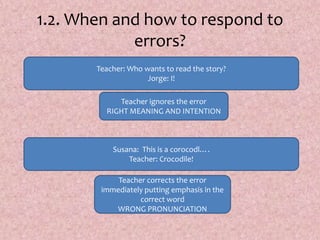
1.2. When and how to respond to
errors?
Teacher: Who wants to read the story?
Jorge: I!
Teacher ignores the error
RIGHT MEANING AND INTENTION
Susana: This is a corocodl….
Teacher: Crocodile!
Teacher corrects the error
immediately putting emphasis in the
correct word
WRONG PRONUNCIATION
Marta: Crocodile have got…
Teacher: Crocodile HAS got!
Teacher corrects immediately
WRONG STRUCTURE
Hugo: Crocodile is sad, because....ugly
Teacher: Because HE IS ugly, ok, well done
Teacher corrects immediately
using rephrasing
ERROR OF FORM
WHEN YOU CORRECT TAKE INTO
ACCOUNT…
 Children should be made or fell silly or bad.
 Children should know that you are helping
them.
 Not praise every effort.
 You should try to increase children’s
confidence and felling of success. How?
 Finish activities and lessons on a
negative note.
2. USING YOUR COURSEBOOK
Many of the lessons are connected with the
coursebook.
In some of the lessons the teacher:
- Use the coursebook
- Extend a topic from the coursebook with
her own material and activities.
- Use the resource book to do some extra
activities.
- Adapt the coursebook activities.
Teacher can use his/her own
programme taking into account….
• age of your pupils
• level/levels you are teaching
• needs of the class you are teaching
• schemes of work in overall school plan
• wishes and hopes of parents and school
authorities
• time allowed for language lessons in your
school's timetable
• time allowed for teachers to prepare materials.
Advantages of the coursebook
• Offer you a prepared set of classroom
activities and language,
• So save time
• Offer children a learning aid
• Set general standards
• Are colourful and attractive to children.
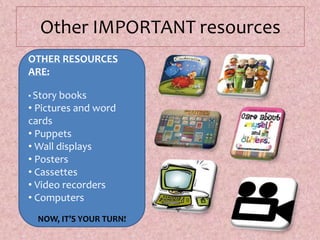
Other IMPORTANT resources
OTHER RESOURCES
ARE:
• Story books
• Pictures and word
cards
• Puppets
• Wall displays
• Posters
• Cassettes
• Video recorders
• Computers
NOW, IT’S YOUR TURN!
2.1. Using a coursebook topic
Activity about food
You can use a topic
and adapt it with
other resources
REAL THINGS
2.1. Using a coursebook topic
Activity about animals
You can use a topic
and adapt it with
other resources
MASKS
2.2. Using text-based activities
With the course book you can make some
matching activities in order to work the
different skills.
1st. Listening & Speaking
2nd. Reading &Writing-
Correct your activity
3. PLANNING YOUR LESSONS
BEFORE THE COURSE
GENERAL LESSON PREPARATION
SPECIFIC LANGUAJE PLANNING FOR A LESSON
BEFORE THE COURSE
-Complete the gaps-
- Create a pleasant in the classroom.
- the room and make easy to move around.
- Keep space in the wall to put pictures that pupils can
- If you don’t stay in the same room, use
, etc.
- Your displays should can be used several times, but when
children tire of them .
- Have a collection of for children who finish
early. NOT COLOURING A PICTURE!
- some of the topics you use throughout the year
Pets at home -> Zoo animals
SIGNIFICATIVE LEARNING
Connect , Roll up friezes, Arrange ,atmosphere
,posters, use, go , on something new, resources
GENERAL LESSON PREPARATION
-Identify the examples-
a) Prepare all the materials you need beforehand
b) Think of your lessons as small steps and sequence activities carefully. Lively-
Tirely.
c) Tell children what you are going to do and why.
d) Have some clearly routines to keep security in the classroom.
e) Remember what you know about how children acquire language.
f) Ask yourself why you are doing each activity and what opportunities the
children need to listen, write, read, etc.
g) Plan how you can make best use of the language pupils are already familiar
with.
h) Plan good learning tasks taking into account the context.
i) Try to give individual attention to different children.
j) Decide how you want to group your pupils.
SPECIFIC LANGUAJE PLANNING FOR
A LESSON
You should know what you are going to say
when…
• Greet your pupils: As you start or finish your
lessons.
• Set up an activity, arrange the room,
organize your pupils, say what you are going
to do and give instructions.
• Speaks to the pupils if you have the
opportunity.
• Want to say something positive to them.
Planning your lessons

Planning your lessons

  • 1.
    10. PLANNING FOREFECTIVE USE OF ENGLISH IN THE CLASSROOM
  • 2.
    1. HELPING CHILDRENLEARN AND IMPROVE 2. USING YOUR COURSE BOOK 3. PLANNING YOUR LESSONS INDEX
  • 3.
    INTRODUCTION • More Englishthey hear, more English they learn. • New language in school is: - Different from the subjects children learn - Not just about learning facts and concepts, it´s more - It’s about communicating: being able to understand and use the language to do things. COMMUNICATION
  • 4.
    IF YOU HAVETHE SAME MOTHER TONGUE AS YOUR PUPILS… Maintain your own PROFICIENCY in English. Advantages: - Same society as your pupils - Ways their first language can help them learn English. RESPONSABLE TEACHERS They have to use English with children
  • 5.
    1. HELPING CHILDRENLEARN AND IMPROVE How can teacher helps pupils to improve their use of English?
  • 6.
    THERE ARE 2APPROACHES  Teachers, in their classes, only use English, but they allow pupils to speak in their mother tongue. TEACHER = GOOD COMUNICATOR PUPILS = INVOLVED IN THE LANGUAGE  Teachers, in their classes, use mainly English, but they give some explanations in pupil’s mother tongue.
  • 7.
    NOW, IT’S YOURTURN Which approach would you use? Why?
  • 8.
    ONLY ENGLISH YOU SHOWYOUR PUPILS THAT: - This new language is a form of expression. - It can be used to communicate and it can be fun. - English show them other culture. - Believes about people who use this language.
  • 9.
    WHEN? ALWAYS! BEGIN YOURCLASS End your class During the class HOW TO DO THINGS Sings songs Commenting their work PLAY GAMES EXPLAIN THOUGHTS Introduce new topics TALK ABOUT THEIR PERSONAL LIVES
  • 10.
    HOW? If you werean English teacher how can you help your students to understand what you say in English? Divide the class in 6 groups and exemplify
  • 11.
    • Tone ofvoice • Eye contact • Gestures • Facial expressions • Pictures/diagrams • Real things • Using familiar contexts and topics • Rephrasing what you say in as many ways as you can • Occasional use of their mother tongue
  • 12.
    RESPONDING ONLY ENGLISH Teacherresponds always in English, and he/she shows pupils that: - You are listening - You can do the same things in both languages - They should try and say more in English as the teacher is doing. - How to say in English what they say in their own language
  • 13.
    Ways to correctour pupils • RECASTING • REPHRASING • CORRECTING • Teacher repeats in English what children say in their mother tongue. • Teacher changes what the child said in English into better English without any negative comments. • Teacher corrects directly English errors. NOW, LOOK AT THE EXAMPLES
  • 14.
    RECASTING María: Teacher, ¿Puedocoger mi sacapuntas? Teacher: Sorry?? You want to take your sharpener? Ok, you can.
  • 15.
    WHY RECASTING? • Theyknow they are understood • They acquire English because they hear what they say in English. • They can communicate in English as they do in their mother tongue. HOW RECASTING? PROGRESSIVELY NOT INTERRUPT THE FLOW OF ANY ACTIVITY
  • 16.
    María: can Itake my rubber to sharpen my pencil?? Teacher: Oh! You can take your sharpener to sharpen your pencil REPHRASING
  • 17.
    WHY REPHRASING? • It’sa way to evaluate communication. • You encourage the child to continue speaking, because what they say is not perfect but they can communicate! • Children improve as they hear the better version. • All children are listening too. HOW? WITHOUT COMMENTS ABOUT THE FORM OF LANGUAGE REPEATING AND ADDING
  • 18.
    María: Can Itake my rubber to sharpen my pencil?? Teacher: Oh! You can take your sharpener to sharpen your pencil, and you can take your rubber to remove the incorrect letters in your notebook. REPHRASING
  • 19.
    María: Can Itake my rubber to sharpen my pencil? Teacher: No María, the rubber is not for sharpening, you mean sharpener. CORRECTING
  • 20.
    WHY CORRECTING? • Yourpupils need to perform their work to a wider audience. • It helps the pupils to acquire English. • You are correcting, so it´s clear you aren´t changing what child has said. • Your pupils obtain a meaning clearer HOW? WITHOUT CHANGING WITH GOOD CORRECTION TECHNIQUES
  • 21.
    REMEMBER!! • REPHRASING :Teacherchanges what the child said in English into better English without any negatives comments. • CORRECTING: Teacher corrects directly English errors. • RECASTING: Teacher repeats in English what children say in their mother tongue
  • 22.
    1.2. When andhow to respond to errors? Teacher: Who wants to read the story? Jorge: I! Teacher ignores the error RIGHT MEANING AND INTENTION Susana: This is a corocodl…. Teacher: Crocodile! Teacher corrects the error immediately putting emphasis in the correct word WRONG PRONUNCIATION
  • 23.
    Marta: Crocodile havegot… Teacher: Crocodile HAS got! Teacher corrects immediately WRONG STRUCTURE Hugo: Crocodile is sad, because....ugly Teacher: Because HE IS ugly, ok, well done Teacher corrects immediately using rephrasing ERROR OF FORM
  • 24.
    WHEN YOU CORRECTTAKE INTO ACCOUNT…  Children should be made or fell silly or bad.  Children should know that you are helping them.  Not praise every effort.  You should try to increase children’s confidence and felling of success. How?  Finish activities and lessons on a negative note.
  • 25.
    2. USING YOURCOURSEBOOK Many of the lessons are connected with the coursebook. In some of the lessons the teacher: - Use the coursebook - Extend a topic from the coursebook with her own material and activities. - Use the resource book to do some extra activities. - Adapt the coursebook activities.
  • 26.
    Teacher can usehis/her own programme taking into account…. • age of your pupils • level/levels you are teaching • needs of the class you are teaching • schemes of work in overall school plan • wishes and hopes of parents and school authorities • time allowed for language lessons in your school's timetable • time allowed for teachers to prepare materials.
  • 27.
    Advantages of thecoursebook • Offer you a prepared set of classroom activities and language, • So save time • Offer children a learning aid • Set general standards • Are colourful and attractive to children.
  • 28.
    Other IMPORTANT resources OTHERRESOURCES ARE: • Story books • Pictures and word cards • Puppets • Wall displays • Posters • Cassettes • Video recorders • Computers NOW, IT’S YOUR TURN!
  • 29.
    2.1. Using acoursebook topic Activity about food You can use a topic and adapt it with other resources REAL THINGS
  • 30.
    2.1. Using acoursebook topic Activity about animals You can use a topic and adapt it with other resources MASKS
  • 31.
    2.2. Using text-basedactivities With the course book you can make some matching activities in order to work the different skills. 1st. Listening & Speaking 2nd. Reading &Writing-
  • 32.
  • 33.
    3. PLANNING YOURLESSONS BEFORE THE COURSE GENERAL LESSON PREPARATION SPECIFIC LANGUAJE PLANNING FOR A LESSON
  • 34.
    BEFORE THE COURSE -Completethe gaps- - Create a pleasant in the classroom. - the room and make easy to move around. - Keep space in the wall to put pictures that pupils can - If you don’t stay in the same room, use , etc. - Your displays should can be used several times, but when children tire of them . - Have a collection of for children who finish early. NOT COLOURING A PICTURE! - some of the topics you use throughout the year Pets at home -> Zoo animals SIGNIFICATIVE LEARNING Connect , Roll up friezes, Arrange ,atmosphere ,posters, use, go , on something new, resources
  • 35.
    GENERAL LESSON PREPARATION -Identifythe examples- a) Prepare all the materials you need beforehand b) Think of your lessons as small steps and sequence activities carefully. Lively- Tirely. c) Tell children what you are going to do and why. d) Have some clearly routines to keep security in the classroom. e) Remember what you know about how children acquire language. f) Ask yourself why you are doing each activity and what opportunities the children need to listen, write, read, etc. g) Plan how you can make best use of the language pupils are already familiar with. h) Plan good learning tasks taking into account the context. i) Try to give individual attention to different children. j) Decide how you want to group your pupils.
  • 36.
    SPECIFIC LANGUAJE PLANNINGFOR A LESSON You should know what you are going to say when… • Greet your pupils: As you start or finish your lessons. • Set up an activity, arrange the room, organize your pupils, say what you are going to do and give instructions. • Speaks to the pupils if you have the opportunity. • Want to say something positive to them.