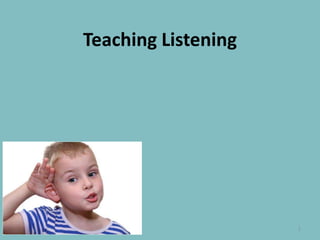
TeachingListening1
Sources	Berne, J. (1995). How Does Varying Pre-listening Activities Affect Second Language Listening Comprehension? Hispania, Vol. 78, No. 2Popieszynska, M. (2000). Listening in FL Classrooms: A few recipes.  International Association of Teachers of English as a Foreign Language . Saricoban, A. (1999). The teaching of listening.  The Internet TESL Journal, Vol. V, No. 12Thanajaro, M. (2000).  Using authentic materials to develop listening comprehension in the ESL classroom. Dissertation submitted to the Faculty of the Virginia Polytechnic Institute and State University	 Vandergrift, L. (2006). Second language listening: Listening ability or language  proficiency?  The Modern Language Journal, Vol. 90, No. 12
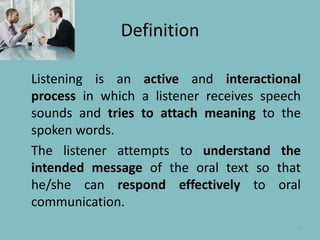
DefinitionListeningisanactive and interactionalprocessin which a listenerreceivesspeechsounds and tries toattachmeaningtothespokenwords.Thelistenerattemptstounderstandtheintendedmessage of the oral text so that he/she can respondeffectivelyto oral communication.3
BackgroundListening has been the forgotten language skill for generationsIt has received little attention in language teaching and learningListening comprehension was usually characterized as a passive activity4
Theorists realized that listening is not a passive but an active process of constructing meaning from a stream of soundsListeners actively attempt to grasp the facts and feelings in what they hear by attending to:what the speaker sayshow the speaker says it the context 5
Knowledge required for listening process	Listening requires comprehension of the speaker's intended message.Command over major components of the language: phonology, lexicon, syntax, semantics, and text structureSocio-cultural competenceStrategic competenceDiscourse competence6
Study: Listening comprehension abilityBoth L2 proficiency and LI listening ability contribute substantially to L2 listening comprehension abilityL2 proficiency appears to be a much better predictor than LI listening comprehension ability7
Study: Listening comprehension abilityLimitation:Most of the questions on the tests required students to read and choose from a list of potential choices. Because of this test structure, the students' ability to read and understand was tested along with their ability to listen and understand.8
Study: Listening comprehension abilityImplications for Pedagogy:Vocabulary developmentMatch aural form of a word with that of mental lexiconTop-down skills/bottom-up skills9
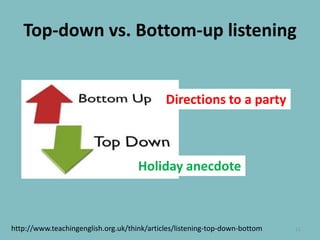
Top-down vs. Bottom-up listeningImagine the following situations:Over lunch, your friend tells you a story about a recent holiday, which was a disaster. You listen with interest and interject at appropriate moments, maybe to express surprise or sympathy.That evening, another friend calls to invite you to a party at her house the following Saturday. As you’ve never been to her house before, she gives you directions. You listen carefully and make notes.How do you listen in each case? Are there any differences?10
Top-down vs. Bottom-up listening11Directions to a partyHoliday anecdotehttp://www.teachingenglish.org.uk/think/articles/listening-top-down-bottom
Study: Listening comprehension abilityImplications for Pedagogy:2. Reduce the gap in transfer of L1 inferencing skills to L2 inferencing taskshow to use world knowledge in L2 listening how to use context to infer logical outcomenonthreatening environment12
Listening Process - StagesPre - listeningWhile – listening Post - listening13
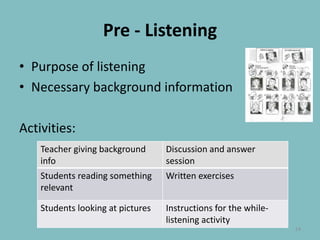
Pre - ListeningPurpose of listening Necessary background informationActivities:14
Pre - ListeningStudying  a vocabulary list may not be an effective way of improving listening comprehensionSuggestion: provide learners with some type of brief summary before listening 15
While - ListeningThe aim is to help learners listen for meaning Attention on listening itselfMarking/checking the items in pictures16
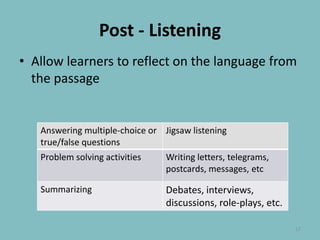
Post - ListeningAllow learners to reflect on the language from the passage17
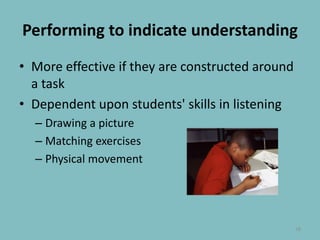
PerformingtoindicateunderstandingMore effective if they are constructed around a taskDependent upon students' skills in listeningDrawing a pictureMatchingexercisesPhysicalmovement18
TeachingratherthantestingThe emphasis should be more on functional listening toward the development of listening process, and less on memory and recall of details heard19
Real-life situationsUse materials cast in real-life situations for listening comprehension exercisesAs close as possible to a "slice of life"20
Aural authenticmaterialsDefinition: Unaltered texts that are generated by native speakers and for native speakersPositive results when given opportunities to interact with authentic oral textsListening-comprehension improves with increased exposure to authentic speech21
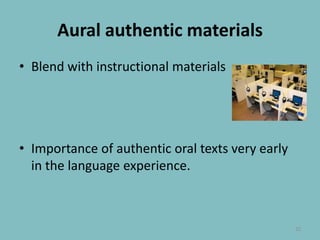
Aural authenticmaterialsBlend with instructional materialsImportance of authentic oral texts very early in the language experience.22
Aural authenticmaterialsProper instructional planning by the teacherStudents experience the rewards of learning a languagePositive effect on both comprehension and motivation23
Aural authenticmaterialsChallenge for the second-language teacher:To identify authentic materials of potential interest to students To prepare the students for dealing with these texts in a meaningful way24
Thank you!25

Teaching Listening

  • 1.
  • 2.
    Sources Berne, J. (1995). HowDoes Varying Pre-listening Activities Affect Second Language Listening Comprehension? Hispania, Vol. 78, No. 2Popieszynska, M. (2000). Listening in FL Classrooms: A few recipes.  International Association of Teachers of English as a Foreign Language . Saricoban, A. (1999). The teaching of listening.  The Internet TESL Journal, Vol. V, No. 12Thanajaro, M. (2000). Using authentic materials to develop listening comprehension in the ESL classroom. Dissertation submitted to the Faculty of the Virginia Polytechnic Institute and State University Vandergrift, L. (2006). Second language listening: Listening ability or language proficiency?  The Modern Language Journal, Vol. 90, No. 12
  • 3.
    DefinitionListeningisanactive and interactionalprocessinwhich a listenerreceivesspeechsounds and tries toattachmeaningtothespokenwords.Thelistenerattemptstounderstandtheintendedmessage of the oral text so that he/she can respondeffectivelyto oral communication.3
  • 4.
    BackgroundListening has beenthe forgotten language skill for generationsIt has received little attention in language teaching and learningListening comprehension was usually characterized as a passive activity4
  • 5.
    Theorists realized thatlistening is not a passive but an active process of constructing meaning from a stream of soundsListeners actively attempt to grasp the facts and feelings in what they hear by attending to:what the speaker sayshow the speaker says it the context 5
  • 6.
    Knowledge required forlistening process Listening requires comprehension of the speaker's intended message.Command over major components of the language: phonology, lexicon, syntax, semantics, and text structureSocio-cultural competenceStrategic competenceDiscourse competence6
  • 7.
    Study: Listening comprehensionabilityBoth L2 proficiency and LI listening ability contribute substantially to L2 listening comprehension abilityL2 proficiency appears to be a much better predictor than LI listening comprehension ability7
  • 8.
    Study: Listening comprehensionabilityLimitation:Most of the questions on the tests required students to read and choose from a list of potential choices. Because of this test structure, the students' ability to read and understand was tested along with their ability to listen and understand.8
  • 9.
    Study: Listening comprehensionabilityImplications for Pedagogy:Vocabulary developmentMatch aural form of a word with that of mental lexiconTop-down skills/bottom-up skills9
  • 10.
    Top-down vs. Bottom-uplisteningImagine the following situations:Over lunch, your friend tells you a story about a recent holiday, which was a disaster. You listen with interest and interject at appropriate moments, maybe to express surprise or sympathy.That evening, another friend calls to invite you to a party at her house the following Saturday. As you’ve never been to her house before, she gives you directions. You listen carefully and make notes.How do you listen in each case? Are there any differences?10
  • 11.
    Top-down vs. Bottom-uplistening11Directions to a partyHoliday anecdotehttp://www.teachingenglish.org.uk/think/articles/listening-top-down-bottom
  • 12.
    Study: Listening comprehensionabilityImplications for Pedagogy:2. Reduce the gap in transfer of L1 inferencing skills to L2 inferencing taskshow to use world knowledge in L2 listening how to use context to infer logical outcomenonthreatening environment12
  • 13.
    Listening Process -StagesPre - listeningWhile – listening Post - listening13
  • 14.
    Pre - ListeningPurposeof listening Necessary background informationActivities:14
  • 15.
    Pre - ListeningStudying a vocabulary list may not be an effective way of improving listening comprehensionSuggestion: provide learners with some type of brief summary before listening 15
  • 16.
    While - ListeningTheaim is to help learners listen for meaning Attention on listening itselfMarking/checking the items in pictures16
  • 17.
    Post - ListeningAllowlearners to reflect on the language from the passage17
  • 18.
    PerformingtoindicateunderstandingMore effective ifthey are constructed around a taskDependent upon students' skills in listeningDrawing a pictureMatchingexercisesPhysicalmovement18
  • 19.
    TeachingratherthantestingThe emphasis shouldbe more on functional listening toward the development of listening process, and less on memory and recall of details heard19
  • 20.
    Real-life situationsUse materialscast in real-life situations for listening comprehension exercisesAs close as possible to a "slice of life"20
  • 21.
    Aural authenticmaterialsDefinition: Unalteredtexts that are generated by native speakers and for native speakersPositive results when given opportunities to interact with authentic oral textsListening-comprehension improves with increased exposure to authentic speech21
  • 22.
    Aural authenticmaterialsBlend withinstructional materialsImportance of authentic oral texts very early in the language experience.22
  • 23.
    Aural authenticmaterialsProper instructionalplanning by the teacherStudents experience the rewards of learning a languagePositive effect on both comprehension and motivation23
  • 24.
    Aural authenticmaterialsChallenge forthe second-language teacher:To identify authentic materials of potential interest to students To prepare the students for dealing with these texts in a meaningful way24
  • 25.