ALLPPT.com _ Free PowerPoint Templates, Diagrams and Charts
Strategies and Methodology
In
Teaching Speaking
Introduction
• Capable of speech
• the capability of a person that involves talking or giving speechesr
< a speaking role >
• Highly significant or expressive.
- To voice one’s opinions freely with force. to speak one’s mind
• Fluency as the ability to converse with others.
Introduction
• Many language learners regard speaking ability as the measure of
knowing a language. They regard speaking as the most important
skill they can acquire, and they assess their progress in terms of
their accomplishments in the spoken communication.
Introduction
Speaking involves three areas of knowledge:
Using the right order with the correct pronunciation (Mechanics)
Knowing when clarity of message is essential and when precise
understanding is not required (Functions)
Understanding how to take into account who is speaking to whom, in
what circumstances, about what, and for what reason. (Social and
cultural rules and norms)
Introduction
How can instructors help:
Providing authentic practice that prepares students for
real-life communication situations with
grammatically correct, logically connected sentences
that are appropriate to specific contexts, and with
comprehensible pronunciation.
Goals and Techniques for
Teaching Speaking
Goal – communicative efficiency
Instructors can use a balanced activities approach that
combines
• Language input
• structured output
• communicative output
LANGUAGE INPUT
• Language input – teacher talk, listening activities,
reading passages, and the language heard and
read outside of class.
• Language input give learners the material they need
to begin producing language themselves.
• Content-oriented input and Form-oriented input
STRUCTURED OUTPUT
• Structured output focuses on correct form.
• Instructors often use structured output exercises as a
transition between the presentation stage and the practice
stage of a lesson plan. Textbook exercises also often make
good structured output practice activities.
COMMUNICATIVE OUTPUT
• Communicative output – to complete a task, such
as obtaining information, developing a travel plan,
or creating a video.
• The learner gets the message across.
• Information gap
Strategies for Developing
Speaking Skills
1. Using minimal responses
Minimal responses are predictable, often idiomatic phrases that
conversation participants use to indicate understanding, agreement, doubt,
and other responses to what another speaker is saying.
Agreeing with what was said: absolutely; yes, that's right
Indicating possible doubt: really? are you sure?
Agreeing to cooperate or not: of course; okay; sorry, I can't; I'm afraid
not
Expressing an opinion: that's nice; how lucky! that's too bad
Expressing interest, encouraging the speaker to continue: what
happened next?; that's really interesting; what did you do?
Strategies for Developing
Speaking Skills
2. Recognizing scripts
Instructors can help students develop speaking ability by making
them aware of the scripts (such as greetings, apologies, compliments,
invitations.) for different situations.
Scripted transactional exchange:
A: May I help you?
B: I'd like to buy two movie tickets, please.
A: Which film?
B: Nightmare Monsters.
Scripted interactional exchange:
A: Hey! How have you been? I haven't seen you in a long time.
B: Yeah, I had the flu, so I was out for a while.
Strategies for Developing
Speaking Skills
3. Using language to talk about language
By encouraging students to use clarification phrases in class when
misunderstanding occurs and by responding positively when they do,
instructors can create an authentic practice environment within the
classroom itself.
When unsure of the speaker's meaning, repeat what you think the
speaker said in a question:
Excuse me, did you say that the sun rises in the west?
When you have missed most of the meaning:
Could you say that again, please?
When you don't know the word for something, describe it and ask its
name:
What do you call the stuff that falls out of the sky, that is rain but frozen?
Developing Speaking Activities
• The purpose of real communication is to accomplish a
task, such as conveying a telephone message.
• Authentic communication involves an information gap;
each participant has information that the other does not
have. In addition, to achieve their purpose, participants
may have to clarify their meaning or ask for
confirmation of their own understanding.
Developing Speaking Activities
• Instructors need to combine structured
output activities, which allow for error
correction and increased accuracy, with
communicative output activities that give
students opportunities to practice language
use more freely.
Structured Output Activities
Information Gap Activities
Filling the gaps in a schedule or timetable: Partner A holds an
airline timetable with some of the arrival and departure
times missing. Partner B has the same timetable but with
different blank spaces. The two partners are not permitted to
see each other's timetables and must fill in the blanks by asking
each other appropriate questions. The features of language that
are practiced would include questions beginning with "when" or
"at what time." Answers would be limited mostly to time
expressions like "at 8:15" or "at ten in the evening."
Structured Output Activities
Jigsaw Activities
• Each partner has one or a few pieces of the “puzzle”,
and the partners must cooperate to fit all the pieces
into a whole picture
• No two partners hear or read exactly the same text or
conversation.
Communicative Output Activities
• This activities allow students to practice using all of
the language they know in situation that resemble
real settings.
• Students must work together to develop a plan,
resolve a problem, or complete a task.
• The most common types of communicative output
activity are role plays and discussion.
To succeed with role plays
• Prepare carefully
• Set a goal or outcome
• Use role cards
• Brainstorm
• Keep groups small
• Give students time to prepare
• Be present as a resource, not a monitor
• Allow students to work at their own levels
• Do topical follow-up
• Do linguistic follow-up
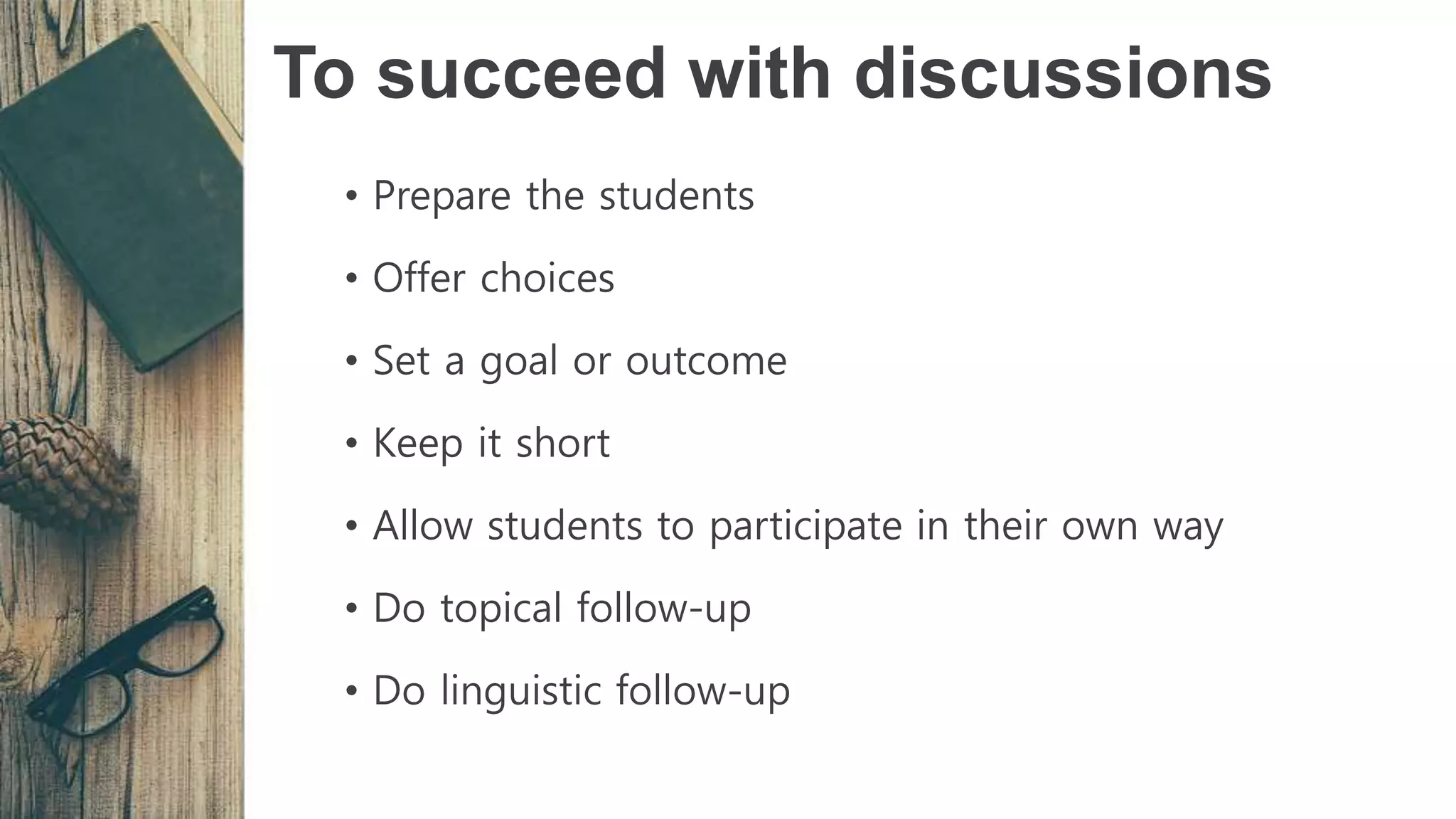
To succeed with discussions
• Prepare the students
• Offer choices
• Set a goal or outcome
• Keep it short
• Allow students to participate in their own way
• Do topical follow-up
• Do linguistic follow-up
To succeed with role plays &
discussions
Through well-prepared communicative output activity
such as role plays and discussions, you can encourage
students to experiment and innovate with the language,
and create a supportive atmosphere that allows them to
make mistakes without fear of embarrassment. This will
contribute to their self-confidence as speakers and to
their motivation to learn more.
Other strategies & their frequency…

Strategies and Methodology In Teaching Speaking

  • 1.
    ALLPPT.com _ FreePowerPoint Templates, Diagrams and Charts Strategies and Methodology In Teaching Speaking
  • 2.
    Introduction • Capable ofspeech • the capability of a person that involves talking or giving speechesr < a speaking role > • Highly significant or expressive. - To voice one’s opinions freely with force. to speak one’s mind
  • 3.
    • Fluency asthe ability to converse with others. Introduction • Many language learners regard speaking ability as the measure of knowing a language. They regard speaking as the most important skill they can acquire, and they assess their progress in terms of their accomplishments in the spoken communication.
  • 4.
    Introduction Speaking involves threeareas of knowledge: Using the right order with the correct pronunciation (Mechanics) Knowing when clarity of message is essential and when precise understanding is not required (Functions) Understanding how to take into account who is speaking to whom, in what circumstances, about what, and for what reason. (Social and cultural rules and norms)
  • 5.
    Introduction How can instructorshelp: Providing authentic practice that prepares students for real-life communication situations with grammatically correct, logically connected sentences that are appropriate to specific contexts, and with comprehensible pronunciation.
  • 6.
    Goals and Techniquesfor Teaching Speaking Goal – communicative efficiency Instructors can use a balanced activities approach that combines • Language input • structured output • communicative output
  • 7.
    LANGUAGE INPUT • Languageinput – teacher talk, listening activities, reading passages, and the language heard and read outside of class. • Language input give learners the material they need to begin producing language themselves. • Content-oriented input and Form-oriented input
  • 8.
    STRUCTURED OUTPUT • Structuredoutput focuses on correct form. • Instructors often use structured output exercises as a transition between the presentation stage and the practice stage of a lesson plan. Textbook exercises also often make good structured output practice activities.
  • 9.
    COMMUNICATIVE OUTPUT • Communicativeoutput – to complete a task, such as obtaining information, developing a travel plan, or creating a video. • The learner gets the message across. • Information gap
  • 10.
    Strategies for Developing SpeakingSkills 1. Using minimal responses Minimal responses are predictable, often idiomatic phrases that conversation participants use to indicate understanding, agreement, doubt, and other responses to what another speaker is saying. Agreeing with what was said: absolutely; yes, that's right Indicating possible doubt: really? are you sure? Agreeing to cooperate or not: of course; okay; sorry, I can't; I'm afraid not Expressing an opinion: that's nice; how lucky! that's too bad Expressing interest, encouraging the speaker to continue: what happened next?; that's really interesting; what did you do?
  • 11.
    Strategies for Developing SpeakingSkills 2. Recognizing scripts Instructors can help students develop speaking ability by making them aware of the scripts (such as greetings, apologies, compliments, invitations.) for different situations. Scripted transactional exchange: A: May I help you? B: I'd like to buy two movie tickets, please. A: Which film? B: Nightmare Monsters. Scripted interactional exchange: A: Hey! How have you been? I haven't seen you in a long time. B: Yeah, I had the flu, so I was out for a while.
  • 12.
    Strategies for Developing SpeakingSkills 3. Using language to talk about language By encouraging students to use clarification phrases in class when misunderstanding occurs and by responding positively when they do, instructors can create an authentic practice environment within the classroom itself. When unsure of the speaker's meaning, repeat what you think the speaker said in a question: Excuse me, did you say that the sun rises in the west? When you have missed most of the meaning: Could you say that again, please? When you don't know the word for something, describe it and ask its name: What do you call the stuff that falls out of the sky, that is rain but frozen?
  • 13.
    Developing Speaking Activities •The purpose of real communication is to accomplish a task, such as conveying a telephone message. • Authentic communication involves an information gap; each participant has information that the other does not have. In addition, to achieve their purpose, participants may have to clarify their meaning or ask for confirmation of their own understanding.
  • 14.
    Developing Speaking Activities •Instructors need to combine structured output activities, which allow for error correction and increased accuracy, with communicative output activities that give students opportunities to practice language use more freely.
  • 15.
    Structured Output Activities InformationGap Activities Filling the gaps in a schedule or timetable: Partner A holds an airline timetable with some of the arrival and departure times missing. Partner B has the same timetable but with different blank spaces. The two partners are not permitted to see each other's timetables and must fill in the blanks by asking each other appropriate questions. The features of language that are practiced would include questions beginning with "when" or "at what time." Answers would be limited mostly to time expressions like "at 8:15" or "at ten in the evening."
  • 16.
    Structured Output Activities JigsawActivities • Each partner has one or a few pieces of the “puzzle”, and the partners must cooperate to fit all the pieces into a whole picture • No two partners hear or read exactly the same text or conversation.
  • 17.
    Communicative Output Activities •This activities allow students to practice using all of the language they know in situation that resemble real settings. • Students must work together to develop a plan, resolve a problem, or complete a task. • The most common types of communicative output activity are role plays and discussion.
  • 18.
    To succeed withrole plays • Prepare carefully • Set a goal or outcome • Use role cards • Brainstorm • Keep groups small • Give students time to prepare • Be present as a resource, not a monitor • Allow students to work at their own levels • Do topical follow-up • Do linguistic follow-up
  • 19.
    To succeed withdiscussions • Prepare the students • Offer choices • Set a goal or outcome • Keep it short • Allow students to participate in their own way • Do topical follow-up • Do linguistic follow-up
  • 20.
    To succeed withrole plays & discussions Through well-prepared communicative output activity such as role plays and discussions, you can encourage students to experiment and innovate with the language, and create a supportive atmosphere that allows them to make mistakes without fear of embarrassment. This will contribute to their self-confidence as speakers and to their motivation to learn more.
  • 21.
    Other strategies &their frequency…