HOW TO TEACH
LISTENING
CONTENT
 Definition
 Why

teach listening?
 Teacher’s and students’ difficulties
 Top tips
 A successful listening activity
 Listening exercises
LISTENING
 Listening

is the ability to identify and
understand what others are saying.
This involves understanding a
speaker's accent or pronunciation,
his grammar and his vocabulary,
and grasping his meaning (Howatt
and Dakin). An able listener is
capable of doing these four things
at the same time.
WHY TEACH LISTENING?
 Students

hear different accents
and varieties.
 Listening helps students to
acquire language
subconsciously.
 Listening is a receptive skill.
 Education.
 Mass communication.
‘WHAT A DIFFICULT TASK…’
 Teaching

listening skills is one of
the most difficult tasks for any
ESL teacher.
 Sometimes students feel
frustrated because they find
listening difficult.
DIFFICULTIES











Students are trying to understand every word.
Students go back trying to understand what a previous
word meant.
Students just don’t know the most important words.
Students don’t recognize the words they know.
Students have problems with different accents.
Students get tired.
Students have mental block.
Students are distracted.
Students cannot cope without images.
Students have hearing problems.
 PRE Tell

LISTENING:

TOP TIPS

your students “ DON’T WORRY”

 Make

sure students know what they are listening for
before you start listening

 Give

questions to check students comprehension

 Check

know

for any words that your students may not
 Check

for any words that your students may not

know
 Short
 Stop

listening
the recording
 WHILE

LISTENING:

 Try

to play the recording once for overall
comprehension and then for specific details.

 Take

notes ( dates, places, people)

 Repeat

parts

the recording especially in the difficult
 POST-LISTENING:
 Compare

their notes in small groups.

 Encourage

discussions and answer questions.

 Write

a summary of the main points and then
compare.

 Make

a list of any new vocabulary.
REMEMBER!!!
 Try

to use as many different sources of
listening material as you can:

advertisements, news programs, poetry,
songs, extracts from plays, speeches,
lectures, telephone conversations,
informal dialogues.
A SUCCESSFUL LISTENING
ACTIVITY
 Ideas

to make the best listening
activities ever!
1
Reduce distractions and
noise during the
listening segment.
2
 make

sure the equipment produces
acceptable sound quality.
3
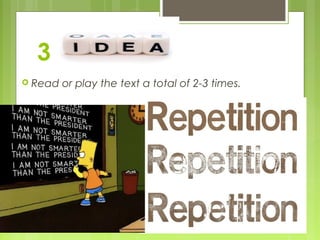
 Read

or play the text a total of 2-3 times.
4
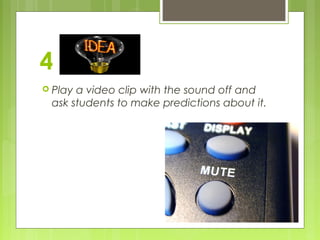
 Play

a video clip with the sound off and
ask students to make predictions about it.
5
 Give

students a listening task to do
between classes.
LISTENING
EXERCISES
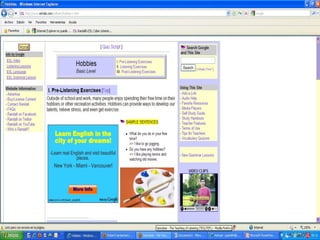
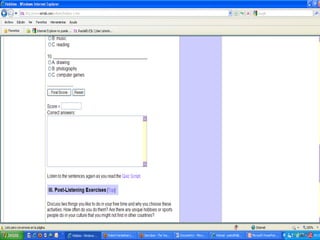
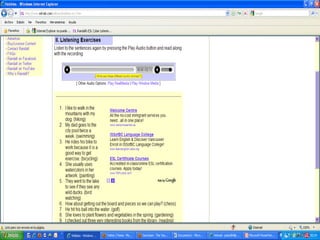
http://www.esl-lab.com

http://www.esl-lab.com/eslbasic/hobbies-1.htm
SOURCES






http://iteslj.org/Articles/Saricoban-Listening.html
http://writing.colostate.edu/guides/teaching/esl/listenin
g.cfm
http://es.scribd.com/doc/14427811/How-to-TeachEnglish-Jeremy-Harmer
http://esl.about.com/cs/teachinglistening/a/a_tlisten.ht
m
http://www.usingenglish.com/teachers/articles/whyyour-students-have-problems-with-listeningcomprehension.html