


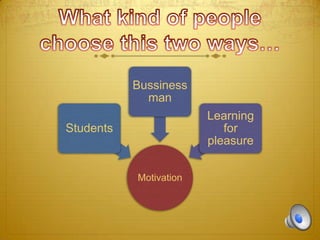








Bussiness
man
Learning
for
pleasure

Students

Motivation
 Motivation is not only created by
and
also by
and feelings of
satisfaction with

but
 Immersion techniques and oral practice,
****immersion means more than a year,
primarily with native FL speaking teacher.
 It is very expensive.
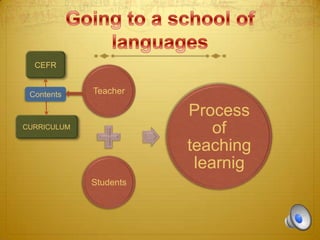
CEFR

Contents

Teacher

Process
of
teaching
learnig

CURRICULUM

Students
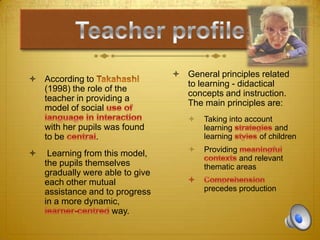
 According to
(1998) the role of the
teacher in providing a
model of social

 General principles related
to learning - didactical
concepts and instruction.
The main principles are:


Taking into account
learning
and
learning
of children



Providing

with her pupils was found
to be
.


Learning from this model,
the pupils themselves
gradually were able to give
each other mutual
assistance and to progress
in a more dynamic,
way.

and relevant
thematic areas
precedes production
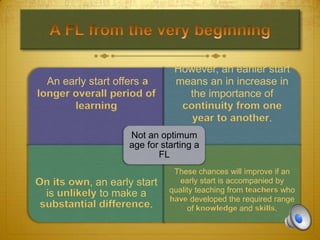
An early start offers a
longer overall period of
learning

However, an earlier start
means an in increase in
the importance of
continuity from one
year to another.

Not an optimum
age for starting a
FL

On its own, an early start
is unlikely to make a
substantial difference.

These chances will improve if an
early start is accompanied by
quality teaching from teachers who
have developed the required range
of knowledge and skills.


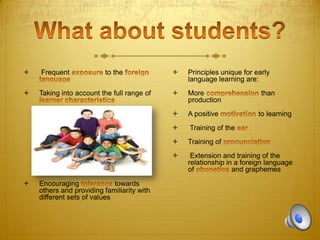
Frequent



Taking into account the full range of



More
production
A positive

Training of the



Training of



Encouraging
towards
others and providing familiarity with
different sets of values

Principles unique for early
language learning are:









to the

Extension and training of the
relationship in a foreign language
of
and graphemes

than
to learning
 Children at all levels benefit from being
encouraged to
on their
.
 It is worthwhile for
to
their pupils document, share, evaluate,
supplement and refine how they learn.
 Once pupils’ strategies have been
collected, shared, discussed and
refined, then research suggests that it
is helpful to
and refine these
further, rather than cover them once
only.
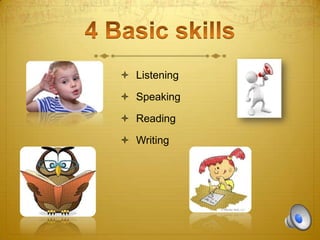
 Listening
 Speaking
 Reading

 Writing
 As a general rule, we can say that, at the
beginning, most of the class time should be
devoted to
to an intelligible input and
(by repeating, asking and answering
questions, drilling just changing one word, you
repeat the same structure for example: you
love music, you love sports, etc.)
 Once they gain confidence in speaking and
understanding messages in the foreign
language, they can begin the process of
and
in that foreign language with
vocabulary, set phrases.
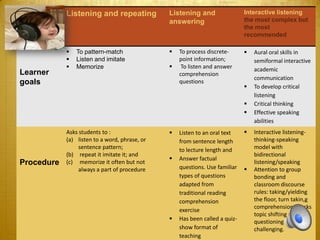
Listening and repeating

Learner
goals

Listening and
answering

Interactive listening
the most complex but
the most
recommended









To pattern-match
Listen and imitate
Memorize



To process discretepoint information;
To listen and answer
comprehension
questions





Procedure

Asks students to :
(a) listen to a word, phrase, or
sentence pattern;
(b) repeat it imitate it; and
(c) memorize it often but not
always a part of procedure







Listen to an oral text
from sentence length
to lecture length and
Answer factual
questions. Use familiar
types of questions
adapted from
traditional reading
comprehension
exercise
Has been called a quizshow format of
teaching





Aural oral skills in
semiformal interactive
academic
communication
To develop critical
listening
Critical thinking
Effective speaking
abilities
Interactive listeningthinking-speaking
model with
bidirectional
listening/speaking
Attention to group
bonding and
classroom discourse
rules: taking/yielding
the floor, turn takin,g
comprehension checks
topic shifting agreeing
questioning
challenging.
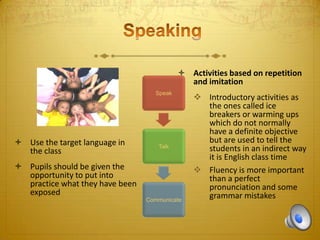
 Activities based on repetition
and imitation
Speak

 Use the target language in
the class

Talk

 Pupils should be given the
opportunity to put into
practice what they have been
exposed
Communicate

 Introductory activities as
the ones called ice
breakers or warming ups
which do not normally
have a definite objective
but are used to tell the
students in an indirect way
it is English class time
 Fluency is more important
than a perfect
pronunciation and some
grammar mistakes


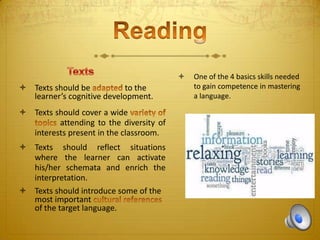
 Texts should be
to the
learner’s cognitive development.
 Texts should cover a wide
attending to the diversity of
interests present in the classroom.
 Texts should reflect situations
where the learner can activate
his/her schemata and enrich the
interpretation.
 Texts should introduce some of the
most important
of the target language.

One of the 4 basics skills needed
to gain competence in mastering
a language.
 The reader can access the information many times as
needed.
 Write words and phrases, known previously in oral
interaction.
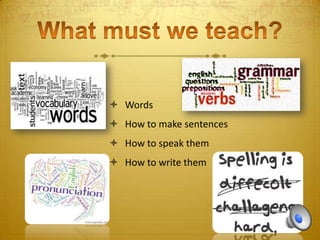
 Words
 How to make sentences
 How to speak them
 How to write them
The first step should
be to help learners
understand the
meaning of new
words

The second to
facilitate the learning
of the pronunciation

Third step: Reading
and writing of words
and,

Finally, to make it
easy for students,
memorize them
Two easy ways to learn a foreign language

Two easy ways to learn a foreign language

  • 3.
  • 4.
     Motivation isnot only created by and also by and feelings of satisfaction with but
  • 6.
     Immersion techniquesand oral practice, ****immersion means more than a year, primarily with native FL speaking teacher.  It is very expensive.
  • 7.
  • 8.
     According to (1998)the role of the teacher in providing a model of social  General principles related to learning - didactical concepts and instruction. The main principles are:  Taking into account learning and learning of children  Providing with her pupils was found to be .  Learning from this model, the pupils themselves gradually were able to give each other mutual assistance and to progress in a more dynamic, way. and relevant thematic areas precedes production
  • 9.
    An early startoffers a longer overall period of learning However, an earlier start means an in increase in the importance of continuity from one year to another. Not an optimum age for starting a FL On its own, an early start is unlikely to make a substantial difference. These chances will improve if an early start is accompanied by quality teaching from teachers who have developed the required range of knowledge and skills.
  • 10.
     Frequent  Taking into accountthe full range of  More production A positive Training of the  Training of  Encouraging towards others and providing familiarity with different sets of values Principles unique for early language learning are:     to the Extension and training of the relationship in a foreign language of and graphemes than to learning
  • 11.
     Children atall levels benefit from being encouraged to on their .  It is worthwhile for to their pupils document, share, evaluate, supplement and refine how they learn.  Once pupils’ strategies have been collected, shared, discussed and refined, then research suggests that it is helpful to and refine these further, rather than cover them once only.
  • 13.
     Listening  Speaking Reading  Writing
  • 14.
     As ageneral rule, we can say that, at the beginning, most of the class time should be devoted to to an intelligible input and (by repeating, asking and answering questions, drilling just changing one word, you repeat the same structure for example: you love music, you love sports, etc.)  Once they gain confidence in speaking and understanding messages in the foreign language, they can begin the process of and in that foreign language with vocabulary, set phrases.
  • 15.
    Listening and repeating Learner goals Listeningand answering Interactive listening the most complex but the most recommended      To pattern-match Listen and imitate Memorize  To process discretepoint information; To listen and answer comprehension questions    Procedure Asks students to : (a) listen to a word, phrase, or sentence pattern; (b) repeat it imitate it; and (c) memorize it often but not always a part of procedure    Listen to an oral text from sentence length to lecture length and Answer factual questions. Use familiar types of questions adapted from traditional reading comprehension exercise Has been called a quizshow format of teaching   Aural oral skills in semiformal interactive academic communication To develop critical listening Critical thinking Effective speaking abilities Interactive listeningthinking-speaking model with bidirectional listening/speaking Attention to group bonding and classroom discourse rules: taking/yielding the floor, turn takin,g comprehension checks topic shifting agreeing questioning challenging.
  • 16.
     Activities basedon repetition and imitation Speak  Use the target language in the class Talk  Pupils should be given the opportunity to put into practice what they have been exposed Communicate  Introductory activities as the ones called ice breakers or warming ups which do not normally have a definite objective but are used to tell the students in an indirect way it is English class time  Fluency is more important than a perfect pronunciation and some grammar mistakes
  • 17.
      Texts shouldbe to the learner’s cognitive development.  Texts should cover a wide attending to the diversity of interests present in the classroom.  Texts should reflect situations where the learner can activate his/her schemata and enrich the interpretation.  Texts should introduce some of the most important of the target language. One of the 4 basics skills needed to gain competence in mastering a language.
  • 18.
     The readercan access the information many times as needed.  Write words and phrases, known previously in oral interaction.
  • 19.
     Words  Howto make sentences  How to speak them  How to write them
  • 20.
    The first stepshould be to help learners understand the meaning of new words The second to facilitate the learning of the pronunciation Third step: Reading and writing of words and, Finally, to make it easy for students, memorize them