Teaching
Speaking
Lecture 1
• Many language learners
  regard speaking ability as
  the measure of knowing a
  language.
• These learners define fluency
  as the ability to converse with
  others, much more than the
  ability to read, write, or
  comprehend oral language.
• They regard speaking as the most
  important skill they can acquire,
  and they assess their progress in
  terms of their accomplishments
  in spoken communication.
Three Areas of
Knowledge that a
Language Learner
   must Know
• Mechanics
  (pronunciation, grammar, and
  vocabulary): Using the right
  words in the right order with
  the correct pronunciation
• Functions (transaction
  and interaction):
  Knowing when clarity of
  message is essential
  (transaction/information
  exchange) and when
  precise understanding is
  not required
  (interaction/relationship
  building)
• Social and cultural rules and norms
  (turn-taking, rate of speech, length
  of pauses between speakers, relative
  roles of participants): Understanding
  how to take into account who is
  speaking to whom, in what
  circumstances, about what, and for
  what reason.
Communicative Model of Language
            Teaching
• Instructors help their students
  develop this body of knowledge
  by providing authentic practice
  that prepares students for real-
  life communication situations.
Communicative Model of Language
            Teaching
• They help their students develop the
  ability to produce grammatically
  correct, logically connected
  sentences that are appropriate to
  specific contexts, and to do so using
  acceptable (that is, comprehensible)
  pronunciation.
Ideas to keep in mind in
  Planning Speaking
       Activities
Content


As much as possible, the content
should be practical and usable in
real-life situations. Avoid too much
new vocabulary or grammar, and
focus on speaking with the language
the students have.
Correcting Errors

You need to provide appropriate feedback and
  correction, but don't interrupt the flow of
  communication. Take notes while pairs or
  groups are talking and address problems to
  the class after the activity without
  embarrassing the student who made the error.
  You can write the error on the board and ask
  who can correct it.
Quantity vs. Quality

Address both interactive fluency
 and accuracy, striving foremost
 for communication. Get to know
 each learner's personality and
 encourage the quieter ones to
 take more risks.
Conversation Strategies


Encourage strategies like asking for
 clarification, paraphrasing,
 gestures, and initiating ('hey,' 'so,'
 'by the way').
Teacher Intervention


If a speaking activity loses steam, you
   may need to jump into a role-play,
   ask more discussion questions,
   clarify your instructions, or stop an
   activity that is too difficult or boring.
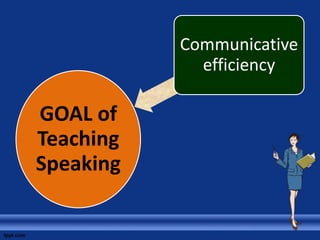
Communicative
             efficiency

GOAL of
Teaching
Speaking
Communicative Efficiency
• Learners should be able to make themselves
  understood, using their current proficiency to
  the fullest.
• They should try to avoid confusion in the
  message due to faulty
  pronunciation, grammar, or vocabulary, and to
  observe the social and cultural rules that
  apply in each communication situation.
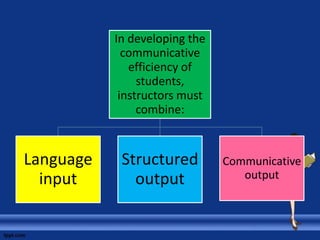
In developing the
             communicative
              efficiency of
                students,
            instructors must
                combine:


Language    Structured         Communicative
  input       output              output
Language input
• comes in the form of teacher talk,
  listening activities, reading passages,
  and the language heard and read
  outside of class
• It gives learners the material they
  need to begin producing language
  themselves.
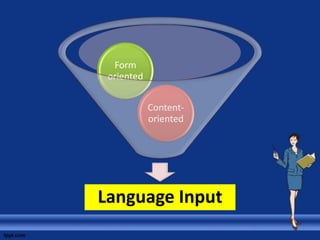
Form
 oriented


            Content-
            oriented


Language Input
Content-oriented

• Content-oriented input focuses on
  information, whether it is a simple
  weather report or an extended lecture
  on an academic topic. Content-oriented
  input may also include descriptions of
  learning strategies and examples of their
  use.
Form-oriented

• Form-oriented input focuses on ways
  of using the language: linguistic
  competence; discourse competence;
  sociolinguistic competence; strategic
  competence.
Competencies to
enhance in using
 the Language
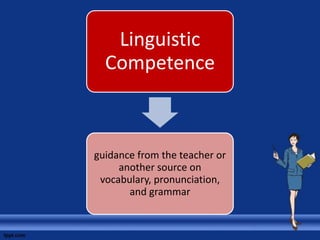
Linguistic
  Competence


guidance from the teacher or
     another source on
 vocabulary, pronunciation,
       and grammar
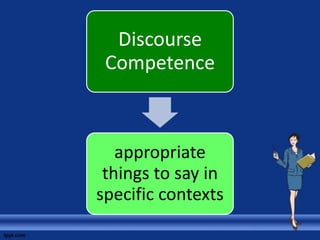
Discourse
 Competence


   appropriate
 things to say in
specific contexts
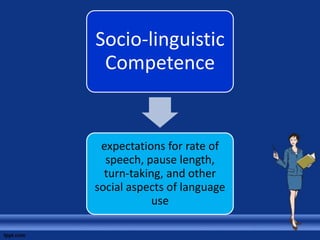
Socio-linguistic
 Competence


 expectations for rate of
  speech, pause length,
  turn-taking, and other
social aspects of language
            use
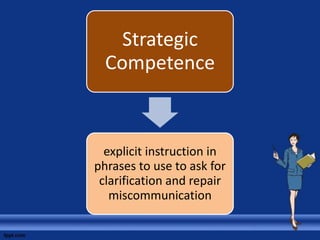
Strategic
  Competence


  explicit instruction in
phrases to use to ask for
 clarification and repair
   miscommunication
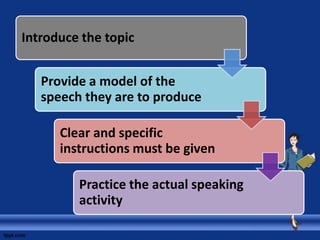
Preparing the
Student before a
Speaking Task
Introduce the topic


   Provide a model of the
   speech they are to produce

      Clear and specific
      instructions must be given

         Practice the actual speaking
         activity
Thank you!