Teaching Speaking  Kingdom of Bahrain Ministry of Education Directorate of Curricula English Language Unit (Basic Education) Prepared by Mr. Emad Abdulla Al Sediri Supervised by Dr. Nawal Al Khaja
Do you think that students are good at speaking?
WHY?
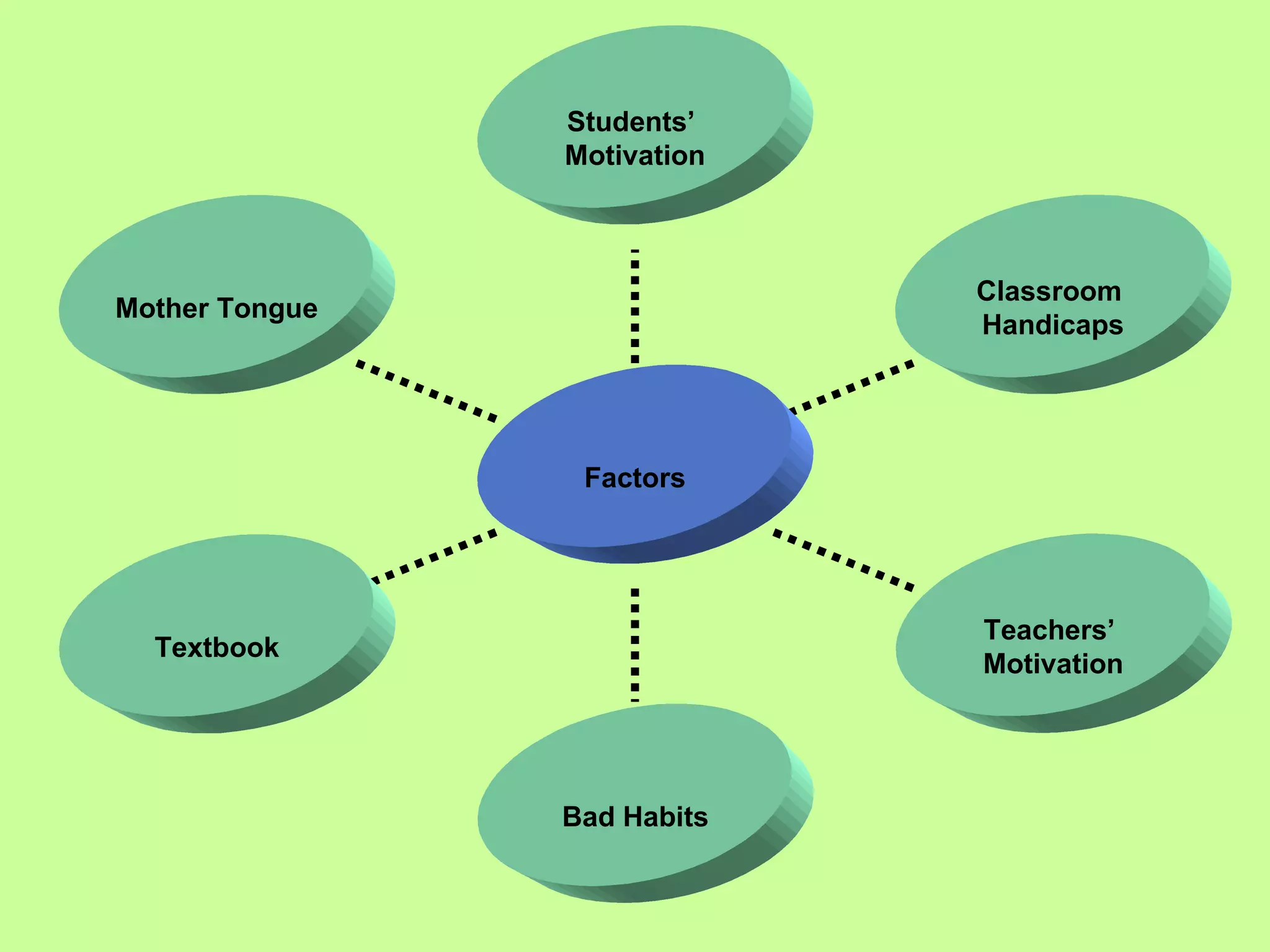
Mother Tongue Textbook Bad Habits Teachers’  Motivation Classroom  Handicaps Students’  Motivation Factors
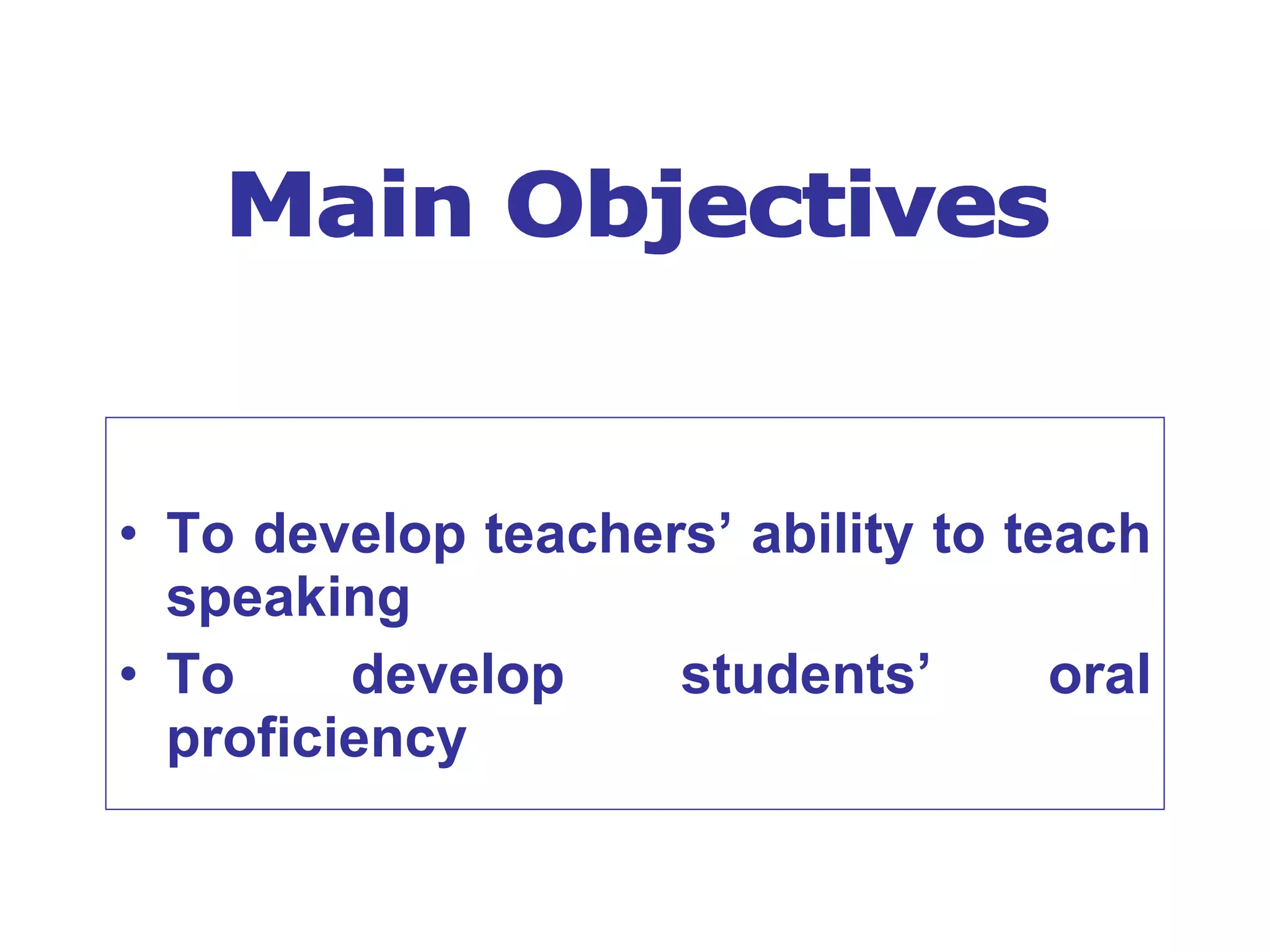
To develop teachers’ ability to teach speaking To develop students’ oral proficiency Main Objectives
What is Speaking?
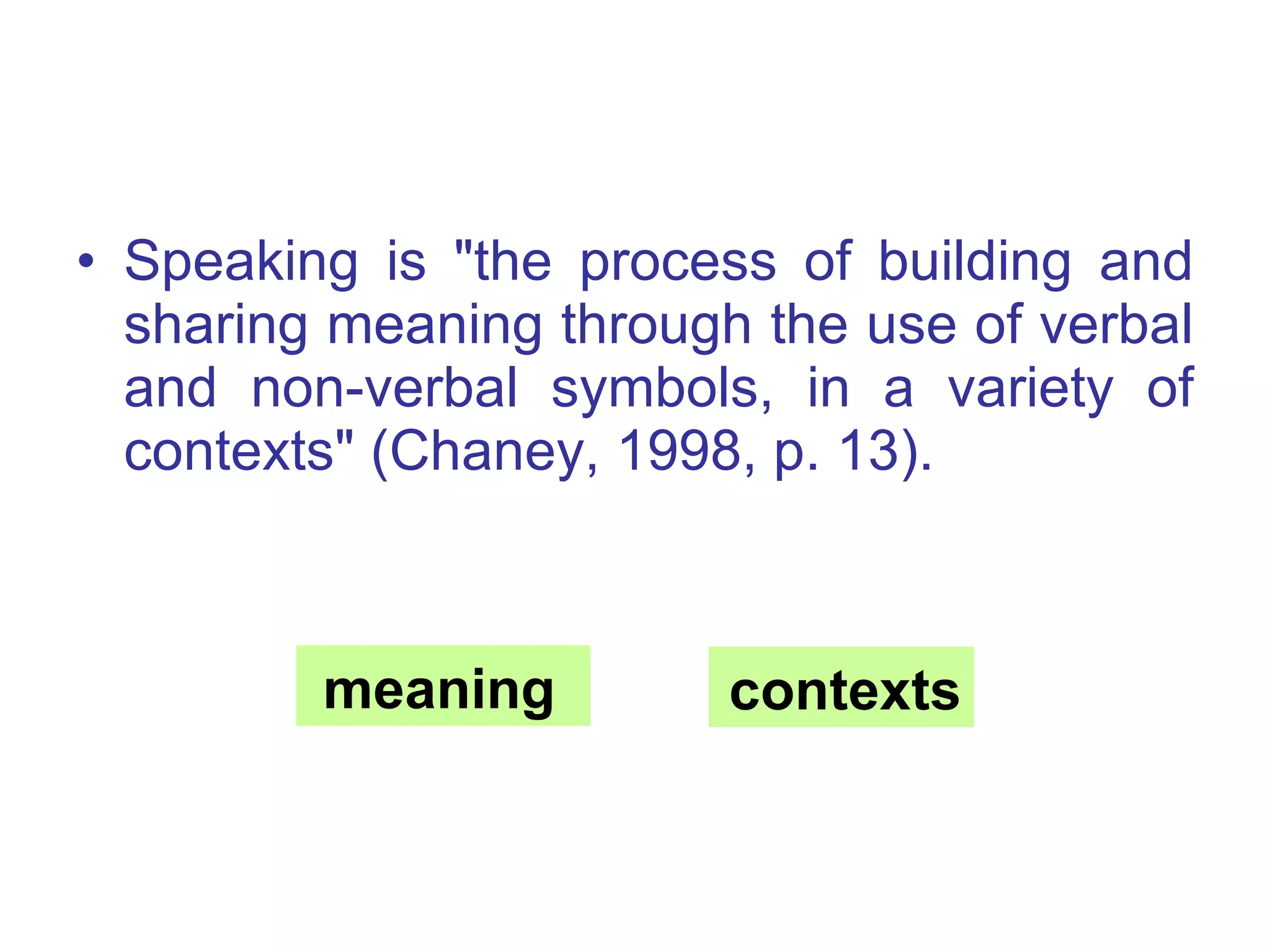
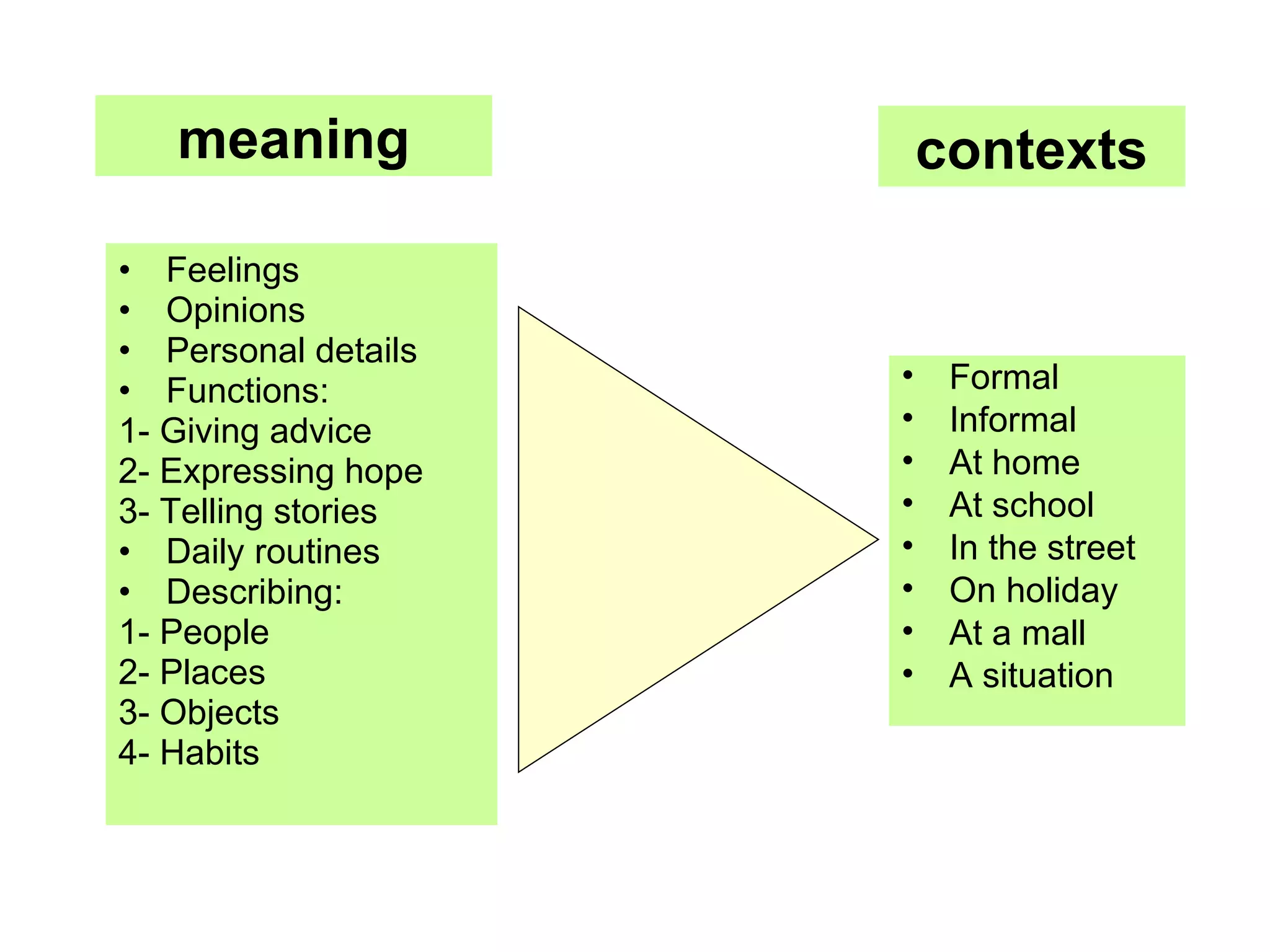
Speaking is  " the process of building and sharing meaning through the use of verbal and non - verbal symbols, in a variety of contexts " ( Chaney, 1998, p .  13 ).   meaning contexts meaning contexts
Feelings Opinions Personal details Functions: 1- Giving advice 2- Expressing hope 3- Telling stories Daily routines Describing:  1- People 2- Places 3- Objects 4- Habits contexts meaning Formal Informal At home At school In the street On holiday At a mall A situation
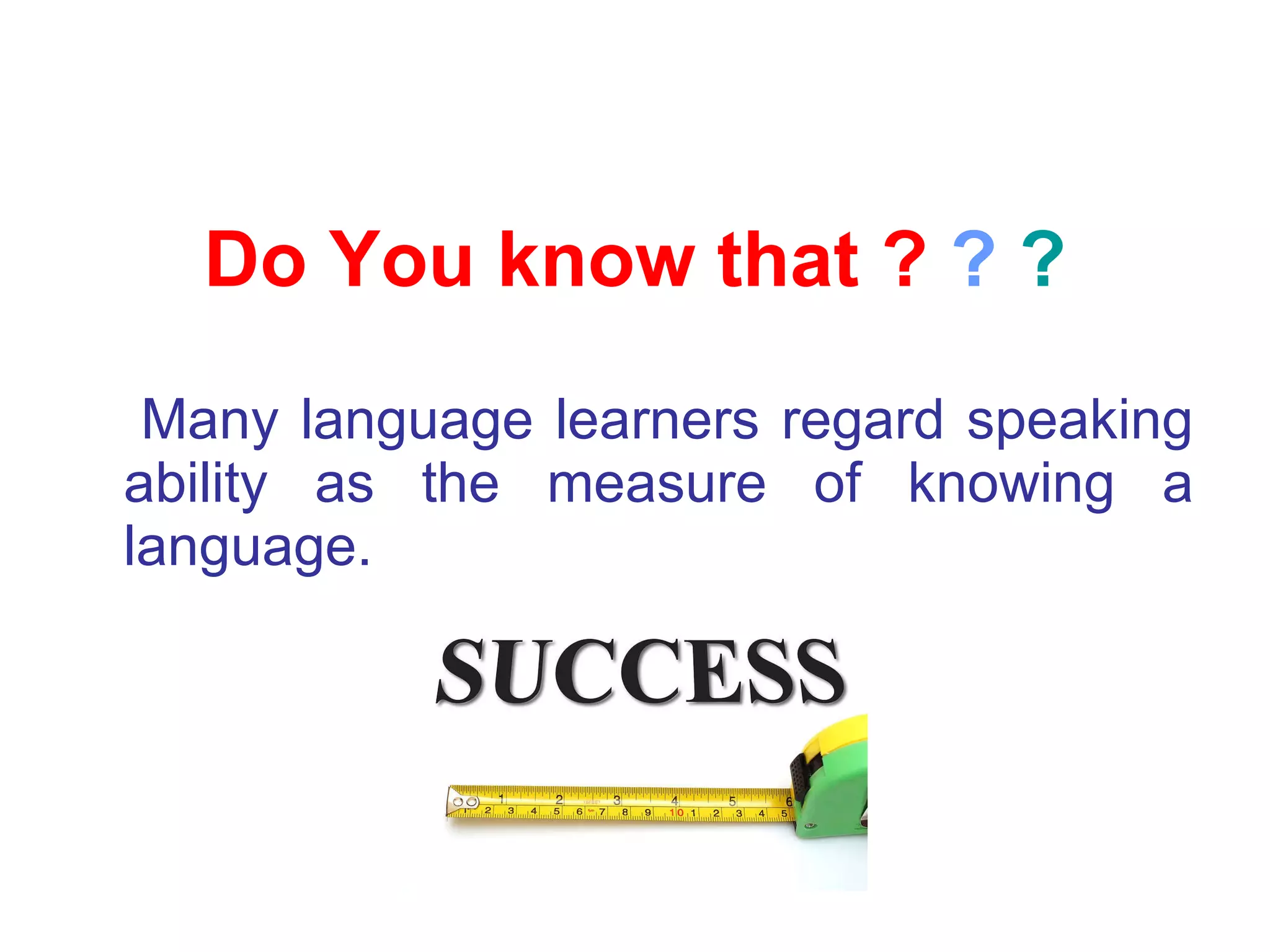
Do You know that ?  ?  ? Many language learners regard speaking ability as the measure of knowing a language .
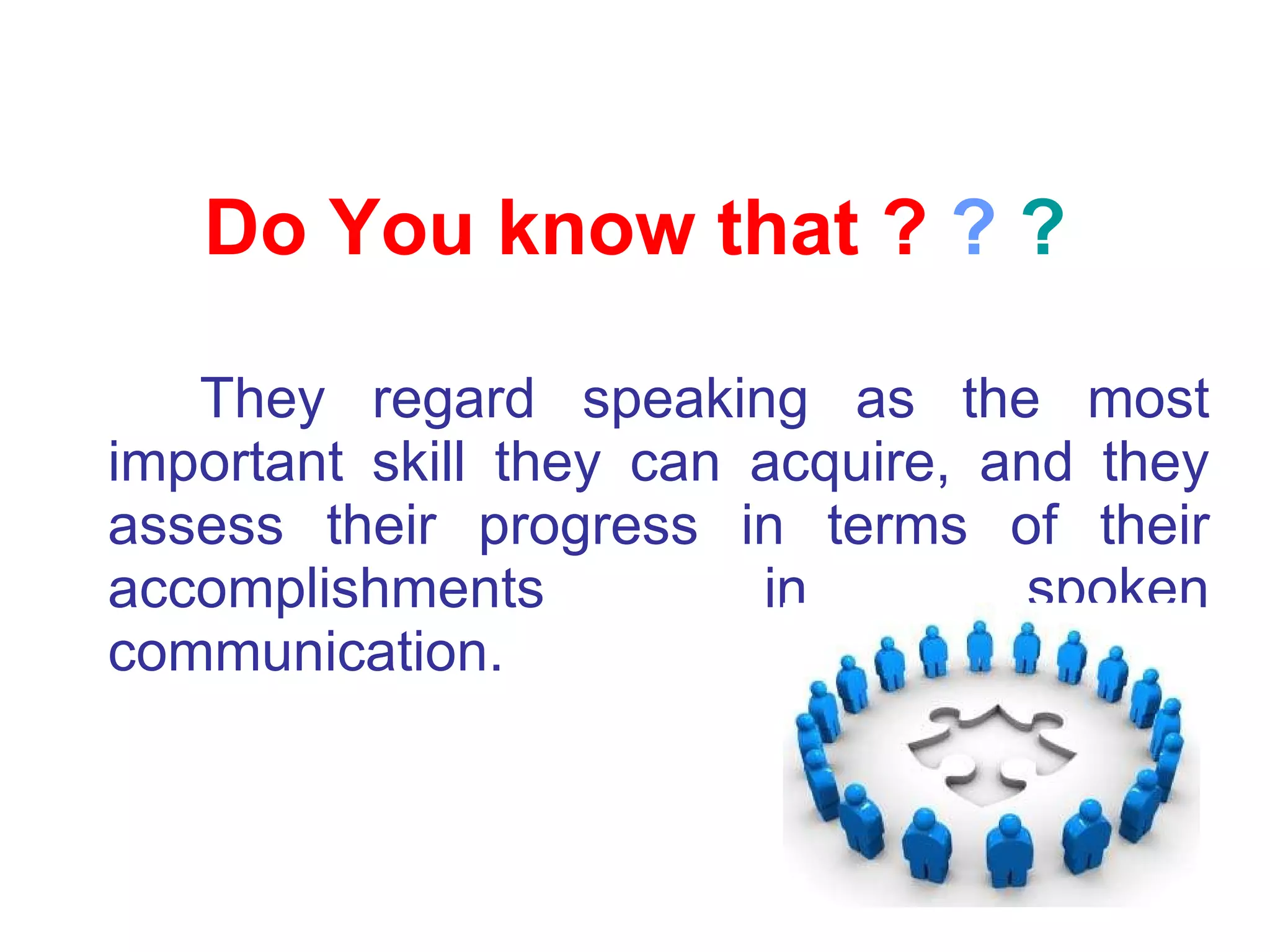
They regard speaking as the most important skill they can acquire, and they assess their progress in terms of their accomplishments in spoken communication .   Do You know that ?  ?  ?
First Part: Despite its importance, for many years, teaching speaking has been undervalued. Second Part:  English language teachers have continued to teach speaking just as a repetition of drills or memorization of dialogues .  The main issues are:
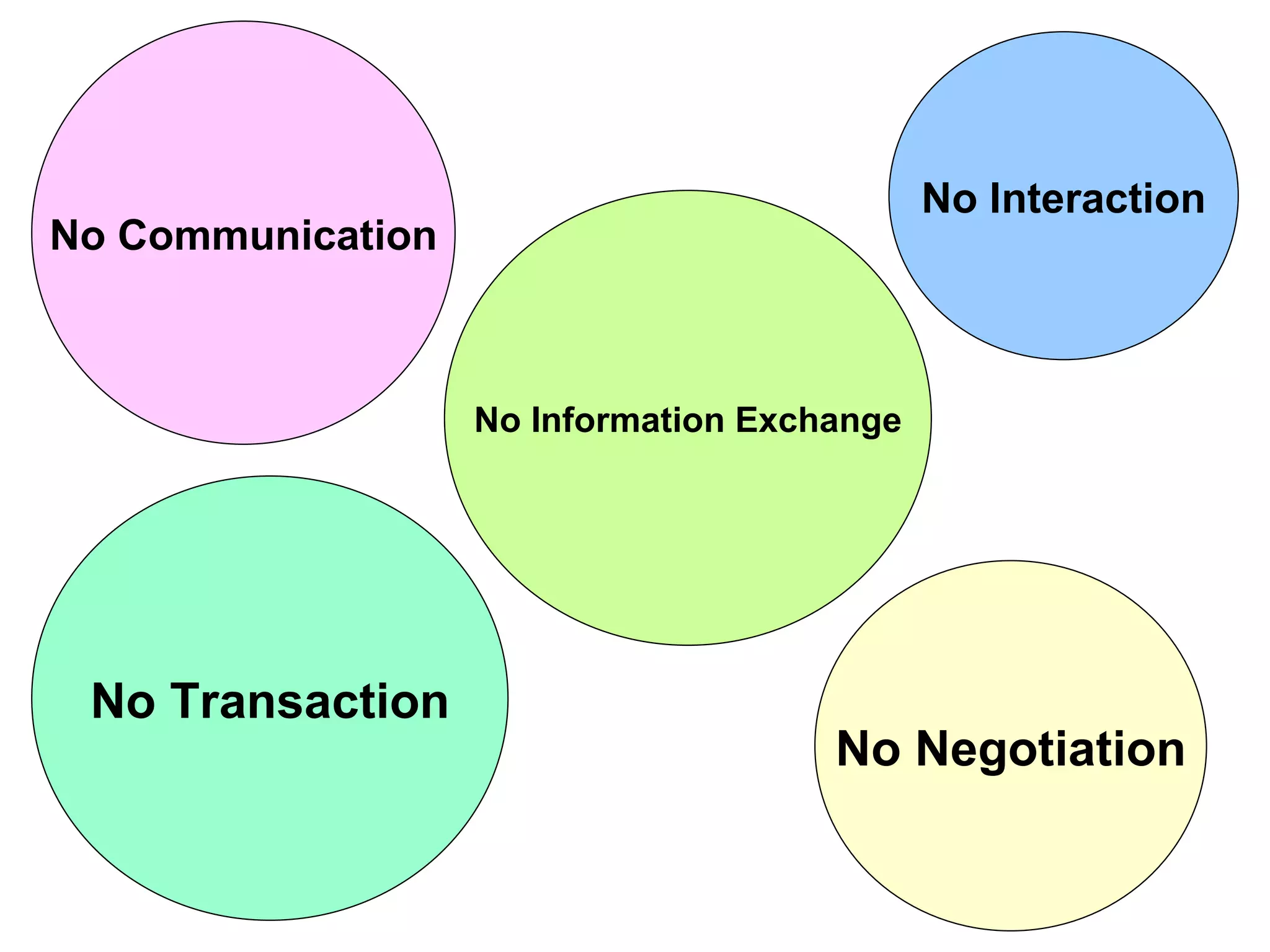
No Communication No Interaction No Negotiation No Transaction No Information Exchange
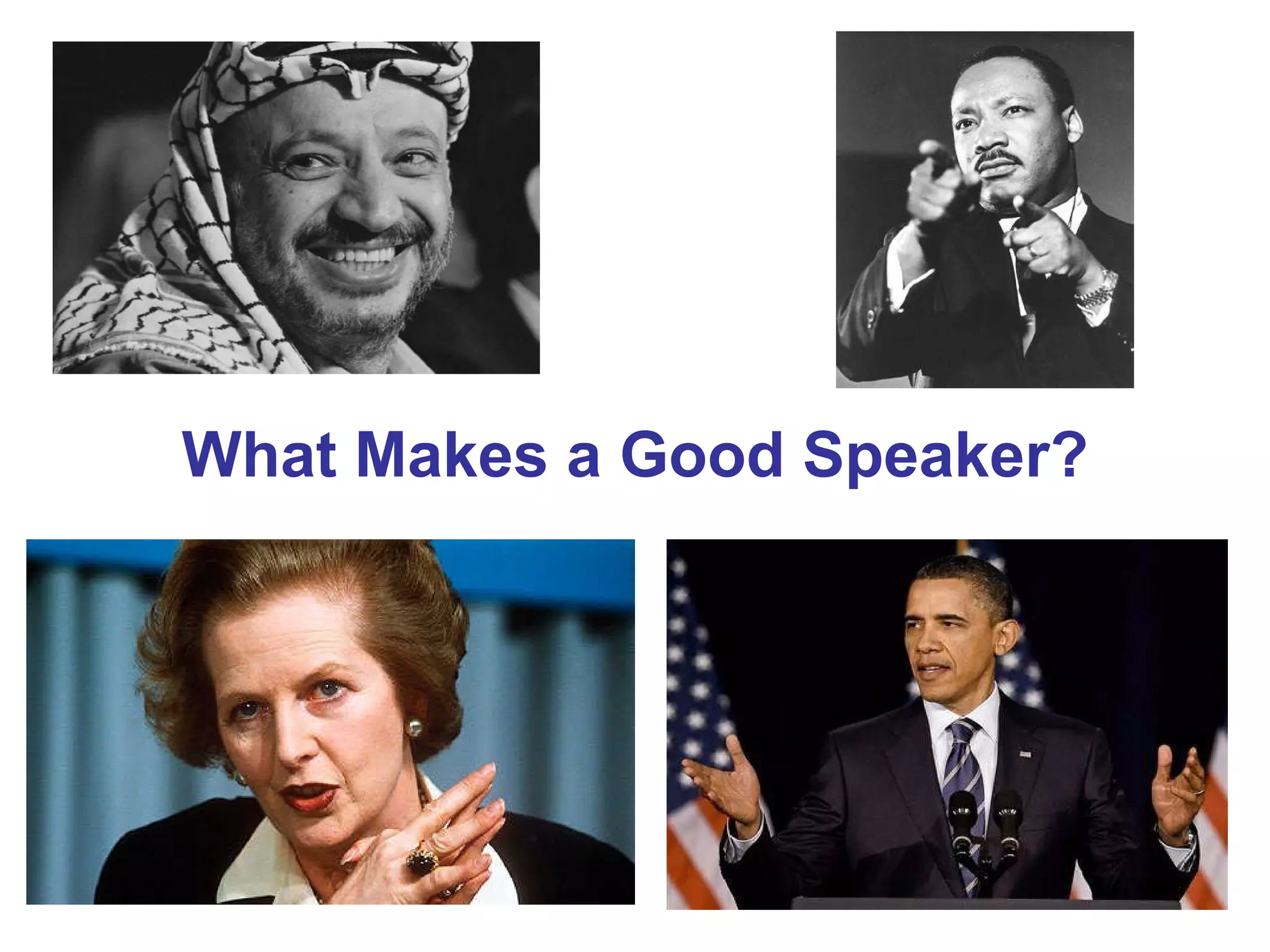
What Makes a Good Speaker?
Teacher Activity   Characteristics of a good language speaker 1- 2- 3- 4- 5 mn
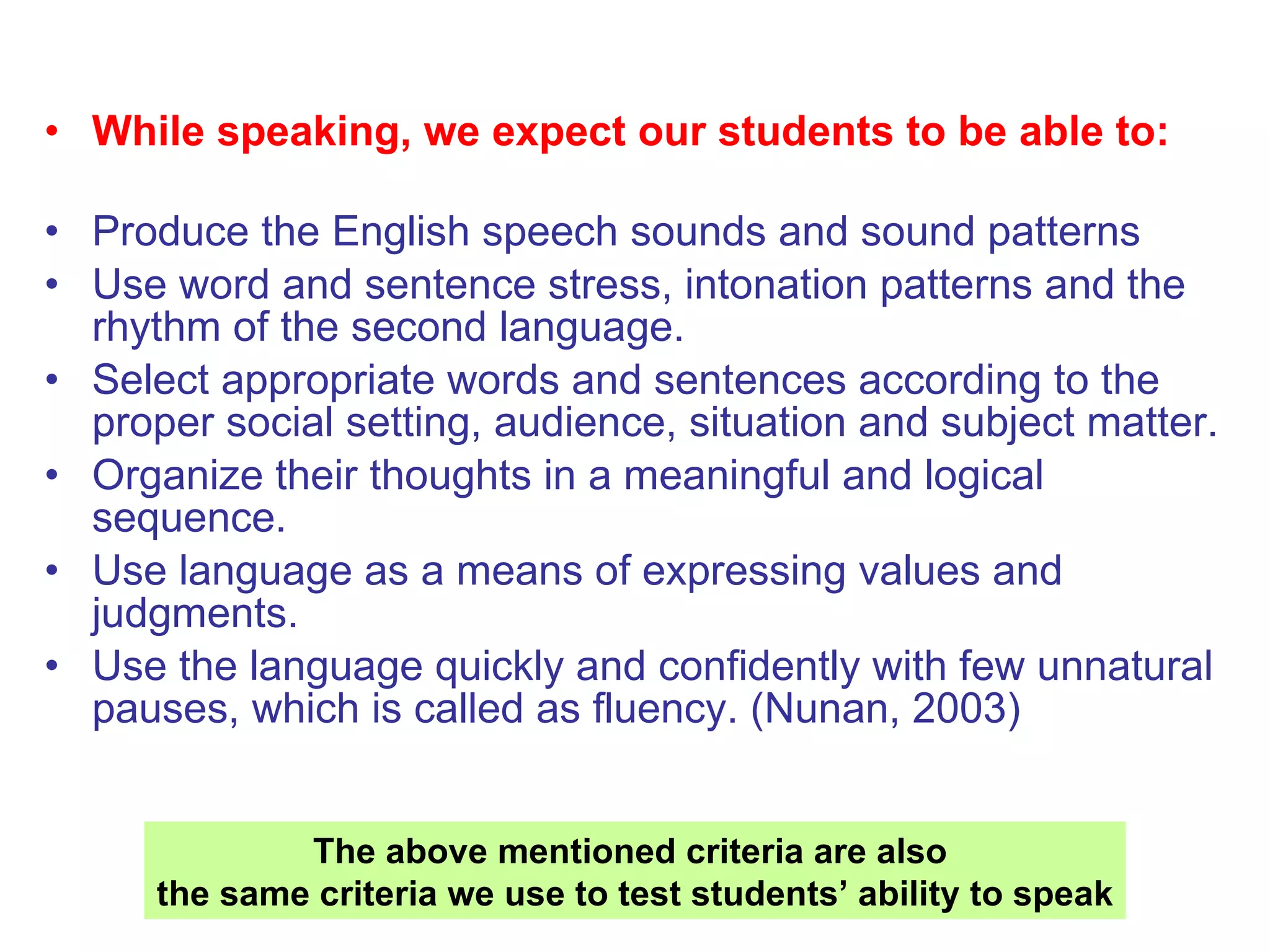
While speaking, we expect our students to be able to: Produce the English speech sounds and sound patterns  Use word and sentence stress, intonation patterns and the rhythm of the second language.  Select appropriate words and sentences according to the proper social setting, audience, situation and subject matter.  Organize their thoughts in a meaningful and logical sequence.  Use language as a means of expressing values and judgments.  Use the language quickly and confidently with few unnatural pauses, which is called as fluency. (Nunan, 2003) The above mentioned criteria are also  the same criteria we use to test students’ ability to speak
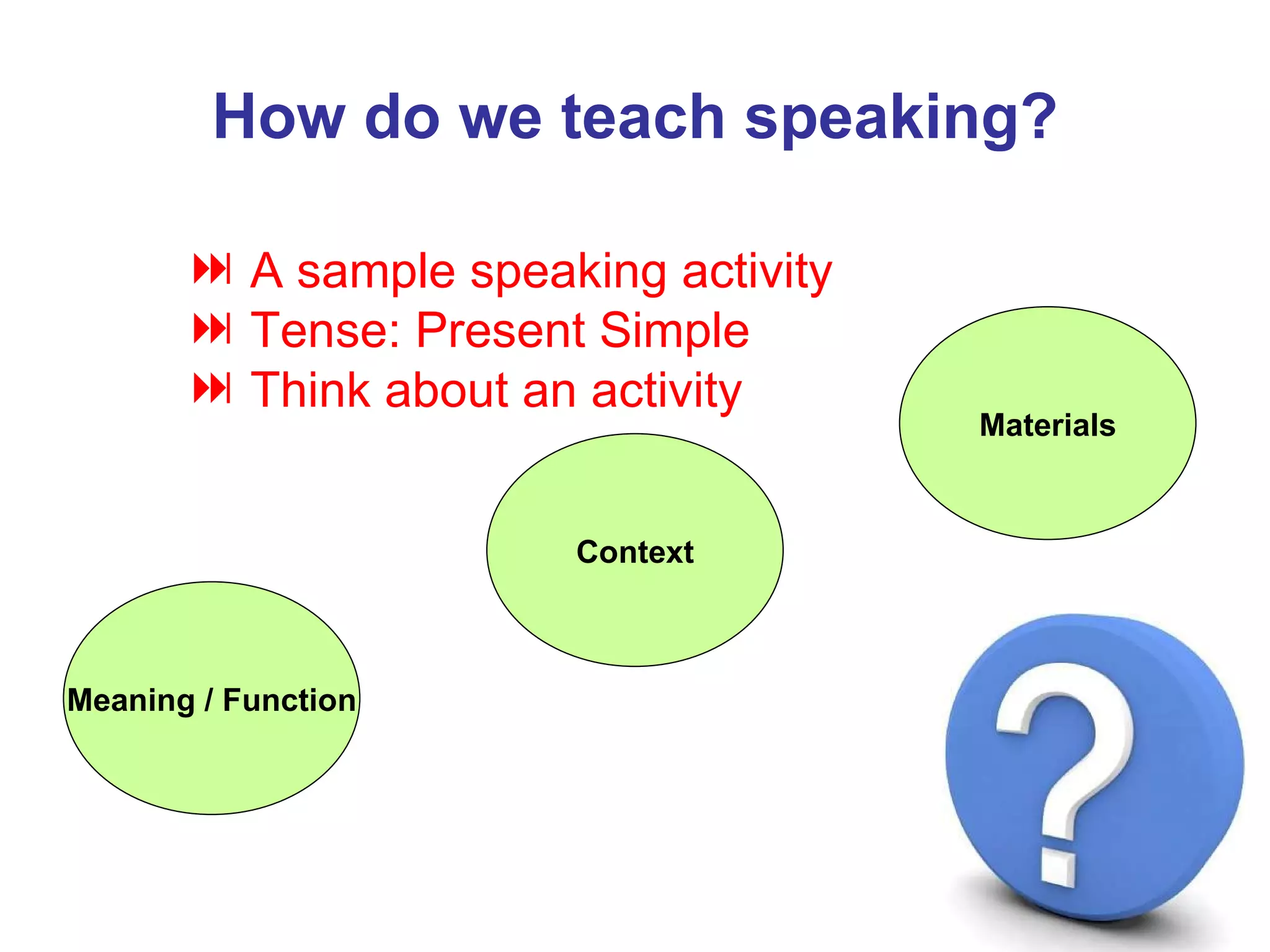
How do we teach speaking? A sample speaking activity Tense: Present Simple Think about an activity Meaning / Function Context Materials 5 mn
Teacher Activity   What do students need to talk fluently? 1- 2- 3- 4- 5- 5 mn
Teachers have to provide authentic practice that prepares students for real - life communication situations .  ) Practise speaking in class) They have to help their students develop the ability to produce grammatically correct, logically connected sentences that are appropriate to specific contexts, and to do so using acceptable  ( that is, comprehensible )  pronunciation .    Teach Vocabulary    Teach Grammar Teach Pronunciation / Intonation          Equip them with everything they need to speak confidently and fluently.
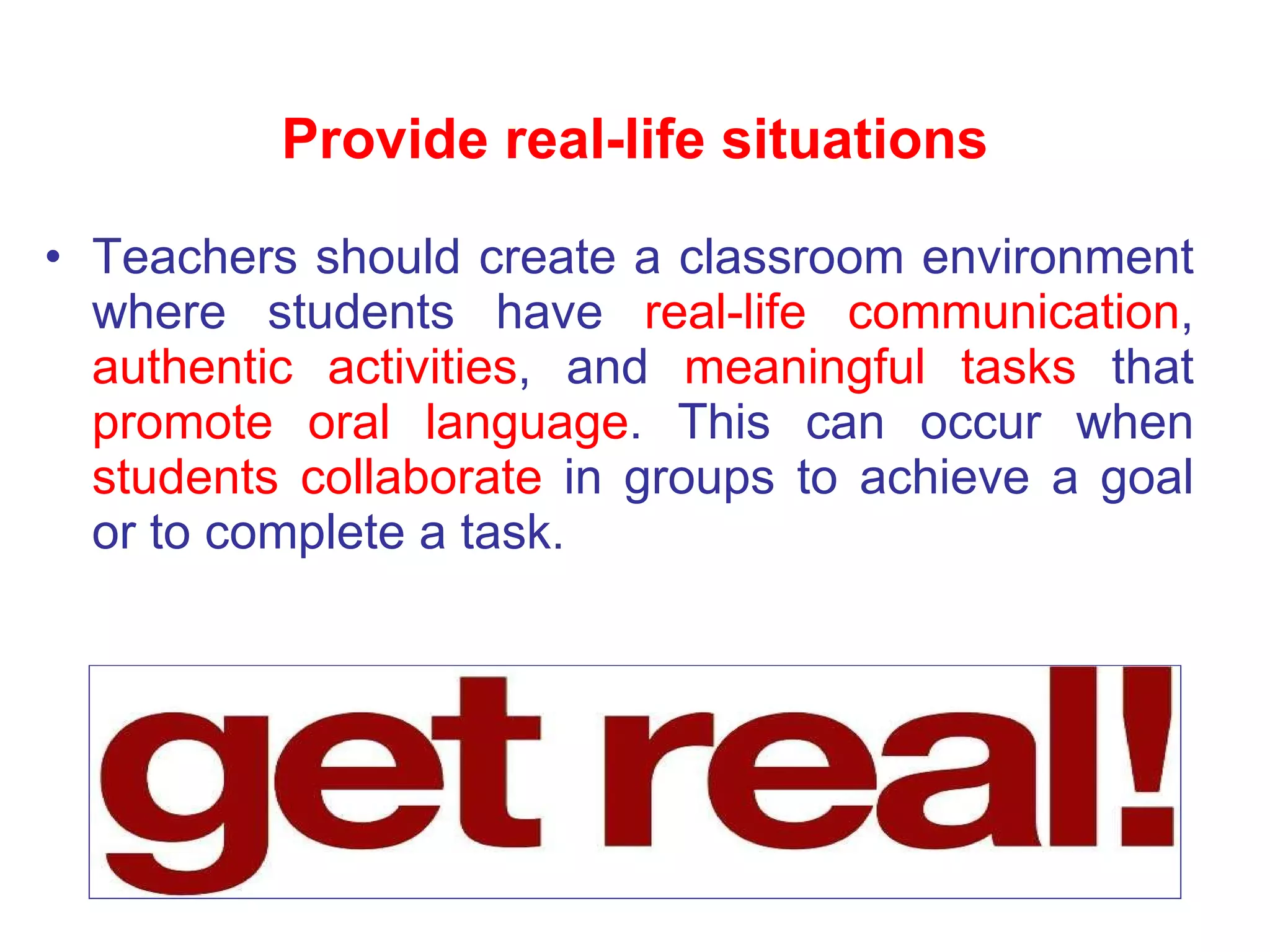
Teachers should create a classroom environment where students have  real-life communication ,  authentic activities , and  meaningful tasks  that  promote oral language . This can occur when  students collaborate  in groups to achieve a goal or to complete a task. Provide real-life situations
Activities that Promote Speaking Tactics for Speaking
Teacher Activity   Activities that Promote Speaking 1- 2- 3- 4- 5 mn
Discussions After a content-based lesson, a discussion can be held for various reasons. The students may aim to arrive at a conclusion, share ideas about an event, or find solutions in their discussion groups. Before the discussion, it is essential that the purpose of the discussion activity is set by the teacher.
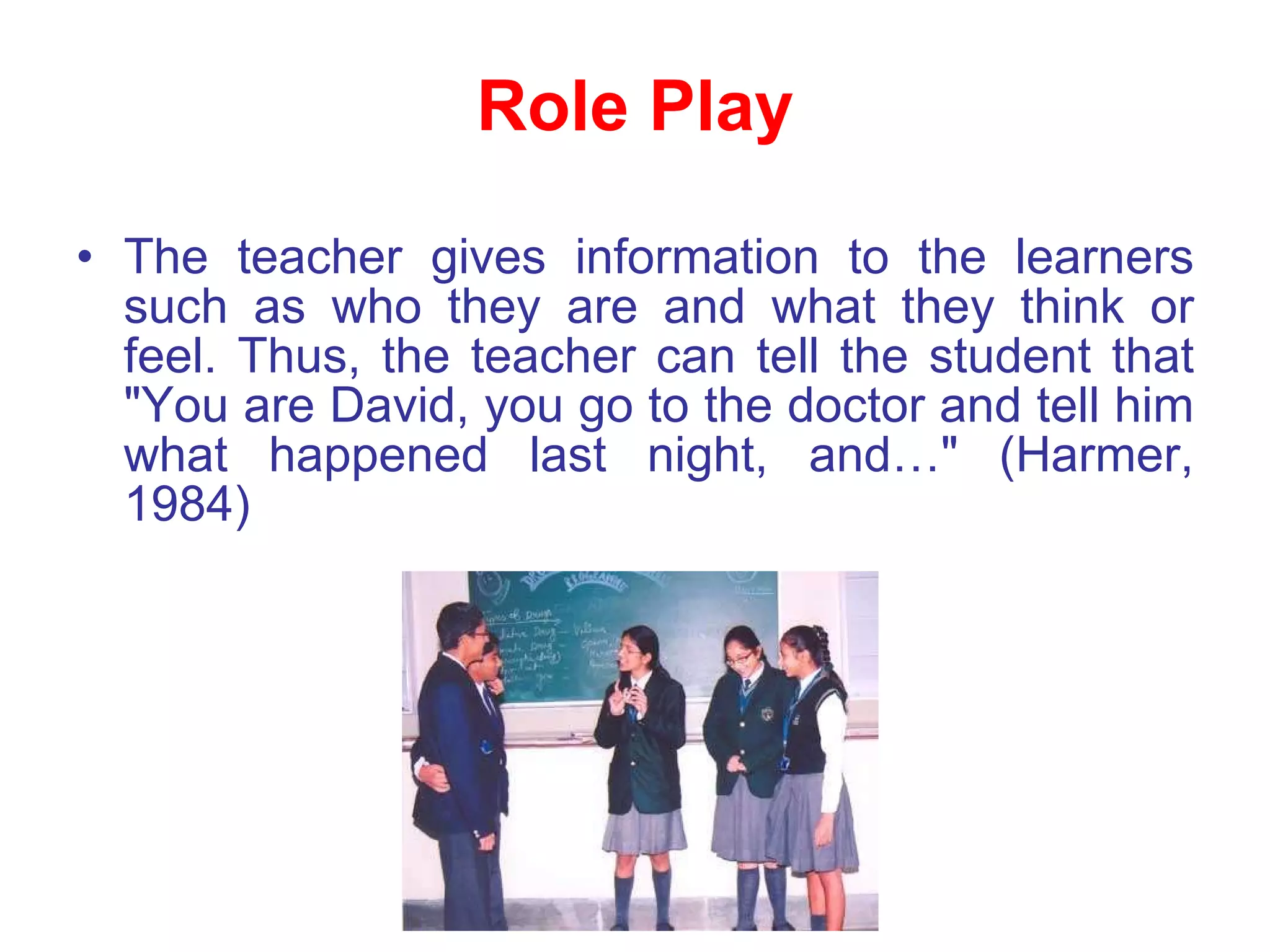
Role Play The teacher gives information to the learners such as who they are and what they think or feel. Thus, the teacher can tell the student that "You are David, you go to the doctor and tell him what happened last night, and…" (Harmer, 1984)
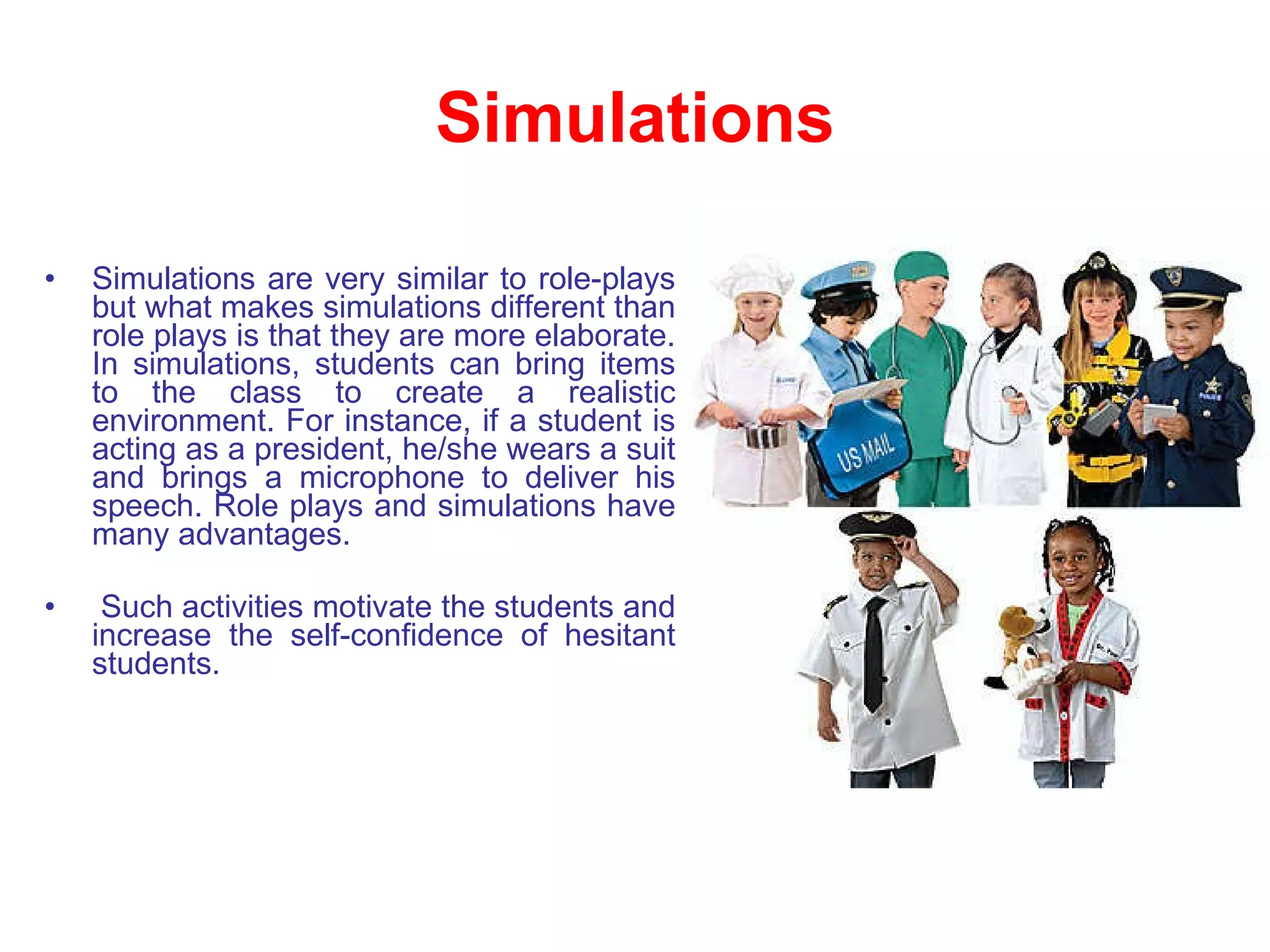
Simulations Simulations are very similar to role-plays but what makes simulations different than role plays is that they are more elaborate. In simulations, students can bring items to the class to create a realistic environment. For instance, if a student is acting as a president, he/she wears a suit and brings a microphone to deliver his speech. Role plays and simulations have many advantages. Such activities motivate the students and increase the self-confidence of hesitant students.
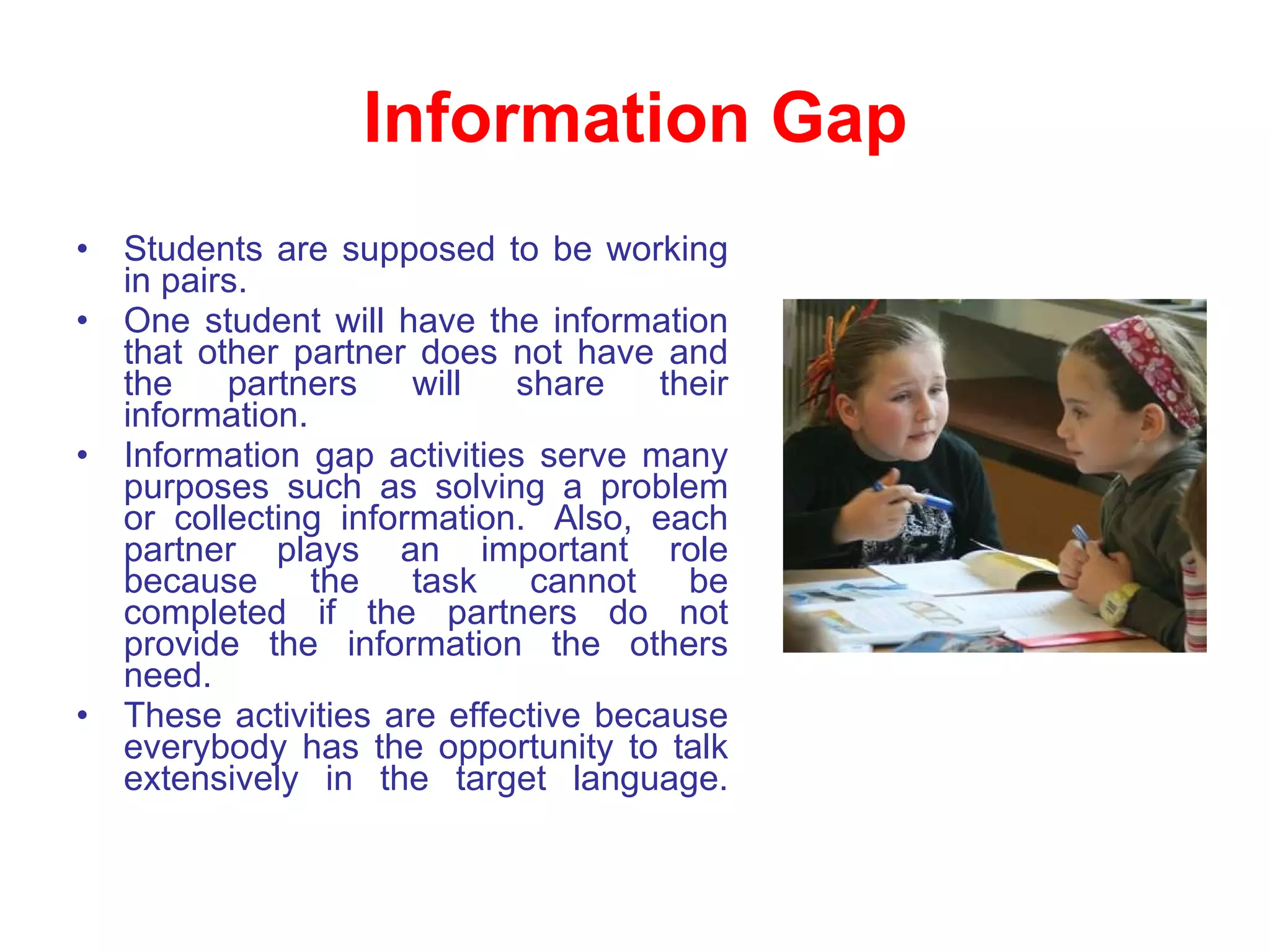
Information Gap Students are supposed to be working in pairs.  One student will have the information that other partner does not have and the partners will share their information.  Information gap activities serve many purposes such as solving a problem or collecting information.  Also, each partner plays an important role because the task cannot be completed if the partners do not provide the information the others need.  These activities are effective because everybody has the opportunity to talk extensively in the target language.
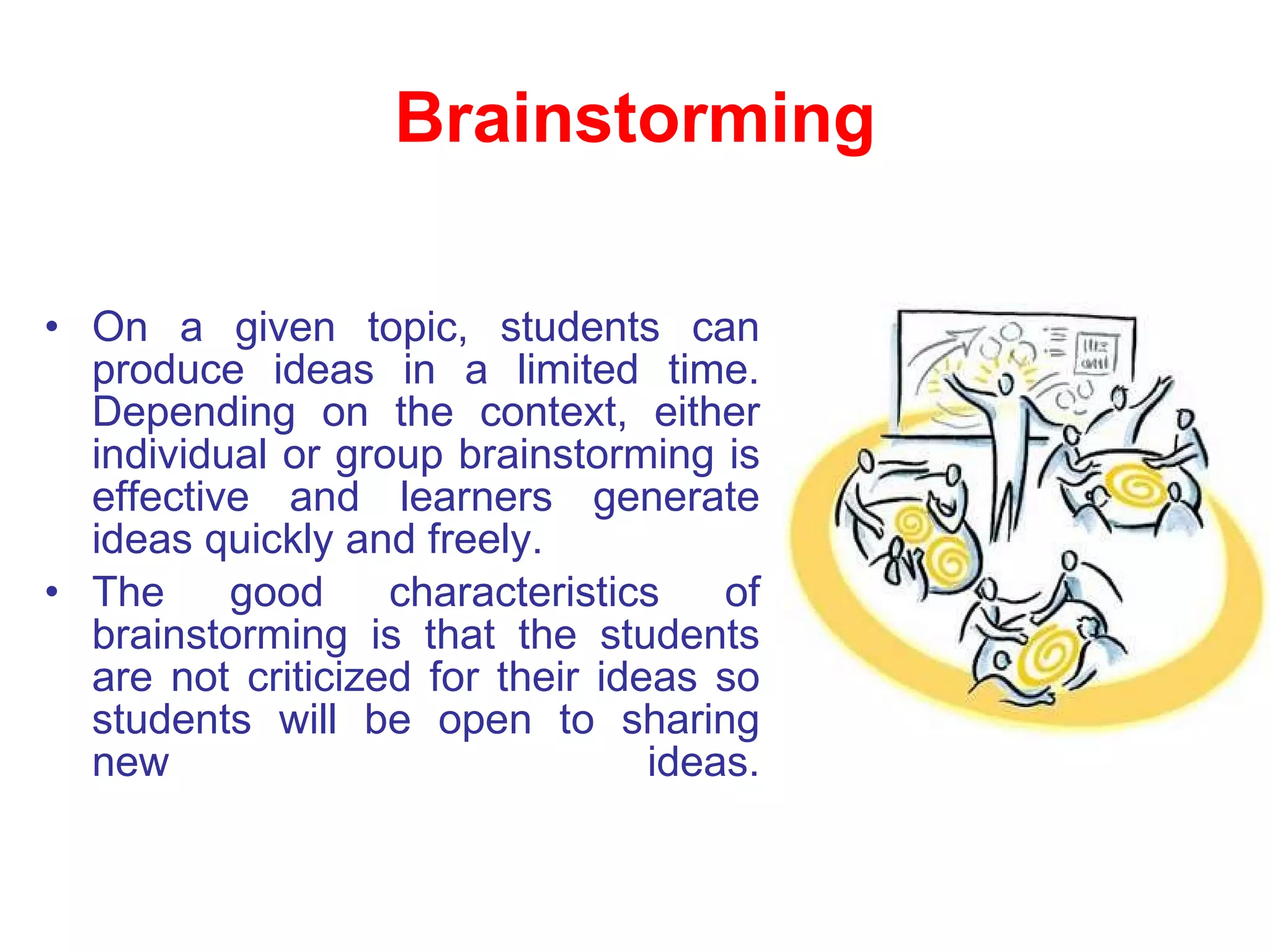
Brainstorming On a given topic, students can produce ideas in a limited time. Depending on the context, either individual or group brainstorming is effective and learners generate ideas quickly and freely.  The good characteristics of brainstorming is that the students are not criticized for their ideas so students will be open to sharing new ideas.
Storytelling Students can briefly summarize a tale or story they heard from somebody beforehand,  They may create/imagine their own stories to tell their classmates.  Story telling fosters creative thinking. It also helps students express ideas in the format of beginning, development, and ending, including the characters and setting a story has to have.
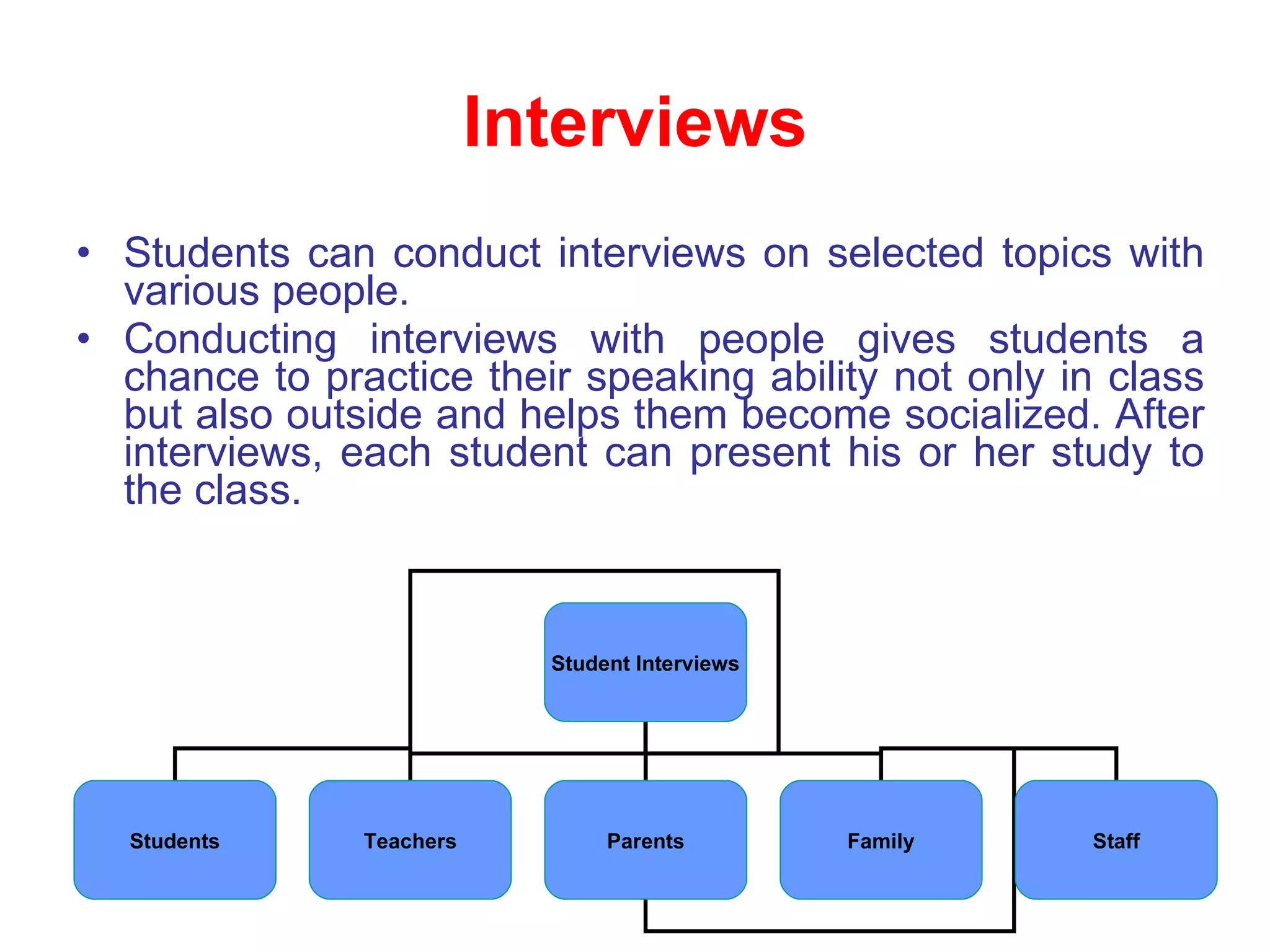
Interviews Students can conduct interviews on selected topics with various people.  Conducting interviews with people gives students a chance to practice their speaking ability not only in class but also outside and helps them become socialized. After interviews, each student can present his or her study to the class.  Student Interviews Students Teachers Parents Family Staff
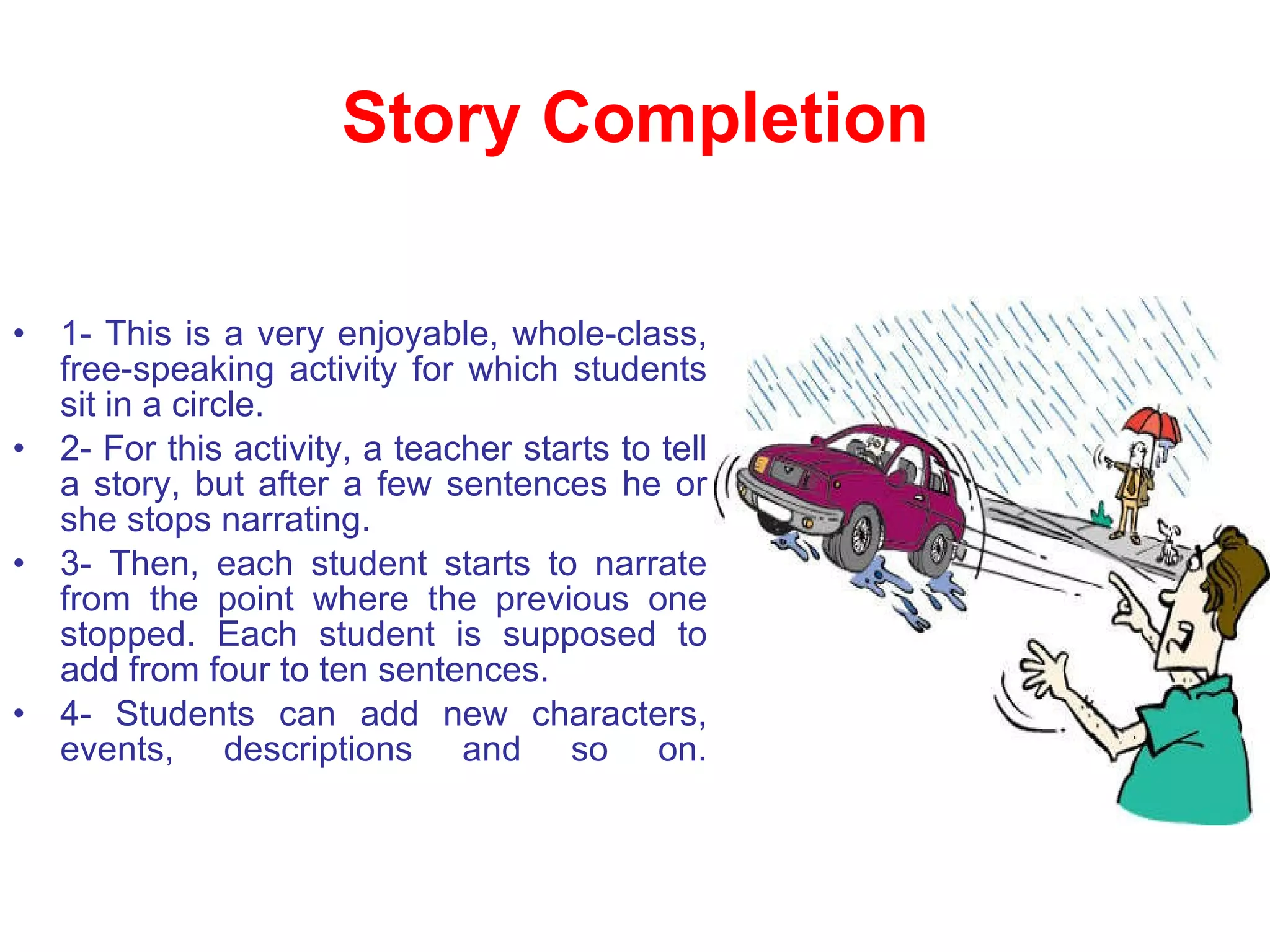
Story Completion 1- This is a very enjoyable, whole-class, free-speaking activity for which students sit in a circle.  2- For this activity, a teacher starts to tell a story, but after a few sentences he or she stops narrating.  3- Then, each student starts to narrate from the point where the previous one stopped. Each student is supposed to add from four to ten sentences.  4- Students can add new characters, events, descriptions and so on.
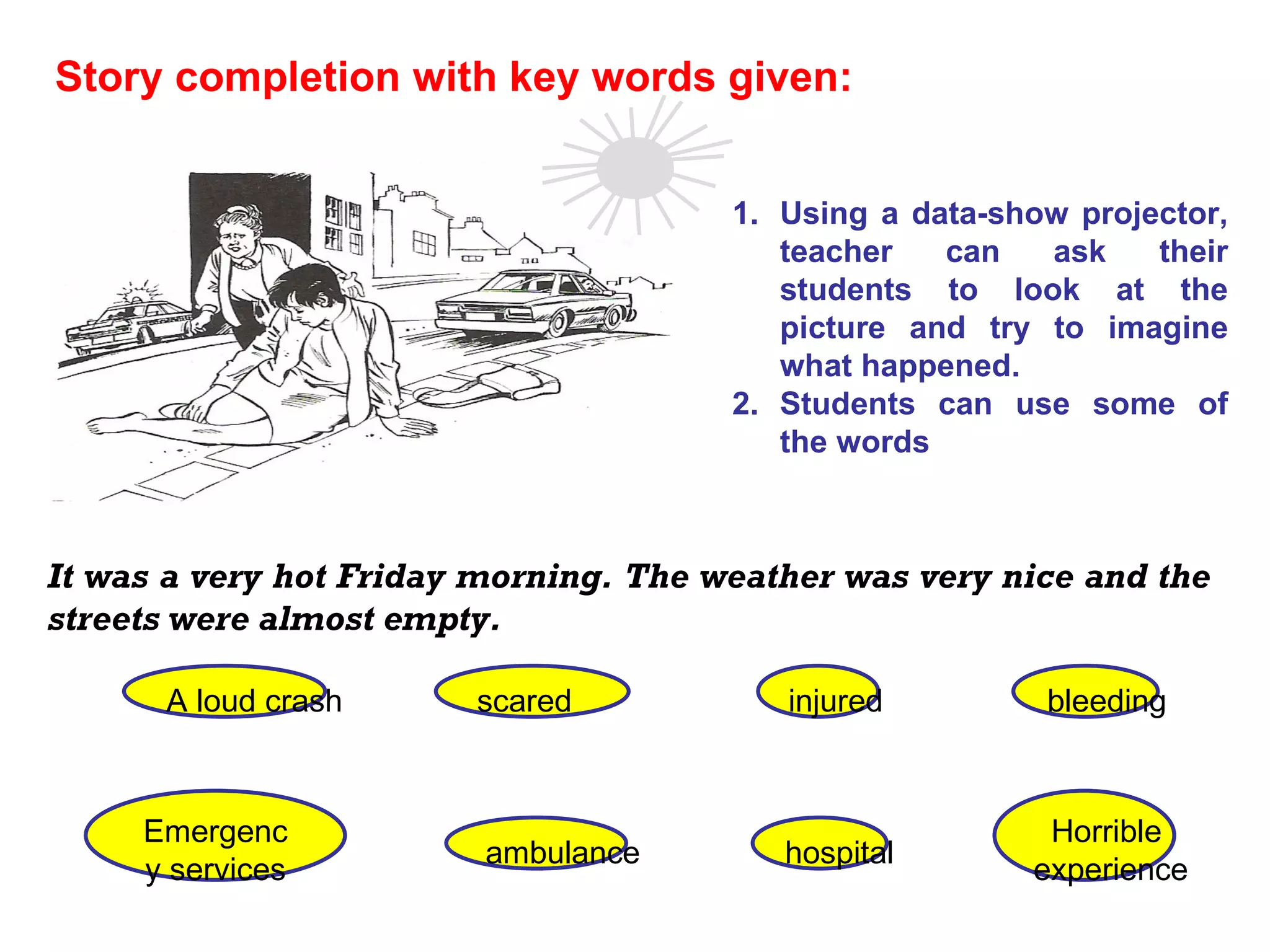
It was a very hot Friday morning. The weather was very nice and the streets were almost empty. Story completion with key words given:   scared A loud crash injured bleeding Emergency services ambulance hospital Horrible  experience Using a data-show projector, teacher can ask their students to look at the picture and try to imagine what happened. Students can use some of the words
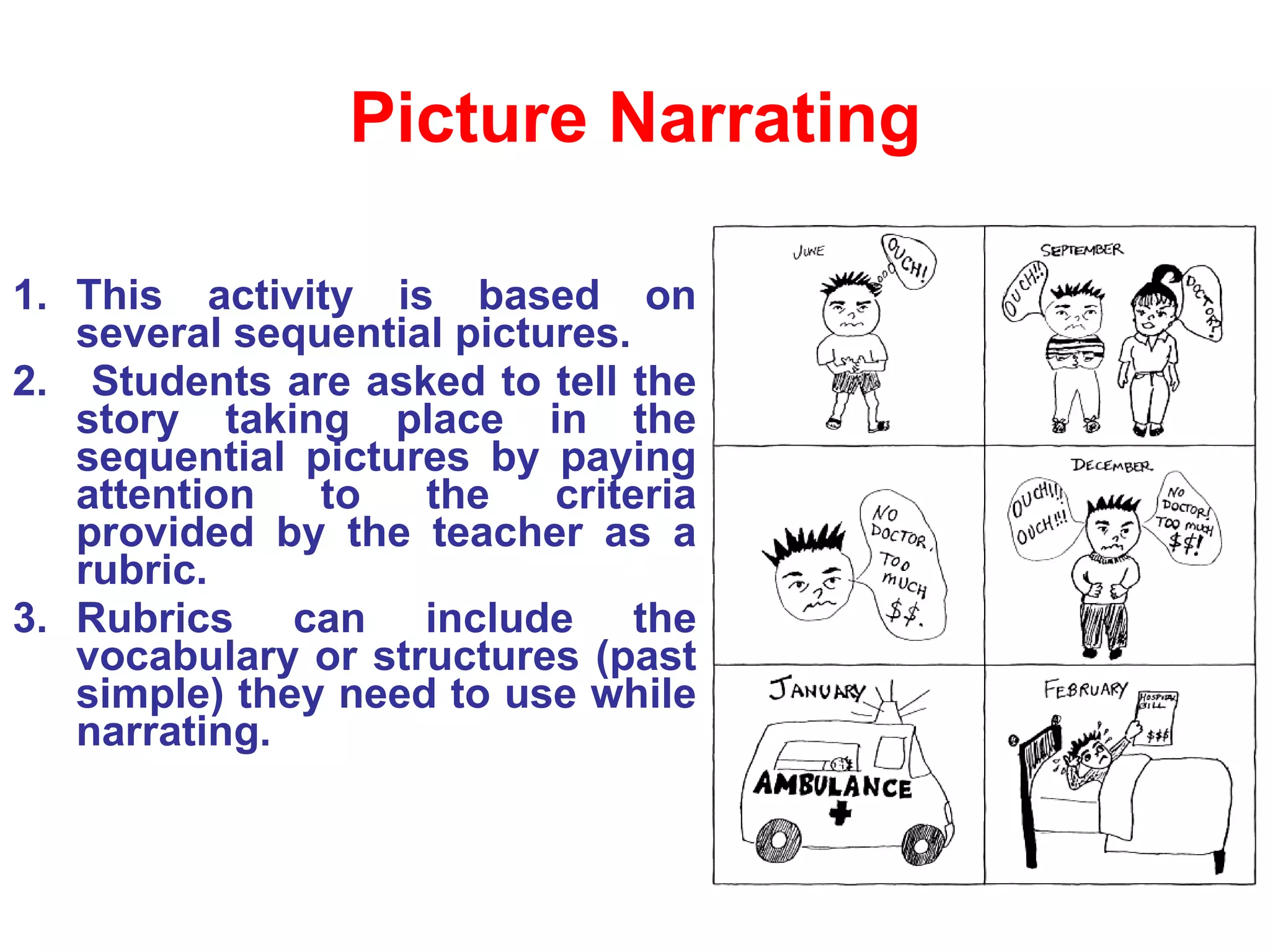
Picture Narrating This activity is based on several sequential pictures. Students are asked to tell the story taking place in the sequential pictures by paying attention to the criteria provided by the teacher as a rubric.  Rubrics can include the vocabulary or structures (past simple) they need to use while narrating.
Reporting Before coming to class, students are asked to read a newspaper or magazine and, in class, they report to their friends what they find as the most interesting news.  Teachers can also ask their students to watch a specific program on a specific channel. Time of the program should be given well-in-advance. Then, students could be asked to report back what they have seen and express their views concerning what was presented in the program or cartoon film…
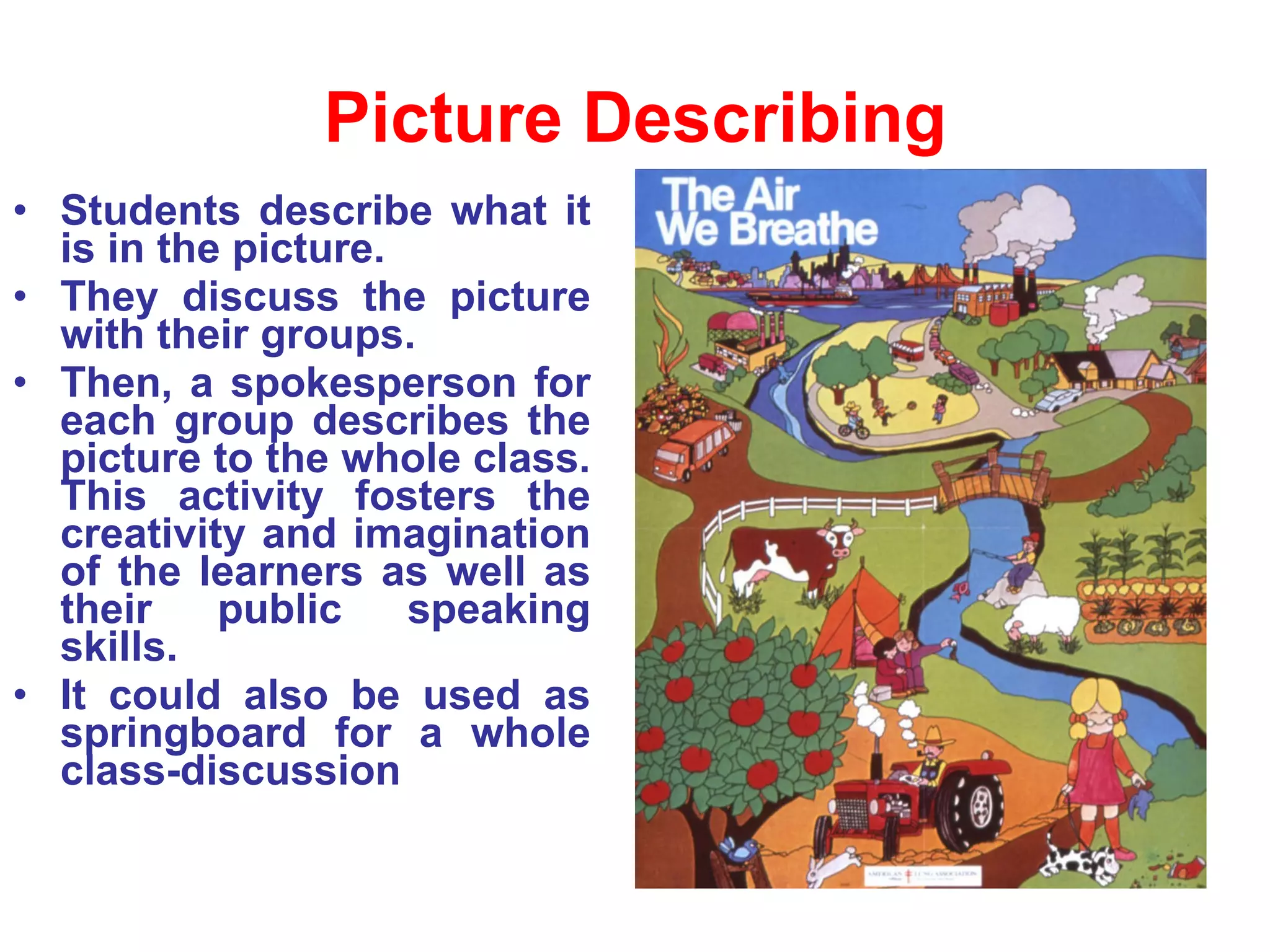
Picture Describing Students describe what it is in the picture.  They discuss the picture with their groups. Then, a spokesperson for each group describes the picture to the whole class. This activity fosters the creativity and imagination of the learners as well as their public speaking skills. It could also be used as springboard for a whole class-discussion
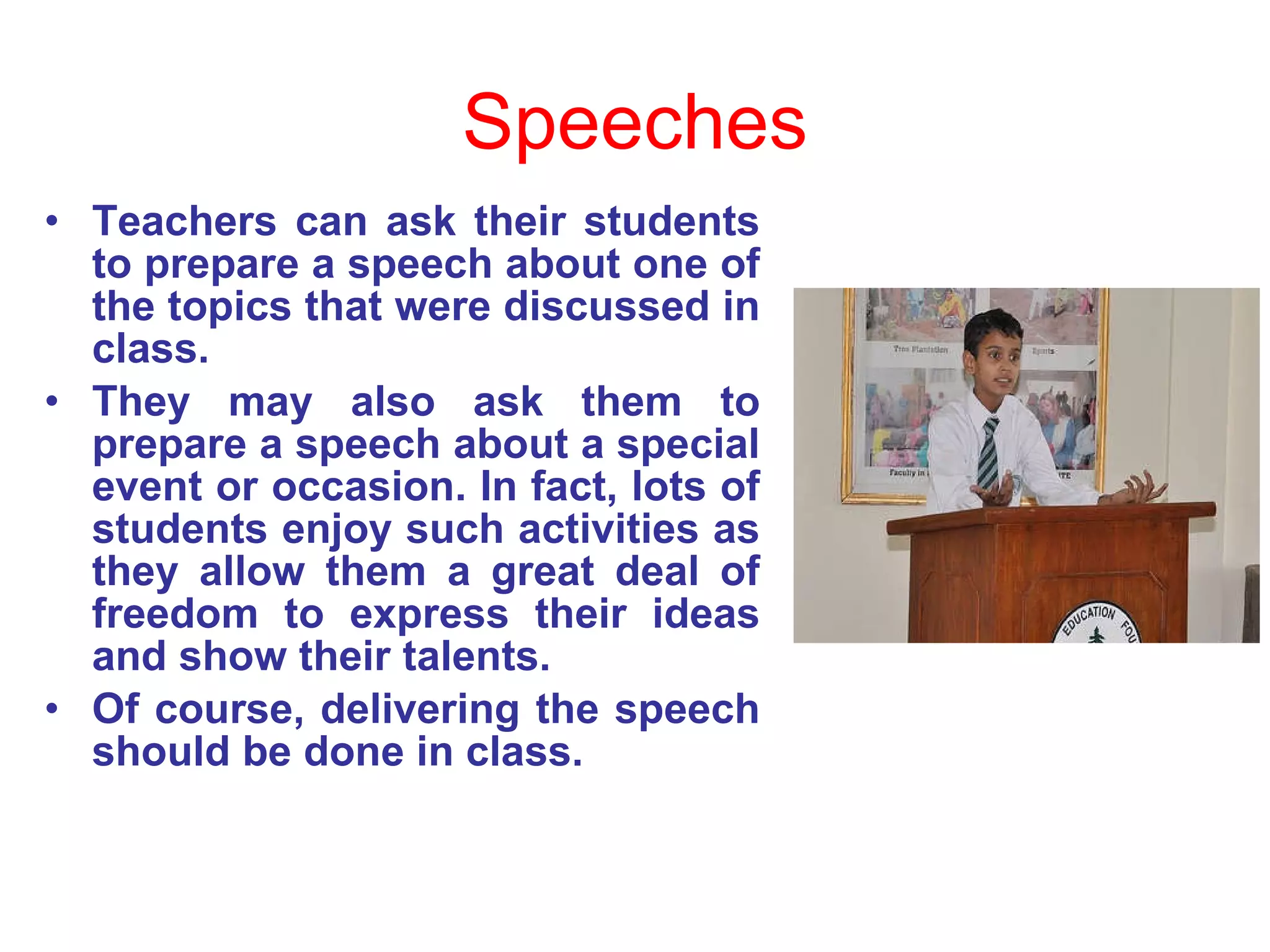
Speeches Teachers can ask their students to prepare a speech about one of the topics that were discussed in class.  They may also ask them to prepare a speech about a special event or occasion. In fact, lots of students enjoy such activities as they allow them a great deal of freedom to express their ideas and show their talents.  Of course, delivering the speech should be done in class.
Activities that Promote Speaking Discussions Role Plays Simulations Information Gap Brainstorming Storytelling Interviews Story Completion Reporting Picture Narrating Picture Describing Speeches
Practical Activities
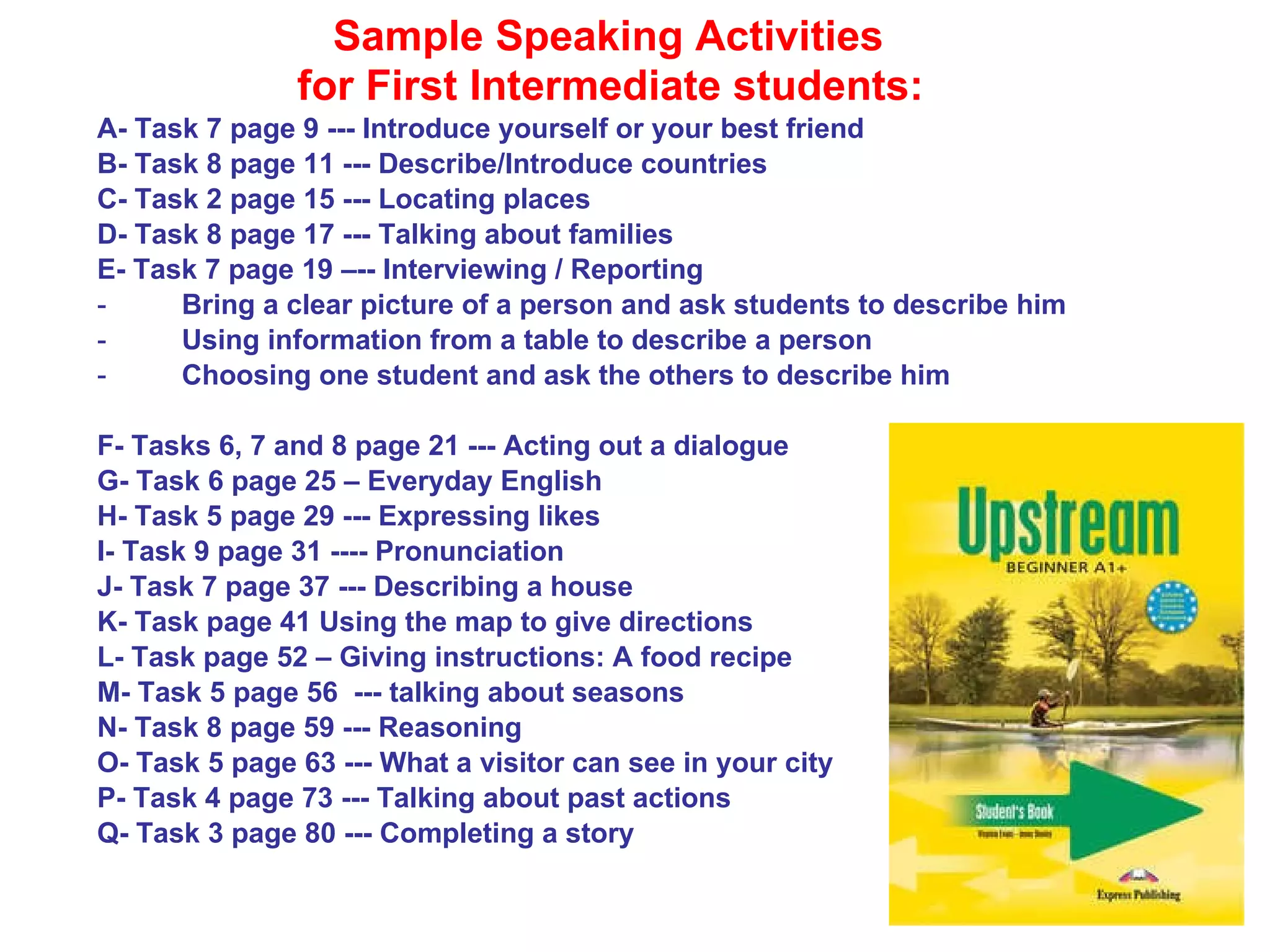
Sample Speaking Activities for First Intermediate students:   A- Task 7 page 9 --- Introduce yourself or your best friend B- Task 8 page 11 --- Describe/Introduce countries C- Task 2 page 15 --- Locating places D- Task 8 page 17 --- Talking about families E- Task 7 page 19 –-- Interviewing / Reporting Bring a clear picture of a person and ask students to describe him Using information from a table to describe a person Choosing one student and ask the others to describe him F- Tasks 6, 7 and 8 page 21 --- Acting out a dialogue G- Task 6 page 25 – Everyday English H- Task 5 page 29 --- Expressing likes I- Task 9 page 31 ---- Pronunciation J- Task 7 page 37 --- Describing a house K- Task page 41 Using the map to give directions L- Task page 52 – Giving instructions: A food recipe M- Task 5 page 56  --- talking about seasons N- Task 8 page 59 --- Reasoning O- Task 5 page 63 --- What a visitor can see in your city P- Task 4 page 73 --- Talking about past actions Q- Task 3 page 80 --- Completing a story
SUMMARY   Suggestions  For Teachers
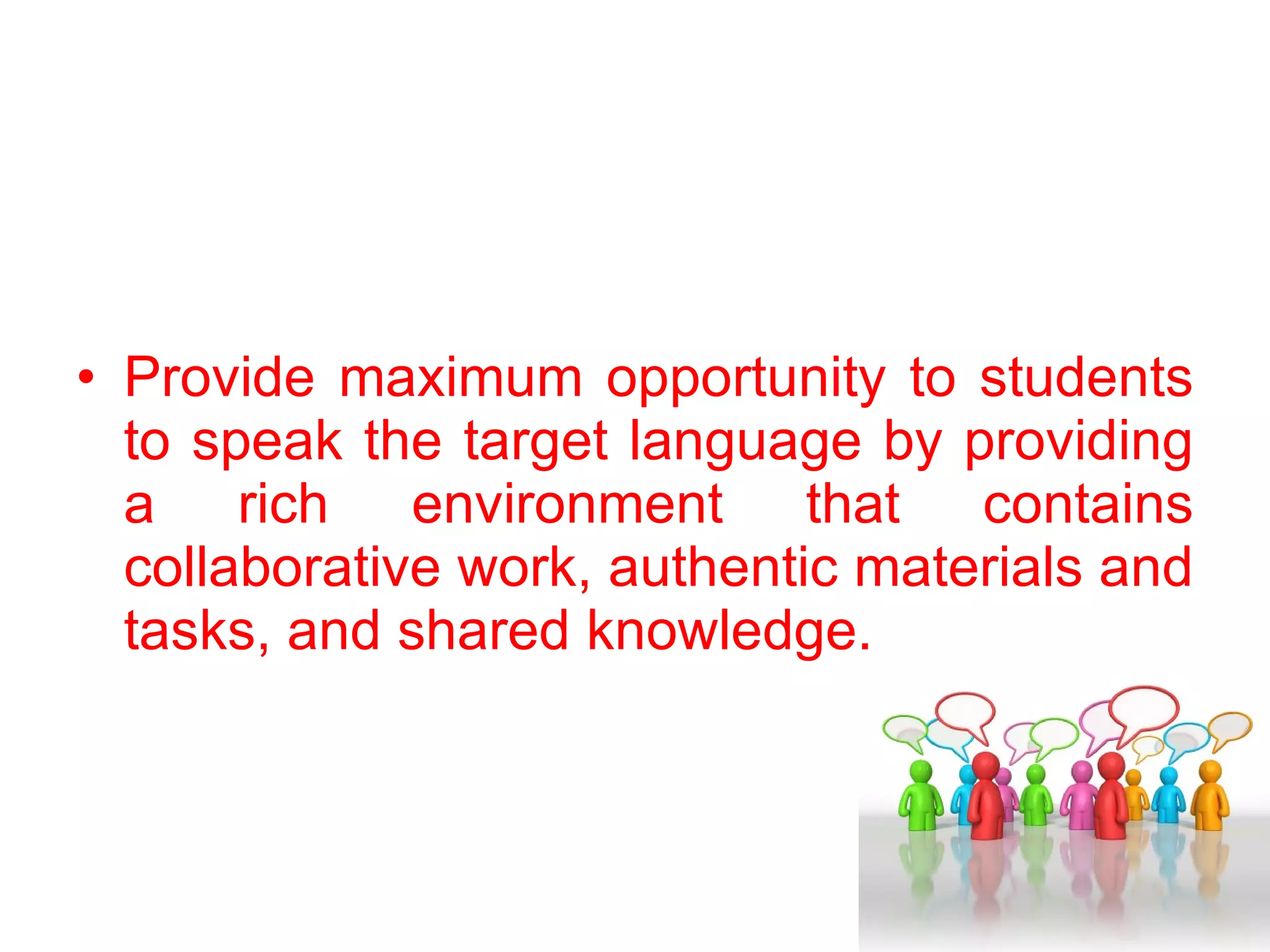
Provide maximum opportunity to students to speak the target language by providing a rich environment that contains collaborative work, authentic materials and tasks, and shared knowledge.
Try to involve as many students as possible in every speaking activity.  For this aim, practice different ways of student participation.
Reduce teacher speaking time in class while increasing student speaking time. Step back and observe students.
Indicate positive signs when commenting on a student's response.
Ask eliciting questions such as "What do you mean? How did you reach that conclusion?" in order to prompt students to speak more.
Provide written feedback like "Your presentation was really great. It was a good job. I really appreciated your efforts in preparing the materials and efficient use of your voice…"
Do not correct students' pronunciation mistakes very often while they are speaking. Correction should not distract student from expressing themselves.
Involve speaking activities not only in class but also out of class; contact parents and other people who can help.
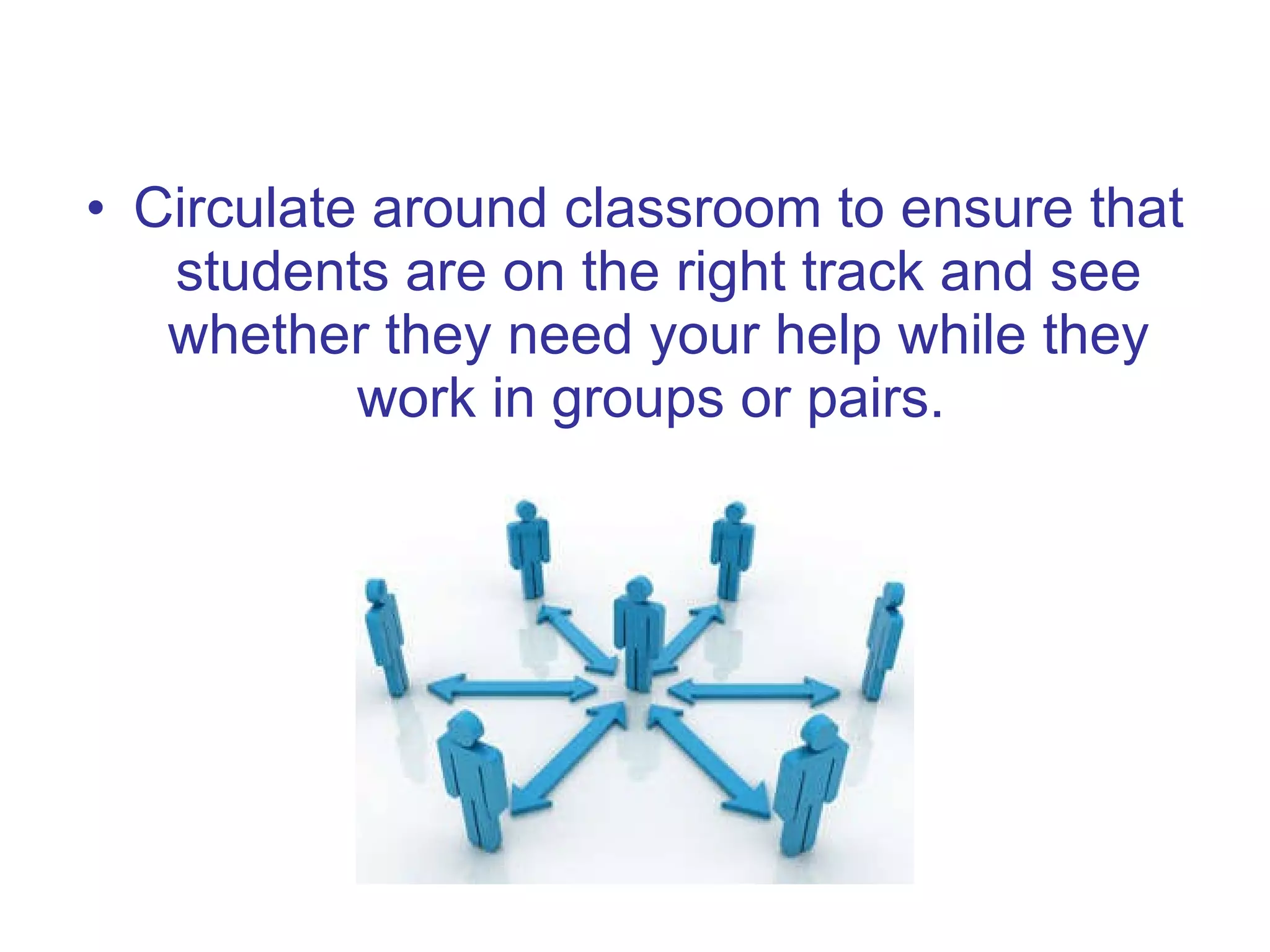
Circulate around classroom to ensure that students are on the right track and see whether they need your help while they work in groups or pairs.
Provide the vocabulary beforehand that students need in speaking activities.
Diagnose problems faced by students who have difficulty in expressing themselves in the target language and provide more opportunities to practice the spoken language.
Conclusion
Pay great attention to teaching speaking. Make students more active in the learning process and reduce their anxiety. Make their learning more meaningful and fun for them.
Dear teachers,  Thank you so much for attending this online training workshop. We hope that the presentation has added to your understanding of how to teach the speaking skill.  In case you have any questions, please do not hesitate to contact us at the English Language Unit (Basic Education). We will be so pleased to serve you. Email1: curriculabh@yahoo.com Email2:   [email_address]
Teaching Speaking  Kingdom of Bahrain Ministry of Education Directorate of Curricula English Language Unit (Basic Education) Prepared by Mr. Emad Abdulla Al Sediri Supervised by Dr. Nawal Al Khaja
References Celce-Murcia. M. 2001. Teaching English as a Second or Foreign Language (3rd ed). USA: Heinle&Heinle.  Chaney, A.L., and T.L. Burk. 1998. Teaching Oral Communication in Grades K-8. Boston: Allyn&Bacon.  Baruah, T.C. 1991. The English Teacher's Handbook. Delhi: Sterling Publishing House.  Brown, G. and G. Yule. 1983. Teaching the Spoken Language. Cambridge: Cambridge University Press.  Harmer, J. 1984. The Practice of English Language Teaching. London: Longman.  McDonough, J. and C. Shaw. 2003. Materials and Methods in ELT: a teacher’s  guide. Malden, MA; Oxford: Blackwell.  Nunan, D., 2003. Practical English Language Teaching. NY:McGraw-Hill.  Staab, C. 1992. Oral language for today's classroom. Markham, ON: Pippin Publishing.

Teaching speaking

  • 1.
    Teaching Speaking Kingdom of Bahrain Ministry of Education Directorate of Curricula English Language Unit (Basic Education) Prepared by Mr. Emad Abdulla Al Sediri Supervised by Dr. Nawal Al Khaja
  • 2.
    Do you thinkthat students are good at speaking?
  • 3.
  • 4.
    Mother Tongue TextbookBad Habits Teachers’ Motivation Classroom Handicaps Students’ Motivation Factors
  • 5.
    To develop teachers’ability to teach speaking To develop students’ oral proficiency Main Objectives
  • 6.
  • 7.
    Speaking is " the process of building and sharing meaning through the use of verbal and non - verbal symbols, in a variety of contexts " ( Chaney, 1998, p . 13 ). meaning contexts meaning contexts
  • 8.
    Feelings Opinions Personaldetails Functions: 1- Giving advice 2- Expressing hope 3- Telling stories Daily routines Describing: 1- People 2- Places 3- Objects 4- Habits contexts meaning Formal Informal At home At school In the street On holiday At a mall A situation
  • 9.
    Do You knowthat ? ? ? Many language learners regard speaking ability as the measure of knowing a language .
  • 10.
    They regard speakingas the most important skill they can acquire, and they assess their progress in terms of their accomplishments in spoken communication . Do You know that ? ? ?
  • 11.
    First Part: Despiteits importance, for many years, teaching speaking has been undervalued. Second Part: English language teachers have continued to teach speaking just as a repetition of drills or memorization of dialogues . The main issues are:
  • 12.
    No Communication NoInteraction No Negotiation No Transaction No Information Exchange
  • 13.
    What Makes aGood Speaker?
  • 14.
    Teacher Activity  Characteristics of a good language speaker 1- 2- 3- 4- 5 mn
  • 15.
    While speaking, weexpect our students to be able to: Produce the English speech sounds and sound patterns Use word and sentence stress, intonation patterns and the rhythm of the second language. Select appropriate words and sentences according to the proper social setting, audience, situation and subject matter. Organize their thoughts in a meaningful and logical sequence. Use language as a means of expressing values and judgments. Use the language quickly and confidently with few unnatural pauses, which is called as fluency. (Nunan, 2003) The above mentioned criteria are also the same criteria we use to test students’ ability to speak
  • 16.
    How do weteach speaking? A sample speaking activity Tense: Present Simple Think about an activity Meaning / Function Context Materials 5 mn
  • 17.
    Teacher Activity  What do students need to talk fluently? 1- 2- 3- 4- 5- 5 mn
  • 18.
    Teachers have toprovide authentic practice that prepares students for real - life communication situations . ) Practise speaking in class) They have to help their students develop the ability to produce grammatically correct, logically connected sentences that are appropriate to specific contexts, and to do so using acceptable ( that is, comprehensible ) pronunciation .  Teach Vocabulary  Teach Grammar Teach Pronunciation / Intonation    Equip them with everything they need to speak confidently and fluently.
  • 19.
    Teachers should createa classroom environment where students have real-life communication , authentic activities , and meaningful tasks that promote oral language . This can occur when students collaborate in groups to achieve a goal or to complete a task. Provide real-life situations
  • 20.
    Activities that PromoteSpeaking Tactics for Speaking
  • 21.
    Teacher Activity  Activities that Promote Speaking 1- 2- 3- 4- 5 mn
  • 22.
    Discussions After acontent-based lesson, a discussion can be held for various reasons. The students may aim to arrive at a conclusion, share ideas about an event, or find solutions in their discussion groups. Before the discussion, it is essential that the purpose of the discussion activity is set by the teacher.
  • 23.
    Role Play Theteacher gives information to the learners such as who they are and what they think or feel. Thus, the teacher can tell the student that "You are David, you go to the doctor and tell him what happened last night, and…" (Harmer, 1984)
  • 24.
    Simulations Simulations arevery similar to role-plays but what makes simulations different than role plays is that they are more elaborate. In simulations, students can bring items to the class to create a realistic environment. For instance, if a student is acting as a president, he/she wears a suit and brings a microphone to deliver his speech. Role plays and simulations have many advantages. Such activities motivate the students and increase the self-confidence of hesitant students.
  • 25.
    Information Gap Studentsare supposed to be working in pairs. One student will have the information that other partner does not have and the partners will share their information. Information gap activities serve many purposes such as solving a problem or collecting information.  Also, each partner plays an important role because the task cannot be completed if the partners do not provide the information the others need. These activities are effective because everybody has the opportunity to talk extensively in the target language.
  • 26.
    Brainstorming On agiven topic, students can produce ideas in a limited time. Depending on the context, either individual or group brainstorming is effective and learners generate ideas quickly and freely. The good characteristics of brainstorming is that the students are not criticized for their ideas so students will be open to sharing new ideas.
  • 27.
    Storytelling Students canbriefly summarize a tale or story they heard from somebody beforehand, They may create/imagine their own stories to tell their classmates. Story telling fosters creative thinking. It also helps students express ideas in the format of beginning, development, and ending, including the characters and setting a story has to have.
  • 28.
    Interviews Students canconduct interviews on selected topics with various people. Conducting interviews with people gives students a chance to practice their speaking ability not only in class but also outside and helps them become socialized. After interviews, each student can present his or her study to the class. Student Interviews Students Teachers Parents Family Staff
  • 29.
    Story Completion 1-This is a very enjoyable, whole-class, free-speaking activity for which students sit in a circle. 2- For this activity, a teacher starts to tell a story, but after a few sentences he or she stops narrating. 3- Then, each student starts to narrate from the point where the previous one stopped. Each student is supposed to add from four to ten sentences. 4- Students can add new characters, events, descriptions and so on.
  • 30.
    It was avery hot Friday morning. The weather was very nice and the streets were almost empty. Story completion with key words given: scared A loud crash injured bleeding Emergency services ambulance hospital Horrible experience Using a data-show projector, teacher can ask their students to look at the picture and try to imagine what happened. Students can use some of the words
  • 31.
    Picture Narrating Thisactivity is based on several sequential pictures. Students are asked to tell the story taking place in the sequential pictures by paying attention to the criteria provided by the teacher as a rubric. Rubrics can include the vocabulary or structures (past simple) they need to use while narrating.
  • 32.
    Reporting Before comingto class, students are asked to read a newspaper or magazine and, in class, they report to their friends what they find as the most interesting news. Teachers can also ask their students to watch a specific program on a specific channel. Time of the program should be given well-in-advance. Then, students could be asked to report back what they have seen and express their views concerning what was presented in the program or cartoon film…
  • 33.
    Picture Describing Studentsdescribe what it is in the picture. They discuss the picture with their groups. Then, a spokesperson for each group describes the picture to the whole class. This activity fosters the creativity and imagination of the learners as well as their public speaking skills. It could also be used as springboard for a whole class-discussion
  • 34.
    Speeches Teachers canask their students to prepare a speech about one of the topics that were discussed in class. They may also ask them to prepare a speech about a special event or occasion. In fact, lots of students enjoy such activities as they allow them a great deal of freedom to express their ideas and show their talents. Of course, delivering the speech should be done in class.
  • 35.
    Activities that PromoteSpeaking Discussions Role Plays Simulations Information Gap Brainstorming Storytelling Interviews Story Completion Reporting Picture Narrating Picture Describing Speeches
  • 36.
  • 37.
    Sample Speaking Activitiesfor First Intermediate students: A- Task 7 page 9 --- Introduce yourself or your best friend B- Task 8 page 11 --- Describe/Introduce countries C- Task 2 page 15 --- Locating places D- Task 8 page 17 --- Talking about families E- Task 7 page 19 –-- Interviewing / Reporting Bring a clear picture of a person and ask students to describe him Using information from a table to describe a person Choosing one student and ask the others to describe him F- Tasks 6, 7 and 8 page 21 --- Acting out a dialogue G- Task 6 page 25 – Everyday English H- Task 5 page 29 --- Expressing likes I- Task 9 page 31 ---- Pronunciation J- Task 7 page 37 --- Describing a house K- Task page 41 Using the map to give directions L- Task page 52 – Giving instructions: A food recipe M- Task 5 page 56 --- talking about seasons N- Task 8 page 59 --- Reasoning O- Task 5 page 63 --- What a visitor can see in your city P- Task 4 page 73 --- Talking about past actions Q- Task 3 page 80 --- Completing a story
  • 38.
    SUMMARY Suggestions  For Teachers
  • 39.
    Provide maximum opportunityto students to speak the target language by providing a rich environment that contains collaborative work, authentic materials and tasks, and shared knowledge.
  • 40.
    Try to involveas many students as possible in every speaking activity. For this aim, practice different ways of student participation.
  • 41.
    Reduce teacher speakingtime in class while increasing student speaking time. Step back and observe students.
  • 42.
    Indicate positive signswhen commenting on a student's response.
  • 43.
    Ask eliciting questionssuch as "What do you mean? How did you reach that conclusion?" in order to prompt students to speak more.
  • 44.
    Provide written feedbacklike "Your presentation was really great. It was a good job. I really appreciated your efforts in preparing the materials and efficient use of your voice…"
  • 45.
    Do not correctstudents' pronunciation mistakes very often while they are speaking. Correction should not distract student from expressing themselves.
  • 46.
    Involve speaking activitiesnot only in class but also out of class; contact parents and other people who can help.
  • 47.
    Circulate around classroomto ensure that students are on the right track and see whether they need your help while they work in groups or pairs.
  • 48.
    Provide the vocabularybeforehand that students need in speaking activities.
  • 49.
    Diagnose problems facedby students who have difficulty in expressing themselves in the target language and provide more opportunities to practice the spoken language.
  • 50.
  • 51.
    Pay great attentionto teaching speaking. Make students more active in the learning process and reduce their anxiety. Make their learning more meaningful and fun for them.
  • 52.
    Dear teachers, Thank you so much for attending this online training workshop. We hope that the presentation has added to your understanding of how to teach the speaking skill. In case you have any questions, please do not hesitate to contact us at the English Language Unit (Basic Education). We will be so pleased to serve you. Email1: curriculabh@yahoo.com Email2: [email_address]
  • 53.
    Teaching Speaking Kingdom of Bahrain Ministry of Education Directorate of Curricula English Language Unit (Basic Education) Prepared by Mr. Emad Abdulla Al Sediri Supervised by Dr. Nawal Al Khaja
  • 54.
    References Celce-Murcia. M.2001. Teaching English as a Second or Foreign Language (3rd ed). USA: Heinle&Heinle. Chaney, A.L., and T.L. Burk. 1998. Teaching Oral Communication in Grades K-8. Boston: Allyn&Bacon. Baruah, T.C. 1991. The English Teacher's Handbook. Delhi: Sterling Publishing House. Brown, G. and G. Yule. 1983. Teaching the Spoken Language. Cambridge: Cambridge University Press. Harmer, J. 1984. The Practice of English Language Teaching. London: Longman. McDonough, J. and C. Shaw. 2003. Materials and Methods in ELT: a teacher’s  guide. Malden, MA; Oxford: Blackwell. Nunan, D., 2003. Practical English Language Teaching. NY:McGraw-Hill. Staab, C. 1992. Oral language for today's classroom. Markham, ON: Pippin Publishing.