Smart Class
Elementary School

English Teachers Training Program
Thursday 26th / 12 / 1434
Prepared by
Abdulrahman Gadah
Introduction
•Introducing each other
•Overview:
What do we need to apply
English in this grade?
 What are the characteristics
of Young Learners (YL)?
Young Learners

Exploiting their energy, curiosity and
enthusiasm to create a motivating
learning environment.
How can a teacher create a happy
working environment?
The seven Rs:

Relationships
Rules

Routines
Rights and responsibilities

Respect
Rewards

Carol Read
Relationships

A positive relationship between the teacher
and the learner is necessary in order to
create an ideal learning environment.
Rules

A set of clear rules as well as the reasons
for having them help children learn how
to act and behave in an acceptable and
appropriate manner.
Routines

Classroom routines make it clear to everyone
what is expected of them and ensure that you
have smooth transitions throughout your lesson.
Rights and responsibilities

Both teacher and students have to be aware of
their rights and responsibilities in order to ensure
there is harmony within the classroom and to
create a happy working environment.
Respect

Respect in the classroom is a two way street.
Teachers have to prove that they respect their students
before students show their respect to them.
Rewards

An effective way of reinforcing good
behaviour, e.g. using
points, stickers, “Good Work
Tickets”, etc.
General characteristics of young
Learners (YL)
• They usually learn indirectly rather than directly.
• They tend to use all their five senses in order to
understand better and they do not depend solely
on explanations.
• They are not afraid to use language even if they
do not understand individual words.
• They show an enthusiasm for learning and a
curiosity about the word around them.
• They are good mimics.
General characteristics of young
Learners (YL)
• They are sometimes egocentric.
• They want to attract their teacher‟s and fellow
students‟ attention.
• They always seek approval from the teacher.
• They have a limited attention span.

Shelley Vernon
Problems and solutions
Problems that teachers might have
with Young Learners
•
•
•
•

Lack of motivation – no real linguistic need
Short attention span
YL tend to forget things quickly
YL get bored quite easily
Problems that teachers might have
with Young Learners
•
•
•
•
•

Not confident in using either L1 or L2
Difficulty in teaching abstract concepts and ideas
Hyperactive
Can be easily overwhelmed
Different developmental stages at this age can
lead to having a mixed ability group

Jeremy Harmer
Possible solutions
• Add variety to your lessons
• Vary the pace of the activities according to your
Ss‟ needs
• Be flexible
• Repeat, review and revise
• Involve physical movement
Possible solutions
•
•
•
•

Encourage and praise your Ss
Avoid using abstract concepts and notions
Focus on positive and not negative behaviour
Make sure that you know exactly your role in the
classroom

Shelley Vernon
Effective Techniques for
Teaching YL
Examples of effective Techniques
• Familiarise your Ss with the Roman script
• Use of pictures
• Use of authentic language through
dialogues/role-play
• Storytelling
• Use of audio-visual aids/Interactive Whiteboard
material
• Use of chants
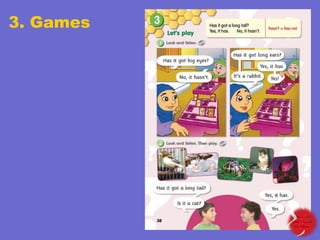
• Use of games
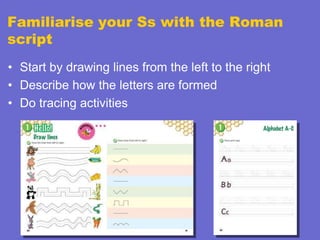
Familiarise your Ss with the Roman
script
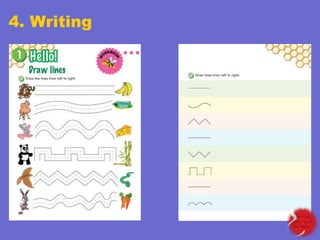
• Start by drawing lines from the left to the right
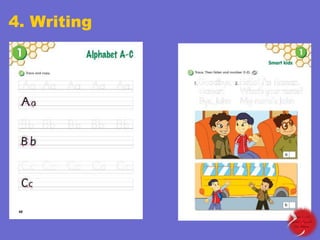
• Describe how the letters are formed
• Do tracing activities
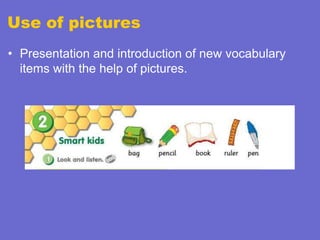
Use of pictures
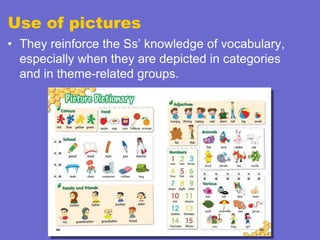
• Presentation and introduction of new vocabulary
items with the help of pictures.
Use of pictures
• They reinforce the Ss‟ knowledge of vocabulary,
especially when they are depicted in categories
and in theme-related groups.
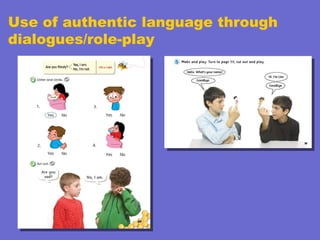
Use of authentic language through
dialogues/role-play
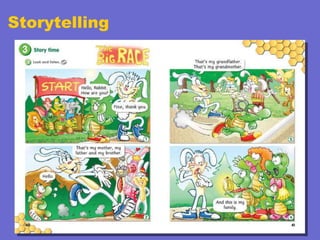
Storytelling
Use of audio-visual aids/Interactive
Whiteboard material
Advantages
• They add variation to the lesson
• Provide authentic language to the Ss
• Help teachers maintain their Ss‟ attention and
interest
• Ss are familiar with New Technologies and can
cope with it easily
• Help teachers save time
Use of audio-visual aids/Interactive
Whiteboard material
Of course remember!

• Both audio-visual aids and Interactive
Whiteboard material are aids to instruction
not ends in themselves.
• Their use requires careful planning on the
part of the teacher in order to achieve
maximum effectiveness.
• When using Internet sources we have to
check them first in terms of appropriacy.
Use of chants
Why use chants to teach young learners?
• Repetitive patterns
• Holistic learning (TRP)
• To introduce or practice language in a different
context
• A variety of new vocabulary items, functions and
structures can be presented through the use of a
chant
• To develop Ss‟ creativity
• To promote group co-ordination (action chants)
• Ss find it easier to chant
Use of chants
Ways of exploiting chants:
• Warm-up: ask general questions related to the theme of
the chant
• Give words from the chant and have students guess
what the story is about
• Find the word: Students listen for a specific word or
phrase or the number of times it occurs
• Gap-filling
• Wrong words: chants with extra words or mistakes
• Jumbled lyrics: put verses or lines in the correct order
Learning through play
Games in the primary
EFL classroom
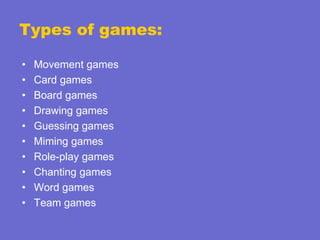
Types of games:
•
•
•
•
•
•
•
•
•
•

Movement games
Card games
Board games
Drawing games
Guessing games
Miming games
Role-play games
Chanting games
Word games
Team games
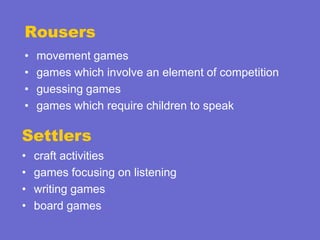
Rousers
•
•
•
•

movement games
games which involve an element of competition
guessing games
games which require children to speak

Settlers
•
•
•
•

craft activities
games focusing on listening
writing games
board games
Role of games
You can use games to:

•
•
•
•

introduce new material
practise recently learned language items
revise, consolidate language
relax or energise a class
COURSE BOOK
( CB )
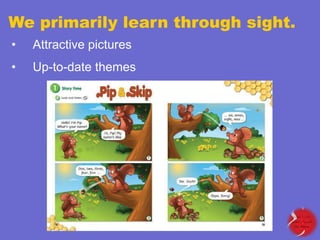
We primarily learn through sight.
•

Attractive pictures

•

Up-to-date themes
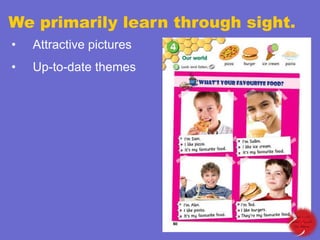
We primarily learn through sight.
•

Attractive pictures

•

Up-to-date themes
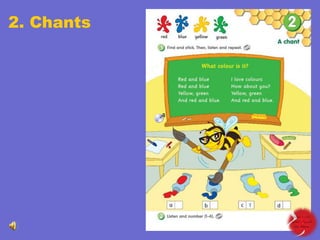
2. Chants
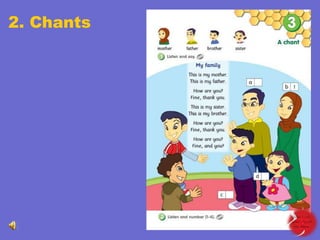
2. Chants
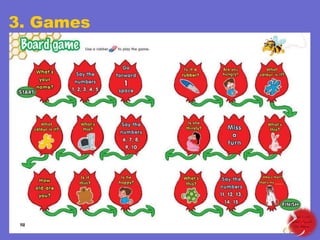
3. Games
3. Games
4. Writing
4. Writing
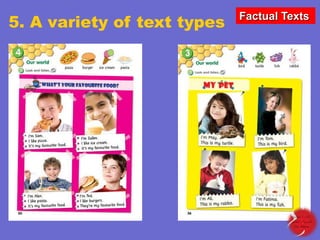
5. A variety of text types

Factual Texts
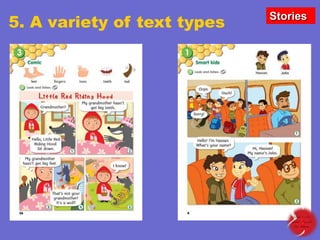
5. A variety of text types

Stories
6. Cross-curricular texts.
What is the value of cross-curricular texts?
• Topic engage Ss‟ interest.
• Help reinforce or revise knowledge about
the real world.
• Allows for a more „spherical‟ approach to
learning.
• Allows even „weak‟ Ss at English to
contribute sth.
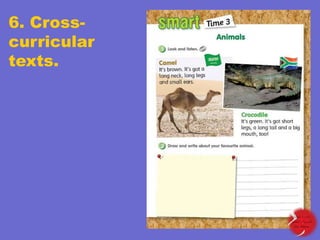
6. Crosscurricular
texts.
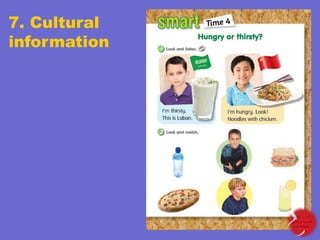
7. Cultural information
What is the value of cultural information?
• Ss learn to make connections
• To learn about cultural similarities and
differences.
• Appreciation of other cultures.
• Because learning a language is not
enough…
7. Cultural
information
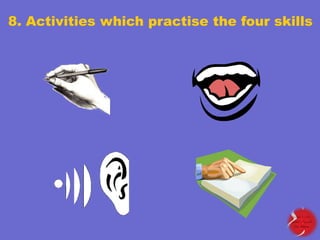
8. Activities which practise the four skills
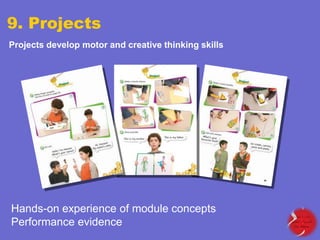
9. Projects
Projects develop motor and creative thinking skills

Hands-on experience of module concepts
Performance evidence
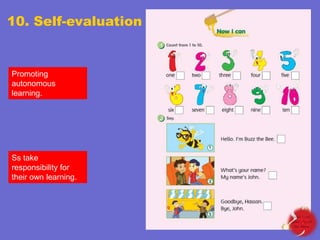
10. Self-evaluation

Promoting
autonomous
learning.

Ss take
responsibility for
their own learning.
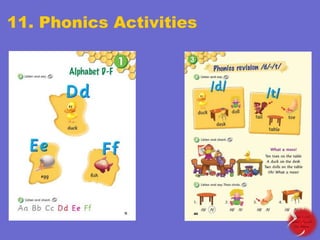
11. Phonics Activities
12. Perhaps the ideal CB could be based
on various theories / approaches.

• choose a SB that‟s eclectic
• combine best methods, ideas or
beliefs from many areas.
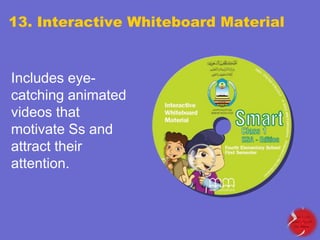
13. Interactive Whiteboard Material

Includes eyecatching animated
videos that
motivate Ss and
attract their
attention.
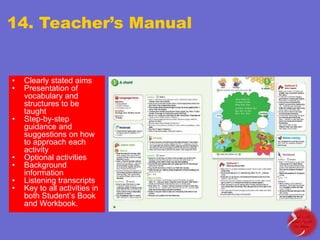
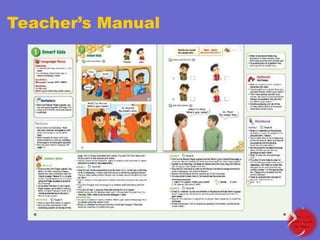
14. Teacher’s Manual

•
•

•

•
•
•
•

Clearly stated aims
Presentation of
vocabulary and
structures to be
taught
Step-by-step
guidance and
suggestions on how
to approach each
activity
Optional activities
Background
information
Listening transcripts
Key to all activities in
both Student‟s Book
and Workbook.
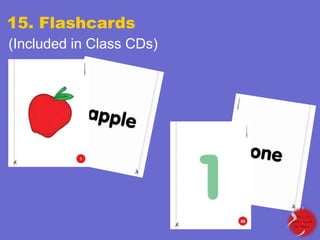
15. Flashcards
(Included in Class CDs)
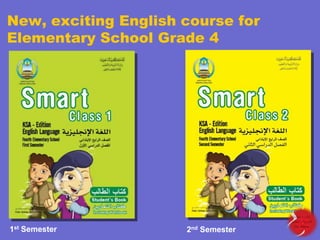
New, exciting English course for
Elementary School Grade 4

1st Semester

2nd Semester
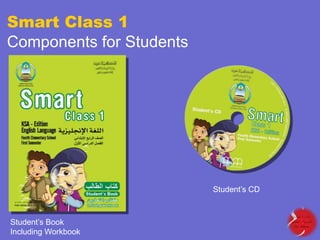
Smart Class 1
Components for Students

Student‟s CD

Student‟s Book
Including Workbook
Smart Class 1
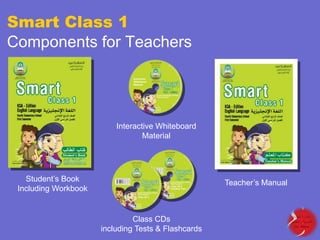
Components for Teachers

Interactive Whiteboard
Material

Student‟s Book
Including Workbook

Teacher‟s Manual

Class CDs
including Tests & Flashcards
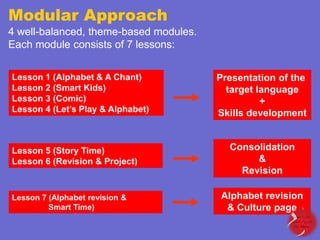
Modular Approach
4 well-balanced, theme-based modules.
Each module consists of 7 lessons:
Lesson 1 (Alphabet & A Chant)
Lesson 2 (Smart Kids)
Lesson 3 (Comic)
Lesson 4 (Let’s Play & Alphabet)

Lesson 5 (Story Time)
Lesson 6 (Revision & Project)

Lesson 7 (Alphabet revision &
Smart Time)

Presentation of the
target language
+
Skills development

Consolidation
&
Revision
Alphabet revision
& Culture page
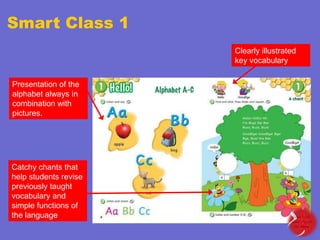
Smart Class 1
Clearly illustrated
key vocabulary
Presentation of the
alphabet always in
combination with
pictures.

Catchy chants that
help students revise
previously taught
vocabulary and
simple functions of
the language
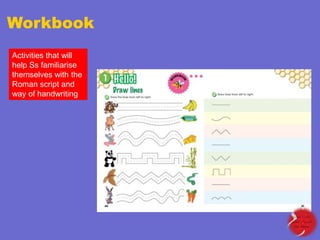
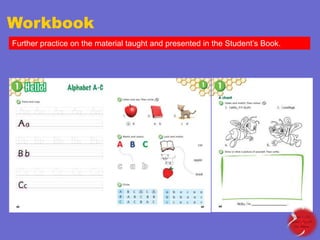
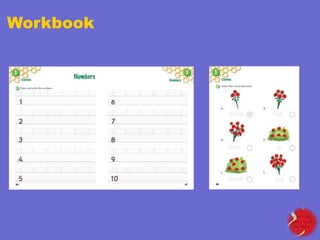
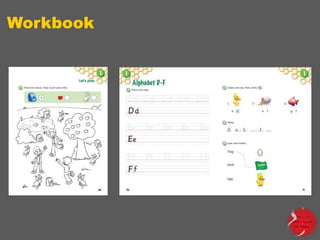
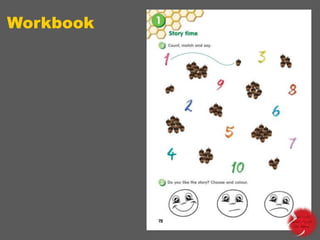
Workbook
Activities that will
help Ss familiarise
themselves with the
Roman script and
way of handwriting
Workbook
Further practice on the material taught and presented in the Student‟s Book.
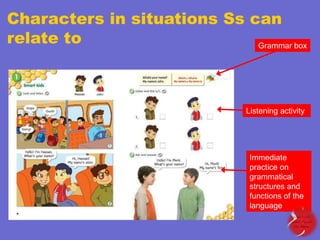
Characters in situations Ss can
relate to
Grammar box

Listening activity

Immediate
practice on
grammatical
structures and
functions of the
language
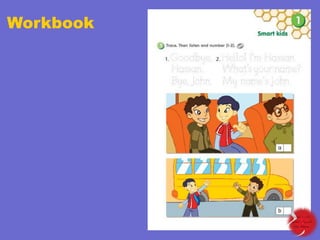
Workbook
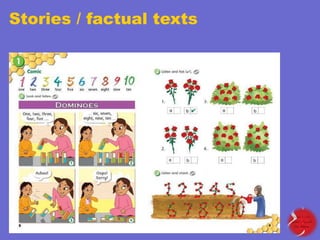
Stories / factual texts
Workbook
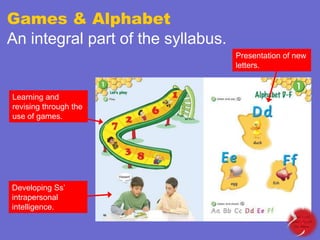
Games & Alphabet
An integral part of the syllabus.
Presentation of new
letters.

Learning and
revising through the
use of games.

Developing Ss‟
intrapersonal
intelligence.
Workbook
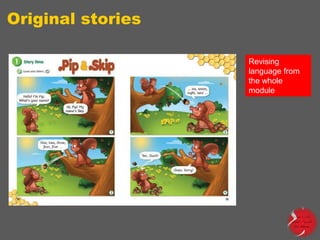
Original stories
Revising
language from
the whole
module
Workbook
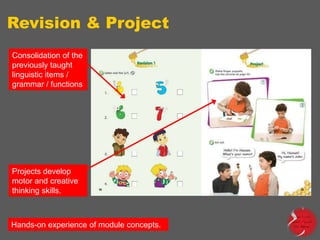
Revision & Project
Consolidation of the
previously taught
linguistic items /
grammar / functions

Projects develop
motor and creative
thinking skills.

Hands-on experience of module concepts.
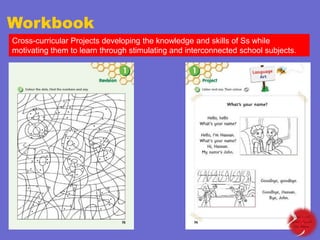
Workbook
Cross-curricular Projects developing the knowledge and skills of Ss while
motivating them to learn through stimulating and interconnected school subjects.
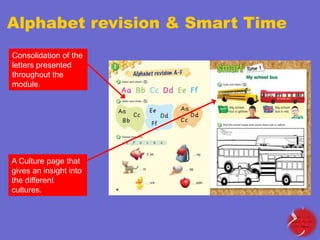
Alphabet revision & Smart Time
Consolidation of the
letters presented
throughout the
module.

A Culture page that
gives an insight into
the different
cultures.
Extra Material in Student’s Book
• Board game
• Picture Dictionary
• Cut-outs

• Stickers
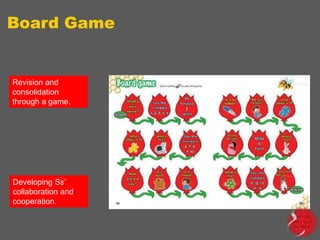
Board Game

Revision and
consolidation
through a game.

Developing Ss‟
collaboration and
cooperation.
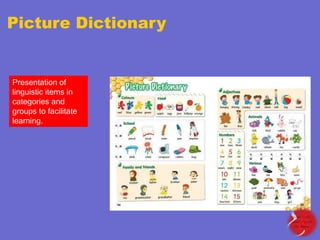
Picture Dictionary

Presentation of
linguistic items in
categories and
groups to facilitate
learning.
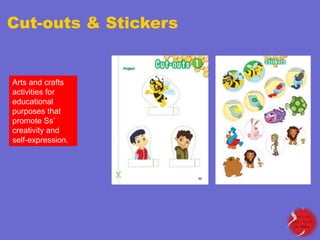
Cut-outs & Stickers

Arts and crafts
activities for
educational
purposes that
promote Ss‟
creativity and
self-expression.
Teacher’s book
Teacher’s Manual
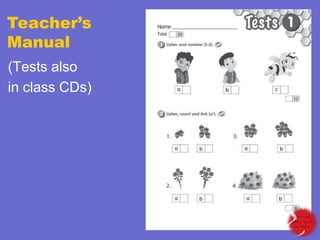
Teacher’s
Manual
(Tests also
in class CDs)
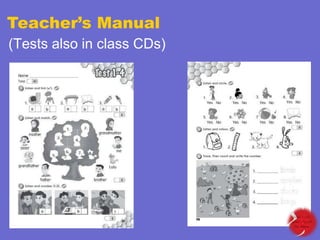
Teacher’s Manual
(Tests also in class CDs)
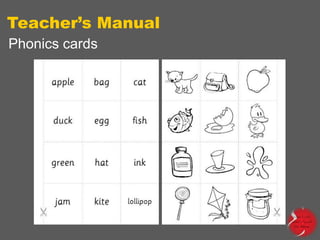
Teacher’s Manual
Phonics cards
Weekly pacing chart:

For a sixteen-week semester, in which Ss
have two sessions per week.
Holidays have also been taken into
consideration.
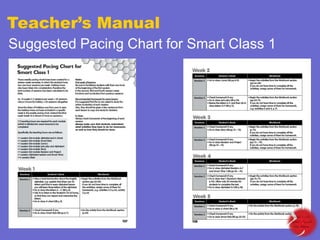
Teacher’s Manual
Suggested Pacing Chart for Smart Class 1
Model Lesson Presentation
DVD
Interactive Whiteboard
Material Demos
CD
Thank you for your
presence and for your
cooperation.
We hope to see you soon

Smart class 1 training program-teachers2