Speaking
Definition
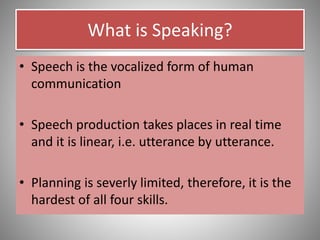
What is Speaking?
• Speech is the vocalized form of human
communication
• Speech production takes places in real time
and it is linear, i.e. utterance by utterance.
• Planning is severly limited, therefore, it is the
hardest of all four skills.
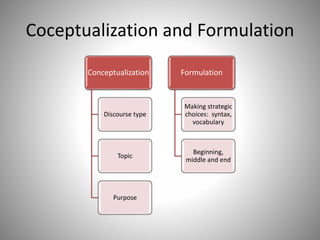
Coceptualization and Formulation
Conceptualization
Discourse type
Topic
Purpose
Formulation
Making strategic
choices: syntax,
vocabulary
Beginning,
middle and end
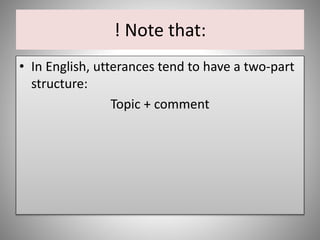
! Note that:
• In English, utterances tend to have a two-part
structure:
Topic + comment
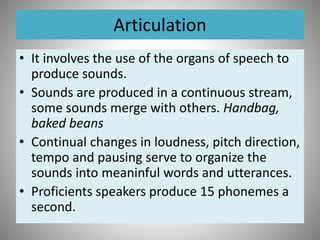
Articulation
• It involves the use of the organs of speech to
produce sounds.
• Sounds are produced in a continuous stream,
some sounds merge with others. Handbag,
baked beans
• Continual changes in loudness, pitch direction,
tempo and pausing serve to organize the
sounds into meaninful words and utterances.
• Proficients speakers produce 15 phonemes a
second.
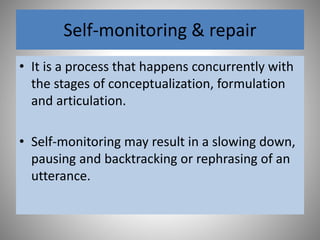
Self-monitoring & repair
• It is a process that happens concurrently with
the stages of conceptualization, formulation
and articulation.
• Self-monitoring may result in a slowing down,
pausing and backtracking or rephrasing of an
utterance.
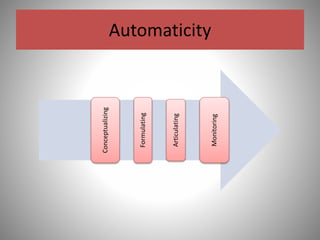
Automaticity
Conceptualizing
Formulating
Articulating
Monitoring
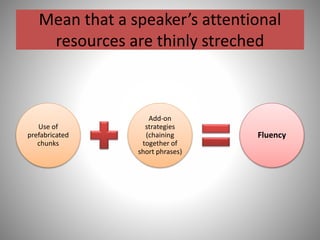
Use of
prefabricated
chunks
Add-on
strategies
(chaining
together of
short phrases)
Fluency
Mean that a speaker’s attentional
resources are thinly streched
! Note that:
Being under pressure or tired will affect a
speaker’s performance
! Note that:
• Speaking is like any other skill such as driving
or playing a musical instrument: the more you
practice, the more likely you are to be able to
chunk small units into larger ones.
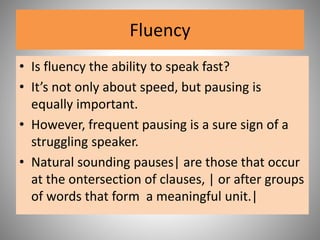
Fluency
• Is fluency the ability to speak fast?
• It’s not only about speed, but pausing is
equally important.
• However, frequent pausing is a sure sign of a
struggling speaker.
• Natural sounding pauses| are those that occur
at the ontersection of clauses, | or after groups
of words that form a meaningful unit.|
Fluency
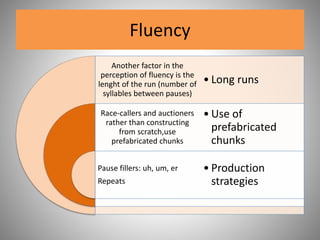
Another factor in the
perception of fluency is the
lenght of the run (number of
syllables between pauses)
Race-callers and auctioners
rather than constructing
from scratch,use
prefabricated chunks
Pause fillers: uh, um, er
Repeats
• Long runs
• Use of
prefabricated
chunks
• Production
strategies
Interaction and turn-taking
• Sometimes, a face-to-face dialogue is involved
in speaking.
• Turn-taking is negotiated because speakers
are familiar with the rules and skills of turn-
taking. Two rules are to be followed:
 Long silences are to be avoided
 Listen when other speakers are speaking
Discourse markers
• That reminds me. (I’m continuing with the same topic)
• By the way… (I’m indicating a topic change)
• Well, anyway.. (I’m returning to the topic)
• Like I say… (I’m repeating what I said before)
• Yes, but.. (I’m indicating a difference of opinion)
• Yes, no I know.. (I’m indicating agreement with a negative
idea)
• Uh-huh… (I’m listening)
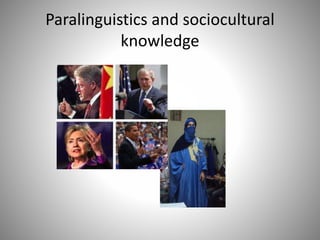
Paralinguistics and sociocultural
knowledge
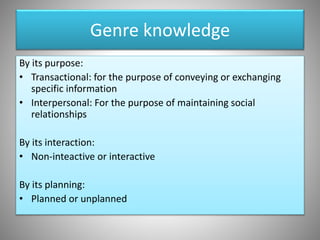
Genre knowledge
By its purpose:
• Transactional: for the purpose of conveying or exchanging
specific information
• Interpersonal: For the purpose of maintaining social
relationships
By its interaction:
• Non-inteactive or interactive
By its planning:
• Planned or unplanned
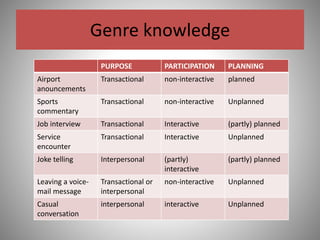
Genre knowledge
PURPOSE PARTICIPATION PLANNING
Airport
anouncements
Transactional non-interactive planned
Sports
commentary
Transactional non-interactive Unplanned
Job interview Transactional Interactive (partly) planned
Service
encounter
Transactional Interactive Unplanned
Joke telling Interpersonal (partly)
interactive
(partly) planned
Leaving a voice-
mail message
Transactional or
interpersonal
non-interactive Unplanned
Casual
conversation
interpersonal interactive Unplanned
The difference between written and
spoken discourse
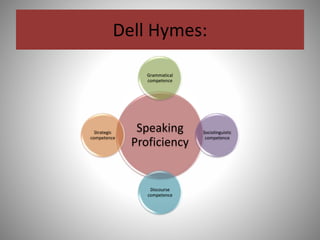
Dell Hymes:
Speaking
Proficiency
Grammatical
competence
Sociolinguistic
competence
Discourse
competence
Strategic
competence

Speaking skill presentation

  • 1.
  • 2.
    What is Speaking? •Speech is the vocalized form of human communication • Speech production takes places in real time and it is linear, i.e. utterance by utterance. • Planning is severly limited, therefore, it is the hardest of all four skills.
  • 3.
    Coceptualization and Formulation Conceptualization Discoursetype Topic Purpose Formulation Making strategic choices: syntax, vocabulary Beginning, middle and end
  • 4.
    ! Note that: •In English, utterances tend to have a two-part structure: Topic + comment
  • 5.
    Articulation • It involvesthe use of the organs of speech to produce sounds. • Sounds are produced in a continuous stream, some sounds merge with others. Handbag, baked beans • Continual changes in loudness, pitch direction, tempo and pausing serve to organize the sounds into meaninful words and utterances. • Proficients speakers produce 15 phonemes a second.
  • 6.
    Self-monitoring & repair •It is a process that happens concurrently with the stages of conceptualization, formulation and articulation. • Self-monitoring may result in a slowing down, pausing and backtracking or rephrasing of an utterance.
  • 7.
  • 8.
    Use of prefabricated chunks Add-on strategies (chaining together of shortphrases) Fluency Mean that a speaker’s attentional resources are thinly streched
  • 9.
    ! Note that: Beingunder pressure or tired will affect a speaker’s performance
  • 10.
    ! Note that: •Speaking is like any other skill such as driving or playing a musical instrument: the more you practice, the more likely you are to be able to chunk small units into larger ones.
  • 11.
    Fluency • Is fluencythe ability to speak fast? • It’s not only about speed, but pausing is equally important. • However, frequent pausing is a sure sign of a struggling speaker. • Natural sounding pauses| are those that occur at the ontersection of clauses, | or after groups of words that form a meaningful unit.|
  • 12.
    Fluency Another factor inthe perception of fluency is the lenght of the run (number of syllables between pauses) Race-callers and auctioners rather than constructing from scratch,use prefabricated chunks Pause fillers: uh, um, er Repeats • Long runs • Use of prefabricated chunks • Production strategies
  • 13.
    Interaction and turn-taking •Sometimes, a face-to-face dialogue is involved in speaking. • Turn-taking is negotiated because speakers are familiar with the rules and skills of turn- taking. Two rules are to be followed:  Long silences are to be avoided  Listen when other speakers are speaking
  • 14.
    Discourse markers • Thatreminds me. (I’m continuing with the same topic) • By the way… (I’m indicating a topic change) • Well, anyway.. (I’m returning to the topic) • Like I say… (I’m repeating what I said before) • Yes, but.. (I’m indicating a difference of opinion) • Yes, no I know.. (I’m indicating agreement with a negative idea) • Uh-huh… (I’m listening)
  • 15.
  • 16.
    Genre knowledge By itspurpose: • Transactional: for the purpose of conveying or exchanging specific information • Interpersonal: For the purpose of maintaining social relationships By its interaction: • Non-inteactive or interactive By its planning: • Planned or unplanned
  • 17.
    Genre knowledge PURPOSE PARTICIPATIONPLANNING Airport anouncements Transactional non-interactive planned Sports commentary Transactional non-interactive Unplanned Job interview Transactional Interactive (partly) planned Service encounter Transactional Interactive Unplanned Joke telling Interpersonal (partly) interactive (partly) planned Leaving a voice- mail message Transactional or interpersonal non-interactive Unplanned Casual conversation interpersonal interactive Unplanned
  • 18.
    The difference betweenwritten and spoken discourse
  • 19.