The Adult Learner Free powerpoints at  http://www.worldofteaching.com
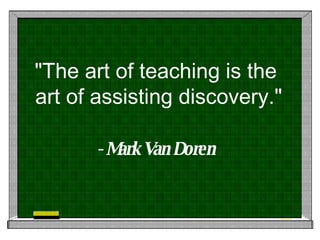
"The art of teaching is the  art of assisting discovery." - Mark Van Doren
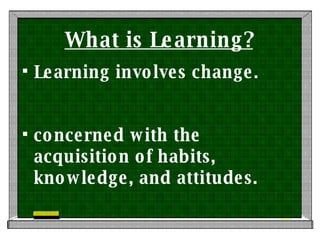
What is Learning? Learning involves change.   concerned with the acquisition of habits, knowledge, and attitudes.
What is Learning? It enables the individual to make both personal and social adjustments.
What is Learning? Learning is a change in the individual, due to the interaction of that individual, and his environment, which fills a need and makes him more capable of dealing adequately with his environment.
What is learning? Learning is a change in human disposition or capability, which can be retained and applied.
Key Assumptions about  Adult Learners: Adults are motivated to learn as they experience needs and interests that learning will satisfy.
Key Assumptions about  Adult Learners: 2.  Experience is the richest  source for adults’ learning.
Key Assumptions about  Adult Learners: 3.  Adults have a need to  be  self-directing.
Dewey’s Key Concepts of Teaching: All genuine education comes about through experience. Democracy/Participation - promotes quality human experience
Dewey’s Key Concepts of Teaching: Continuity - builds upon experiences that are worth while Interaction/Participative- it’s a social process

What Adults Need to Know Prior to Learning: how learning will be conducted what will be learned why it will be valuable
"Anyone who stops learning is old, whether at twenty or eighty. Anyone who keeps learning  stays young." - Henry Ford
Breakdown of the  Principals of Adult Learning Learning is enhanced when it can immediately be applied in a real-life context.
Learning is enhanced when  adult learners have control  or influence over their  educational experiences.
Learning depends  on past  and current experiences.
Learning is enhanced  when  people are active participants.
Learning requires an environment  of comfort and respect.
Learning is enhanced  when  self-directed.
Adult learning is enhanced when participants  experience success.
KWL  What do we know ? What do we want to know ? What did we learn ?
“ Show me and I forget; Teach me and I remember;  Involve me and I learn.” - B. Franklin
Jane Vella’s  12 Principles of  teaching adults
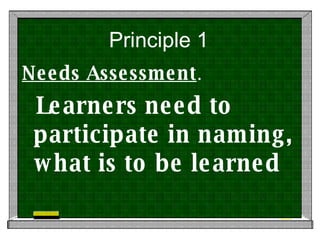
Principle 1 Needs Assessment .  Learners need to participate in naming, what is to be learned
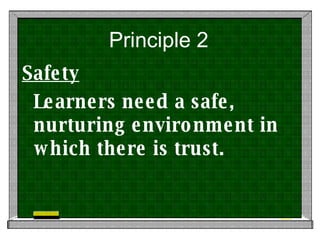
Principle 2 Safety Learners need a safe, nurturing environment in which there is trust.
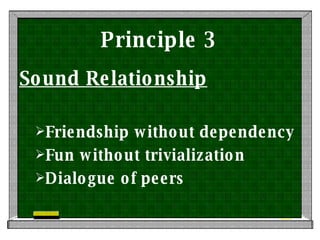
Principle 3 Sound Relationship Friendship without dependency Fun without trivialization Dialogue of peers
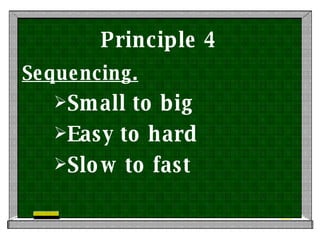
Principle 4 Sequencing. Small to big Easy to hard Slow to fast
 
Principle 5 Action with reflection. Description / Analysis /  Application / Implementation
Principle 6 Control. Learners as subjects.  Learners as decision makers.
Principle 7 Feelings / Emotions Learning through pictures / sound / opinion / discussion. Learning through the learners experiences / beliefs.
Principle 8 Immediacy. Learning that is practical, can be used in their workplace, learning directly relevant to tomorrow.
Principle 9 Clear Roles. Clearly defined roles and who does what in the learning process.
Principle 10 Teamwork. A social aspect to the learning. Adults need to network, learn by facilitation with other peers.
Principle 11 Engagement. Learners are active participants with an investment in the learning beyond the classroom.
Principle 12 Accountability. Learners expect results. What was planned for should be seen/reviewed in an outcome.
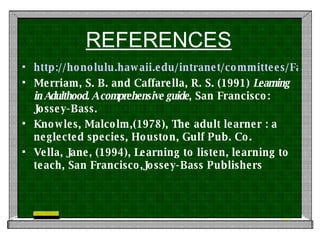
REFERENCES http://honolulu.hawaii.edu/intranet/committees/FacDevCom/guidebk/teachtip/adults-1.htm Merriam, S. B. and Caffarella, R. S. (1991)  Learning in Adulthood. A comprehensive guide , San Francisco: Jossey-Bass.  Knowles, Malcolm,(1978),  The adult learner : a neglected species , Houston, Gulf Pub. Co.  Vella, Jane, (1994), Learning to listen, learning to teach, San Francisco,Jossey-Bass Publishers
WWW.DDD.BATCAVE.NET EFL CLASSROOM http://eflclassroom.ning.com

Teaching Adults

  • 1.
    The Adult LearnerFree powerpoints at http://www.worldofteaching.com
  • 2.
    "The art ofteaching is the art of assisting discovery." - Mark Van Doren
  • 3.
    What is Learning?Learning involves change. concerned with the acquisition of habits, knowledge, and attitudes.
  • 4.
    What is Learning?It enables the individual to make both personal and social adjustments.
  • 5.
    What is Learning?Learning is a change in the individual, due to the interaction of that individual, and his environment, which fills a need and makes him more capable of dealing adequately with his environment.
  • 6.
    What is learning?Learning is a change in human disposition or capability, which can be retained and applied.
  • 7.
    Key Assumptions about Adult Learners: Adults are motivated to learn as they experience needs and interests that learning will satisfy.
  • 8.
    Key Assumptions about Adult Learners: 2. Experience is the richest source for adults’ learning.
  • 9.
    Key Assumptions about Adult Learners: 3. Adults have a need to be self-directing.
  • 10.
    Dewey’s Key Conceptsof Teaching: All genuine education comes about through experience. Democracy/Participation - promotes quality human experience
  • 11.
    Dewey’s Key Conceptsof Teaching: Continuity - builds upon experiences that are worth while Interaction/Participative- it’s a social process
  • 12.
    What Adults Needto Know Prior to Learning: how learning will be conducted what will be learned why it will be valuable
  • 13.
    "Anyone who stopslearning is old, whether at twenty or eighty. Anyone who keeps learning stays young." - Henry Ford
  • 14.
    Breakdown of the Principals of Adult Learning Learning is enhanced when it can immediately be applied in a real-life context.
  • 15.
    Learning is enhancedwhen adult learners have control or influence over their educational experiences.
  • 16.
    Learning depends on past and current experiences.
  • 17.
    Learning is enhanced when people are active participants.
  • 18.
    Learning requires anenvironment of comfort and respect.
  • 19.
    Learning is enhanced when self-directed.
  • 20.
    Adult learning isenhanced when participants experience success.
  • 21.
    KWL Whatdo we know ? What do we want to know ? What did we learn ?
  • 22.
    “ Show meand I forget; Teach me and I remember; Involve me and I learn.” - B. Franklin
  • 23.
    Jane Vella’s 12 Principles of teaching adults
  • 24.
    Principle 1 NeedsAssessment . Learners need to participate in naming, what is to be learned
  • 25.
    Principle 2 SafetyLearners need a safe, nurturing environment in which there is trust.
  • 26.
    Principle 3 SoundRelationship Friendship without dependency Fun without trivialization Dialogue of peers
  • 27.
    Principle 4 Sequencing.Small to big Easy to hard Slow to fast
  • 28.
  • 29.
    Principle 5 Actionwith reflection. Description / Analysis / Application / Implementation
  • 30.
    Principle 6 Control.Learners as subjects. Learners as decision makers.
  • 31.
    Principle 7 Feelings/ Emotions Learning through pictures / sound / opinion / discussion. Learning through the learners experiences / beliefs.
  • 32.
    Principle 8 Immediacy.Learning that is practical, can be used in their workplace, learning directly relevant to tomorrow.
  • 33.
    Principle 9 ClearRoles. Clearly defined roles and who does what in the learning process.
  • 34.
    Principle 10 Teamwork.A social aspect to the learning. Adults need to network, learn by facilitation with other peers.
  • 35.
    Principle 11 Engagement.Learners are active participants with an investment in the learning beyond the classroom.
  • 36.
    Principle 12 Accountability.Learners expect results. What was planned for should be seen/reviewed in an outcome.
  • 37.
    REFERENCES http://honolulu.hawaii.edu/intranet/committees/FacDevCom/guidebk/teachtip/adults-1.htm Merriam,S. B. and Caffarella, R. S. (1991) Learning in Adulthood. A comprehensive guide , San Francisco: Jossey-Bass. Knowles, Malcolm,(1978), The adult learner : a neglected species , Houston, Gulf Pub. Co. Vella, Jane, (1994), Learning to listen, learning to teach, San Francisco,Jossey-Bass Publishers
  • 38.
    WWW.DDD.BATCAVE.NET EFL CLASSROOMhttp://eflclassroom.ning.com

Editor's Notes

  • #2 The Adult Learner by Cathy Abraham Credit to: PA Pathways training manual