Learner
Centered
Teaching
Lt. Dr. B. Ajantha Parthasarathi,
Assistant Professor of English,
Sri SRNM College, Sattur.
LEARNER-CENTERED APPROACH
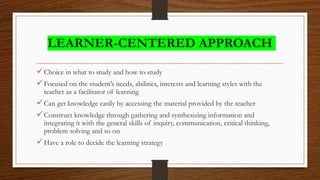
Choice in what to study and how to study
Focused on the student’s needs, abilities, interests and learning styles with the
teacher as a facilitator of learning
Can get knowledge easily by accessing the material provided by the teacher
Construct knowledge through gathering and synthesizing information and
integrating it with the general skills of inquiry, communication, critical thinking,
problem solving and so on
Have a role to decide the learning strategy
LEARNER-CENTERED APPROACH
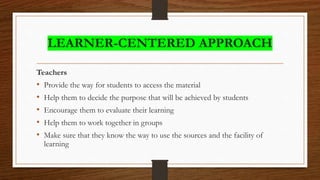
Teachers
• Provide the way for students to access the material
• Help them to decide the purpose that will be achieved by students
• Encourage them to evaluate their learning
• Help them to work together in groups
• Make sure that they know the way to use the sources and the facility of
learning
LEARNER-CENTERED APPROACH
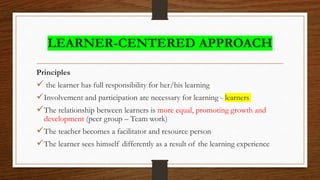
Principles
 the learner has full responsibility for her/his learning
Involvement and participation are necessary for learning - learners
The relationship between learners is more equal, promoting growth and
development (peer group – Team work)
The teacher becomes a facilitator and resource person
The learner sees himself differently as a result of the learning experience
LEARNER-CENTERED APPROACH
Characteristics
 Engages students in the hard, messy work of learning. Teachers are doing too many learning tasks for
students – ask the questions, call on students, add details to their answers, offer the examples, organize the
content, do the preview and the review – teachers are working much harder than students – get far more
practice than the students.
 Explicit skill instruction – teachers teach students how to think, solve problems, evaluate evidence, analyze
arguments, generate hypotheses – do not assume that students pick up these skills on their own,
automatically.
 Encourages students to reflect on what they are learning and how they are learning it – include assignment
(seminar, quiz, role play, debate, elocution, model making, skit, ) components in which students reflect,
analyze and critique what they are learning and how they are learning it – make students aware of themselves
as learners and to make learning skills something students want to develop
LEARNER-CENTERED APPROACH
Characteristics
Control over learning processes – teachers decide
what students should learn,
how they learn it,
the pace at which they learn,
the conditions under which they learn
teachers determine whether students have learned
Encourages collaboration – teachers work to develop structures that promote
shared commitments to learning (peer group learning/team work)
LEARNER-CENTERED APPROACH
Advantages
• Learn important communicative and collaborative skills through group work
• More interested in learning activities when they can interact with one another
and participate actively
• Learn to direct their own learning, ask questions and complete tasks
independently
LEARNER-CENTERED APPROACH
Disadvantages
× Students are talking, classrooms are often busy, noisy and chaotic
× Teachers must attempt to manage all students activities at once, which can
be difficult when students are working on different stages of the same
project
× The teacher does not deliver instruction to all students at once, some
students may miss important facts
× Some students prefer to work alone, so group work can become a bit difficult
for them

Learner Centered Teaching

  • 1.
    Learner Centered Teaching Lt. Dr. B.Ajantha Parthasarathi, Assistant Professor of English, Sri SRNM College, Sattur.
  • 2.
    LEARNER-CENTERED APPROACH Choice inwhat to study and how to study Focused on the student’s needs, abilities, interests and learning styles with the teacher as a facilitator of learning Can get knowledge easily by accessing the material provided by the teacher Construct knowledge through gathering and synthesizing information and integrating it with the general skills of inquiry, communication, critical thinking, problem solving and so on Have a role to decide the learning strategy
  • 3.
    LEARNER-CENTERED APPROACH Teachers • Providethe way for students to access the material • Help them to decide the purpose that will be achieved by students • Encourage them to evaluate their learning • Help them to work together in groups • Make sure that they know the way to use the sources and the facility of learning
  • 4.
    LEARNER-CENTERED APPROACH Principles  thelearner has full responsibility for her/his learning Involvement and participation are necessary for learning - learners The relationship between learners is more equal, promoting growth and development (peer group – Team work) The teacher becomes a facilitator and resource person The learner sees himself differently as a result of the learning experience
  • 5.
    LEARNER-CENTERED APPROACH Characteristics  Engagesstudents in the hard, messy work of learning. Teachers are doing too many learning tasks for students – ask the questions, call on students, add details to their answers, offer the examples, organize the content, do the preview and the review – teachers are working much harder than students – get far more practice than the students.  Explicit skill instruction – teachers teach students how to think, solve problems, evaluate evidence, analyze arguments, generate hypotheses – do not assume that students pick up these skills on their own, automatically.  Encourages students to reflect on what they are learning and how they are learning it – include assignment (seminar, quiz, role play, debate, elocution, model making, skit, ) components in which students reflect, analyze and critique what they are learning and how they are learning it – make students aware of themselves as learners and to make learning skills something students want to develop
  • 6.
    LEARNER-CENTERED APPROACH Characteristics Control overlearning processes – teachers decide what students should learn, how they learn it, the pace at which they learn, the conditions under which they learn teachers determine whether students have learned Encourages collaboration – teachers work to develop structures that promote shared commitments to learning (peer group learning/team work)
  • 7.
    LEARNER-CENTERED APPROACH Advantages • Learnimportant communicative and collaborative skills through group work • More interested in learning activities when they can interact with one another and participate actively • Learn to direct their own learning, ask questions and complete tasks independently
  • 8.
    LEARNER-CENTERED APPROACH Disadvantages × Studentsare talking, classrooms are often busy, noisy and chaotic × Teachers must attempt to manage all students activities at once, which can be difficult when students are working on different stages of the same project × The teacher does not deliver instruction to all students at once, some students may miss important facts × Some students prefer to work alone, so group work can become a bit difficult for them