ADULT LEARNING PRINCIPLES
“ANDRAGOGY”
Adult learning is defined as the range of
the formal, non formal and informal
learning activities which are undertaken
by adults after a break since leaving
education and training and which results
in the acquisition of new knowledge and
skills
To understand the adult learning
principles
To know personal needs of learning
To get tips to enhance learnings
practice
Dr Saroj Sawant/ drsaroj2112@gmail.com 3
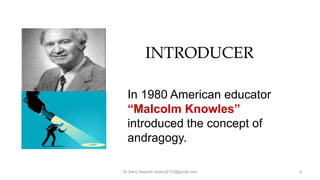
INTRODUCER
In 1980 American educator
“Malcolm Knowles”
introduced the concept of
andragogy.
Dr Saroj Sawant/ drsaroj2112@gmail.com 4
Adult learning theory is rooted in
andragogy, the practice of teaching
adults, as opposed to pedagogy, the
practice of teaching children.
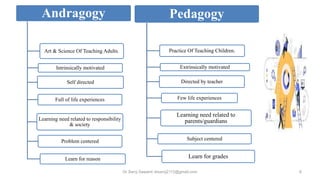
Andragogy
Art & Science Of Teaching Adults.
Intrinsically motivated
Self directed
Full of life experiences
Learning need related to responsibility
& society
Problem centered
Learn for reason
Pedagogy
Practice Of Teaching Children.
Extrinsically motivated
Directed by teacher
Few life experiences
Learning need related to
parents/guardians
Subject centered
Learn for grades
Dr Saroj Sawant/ drsaroj2112@gmail.com 6
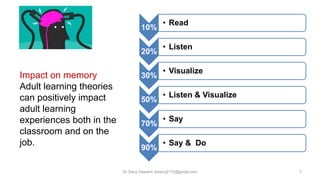
Impact on memory
Adult learning theories
can positively impact
adult learning
experiences both in the
classroom and on the
job.
10%
• Read
20%
• Listen
30%
• Visualize
50%
• Listen & Visualize
70%
• Say
90%
• Say & Do
Dr Saroj Sawant/ drsaroj2112@gmail.com 7
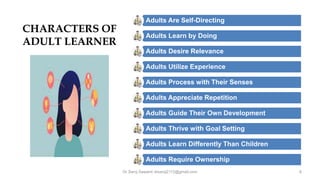
CHARACTERS OF
ADULT LEARNER
Adults Are Self-Directing
Adults Learn by Doing
Adults Desire Relevance
Adults Utilize Experience
Adults Process with Their Senses
Adults Appreciate Repetition
Adults Guide Their Own Development
Adults Thrive with Goal Setting
Adults Learn Differently Than Children
Adults Require Ownership
Dr Saroj Sawant/ drsaroj2112@gmail.com 8
Challenges Of
Adult Learning
Language
Expectations
Personal
Factors-Traits/
Age/
Self Doubt/
Content
Competition
Finances
Time
Dr Saroj Sawant/ drsaroj2112@gmail.com 9
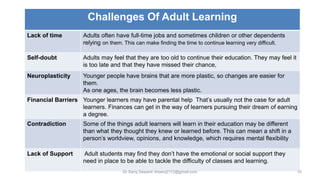
Challenges Of Adult Learning
Lack of time Adults often have full-time jobs and sometimes children or other dependents
relying on them. This can make finding the time to continue learning very difficult.
Self-doubt Adults may feel that they are too old to continue their education. They may feel it
is too late and that they have missed their chance,
Neuroplasticity Younger people have brains that are more plastic, so changes are easier for
them.
As one ages, the brain becomes less plastic.
Financial Barriers Younger learners may have parental help That’s usually not the case for adult
learners. Finances can get in the way of learners pursuing their dream of earning
a degree.
Contradiction Some of the things adult learners will learn in their education may be different
than what they thought they knew or learned before. This can mean a shift in a
person’s worldview, opinions, and knowledge, which requires mental flexibility
Lack of Support Adult students may find they don’t have the emotional or social support they
need in place to be able to tackle the difficulty of classes and learning.
Dr Saroj Sawant/ drsaroj2112@gmail.com 10
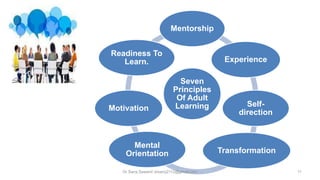
Seven
Principles
Of Adult
Learning
Mentorship
Experience
Self-
direction
Transformation
Mental
Orientation
Motivation
Readiness To
Learn.
Dr Saroj Sawant/ drsaroj2112@gmail.com 11
Self-directed
“Learning at one’s own pace in one’s
own way”
• What You Need To Learn
• Set Your Own Goals,
• Track Down Materials,
• Create A Plan To Foster Your Own
Learning,
• Then Self-evaluate.
Dr Saroj Sawant/ drsaroj2112@gmail.com 12
Transformational
“Learning can change your perspective on
the world and vice-versa whether from a
teacher, a mentor or some other channel”
• new information can shift a person’s
worldview
• challenge their preconceived notions.
• In shifting the learner’s outlook, the
information becomes both applied and
retained.
Dr Saroj Sawant/ drsaroj2112@gmail.com 13
Experiential
“Focuses on developing life
experience or "hands-on"
learning”
• Participate physically in the
learning environment ("getting
your hands dirty")
• Reflecting on what worked and
what didn’t.
Dr Saroj Sawant/ drsaroj2112@gmail.com 14
Mentorship
“Learning from an outside mentor
(established figure) in a field”
• Mentors and mentees can learn from each
other.
(Mentees ask challenging questions,
mentors train mentee with
understanding of the material.)
Dr Saroj Sawant/ drsaroj2112@gmail.com 15
Orientation to (or of)
learning
“Adults need to reframe their
emotions and assumptions around
the experience and value of
learning”
• Educators instruct their students
on how to apply new lessons in
the real world, which helps
students retain information.
Dr Saroj Sawant/ drsaroj2112@gmail.com 16
Motivation
“Children are motivated by parents
and laws requiring their education;
adults often have internal
motivation”
• Adults put in the time and effort
to learn because they’ve
typically internalized their
motivation, whether it’s career
success, the prestige of a
degree or a better salary.
Dr Saroj Sawant/ drsaroj2112@gmail.com 17
“As a child matures, they reach a certain threshold of
learning readiness (such as reading or basic math facts),
but adults have already been through this development
and need to rely on past experience or life changes to
develop a renewed readiness”
Renewing your readiness to learn as an adult often
happens by way of a situational trigger like-
• lose your job
• want to switch careers,
• your next promotion hinges on mastering a skill.
Dr Saroj Sawant/ drsaroj2112@gmail.com 18
Benefits of
knowledge of adult
leaning principles
Identify early on the
"why" behind your
decision to enroll in a
university
Tend to draw on
their life
experiences to
learn new
information
Approach classes,
lessons and even
reading material
from that
perspective
Looking to stay up-
to-date in your field
Enhance desire
to learn when
transitioning to a
new role
Dr Saroj Sawant/ drsaroj2112@gmail.com 19
Tips to improve
learning
Dr Saroj Sawant/ drsaroj2112@gmail.com 20
Dr Saroj Sawant/ drsaroj2112@gmail.com 21

Adult Learning Principles.pptx

  • 1.
  • 2.
    Adult learning isdefined as the range of the formal, non formal and informal learning activities which are undertaken by adults after a break since leaving education and training and which results in the acquisition of new knowledge and skills
  • 3.
    To understand theadult learning principles To know personal needs of learning To get tips to enhance learnings practice Dr Saroj Sawant/ drsaroj2112@gmail.com 3
  • 4.
    INTRODUCER In 1980 Americaneducator “Malcolm Knowles” introduced the concept of andragogy. Dr Saroj Sawant/ drsaroj2112@gmail.com 4
  • 5.
    Adult learning theoryis rooted in andragogy, the practice of teaching adults, as opposed to pedagogy, the practice of teaching children.
  • 6.
    Andragogy Art & ScienceOf Teaching Adults. Intrinsically motivated Self directed Full of life experiences Learning need related to responsibility & society Problem centered Learn for reason Pedagogy Practice Of Teaching Children. Extrinsically motivated Directed by teacher Few life experiences Learning need related to parents/guardians Subject centered Learn for grades Dr Saroj Sawant/ drsaroj2112@gmail.com 6
  • 7.
    Impact on memory Adultlearning theories can positively impact adult learning experiences both in the classroom and on the job. 10% • Read 20% • Listen 30% • Visualize 50% • Listen & Visualize 70% • Say 90% • Say & Do Dr Saroj Sawant/ drsaroj2112@gmail.com 7
  • 8.
    CHARACTERS OF ADULT LEARNER AdultsAre Self-Directing Adults Learn by Doing Adults Desire Relevance Adults Utilize Experience Adults Process with Their Senses Adults Appreciate Repetition Adults Guide Their Own Development Adults Thrive with Goal Setting Adults Learn Differently Than Children Adults Require Ownership Dr Saroj Sawant/ drsaroj2112@gmail.com 8
  • 9.
    Challenges Of Adult Learning Language Expectations Personal Factors-Traits/ Age/ SelfDoubt/ Content Competition Finances Time Dr Saroj Sawant/ drsaroj2112@gmail.com 9
  • 10.
    Challenges Of AdultLearning Lack of time Adults often have full-time jobs and sometimes children or other dependents relying on them. This can make finding the time to continue learning very difficult. Self-doubt Adults may feel that they are too old to continue their education. They may feel it is too late and that they have missed their chance, Neuroplasticity Younger people have brains that are more plastic, so changes are easier for them. As one ages, the brain becomes less plastic. Financial Barriers Younger learners may have parental help That’s usually not the case for adult learners. Finances can get in the way of learners pursuing their dream of earning a degree. Contradiction Some of the things adult learners will learn in their education may be different than what they thought they knew or learned before. This can mean a shift in a person’s worldview, opinions, and knowledge, which requires mental flexibility Lack of Support Adult students may find they don’t have the emotional or social support they need in place to be able to tackle the difficulty of classes and learning. Dr Saroj Sawant/ drsaroj2112@gmail.com 10
  • 11.
  • 12.
    Self-directed “Learning at one’sown pace in one’s own way” • What You Need To Learn • Set Your Own Goals, • Track Down Materials, • Create A Plan To Foster Your Own Learning, • Then Self-evaluate. Dr Saroj Sawant/ drsaroj2112@gmail.com 12
  • 13.
    Transformational “Learning can changeyour perspective on the world and vice-versa whether from a teacher, a mentor or some other channel” • new information can shift a person’s worldview • challenge their preconceived notions. • In shifting the learner’s outlook, the information becomes both applied and retained. Dr Saroj Sawant/ drsaroj2112@gmail.com 13
  • 14.
    Experiential “Focuses on developinglife experience or "hands-on" learning” • Participate physically in the learning environment ("getting your hands dirty") • Reflecting on what worked and what didn’t. Dr Saroj Sawant/ drsaroj2112@gmail.com 14
  • 15.
    Mentorship “Learning from anoutside mentor (established figure) in a field” • Mentors and mentees can learn from each other. (Mentees ask challenging questions, mentors train mentee with understanding of the material.) Dr Saroj Sawant/ drsaroj2112@gmail.com 15
  • 16.
    Orientation to (orof) learning “Adults need to reframe their emotions and assumptions around the experience and value of learning” • Educators instruct their students on how to apply new lessons in the real world, which helps students retain information. Dr Saroj Sawant/ drsaroj2112@gmail.com 16
  • 17.
    Motivation “Children are motivatedby parents and laws requiring their education; adults often have internal motivation” • Adults put in the time and effort to learn because they’ve typically internalized their motivation, whether it’s career success, the prestige of a degree or a better salary. Dr Saroj Sawant/ drsaroj2112@gmail.com 17
  • 18.
    “As a childmatures, they reach a certain threshold of learning readiness (such as reading or basic math facts), but adults have already been through this development and need to rely on past experience or life changes to develop a renewed readiness” Renewing your readiness to learn as an adult often happens by way of a situational trigger like- • lose your job • want to switch careers, • your next promotion hinges on mastering a skill. Dr Saroj Sawant/ drsaroj2112@gmail.com 18
  • 19.
    Benefits of knowledge ofadult leaning principles Identify early on the "why" behind your decision to enroll in a university Tend to draw on their life experiences to learn new information Approach classes, lessons and even reading material from that perspective Looking to stay up- to-date in your field Enhance desire to learn when transitioning to a new role Dr Saroj Sawant/ drsaroj2112@gmail.com 19
  • 20.
    Tips to improve learning DrSaroj Sawant/ drsaroj2112@gmail.com 20
  • 21.
    Dr Saroj Sawant/drsaroj2112@gmail.com 21