Learning Styles

How do you learn?


                    By Rhonda Fisher
What is a learning style?
How you prefer to absorb information
Approach to the learning experience
Pattern of behavior
Why is it important to know
your learning style?
Know your strengths
Know your weaknesses
Know how to adapt to learning
situations
What are types of learning
styles?
Logical/Mathematical
Linguistic/Verbal
Musical/Auditory
Spatial/Visual
Bodily/Physical
Interpersonal/Social
Intrapersonal/Solitary
Logical/Mathematical
Pattern recognition
Works well with numbers
Performs complex calculations
Remembers basics of trig & algebra
Works through problems
 systematically
Sets numerical targets
Logical/Mathematical
Likes creating agendas, itineraries,
  to-do lists
Supports point of view with statistics
  & logical examples
Picks flaws in logic in others' words,
  writing, or actions
Careers include: sciences,
  mathematics, accounting, detective
  work, law, & computer
  programming
Logical/Mathematical
Common Phrases
“That's logical.”
“Follow the process, rules, or
  procedures.”
“There's no pattern to this.”
“Let's make a list.”
“We can work this out.”
“Quantify it, or prove it!”
Logical/Mathematical
Pastimes
Brainteasers, backgammon, or chess
PC Games such as Dune II, Starcraft
  , Age of Empires, Sid Meier games,
  etc.
TV shows--Numb3rs
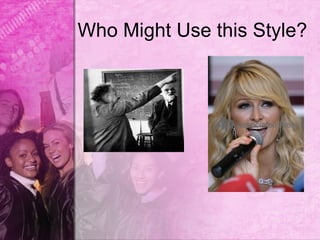
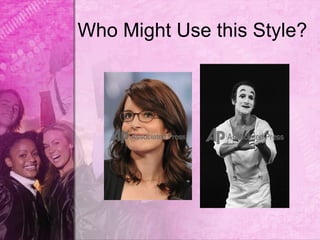
Who Might Use this Style?
Linguistic/Verbal
Prefers written or spoken word
Expresses self easily verbally or in
  writing
Loves reading & writing
Enjoys wordplay: tongue twisters,
  limericks, rhymes, double
  entendres, puns, etc.
Large vocabularies
Linguistic/Verbal
Careers: public speaking, debating,
 politics, writing, & journalism
Phrases:
   “Tell me word for word.”
  “I hear you but I'm not sure I agree.”
  “Let me spell it out.”
  “In other words...”
  “The word you are looking for is...”
Linguistic/Verbal
Learning Techniques
Mnemonics: ROYGBIV
Scripting (writing or recording)
Read dramatically (with feeling)
Roleplaying with scripts
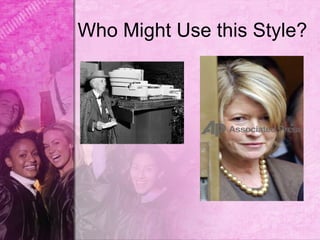
Who Might Use this Style?
Auditory/Musical
Like to work with sound & music
Good sense of pitch & rhythm
Can sing, play musical instrument, or
  identify sounds of different
  instruments
Notices background music on TV
  shows or in movies
Often hums or taps out songs
Auditory/Musical
Careers:
  Playing instrument, conducting,
    composing music, & sound
    engineering
Phrases:
  “That sounds right.”
  “Tune in to what I'm saying.”
  “That rings a bell.”
  “It's coming through loud and clear.”
  “That's music to my ears.”
Auditory/Musical
Learning Techniques
Use sound, rhyme, & music
Focus on auditory content
Use sound recording as background
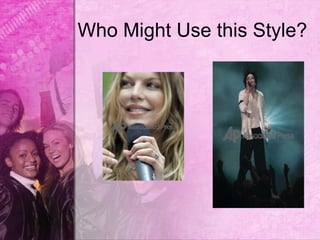
Who Might Use this Style?
Spatial/Visual Learning
Style
Prefers images, pictures, color, maps
Can easily visualize objects, plans,
  outcomes, in “mind's eye”
Good spatial sense
Rarely gets lost
Likes whiteboards, drawing,
  doodling, & scribbling
Spatial/Visual
Careers:
  Visual arts, architecture, photography,
    video or film, design, strategic
    planning, and navigation
Phrases:
  “Let's look at it differently.”
  “Let's draw a diagram.”
  “See how this works for you.”
  “I can't quite picture it.”
  “I'd like to get a different perspective.”
Spatial/Visual Learning
Techniques
Uses images, pictures, color, & other
  visual media
Use color, layout, & spatial
  organization
Mind mapping
Color pens
Diagrams
Who Might Use this Style?
Bodily/Physical
Uses body and sense of touch
Likes sport & exercise
Works on problems while going for walk or
  run
Enjoys getting “hands dirty”
Makes models
Uses gestures & body language
Likes to “jump in” playing with physical
  parts as soon as possible
Fidgets through lectures
Bodily/Physical
Careers:
  Physical work, construction, sports,
   athletics, drama, & dancing
Phrases:
  “That feels right to me.”
  “I can't get a grip on that.”
  “Get in touch with...”
  “My gut feeling is...”
Bodily/Physical Learning
Techniques
Uses touch, action, movement, and
 hands-on work
Focuses on physical sensations
Touch objects, models
Use flash cards
Draws diagrams
Roleplaying to simulate learning
 experience
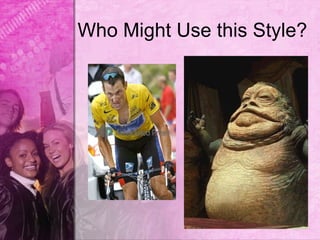
Who Might Use this Style?
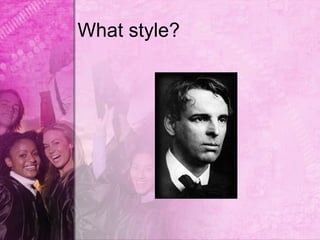
What style?
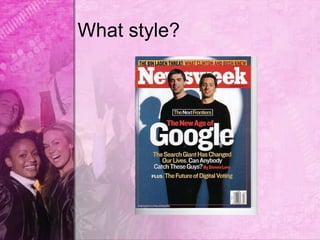
What style?
What style?
Social/Interpersonal
Communicate well with others
  verbally & nonverbally
People come to you for advice
Sensitive to others feelings,
  motivations, or moods
Enjoy teaching or counseling others
Prefer learning in groups or classes
Social/Interpersonal
Enjoy games that involve others-
 cards, board games, and team
 sports
Social/Interpersonal
Careers:
  Counseling, teaching, training,
   coaching, politics, human resources,
   etc.
Phrases:
  “Let's work together on this.”
  “Help me understand this.”
  “Let's pull some people together to
    discuss...”
  “Tell me what you are thinking.”
Solitary/Intrapersonal
Private, introspective, independent
Good concentration & focus
Self-aware
Travel to remote places, away from
  crowds
Work better alone
Solitary/Intrapersonal
Careers: authors, researchers, park
 rangers, and security guards
Common phrases:
  “I'd like some time to think it over.”
  “I'd like to get away from everyone for a
     while.”
  “I'll get back to you on that.”
Assignment
Learning Styles Inventory @
http://www.learning-styles-online.com/inventory/
Sources
AP Photo Archive
CBS's Numb3rs
Google images
Learning Style Perspectives: impact
in the classroom by Lynne Celli
Sarasin
Learning-Styles-Online.com