ROBERTITA M. FERNANDO
EDUCATION PROGRAM SUPERVISOR I, ALS
Alternative
Delivery
Modes(ADM
s)
The Department of Education is tasked
to provide quality basic education that
is equitably accessible to all and lay the
foundation for life long learning and
service for the common good.
Aside from formal education DepEd offers
alternative delivery mode of interventions to meet
the needs of young people in different
communities.
IMPORTANCE OF ADMs
The ADMs in formal basic education are
implemented to improve certain performance
indicators in order to achieve the 2015 targets of
Education For All (EFA) and the Millennium
Development Goal (MDG) on achieving the universal
primary Education.
The ADMs address the learning needs of the
marginalized pupils and those learners at risk of
dropping out in order to help them overcome social
and economic constraints in their schooling.
ADMs BOTH IN ELEMENTARY & SECONDARY LEVELS
The ADMs both at the elementary and secondary Levels
include the following:
 Elementary Level
A. Modified In-School, Off-school Approach
(MISOSA);
B. Enhanced Instructional Management by
Parents, Community and Teachers
(e- IMPACT)System;
C. Home Schooling Program
D. Multigrade Program in Philippine Education
(MPPE)
 Secondary Level
E. Dropout Reduction Program (DORP)
“THE MISOSA”
M-odified
I - n School
S - chool
O - ff
S - chool
A - pproach
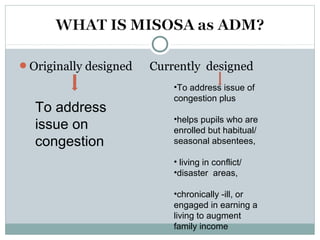
Originally designed Currently designed
To address
issue on
congestion
•To address issue of
congestion plus
•helps pupils who are
enrolled but habitual/
seasonal absentees,
• living in conflict/
•disaster areas,
•chronically -ill, or
engaged in earning a
living to augment
family income
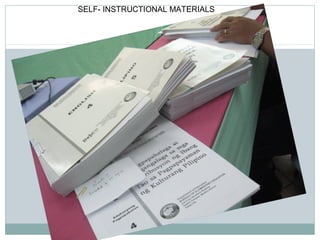
1.Use of Self-Instructional Materials
(SIMs).
 that contain the lessons to be learned
for the day.
include learning objectives,
activities to work on,
exercises and questions to answer.
enrichment activities utilizing the
community resources.
SELF- INSTRUCTIONAL MATERIALS
2.Utilization of community school
as a laboratory for learning aside
from the classroom i.e. half of the
class stays with the teacher while
the other half stays with the
teacher-facilitator in the
community school.
3. In compliance with existing
policies:
3.1.DepEd Order #23,s.2005
re time allotment
3.2. DepEd Order No. 33, s. 2004
re grading system
3.3. DepEd Order No. 53, s. 2011
re policy guidelines
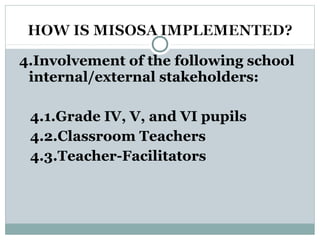
4.Involvement of the following school
internal/external stakeholders:
4.1.Grade IV, V, and VI pupils
4.2.Classroom Teachers
4.3.Teacher-Facilitators
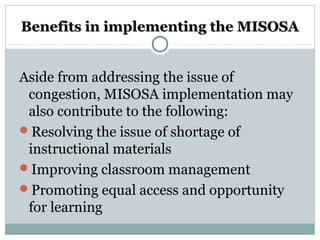
Benefits in implementing the MISOSABenefits in implementing the MISOSA
Aside from addressing the issue of
congestion, MISOSA implementation may
also contribute to the following:
Resolving the issue of shortage of
instructional materials
Improving classroom management
Promoting equal access and opportunity
for learning
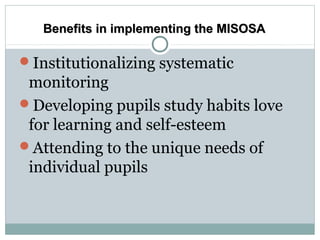
Institutionalizing systematic
monitoring
Developing pupils study habits love
for learning and self-esteem
Attending to the unique needs of
individual pupils
Benefits in implementing the MISOSABenefits in implementing the MISOSA
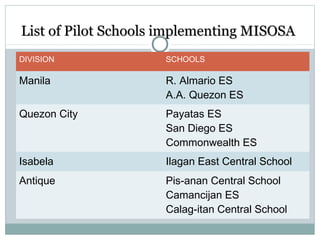
List of Pilot Schools implementing MISOSAList of Pilot Schools implementing MISOSA
DIVISION SCHOOLS
Manila R. Almario ES
A.A. Quezon ES
Quezon City Payatas ES
San Diego ES
Commonwealth ES
Isabela Ilagan East Central School
Antique Pis-anan Central School
Camancijan ES
Calag-itan Central School
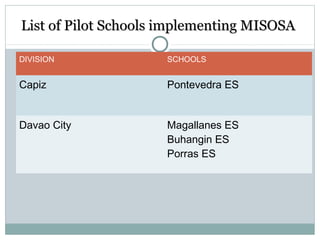
List of Pilot Schools implementing MISOSAList of Pilot Schools implementing MISOSA
DIVISION SCHOOLS
Capiz Pontevedra ES
Davao City Magallanes ES
Buhangin ES
Porras ES
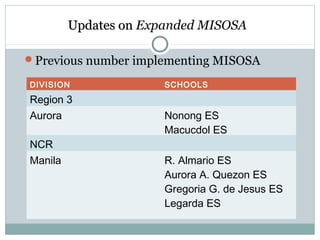
Updates onUpdates on Expanded MISOSA
Previous number implementing MISOSA
DIVISION SCHOOLS
Region 3
Aurora Nonong ES
Macucdol ES
NCR
Manila R. Almario ES
Aurora A. Quezon ES
Gregoria G. de Jesus ES
Legarda ES
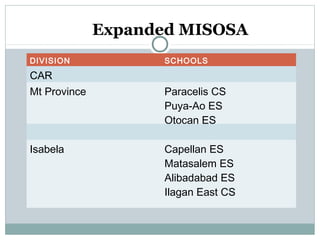
Expanded MISOSA
DIVISION SCHOOLS
CAR
Mt Province Paracelis CS
Puya-Ao ES
Otocan ES
Isabela Capellan ES
Matasalem ES
Alibadabad ES
Ilagan East CS
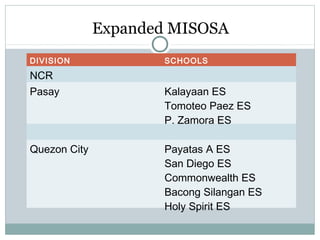
Expanded MISOSA
DIVISION SCHOOLS
NCR
Pasay Kalayaan ES
Tomoteo Paez ES
P. Zamora ES
Quezon City Payatas A ES
San Diego ES
Commonwealth ES
Bacong Silangan ES
Holy Spirit ES
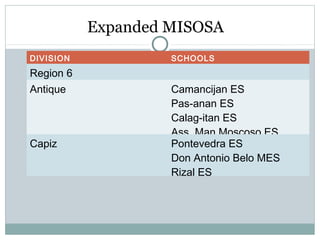
Expanded MISOSA
DIVISION SCHOOLS
Region 6
Antique Camancijan ES
Pas-anan ES
Calag-itan ES
Ass. Man Moscoso ES
Capiz Pontevedra ES
Don Antonio Belo MES
Rizal ES
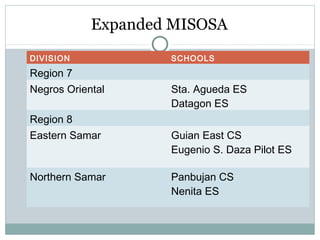
Expanded MISOSA
DIVISION SCHOOLS
Region 7
Negros Oriental Sta. Agueda ES
Datagon ES
Region 8
Eastern Samar Guian East CS
Eugenio S. Daza Pilot ES
Northern Samar Panbujan CS
Nenita ES
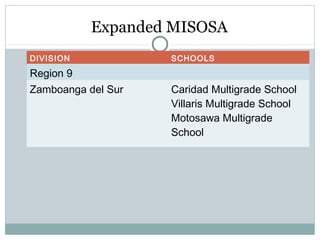
Expanded MISOSA
DIVISION SCHOOLS
Region 9
Zamboanga del Sur Caridad Multigrade School
Villaris Multigrade School
Motosawa Multigrade
School
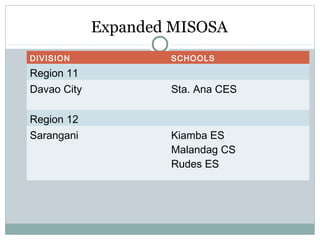
Expanded MISOSA
DIVISION SCHOOLS
Region 11
Davao City Sta. Ana CES
Region 12
Sarangani Kiamba ES
Malandag CS
Rudes ES
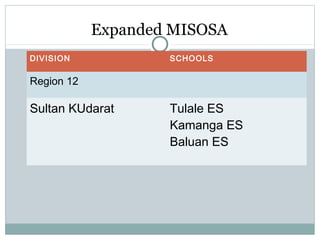
Expanded MISOSA
DIVISION SCHOOLS
Region 12
Sultan KUdarat Tulale ES
Kamanga ES
Baluan ES
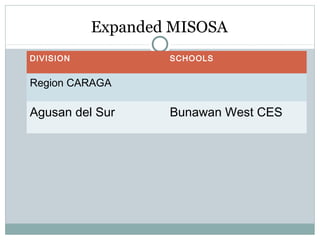
Expanded MISOSA
DIVISION SCHOOLS
Region CARAGA
Agusan del Sur Bunawan West CES
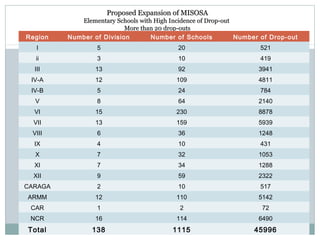
Proposed Expansion of MISOSAProposed Expansion of MISOSA
Elementary Schools with High Incidence of Drop-outElementary Schools with High Incidence of Drop-out
More than 20 drop-outsMore than 20 drop-outs
Region Number of Division Number of Schools Number of Drop-out
I 5 20 521
ii 3 10 419
III 13 92 3941
IV-A 12 109 4811
IV-B 5 24 784
V 8 64 2140
VI 15 230 8878
VII 13 159 5939
VIII 6 36 1248
IX 4 10 431
X 7 32 1053
XI 7 34 1288
XII 9 59 2322
CARAGA 2 10 517
ARMM 12 110 5142
CAR 1 2 72
NCR 16 114 6490
Total 138 1115 45996
THANK YOU
THANK YOU
& Mabuhay…
The e-IMPACT System
A Quality Alternative Delivery Mode for Elementary
Education
a. A technology-enhanced alternative delivery
mode;
b. Developed to address high student population
and high percentage of dropouts;
c. Management system where the parents, teachers
and community collaborate to provide the child
Principles of the e-IMPACT System
1. Children become active participants of the
learning process.
Three Primary Modes of Delivery
a. Programmed Teaching
b. Peer Group Learning
c. Individual Study
Principles of the e-IMPACT System
2. Learning Materials are based on the national
curriculum standards of DepED.
a. PRODED
b. NESC –New Elementary School Curriculum
c. BEC – Basic Education Curriculum
d. PELC – Phil. Elementary Learning
Competencies
Principles of the e-IMPACT System
3. The essence of education is the learning process
a. Education in the e-IMPACT system
encourages and develops in the children
the skill to learn independently and
eventually become self-and lifelong learners.
b. IMPACT also encourages peer learning and
peer mentoring as important strategies for
empowering learners as active partners in the
instructional process.
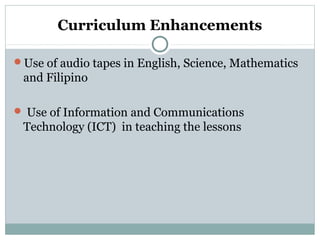
Curriculum Enhancements
Use of audio tapes in English, Science, Mathematics
and Filipino
 Use of Information and Communications
Technology (ICT) in teaching the lessons
Alternative delivery modes   robertita fernando (1)

Alternative delivery modes robertita fernando (1)

  • 1.
    ROBERTITA M. FERNANDO EDUCATIONPROGRAM SUPERVISOR I, ALS Alternative Delivery Modes(ADM s)
  • 2.
    The Department ofEducation is tasked to provide quality basic education that is equitably accessible to all and lay the foundation for life long learning and service for the common good.
  • 3.
    Aside from formaleducation DepEd offers alternative delivery mode of interventions to meet the needs of young people in different communities.
  • 4.
    IMPORTANCE OF ADMs TheADMs in formal basic education are implemented to improve certain performance indicators in order to achieve the 2015 targets of Education For All (EFA) and the Millennium Development Goal (MDG) on achieving the universal primary Education. The ADMs address the learning needs of the marginalized pupils and those learners at risk of dropping out in order to help them overcome social and economic constraints in their schooling.
  • 5.
    ADMs BOTH INELEMENTARY & SECONDARY LEVELS The ADMs both at the elementary and secondary Levels include the following:  Elementary Level A. Modified In-School, Off-school Approach (MISOSA); B. Enhanced Instructional Management by Parents, Community and Teachers (e- IMPACT)System; C. Home Schooling Program D. Multigrade Program in Philippine Education (MPPE)  Secondary Level E. Dropout Reduction Program (DORP)
  • 6.
    “THE MISOSA” M-odified I -n School S - chool O - ff S - chool A - pproach
  • 7.
    Originally designed Currentlydesigned To address issue on congestion •To address issue of congestion plus •helps pupils who are enrolled but habitual/ seasonal absentees, • living in conflict/ •disaster areas, •chronically -ill, or engaged in earning a living to augment family income
  • 8.
    1.Use of Self-InstructionalMaterials (SIMs).  that contain the lessons to be learned for the day. include learning objectives, activities to work on, exercises and questions to answer. enrichment activities utilizing the community resources.
  • 9.
  • 10.
    2.Utilization of communityschool as a laboratory for learning aside from the classroom i.e. half of the class stays with the teacher while the other half stays with the teacher-facilitator in the community school.
  • 11.
    3. In compliancewith existing policies: 3.1.DepEd Order #23,s.2005 re time allotment 3.2. DepEd Order No. 33, s. 2004 re grading system 3.3. DepEd Order No. 53, s. 2011 re policy guidelines
  • 12.
    4.Involvement of thefollowing school internal/external stakeholders: 4.1.Grade IV, V, and VI pupils 4.2.Classroom Teachers 4.3.Teacher-Facilitators
  • 13.
    Benefits in implementingthe MISOSABenefits in implementing the MISOSA Aside from addressing the issue of congestion, MISOSA implementation may also contribute to the following: Resolving the issue of shortage of instructional materials Improving classroom management Promoting equal access and opportunity for learning
  • 14.
    Institutionalizing systematic monitoring Developing pupilsstudy habits love for learning and self-esteem Attending to the unique needs of individual pupils Benefits in implementing the MISOSABenefits in implementing the MISOSA
  • 15.
    List of PilotSchools implementing MISOSAList of Pilot Schools implementing MISOSA DIVISION SCHOOLS Manila R. Almario ES A.A. Quezon ES Quezon City Payatas ES San Diego ES Commonwealth ES Isabela Ilagan East Central School Antique Pis-anan Central School Camancijan ES Calag-itan Central School
  • 16.
    List of PilotSchools implementing MISOSAList of Pilot Schools implementing MISOSA DIVISION SCHOOLS Capiz Pontevedra ES Davao City Magallanes ES Buhangin ES Porras ES
  • 17.
    Updates onUpdates onExpanded MISOSA Previous number implementing MISOSA DIVISION SCHOOLS Region 3 Aurora Nonong ES Macucdol ES NCR Manila R. Almario ES Aurora A. Quezon ES Gregoria G. de Jesus ES Legarda ES
  • 18.
    Expanded MISOSA DIVISION SCHOOLS CAR MtProvince Paracelis CS Puya-Ao ES Otocan ES Isabela Capellan ES Matasalem ES Alibadabad ES Ilagan East CS
  • 19.
    Expanded MISOSA DIVISION SCHOOLS NCR PasayKalayaan ES Tomoteo Paez ES P. Zamora ES Quezon City Payatas A ES San Diego ES Commonwealth ES Bacong Silangan ES Holy Spirit ES
  • 20.
    Expanded MISOSA DIVISION SCHOOLS Region6 Antique Camancijan ES Pas-anan ES Calag-itan ES Ass. Man Moscoso ES Capiz Pontevedra ES Don Antonio Belo MES Rizal ES
  • 21.
    Expanded MISOSA DIVISION SCHOOLS Region7 Negros Oriental Sta. Agueda ES Datagon ES Region 8 Eastern Samar Guian East CS Eugenio S. Daza Pilot ES Northern Samar Panbujan CS Nenita ES
  • 22.
    Expanded MISOSA DIVISION SCHOOLS Region9 Zamboanga del Sur Caridad Multigrade School Villaris Multigrade School Motosawa Multigrade School
  • 23.
    Expanded MISOSA DIVISION SCHOOLS Region11 Davao City Sta. Ana CES Region 12 Sarangani Kiamba ES Malandag CS Rudes ES
  • 24.
    Expanded MISOSA DIVISION SCHOOLS Region12 Sultan KUdarat Tulale ES Kamanga ES Baluan ES
  • 25.
    Expanded MISOSA DIVISION SCHOOLS RegionCARAGA Agusan del Sur Bunawan West CES
  • 26.
    Proposed Expansion ofMISOSAProposed Expansion of MISOSA Elementary Schools with High Incidence of Drop-outElementary Schools with High Incidence of Drop-out More than 20 drop-outsMore than 20 drop-outs Region Number of Division Number of Schools Number of Drop-out I 5 20 521 ii 3 10 419 III 13 92 3941 IV-A 12 109 4811 IV-B 5 24 784 V 8 64 2140 VI 15 230 8878 VII 13 159 5939 VIII 6 36 1248 IX 4 10 431 X 7 32 1053 XI 7 34 1288 XII 9 59 2322 CARAGA 2 10 517 ARMM 12 110 5142 CAR 1 2 72 NCR 16 114 6490 Total 138 1115 45996
  • 27.
  • 28.
    The e-IMPACT System AQuality Alternative Delivery Mode for Elementary Education a. A technology-enhanced alternative delivery mode; b. Developed to address high student population and high percentage of dropouts; c. Management system where the parents, teachers and community collaborate to provide the child
  • 29.
    Principles of thee-IMPACT System 1. Children become active participants of the learning process. Three Primary Modes of Delivery a. Programmed Teaching b. Peer Group Learning c. Individual Study
  • 30.
    Principles of thee-IMPACT System 2. Learning Materials are based on the national curriculum standards of DepED. a. PRODED b. NESC –New Elementary School Curriculum c. BEC – Basic Education Curriculum d. PELC – Phil. Elementary Learning Competencies
  • 31.
    Principles of thee-IMPACT System 3. The essence of education is the learning process a. Education in the e-IMPACT system encourages and develops in the children the skill to learn independently and eventually become self-and lifelong learners. b. IMPACT also encourages peer learning and peer mentoring as important strategies for empowering learners as active partners in the instructional process.
  • 32.
    Curriculum Enhancements Use ofaudio tapes in English, Science, Mathematics and Filipino  Use of Information and Communications Technology (ICT) in teaching the lessons