The document discusses mainstreaming English and language proficiency. It defines mainstreaming as the bridge to language proficiency, especially for listening skills. There are five stages of language proficiency from basic to advanced proficient levels. Mainstreaming is important because it acknowledges minority languages and allows students to learn in their native language before transitioning to English, helping ensure they do not fall behind in other subjects.
Aligning Language ofNon –
Mainstreaming English
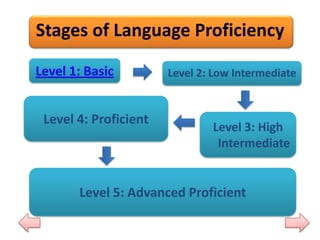
Stages of Language
Proficiency
Ms. Edna Buendia Salomon
Discussant
2.
Objectives
At the endof the oral presentation, the learners
should be able to:
define mainstreaming;
tell the importance of mainstreaming
in teaching listening and speaking ;
3.
define language proficiency;
citethe stages of language
proficiency;
explain why mainstreaming is related
to language proficiency and
participate actively in the language
proficiency session
4.
What is mainstreaming?
•if listening is an essential building block for the
development of other skills, mainstreaming is
the bridge to language proficiency
5.
Why is itimportant?
•
four percent of the world’s population
speaks one or more of the thousands of
minority languages found around the
globe. Yet minority-language speakers
make up almost 50% of the world’s nonliterate population.
6.
Basic Principles
• Welearn best when we can use what we
know to understand what is new.
• We only learn to read once.
• When we learn an academic concept in our
own language, we will understand and be able
to use that concept in any other language that
we learn.
7.
• We feelbetter about ourselves when our
heritage language and culture are affirmed
rather than ignored or denigrated.
• Using children’s own language in formal
education acknowledges and honors the place
of all languages and their associated cultures.
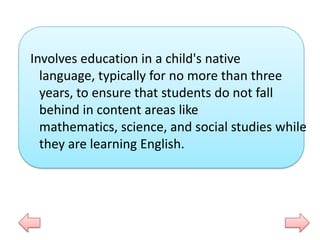
Involves education ina child's native
language, typically for no more than three
years, to ensure that students do not fall
behind in content areas like
mathematics, science, and social studies while
they are learning English.
10.
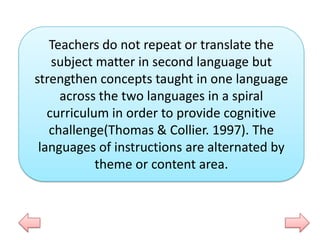
Teachers do notrepeat or translate the
subject matter in second language but
strengthen concepts taught in one language
across the two languages in a spiral
curriculum in order to provide cognitive
challenge(Thomas & Collier. 1997). The
languages of instructions are alternated by
theme or content area.
11.
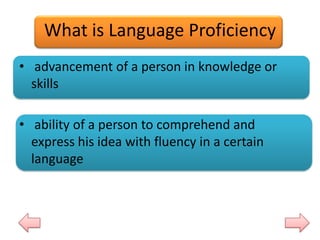
What is LanguageProficiency
• advancement of a person in knowledge or
skills
• ability of a person to comprehend and
express his idea with fluency in a certain
language
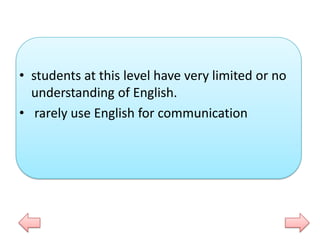
• students atthis level have very limited or no
understanding of English.
• rarely use English for communication
14.
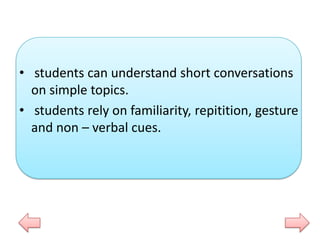
• students canunderstand short conversations
on simple topics.
• students rely on familiarity, repitition, gesture
and non – verbal cues.
15.
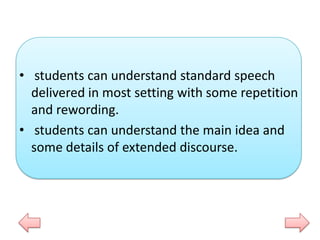
• students canunderstand standard speech
delivered in most setting with some repetition
and rewording.
• students can understand the main idea and
some details of extended discourse.
16.
• students haveadequate language skills for
day – to – day communication although
occasional structural and lexical errors still
occur.
17.
• students demonstrateEnglish proficiency
where in they are expected to participate fully
with their peers in grade level content area
classes.