KEY CONCEPTS
 History and the Development of NFE / Adult
Education/ ALS in the Philippines
 Legal Bases of NFE / Adult Education/
 ALS in the Philippines
 Functions, Goals and Objectives of ALS
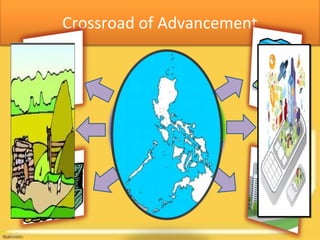
Crossroad of Advancement
UNESCO Symposium (Aug. 1990)
a. new concept of development in which man will be
the focal point
b. explosion of knowledge which will bring about
unpredicted development in science & technology
c. advances in transportation and communication
technology
d. Environmental crisis
e. Crisis in human values
is firmly anchored on a new concept of
development which focuses on the actualization of
the human potential.
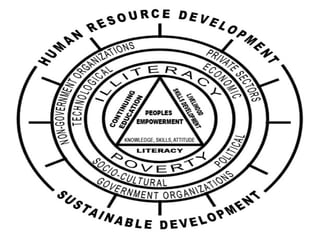
Thus, Human Resource Development (HRD) is a vital
factor in alleviating poverty, accelerating economic
recovery and sustaining economic and socio-cultural
growth and progress.
NONFORMAL EDUCATION (PHIL.)
To empower the clientele through more
responsive quality NFE programs.
NFE
NFE
Empowerment of the Filipino with desirable
knowledge, skills, attitudes and values that will
enable him to think critically and creatively; act
innovatively and humanely in improving the quality
of his/ her life and that of his/ her family,
community and country.
 May 21, 1908 Nonformal Educ. Started in the
Phil. As civic movement
NFE History:
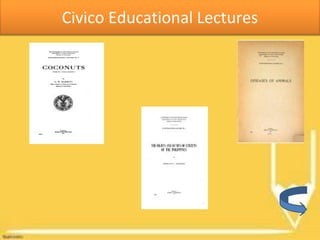
 Act. No. 1829 provided for the giving of civico
educational lectures in towns and barrios
 On Dec.4,1914 the Act was amended by Act. No.
2424 making public school teachers in charge
of conducting lectures
Civico Educational Lectures
NFE History:
 Commonwealth Act. No. 80 was passed in 1936
creating the office of Adult Educ. , under the
department of Instruction.
 Exec. Order No. 94 ,dated Oct. 4,1947 converted
the office of Adult Educ. Into Adult and
Community Educ. Division under the Bureau of
Public Schools.
NFE History:
 Provisions of the 1973 Phil. Constitution which
have relevance to nonformal educ.
Article II Sec. 4. The State shall strengthen the family
as basic social institution. The natural right
and duty of parents in rearing the youth for civic
efficiency and the development of moral
character shall receive the aid support of the
government.
NFE History:
 Provisions of the 1973 Phil. Constitution which
have relevance to nonformal educ.
Article II Sec. 5. The State shall recognize the vital
role of the youth in nation-building and shall
promote their physical, intellectual and social
well-being.
Presidential Decree No.1139 which took effect on
May 13,1977 created the position of
Undersecretary for Nonformal Educ. Who has the
overall responsibility for the nonformal educ.
programs of the department.
NFE History:
The Office of Nonformal Educ. became a fully
staffed Bureau by virtue of Batas Pambansa 232,
otherwise known as Educ. Act f 1982. This law
created the Bureau of Continuing Educ.
NFE History:
The 1986 Phil. Constitution Article XIV Sec.2 gives
special focus to nonformal educ. “ the state
shall encourage nonformal, informal and
indigenous learning systems as well as self-learning,
independent and out-of-school study programs
particularly those that respond to community
needs, and provide adult citizens, the disabled ,
and out-of-school youth with training in civics
efficiency and other skills.
NFE History:
Exec. Order No. 117 Sec. 15 , s. 1987 spells out the
Reorganization of the Ministry of Education,
Culture and Sports to redefine the mandate,
Powers and Functions and for the other
purposes, provided among others,
renaming of Continuing Educ. as the Bureau of
Nonformal Educ. The functions of the Bureau
as stated therein are as follows:
NFE Functions:
(a) Serve as a means of meeting the learning
needs of those unable to avail
themselves of the educational services and
program of formal education;
(b) Coordinate with various agencies in
providing opportunities for the
acquisition of skills necessary to
enhance and ensure continuing
employability, efficiency, productivity, and
competitiveness in the labor market;
NFE Functions:
(c) Serve as means of expanding access to
educational opportunities to citizens of
varied interests, demographic
characteristics and socio- economic origins
of status.
NFE History:
Executive Order No. 356
Renaming The Bureau of Nonformal Education to
Bureau of Alternative Learning System (ALS)
NFE History:
WHEREAS, it is declared State policy , to
protect and promote the right of all citizens to
quality basic education and to promote the right of
all citizens to quality basic education and such
education accessible to all by providing all Filipino
children in the elementary level and free education
in the high school level. Such education shall also
include alternative learning system for out-of-school
youth and adult learners .” (Sec. 2 of R.A. 9155, The
Governance of Basic Education Act of 2001.)
NFE History:
WHEREAS, Section 12.1 Rules XII of R.A. 9155
stipulates that ,”the alternative Learning System is a
parallel learning system to provide a viable
alternative to the existing formal education
instruction, encompassing both the nonformal and
informal sources of knowledge and skills.
NFE History:
WHEREAS, the Dept. of Education, through the
Bureau of Nonformal Educ. Is mandated to ensure
that all learning needs of marginalized learners are
addressed.
WHEREAS, one of the most important
initiatives in Nonformal Educ. in the Phil. in the last
10 years is the Alternative Learning System (ALS),
which is a major component of basic education with
a clearly defined role within the overall educational
goals.
NFE History:
WHEREAS, the ALS will respond to the need of
a more systematic and flexible approach in reaching
to all types of learners outside the school system.
NFE History:
By the power vested upon Pres. Gloria
Macapagal Arroyo did hereby order:
Section 1 The Bureau of Nonformal Education
is hereby renamed to Bureau of Alternative Learning
System (BALS)
Section 2 The Bureau of Alternative Learning
System (BALS) shall have the following functions:
BALS FUNCTIONS:
a. Address the learning needs of the
marginalized groups of the population including the
deprived, depressed and underserved citizens
b. Coordinate with various agencies for skills
development to enhance and ensure continuing
employability, efficiency, productivity, and
competitiveness in the labor market.
BALS FUNCTIONS:
c. Ensure the expansion of access to
educational opportunities for citizens of different
interests, capabilities, demographic characteristics
and socio-economic origins and status ; and
d. Promote certification and accreditation of
alternative learning programs both formal and
informal in nature for basic education.
NFE History:
Section 3 Funds necessary to carry out the
provisions of this Executive Order shall be taken
from the present funds available in the Dept. of
Education and shall thereafter be included in the
General Appropriations Act.
NFE GOALS:
• to protect and promote the right of all the citizen
to quality basic education
•to promote the right of all citizens to quality basic
education and such education accessible to all
by providing all Filipino children in the
elementary level and free education in the high
school level. Such education shall also include
alternative learning system for out-of-school
youth and adult learners. (Sec 2 of P.A. 9155 , The
Governance of Basic Education Act of 2001.
NFE GOALS:
•to provide a viable alternative to the existing
formal education instruction encompassing
both the nonformal and informal sources of k
nowledge and skills
NFE OBJECTIVES :
To improve the socio-economic status of the OSY
and the poor by enhancing their basic
educational capability through functional
education and literacy, and continuing
education programs , which will enable them to
become more self-reliant , be integrated more
effectively into the social and economic
enhancement and self-growth opportunities.
NFE OBJECTIVES :
 the promotion of literacy programs for
the attainment of basic skills that
include numeracy and functional literacy
and which are basic needs for every
individual;
 the development of livelihood skills
which manifest in the individual specific
competencies that prepare, improve, and
enhance employability and economic
productivity;
NFE OBJECTIVES :
 the expansion of certification and
equivalency programs, which are
administered by the formal education
subsystem, into the non-formal sector.
http://en.wikipilipinas.org/index.php?title=Alternative_Learning_System
References:
http://unesdoc.unesco.org/images/0015/001555/155532e.pdf
http://www.lawphil.net/executive/execord/eo1987/eo_117_1987.html
http://www.scribd.com/doc/6946396/Alternative-Learning-System
Alternative learning system in the philippines

Alternative learning system in the philippines

  • 2.
    KEY CONCEPTS  Historyand the Development of NFE / Adult Education/ ALS in the Philippines  Legal Bases of NFE / Adult Education/  ALS in the Philippines  Functions, Goals and Objectives of ALS
  • 4.
  • 5.
    UNESCO Symposium (Aug.1990) a. new concept of development in which man will be the focal point b. explosion of knowledge which will bring about unpredicted development in science & technology c. advances in transportation and communication technology d. Environmental crisis e. Crisis in human values
  • 7.
    is firmly anchoredon a new concept of development which focuses on the actualization of the human potential. Thus, Human Resource Development (HRD) is a vital factor in alleviating poverty, accelerating economic recovery and sustaining economic and socio-cultural growth and progress. NONFORMAL EDUCATION (PHIL.)
  • 8.
    To empower theclientele through more responsive quality NFE programs. NFE
  • 9.
    NFE Empowerment of theFilipino with desirable knowledge, skills, attitudes and values that will enable him to think critically and creatively; act innovatively and humanely in improving the quality of his/ her life and that of his/ her family, community and country.
  • 10.
     May 21,1908 Nonformal Educ. Started in the Phil. As civic movement NFE History:  Act. No. 1829 provided for the giving of civico educational lectures in towns and barrios  On Dec.4,1914 the Act was amended by Act. No. 2424 making public school teachers in charge of conducting lectures
  • 11.
  • 12.
    NFE History:  CommonwealthAct. No. 80 was passed in 1936 creating the office of Adult Educ. , under the department of Instruction.  Exec. Order No. 94 ,dated Oct. 4,1947 converted the office of Adult Educ. Into Adult and Community Educ. Division under the Bureau of Public Schools.

  • 13.
    NFE History:  Provisionsof the 1973 Phil. Constitution which have relevance to nonformal educ. Article II Sec. 4. The State shall strengthen the family as basic social institution. The natural right and duty of parents in rearing the youth for civic efficiency and the development of moral character shall receive the aid support of the government.
  • 14.
    NFE History:  Provisionsof the 1973 Phil. Constitution which have relevance to nonformal educ. Article II Sec. 5. The State shall recognize the vital role of the youth in nation-building and shall promote their physical, intellectual and social well-being. Presidential Decree No.1139 which took effect on May 13,1977 created the position of Undersecretary for Nonformal Educ. Who has the overall responsibility for the nonformal educ. programs of the department.
  • 15.
    NFE History: The Officeof Nonformal Educ. became a fully staffed Bureau by virtue of Batas Pambansa 232, otherwise known as Educ. Act f 1982. This law created the Bureau of Continuing Educ.
  • 16.
    NFE History: The 1986Phil. Constitution Article XIV Sec.2 gives special focus to nonformal educ. “ the state shall encourage nonformal, informal and indigenous learning systems as well as self-learning, independent and out-of-school study programs particularly those that respond to community needs, and provide adult citizens, the disabled , and out-of-school youth with training in civics efficiency and other skills.
  • 17.
    NFE History: Exec. OrderNo. 117 Sec. 15 , s. 1987 spells out the Reorganization of the Ministry of Education, Culture and Sports to redefine the mandate, Powers and Functions and for the other purposes, provided among others, renaming of Continuing Educ. as the Bureau of Nonformal Educ. The functions of the Bureau as stated therein are as follows:
  • 18.
    NFE Functions: (a) Serveas a means of meeting the learning needs of those unable to avail themselves of the educational services and program of formal education; (b) Coordinate with various agencies in providing opportunities for the acquisition of skills necessary to enhance and ensure continuing employability, efficiency, productivity, and competitiveness in the labor market;
  • 19.
    NFE Functions: (c) Serveas means of expanding access to educational opportunities to citizens of varied interests, demographic characteristics and socio- economic origins of status.
  • 22.
    NFE History: Executive OrderNo. 356 Renaming The Bureau of Nonformal Education to Bureau of Alternative Learning System (ALS)
  • 23.
    NFE History: WHEREAS, itis declared State policy , to protect and promote the right of all citizens to quality basic education and to promote the right of all citizens to quality basic education and such education accessible to all by providing all Filipino children in the elementary level and free education in the high school level. Such education shall also include alternative learning system for out-of-school youth and adult learners .” (Sec. 2 of R.A. 9155, The Governance of Basic Education Act of 2001.)
  • 24.
    NFE History: WHEREAS, Section12.1 Rules XII of R.A. 9155 stipulates that ,”the alternative Learning System is a parallel learning system to provide a viable alternative to the existing formal education instruction, encompassing both the nonformal and informal sources of knowledge and skills.
  • 25.
    NFE History: WHEREAS, theDept. of Education, through the Bureau of Nonformal Educ. Is mandated to ensure that all learning needs of marginalized learners are addressed. WHEREAS, one of the most important initiatives in Nonformal Educ. in the Phil. in the last 10 years is the Alternative Learning System (ALS), which is a major component of basic education with a clearly defined role within the overall educational goals.
  • 26.
    NFE History: WHEREAS, theALS will respond to the need of a more systematic and flexible approach in reaching to all types of learners outside the school system.
  • 27.
    NFE History: By thepower vested upon Pres. Gloria Macapagal Arroyo did hereby order: Section 1 The Bureau of Nonformal Education is hereby renamed to Bureau of Alternative Learning System (BALS) Section 2 The Bureau of Alternative Learning System (BALS) shall have the following functions:
  • 28.
    BALS FUNCTIONS: a. Addressthe learning needs of the marginalized groups of the population including the deprived, depressed and underserved citizens b. Coordinate with various agencies for skills development to enhance and ensure continuing employability, efficiency, productivity, and competitiveness in the labor market.
  • 29.
    BALS FUNCTIONS: c. Ensurethe expansion of access to educational opportunities for citizens of different interests, capabilities, demographic characteristics and socio-economic origins and status ; and d. Promote certification and accreditation of alternative learning programs both formal and informal in nature for basic education.
  • 30.
    NFE History: Section 3Funds necessary to carry out the provisions of this Executive Order shall be taken from the present funds available in the Dept. of Education and shall thereafter be included in the General Appropriations Act.
  • 31.
    NFE GOALS: • toprotect and promote the right of all the citizen to quality basic education •to promote the right of all citizens to quality basic education and such education accessible to all by providing all Filipino children in the elementary level and free education in the high school level. Such education shall also include alternative learning system for out-of-school youth and adult learners. (Sec 2 of P.A. 9155 , The Governance of Basic Education Act of 2001.
  • 32.
    NFE GOALS: •to providea viable alternative to the existing formal education instruction encompassing both the nonformal and informal sources of k nowledge and skills
  • 33.
    NFE OBJECTIVES : Toimprove the socio-economic status of the OSY and the poor by enhancing their basic educational capability through functional education and literacy, and continuing education programs , which will enable them to become more self-reliant , be integrated more effectively into the social and economic enhancement and self-growth opportunities.
  • 34.
    NFE OBJECTIVES : the promotion of literacy programs for the attainment of basic skills that include numeracy and functional literacy and which are basic needs for every individual;  the development of livelihood skills which manifest in the individual specific competencies that prepare, improve, and enhance employability and economic productivity;
  • 35.
    NFE OBJECTIVES : the expansion of certification and equivalency programs, which are administered by the formal education subsystem, into the non-formal sector.
  • 36.