GANDHINAGAR INSTITUTE OF
TECHNOLOGY
CDMA/FDMA/TDMA
Active Learning Assignment
Communication
7th Sem. EC, A1
Name: Keerthana Nambiar(140120111012)
Faculty Guide: Prof. Hardik Bhatt
CDMA/FDMA/TDMA
Which telecommunication service is
better for you?
International Cocktail Party
• FDMA – Large room divided up into small rooms.
Each pair of people takes turns speaking.
• TDMA – Large room divided up into small rooms.
Three pairs of people per room, however, each pair
gets 20 seconds to speak.
• CDMA – No small rooms. Everyone is speaking in
different languages. If voice volume is minimized,
the number of people is maximized.
Definitions
• TDMA – Time Division Multiple Access
• FDMA – Frequency Division Multiple Access
• CDMA – Code Division Multiple Access
TDMA
• Here, we give certain time frame to each channel.
Within that time frame, the channel can access the
entire spectrum bandwidth
• Each station got a fixed length or slot. The slots,
which are unused will remain in idle stage.
Time Division
General Specification of TDMA
• Rx: 869-894MHz Tx: 824-849MHz
• 832 Channels spaced 30kHz apart
(3 users/channel)
• DQPSK modulation scheme
• 48.6kbps bit rate
• Interim Standard (IS) – 54
• Digital AMPS (Advanced Mobile Phone System)
• Uses Time Division Duplexing (TDD) usually
TDMA Operation
• Efficiency of TDMA frame:
- overhead bits per frame
- number of reference bursts per frame
- number of traffic bursts per frame
- number of overhead bits per reference burst
- number of overhead bits per preamble p
OH
r
t
r
p
b
N
N
b
b
 
er slot
- number of equivalent bits in each guard time interval
- frame duration
- bit rate of the radio-frequency channel
1 100%
g
f
rf
OH r r t p t r g
total f rf
OH
f
total
b
T
R
b N b N b N N b
b T R
b
b

   
 
 
  
 
 
Advantages of TDMA
• Flexible bit rate
• No frequency guard band required
• No need for precise narrowband filters
• Easy for mobile or base stations to initiate and
execute hands off
• Extended battery life
• TDMA installations offer savings in base station
equipment, space and maintenance
• The most cost-effective technology for upgrading a
current analog system to digital
Disadvantages to using TDMA
• Requires network-wide timing synchronization
• Requires signal processing fro matched filtering and
correlation detection
• Demands high peak power on uplink in transient
mode
• Multipath distortion
Application
FDMA
• In this type of multiple access, we assign each signal
a different type of frequency band (range).
• So, any two signals should not have same type of
frequency range.
• Hence, there won’t be any interference between them,
even if we send those signals in one channel.
Frequency Division
General Specification of FDMA
• Rx: 869-894MHz Tx: 824-849MHz
• 832 Channels spaced 30kHz apart
(3 users/channel)
• DQPSK modulation scheme
• 48.6kbps bit rate
• Used in analog cellular phone systems (i.e. AMPS)
• Uses Frequency Division Duplexing (FDD)
• ISI (Intersymbol Interference) is low
FDMA Operation
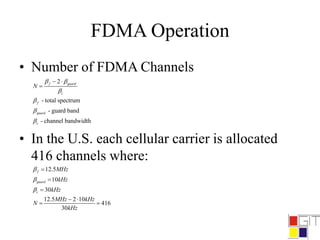
• Number of FDMA Channels
• In the U.S. each cellular carrier is allocated
416 channels where:
2
- total spectrum
- guard band
- channel bandwidth
f guard
c
f
guard
c
N
 




 

12.5
10
30
12.5 2 10
416
30
f
guard
c
MHz
kHz
kHz
MHz kHz
N
kHz






 
 
Advantages of FDMA
• If channel is not in use, it sits idle
• Channel bandwidth is relatively narrow (30kHz)
• Simple algorithmically, and from a hardware standpoint
• Fairly efficient when the number of stations is small and the
traffic is uniformly constant
• Capacity increase can be obtained by reducing the information
bit rate and using efficient digital code
• No need for network timing
• No restriction regarding the type of baseband or type of
modulation
Disadvantages to using FDMA
• The presence of guard bands
• Requires right RF filtering to minimize adjacent
channel interference
• Maximum bit rate per channel is fixed
• Small inhibiting flexibility in bit rate capability
• Does not differ significantly from analog system
Application
CDMA
• In CDMA technique, a unique code has been assigned
to each channel to distinguish from each other.
• A perfect example of this type of multiple access is
our cellular system. We can see that no two persons’
mobile number match with each other although they
are same X or Y mobile service providing company’s
customers using the same bandwidth.
Code Division
Code
General Specification of CDMA
• Rx: 869-894MHz Tx: 824-849MHz
• 20 Channels spaced 1250kHz apart
(798users/channel)
• QPSK/(Offset) OQPSK modulation scheme
• 1.2288Mbps bit rate
• IS-95 standard
• Operates at both 800 and 1900 MHz frequency bands
CDMA Operation
• Spread Spectrum Multiple Access Technologies
Advantages of CDMA
• Many users of CDMA use the same frequency, TDD
or FDD may be used
• Multipath fading may be substantially reduced
because of large signal bandwidth
• No absolute limit on the number of users
• Easy addition of more users
• Impossible for hackers to decipher the code sent
• Better signal quality
• No sense of handoff when changing cells
Disadvantages to using CDMA
• As the number of users increases, the overall quality
of service decreases
• Self-jamming
• Near- Far- problem arises
Application
Thank You

TDMA, FDMA, CDMA

  • 1.
    GANDHINAGAR INSTITUTE OF TECHNOLOGY CDMA/FDMA/TDMA ActiveLearning Assignment Communication 7th Sem. EC, A1 Name: Keerthana Nambiar(140120111012) Faculty Guide: Prof. Hardik Bhatt
  • 2.
  • 3.
    International Cocktail Party •FDMA – Large room divided up into small rooms. Each pair of people takes turns speaking. • TDMA – Large room divided up into small rooms. Three pairs of people per room, however, each pair gets 20 seconds to speak. • CDMA – No small rooms. Everyone is speaking in different languages. If voice volume is minimized, the number of people is maximized.
  • 5.
    Definitions • TDMA –Time Division Multiple Access • FDMA – Frequency Division Multiple Access • CDMA – Code Division Multiple Access
  • 6.
    TDMA • Here, wegive certain time frame to each channel. Within that time frame, the channel can access the entire spectrum bandwidth • Each station got a fixed length or slot. The slots, which are unused will remain in idle stage.
  • 7.
  • 8.
    General Specification ofTDMA • Rx: 869-894MHz Tx: 824-849MHz • 832 Channels spaced 30kHz apart (3 users/channel) • DQPSK modulation scheme • 48.6kbps bit rate • Interim Standard (IS) – 54 • Digital AMPS (Advanced Mobile Phone System) • Uses Time Division Duplexing (TDD) usually
  • 9.
    TDMA Operation • Efficiencyof TDMA frame: - overhead bits per frame - number of reference bursts per frame - number of traffic bursts per frame - number of overhead bits per reference burst - number of overhead bits per preamble p OH r t r p b N N b b   er slot - number of equivalent bits in each guard time interval - frame duration - bit rate of the radio-frequency channel 1 100% g f rf OH r r t p t r g total f rf OH f total b T R b N b N b N N b b T R b b                
  • 10.
    Advantages of TDMA •Flexible bit rate • No frequency guard band required • No need for precise narrowband filters • Easy for mobile or base stations to initiate and execute hands off • Extended battery life • TDMA installations offer savings in base station equipment, space and maintenance • The most cost-effective technology for upgrading a current analog system to digital
  • 11.
    Disadvantages to usingTDMA • Requires network-wide timing synchronization • Requires signal processing fro matched filtering and correlation detection • Demands high peak power on uplink in transient mode • Multipath distortion
  • 12.
  • 13.
    FDMA • In thistype of multiple access, we assign each signal a different type of frequency band (range). • So, any two signals should not have same type of frequency range. • Hence, there won’t be any interference between them, even if we send those signals in one channel.
  • 14.
  • 15.
    General Specification ofFDMA • Rx: 869-894MHz Tx: 824-849MHz • 832 Channels spaced 30kHz apart (3 users/channel) • DQPSK modulation scheme • 48.6kbps bit rate • Used in analog cellular phone systems (i.e. AMPS) • Uses Frequency Division Duplexing (FDD) • ISI (Intersymbol Interference) is low
  • 16.
    FDMA Operation • Numberof FDMA Channels • In the U.S. each cellular carrier is allocated 416 channels where: 2 - total spectrum - guard band - channel bandwidth f guard c f guard c N          12.5 10 30 12.5 2 10 416 30 f guard c MHz kHz kHz MHz kHz N kHz          
  • 17.
    Advantages of FDMA •If channel is not in use, it sits idle • Channel bandwidth is relatively narrow (30kHz) • Simple algorithmically, and from a hardware standpoint • Fairly efficient when the number of stations is small and the traffic is uniformly constant • Capacity increase can be obtained by reducing the information bit rate and using efficient digital code • No need for network timing • No restriction regarding the type of baseband or type of modulation
  • 18.
    Disadvantages to usingFDMA • The presence of guard bands • Requires right RF filtering to minimize adjacent channel interference • Maximum bit rate per channel is fixed • Small inhibiting flexibility in bit rate capability • Does not differ significantly from analog system
  • 19.
  • 20.
    CDMA • In CDMAtechnique, a unique code has been assigned to each channel to distinguish from each other. • A perfect example of this type of multiple access is our cellular system. We can see that no two persons’ mobile number match with each other although they are same X or Y mobile service providing company’s customers using the same bandwidth.
  • 21.
  • 22.
    General Specification ofCDMA • Rx: 869-894MHz Tx: 824-849MHz • 20 Channels spaced 1250kHz apart (798users/channel) • QPSK/(Offset) OQPSK modulation scheme • 1.2288Mbps bit rate • IS-95 standard • Operates at both 800 and 1900 MHz frequency bands
  • 23.
    CDMA Operation • SpreadSpectrum Multiple Access Technologies
  • 24.
    Advantages of CDMA •Many users of CDMA use the same frequency, TDD or FDD may be used • Multipath fading may be substantially reduced because of large signal bandwidth • No absolute limit on the number of users • Easy addition of more users • Impossible for hackers to decipher the code sent • Better signal quality • No sense of handoff when changing cells
  • 25.
    Disadvantages to usingCDMA • As the number of users increases, the overall quality of service decreases • Self-jamming • Near- Far- problem arises
  • 26.
  • 27.