Time Division Multiplexing
                           Claude Rigault
                               ENST
                       claude.rigault@enst.fr


Claude Rigault, ENST   Communication networks 03   1
04/10/2004
Time division multiplexing


      Claude Rigault, ENST   Communication networks 03   2
      04/10/2004
Time division multiplexing


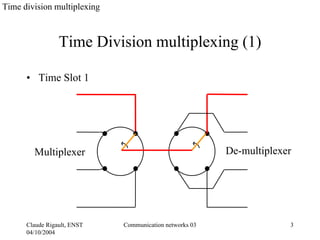
                 Time Division multiplexing (1)

      • Time Slot 1


        Multiplexer                                      De-multiplexer


      Claude Rigault, ENST   Communication networks 03                3
      04/10/2004
Time division multiplexing


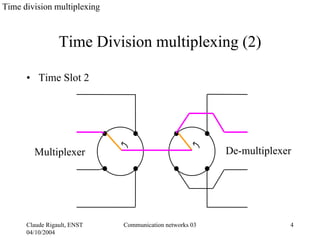
                 Time Division multiplexing (2)

      • Time Slot 2


        Multiplexer                                      De-multiplexer


      Claude Rigault, ENST   Communication networks 03                4
      04/10/2004
Time division multiplexing


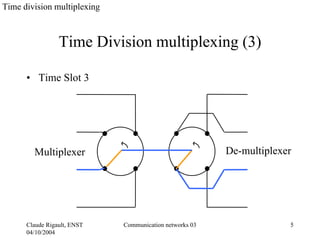
                 Time Division multiplexing (3)

      • Time Slot 3


        Multiplexer                                      De-multiplexer


      Claude Rigault, ENST   Communication networks 03                5
      04/10/2004
Time division multiplexing


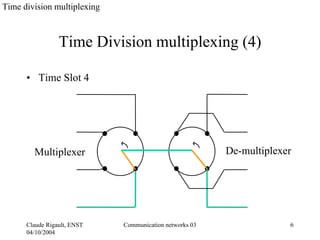
                 Time Division multiplexing (4)

      • Time Slot 4


        Multiplexer                                      De-multiplexer


      Claude Rigault, ENST   Communication networks 03                6
      04/10/2004
Time division multiplexing


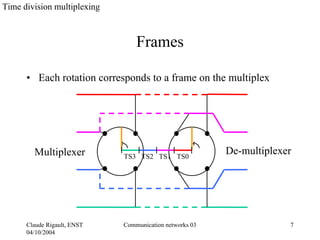
                                 Frames

      • Each rotation corresponds to a frame on the multiplex


        Multiplexer          TS3 TS2 TS1 TS0
                                                         De-multiplexer


      Claude Rigault, ENST   Communication networks 03                7
      04/10/2004
Time division multiplexing


                       Time Division multiplexing

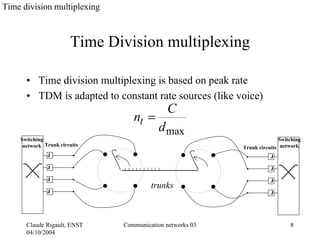
      • Time division multiplexing is based on peak rate
      • TDM is adapted to constant rate sources (like voice)
                                             C
                                 nt =
                                          d max
    Switching                                                           Switching
     network Trunk circuits                               Trunk circuits network
              J                                                      J

              J                                                      J
              J                                                      J
                                       trunks
              J                                                      J


      Claude Rigault, ENST    Communication networks 03                     8
      04/10/2004
Time division multiplexing


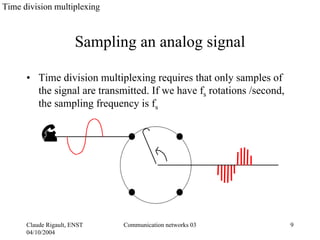
                       Sampling an analog signal

      • Time division multiplexing requires that only samples of
        the signal are transmitted. If we have fs rotations /second,
        the sampling frequency is fs


      Claude Rigault, ENST    Communication networks 03                9
      04/10/2004
Time division multiplexing


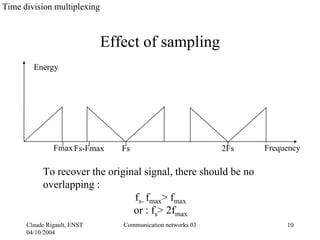
                             Effect of sampling
        Energy


               Fmax Fs-Fmax     Fs                          2Fs   Frequency

           To recover the original signal, there should be no
           overlapping :
                                fs- fmax> fmax
                                or : fs> 2fmax
      Claude Rigault, ENST      Communication networks 03              10
      04/10/2004
Time division multiplexing


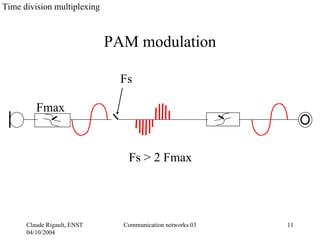
                             PAM modulation

                               Fs

         Fmax


                                Fs > 2 Fmax


      Claude Rigault, ENST     Communication networks 03   11
      04/10/2004
Time division multiplexing


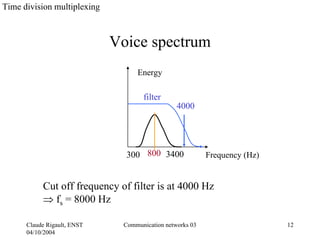
                             Voice spectrum
                                  Energy

                                    filter
                                                4000


                               300 800 3400               Frequency (Hz)


           Cut off frequency of filter is at 4000 Hz
           ⇒ fs = 8000 Hz

      Claude Rigault, ENST    Communication networks 03                    12
      04/10/2004
Time division multiplexing


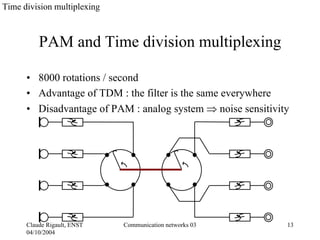
          PAM and Time division multiplexing

      • 8000 rotations / second
      • Advantage of TDM : the filter is the same everywhere
      • Disadvantage of PAM : analog system ⇒ noise sensitivity


      Claude Rigault, ENST   Communication networks 03        13
      04/10/2004
Time division multiplexing


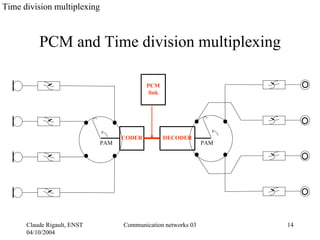
          PCM and Time division multiplexing

                                           PCM
                                           link


                                   CODER          DECODER
                             PAM                               PAM


      Claude Rigault, ENST         Communication networks 03         14
      04/10/2004
Time division multiplexing


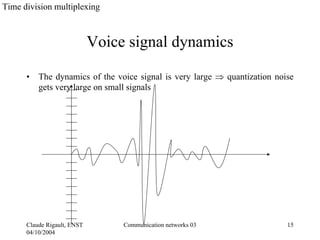
                             Voice signal dynamics

      •   The dynamics of the voice signal is very large ⇒ quantization noise
          gets very large on small signals


      Claude Rigault, ENST        Communication networks 03                15
      04/10/2004
Time division multiplexing


                             Quantization noise

      •   Quantization produces « Quantization noise »
      •   A linear measurement scale would result in a lower SNR for small
          signals than for big signals


      •   What we want is an amplitude independent SNR


      Claude Rigault, ENST      Communication networks 03               16
      04/10/2004
Time division multiplexing


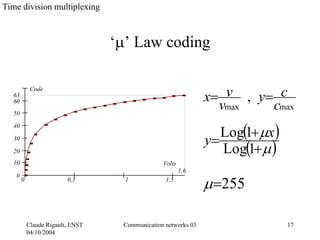
                                  ‘µ’ Law coding


                                                               x= v , y= c
            Code
  63
  60
  50
                                                                 vmax   cmax
                                                                  Log(1+µx)
  40

                                                               y=
                                                                  Log(1+µ )
  30

  20
  10                                            Volts
                                                        1,6

                                                               µ =255
   0
       0                 0,5        1            1,5


           Claude Rigault, ENST    Communication networks 03                  17
           04/10/2004
Time division multiplexing


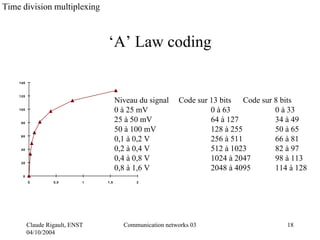
                                 ‘A’ Law coding

    140


    120
                                       Niveau du signal    Code sur 13 bits Code sur 8 bits
    100                                0 à 25 mV                    0 à 63           0 à 33
     80
                                       25 à 50 mV                   64 à 127         34 à 49
                                       50 à 100 mV                  128 à 255        50 à 65
     60
                                       0,1 à 0,2 V                  256 à 511        66 à 81
     40                                0,2 à 0,4 V                  512 à 1023       82 à 97
     20
                                       0,4 à 0,8 V                  1024 à 2047      98 à 113
                                       0,8 à 1,6 V                  2048 à 4095      114 à 128
      0
          0        0,5       1   1,5         2


          Claude Rigault, ENST           Communication networks 03                      18
          04/10/2004
Time division multiplexing


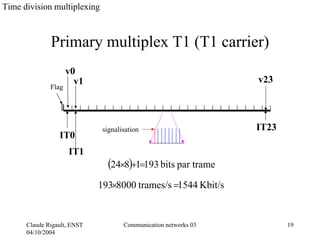
              Primary multiplex T1 (T1 carrier)
                     v0
                       v1                                        v23
              Flag


                              signalisation                      IT23
                 IT0
                     IT1
                                (24×8)+1=193 bits par trame
                             193×8000 trames/s =1544 Kbit/s


      Claude Rigault, ENST           Communication networks 03          19
      04/10/2004
Time division multiplexing


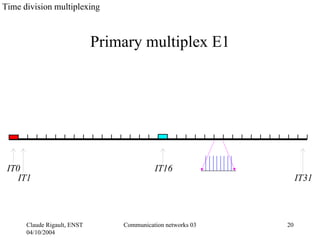
                             Primary multiplex E1


 IT0                                       IT16
    IT1                                                           IT31


      Claude Rigault, ENST       Communication networks 03   20
      04/10/2004
Time division multiplexing


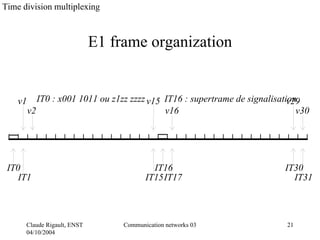
                             E1 frame organization


    v1      IT0 : x001 1011 ou z1zz zzzz v15 IT16 : supertrame de signalisation
                                                                             v29
         v2                                  v16                               v30


 IT0                                       IT16                            IT30
    IT1                                  IT15 IT17                           IT31


      Claude Rigault, ENST        Communication networks 03                 21
      04/10/2004
Time division multiplexing


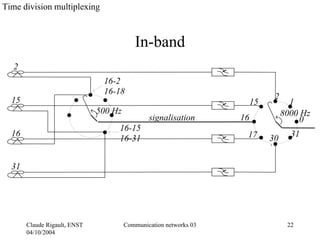
                                          In-band
   2
                               16-2
                               16-18
  15                                                                          2
                                                                        15          1
                              500 Hz                                              8000 Hz
                                               signalisation       16                 0
                                   16-15
  16                                                                17              31
                                   16-31                                     30


  31


       Claude Rigault, ENST            Communication networks 03                   22
       04/10/2004
Time division multiplexing


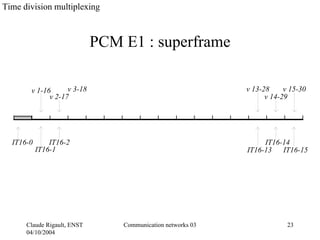
                             PCM E1 : superframe

       v 1-16      v 3-18                                    v 13-28     v 15-30
             v 2-17                                                v 14-29


  IT16-0       IT16-2                                             IT16-14
           IT16-1                                            IT16-13   IT16-15


      Claude Rigault, ENST       Communication networks 03                23
      04/10/2004
Time division multiplexing


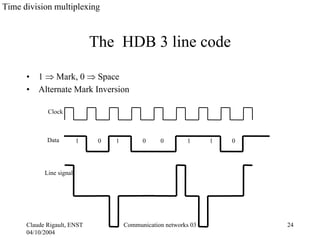
                              The HDB 3 line code

      • 1 ⇒ Mark, 0 ⇒ Space
      • Alternate Mark Inversion

             Clock


             Data         1    0   1         0     0        1      1   0


            Line signal


      Claude Rigault, ENST             Communication networks 03           24
      04/10/2004
Time division multiplexing


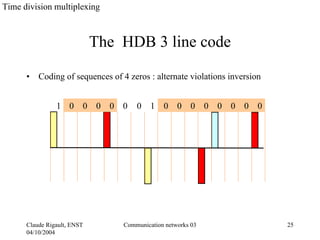
                             The HDB 3 line code

      •   Coding of sequences of 4 zeros : alternate violations inversion


                1 0 0 0 0 0           0 1 0 0 0 0 0 0 0 0


      Claude Rigault, ENST        Communication networks 03                 25
      04/10/2004
Time division multiplexing


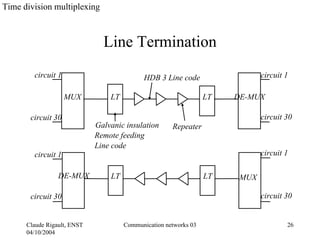
                               Line Termination
        circuit 1                           HDB 3 Line code                   circuit 1

                    MUX          LT                               LT   DE-MUX

       circuit 30                                                             circuit 30
                             Galvanic insulation      Repeater
                             Remote feeding
                             Line code
        circuit 1                                                             circuit 1

                 DE-MUX          LT                               LT    MUX

       circuit 30                                                             circuit 30


      Claude Rigault, ENST            Communication networks 03                       26
      04/10/2004
Time division multiplexing


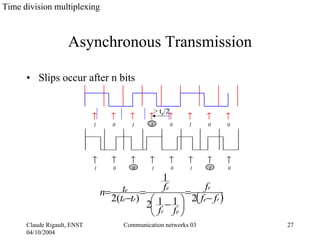
                    Asynchronous Transmission

      • Slips occur after n bits


                                                       > te/2
                             1        0     1      1            0   1   0   0


                             1        0     0      1            0   1   1   0

                                                          1
                                         te =             fefr
                                 n=                       =
                                      2(te−tr)  1 1  2( fe− fr )
                                               2 − 
                                                 fr fe 
      Claude Rigault, ENST                Communication networks 03             27
      04/10/2004
Time division multiplexing


                    Asynchronous Transmission

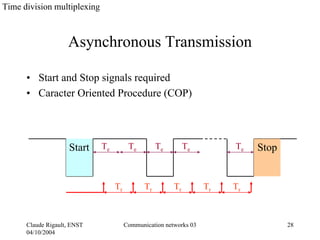
      • Start and Stop signals required
      • Caracter Oriented Procedure (COP)


                     Start   Te         Te         Te        Te         Te   Stop


                                  Tr          Tr        Tr         Tr   Tr


      Claude Rigault, ENST             Communication networks 03                    28
      04/10/2004
Time division multiplexing


                      Synchronous Transmission

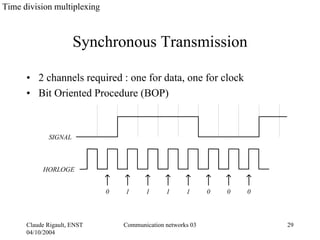
      • 2 channels required : one for data, one for clock
      • Bit Oriented Procedure (BOP)


             SIGNAL


           HORLOGE


                             0   1      1      1      1      0   0   0


      Claude Rigault, ENST       Communication networks 03               29
      04/10/2004
Time division multiplexing


                             Mixing clock and data

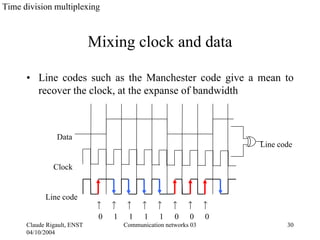
      • Line codes such as the Manchester code give a mean to
        recover the clock, at the expanse of bandwidth


                Data
                                                                      Line code

               Clock


            Line code

                              0   1    1     1    1    0    0     0
      Claude Rigault, ENST            Communication networks 03              30
      04/10/2004
Time division multiplexing


                      Asynchronous multiplexing
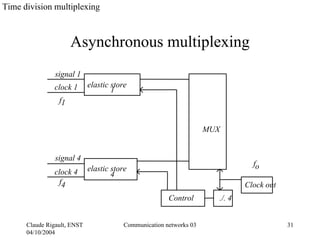
                signal 1
               clock 1       elastic store
                                     1
                 f1


                                                                     MUX


                signal 4
                                                                                 fo
               clock 4       elastic store
                                     4
                f4                                                             Clock out
                                                        Control        ./. 4


      Claude Rigault, ENST               Communication networks 03                         31
      04/10/2004
Time division multiplexing


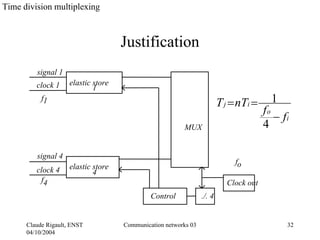
                                     Justification
         signal 1
         clock 1     elastic store
                             1
           f1
                                                                         T j = nTi =     1
                                                                                       fo
                                                                                          − fi
                                                         MUX                           4

         signal 4
                                                                              fo
         clock 4     elastic store
                             4
          f4                                                               Clock out
                                              Control            ./. 4


      Claude Rigault, ENST           Communication networks 03                               32
      04/10/2004
Time division multiplexing


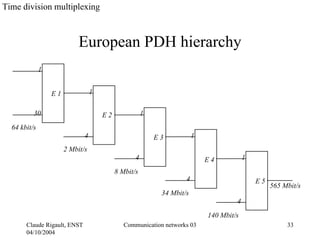
                            European PDH hierarchy
              1


                  E1              1

          30                          E2              1
  64 kbit/s
                              4                           E3           1
                       2 Mbit/s
                                                  4                        E4           1
                                           8 Mbit/s
                                                                   4                        E5
                                                                                                 565 Mbit/s
                                                           34 Mbit/s
                                                                                    4
                                                                           140 Mbit/s
       Claude Rigault, ENST                   Communication networks 03                               33
       04/10/2004
Time division multiplexing


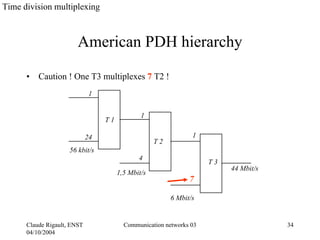
                        American PDH hierarchy

      •   Caution ! One T3 multiplexes 7 T2 !
                              1


                                               1
                                  T1

                             24                                 1
                                                    T2
                     56 kbit/s
                                              4
                                                                     T3
                                                                          44 Mbit/s
                                       1,5 Mbit/s
                                                               7

                                                         6 Mbit/s


      Claude Rigault, ENST               Communication networks 03                    34
      04/10/2004
Time division multiplexing


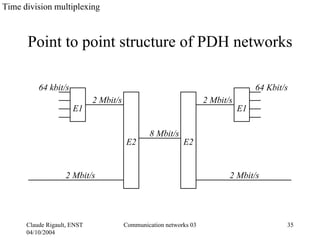
      Point to point structure of PDH networks

          64 kbit/s                                                                 64 Kbit/s
                             2 Mbit/s                               2 Mbit/s
                      E1                                                       E1

                                                8 Mbit/s
                                        E2                  E2


                   2 Mbit/s                                                2 Mbit/s


      Claude Rigault, ENST              Communication networks 03                           35
      04/10/2004
Time division multiplexing


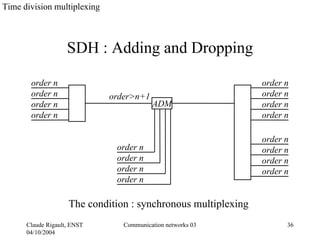
                    SDH : Adding and Dropping

       order n                                                 order n
       order n               order>n+1                         order n
       order n                           ADM                   order n
       order n                                                 order n

                                                               order n
                              order n                          order n
                              order n                          order n
                              order n                          order n
                              order n

                    The condition : synchronous multiplexing
      Claude Rigault, ENST      Communication networks 03            36
      04/10/2004
Time division multiplexing


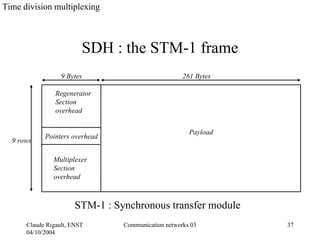
                         SDH : the STM-1 frame
                  9 Bytes                            261 Bytes

                Regenerator
                Section
                overhead


                                                       Payload
            Pointers overhead
  9 rows

               Multiplexer
               Section
               overhead


                       STM-1 : Synchronous transfer module
      Claude Rigault, ENST       Communication networks 03       37
      04/10/2004
Time division multiplexing


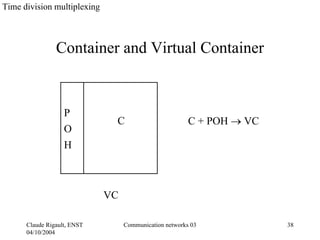
                Container and Virtual Container


                   P
                              C                         C + POH → VC
                   O
                   H


                             VC

      Claude Rigault, ENST        Communication networks 03            38
      04/10/2004
Time division multiplexing


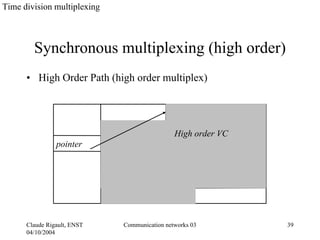
        Synchronous multiplexing (high order)
      • High Order Path (high order multiplex)


                                              High order VC
                pointer


      Claude Rigault, ENST   Communication networks 03        39
      04/10/2004
Time division multiplexing


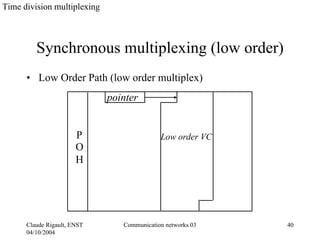
         Synchronous multiplexing (low order)
      • Low Order Path (low order multiplex)
                             pointer


                       P                    Low order VC
                       O
                       H


      Claude Rigault, ENST      Communication networks 03   40
      04/10/2004
Time division multiplexing


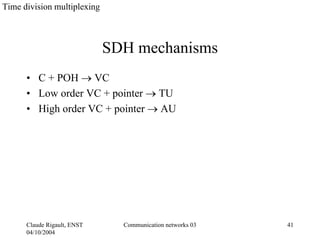
                             SDH mechanisms
      • C + POH → VC
      • Low order VC + pointer → TU
      • High order VC + pointer → AU


      Claude Rigault, ENST     Communication networks 03   41
      04/10/2004
Time division multiplexing


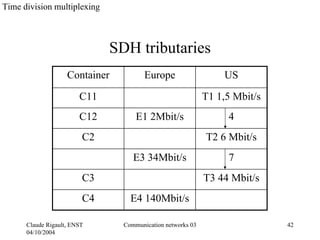
                              SDH tributaries
                    Container          Europe                   US

                        C11                                 T1 1,5 Mbit/s
                        C12         E1 2Mbit/s                   4
                         C2                                 T2 6 Mbit/s
                                   E3 34Mbit/s                   7
                         C3                                 T3 44 Mbit/s
                         C4       E4 140Mbit/s

      Claude Rigault, ENST      Communication networks 03                   42
      04/10/2004
Time division multiplexing


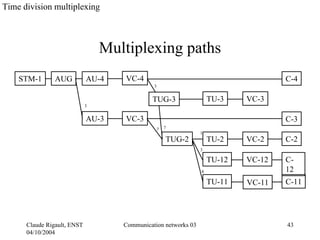
                                 Multiplexing paths
    STM-1       AUG          AU-4   VC-4                                            C-4
                                              3


                                             TUG-3                  TU-3    VC-3
                             3


                             AU-3   VC-3                                            C-3
                                                  7   7
                                                                1
                                                      TUG-2         TU-2    VC-2    C-2
                                                                3

                                                                    TU-12   VC-12   C-
                                                                4                   12
                                                                    TU-11   VC-11   C-11


      Claude Rigault, ENST          Communication networks 03                       43
      04/10/2004

03 time division-multiplexing

  • 1.
    Time Division Multiplexing Claude Rigault ENST claude.rigault@enst.fr Claude Rigault, ENST Communication networks 03 1 04/10/2004
  • 2.
    Time division multiplexing Claude Rigault, ENST Communication networks 03 2 04/10/2004
  • 3.
    Time division multiplexing Time Division multiplexing (1) • Time Slot 1 Multiplexer De-multiplexer Claude Rigault, ENST Communication networks 03 3 04/10/2004
  • 4.
    Time division multiplexing Time Division multiplexing (2) • Time Slot 2 Multiplexer De-multiplexer Claude Rigault, ENST Communication networks 03 4 04/10/2004
  • 5.
    Time division multiplexing Time Division multiplexing (3) • Time Slot 3 Multiplexer De-multiplexer Claude Rigault, ENST Communication networks 03 5 04/10/2004
  • 6.
    Time division multiplexing Time Division multiplexing (4) • Time Slot 4 Multiplexer De-multiplexer Claude Rigault, ENST Communication networks 03 6 04/10/2004
  • 7.
    Time division multiplexing Frames • Each rotation corresponds to a frame on the multiplex Multiplexer TS3 TS2 TS1 TS0 De-multiplexer Claude Rigault, ENST Communication networks 03 7 04/10/2004
  • 8.
    Time division multiplexing Time Division multiplexing • Time division multiplexing is based on peak rate • TDM is adapted to constant rate sources (like voice) C nt = d max Switching Switching network Trunk circuits Trunk circuits network J J J J J J trunks J J Claude Rigault, ENST Communication networks 03 8 04/10/2004
  • 9.
    Time division multiplexing Sampling an analog signal • Time division multiplexing requires that only samples of the signal are transmitted. If we have fs rotations /second, the sampling frequency is fs Claude Rigault, ENST Communication networks 03 9 04/10/2004
  • 10.
    Time division multiplexing Effect of sampling Energy Fmax Fs-Fmax Fs 2Fs Frequency To recover the original signal, there should be no overlapping : fs- fmax> fmax or : fs> 2fmax Claude Rigault, ENST Communication networks 03 10 04/10/2004
  • 11.
    Time division multiplexing PAM modulation Fs Fmax Fs > 2 Fmax Claude Rigault, ENST Communication networks 03 11 04/10/2004
  • 12.
    Time division multiplexing Voice spectrum Energy filter 4000 300 800 3400 Frequency (Hz) Cut off frequency of filter is at 4000 Hz ⇒ fs = 8000 Hz Claude Rigault, ENST Communication networks 03 12 04/10/2004
  • 13.
    Time division multiplexing PAM and Time division multiplexing • 8000 rotations / second • Advantage of TDM : the filter is the same everywhere • Disadvantage of PAM : analog system ⇒ noise sensitivity Claude Rigault, ENST Communication networks 03 13 04/10/2004
  • 14.
    Time division multiplexing PCM and Time division multiplexing PCM link CODER DECODER PAM PAM Claude Rigault, ENST Communication networks 03 14 04/10/2004
  • 15.
    Time division multiplexing Voice signal dynamics • The dynamics of the voice signal is very large ⇒ quantization noise gets very large on small signals Claude Rigault, ENST Communication networks 03 15 04/10/2004
  • 16.
    Time division multiplexing Quantization noise • Quantization produces « Quantization noise » • A linear measurement scale would result in a lower SNR for small signals than for big signals • What we want is an amplitude independent SNR Claude Rigault, ENST Communication networks 03 16 04/10/2004
  • 17.
    Time division multiplexing ‘µ’ Law coding x= v , y= c Code 63 60 50 vmax cmax Log(1+µx) 40 y= Log(1+µ ) 30 20 10 Volts 1,6 µ =255 0 0 0,5 1 1,5 Claude Rigault, ENST Communication networks 03 17 04/10/2004
  • 18.
    Time division multiplexing ‘A’ Law coding 140 120 Niveau du signal Code sur 13 bits Code sur 8 bits 100 0 à 25 mV 0 à 63 0 à 33 80 25 à 50 mV 64 à 127 34 à 49 50 à 100 mV 128 à 255 50 à 65 60 0,1 à 0,2 V 256 à 511 66 à 81 40 0,2 à 0,4 V 512 à 1023 82 à 97 20 0,4 à 0,8 V 1024 à 2047 98 à 113 0,8 à 1,6 V 2048 à 4095 114 à 128 0 0 0,5 1 1,5 2 Claude Rigault, ENST Communication networks 03 18 04/10/2004
  • 19.
    Time division multiplexing Primary multiplex T1 (T1 carrier) v0 v1 v23 Flag signalisation IT23 IT0 IT1 (24×8)+1=193 bits par trame 193×8000 trames/s =1544 Kbit/s Claude Rigault, ENST Communication networks 03 19 04/10/2004
  • 20.
    Time division multiplexing Primary multiplex E1 IT0 IT16 IT1 IT31 Claude Rigault, ENST Communication networks 03 20 04/10/2004
  • 21.
    Time division multiplexing E1 frame organization v1 IT0 : x001 1011 ou z1zz zzzz v15 IT16 : supertrame de signalisation v29 v2 v16 v30 IT0 IT16 IT30 IT1 IT15 IT17 IT31 Claude Rigault, ENST Communication networks 03 21 04/10/2004
  • 22.
    Time division multiplexing In-band 2 16-2 16-18 15 2 15 1 500 Hz 8000 Hz signalisation 16 0 16-15 16 17 31 16-31 30 31 Claude Rigault, ENST Communication networks 03 22 04/10/2004
  • 23.
    Time division multiplexing PCM E1 : superframe v 1-16 v 3-18 v 13-28 v 15-30 v 2-17 v 14-29 IT16-0 IT16-2 IT16-14 IT16-1 IT16-13 IT16-15 Claude Rigault, ENST Communication networks 03 23 04/10/2004
  • 24.
    Time division multiplexing The HDB 3 line code • 1 ⇒ Mark, 0 ⇒ Space • Alternate Mark Inversion Clock Data 1 0 1 0 0 1 1 0 Line signal Claude Rigault, ENST Communication networks 03 24 04/10/2004
  • 25.
    Time division multiplexing The HDB 3 line code • Coding of sequences of 4 zeros : alternate violations inversion 1 0 0 0 0 0 0 1 0 0 0 0 0 0 0 0 Claude Rigault, ENST Communication networks 03 25 04/10/2004
  • 26.
    Time division multiplexing Line Termination circuit 1 HDB 3 Line code circuit 1 MUX LT LT DE-MUX circuit 30 circuit 30 Galvanic insulation Repeater Remote feeding Line code circuit 1 circuit 1 DE-MUX LT LT MUX circuit 30 circuit 30 Claude Rigault, ENST Communication networks 03 26 04/10/2004
  • 27.
    Time division multiplexing Asynchronous Transmission • Slips occur after n bits > te/2 1 0 1 1 0 1 0 0 1 0 0 1 0 1 1 0 1 te = fefr n= = 2(te−tr)  1 1  2( fe− fr ) 2 −   fr fe  Claude Rigault, ENST Communication networks 03 27 04/10/2004
  • 28.
    Time division multiplexing Asynchronous Transmission • Start and Stop signals required • Caracter Oriented Procedure (COP) Start Te Te Te Te Te Stop Tr Tr Tr Tr Tr Claude Rigault, ENST Communication networks 03 28 04/10/2004
  • 29.
    Time division multiplexing Synchronous Transmission • 2 channels required : one for data, one for clock • Bit Oriented Procedure (BOP) SIGNAL HORLOGE 0 1 1 1 1 0 0 0 Claude Rigault, ENST Communication networks 03 29 04/10/2004
  • 30.
    Time division multiplexing Mixing clock and data • Line codes such as the Manchester code give a mean to recover the clock, at the expanse of bandwidth Data Line code Clock Line code 0 1 1 1 1 0 0 0 Claude Rigault, ENST Communication networks 03 30 04/10/2004
  • 31.
    Time division multiplexing Asynchronous multiplexing signal 1 clock 1 elastic store 1 f1 MUX signal 4 fo clock 4 elastic store 4 f4 Clock out Control ./. 4 Claude Rigault, ENST Communication networks 03 31 04/10/2004
  • 32.
    Time division multiplexing Justification signal 1 clock 1 elastic store 1 f1 T j = nTi = 1 fo − fi MUX 4 signal 4 fo clock 4 elastic store 4 f4 Clock out Control ./. 4 Claude Rigault, ENST Communication networks 03 32 04/10/2004
  • 33.
    Time division multiplexing European PDH hierarchy 1 E1 1 30 E2 1 64 kbit/s 4 E3 1 2 Mbit/s 4 E4 1 8 Mbit/s 4 E5 565 Mbit/s 34 Mbit/s 4 140 Mbit/s Claude Rigault, ENST Communication networks 03 33 04/10/2004
  • 34.
    Time division multiplexing American PDH hierarchy • Caution ! One T3 multiplexes 7 T2 ! 1 1 T1 24 1 T2 56 kbit/s 4 T3 44 Mbit/s 1,5 Mbit/s 7 6 Mbit/s Claude Rigault, ENST Communication networks 03 34 04/10/2004
  • 35.
    Time division multiplexing Point to point structure of PDH networks 64 kbit/s 64 Kbit/s 2 Mbit/s 2 Mbit/s E1 E1 8 Mbit/s E2 E2 2 Mbit/s 2 Mbit/s Claude Rigault, ENST Communication networks 03 35 04/10/2004
  • 36.
    Time division multiplexing SDH : Adding and Dropping order n order n order n order>n+1 order n order n ADM order n order n order n order n order n order n order n order n order n order n order n The condition : synchronous multiplexing Claude Rigault, ENST Communication networks 03 36 04/10/2004
  • 37.
    Time division multiplexing SDH : the STM-1 frame 9 Bytes 261 Bytes Regenerator Section overhead Payload Pointers overhead 9 rows Multiplexer Section overhead STM-1 : Synchronous transfer module Claude Rigault, ENST Communication networks 03 37 04/10/2004
  • 38.
    Time division multiplexing Container and Virtual Container P C C + POH → VC O H VC Claude Rigault, ENST Communication networks 03 38 04/10/2004
  • 39.
    Time division multiplexing Synchronous multiplexing (high order) • High Order Path (high order multiplex) High order VC pointer Claude Rigault, ENST Communication networks 03 39 04/10/2004
  • 40.
    Time division multiplexing Synchronous multiplexing (low order) • Low Order Path (low order multiplex) pointer P Low order VC O H Claude Rigault, ENST Communication networks 03 40 04/10/2004
  • 41.
    Time division multiplexing SDH mechanisms • C + POH → VC • Low order VC + pointer → TU • High order VC + pointer → AU Claude Rigault, ENST Communication networks 03 41 04/10/2004
  • 42.
    Time division multiplexing SDH tributaries Container Europe US C11 T1 1,5 Mbit/s C12 E1 2Mbit/s 4 C2 T2 6 Mbit/s E3 34Mbit/s 7 C3 T3 44 Mbit/s C4 E4 140Mbit/s Claude Rigault, ENST Communication networks 03 42 04/10/2004
  • 43.
    Time division multiplexing Multiplexing paths STM-1 AUG AU-4 VC-4 C-4 3 TUG-3 TU-3 VC-3 3 AU-3 VC-3 C-3 7 7 1 TUG-2 TU-2 VC-2 C-2 3 TU-12 VC-12 C- 4 12 TU-11 VC-11 C-11 Claude Rigault, ENST Communication networks 03 43 04/10/2004