CDMA Technology & IS-95
What is CDMA
 Both an access method and air-interface
 Rest of the network is very similar
   Radio resource management, mobility
   management, security are similar
   Power control and handoffs are different
 Uses DSSS and ECC
 Frequency reuse factor is 1
 3 systems
   IS-95 2G, W-CDMA, and CDMA2000
Advantages of CDMA Cellular
 Higher capacity
 Improves voice quality (new coder)
 Soft-handoffs
 Less power consumption (6-7 mW)
 Choice for 3G systems
Advantages of CDMA Cellular
 Frequency diversity – frequency-dependent
 transmission impairments have less effect on
 signal
 Multipath resistance – chipping codes used for
 CDMA exhibit low cross correlation and low
 autocorrelation
 Privacy – privacy is inherent since spread
 spectrum is obtained by use of noise-like signals
 Graceful degradation – system only gradually
 degrades as more users access the system
Drawbacks of CDMA Cellular
 Self-jamming – arriving transmissions from
 multiple users not aligned on chip boundaries
 unless users are perfectly synchronized
 Near-far problem – signals closer to the receiver
 are received with less attenuation than signals
 farther away
 Soft handoff – requires that the mobile acquires
 the new cell before it relinquishes the old; this is
 more complex than hard handoff used in FDMA
 and TDMA schemes
Drawbacks of CDMA Cellular
 Air-interface is the most complex
 Not symmetrical (unlike TDMA)
   Forward and reverse channels are different
   Forward channel (1 Many) synchronized
   Forward channel uses orthogonal spreading codes
   Reverse channel transmissions are not
   synchronized
   Orthogonal codes are used for orthogonal
   waveform coding
Mobile Wireless CDMA Design
Considerations
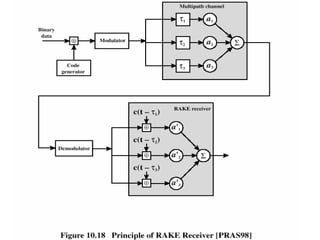
 RAKE receiver – when multiple versions of a
 signal arrive more than one chip interval apart,
 RAKE receiver attempts to recover signals from
 multiple paths and combine them
   This method achieves better performance than simply
   recovering dominant signal and treating remaining
   signals as noise
 Soft Handoff – mobile station temporarily
 connected to more than one base station
 simultaneously
Principle of RAKE Receiver
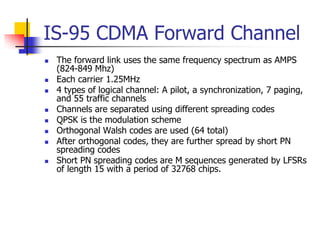
IS-95 CDMA Forward Channel
 The forward link uses the same frequency spectrum as AMPS
 (824-849 Mhz)
 Each carrier 1.25MHz
 4 types of logical channel: A pilot, a synchronization, 7 paging,
 and 55 traffic channels
 Channels are separated using different spreading codes
 QPSK is the modulation scheme
 Orthogonal Walsh codes are used (64 total)
 After orthogonal codes, they are further spread by short PN
 spreading codes
 Short PN spreading codes are M sequences generated by LFSRs
 of length 15 with a period of 32768 chips.
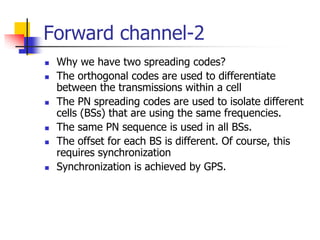
Forward channel-2
 Why we have two spreading codes?
 The orthogonal codes are used to differentiate
 between the transmissions within a cell
 The PN spreading codes are used to isolate different
 cells (BSs) that are using the same frequencies.
 The same PN sequence is used in all BSs.
 The offset for each BS is different. Of course, this
 requires synchronization
 Synchronization is achieved by GPS.
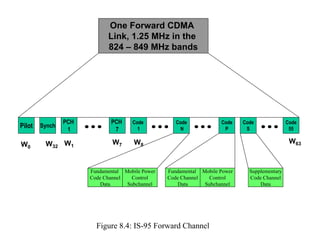
One Forward CDMA
                            Link, 1.25 MHz in the
                            824 – 849 MHz bands


                PCH          PCH     Code           Code            Code    Code              Code
Pilot   Synch
                 1            7        1             N               P       S                 55


W0       W32 W1               W7      W8                                                       W63


                      Fundamental Mobile Power   Fundamental Mobile Power     Supplementary
                      Code Channel   Control     Code Channel   Control       Code Channel
                          Data     Subchannel        Data     Subchannel          Data


                        Figure 8.4: IS-95 Forward Channel
I Pilot PN at
                Walsh Code                1.288 Mcps

                      1.2288                      Baseband
                                                    Filter
 Channel               Mcps
Dependent
 Symbols                                          Baseband
                                                    Filter


                                        Q Pilot PN at
                                         1.288 Mcps


            Figure 8.5: Basic Spreading Procedure on the
                      Forward Channel in IS-95
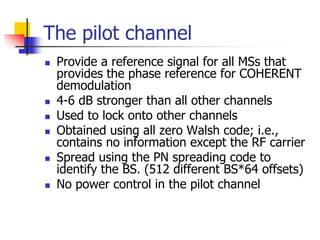
The pilot channel
 Provide a reference signal for all MSs that
 provides the phase reference for COHERENT
 demodulation
 4-6 dB stronger than all other channels
 Used to lock onto other channels
 Obtained using all zero Walsh code; i.e.,
 contains no information except the RF carrier
 Spread using the PN spreading code to
 identify the BS. (512 different BS*64 offsets)
 No power control in the pilot channel
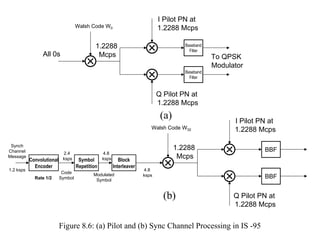
I Pilot PN at
                                    Walsh Code W0                            1.2288 Mcps

                                             1.2288                                    Baseband
                                                                                         Filter
                 All 0s                       Mcps                                                To QPSK
                                                                                                  Modulator
                                                                                       Baseband
                                                                                         Filter


                                                                             Q Pilot PN at
                                                                             1.2288 Mcps
                                                                              (a)                       I Pilot PN at
                                                                         Walsh Code W32                 1.2288 Mcps

 Synch
Channel
                                                                                    1.2288                       BBF
                            2.4                  4.8
Message
           Convolutional    ksps     Symbol      ksps      Block
                                                                                     Mcps
             Encoder                Repetition          Interleaver
1.2 ksps                                                              4.8
                            Code            Modulated                 ksps                                       BBF
             Rate 1/2      Symbol            Symbol


                                                                               (b)                      Q Pilot PN at
                                                                                                        1.2288 Mcps


                           Figure 8.6: (a) Pilot and (b) Sync Channel Processing in IS -95
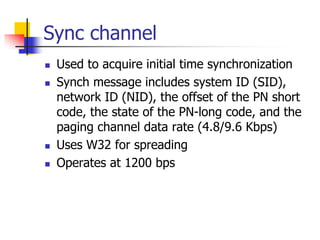
Sync channel
 Used to acquire initial time synchronization
 Synch message includes system ID (SID),
 network ID (NID), the offset of the PN short
 code, the state of the PN-long code, and the
 paging channel data rate (4.8/9.6 Kbps)
 Uses W32 for spreading
 Operates at 1200 bps
I Pilot PN at
                                    Walsh Code W0                            1.2288 Mcps

                                             1.2288                                    Baseband
                                                                                         Filter
                 All 0s                       Mcps                                                To QPSK
                                                                                                  Modulator
                                                                                       Baseband
                                                                                         Filter


                                                                             Q Pilot PN at
                                                                             1.2288 Mcps
                                                                              (a)                       I Pilot PN at
                                                                         Walsh Code W32                 1.2288 Mcps

 Synch
Channel
                                                                                    1.2288                       BBF
                            2.4                  4.8
Message
           Convolutional    ksps     Symbol      ksps      Block
                                                                                     Mcps
             Encoder                Repetition          Interleaver
1.2 ksps                                                              4.8
                            Code            Modulated                 ksps                                       BBF
             Rate 1/2      Symbol            Symbol


                                                                               (b)                      Q Pilot PN at
                                                                                                        1.2288 Mcps


                           Figure 8.6: (a) Pilot and (b) Sync Channel Processing in IS -95
Paging channels
 Used to page the MS in case of an incoming
 call, or to carry the control messages for call
 set up
 Uses W1-W7
 There is no power control
 Additionally scrambled by PN long code,
 which is generated by LFSR of length 42
 The rate 4.8 Kbps or 9.6Kbps
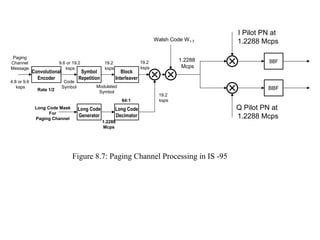
I Pilot PN at
                                                                                Walsh Code W1-7   1.2288 Mcps

 Paging
                                                                         19.2            1.2288             BBF
Channel                   9.6 or 19.2               19.2
Message                      ksps                   ksps                 ksps             Mcps
             Convolutional             Symbol                 Block
               Encoder                Repetition           Interleaver
4.8 or 9.6                    Code
   ksps                      Symbol           Modulated                                                    BBF
               Rate 1/2                        Symbol
                                                                                 19.2
                                                              64:1               ksps
              Long Code Mask          Long Code            Long Code                              Q Pilot PN at
                    For
              Paging Channel
                                      Generator            Decimator                              1.2288 Mcps
                                                   1.2288
                                                   Mcps


                                 Figure 8.7: Paging Channel Processing in IS -95
The traffic channels
 Carry user information
 Two possible date rates
   RS1={9.6, 4.8, 2.4, 1.2 Kbps}
   RS2={14.4, 7.2, 3.6, 1.8 Kbps}
 RS1 is mandatory for IS-95, but support
 for RS2 is optional
 Also carry power control bits for the
 reverse channel
Rate 1/2
     Voice
     Traffic   Convolutional                                                                      I Pilot PN at
                 Encoder                                  Power                 Walsh Code Wi     1.2288 Mcps
                                                         Control
                                                           Bits
                                                         800 bps
                                19.2                                                     1.2288            BBF
                                ksps                                                      Mcps
                  Symbol                  Block
                 Repetition            Interleaver                      MUX
                                                                                19.2
                                                                                ksps                       BBF
                                                      19.2
                                                      ksps
                                                                               800 bps            Q Pilot PN at
                                            64:1                    24:1                          1.2288 Mcps
Long Code Mask      Long Code             Long Code                Long Code
                    Generator             Decimator                Decimator
                                 1.2288
                                 Mcps


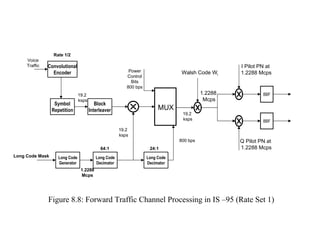
               Figure 8.8: Forward Traffic Channel Processing in IS –95 (Rate Set 1)
Rate 1/2
 Voice
 Traffic   Convolutional          Symbol
             Encoder             Repetition                                                       I Pilot PN at
                                                          Power                 Walsh Code Wi     1.2288 Mcps
                                                         Control
                                                           Bits
                                                         800 bps
                                19.2                                                     1.2288            BBF
                                ksps                                                      Mcps
             Puncture 2 of                Block
             Every 6 inputs            Interleaver                      MUX
                                                                                19.2
                                                                                ksps                       BBF
                                                      19.2
                                                      ksps
                                                                               800 bps            Q Pilot PN at
                                            64:1                    24:1                          1.2288 Mcps
Long Code Mask      Long Code             Long Code                Long Code
                    Generator             Decimator                Decimator
                                 1.2288
                                 Mcps


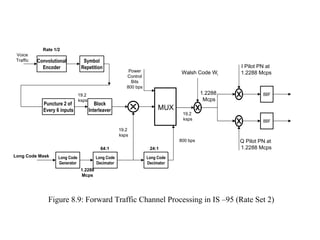
               Figure 8.9: Forward Traffic Channel Processing in IS –95 (Rate Set 2)
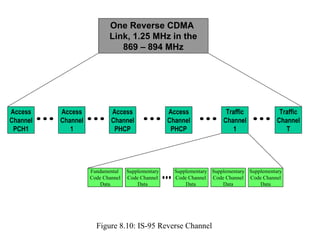
IS-95 CDMA Reverse Channel
 Fundamentally different from the forward channels
 Uses OQPSK for power efficiency
 QPSK demodulation is easy
 869-894 MHz range.
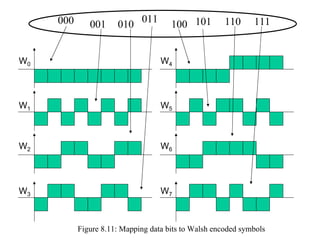
 No spreading of the data using orthogonal codes
 Same orthogonal codes are used for WAVEFORM
 encoding
 Two types of logical channels: The access channels
 and the reverse traffic channels
One Reverse CDMA
                           Link, 1.25 MHz in the
                              869 – 894 MHz


Access    Access            Access                 Access               Traffic              Traffic
Channel   Channel           Channel                Channel             Channel              Channel
 PCH1        1               PHCP                   PHCP                  1                    T


                    Fundamental    Supplementary     Supplementary Supplementary Supplementary
                    Code Channel   Code Channel      Code Channel Code Channel Code Channel
                        Data           Data              Data          Data          Data


                      Figure 8.10: IS-95 Reverse Channel
000      001     010 011         100 101         110     111


W0                                 W4


W1                                 W5


W2                                 W6


W3                                 W7


           Figure 8.11: Mapping data bits to Walsh encoded symbols
I Pilot PN at
                                                                                           1.2288 Mcps


Access
Message                    14.4                28.8
                                                                                  1.2288            BBF
                           ksps                ksps                   64-ary       Mcps
           Convolutional           Symbol                Block      Orthogonal
             Encoder              Repetition          Interleaver
4.8 ksps                                                            Modulator
             Rate 1/3                                                                               BBF


                                                  Long Code Mask      Long Code            Q Pilot PN at
                                                                      Generator            1.2288 Mcps


                                    Figure 8.12: Access Channel Processing in IS-95

IS95 CDMA Technology

  • 1.
  • 2.
    What is CDMA Both an access method and air-interface Rest of the network is very similar Radio resource management, mobility management, security are similar Power control and handoffs are different Uses DSSS and ECC Frequency reuse factor is 1 3 systems IS-95 2G, W-CDMA, and CDMA2000
  • 3.
    Advantages of CDMACellular Higher capacity Improves voice quality (new coder) Soft-handoffs Less power consumption (6-7 mW) Choice for 3G systems
  • 4.
    Advantages of CDMACellular Frequency diversity – frequency-dependent transmission impairments have less effect on signal Multipath resistance – chipping codes used for CDMA exhibit low cross correlation and low autocorrelation Privacy – privacy is inherent since spread spectrum is obtained by use of noise-like signals Graceful degradation – system only gradually degrades as more users access the system
  • 5.
    Drawbacks of CDMACellular Self-jamming – arriving transmissions from multiple users not aligned on chip boundaries unless users are perfectly synchronized Near-far problem – signals closer to the receiver are received with less attenuation than signals farther away Soft handoff – requires that the mobile acquires the new cell before it relinquishes the old; this is more complex than hard handoff used in FDMA and TDMA schemes
  • 6.
    Drawbacks of CDMACellular Air-interface is the most complex Not symmetrical (unlike TDMA) Forward and reverse channels are different Forward channel (1 Many) synchronized Forward channel uses orthogonal spreading codes Reverse channel transmissions are not synchronized Orthogonal codes are used for orthogonal waveform coding
  • 7.
    Mobile Wireless CDMADesign Considerations RAKE receiver – when multiple versions of a signal arrive more than one chip interval apart, RAKE receiver attempts to recover signals from multiple paths and combine them This method achieves better performance than simply recovering dominant signal and treating remaining signals as noise Soft Handoff – mobile station temporarily connected to more than one base station simultaneously
  • 8.
  • 9.
    IS-95 CDMA ForwardChannel The forward link uses the same frequency spectrum as AMPS (824-849 Mhz) Each carrier 1.25MHz 4 types of logical channel: A pilot, a synchronization, 7 paging, and 55 traffic channels Channels are separated using different spreading codes QPSK is the modulation scheme Orthogonal Walsh codes are used (64 total) After orthogonal codes, they are further spread by short PN spreading codes Short PN spreading codes are M sequences generated by LFSRs of length 15 with a period of 32768 chips.
  • 10.
    Forward channel-2 Whywe have two spreading codes? The orthogonal codes are used to differentiate between the transmissions within a cell The PN spreading codes are used to isolate different cells (BSs) that are using the same frequencies. The same PN sequence is used in all BSs. The offset for each BS is different. Of course, this requires synchronization Synchronization is achieved by GPS.
  • 11.
    One Forward CDMA Link, 1.25 MHz in the 824 – 849 MHz bands PCH PCH Code Code Code Code Code Pilot Synch 1 7 1 N P S 55 W0 W32 W1 W7 W8 W63 Fundamental Mobile Power Fundamental Mobile Power Supplementary Code Channel Control Code Channel Control Code Channel Data Subchannel Data Subchannel Data Figure 8.4: IS-95 Forward Channel
  • 12.
    I Pilot PNat Walsh Code 1.288 Mcps 1.2288 Baseband Filter Channel Mcps Dependent Symbols Baseband Filter Q Pilot PN at 1.288 Mcps Figure 8.5: Basic Spreading Procedure on the Forward Channel in IS-95
  • 13.
    The pilot channel Provide a reference signal for all MSs that provides the phase reference for COHERENT demodulation 4-6 dB stronger than all other channels Used to lock onto other channels Obtained using all zero Walsh code; i.e., contains no information except the RF carrier Spread using the PN spreading code to identify the BS. (512 different BS*64 offsets) No power control in the pilot channel
  • 14.
    I Pilot PNat Walsh Code W0 1.2288 Mcps 1.2288 Baseband Filter All 0s Mcps To QPSK Modulator Baseband Filter Q Pilot PN at 1.2288 Mcps (a) I Pilot PN at Walsh Code W32 1.2288 Mcps Synch Channel 1.2288 BBF 2.4 4.8 Message Convolutional ksps Symbol ksps Block Mcps Encoder Repetition Interleaver 1.2 ksps 4.8 Code Modulated ksps BBF Rate 1/2 Symbol Symbol (b) Q Pilot PN at 1.2288 Mcps Figure 8.6: (a) Pilot and (b) Sync Channel Processing in IS -95
  • 15.
    Sync channel Usedto acquire initial time synchronization Synch message includes system ID (SID), network ID (NID), the offset of the PN short code, the state of the PN-long code, and the paging channel data rate (4.8/9.6 Kbps) Uses W32 for spreading Operates at 1200 bps
  • 16.
    I Pilot PNat Walsh Code W0 1.2288 Mcps 1.2288 Baseband Filter All 0s Mcps To QPSK Modulator Baseband Filter Q Pilot PN at 1.2288 Mcps (a) I Pilot PN at Walsh Code W32 1.2288 Mcps Synch Channel 1.2288 BBF 2.4 4.8 Message Convolutional ksps Symbol ksps Block Mcps Encoder Repetition Interleaver 1.2 ksps 4.8 Code Modulated ksps BBF Rate 1/2 Symbol Symbol (b) Q Pilot PN at 1.2288 Mcps Figure 8.6: (a) Pilot and (b) Sync Channel Processing in IS -95
  • 17.
    Paging channels Usedto page the MS in case of an incoming call, or to carry the control messages for call set up Uses W1-W7 There is no power control Additionally scrambled by PN long code, which is generated by LFSR of length 42 The rate 4.8 Kbps or 9.6Kbps
  • 18.
    I Pilot PNat Walsh Code W1-7 1.2288 Mcps Paging 19.2 1.2288 BBF Channel 9.6 or 19.2 19.2 Message ksps ksps ksps Mcps Convolutional Symbol Block Encoder Repetition Interleaver 4.8 or 9.6 Code ksps Symbol Modulated BBF Rate 1/2 Symbol 19.2 64:1 ksps Long Code Mask Long Code Long Code Q Pilot PN at For Paging Channel Generator Decimator 1.2288 Mcps 1.2288 Mcps Figure 8.7: Paging Channel Processing in IS -95
  • 19.
    The traffic channels Carry user information Two possible date rates RS1={9.6, 4.8, 2.4, 1.2 Kbps} RS2={14.4, 7.2, 3.6, 1.8 Kbps} RS1 is mandatory for IS-95, but support for RS2 is optional Also carry power control bits for the reverse channel
  • 20.
    Rate 1/2 Voice Traffic Convolutional I Pilot PN at Encoder Power Walsh Code Wi 1.2288 Mcps Control Bits 800 bps 19.2 1.2288 BBF ksps Mcps Symbol Block Repetition Interleaver MUX 19.2 ksps BBF 19.2 ksps 800 bps Q Pilot PN at 64:1 24:1 1.2288 Mcps Long Code Mask Long Code Long Code Long Code Generator Decimator Decimator 1.2288 Mcps Figure 8.8: Forward Traffic Channel Processing in IS –95 (Rate Set 1)
  • 21.
    Rate 1/2 Voice Traffic Convolutional Symbol Encoder Repetition I Pilot PN at Power Walsh Code Wi 1.2288 Mcps Control Bits 800 bps 19.2 1.2288 BBF ksps Mcps Puncture 2 of Block Every 6 inputs Interleaver MUX 19.2 ksps BBF 19.2 ksps 800 bps Q Pilot PN at 64:1 24:1 1.2288 Mcps Long Code Mask Long Code Long Code Long Code Generator Decimator Decimator 1.2288 Mcps Figure 8.9: Forward Traffic Channel Processing in IS –95 (Rate Set 2)
  • 22.
    IS-95 CDMA ReverseChannel Fundamentally different from the forward channels Uses OQPSK for power efficiency QPSK demodulation is easy 869-894 MHz range. No spreading of the data using orthogonal codes Same orthogonal codes are used for WAVEFORM encoding Two types of logical channels: The access channels and the reverse traffic channels
  • 23.
    One Reverse CDMA Link, 1.25 MHz in the 869 – 894 MHz Access Access Access Access Traffic Traffic Channel Channel Channel Channel Channel Channel PCH1 1 PHCP PHCP 1 T Fundamental Supplementary Supplementary Supplementary Supplementary Code Channel Code Channel Code Channel Code Channel Code Channel Data Data Data Data Data Figure 8.10: IS-95 Reverse Channel
  • 24.
    000 001 010 011 100 101 110 111 W0 W4 W1 W5 W2 W6 W3 W7 Figure 8.11: Mapping data bits to Walsh encoded symbols
  • 25.
    I Pilot PNat 1.2288 Mcps Access Message 14.4 28.8 1.2288 BBF ksps ksps 64-ary Mcps Convolutional Symbol Block Orthogonal Encoder Repetition Interleaver 4.8 ksps Modulator Rate 1/3 BBF Long Code Mask Long Code Q Pilot PN at Generator 1.2288 Mcps Figure 8.12: Access Channel Processing in IS-95