Multiplexing Prepared By : Devang Bhatti
Multiplexing Under the simplest conditions, a medium can carry only one signal at any moment in time. For multiple signals to share one medium, the medium must somehow be divided, giving each signal a portion of the total bandwidth.
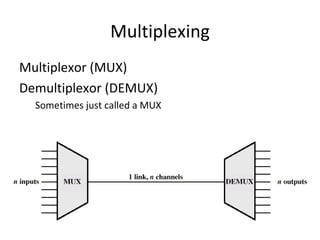
Multiplexing Multiplexor (MUX) Demultiplexor (DEMUX) Sometimes just called a MUX
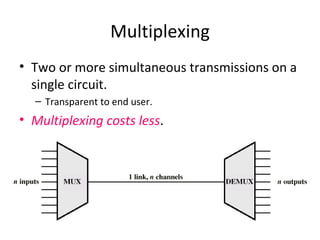
Multiplexing Two or more simultaneous transmissions on a single circuit. Transparent to end user. Multiplexing costs less .
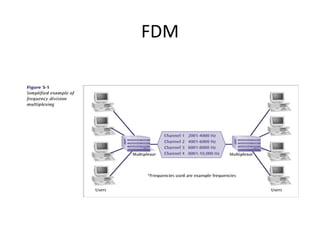
Multiplexing Frequency Division Multiplexing (FDM) Assignment of non-overlapping frequency ranges to each “user” or signal on a medium.  Thus, all signals are transmitted at the same time, each using different frequencies. A multiplexor accepts inputs and assigns frequencies to each device.  The multiplexor is attached to a high-speed communications line. A corresponding multiplexor, or Demultiplexor, is on the end of the high-speed line and separates the multiplexed signals.
FDM
FDM Analog signaling is used to transmits the signals. Broadcast radio and television, cable television, and the AMPS cellular phone systems use frequency division multiplexing. This technique is the oldest multiplexing technique. Since it involves analog signaling, it is more susceptible to noise.
Multiplexing Time Division Multiplexing (TDM) Sharing of the signal is accomplished by dividing available transmission time on a medium among users. Digital signaling is used exclusively. Time division multiplexing comes in two basic forms: 1. Synchronous time division multiplexing, and 2. Statistical, or asynchronous time division multiplexing.
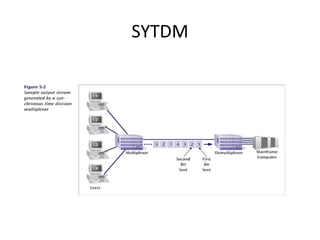
SYTDM The original time division multiplexing. The multiplexor accepts input from attached devices in a round-robin fashion and transmit the data in a never ending pattern. ISDN telephone lines are common examples of synchronous time division multiplexing.
SYTDM
SYTDM If one device generates data at a faster rate than other devices, then the multiplexor must either sample the incoming data stream from that device more often than it samples the other devices, or buffer the faster incoming stream. If a device has nothing to transmit, the multiplexor must still insert a piece of data from that device into the multiplexed stream.
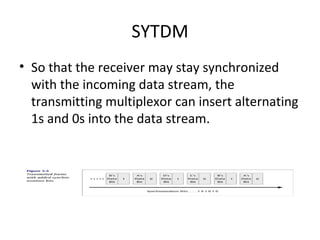
SYTDM So that the receiver may stay synchronized with the incoming data stream, the transmitting multiplexor can insert alternating 1s and 0s into the data stream.
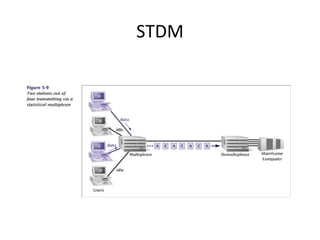
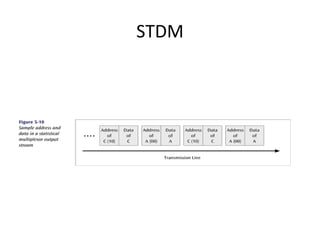
STDM Statistical Time Division Multiplexing A statistical multiplexor transmits only the data from active workstations ( or why work when you don’t have to ). If a workstation is not active, no space is wasted on the multiplexed stream. A statistical multiplexor accepts the incoming data streams and creates a frame containing only the data to be transmitted.
STDM
STDM
STDM A statistical multiplexor does not require a line over as high a speed line since STDM does not assume all sources will transmit all of the time! Good for low bandwidth lines (used for LANs) Much more efficient use of bandwidth!

Multiplexing

  • 1.
    Multiplexing Prepared By: Devang Bhatti
  • 2.
    Multiplexing Under thesimplest conditions, a medium can carry only one signal at any moment in time. For multiple signals to share one medium, the medium must somehow be divided, giving each signal a portion of the total bandwidth.
  • 3.
    Multiplexing Multiplexor (MUX)Demultiplexor (DEMUX) Sometimes just called a MUX
  • 4.
    Multiplexing Two ormore simultaneous transmissions on a single circuit. Transparent to end user. Multiplexing costs less .
  • 5.
    Multiplexing Frequency DivisionMultiplexing (FDM) Assignment of non-overlapping frequency ranges to each “user” or signal on a medium. Thus, all signals are transmitted at the same time, each using different frequencies. A multiplexor accepts inputs and assigns frequencies to each device. The multiplexor is attached to a high-speed communications line. A corresponding multiplexor, or Demultiplexor, is on the end of the high-speed line and separates the multiplexed signals.
  • 6.
  • 7.
    FDM Analog signalingis used to transmits the signals. Broadcast radio and television, cable television, and the AMPS cellular phone systems use frequency division multiplexing. This technique is the oldest multiplexing technique. Since it involves analog signaling, it is more susceptible to noise.
  • 8.
    Multiplexing Time DivisionMultiplexing (TDM) Sharing of the signal is accomplished by dividing available transmission time on a medium among users. Digital signaling is used exclusively. Time division multiplexing comes in two basic forms: 1. Synchronous time division multiplexing, and 2. Statistical, or asynchronous time division multiplexing.
  • 9.
    SYTDM The originaltime division multiplexing. The multiplexor accepts input from attached devices in a round-robin fashion and transmit the data in a never ending pattern. ISDN telephone lines are common examples of synchronous time division multiplexing.
  • 10.
  • 11.
    SYTDM If onedevice generates data at a faster rate than other devices, then the multiplexor must either sample the incoming data stream from that device more often than it samples the other devices, or buffer the faster incoming stream. If a device has nothing to transmit, the multiplexor must still insert a piece of data from that device into the multiplexed stream.
  • 12.
    SYTDM So thatthe receiver may stay synchronized with the incoming data stream, the transmitting multiplexor can insert alternating 1s and 0s into the data stream.
  • 13.
    STDM Statistical TimeDivision Multiplexing A statistical multiplexor transmits only the data from active workstations ( or why work when you don’t have to ). If a workstation is not active, no space is wasted on the multiplexed stream. A statistical multiplexor accepts the incoming data streams and creates a frame containing only the data to be transmitted.
  • 14.
  • 15.
  • 16.
    STDM A statisticalmultiplexor does not require a line over as high a speed line since STDM does not assume all sources will transmit all of the time! Good for low bandwidth lines (used for LANs) Much more efficient use of bandwidth!