The document discusses different techniques for multiplexing, which is the sharing of a transmission medium by multiple signals. It describes frequency division multiplexing (FDM), time division multiplexing (TDM) including synchronous and statistical TDM, wavelength division multiplexing (WDM), and code division multiplexing (CDM). TDM techniques like T-1 and ISDN use synchronous multiplexing to transmit multiple digital signals over a single circuit simultaneously.
In this document
Powered by AI
Discusses multiplexing in data communication, explaining FDM, TDM, WDM, and CDM techniques.
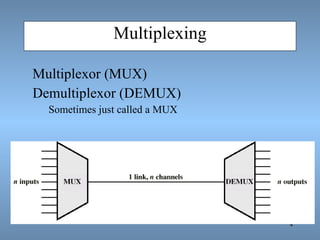
Defines multiplexors and demultiplexors, emphasizing their role in simultaneous transmissions.
Explains FDM's mechanism of assigning frequency ranges for concurrent signal transmission.
Introduces TDM, outlining its methods and forms: synchronous and statistical.
Details how synchronous TDM functions, including examples like T-1 and ISDN.
Illustrates T1's 1.54 Mbps channels and ISDN's frame structure, emphasizing their applications.
Describes SONET's capabilities for high data rates and bandwidth demands.
Analyzes statistical TDM's efficiency by transmitting data only from active sources.Explains DWDM's capability to transmit multiple signals using different wavelengths on fiber.
Details on CDM and its technique allowing multiple devices to share frequencies using codes.
Presents a practical example of efficiently linking two corporate buildings using multiplexing.
Recaps various multiplexing types: TDM, FDM, WDM, and CDM with their specific applications.
Chapter 5 Multiplexing: Sharing a Medium Data Communications and Computer Networks: A Business User’s Approach
2.
DataCommunications and Computer Networks Chapter 5 Making connections – multiplexing Many into one; one into many (spatial) Will use time and frequency to do it.
3.
Introduction Under thesimplest conditions, a medium can carry only one signal at any moment in time. For multiple signals to share one medium, the medium must somehow be divided, giving each signal a portion of the total bandwidth. The current techniques that can accomplish this include frequency division multiplexing (FDM) time division multiplexing (TDM) Synchronous vs statistical wavelength division multiplexing (WDM) code division multiplexing (CDM)
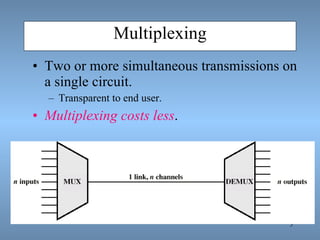
Multiplexing Two ormore simultaneous transmissions on a single circuit. Transparent to end user. Multiplexing costs less .
6.
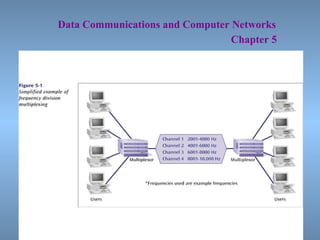
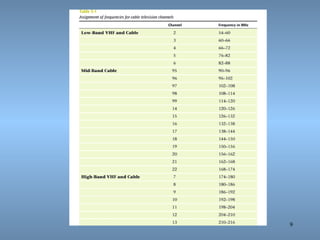
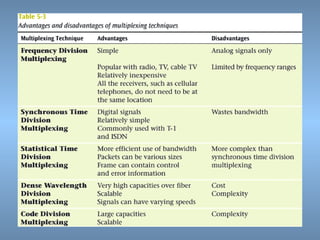
DataCommunications and Computer Networks Chapter 5 Frequency Division Multiplexing Assignment of non-overlapping frequency ranges to each “user” or signal on a medium. Thus, all signals are transmitted at the same time, each using different frequencies. A multiplexor accepts inputs and assigns frequencies to each device. The multiplexor is attached to a high-speed communications line. A corresponding multiplexor, or demultiplexor, is on the end of the high-speed line and separates the multiplexed signals.
7.
DataCommunications and Computer Networks Chapter 5
8.
DataCommunications and Computer Networks Chapter 5 Frequency Division Multiplexing Analog signaling is used to transmits the signals. Broadcast radio and television, cable television, and the AMPS cellular phone systems use frequency division multiplexing. This technique is the oldest multiplexing technique. Since it involves analog signaling, it is more susceptible to noise.
10.
DataCommunications and Computer Networks Chapter 5 Time Division Multiplexing Sharing of the signal is accomplished by dividing available transmission time on a medium among users. Digital signaling is used exclusively. Time division multiplexing comes in two basic forms: 1. Synchronous time division multiplexing, and 2. Statistical, or asynchronous time division multiplexing.
11.
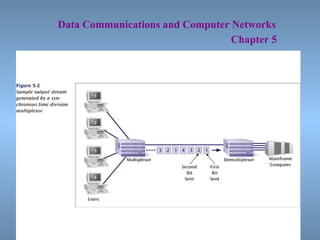
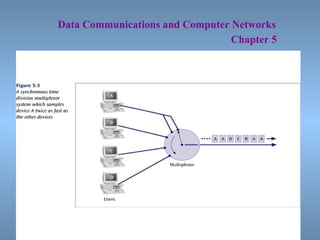
DataCommunications and Computer Networks Chapter 5 Synchronous Time Division Multiplexing The original time division multiplexing. The multiplexor accepts input from attached devices in a round-robin fashion and transmit the data in a never ending pattern. T-1 and ISDN telephone lines are common examples of synchronous time division multiplexing.
12.
DataCommunications and Computer Networks Chapter 5
13.
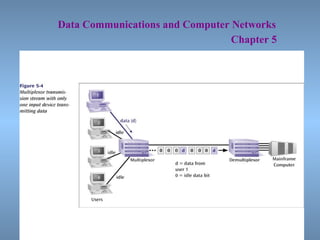
DataCommunications and Computer Networks Chapter 5 Synchronous Time Division Multiplexing If one device generates data at a faster rate than other devices, then the multiplexor must either sample the incoming data stream from that device more often than it samples the other devices, or buffer the faster incoming stream. If a device has nothing to transmit, the multiplexor must still insert a piece of data from that device into the multiplexed stream.
14.
DataCommunications and Computer Networks Chapter 5
15.
DataCommunications and Computer Networks Chapter 5
16.
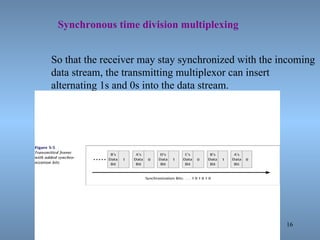
Synchronoustime division multiplexing So that the receiver may stay synchronized with the incoming data stream, the transmitting multiplexor can insert alternating 1s and 0s into the data stream.
17.
DataCommunications and Computer Networks Chapter 5 Synchronous Time Division Multiplexing Three types popular today: T-1 multiplexing (the classic) ISDN multiplexing SONET ( S ynchronous O ptical NET work)
18.
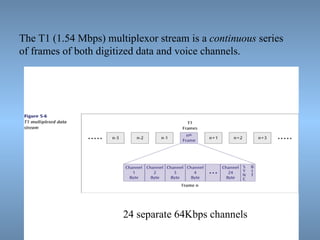
The T1 (1.54Mbps) multiplexor stream is a continuous series of frames of both digitized data and voice channels. 24 separate 64Kbps channels
19.
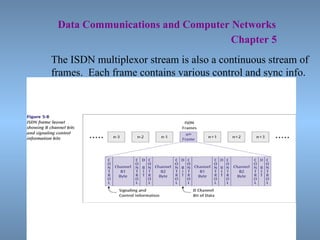
DataCommunications and Computer Networks Chapter 5 The ISDN multiplexor stream is also a continuous stream of frames. Each frame contains various control and sync info.
20.
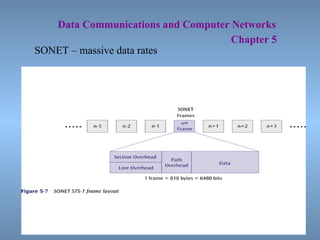
DataCommunications and Computer Networks Chapter 5 SONET – massive data rates
21.
Synchronous TDM Verypopular Line will require as much bandwidth as all the bandwidths of the sources
22.
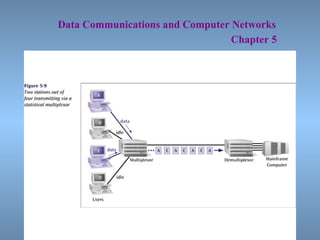
DataCommunications and Computer Networks Chapter 5 Statistical Time Division Multiplexing A statistical multiplexor transmits only the data from active workstations ( or why work when you don’t have to ). If a workstation is not active, no space is wasted on the multiplexed stream. A statistical multiplexor accepts the incoming data streams and creates a frame containing only the data to be transmitted.
23.
DataCommunications and Computer Networks Chapter 5
24.
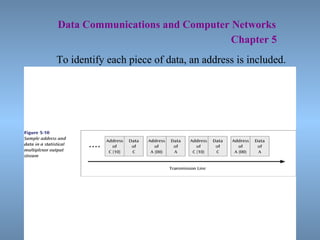
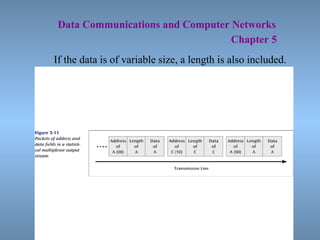
DataCommunications and Computer Networks Chapter 5 To identify each piece of data, an address is included.
25.
DataCommunications and Computer Networks Chapter 5 If the data is of variable size, a length is also included.
26.
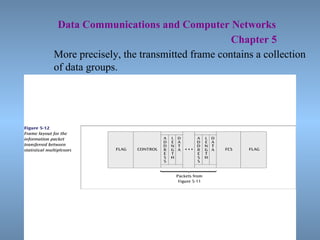
DataCommunications and Computer Networks Chapter 5 More precisely, the transmitted frame contains a collection of data groups.
27.
DataCommunications and Computer Networks Chapter 5 Statistical Time Division Multiplexing A statistical multiplexor does not require a line over as high a speed line as synchronous time division multiplexing since STDM does not assume all sources will transmit all of the time! Good for low bandwidth lines (used for LANs) Much more efficient use of bandwidth!
28.
DataCommunications and Computer Networks Chapter 5 Wavelength Division Multiplexing (WDM) Give each message a different wavelength (frequency) Easy to do with fiber optics and optical sources
29.
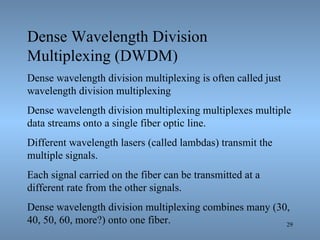
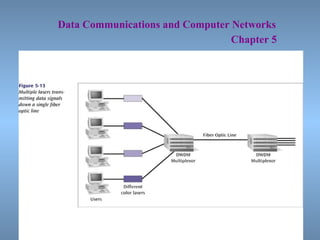
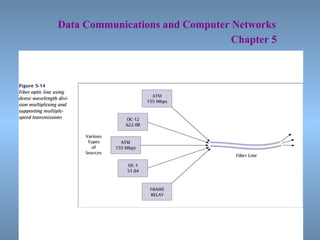
Dense Wavelength DivisionMultiplexing (DWDM) Dense wavelength division multiplexing is often called just wavelength division multiplexing Dense wavelength division multiplexing multiplexes multiple data streams onto a single fiber optic line. Different wavelength lasers (called lambdas) transmit the multiple signals. Each signal carried on the fiber can be transmitted at a different rate from the other signals. Dense wavelength division multiplexing combines many (30, 40, 50, 60, more?) onto one fiber.
30.
DataCommunications and Computer Networks Chapter 5
31.
DataCommunications and Computer Networks Chapter 5
32.
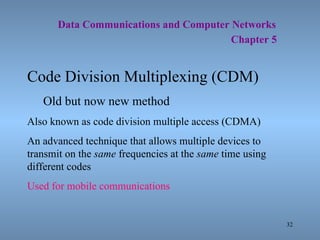
DataCommunications and Computer Networks Chapter 5 Code Division Multiplexing (CDM) Old but now new method Also known as code division multiple access (CDMA) An advanced technique that allows multiple devices to transmit on the same frequencies at the same time using different codes Used for mobile communications
33.
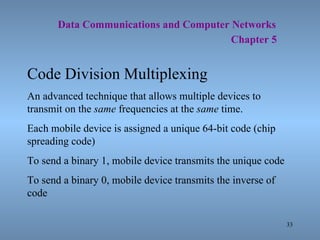
DataCommunications and Computer Networks Chapter 5 Code Division Multiplexing An advanced technique that allows multiple devices to transmit on the same frequencies at the same time. Each mobile device is assigned a unique 64-bit code (chip spreading code) To send a binary 1, mobile device transmits the unique code To send a binary 0, mobile device transmits the inverse of code
34.
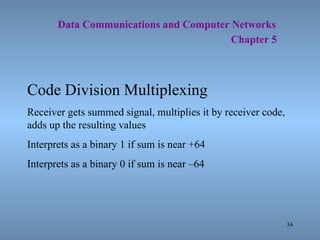
DataCommunications and Computer Networks Chapter 5 Code Division Multiplexing Receiver gets summed signal, multiplies it by receiver code, adds up the resulting values Interprets as a binary 1 if sum is near +64 Interprets as a binary 0 if sum is near –64
36.
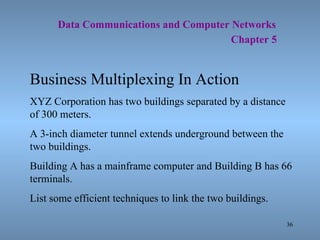
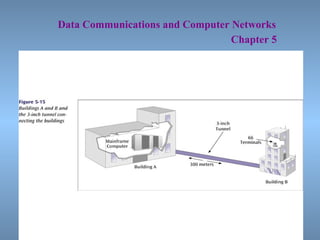
DataCommunications and Computer Networks Chapter 5 Business Multiplexing In Action XYZ Corporation has two buildings separated by a distance of 300 meters. A 3-inch diameter tunnel extends underground between the two buildings. Building A has a mainframe computer and Building B has 66 terminals. List some efficient techniques to link the two buildings.
37.
DataCommunications and Computer Networks Chapter 5
38.
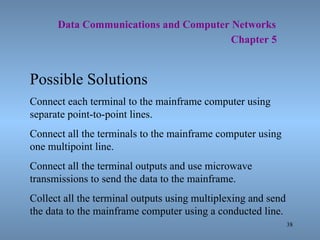
DataCommunications and Computer Networks Chapter 5 Possible Solutions Connect each terminal to the mainframe computer using separate point-to-point lines. Connect all the terminals to the mainframe computer using one multipoint line. Connect all the terminal outputs and use microwave transmissions to send the data to the mainframe. Collect all the terminal outputs using multiplexing and send the data to the mainframe computer using a conducted line.
39.
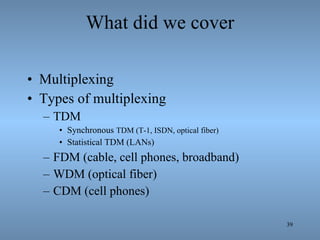
What did wecover Multiplexing Types of multiplexing TDM Synchronous TDM (T-1, ISDN, optical fiber) Statistical TDM (LANs) FDM (cable, cell phones, broadband) WDM (optical fiber) CDM (cell phones)