Downloaded 626 times
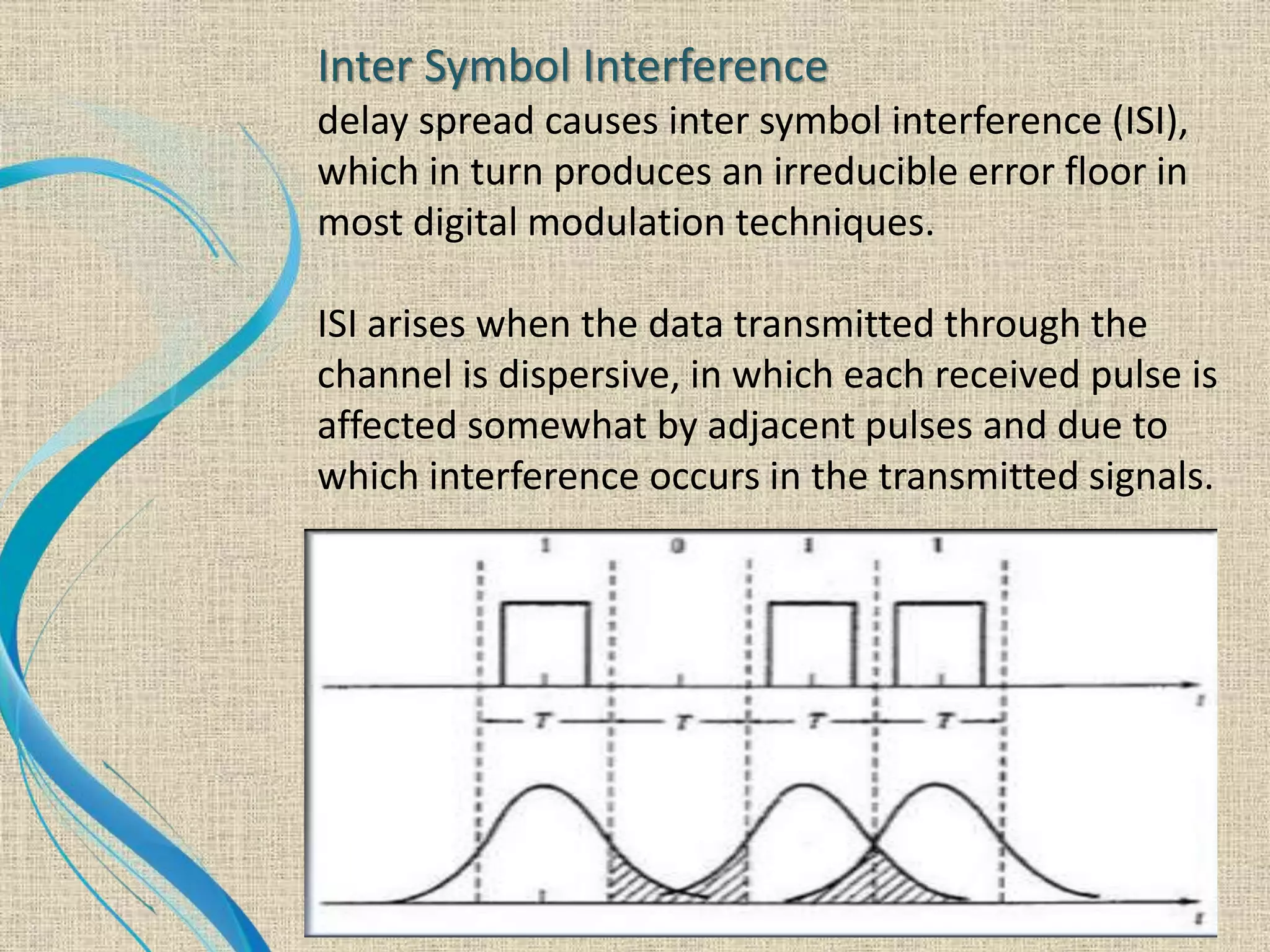

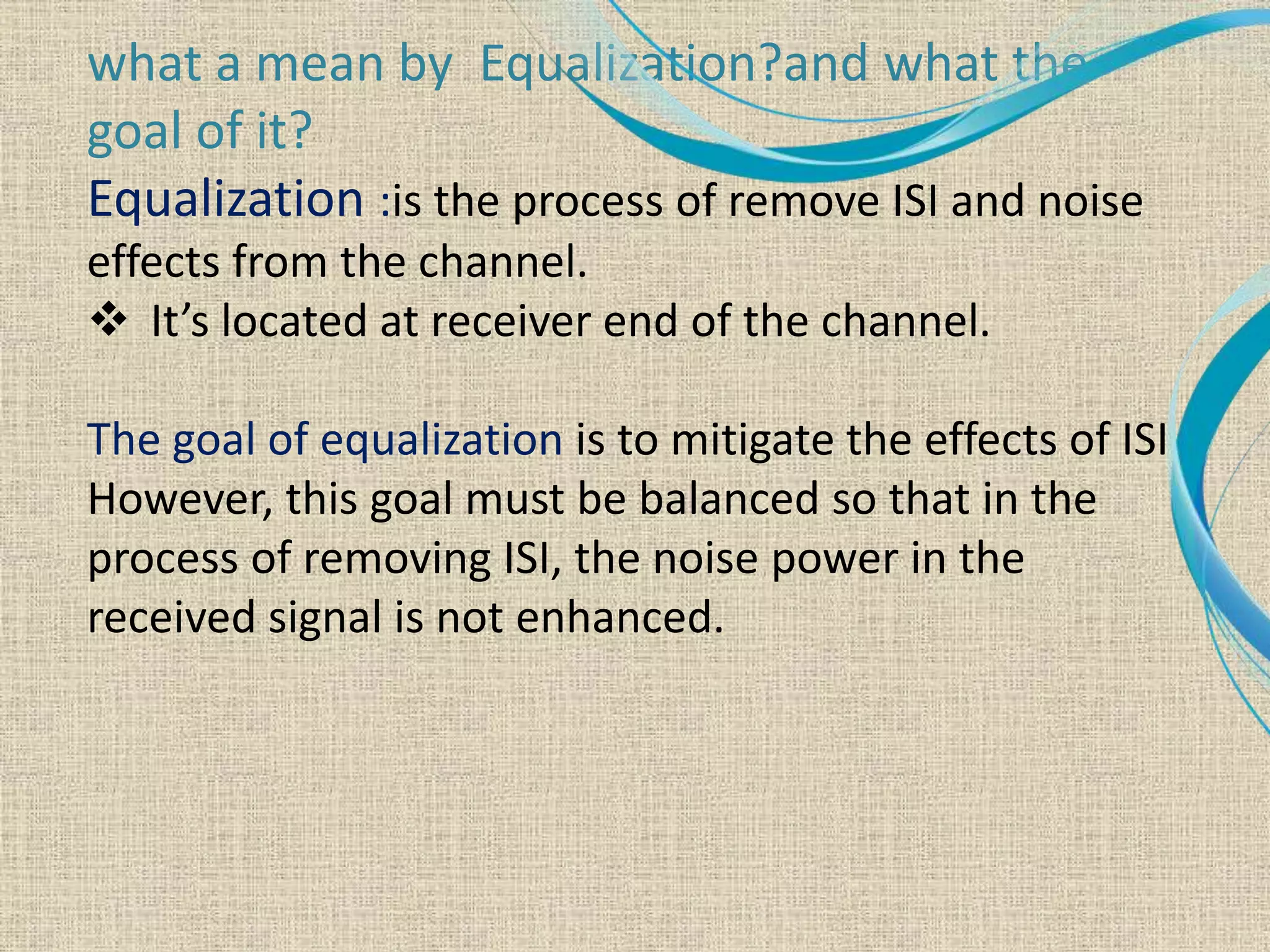
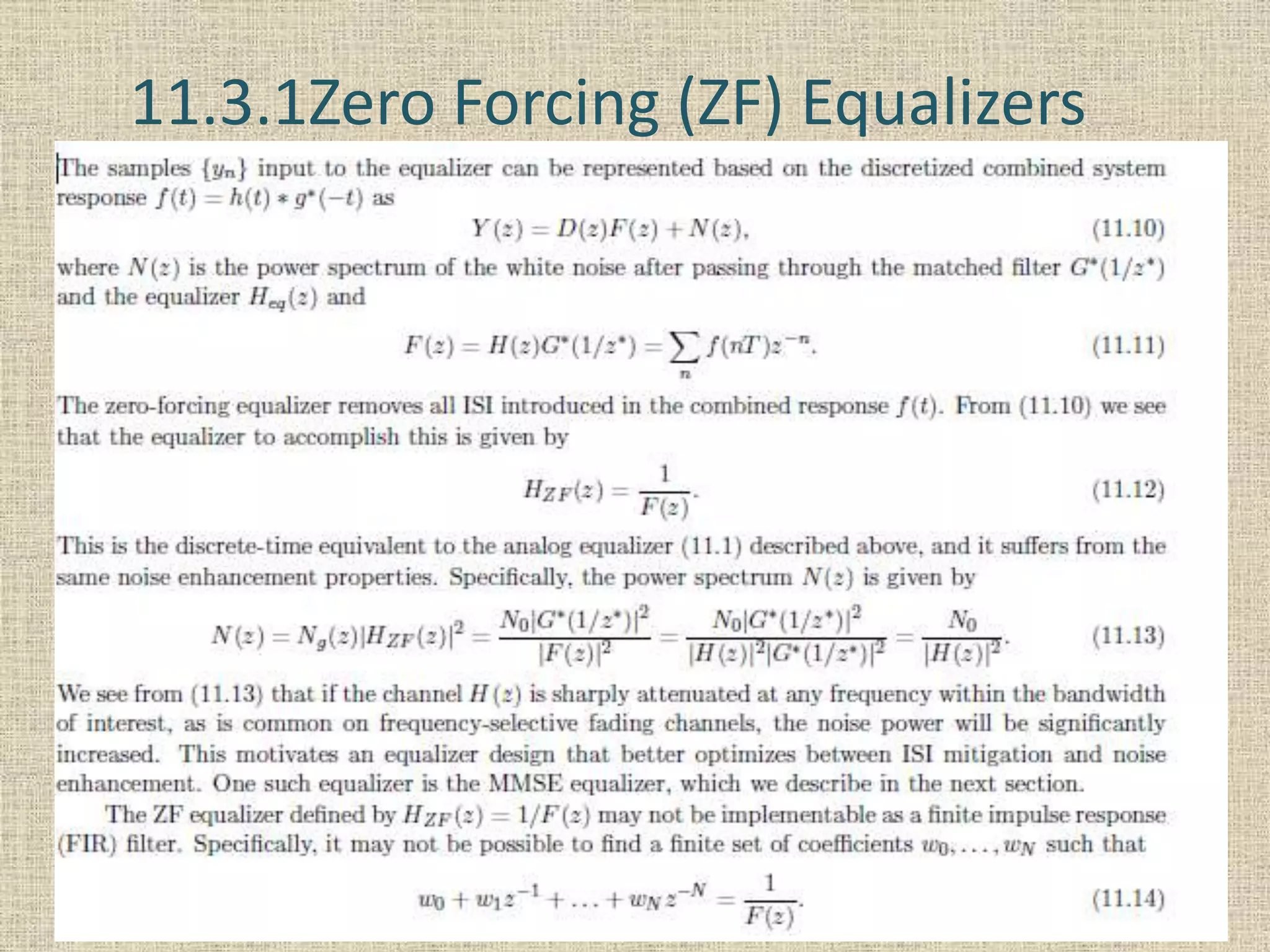
![The receiver signal W(f) after passing through this equalizer
becomes [S(f)H(f) + N(f)] 𝐻𝑒𝑞(f) = S(f) + N0(f),
where N0(f) is colored Gaussian noise with power spectral
density N0/|H(f)|2. Thus, all ISI has been removed from the
transmitted signal S(f).
For an equalizer to mitigate the ISI introduced by the
channel, it must have an estimate of the channel impulse or
frequency response. Since the wireless channel varies over
time, the equalizer must learn the frequency response of
the channel (training) and then update its estimate of the
frequency response as the channel changes (tracking).
The process of equalizer training and tracking is often
referred to as adaptive equalization, since the equalizer
adapts to the changing channel.](https://image.slidesharecdn.com/equalization-160228123351/75/Equalization-6-2048.jpg)



![11.3.2Minimum Mean Square Error (MMSE)
Equalizer
In MMSE equalization the goal of the equalizer design is to minimize
the average mean square error (MSE) between the transmitted
symbol 𝑑 𝑘 and its estimate 𝑑 𝑘at the output of the equalizer, i.e we
want to find the {𝑤𝑖}s to minimize E[𝑑 𝑘− 𝑑 𝑘]. Since we are dealing
with linear equalizers, the equalizer output 𝑑 𝑘̂ is a linear
combination of the input samples 𝑦 𝑘:](https://image.slidesharecdn.com/equalization-160228123351/75/Equalization-13-2048.jpg)

![Maximum-likelihood sequence estimation (MLSE) avoids the problem of noise
enhancement since it doesn’t use an equalizing filter: instead it estimates the
sequence of transmitted symbols . Using a Gram-Schmidt orthonormalization
procedure we can express w(t) on a time interval [0, LT] as
11.4Maximum Likelihood Sequence
Estimation](https://image.slidesharecdn.com/equalization-160228123351/75/Equalization-15-2048.jpg)




The document discusses equalization techniques used to mitigate inter-symbol interference (ISI) in digital communication systems. Equalization aims to remove ISI and noise effects from the channel. It is located at the receiver and uses techniques like linear equalizers, decision feedback equalization, and maximum likelihood sequence estimation to estimate the channel response and minimize the error between transmitted and received symbols while balancing noise. As the wireless channel changes over time, adaptive equalization is used where the equalizer periodically trains and tracks the changing channel response.


