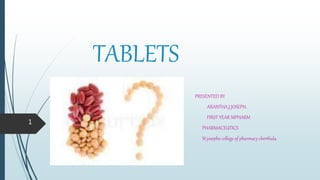
TABLETS
PRESENTED BY
ARANTHA.J.JOSEPH.
FIRST YEAR MPHARM
PHARMACEUTICS
St josephs college of pharmacy cherthala.
1
CONTENTS
Introduction .
Formulation.
 Design.
Manufacturing.
2
TABLETS
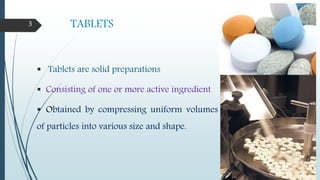
 Tablets are solid preparations
 Consisting of one or more active ingredient
 Obtained by compressing uniform volumes
of particles into various size and shape.
3
THE ADVANTAGES OF THE TABLET
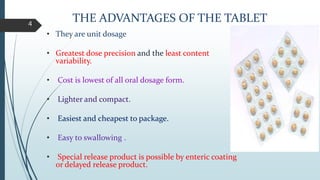
• They are unit dosage
• Greatest dose precision and the least content
variability.
• Cost is lowest of all oral dosage form.
• Lighter and compact.
• Easiest and cheapest to package.
• Easy to swallowing .
• Special release product is possible by enteric coating
or delayed release product.
4
• odour and bitter taste can be masked by coating
technique.
• Suitable for large scale production.
• Greatest chemical ,mechanical and microbial
stability over all oral dosage form.
• Product identification is easy and cheapest.
5
DISADVANTAGES OF TABLET
• Difficult to swallow in case of children and unconscious
patients.
• Some drugs resist compression into dense compacts.
• Drugs with poor wetting, slow dissolution properties, is
difficult to formulate.
• Bitter testing drugs, drugs with an objectionable odor or
drugs that are sensitive to oxygen may require
encapsulation or coating.
6
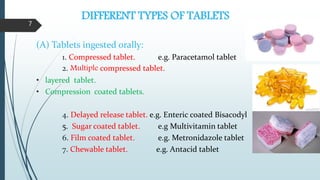
DIFFERENT TYPES OF TABLETS
(A) Tablets ingested orally:
1. Compressed tablet. e.g. Paracetamol tablet
2. Multiple compressed tablet.
• layered tablet.
• Compression coated tablets.
4. Delayed release tablet. e.g. Enteric coated Bisacodyl
5. Sugar coated tablet. e.g Multivitamin tablet
6. Film coated tablet. e.g. Metronidazole tablet
7. Chewable tablet. e.g. Antacid tablet
7
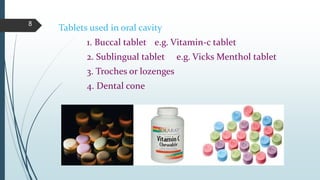
Tablets used in oral cavity
1. Buccal tablet e.g. Vitamin-c tablet
2. Sublingual tablet e.g. Vicks Menthol tablet
3. Troches or lozenges
4. Dental cone
8
(c) Tablets administered by other route:
1. Implantation tablet
2. Vaginal tablet, e.g. Clotrimazole tablet
(D) Tablets used to prepare solution:
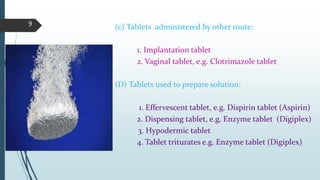
1. Effervescent tablet, e.g. Dispirin tablet (Aspirin)
2. Dispensing tablet, e.g. Enzyme tablet (Digiplex)
3. Hypodermic tablet
4. Tablet triturates e.g. Enzyme tablet (Digiplex)
9
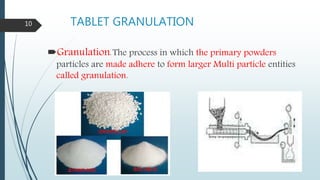
TABLET GRANULATION
Granulation: The process in which the primary powders
particles are made adhere to form larger Multi particle entities
called granulation.
10
Powders intended for compression into tablets must possess
two essential properties.
Powder fluidity or flowability
• Powder flow can be improved mechanically by the use of
vibrators, glidant.
Powder compressibility
• The property of forming a stable, intact compact mass
when pressure is applied is called powder
compressibility.
1
11
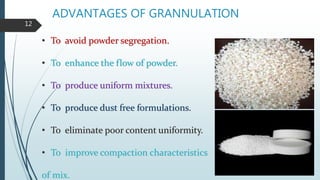
ADVANTAGES OF GRANNULATION
• To avoid powder segregation.
• To enhance the flow of powder.
• To produce uniform mixtures.
• To produce dust free formulations.
• To eliminate poor content uniformity.
• To improve compaction characteristics
of mix.
12
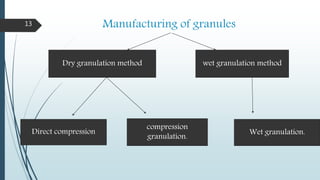
Manufacturing of granules
Dry granulation method wet granulation method
Direct compression
compression
granulation.
Wet granulation.
13
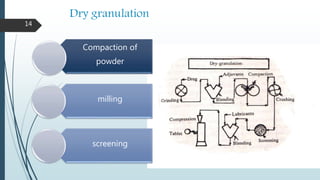
Dry granulation
14
Compaction of
powder
milling
screening
15
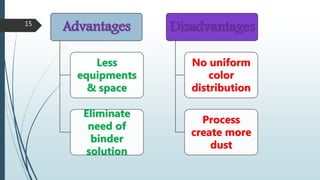
Advantages
Less
equipments
& space
Eliminate
need of
binder
solution
Disadvantages
No uniform
color
distribution
Process
create more
dust
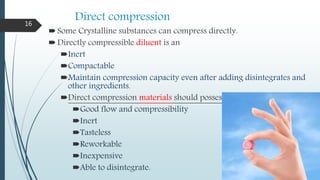
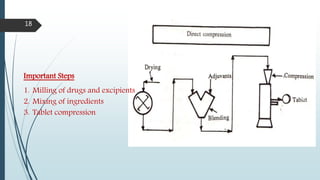
Direct compression
Some Crystalline substances can compress directly.
Directly compressible diluent is an
Inert
Compactable
Maintain compression capacity even after adding disintegrates and
other ingredients.
Direct compression materials should posses
Good flow and compressibility
Inert
Tasteless
Reworkable
Inexpensive
Able to disintegrate.
16
Drug
Excipients
Diluents
Disintegrant
Large sized tablets
Slugs
Granules
Disintegrant
Glidant
Lubricant
tablets
Compression
granulation
17
Weighing
Mixing [blender]
Slugging[tablet press,
roller compactor.
Screening sieve[20-25]
Mixing
Compression [tablet
press]
18
Important Steps
1. Milling of drugs and excipients
2. Mixing of ingredients
3. Tablet compression
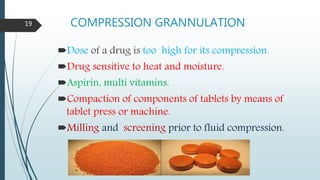
COMPRESSION GRANNULATION
Dose of a drug is too high for its compression.
Drug sensitive to heat and moisture.
Aspirin, multi vitamins.
Compaction of components of tablets by means of
tablet press or machine.
Milling and screening prior to fluid compression.
19
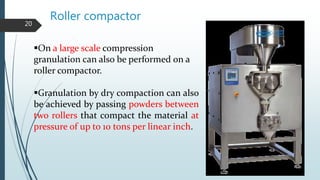
Roller compactor
20
On a large scale compression
granulation can also be performed on a
roller compactor.
Granulation by dry compaction can also
be achieved by passing powders between
two rollers that compact the material at
pressure of up to 10 tons per linear inch.
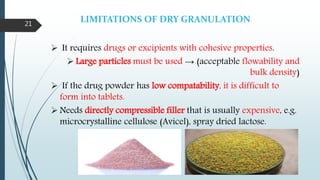
 It requires drugs or excipients with cohesive properties.
 Large particles must be used → (acceptable flowability and
bulk density)
 If the drug powder has low compatability, it is difficult to
form into tablets.
 Needs directly compressible filler that is usually expensive, e.g.
microcrystalline cellulose (Avicel), spray dried lactose.
LIMITATIONS OF DRY GRANULATION21
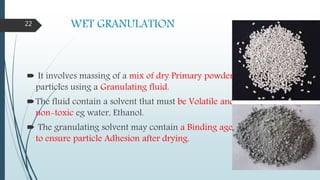
WET GRANULATION
 It involves massing of a mix of dry Primary powder
particles using a Granulating fluid.
The fluid contain a solvent that must be Volatile and
non-toxic eg water, Ethanol.
 The granulating solvent may contain a Binding agent
to ensure particle Adhesion after drying.
22
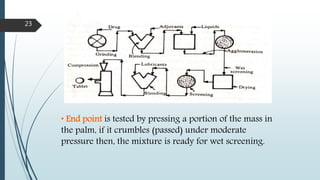
23
• End point is tested by pressing a portion of the mass in
the palm, if it crumbles (passed) under moderate
pressure then, the mixture is ready for wet screening.
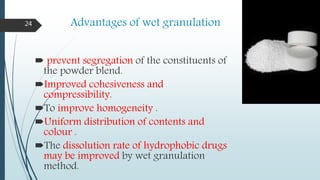
Advantages of wet granulation
 prevent segregation of the constituents of
the powder blend.
Improved cohesiveness and
compressibility.
To improve homogeneity .
Uniform distribution of contents and
colour .
The dissolution rate of hydrophobic drugs
may be improved by wet granulation
method.
24
Limitations of wet granulation:
• Multiple separate steps are involved.
• Not suitable for heat and moisture sensitive drugs
• It is an expensive process-
• Cannot be used for moisture sensitive drugs.
• The use of soluble dyes often lead to migration of
dyes during drying stage.
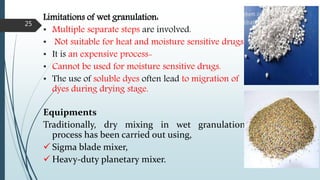
Equipments
Traditionally, dry mixing in wet granulation
process has been carried out using,
 Sigma blade mixer,
 Heavy-duty planetary mixer.
25
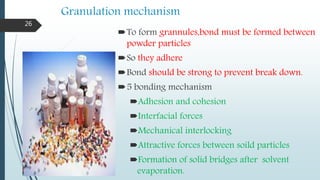
Granulation mechanism
To form grannules,bond must be formed between
powder particles
So they adhere
Bond should be strong to prevent break down.
5 bonding mechanism
Adhesion and cohesion
Interfacial forces
Mechanical interlocking
Attractive forces between soild particles
Formation of solid bridges after solvent
evaporation.
26
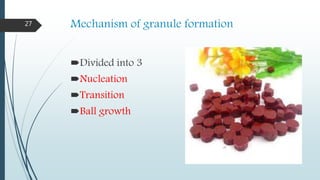
Mechanism of granule formation
Divided into 3
Nucleation
Transition
Ball growth
27
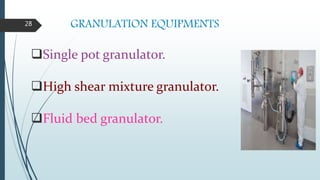
GRANULATION EQUIPMENTS28
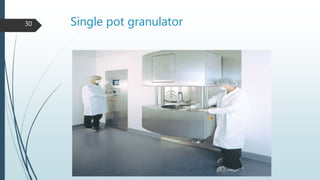
Single pot granulator.
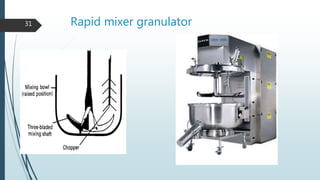
High shear mixture granulator.
Fluid bed granulator.
29
Single pot granulation
The granulation is done in a normal
high shear processor and dried in same
equipment.
e.g. Single Pot Processor /
One-Pot Processor
Single pot granulator30
Rapid mixer granulator31
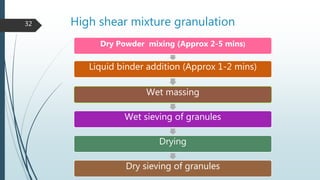
High shear mixture granulation32
Dry Powder mixing (Approx 2-5 mins)
Liquid binder addition (Approx 1-2 mins)
Wet massing
Wet sieving of granules
Drying
Dry sieving of granules
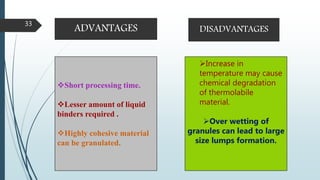
33
Short processing time.
Lesser amount of liquid
binders required .
Highly cohesive material
can be granulated.
Increase in
temperature may cause
chemical degradation
of thermolabile
material.
Over wetting of
granules can lead to large
size lumps formation.
ADVANTAGES DISADVANTAGES
Fluid bed granulator34
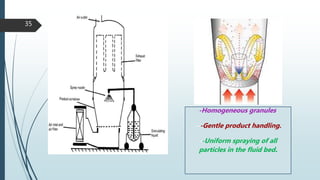
Fluidization is the operation by which fine
solids are transformed into a fluid like state
through contact with a gas.
Granulating and drying can be completed in one
step inside the machine.
35
-Homogeneous granules.
---Gentle product handling.
--Uniform spraying of all
particles in the fluid bed.
Advantages
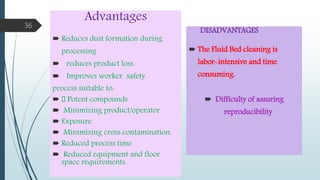
 Reduces dust formation during
processing
 reduces product loss.
 Improves worker safety.
process suitable to:
 􀂄 Potent compounds
 Minimizing product/operator
 Exposure
 Minimizing cross contamination.
 Reduced process time
 Reduced equipment and floor
space requirements.
DISADVANTAGES
 The Fluid Bed cleaning is
labor-intensive and time
consuming.
 Difficulty of assuring
reproducibility.
36
Tablets Excipients
37
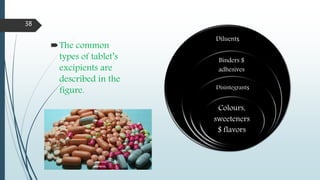
The common
types of tablet’s
excipients are
described in the
figure.
38
Diluents
Binders $
adhesives
Disintegrants
Colours,
sweeteners
$ flavors
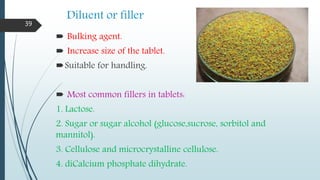
Diluent or filler
 Bulking agent.
 Increase size of the tablet.
Suitable for handling.
 Most common fillers in tablets:
1. Lactose.
2. Sugar or sugar alcohol (glucose,sucrose, sorbitol and
mannitol).
3. Cellulose and microcrystalline cellulose.
4. diCalcium phosphate dihydrate.
39
Requirements for a good diluent
 Chemically inert, biocompatible, cheap.
 Non-hygroscopic.
Good biopharmaceutical properties.
water soluble or hydrophilic.
compatibility
 Have an acceptable taste.
40
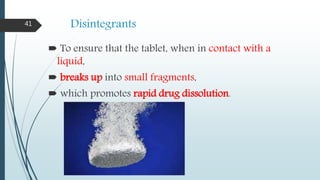
Disintegrants
 To ensure that the tablet, when in contact with a
liquid,
 breaks up into small fragments,
 which promotes rapid drug dissolution.
41
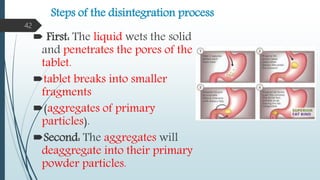
Steps of the disintegration process
 First: The liquid wets the solid
and penetrates the pores of the
tablet.
tablet breaks into smaller
fragments
(aggregates of primary
particles).
Second: The aggregates will
deaggregate into their primary
powder particles.
42
The Method of Disintegrant Addition
 Mixed with other ingredients prior to granulation &
thus incorporated within the granules
(INTRAGRANULAR ADDITION).
 Mixed with the dry granules.(EXTRA GRANULAR
ADDITION).
 Incorporated as both an intragranular and an extra
granular portion.
43
Commonly Used Disintegrants
1. Starch.
2.Cellulose (e.g. sodium carboxymethyl cellulose).
Typical concentration of 1-5% by weight
3. High swelling disintegrants
(Modified Starch or Modified cellulose, in concentration
of 1-2%
44
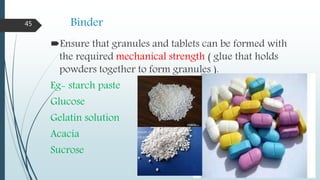
Binder45
Ensure that granules and tablets can be formed with
the required mechanical strength ( glue that holds
powders together to form granules ).
Eg- starch paste
Glucose
Gelatin solution
Acacia
Sucrose
Incorporation of binder
1. Dry Powder
 As dry powder mixed with other ingredient before wet
granulation
 As a dry powder in dry granulation (roller compaction,
slugging)
2. Solution binder
As a solution in wet granulation.
Binder can be added either dry with other excipients for
granulation or
Already dissolved in the granulating fluid;
46
Typical binder concentration is 2 – 10% by
weight
Binders can be:
Insoluble in water, e.g. starch
Soluble in water e.g. HPMC
Soluble in water and ethanol e.g.Povidone
47
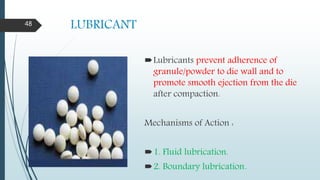
LUBRICANT
Lubricants prevent adherence of
granule/powder to die wall and to
promote smooth ejection from the die
after compaction.
Mechanisms of Action :
1. Fluid lubrication.
2. Boundary lubrication.
48
1. Fluid lubrication
 A layer of fluid is located between the moving surfaces
separating them from each other & thus reduces the friction,
e.g. liquid paraffin.
2. Boundary lubrication:
The sliding surfaces are separated by only a very thin film of
lubricant.
So, the nature of the solid surfaces will therefore affect
friction.
49
Disadvantages of lubricants
 1. Lubricants tend to be hydrophobic.
Under-lubricated blends tend to flow poorly and show
compression sticking problems
Over-lubricated blends can adversely affect tablet hardness
and dissolution rate, as well as tablet strength.
Eg:
Magnesium Stearate
Calcium Stearate , Talc
 Stearic Acid
 Sodium Lauryl Sulfate, liquid Paraffin, propylene glycol, (PG)
50
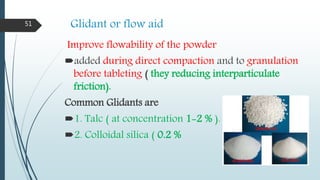
Glidant or flow aid
Improve flowability of the powder
added during direct compaction and to granulation
before tableting ( they reducing interparticulate
friction).
Common Glidants are
1. Talc ( at concentration 1-2 % ).
2. Colloidal silica ( 0.2 %
51
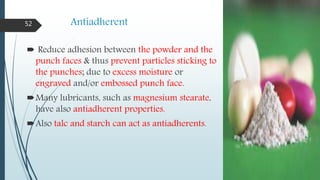
Antiadherent
 Reduce adhesion between the powder and the
punch faces & thus prevent particles sticking to
the punches; due to excess moisture or
engraved and/or embossed punch face.
Many lubricants, such as magnesium stearate,
have also antiadherent properties.
Also talc and starch can act as antiadherents.
52
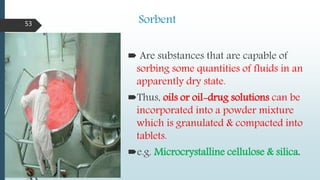
Sorbent
 Are substances that are capable of
sorbing some quantities of fluids in an
apparently dry state.
Thus, oils or oil-drug solutions can be
incorporated into a powder mixture
which is granulated & compacted into
tablets.
e.g. Microcrystalline cellulose & silica.
53
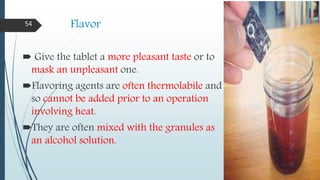
Flavor
 Give the tablet a more pleasant taste or to
mask an unpleasant one.
Flavoring agents are often thermolabile and
so cannot be added prior to an operation
involving heat.
They are often mixed with the granules as
an alcohol solution.
54
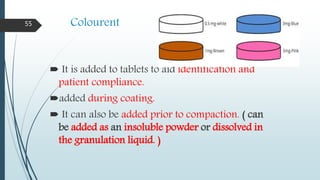
Colourent
 It is added to tablets to aid identification and
patient compliance.
added during coating.
 It can also be added prior to compaction. ( can
be added as an insoluble powder or dissolved in
the granulation liquid. )
55
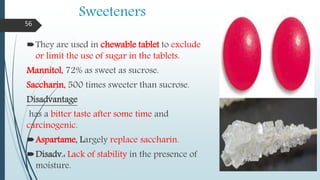
Sweeteners
They are used in chewable tablet to exclude
or limit the use of sugar in the tablets.
Mannitol, 72% as sweet as sucrose.
Saccharin, 500 times sweeter than sucrose.
Disadvantage
has a bitter taste after some time and
carcinogenic.
Aspartame, Largely replace saccharin.
Disadv.: Lack of stability in the presence of
moisture.
56
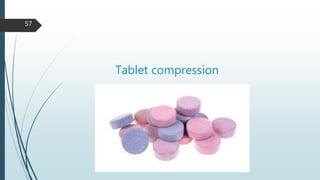
Tablet compression
57
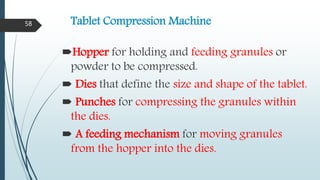
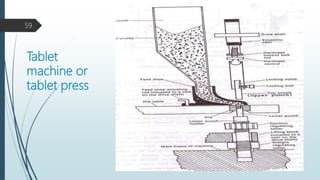
Tablet Compression Machine
Hopper for holding and feeding granules or
powder to be compressed.
 Dies that define the size and shape of the tablet.
 Punches for compressing the granules within
the dies.
 A feeding mechanism for moving granules
from the hopper into the dies.
58
Tablet
machine or
tablet press
59
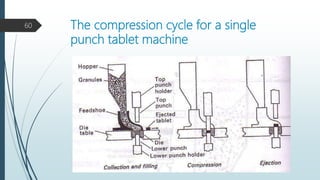
The compression cycle for a single
punch tablet machine
60
Stages of Tablet Formation
(Compaction Cycle)
Gravitational flow of the powder from hopper via the die table
into the die .
(the die is closed at its lower end by the lower punch).
Tablet formation
The upper punch descends , enters the die ,the powder is
Compressed until a tablet is formed.
After maximum applied force is reached,the upper punch
leaves the powder.
61
Tablet ejection
The lower punch rises until its tip reaches
the level of the top of the die.
The tablet is subsequently removed from the
die and die table by a pushing device.
62
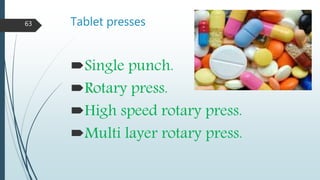
Tablet presses63
Single punch.
Rotary press.
High speed rotary press.
Multi layer rotary press.
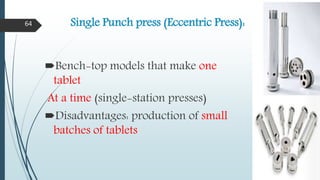
Single Punch press (Eccentric Press):
Bench-top models that make one
tablet
At a time (single-station presses)
Disadvantages: production of small
batches of tablets
64
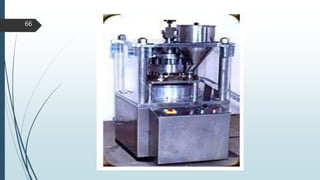
Rotary Press( Multi station Press):
(10 000 tablets per minute)
Large scale production.
It consists of a number of dies and sets of punches (
from 3 up to 60).
The dies are mounted in a circle in the die table
both the die and the punches rotate together during
operation of the machine.
65
66
67
The powder is held in a hopper whose lower
opening is located just above the die table.
 The powder flows on to the die table & fed into the
die by a feed frame.
During powder compression both punches operate
by vertical movement.
 After tablet ejection, the tablet is knocked away as
the die passes the feed frame.
Reference
Text book of physical pharmacy by Tripathi pg no 210-263.
Sherwood BE & Becker JW (1998) “A new class of high-
functionality excipients: silici-fied microcrystalline cellulose”
Pharm Tech 22 78–88.
Vogel, P.J.; Schmidt, P.C. Force –Time Curves of a Modern
Rotary Tablet Machine. II. Influence ofCompression Force and
Tableting Speed on the Deformation Mechanisms of
Pharmaceutical Substances. Drug Dev. Ind. Pharm. 1993, 19,
1917.
The theory and practice of industrial pharmacy fourth edition
by lachman/lieberman page no 449-543
68
69

Tablets formulation

  • 1.
    TABLETS PRESENTED BY ARANTHA.J.JOSEPH. FIRST YEARMPHARM PHARMACEUTICS St josephs college of pharmacy cherthala. 1
  • 2.
  • 3.
    TABLETS  Tablets aresolid preparations  Consisting of one or more active ingredient  Obtained by compressing uniform volumes of particles into various size and shape. 3
  • 4.
    THE ADVANTAGES OFTHE TABLET • They are unit dosage • Greatest dose precision and the least content variability. • Cost is lowest of all oral dosage form. • Lighter and compact. • Easiest and cheapest to package. • Easy to swallowing . • Special release product is possible by enteric coating or delayed release product. 4
  • 5.
    • odour andbitter taste can be masked by coating technique. • Suitable for large scale production. • Greatest chemical ,mechanical and microbial stability over all oral dosage form. • Product identification is easy and cheapest. 5
  • 6.
    DISADVANTAGES OF TABLET •Difficult to swallow in case of children and unconscious patients. • Some drugs resist compression into dense compacts. • Drugs with poor wetting, slow dissolution properties, is difficult to formulate. • Bitter testing drugs, drugs with an objectionable odor or drugs that are sensitive to oxygen may require encapsulation or coating. 6
  • 7.
    DIFFERENT TYPES OFTABLETS (A) Tablets ingested orally: 1. Compressed tablet. e.g. Paracetamol tablet 2. Multiple compressed tablet. • layered tablet. • Compression coated tablets. 4. Delayed release tablet. e.g. Enteric coated Bisacodyl 5. Sugar coated tablet. e.g Multivitamin tablet 6. Film coated tablet. e.g. Metronidazole tablet 7. Chewable tablet. e.g. Antacid tablet 7
  • 8.
    Tablets used inoral cavity 1. Buccal tablet e.g. Vitamin-c tablet 2. Sublingual tablet e.g. Vicks Menthol tablet 3. Troches or lozenges 4. Dental cone 8
  • 9.
    (c) Tablets administeredby other route: 1. Implantation tablet 2. Vaginal tablet, e.g. Clotrimazole tablet (D) Tablets used to prepare solution: 1. Effervescent tablet, e.g. Dispirin tablet (Aspirin) 2. Dispensing tablet, e.g. Enzyme tablet (Digiplex) 3. Hypodermic tablet 4. Tablet triturates e.g. Enzyme tablet (Digiplex) 9
  • 10.
    TABLET GRANULATION Granulation: Theprocess in which the primary powders particles are made adhere to form larger Multi particle entities called granulation. 10
  • 11.
    Powders intended forcompression into tablets must possess two essential properties. Powder fluidity or flowability • Powder flow can be improved mechanically by the use of vibrators, glidant. Powder compressibility • The property of forming a stable, intact compact mass when pressure is applied is called powder compressibility. 1 11
  • 12.
    ADVANTAGES OF GRANNULATION •To avoid powder segregation. • To enhance the flow of powder. • To produce uniform mixtures. • To produce dust free formulations. • To eliminate poor content uniformity. • To improve compaction characteristics of mix. 12
  • 13.
    Manufacturing of granules Drygranulation method wet granulation method Direct compression compression granulation. Wet granulation. 13
  • 14.
  • 15.
  • 16.
    Direct compression Some Crystallinesubstances can compress directly. Directly compressible diluent is an Inert Compactable Maintain compression capacity even after adding disintegrates and other ingredients. Direct compression materials should posses Good flow and compressibility Inert Tasteless Reworkable Inexpensive Able to disintegrate. 16
  • 17.
    Drug Excipients Diluents Disintegrant Large sized tablets Slugs Granules Disintegrant Glidant Lubricant tablets Compression granulation 17 Weighing Mixing[blender] Slugging[tablet press, roller compactor. Screening sieve[20-25] Mixing Compression [tablet press]
  • 18.
    18 Important Steps 1. Millingof drugs and excipients 2. Mixing of ingredients 3. Tablet compression
  • 19.
    COMPRESSION GRANNULATION Dose ofa drug is too high for its compression. Drug sensitive to heat and moisture. Aspirin, multi vitamins. Compaction of components of tablets by means of tablet press or machine. Milling and screening prior to fluid compression. 19
  • 20.
    Roller compactor 20 On alarge scale compression granulation can also be performed on a roller compactor. Granulation by dry compaction can also be achieved by passing powders between two rollers that compact the material at pressure of up to 10 tons per linear inch.
  • 21.
     It requiresdrugs or excipients with cohesive properties.  Large particles must be used → (acceptable flowability and bulk density)  If the drug powder has low compatability, it is difficult to form into tablets.  Needs directly compressible filler that is usually expensive, e.g. microcrystalline cellulose (Avicel), spray dried lactose. LIMITATIONS OF DRY GRANULATION21
  • 22.
    WET GRANULATION  Itinvolves massing of a mix of dry Primary powder particles using a Granulating fluid. The fluid contain a solvent that must be Volatile and non-toxic eg water, Ethanol.  The granulating solvent may contain a Binding agent to ensure particle Adhesion after drying. 22
  • 23.
    23 • End pointis tested by pressing a portion of the mass in the palm, if it crumbles (passed) under moderate pressure then, the mixture is ready for wet screening.
  • 24.
    Advantages of wetgranulation  prevent segregation of the constituents of the powder blend. Improved cohesiveness and compressibility. To improve homogeneity . Uniform distribution of contents and colour . The dissolution rate of hydrophobic drugs may be improved by wet granulation method. 24
  • 25.
    Limitations of wetgranulation: • Multiple separate steps are involved. • Not suitable for heat and moisture sensitive drugs • It is an expensive process- • Cannot be used for moisture sensitive drugs. • The use of soluble dyes often lead to migration of dyes during drying stage. Equipments Traditionally, dry mixing in wet granulation process has been carried out using,  Sigma blade mixer,  Heavy-duty planetary mixer. 25
  • 26.
    Granulation mechanism To formgrannules,bond must be formed between powder particles So they adhere Bond should be strong to prevent break down. 5 bonding mechanism Adhesion and cohesion Interfacial forces Mechanical interlocking Attractive forces between soild particles Formation of solid bridges after solvent evaporation. 26
  • 27.
    Mechanism of granuleformation Divided into 3 Nucleation Transition Ball growth 27
  • 28.
    GRANULATION EQUIPMENTS28 Single potgranulator. High shear mixture granulator. Fluid bed granulator.
  • 29.
    29 Single pot granulation Thegranulation is done in a normal high shear processor and dried in same equipment. e.g. Single Pot Processor / One-Pot Processor
  • 30.
  • 31.
  • 32.
    High shear mixturegranulation32 Dry Powder mixing (Approx 2-5 mins) Liquid binder addition (Approx 1-2 mins) Wet massing Wet sieving of granules Drying Dry sieving of granules
  • 33.
    33 Short processing time. Lesseramount of liquid binders required . Highly cohesive material can be granulated. Increase in temperature may cause chemical degradation of thermolabile material. Over wetting of granules can lead to large size lumps formation. ADVANTAGES DISADVANTAGES
  • 34.
    Fluid bed granulator34 Fluidizationis the operation by which fine solids are transformed into a fluid like state through contact with a gas. Granulating and drying can be completed in one step inside the machine.
  • 35.
    35 -Homogeneous granules. ---Gentle producthandling. --Uniform spraying of all particles in the fluid bed.
  • 36.
    Advantages  Reduces dustformation during processing  reduces product loss.  Improves worker safety. process suitable to:  􀂄 Potent compounds  Minimizing product/operator  Exposure  Minimizing cross contamination.  Reduced process time  Reduced equipment and floor space requirements. DISADVANTAGES  The Fluid Bed cleaning is labor-intensive and time consuming.  Difficulty of assuring reproducibility. 36
  • 37.
  • 38.
    The common types oftablet’s excipients are described in the figure. 38 Diluents Binders $ adhesives Disintegrants Colours, sweeteners $ flavors
  • 39.
    Diluent or filler Bulking agent.  Increase size of the tablet. Suitable for handling.  Most common fillers in tablets: 1. Lactose. 2. Sugar or sugar alcohol (glucose,sucrose, sorbitol and mannitol). 3. Cellulose and microcrystalline cellulose. 4. diCalcium phosphate dihydrate. 39
  • 40.
    Requirements for agood diluent  Chemically inert, biocompatible, cheap.  Non-hygroscopic. Good biopharmaceutical properties. water soluble or hydrophilic. compatibility  Have an acceptable taste. 40
  • 41.
    Disintegrants  To ensurethat the tablet, when in contact with a liquid,  breaks up into small fragments,  which promotes rapid drug dissolution. 41
  • 42.
    Steps of thedisintegration process  First: The liquid wets the solid and penetrates the pores of the tablet. tablet breaks into smaller fragments (aggregates of primary particles). Second: The aggregates will deaggregate into their primary powder particles. 42
  • 43.
    The Method ofDisintegrant Addition  Mixed with other ingredients prior to granulation & thus incorporated within the granules (INTRAGRANULAR ADDITION).  Mixed with the dry granules.(EXTRA GRANULAR ADDITION).  Incorporated as both an intragranular and an extra granular portion. 43
  • 44.
    Commonly Used Disintegrants 1.Starch. 2.Cellulose (e.g. sodium carboxymethyl cellulose). Typical concentration of 1-5% by weight 3. High swelling disintegrants (Modified Starch or Modified cellulose, in concentration of 1-2% 44
  • 45.
    Binder45 Ensure that granulesand tablets can be formed with the required mechanical strength ( glue that holds powders together to form granules ). Eg- starch paste Glucose Gelatin solution Acacia Sucrose
  • 46.
    Incorporation of binder 1.Dry Powder  As dry powder mixed with other ingredient before wet granulation  As a dry powder in dry granulation (roller compaction, slugging) 2. Solution binder As a solution in wet granulation. Binder can be added either dry with other excipients for granulation or Already dissolved in the granulating fluid; 46
  • 47.
    Typical binder concentrationis 2 – 10% by weight Binders can be: Insoluble in water, e.g. starch Soluble in water e.g. HPMC Soluble in water and ethanol e.g.Povidone 47
  • 48.
    LUBRICANT Lubricants prevent adherenceof granule/powder to die wall and to promote smooth ejection from the die after compaction. Mechanisms of Action : 1. Fluid lubrication. 2. Boundary lubrication. 48
  • 49.
    1. Fluid lubrication A layer of fluid is located between the moving surfaces separating them from each other & thus reduces the friction, e.g. liquid paraffin. 2. Boundary lubrication: The sliding surfaces are separated by only a very thin film of lubricant. So, the nature of the solid surfaces will therefore affect friction. 49
  • 50.
    Disadvantages of lubricants 1. Lubricants tend to be hydrophobic. Under-lubricated blends tend to flow poorly and show compression sticking problems Over-lubricated blends can adversely affect tablet hardness and dissolution rate, as well as tablet strength. Eg: Magnesium Stearate Calcium Stearate , Talc  Stearic Acid  Sodium Lauryl Sulfate, liquid Paraffin, propylene glycol, (PG) 50
  • 51.
    Glidant or flowaid Improve flowability of the powder added during direct compaction and to granulation before tableting ( they reducing interparticulate friction). Common Glidants are 1. Talc ( at concentration 1-2 % ). 2. Colloidal silica ( 0.2 % 51
  • 52.
    Antiadherent  Reduce adhesionbetween the powder and the punch faces & thus prevent particles sticking to the punches; due to excess moisture or engraved and/or embossed punch face. Many lubricants, such as magnesium stearate, have also antiadherent properties. Also talc and starch can act as antiadherents. 52
  • 53.
    Sorbent  Are substancesthat are capable of sorbing some quantities of fluids in an apparently dry state. Thus, oils or oil-drug solutions can be incorporated into a powder mixture which is granulated & compacted into tablets. e.g. Microcrystalline cellulose & silica. 53
  • 54.
    Flavor  Give thetablet a more pleasant taste or to mask an unpleasant one. Flavoring agents are often thermolabile and so cannot be added prior to an operation involving heat. They are often mixed with the granules as an alcohol solution. 54
  • 55.
    Colourent  It isadded to tablets to aid identification and patient compliance. added during coating.  It can also be added prior to compaction. ( can be added as an insoluble powder or dissolved in the granulation liquid. ) 55
  • 56.
    Sweeteners They are usedin chewable tablet to exclude or limit the use of sugar in the tablets. Mannitol, 72% as sweet as sucrose. Saccharin, 500 times sweeter than sucrose. Disadvantage has a bitter taste after some time and carcinogenic. Aspartame, Largely replace saccharin. Disadv.: Lack of stability in the presence of moisture. 56
  • 57.
  • 58.
    Tablet Compression Machine Hopperfor holding and feeding granules or powder to be compressed.  Dies that define the size and shape of the tablet.  Punches for compressing the granules within the dies.  A feeding mechanism for moving granules from the hopper into the dies. 58
  • 59.
  • 60.
    The compression cyclefor a single punch tablet machine 60
  • 61.
    Stages of TabletFormation (Compaction Cycle) Gravitational flow of the powder from hopper via the die table into the die . (the die is closed at its lower end by the lower punch). Tablet formation The upper punch descends , enters the die ,the powder is Compressed until a tablet is formed. After maximum applied force is reached,the upper punch leaves the powder. 61
  • 62.
    Tablet ejection The lowerpunch rises until its tip reaches the level of the top of the die. The tablet is subsequently removed from the die and die table by a pushing device. 62
  • 63.
    Tablet presses63 Single punch. Rotarypress. High speed rotary press. Multi layer rotary press.
  • 64.
    Single Punch press(Eccentric Press): Bench-top models that make one tablet At a time (single-station presses) Disadvantages: production of small batches of tablets 64
  • 65.
    Rotary Press( Multistation Press): (10 000 tablets per minute) Large scale production. It consists of a number of dies and sets of punches ( from 3 up to 60). The dies are mounted in a circle in the die table both the die and the punches rotate together during operation of the machine. 65
  • 66.
  • 67.
    67 The powder isheld in a hopper whose lower opening is located just above the die table.  The powder flows on to the die table & fed into the die by a feed frame. During powder compression both punches operate by vertical movement.  After tablet ejection, the tablet is knocked away as the die passes the feed frame.
  • 68.
    Reference Text book ofphysical pharmacy by Tripathi pg no 210-263. Sherwood BE & Becker JW (1998) “A new class of high- functionality excipients: silici-fied microcrystalline cellulose” Pharm Tech 22 78–88. Vogel, P.J.; Schmidt, P.C. Force –Time Curves of a Modern Rotary Tablet Machine. II. Influence ofCompression Force and Tableting Speed on the Deformation Mechanisms of Pharmaceutical Substances. Drug Dev. Ind. Pharm. 1993, 19, 1917. The theory and practice of industrial pharmacy fourth edition by lachman/lieberman page no 449-543 68
  • 69.