FORMULATION OF PARENTERALS
FORMULATION
 Parenterals will be dispensed in several forms including
solutions, suspensions, emulsions, Nano systems and
powders (which are made in to injection by addition of
solvent).
I. Active ingredients
II. Vehicles
III. Added substances
ADDED SUBSTANCES
 These include the substances that safeguard the purity of the
formulation.
PURPOSE:
I. Maintain sterility
II. Maintain stability
III. Minimize pain and tissue irrtitation
IV. Establish, maintain and control soluability
V. Miscellaneous involves:
* Bulking agent
* Suspending agent
* Viscosity imparting agent
 SOLUBILIZERS
 ANTI-OXIDANTS
 CHELATING AGENTS
 ANTI-MICROBIAL AGENTS
 INERT GASES
 BUFFERS
 TONICITY CONTRIBUTORS
 PROTECTANTS
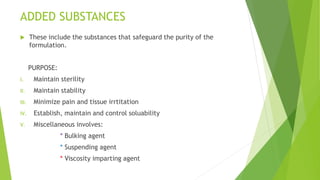
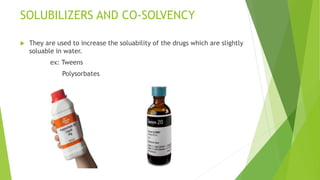
SOLUBILIZERS AND CO-SOLVENCY
 They are used to increase the soluability of the drugs which are slightly
soluable in water.
ex: Tweens
Polysorbates
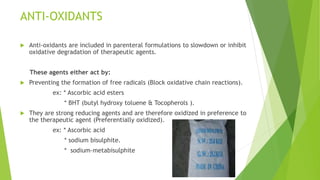
ANTI-OXIDANTS
 Anti-oxidants are included in parenteral formulations to slowdown or inhibit
oxidative degradation of therapeutic agents.
These agents either act by:
 Preventing the formation of free radicals (Block oxidative chain reactions).
ex: * Ascorbic acid esters
* BHT (butyl hydroxy toluene & Tocopherols ).
 They are strong reducing agents and are therefore oxidized in preference to
the therapeutic agent (Preferentially oxidized).
ex: * Ascorbic acid
* sodium bisulphite.
* sodium-metabisulphite
CHELATING AGENTS
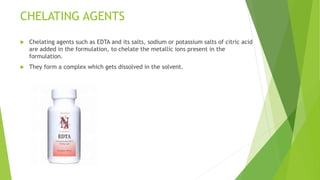
 Chelating agents such as EDTA and its salts, sodium or potassium salts of citric acid
are added in the formulation, to chelate the metallic ions present in the
formulation.
 They form a complex which gets dissolved in the solvent.
ANTI-MICROBIAL AGENTS
(PRESERVATIVES)
 USP suggests the addition of bacteriostatic,
fungistatic and anti-microbials to parenteral
formulations.
 Its concentration in parenterals should be
enough that they should not allow micro
organisms development when the product is
drawed and during the usage.
 Aqueous preparations which are prepared
using aseptic precautions and which cannot be
terminally sterilized may contain a suitable
antimicrobial preservative in an appropriate
concentration.
EXAMPLES:
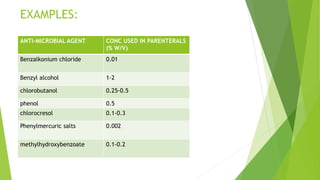
ANTI-MICROBIAL AGENT CONC USED IN PARENTERALS
(% W/V)
Benzalkonium chloride 0.01
Benzyl alcohol 1-2
chlorobutanol 0.25-0.5
phenol 0.5
chlorocresol 0.1-0.3
Phenylmercuric salts 0.002
methylhydroxybenzoate 0.1-0.2
INERT GASES
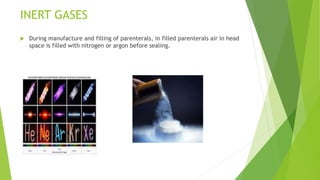
 During manufacture and filling of parenterals, in filled parenterals air in head
space is filled with nitrogen or argon before sealing.
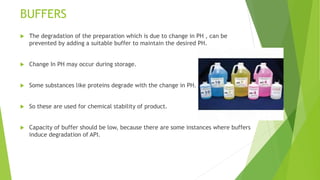
BUFFERS
 The degradation of the preparation which is due to change in PH , can be
prevented by adding a suitable buffer to maintain the desired PH.
 Change In PH may occur during storage.
 Some substances like proteins degrade with the change in PH.
 So these are used for chemical stability of product.
 Capacity of buffer should be low, because there are some instances where buffers
induce degradation of API.
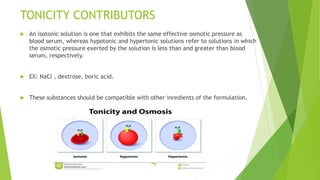
TONICITY CONTRIBUTORS
 An isotonic solution is one that exhibits the same effective osmotic pressure as
blood serum, whereas hypotonic and hypertonic solutions refer to solutions in which
the osmotic pressure exerted by the solution is less than and greater than blood
serum, respectively.
 EX: NaCl , dextrose, boric acid.
 These substances should be compatible with other inredients of the formulation.
PROTECTANTS
 They are of two types:
* cryoprotectants
* lyoprotectants
CRYOPROTECTANTS
 Stabilizes and prevents degradation of drugs, espacially proteins, from
effect of freezing.
 Freezing may denature some proteins.
Ex : * Sugars: Sucrose, Lactose, Glucose, Trehalose
* Polyols: Glycerol, Mannitol, Sorbitol
* Amino Acids: Glycine, Alanine, Lysine
* Polymers: PEG, Dextran, PVP
LYOPROTECTANTS
 Substance which protect drugs especially proteins from degradation during
drying (dehydration).
It involves two mechanisms:
 Water replacement theory: a good stabilizer serves as a water substitutes
by hydrogen-bonding to the dried protein.
 Vitrification theory: the protein and stabilizer are both amorphous glasses
immobilized together where the stabilizer protect the protein from
degradation.
 Ex: Sugars: Mannitol, Lactose, Maltose, Maltodextrin, Trehalose, Sucrose
Amino Acids: Glycine, histidine, arginine
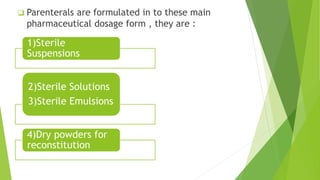
 Parenterals are formulated in to these main
pharmaceutical dosage form , they are :
1)Sterile
Suspensions
2)Sterile Solutions
3)Sterile Emulsions
4)Dry powders for
reconstitution
STERILE SUSPENSIONS
 ‘Suspensions’ are defined as biphasic liquid dosage form of
medicaments in which insoluable solid particles are suspended
uniformly in a liquid or semi-solid phase.
 The size of insoluable solid particles may not exceed more than
0.1 pm.
 Parenteral suspensions provide ‘prolonged duration of action’ by
forming a depot.
 Concentration of suspended particles ranges from 0.5-30% w/v.
 ex: 1) penilcillin G procaine injectable suspension USP.
2) Sterile testosterone injectable suspension USP.
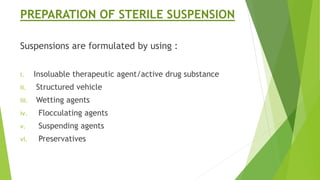
PREPARATION OF STERILE SUSPENSION
Suspensions are formulated by using :
i. Insoluable therapeutic agent/active drug substance
ii. Structured vehicle
iii. Wetting agents
iv. Flocculating agents
v. Suspending agents
vi. Preservatives
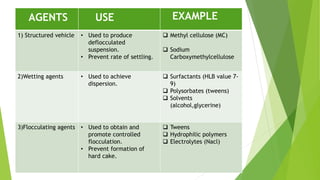
AGENTS USE EXAMPLE
1) Structured vehicle • Used to produce
deflocculated
suspension.
• Prevent rate of settling.
 Methyl cellulose (MC)
 Sodium
Carboxymethylcellulose
2)Wetting agents • Used to achieve
dispersion.
 Surfactants (HLB value 7-
9)
 Polysorbates (tweens)
 Solvents
(alcohol,glycerine)
3)Flocculating agents • Used to obtain and
promote controlled
flocculation.
• Prevent formation of
hard cake.
 Tweens
 Hydrophilic polymers
 Electrolytes (Nacl)
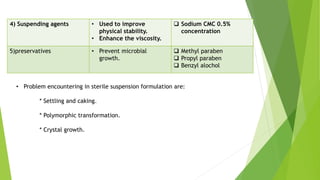
4) Suspending agents • Used to improve
physical stability.
• Enhance the viscosity.
 Sodium CMC 0.5%
concentration
5)preservatives • Prevent microbial
growth.
 Methyl paraben
 Propyl paraben
 Benzyl alochol
• Problem encountering in sterile suspension formulation are:
* Settling and caking.
* Polymorphic transformation.
* Crystal growth.
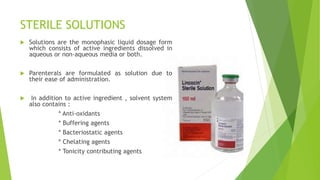
STERILE SOLUTIONS
 Solutions are the monophasic liquid dosage form
which consists of active ingredients dissolved in
aqueous or non-aqueous media or both.
 Parenterals are formulated as solution due to
their ease of administration.
 In addition to active ingredient , solvent system
also contains :
* Anti-oxidants
* Buffering agents
* Bacteriostatic agents
* Chelating agents
* Tonicity contributing agents
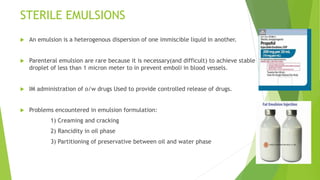
STERILE EMULSIONS
 An emulsion is a heterogenous dispersion of one immiscible liquid in another.
 Parenteral emulsion are rare because it is necessary(and difficult) to achieve stable
droplet of less than 1 micron meter to in prevent emboli in blood vessels.
 IM administration of o/w drugs Used to provide controlled release of drugs.
 Problems encountered in emulsion formulation:
1) Creaming and cracking
2) Rancidity in oil phase
3) Partitioning of preservative between oil and water phase
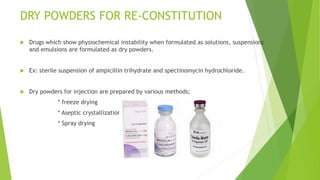
DRY POWDERS FOR RE-CONSTITUTION
 Drugs which show physiochemical instability when formulated as solutions, suspensions
and emulsions are formulated as dry powders.
 Ex: sterile suspension of ampicillin trihydrate and spectinomycin hydrochloride.
 Dry powders for injection are prepared by various methods:
* freeze drying
* Aseptic crystallization
* Spray drying
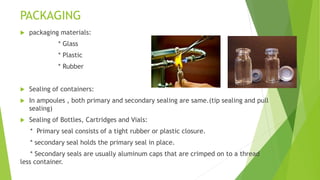
PACKAGING
 packaging materials:
* Glass
* Plastic
* Rubber
 Sealing of containers:
 In ampoules , both primary and secondary sealing are same.(tip sealing and pull
sealing)
 Sealing of Bottles, Cartridges and Vials:
* Primary seal consists of a tight rubber or plastic closure.
* secondary seal holds the primary seal in place.
* Secondary seals are usually aluminum caps that are crimped on to a thread
less container.
QUALITY CONTROL TESTS.
 LEAKAGE TEST
 CLARITY TEST
* Visual method
* Microscopic count method
* light obstruction method
* Coulter counter method
 PYROGEN TEST
* Rabbit test
* LAL (limulus amoebocyte lysate test)
 STERILITY TEST
Parenteral formulations

Parenteral formulations

  • 1.
  • 2.
    FORMULATION  Parenterals willbe dispensed in several forms including solutions, suspensions, emulsions, Nano systems and powders (which are made in to injection by addition of solvent). I. Active ingredients II. Vehicles III. Added substances
  • 3.
    ADDED SUBSTANCES  Theseinclude the substances that safeguard the purity of the formulation. PURPOSE: I. Maintain sterility II. Maintain stability III. Minimize pain and tissue irrtitation IV. Establish, maintain and control soluability V. Miscellaneous involves: * Bulking agent * Suspending agent * Viscosity imparting agent
  • 4.
     SOLUBILIZERS  ANTI-OXIDANTS CHELATING AGENTS  ANTI-MICROBIAL AGENTS  INERT GASES  BUFFERS  TONICITY CONTRIBUTORS  PROTECTANTS
  • 5.
    SOLUBILIZERS AND CO-SOLVENCY They are used to increase the soluability of the drugs which are slightly soluable in water. ex: Tweens Polysorbates
  • 6.
    ANTI-OXIDANTS  Anti-oxidants areincluded in parenteral formulations to slowdown or inhibit oxidative degradation of therapeutic agents. These agents either act by:  Preventing the formation of free radicals (Block oxidative chain reactions). ex: * Ascorbic acid esters * BHT (butyl hydroxy toluene & Tocopherols ).  They are strong reducing agents and are therefore oxidized in preference to the therapeutic agent (Preferentially oxidized). ex: * Ascorbic acid * sodium bisulphite. * sodium-metabisulphite
  • 7.
    CHELATING AGENTS  Chelatingagents such as EDTA and its salts, sodium or potassium salts of citric acid are added in the formulation, to chelate the metallic ions present in the formulation.  They form a complex which gets dissolved in the solvent.
  • 8.
    ANTI-MICROBIAL AGENTS (PRESERVATIVES)  USPsuggests the addition of bacteriostatic, fungistatic and anti-microbials to parenteral formulations.  Its concentration in parenterals should be enough that they should not allow micro organisms development when the product is drawed and during the usage.  Aqueous preparations which are prepared using aseptic precautions and which cannot be terminally sterilized may contain a suitable antimicrobial preservative in an appropriate concentration.
  • 9.
    EXAMPLES: ANTI-MICROBIAL AGENT CONCUSED IN PARENTERALS (% W/V) Benzalkonium chloride 0.01 Benzyl alcohol 1-2 chlorobutanol 0.25-0.5 phenol 0.5 chlorocresol 0.1-0.3 Phenylmercuric salts 0.002 methylhydroxybenzoate 0.1-0.2
  • 10.
    INERT GASES  Duringmanufacture and filling of parenterals, in filled parenterals air in head space is filled with nitrogen or argon before sealing.
  • 11.
    BUFFERS  The degradationof the preparation which is due to change in PH , can be prevented by adding a suitable buffer to maintain the desired PH.  Change In PH may occur during storage.  Some substances like proteins degrade with the change in PH.  So these are used for chemical stability of product.  Capacity of buffer should be low, because there are some instances where buffers induce degradation of API.
  • 12.
    TONICITY CONTRIBUTORS  Anisotonic solution is one that exhibits the same effective osmotic pressure as blood serum, whereas hypotonic and hypertonic solutions refer to solutions in which the osmotic pressure exerted by the solution is less than and greater than blood serum, respectively.  EX: NaCl , dextrose, boric acid.  These substances should be compatible with other inredients of the formulation.
  • 13.
    PROTECTANTS  They areof two types: * cryoprotectants * lyoprotectants CRYOPROTECTANTS  Stabilizes and prevents degradation of drugs, espacially proteins, from effect of freezing.  Freezing may denature some proteins. Ex : * Sugars: Sucrose, Lactose, Glucose, Trehalose * Polyols: Glycerol, Mannitol, Sorbitol * Amino Acids: Glycine, Alanine, Lysine * Polymers: PEG, Dextran, PVP
  • 14.
    LYOPROTECTANTS  Substance whichprotect drugs especially proteins from degradation during drying (dehydration). It involves two mechanisms:  Water replacement theory: a good stabilizer serves as a water substitutes by hydrogen-bonding to the dried protein.  Vitrification theory: the protein and stabilizer are both amorphous glasses immobilized together where the stabilizer protect the protein from degradation.  Ex: Sugars: Mannitol, Lactose, Maltose, Maltodextrin, Trehalose, Sucrose Amino Acids: Glycine, histidine, arginine
  • 15.
     Parenterals areformulated in to these main pharmaceutical dosage form , they are : 1)Sterile Suspensions 2)Sterile Solutions 3)Sterile Emulsions 4)Dry powders for reconstitution
  • 16.
    STERILE SUSPENSIONS  ‘Suspensions’are defined as biphasic liquid dosage form of medicaments in which insoluable solid particles are suspended uniformly in a liquid or semi-solid phase.  The size of insoluable solid particles may not exceed more than 0.1 pm.  Parenteral suspensions provide ‘prolonged duration of action’ by forming a depot.  Concentration of suspended particles ranges from 0.5-30% w/v.  ex: 1) penilcillin G procaine injectable suspension USP. 2) Sterile testosterone injectable suspension USP.
  • 17.
    PREPARATION OF STERILESUSPENSION Suspensions are formulated by using : i. Insoluable therapeutic agent/active drug substance ii. Structured vehicle iii. Wetting agents iv. Flocculating agents v. Suspending agents vi. Preservatives
  • 18.
    AGENTS USE EXAMPLE 1)Structured vehicle • Used to produce deflocculated suspension. • Prevent rate of settling.  Methyl cellulose (MC)  Sodium Carboxymethylcellulose 2)Wetting agents • Used to achieve dispersion.  Surfactants (HLB value 7- 9)  Polysorbates (tweens)  Solvents (alcohol,glycerine) 3)Flocculating agents • Used to obtain and promote controlled flocculation. • Prevent formation of hard cake.  Tweens  Hydrophilic polymers  Electrolytes (Nacl)
  • 19.
    4) Suspending agents• Used to improve physical stability. • Enhance the viscosity.  Sodium CMC 0.5% concentration 5)preservatives • Prevent microbial growth.  Methyl paraben  Propyl paraben  Benzyl alochol • Problem encountering in sterile suspension formulation are: * Settling and caking. * Polymorphic transformation. * Crystal growth.
  • 20.
    STERILE SOLUTIONS  Solutionsare the monophasic liquid dosage form which consists of active ingredients dissolved in aqueous or non-aqueous media or both.  Parenterals are formulated as solution due to their ease of administration.  In addition to active ingredient , solvent system also contains : * Anti-oxidants * Buffering agents * Bacteriostatic agents * Chelating agents * Tonicity contributing agents
  • 21.
    STERILE EMULSIONS  Anemulsion is a heterogenous dispersion of one immiscible liquid in another.  Parenteral emulsion are rare because it is necessary(and difficult) to achieve stable droplet of less than 1 micron meter to in prevent emboli in blood vessels.  IM administration of o/w drugs Used to provide controlled release of drugs.  Problems encountered in emulsion formulation: 1) Creaming and cracking 2) Rancidity in oil phase 3) Partitioning of preservative between oil and water phase
  • 22.
    DRY POWDERS FORRE-CONSTITUTION  Drugs which show physiochemical instability when formulated as solutions, suspensions and emulsions are formulated as dry powders.  Ex: sterile suspension of ampicillin trihydrate and spectinomycin hydrochloride.  Dry powders for injection are prepared by various methods: * freeze drying * Aseptic crystallization * Spray drying
  • 23.
    PACKAGING  packaging materials: *Glass * Plastic * Rubber  Sealing of containers:  In ampoules , both primary and secondary sealing are same.(tip sealing and pull sealing)  Sealing of Bottles, Cartridges and Vials: * Primary seal consists of a tight rubber or plastic closure. * secondary seal holds the primary seal in place. * Secondary seals are usually aluminum caps that are crimped on to a thread less container.
  • 24.
    QUALITY CONTROL TESTS. LEAKAGE TEST  CLARITY TEST * Visual method * Microscopic count method * light obstruction method * Coulter counter method  PYROGEN TEST * Rabbit test * LAL (limulus amoebocyte lysate test)  STERILITY TEST