Tablets
Dr. M. N.Chishti,
Assist Prof,
Dept of Pharmaceutics
Tablet is defined as a compressed solid dosage form containing
medicaments with or without excipients.
According to the Indian Pharmacopoeia Pharmaceutical tablets are
solid, flat or biconvex, unit dosage form, prepared by compressing a
drugs or a mixture of drugs, with or without diluents.
They vary in shape and differ greatly in size and weight, depending on
amount of medicinal substances and the intended mode of
administration. It is the most popular dosage form and 70% of the total
medicines are dispensed in the form of Tablet.
All medicaments are available in the Tablet form except where it is
difficult to formulate or administer.
The advantages of the Tablet dosage form are:
1. They are unit dosage form and offer the greatest capabilities of
all oral dosage form for the greatest dose precision and the
least content variability.
2. Cost is lowest of all oral dosage form.
3. Lighter and compact.
4. Easiest and cheapest to package and strip.
5. Easy to swallowing with least tendency for hang‐up.
6. Sustained release product is possible by enteric coating.
7. Objectionable odour and bitter taste can be masked by
coating technique.
8. Suitable for large scale production.
9. Greatest chemical and microbial stability over all oral
dosage form.
10. Product identification is easy and rapid requiring no
additional steps when employing an embossed and/or
monogrammed punch face.
Disadvantages of Tablet dosage form are:
1. Difficult to swallow in case of children and unconscious
patients.
2. Some drugs resist compression into dense compacts, owing
to amorphous nature, low density character.
3. Drugs with poor wetting, slow dissolution properties,
optimum absorption high in GIT may be difficult to formulate
or manufacture as a tablet that will still provide adequate or
full drug bioavailability.
4. Bitter testing drugs, drugs with an objectionable odor or
drugs that are sensitive to oxygen may require encapsulation
or coating. In such cases, capsule may offer the best and
lowest cost.
General properties of Tablet dosage forms:
1. A tablet should have elegant product identity while free of defects
like chips, cracks, discoloration, and discoloration, and
contamination.
2. Should have sufficient strength to withstand mechanical shock
during its production packaging, shipping and dispensing.
3. Should have the chemical and physical stability to maintain its
physical attributes over time.
4. The tablet must be able to release the medicinal agents in a
predictable and reproducible manner.
5. Must have a chemical stability over time so as not to follow
alteration of the medicinal agents.
(A) Tablets ingested orally:
1. Compressed tablet, e.g. Paracetamol tablet
2. Multiple compressed tablet
3. Repeat action tablet
4. Delayed release tablet, e.g. Enteric coated Bisacodyl tablet
5. Sugar coated tablet, e.g. Multivitamin tablet
6. Film coated tablet, e.g. Metronidazole tablet
7. Chewable tablet, e.g. Antacid tablet
(B) Tablets used in oral cavity:
1. Buccal tablet, e.g. Vitamin‐c tablet
2. Sublingual tablet,
3. Troches or lozenges
4. Dental cone
(C) Tablets administered by other route:
1. Implantation tablet
2. Vaginal tablet, e.g. Clotrimazole tablet
(D) Tablets used to prepare solution:
1.Effervescent tablet, e.g. Dispirin tablet
(Aspirin)
2. Dispensing tablet, e.g. Enzyme tablet
(Digiplex)
3. Hypodermic tablet
4. Tablet triturates e.g. Enzyme tablet
(Digiplex)
Tablet Ingredients: In addition to active ingredients,
tablet contains a number of inert materials known
as additives or excipients.
Different excipients are:
1. Diluent
2. Binder and adhesive
3. Disintegrents
4. Lubricants and glidants
5. Colouring agents
6. Flavoring agents
7. Sweetening agents
1. Diluent:
Diluents are fillers used to make required bulk of the tablet when the drug
dosage itself is inadequate to produce the bulk. Secondary reason is to
provide better tablet properties such as improve cohesion, to permit use of
direct compression manufacturing or to promote flow.
A diluent should have following properties:
1. They must be non toxic
2. They must be commercially available in acceptable grade
3. There cost must be low
4. They must be physiologically inert
5. They must be physically & chemically stable by themselves & in
combination with the drugs.
6. They must be free from all microbial contamination.
7. They do not alter the bioavailability of drug.
8. They must be color compatible.
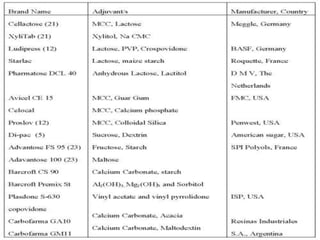
Commonly used tablet diluents
1. Lactose‐anhydrous and spray dried lactose
2. Directly compressed starch‐Sta Rx 1500
3. Hydrolyzed starch‐Emdex and Celutab
4. Microcrystalline cellulose‐Avicel (PH
101and PH 102)
5. Dibasic calcium phosphate dehydrate
6. Calcium sulphate dihydrate
7. Mannitol
8. Sorbitol
9. Sucrose‐ Sugartab, DiPac, Nutab 10.
Dextrose
2. Binders and Adhesives:
These materials are added either dry or in wet‐ form
to form granules or to form cohesive compacts for
directly compressed tablet.
Example: Acacia, tragacanth‐ Solution for 10‐25%
Conc.
Cellulose derivatives‐ Methyl cellulose, Hydroxy propyl
methyl cellulose, Hydroxy propyl cellulose Gelatin‐
10‐20% solution
Glucose‐ 50% solution
Polyvinylpyrrolidone (PVP)‐ 2% conc.
Starch paste‐10‐20% solution
3. Disintegrants:
Added to a tablet formulation to facilitate its breaking
or disintegration when it contact in water in the GIT.
Example:
Starch‐ 5‐20% of tablet weight.
Starch derivative – Primogel and Explotab (1‐8%)
Clays‐ Veegum HV, bentonite 10% level in colored
tablet
Cellulose derivatives‐ (sodium carboxy methyl
cellulose)
Sodium Alginate
PVP (Polyvinylpyrrolidone)
Superdisintegrants:
Swells up to ten fold within 30 seconds when contact
water.
Example: Crosscarmellose‐ cross‐linked cellulose,
Crosspovidone‐ cross‐linked povidone (polymer),
Sodium starch glycolate‐ cross‐linked starch.
These cross‐ linked products swell upto 10n fold with in
30 seconds when in contact with water.
A portion of disintegrant is added before granulation
and a portion before compression, which serve as
glidants or lubricant.
Evaluation of carbon dioxide in effervescent tablets is
also one way of disintegration.
4. Lubricant and Glidants:
Lubricants are intended to prevent adhesion of the tablet
materials to the surface of dies and punches, reduce inter particle
friction and may improve the rate of flow of the tablet granulation.
Glidants are intended to promote flow of granules or powder
material by reducing the friction between the particles.
Example:
Lubricants‐ Stearic acid, Stearic acid salt ‐ Stearic acid, Magnesium
stearate, Talc, PEG (Polyethylene glycols), Surfactants
Glidants‐ Corn Starch – 5‐10% conc., Talc‐5% conc., Silica derivative
‐ Colloidal silicas such as Cab‐O‐Sil, Syloid, Aerosil in 0.25‐3% conc.
5. Coloring agent:
The use of colors and dyes in a tablet has three purposes:
(1) Masking of off color drugs
(2) Product Identification
(3) Production of more elegant product All coloring agents must be approved
and certified by FDA.
Two forms of colors are used in tablet preparation – FD &C and D & C dyes.
These dyes are applied as solution in the granulating agent or Lake form of
these dyes.
Lakes are dyes absorbed on hydrous oxide and employed as dry powder
coloring.
Example: FD & C yellow 6‐sunset yellow FD & C yellow 5‐ Tartrazine FD & C
green 3‐ Fast Green FD & C blue 1‐ Brilliant Blue FD & C blue 2 ‐ Indigo
carmine D & C red 3‐ Erythrosine. D & C red 22 – Eosin Y
6. Flavoring agents:
For chewable tablet‐ flavor oil are used
7. Sweetening agents:
For chewable tablets: Sugar, mannitol. Saccharine
(artificial): 500 time’s sweeter than sucrose
Disadvantage: Bitter aftertaste and carcinogenic
Aspartame (artificial) Disadvantage: Lack of stability
in presence of moisture.
Why granulation
• Improving flow and compression characteristics,
• Improving content uniformity,
• Reducing segregation,
• Facilitating metering or volumetric dispensing,
• Controlling/manipulating release rate,
• Eliminating generation of excessive amounts of
fine particles thereby increasing bulk density of
the product.
ADVANTAGES
• Improves flowability and compressibility of the
material
• Bioavailability improves as hydrophobic surfaces
gets changed into hydrophilic surfaces
• Fast method to prepare controlled release
granules
• Improves homogeneity of dosage forms with low
active content
• Adverse influence of poor electrostatic
properties of powder can be avoided
DISADVANTAGES
• An expensive process associated with
requirement for more labour, space, time, special
equipment and energy
• Involves multiple processing steps thereby
increases complexity
• Process loss of material is high
• Unsuitable for moisture sensitive, thermolabile,
and incompatible materials
• Any incompatibility between the formulation
components is aggravated during the processing.
Mechanisms of particle-particle
interactions during Granulation
• Solid bridges: formed due to solvent evaporation in
the drying phase (partial melting, hardening binders or
crystallization of dissolved substances)
• Adhesion and cohesion forces in the Immobile liquids
between individual particles.
• Interfacial forces in mobile liquids films within the
granules
• Intermolecular and long-range forces: vander Waals
forces, electrostatic forces results in bonding of the
particles.
• Mechanical interlocking: fracture and deformation due
to pressure that results in shape related bonding or
intertwining of long fibrous particles.
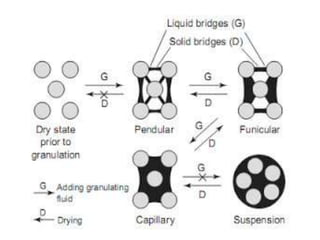
Pendular State:
• This state usually occurs at low moisture level.
• In this state the particles are held together by
lens shaped rings of liquid.
• It causes adhesion due to lowering of the
surface tension forces at the liquid air
interface and the hydrostatic suction pressure
in the liquid bridge.
Funicular State:
• This state represents an intermediate stage
between the pendular and capillary states.
• When the air starts to displace from between
the particles, the particles arrange in funicular
state.
• After the funicular state, the particle arrange
themselves in capillary state and there is no
air between them.
Capillary State:
• When all the air has been displaced from between the
particles the capillary state is reached, and the particles
are held by capillary suction at the liquid-air interface,
which is now only at the granule surface.
• Moist granule tensile strength increases about three
times between the pendular and the capillary state.
• It may appear that the state of the powder bed is
dependent upon the total moisture content of the
wetted powders, but the capillary state may also be
reached by decreasing the separation of the particles.
This state is the most desirable state in the process of
granulation.
Droplet state
• Strength of droplet depends upon the surface
tension of liquid used.
Mechanisms of Granule Formation
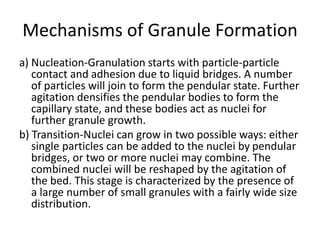
a) Nucleation-Granulation starts with particle-particle
contact and adhesion due to liquid bridges. A number
of particles will join to form the pendular state. Further
agitation densifies the pendular bodies to form the
capillary state, and these bodies act as nuclei for
further granule growth.
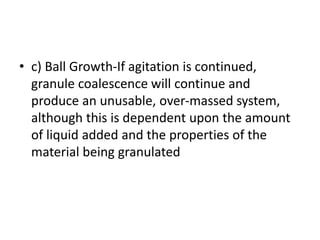
b) Transition-Nuclei can grow in two possible ways: either
single particles can be added to the nuclei by pendular
bridges, or two or more nuclei may combine. The
combined nuclei will be reshaped by the agitation of
the bed. This stage is characterized by the presence of
a large number of small granules with a fairly wide size
distribution.
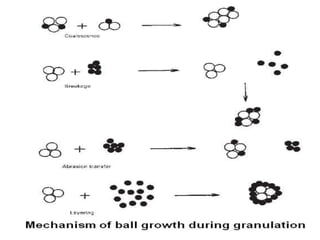
• c) Ball Growth-If agitation is continued,
granule coalescence will continue and
produce an unusable, over-massed system,
although this is dependent upon the amount
of liquid added and the properties of the
material being granulated
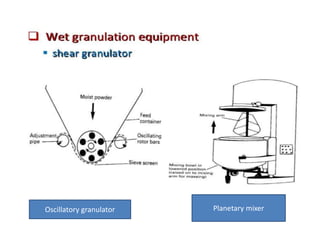
Oscillatory granulator Planetary mixer
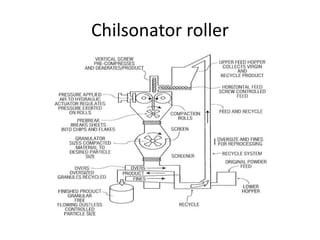
Chilsonator roller
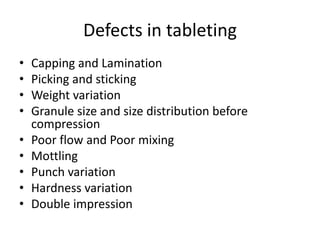
Defects in tableting
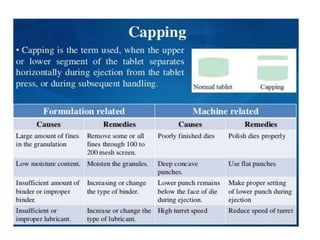
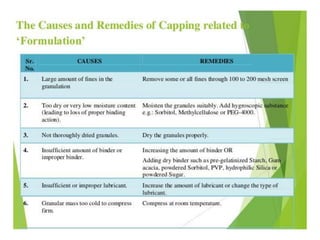
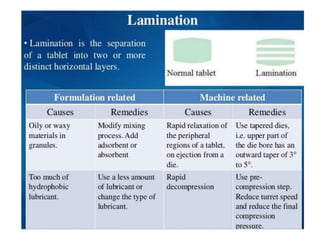
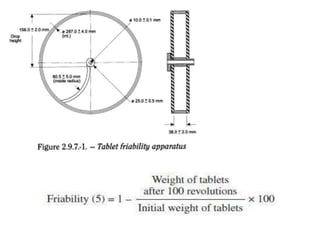
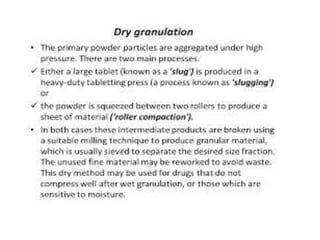
• Capping and Lamination
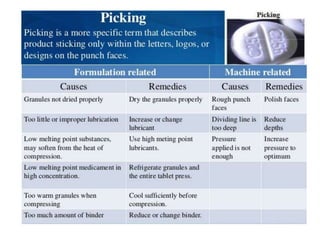
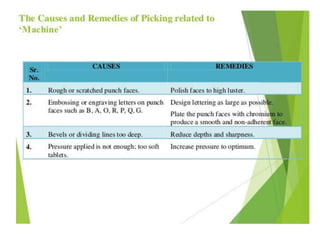
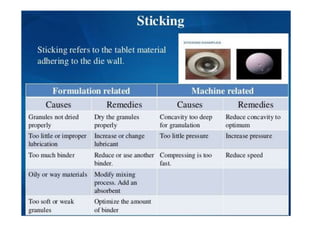
• Picking and sticking
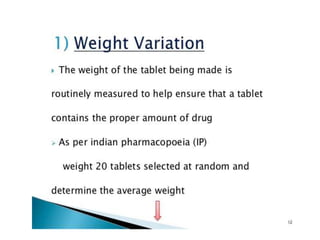
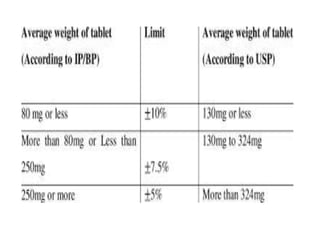
• Weight variation
• Granule size and size distribution before
compression
• Poor flow and Poor mixing
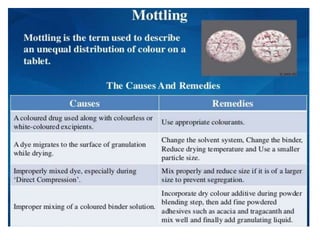
• Mottling
• Punch variation
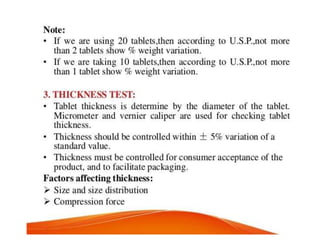
• Hardness variation
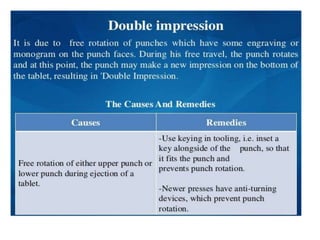
• Double impression
B.ph., iii yr sem v, Tablets .pptx, IP-I

B.ph., iii yr sem v, Tablets .pptx, IP-I

  • 1.
    Tablets Dr. M. N.Chishti, AssistProf, Dept of Pharmaceutics
  • 2.
    Tablet is definedas a compressed solid dosage form containing medicaments with or without excipients. According to the Indian Pharmacopoeia Pharmaceutical tablets are solid, flat or biconvex, unit dosage form, prepared by compressing a drugs or a mixture of drugs, with or without diluents. They vary in shape and differ greatly in size and weight, depending on amount of medicinal substances and the intended mode of administration. It is the most popular dosage form and 70% of the total medicines are dispensed in the form of Tablet. All medicaments are available in the Tablet form except where it is difficult to formulate or administer.
  • 3.
    The advantages ofthe Tablet dosage form are: 1. They are unit dosage form and offer the greatest capabilities of all oral dosage form for the greatest dose precision and the least content variability. 2. Cost is lowest of all oral dosage form. 3. Lighter and compact. 4. Easiest and cheapest to package and strip. 5. Easy to swallowing with least tendency for hang‐up. 6. Sustained release product is possible by enteric coating.
  • 4.
    7. Objectionable odourand bitter taste can be masked by coating technique. 8. Suitable for large scale production. 9. Greatest chemical and microbial stability over all oral dosage form. 10. Product identification is easy and rapid requiring no additional steps when employing an embossed and/or monogrammed punch face.
  • 5.
    Disadvantages of Tabletdosage form are: 1. Difficult to swallow in case of children and unconscious patients. 2. Some drugs resist compression into dense compacts, owing to amorphous nature, low density character. 3. Drugs with poor wetting, slow dissolution properties, optimum absorption high in GIT may be difficult to formulate or manufacture as a tablet that will still provide adequate or full drug bioavailability. 4. Bitter testing drugs, drugs with an objectionable odor or drugs that are sensitive to oxygen may require encapsulation or coating. In such cases, capsule may offer the best and lowest cost.
  • 6.
    General properties ofTablet dosage forms: 1. A tablet should have elegant product identity while free of defects like chips, cracks, discoloration, and discoloration, and contamination. 2. Should have sufficient strength to withstand mechanical shock during its production packaging, shipping and dispensing. 3. Should have the chemical and physical stability to maintain its physical attributes over time. 4. The tablet must be able to release the medicinal agents in a predictable and reproducible manner. 5. Must have a chemical stability over time so as not to follow alteration of the medicinal agents.
  • 7.
    (A) Tablets ingestedorally: 1. Compressed tablet, e.g. Paracetamol tablet 2. Multiple compressed tablet 3. Repeat action tablet 4. Delayed release tablet, e.g. Enteric coated Bisacodyl tablet 5. Sugar coated tablet, e.g. Multivitamin tablet 6. Film coated tablet, e.g. Metronidazole tablet 7. Chewable tablet, e.g. Antacid tablet (B) Tablets used in oral cavity: 1. Buccal tablet, e.g. Vitamin‐c tablet 2. Sublingual tablet, 3. Troches or lozenges 4. Dental cone (C) Tablets administered by other route: 1. Implantation tablet 2. Vaginal tablet, e.g. Clotrimazole tablet
  • 8.
    (D) Tablets usedto prepare solution: 1.Effervescent tablet, e.g. Dispirin tablet (Aspirin) 2. Dispensing tablet, e.g. Enzyme tablet (Digiplex) 3. Hypodermic tablet 4. Tablet triturates e.g. Enzyme tablet (Digiplex)
  • 9.
    Tablet Ingredients: Inaddition to active ingredients, tablet contains a number of inert materials known as additives or excipients. Different excipients are: 1. Diluent 2. Binder and adhesive 3. Disintegrents 4. Lubricants and glidants 5. Colouring agents 6. Flavoring agents 7. Sweetening agents
  • 10.
    1. Diluent: Diluents arefillers used to make required bulk of the tablet when the drug dosage itself is inadequate to produce the bulk. Secondary reason is to provide better tablet properties such as improve cohesion, to permit use of direct compression manufacturing or to promote flow. A diluent should have following properties: 1. They must be non toxic 2. They must be commercially available in acceptable grade 3. There cost must be low 4. They must be physiologically inert 5. They must be physically & chemically stable by themselves & in combination with the drugs. 6. They must be free from all microbial contamination. 7. They do not alter the bioavailability of drug. 8. They must be color compatible.
  • 11.
    Commonly used tabletdiluents 1. Lactose‐anhydrous and spray dried lactose 2. Directly compressed starch‐Sta Rx 1500 3. Hydrolyzed starch‐Emdex and Celutab 4. Microcrystalline cellulose‐Avicel (PH 101and PH 102) 5. Dibasic calcium phosphate dehydrate 6. Calcium sulphate dihydrate 7. Mannitol 8. Sorbitol 9. Sucrose‐ Sugartab, DiPac, Nutab 10. Dextrose
  • 12.
    2. Binders andAdhesives: These materials are added either dry or in wet‐ form to form granules or to form cohesive compacts for directly compressed tablet. Example: Acacia, tragacanth‐ Solution for 10‐25% Conc. Cellulose derivatives‐ Methyl cellulose, Hydroxy propyl methyl cellulose, Hydroxy propyl cellulose Gelatin‐ 10‐20% solution Glucose‐ 50% solution Polyvinylpyrrolidone (PVP)‐ 2% conc. Starch paste‐10‐20% solution
  • 13.
    3. Disintegrants: Added toa tablet formulation to facilitate its breaking or disintegration when it contact in water in the GIT. Example: Starch‐ 5‐20% of tablet weight. Starch derivative – Primogel and Explotab (1‐8%) Clays‐ Veegum HV, bentonite 10% level in colored tablet Cellulose derivatives‐ (sodium carboxy methyl cellulose) Sodium Alginate PVP (Polyvinylpyrrolidone)
  • 14.
    Superdisintegrants: Swells up toten fold within 30 seconds when contact water. Example: Crosscarmellose‐ cross‐linked cellulose, Crosspovidone‐ cross‐linked povidone (polymer), Sodium starch glycolate‐ cross‐linked starch. These cross‐ linked products swell upto 10n fold with in 30 seconds when in contact with water. A portion of disintegrant is added before granulation and a portion before compression, which serve as glidants or lubricant. Evaluation of carbon dioxide in effervescent tablets is also one way of disintegration.
  • 15.
    4. Lubricant andGlidants: Lubricants are intended to prevent adhesion of the tablet materials to the surface of dies and punches, reduce inter particle friction and may improve the rate of flow of the tablet granulation. Glidants are intended to promote flow of granules or powder material by reducing the friction between the particles. Example: Lubricants‐ Stearic acid, Stearic acid salt ‐ Stearic acid, Magnesium stearate, Talc, PEG (Polyethylene glycols), Surfactants Glidants‐ Corn Starch – 5‐10% conc., Talc‐5% conc., Silica derivative ‐ Colloidal silicas such as Cab‐O‐Sil, Syloid, Aerosil in 0.25‐3% conc.
  • 16.
    5. Coloring agent: Theuse of colors and dyes in a tablet has three purposes: (1) Masking of off color drugs (2) Product Identification (3) Production of more elegant product All coloring agents must be approved and certified by FDA. Two forms of colors are used in tablet preparation – FD &C and D & C dyes. These dyes are applied as solution in the granulating agent or Lake form of these dyes. Lakes are dyes absorbed on hydrous oxide and employed as dry powder coloring. Example: FD & C yellow 6‐sunset yellow FD & C yellow 5‐ Tartrazine FD & C green 3‐ Fast Green FD & C blue 1‐ Brilliant Blue FD & C blue 2 ‐ Indigo carmine D & C red 3‐ Erythrosine. D & C red 22 – Eosin Y
  • 17.
    6. Flavoring agents: Forchewable tablet‐ flavor oil are used 7. Sweetening agents: For chewable tablets: Sugar, mannitol. Saccharine (artificial): 500 time’s sweeter than sucrose Disadvantage: Bitter aftertaste and carcinogenic Aspartame (artificial) Disadvantage: Lack of stability in presence of moisture.
  • 20.
    Why granulation • Improvingflow and compression characteristics, • Improving content uniformity, • Reducing segregation, • Facilitating metering or volumetric dispensing, • Controlling/manipulating release rate, • Eliminating generation of excessive amounts of fine particles thereby increasing bulk density of the product.
  • 21.
    ADVANTAGES • Improves flowabilityand compressibility of the material • Bioavailability improves as hydrophobic surfaces gets changed into hydrophilic surfaces • Fast method to prepare controlled release granules • Improves homogeneity of dosage forms with low active content • Adverse influence of poor electrostatic properties of powder can be avoided
  • 22.
    DISADVANTAGES • An expensiveprocess associated with requirement for more labour, space, time, special equipment and energy • Involves multiple processing steps thereby increases complexity • Process loss of material is high • Unsuitable for moisture sensitive, thermolabile, and incompatible materials • Any incompatibility between the formulation components is aggravated during the processing.
  • 23.
    Mechanisms of particle-particle interactionsduring Granulation • Solid bridges: formed due to solvent evaporation in the drying phase (partial melting, hardening binders or crystallization of dissolved substances) • Adhesion and cohesion forces in the Immobile liquids between individual particles. • Interfacial forces in mobile liquids films within the granules • Intermolecular and long-range forces: vander Waals forces, electrostatic forces results in bonding of the particles. • Mechanical interlocking: fracture and deformation due to pressure that results in shape related bonding or intertwining of long fibrous particles.
  • 25.
    Pendular State: • Thisstate usually occurs at low moisture level. • In this state the particles are held together by lens shaped rings of liquid. • It causes adhesion due to lowering of the surface tension forces at the liquid air interface and the hydrostatic suction pressure in the liquid bridge.
  • 26.
    Funicular State: • Thisstate represents an intermediate stage between the pendular and capillary states. • When the air starts to displace from between the particles, the particles arrange in funicular state. • After the funicular state, the particle arrange themselves in capillary state and there is no air between them.
  • 27.
    Capillary State: • Whenall the air has been displaced from between the particles the capillary state is reached, and the particles are held by capillary suction at the liquid-air interface, which is now only at the granule surface. • Moist granule tensile strength increases about three times between the pendular and the capillary state. • It may appear that the state of the powder bed is dependent upon the total moisture content of the wetted powders, but the capillary state may also be reached by decreasing the separation of the particles. This state is the most desirable state in the process of granulation.
  • 28.
    Droplet state • Strengthof droplet depends upon the surface tension of liquid used.
  • 29.
    Mechanisms of GranuleFormation a) Nucleation-Granulation starts with particle-particle contact and adhesion due to liquid bridges. A number of particles will join to form the pendular state. Further agitation densifies the pendular bodies to form the capillary state, and these bodies act as nuclei for further granule growth. b) Transition-Nuclei can grow in two possible ways: either single particles can be added to the nuclei by pendular bridges, or two or more nuclei may combine. The combined nuclei will be reshaped by the agitation of the bed. This stage is characterized by the presence of a large number of small granules with a fairly wide size distribution.
  • 30.
    • c) BallGrowth-If agitation is continued, granule coalescence will continue and produce an unusable, over-massed system, although this is dependent upon the amount of liquid added and the properties of the material being granulated
  • 34.
  • 40.
  • 53.
    Defects in tableting •Capping and Lamination • Picking and sticking • Weight variation • Granule size and size distribution before compression • Poor flow and Poor mixing • Mottling • Punch variation • Hardness variation • Double impression