TABLETS
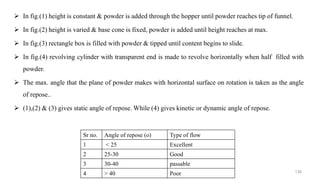
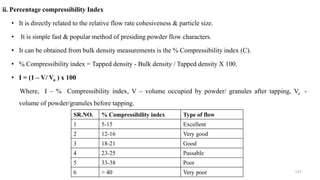
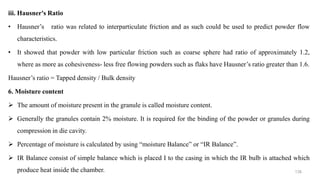
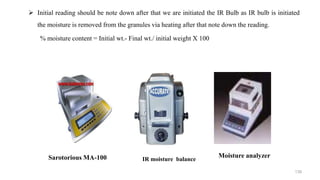
1
Prepared By: Roshni Mehta
PhD Research Scholar
Guided By: Dr. Yamini Shah
Associate Professor
Department of Pharmaceutics, L. M. College of Pharmacy, Ahmedabad
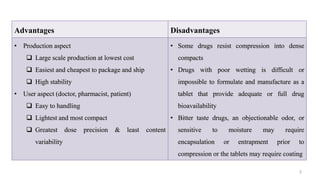
Advantages Disadvantages
• Production aspect
 Large scale production at lowest cost
 Easiest and cheapest to package and ship
 High stability
• User aspect (doctor, pharmacist, patient)
 Easy to handling
 Lightest and most compact
 Greatest dose precision & least content
variability
• Some drugs resist compression into dense
compacts
• Drugs with poor wetting is difficult or
impossible to formulate and manufacture as a
tablet that provide adequate or full drug
bioavailability
• Bitter taste drugs, an objectionable odor, or
sensitive to moisture may require
encapsulation or entrapment prior to
compression or the tablets may require coating
2
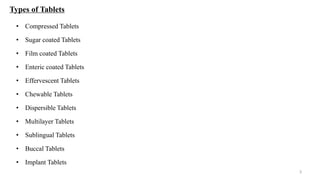
Types of Tablets
• Compressed Tablets
• Sugar coated Tablets
• Film coated Tablets
• Enteric coated Tablets
• Effervescent Tablets
• Chewable Tablets
• Dispersible Tablets
• Multilayer Tablets
• Sublingual Tablets
• Buccal Tablets
• Implant Tablets
3
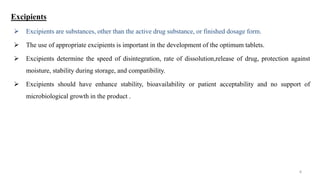
Excipients
 Excipients are substances, other than the active drug substance, or finished dosage form.
 The use of appropriate excipients is important in the development of the optimum tablets.
 Excipients determine the speed of disintegration, rate of dissolution,release of drug, protection against
moisture, stability during storage, and compatibility.
 Excipients should have enhance stability, bioavailability or patient acceptability and no support of
microbiological growth in the product .
4
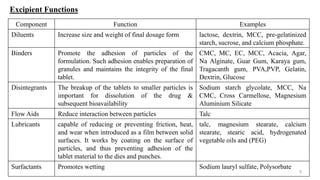
Excipient Functions
Component Function Examples
Diluents Increase size and weight of final dosage form lactose, dextrin, MCC, pre-gelatinized
starch, sucrose, and calcium phosphate.
Binders Promote the adhesion of particles of the
formulation. Such adhesion enables preparation of
granules and maintains the integrity of the final
tablet.
CMC, MC, EC, MCC, Acacia, Agar,
Na Alginate, Guar Gum, Karaya gum,
Tragacanth gum, PVA,PVP, Gelatin,
Dextrin, Glucose
Disintegrants The breakup of the tablets to smaller particles is
important for dissolution of the drug &
subsequent bioavailability
Sodium starch glycolate, MCC, Na
CMC, Cross Carmellose, Magnesium
Aluminium Silicate
Flow Aids Reduce interaction between particles Talc
Lubricants capable of reducing or preventing friction, heat,
and wear when introduced as a film between solid
surfaces. It works by coating on the surface of
particles, and thus preventing adhesion of the
tablet material to the dies and punches.
talc, magnesium stearate, calcium
stearate, stearic acid, hydrogenated
vegetable oils and (PEG)
Surfactants Promotes wetting Sodium lauryl sulfate, Polysorbate
5
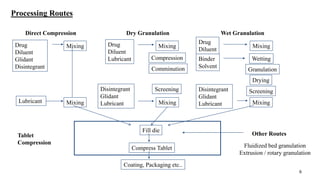
Processing Routes
Fill die
Coating, Packaging etc..
Compress Tablet
Direct Compression
Drug
Diluent
Glidant
Disintegrant
Lubricant Mixing
Mixing
Dry Granulation
Disintegrant
Glidant
Lubricant
Drug
Diluent
Lubricant
Mixing
Compression
Comminution
Screening
Mixing
Mixing
Wetting
Granulation
Drying
Screening
Mixing
Drug
Diluent
Binder
Solvent
Disintegrant
Glidant
Lubricant
Wet Granulation
Other Routes
Fluidized bed granulation
Extrusion / rotary granulation
Tablet
Compression
6
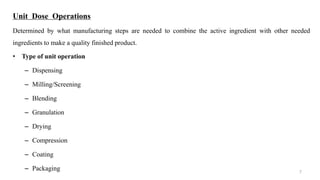
Unit Dose Operations
Determined by what manufacturing steps are needed to combine the active ingredient with other needed
ingredients to make a quality finished product.
• Type of unit operation
– Dispensing
– Milling/Screening
– Blending
– Granulation
– Drying
– Compression
– Coating
– Packaging 7
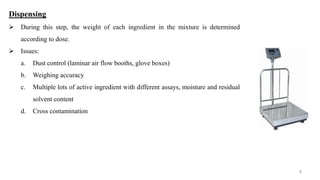
Dispensing
 During this step, the weight of each ingredient in the mixture is determined
according to dose.
 Issues:
a. Dust control (laminar air flow booths, glove boxes)
b. Weighing accuracy
c. Multiple lots of active ingredient with different assays, moisture and residual
solvent content
d. Cross contamination
8
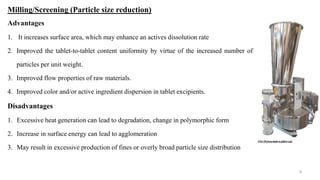
Milling/Screening (Particle size reduction)
Advantages
1. It increases surface area, which may enhance an actives dissolution rate
2. Improved the tablet-to-tablet content uniformity by virtue of the increased number of
particles per unit weight.
3. Improved flow properties of raw materials.
4. Improved color and/or active ingredient dispersion in tablet excipients.
Disadvantages
1. Excessive heat generation can lead to degradation, change in polymorphic form
2. Increase in surface energy can lead to agglomeration
3. May result in excessive production of fines or overly broad particle size distribution
9
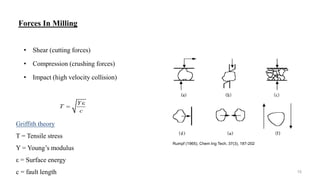
Forces In Milling
• Shear (cutting forces)
• Compression (crushing forces)
• Impact (high velocity collision)
Y
T
c


Rumpf (1965), Chem Ing Tech, 37(3), 187-202
Griffith theory
T = Tensile stress
Y = Young’s modulus
ε = Surface energy
c = fault length 10
Milling Equipment – Screen Mills
• Critical parameters for a conical screen mill
• Screen Hole Size/Shape has largest impact on particle size reduction, milling time and energy requirements
• Milling work index significantly lower for smaller screen hole sizes
• Impeller type has largest effect on overall milling performance
• Impeller clearance not significant at small clearances
• Milling work index lower at higher mill speeds
– Deflection of material away from screens
– Speed
• Evaluate impact on aspirin granulation
– Particle size reduction
– Milling time and energy requirements
Byers, Peck (1990), Drug Dev Ind Pharm, 16(11), 1761-1779
Milling Work Index = Size reduction / Milling work
Milling Time Index = Size reduction / Milling time
11
Milling Equipment – Impact Mills
• Significant wear on surfaces
• Hammer mills
– Medium to coarse size reduction
– Peripheral speed 20-50 m/sec
• Pin mills
– Peripheral speed up to 200 m/sec
– Capable of fine grinding
– Can be used to mill sticky materials
12
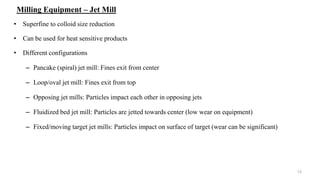
Milling Equipment – Jet Mill
• Superfine to colloid size reduction
• Can be used for heat sensitive products
• Different configurations
– Pancake (spiral) jet mill: Fines exit from center
– Loop/oval jet mill: Fines exit from top
– Opposing jet mills: Particles impact each other in opposing jets
– Fluidized bed jet mill: Particles are jetted towards center (low wear on equipment)
– Fixed/moving target jet mills: Particles impact on surface of target (wear can be significant)
13
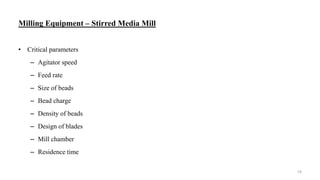
Milling Equipment – Stirred Media Mill
• Critical parameters
– Agitator speed
– Feed rate
– Size of beads
– Bead charge
– Density of beads
– Design of blades
– Mill chamber
– Residence time
14
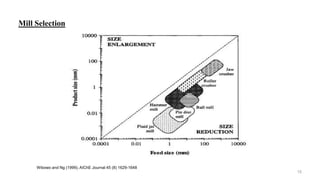
Mill Selection
Wibowo and Ng (1999), AIChE Journal 45 (8) 1629-1648
15
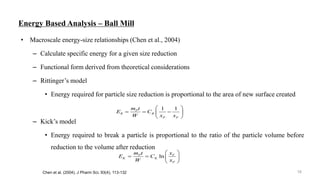
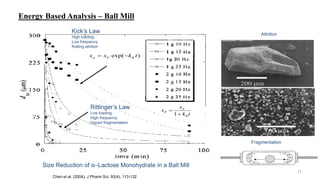
Energy Based Analysis – Ball Mill
• Macroscale energy-size relationships (Chen et al., 2004)
– Calculate specific energy for a given size reduction
– Functional form derived from theoretical considerations
– Rittinger’s model
• Energy required for particle size reduction is proportional to the area of new surface created
– Kick’s model
• Energy required to break a particle is proportional to the ratio of the particle volume before
reduction to the volume after reduction
Chen et al. (2004), J Pharm Sci, 93(4), 113-132
1 1P
R R
P F
m t
E C
W x x
 
   
 
lnP F
K K
P
m t x
E C
W x
 
   
 
16
Energy Based Analysis – Ball Mill
Kick’s Law
High loading
Low frequency
Rolling attrition
Rittinger’s Law
Low loading
High frequency
Impact fragmentation
1
F
P
R
x
x
k t


exp( )p F Kx x k t 
Attrition
Fragmentation
Size Reduction of α–Lactose Monohydrate in a Ball Mill
Chen et al. (2004), J Pharm Sci, 93(4), 113-132
17
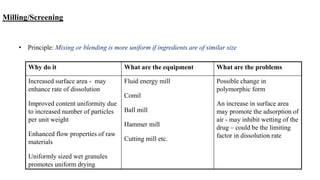
Milling/Screening
• Principle: Mixing or blending is more uniform if ingredients are of similar size
What are the problemsWhat are the equipmentWhy do it
Possible change in
polymorphic form
An increase in surface area
may promote the adsorption of
air - may inhibit wetting of the
drug – could be the limiting
factor in dissolution rate
Fluid energy mill
Comil
Ball mill
Hammer mill
Cutting mill etc.
Increased surface area - may
enhance rate of dissolution
Improved content uniformity due
to increased number of particles
per unit weight
Enhanced flow properties of raw
materials
Uniformly sized wet granules
promotes uniform drying
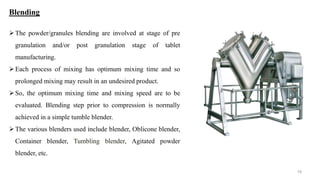
Blending
The powder/granules blending are involved at stage of pre
granulation and/or post granulation stage of tablet
manufacturing.
Each process of mixing has optimum mixing time and so
prolonged mixing may result in an undesired product.
So, the optimum mixing time and mixing speed are to be
evaluated. Blending step prior to compression is normally
achieved in a simple tumble blender.
The various blenders used include blender, Oblicone blender,
Container blender, Tumbling blender, Agitated powder
blender, etc.
19
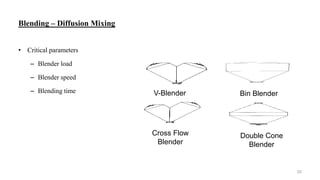
Blending – Diffusion Mixing
• Critical parameters
– Blender load
– Blender speed
– Blending time V-Blender
Cross Flow
Blender
Bin Blender
Double Cone
Blender
20
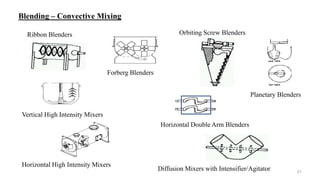
Blending – Convective Mixing
Ribbon Blenders Orbiting Screw Blenders
Planetary Blenders
Horizontal Double Arm Blenders
Forberg Blenders
Vertical High Intensity Mixers
Horizontal High Intensity Mixers
Diffusion Mixers with Intensifier/Agitator 21
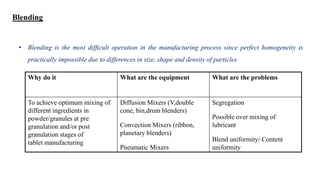
Blending
• Blending is the most difficult operation in the manufacturing process since perfect homogeneity is
practically impossible due to differences in size, shape and density of particles
What are the problemsWhat are the equipmentWhy do it
Segregation
Possible over mixing of
lubricant
Blend uniformity/ Content
uniformity
Diffusion Mixers (V,double
cone, bin,drum blenders)
Convection Mixers (ribbon,
planetary blenders)
Pneumatic Mixers
To achieve optimum mixing of
different ingredients in
powder/granules at pre
granulation and/or post
granulation stages of
tablet manufacturing
23
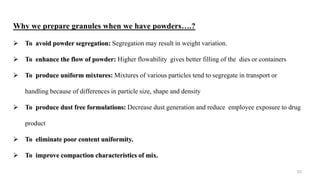
Why we prepare granules when we have powders….?
 To avoid powder segregation: Segregation may result in weight variation.
 To enhance the flow of powder: Higher flowability gives better filling of the dies or containers
 To produce uniform mixtures: Mixtures of various particles tend to segregate in transport or
handling because of differences in particle size, shape and density
 To produce dust free formulations: Decrease dust generation and reduce employee exposure to drug
product
 To eliminate poor content uniformity.
 To improve compaction characteristics of mix.
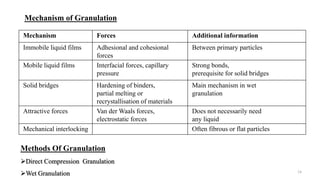
Mechanism Forces Additional information
Immobile liquid films Adhesional and cohesional
forces
Between primary particles
Mobile liquid films Interfacial forces, capillary
pressure
Strong bonds,
prerequisite for solid bridges
Solid bridges Hardening of binders,
partial melting or
recrystallisation of materials
Main mechanism in wet
granulation
Attractive forces Van der Waals forces,
electrostatic forces
Does not necessarily need
any liquid
Mechanical interlocking Often fibrous or flat particles
24
Mechanism of Granulation
Methods Of Granulation
Direct Compression Granulation
Wet Granulation
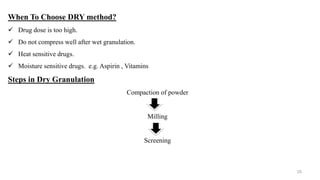
When To Choose DRY method?
 Drug dose is too high.
 Do not compress well after wet granulation.
 Heat sensitive drugs.
 Moisture sensitive drugs. e.g. Aspirin , Vitamins
Steps in Dry Granulation
Compaction of powder
Milling
Screening
25
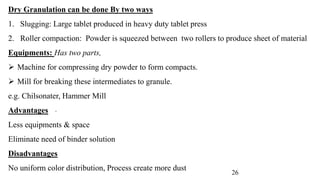
Dry Granulation can be done By two ways
1. Slugging: Large tablet produced in heavy duty tablet press
2. Roller compaction: Powder is squeezed between two rollers to produce sheet of material
Equipments: Has two parts,
 Machine for compressing dry powder to form compacts.
 Mill for breaking these intermediates to granule.
e.g. Chilsonater, Hammer Mill
Advantages
Less equipments & space
Eliminate need of binder solution
Disadvantages
No uniform color distribution, Process create more dust
.
26
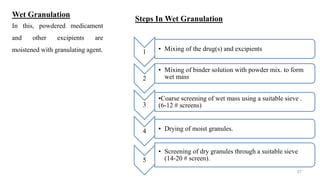
1 • Mixing of the drug(s) and excipients
2
• Mixing of binder solution with powder mix. to form
wet mass
3
•Coarse screening of wet mass using a suitable sieve .
(6-12 # screens)
4 • Drying of moist granules.
5
• Screening of dry granules through a suitable sieve
(14-20 # screen).
27
Steps In Wet Granulation
Wet Granulation
In this, powdered medicament
and other excipients are
moistened with granulating agent.
28
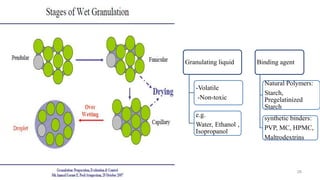
Granulating liquid
-Volatile
-Non-toxic
e.g.
Water, Ethanol ,
Isopropanol
Binding agent
Natural Polymers:
Starch,
Pregelatinized
Starch
synthetic binders:
PVP, MC, HPMC,
Maltrodextrins
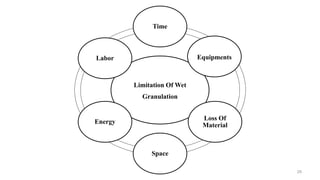
Limitation Of Wet
Granulation
Time
Equipments
Loss Of
Material
Space
Energy
Labor
29
Methods
 Single pot granulation
 High shear mixture granulation
 Fluid bed granulation
 Extrusion- Spheronization
30
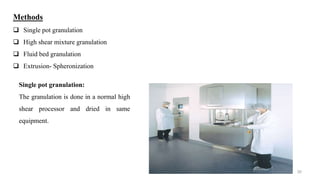
Single pot granulation:
The granulation is done in a normal high
shear processor and dried in same
equipment.
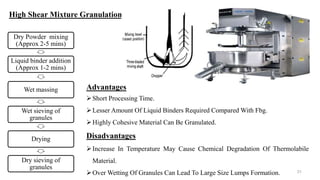
Dry Powder mixing
(Approx 2-5 mins)
Liquid binder addition
(Approx 1-2 mins)
Wet massing
Wet sieving of
granules
Drying
Dry sieving of
granules
31
High Shear Mixture Granulation
Advantages
Short Processing Time.
Lesser Amount Of Liquid Binders Required Compared With Fbg.
Highly Cohesive Material Can Be Granulated.
Disadvantages
Increase In Temperature May Cause Chemical Degradation Of Thermolabile
Material.
Over Wetting Of Granules Can Lead To Large Size Lumps Formation.
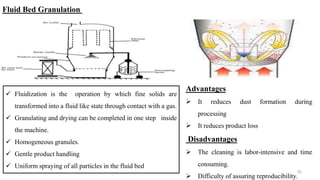
 Fluidization is the operation by which fine solids are
transformed into a fluid like state through contact with a gas.
 Granulating and drying can be completed in one step inside
the machine.
 Homogeneous granules.
 Gentle product handling
 Uniform spraying of all particles in the fluid bed
32
Fluid Bed Granulation
Advantages
 It reduces dust formation during
processing
 It reduces product loss
Disadvantages
 The cleaning is labor-intensive and time
consuming.
 Difficulty of assuring reproducibility.
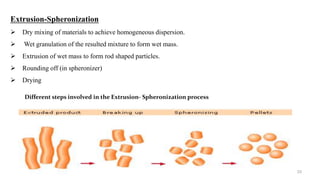
Different steps involved in the Extrusion- Spheronization process
33
Extrusion-Spheronization
 Dry mixing of materials to achieve homogeneous dispersion.
 Wet granulation of the resulted mixture to form wet mass.
 Extrusion of wet mass to form rod shaped particles.
 Rounding off (in spheronizer)
 Drying
Advanced Granulation Techniques
 Steam Granulation
 Melt Granulation
 Moisture Activated Dry Granulation (MADG)
 Moist Granulation Technique (MGT)
 Thermal Adhesion Granulation Process (TAGP)
 Foam Granulation
 Pneumatic Dry Granulation (PDG)
 Freeze granulation Technology
 Steam Granulation
 Melt Extrusion Technology
 Liquisolid Technique
 TOPO Technology
 Continuous Flow Technology
34
Steam Granulation
This process is a modification of conventional wet granulation.
Here steam is used as a binder instead of water.
Advantages
 Uniformly distribution the powder particles.
 Higher dissolution rate of granules because of larger surface area generated.
 Time efficient.
 Maintain sterility.
Disadvantages
 Requires special equipment for steam generation and transportation.
 Requires high energy inputs.
 Thermolabile materials are poor candidates.
 More safety measure required.
35
Melt Granulation
Here granulation is achieved by the addition of meltable binder.
Binder is in solid state at room temperature but melts in the temperature range of 50 – 80˚C.
There is no need of drying phase since dried granules are obtained by cooling it to room temperature.
water soluble binders- e.g. Polyethylene Glycol (PEG) 2000, 4000, 6000, 8000 (40-60 0C)
water insoluble binders- e.g.. Stearic acid (46-590C), Cetyl or stearyl alcohol(56-60 0C)
Advantages
Time and cost effective
Controlling and modifying the release of drugs. Water sensitive drugs are good candidates
Disadvantages
Heat sensitive materials are poor candidates. Lower-melting-point binder may melt/ soften during handling and
storage
Higher-melting-point binders require high melting temp. and can contribute instability problems for heat-labile
materials. 36
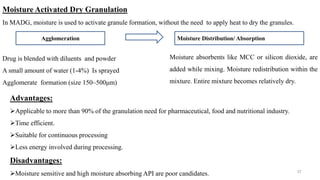
Moisture Activated Dry Granulation
In MADG, moisture is used to activate granule formation, without the need to apply heat to dry the granules.
Drug is blended with diluents and powder
A small amount of water (1-4%) Is sprayed
Agglomerate formation (size 150–500μm)
Agglomeration Moisture Distribution/ Absorption
Moisture absorbents like MCC or silicon dioxide, are
added while mixing. Moisture redistribution within the
mixture. Entire mixture becomes relatively dry.
37
Advantages:
Applicable to more than 90% of the granulation need for pharmaceutical, food and nutritional industry.
Time efficient.
Suitable for continuous processing
Less energy involved during processing.
Disadvantages:
Moisture sensitive and high moisture absorbing API are poor candidates.
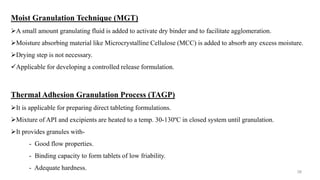
Moist Granulation Technique (MGT)
A small amount granulating fluid is added to activate dry binder and to facilitate agglomeration.
Moisture absorbing material like Microcrystalline Cellulose (MCC) is added to absorb any excess moisture.
Drying step is not necessary.
Applicable for developing a controlled release formulation.
Thermal Adhesion Granulation Process (TAGP)
It is applicable for preparing direct tableting formulations.
Mixture of API and excipients are heated to a temp. 30-130ºC in closed system until granulation.
It provides granules with-
- Good flow properties.
- Binding capacity to form tablets of low friability.
- Adequate hardness. 38
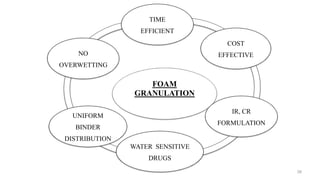
FOAM
GRANULATION
TIME
EFFICIENT
COST
EFFECTIVE
IR, CR
FORMULATION
WATER SENSITIVE
DRUGS
UNIFORM
BINDER
DISTRIBUTION
NO
OVERWETTING
39
40
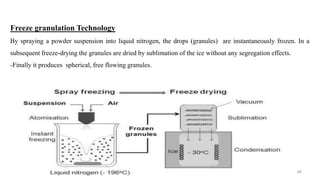
Freeze granulation Technology
By spraying a powder suspension into liquid nitrogen, the drops (granules) are instantaneously frozen. In a
subsequent freeze-drying the granules are dried by sublimation of the ice without any segregation effects.
-Finally it produces spherical, free flowing granules.
TOPO Technology
HERMES PHARMA has developed unique technology for carrying out single pot granulation.
Requires very small quantity of liquid to start the chain reaction
Pure water or water-ethanol mixtures are used.
Technology produces granules for tablets which contain at least one solid crystalline, organic acid and one
alkaline or alkaline earth metal carbonate that reacts with the organic acid in aqueous solution to form carbon
dioxide.
As a result, there are no solvent residues in the finished products, granules have excellent hardness and stability.
Continuous Flow Technology
The technology does not need any liquid to start the chain reaction.
Granulation is carried out in an inclined drum into which powder is fed at one end and granulate is removed at the
other.
The process produces granule with surface protected by inactive component that do not harm to sensitive API.
CF technology can produce up to 12 tons of granules every day.
41
42
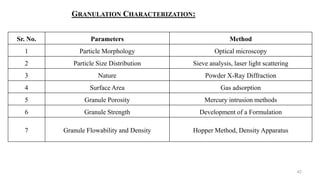
Sr. No. Parameters Method
1 Particle Morphology Optical microscopy
2 Particle Size Distribution Sieve analysis, laser light scattering
3 Nature Powder X-Ray Diffraction
4 Surface Area Gas adsorption
5 Granule Porosity Mercury intrusion methods
6 Granule Strength Development of a Formulation
7 Granule Flowability and Density Hopper Method, Density Apparatus
GRANULATION CHARACTERIZATION:
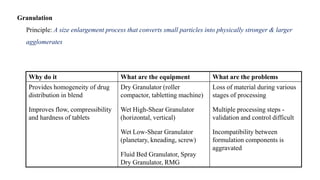
Granulation
Principle: A size enlargement process that converts small particles into physically stronger & larger
agglomerates
What are the problemsWhat are the equipmentWhy do it
Loss of material during various
stages of processing
Multiple processing steps -
validation and control difficult
Incompatibility between
formulation components is
aggravated
Dry Granulator (roller
compactor, tabletting machine)
Wet High-Shear Granulator
(horizontal, vertical)
Wet Low-Shear Granulator
(planetary, kneading, screw)
Fluid Bed Granulator, Spray
Dry Granulator, RMG
Provides homogeneity of drug
distribution in blend
Improves flow, compressibility
and hardness of tablets
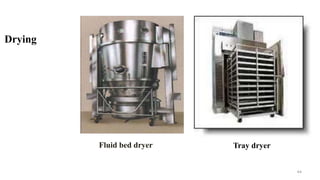
Drying
Tray dryerFluid bed dryer
44
Drying
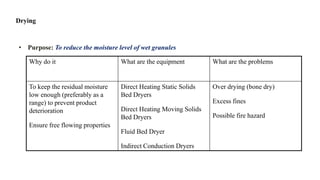
• Drying is a most important step in the formulation and development of pharmaceutical product.
• It is important to keep the residual moisture low enough to prevent product deterioration and ensure free
flowing properties.
• The commonly used dryer includes Fluidized bed dryer, Vacuum tray dryer, Microwave dryer, Spray
dryer, Freeze dryer, Turbo - tray dryer, Pan dryer, etc.
•Drying Process
• A process of evaporating the liquid contained within aggregates produced by a wet granulation process to
a predetermined moisture content
• Accomplished via
1. Tray dryer (direct contact with heating medium)
2. Fluidized bed dryer (indirect contact of the product with the heating medium
45
Drying
• Purpose: To reduce the moisture level of wet granules
What are the problemsWhat are the equipmentWhy do it
Over drying (bone dry)
Excess fines
Possible fire hazard
Direct Heating Static Solids
Bed Dryers
Direct Heating Moving Solids
Bed Dryers
Fluid Bed Dryer
Indirect Conduction Dryers
To keep the residual moisture
low enough (preferably as a
range) to prevent product
deterioration
Ensure free flowing properties
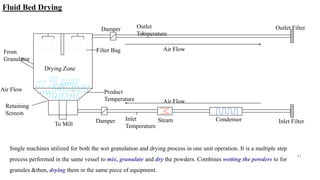
Fluid Bed Drying
Air Flow
Inlet FilterCondensorSteamDamper
Damper Outlet Filter
Air Flow
Product
Temperature
Inlet
Temperature
Outlet
Temperature
From
Granulator
To Mill
Drying Zone
Filter Bag
Air Flow
Retaining
Screein
47
Single machines utilized for both the wet granulation and drying process in one unit operation. It is a multiple step
process performed in the same vessel to mix, granulate and dry the powders. Combines wetting the powders to for
granules &then, drying them in the same piece of equipment.
Strength of the Tablets
The tablet should be sufficiently strong to withstand the mechanical shocks during the subsequent handling and
transport. The mechanical strength of tablet is described by the following parameters.
• Crushing Strength
• Friability
• Hardness
• Bonding Strength
• Fracture resistance.
48
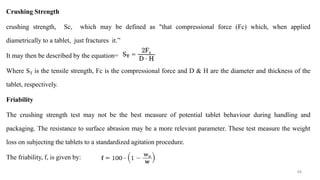
Crushing Strength
crushing strength, Sc, which may be defined as "that compressional force (Fc) which, when applied
diametrically to a tablet, just fractures it.”
It may then be described by the equation=
Where ST is the tensile strength, Fc is the compressional force and D & H are the diameter and thickness of the
tablet, respectively.
Friability
The crushing strength test may not be the best measure of potential tablet behaviour during handling and
packaging. The resistance to surface abrasion may be a more relevant parameter. These test measure the weight
loss on subjecting the tablets to a standardized agitation procedure.
The friability, f, is given by:
49
Factors Affecting Strength of the Tablets
Particle size
Smaller particles have larger surface area & when these are exposed to atmosphere may be prone to oxidation and
moisture absorption takes place which affects the strength of tablet.
Extensive fragmentation during compaction of a brittle material may result in a large number of interparticulate
contact points, which in turn provide a large number of possible bonding zones. The tablets made of these
materials can have a high mechanical strength.
Compaction pressure
The compaction pressure and speed affects the strength of the resulting tablet.
A fragmenting material has been shown to be less affected by variations in compression speed. The behaviour of
granules during compaction, the extent to which they bond together & the strength of the inter granule bonds
relative to the strength of the granules determine tablet hardness.
50
Particle shape & surface roughness
The mechanical strength of tablets of materials with a high fragmentation tendency are less affected by particle
shape and surface texture. Particle shape affects the inter particulate friction & flow properties of the powder.
Spherical particles are considered to be ideal.
General particle shapes and their effect on powder flow are as follows:
Spherical particles - Good
Oblong shaped particles - Poor
Cubical shaped particles - Poor
Irregular shaped particles - Medium
51
Binders
A binder is a material that is added to a formulation in order to improve the mechanical strength of a tablet. In direct
compression, it is generally considered that a binder should have a high compactibility to ensure the mechanical strength
of the tablet mixture. Addition of a binder which increases elasticity can decrease tablet strength because of the breakage
of bonds as the compaction pressure is released.
Lubricants
Lubricants are used to improve granule flow, minimize die wall friction & prevent adhesion of the granules to the
punch faces. Lubricant decreases the strength of the tablets. When lubricants are added as dry powder to granules, they
adhere & form a coat or a film around the host particles during the mixing process. The Lubricant film interferes with
the bonding properties of host particle by acting as a physical barrier. When the tablet is blended lightly, the lubricant is
present as a free fraction. Prolonged mixing time will produce a surface film of lubricants over the drug particles due to
which inter particulate bonding is reduced.
52
Entrapped air
When the air does not freely escape from the granules in the die cavity, the force created by the expansion of the entrapped air may
be sufficient to disrupt the bonds.
The presence of entrapped air will produce a tablet which can be broken easily & it lowers the tablet strength.
Moisture content
A small proportion of moisture content is desirable for the formation of a coherent tablet. At low moisture content there will be
increase in die wall friction due to increased stress, hence the tablet hardness will be poor. At high moisture level the die wall friction
is reduced owing to lubricating effect of moisture. At further increase in moisture content there will be decrease in compact strength
due to reduction in inter particulate bond.
Optimum moisture content is in the range of 0.5 – 4%.
Porosity
When particles of large size are subjected to light compression the tablet will be highly porous–low tablet strength. Reduction in
porosity is due to granule fragmentation giving smaller particles which may be more closely packed & plastic deformation which
allows the granules to flow into the void spaces.
53
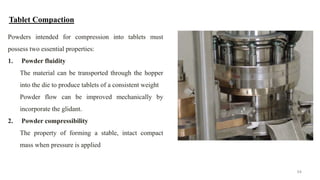
Tablet Compaction
Powders intended for compression into tablets must
possess two essential properties:
1. Powder fluidity
The material can be transported through the hopper
into the die to produce tablets of a consistent weight
Powder flow can be improved mechanically by
incorporate the glidant.
2. Powder compressibility
The property of forming a stable, intact compact
mass when pressure is applied
54
Direct compression
• The term “direct compression” is defined as the process by which tablets are compressed directly from
powder mixture of API and suitable excipients.
• It involves only two unite operations powder mixing and tableting.
Advantages of Direct Compaction:
• Reduced production time &cost.
• Product stability can be improved.
• Faster drug dissolution due to fast disintegration into primary particles.
• less number of equipment are required, less process validation
• Elimination of heat and moisture, thus increasing not only the stability but also the suitability of the process
for thermo-labile and moisture sensitive API’s.
55
Disadvantages of Direct Compaction
1. Large particles must be used → (acceptable flowability and bulk density)
2. Needs directly compressible filler that is usually expensive, e.g. microcrystalline cellulose (Avicel), spray
dried lactose
3. High dose drugs having high bulk volume, poor flowability and poor compressibility are not suitable for direct
compression. For example, Aluminium Hydroxide, Magnesium Hydroxide
4. Non-uniform distribution of colour, especially in tablets of deep colours
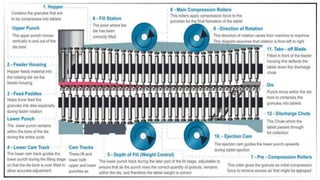
Tablet Compression Machine Design:
1. Hopper for holding and feeding granules or powder to be compressed.
2. Dies that define the size and shape of the tablet.
3. Punches for compressing the granules within the dies.
4. Cam tracks for guiding the movement of the punches.
5. A feeding mechanism for moving granules from the hopper into the dies. 56
57
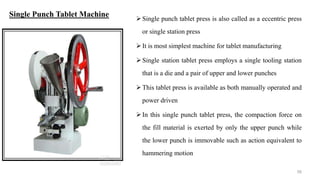
Single punch tablet press is also called as a eccentric press
or single station press
It is most simplest machine for tablet manufacturing
Single station tablet press employs a single tooling station
that is a die and a pair of upper and lower punches
This tablet press is available as both manually operated and
power driven
In this single punch tablet press, the compaction force on
the fill material is exerted by only the upper punch while
the lower punch is immovable such as action equivalent to
hammering motion
58
Single Punch Tablet Machine
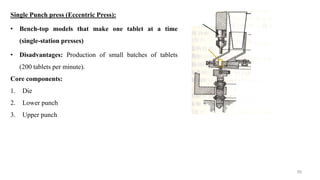
Single Punch press (Eccentric Press):
• Bench-top models that make one tablet at a time
(single-station presses)
• Disadvantages: Production of small batches of tablets
(200 tablets per minute).
Core components:
1. Die
2. Lower punch
3. Upper punch
59
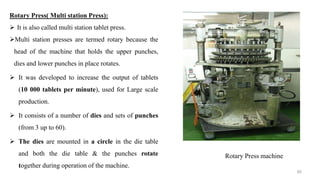
Rotary Press machine
Rotary Press( Multi station Press):
 It is also called multi station tablet press.
Multi station presses are termed rotary because the
head of the machine that holds the upper punches,
dies and lower punches in place rotates.
 It was developed to increase the output of tablets
(10 000 tablets per minute), used for Large scale
production.
 It consists of a number of dies and sets of punches
(from 3 up to 60).
 The dies are mounted in a circle in the die table
and both the die table & the punches rotate
together during operation of the machine.
60
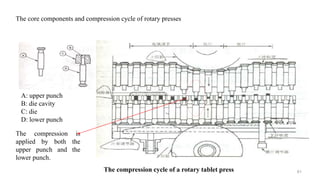
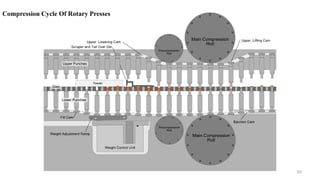
The core components and compression cycle of rotary presses
A: upper punch
B: die cavity
C: die
D: lower punch
The compression is
applied by both the
upper punch and the
lower punch.
The compression cycle of a rotary tablet press 61
Compression Cycle Of Rotary Presses
62
Compression Cycle Of Rotary Presses
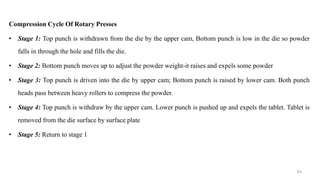
• Stage 1: Top punch is withdrawn from the die by the upper cam, Bottom punch is low in the die so powder
falls in through the hole and fills the die.
• Stage 2: Bottom punch moves up to adjust the powder weight-it raises and expels some powder
• Stage 3: Top punch is driven into the die by upper cam; Bottom punch is raised by lower cam. Both punch
heads pass between heavy rollers to compress the powder.
• Stage 4: Top punch is withdraw by the upper cam. Lower punch is pushed up and expels the tablet. Tablet is
removed from the die surface by surface plate
• Stage 5: Return to stage 1
63
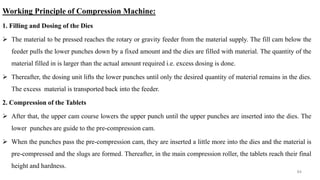
Working Principle of Compression Machine:
1. Filling and Dosing of the Dies
 The material to be pressed reaches the rotary or gravity feeder from the material supply. The fill cam below the
feeder pulls the lower punches down by a fixed amount and the dies are filled with material. The quantity of the
material filled in is larger than the actual amount required i.e. excess dosing is done.
 Thereafter, the dosing unit lifts the lower punches until only the desired quantity of material remains in the dies.
The excess material is transported back into the feeder.
2. Compression of the Tablets
 After that, the upper cam course lowers the upper punch until the upper punches are inserted into the dies. The
lower punches are guide to the pre-compression cam.
 When the punches pass the pre-compression cam, they are inserted a little more into the dies and the material is
pre-compressed and the slugs are formed. Thereafter, in the main compression roller, the tablets reach their final
height and hardness.
64
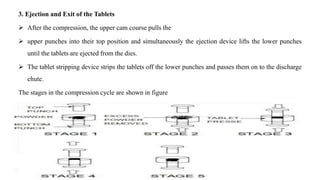
3. Ejection and Exit of the Tablets
 After the compression, the upper cam course pulls the
 upper punches into their top position and simultaneously the ejection device lifts the lower punches
until the tablets are ejected from the dies.
 The tablet stripping device strips the tablets off the lower punches and passes them on to the discharge
chute.
The stages in the compression cycle are shown in figure
65
Auxiliary Equipments
1.Granulation Feeding Device:
 Speed of die table is such that the time of die under feed frame is too short to allow adequate or consistent gravity filling of
die with granules, resulting in weight variation and content uniformity. These also seen with poorly flowing granules. To
avoid these problems, mechanized feeder can employ to force granules into die cavity.
2. Tablet weight monitoring devices:-
 High rate of tablet output with modern press requires continuous tablet weight monitoring with electronic monitoring
devices
3. Tablet Deduster : -
 Tblets coming out of a tablet machine bear excess powder on its surface and are run through the tablet deduster to remove
that excess powder.
4. Fette machine
 Fette machine is device that chills the compression components to allow the compression of low melting point substance
such as waxes and thereby making it possible to compress product with low meting points.
66
Compression
• Principle: Powder/granules are pressed inside a die and compressed by two punches into required
size, shape and embossing
What are the problemsWhat are the equipmentWhy do it
Poor flow in hopper
Inadequate lubrication
Capping, chipping, cracking,
lamination, sticking, picking,
binding, mottling
Double compression
Multiple Stations (Rotary) and
High Speed Tablet Presses
To compress powder into tablets
Tablet Coating
A. Tablet properties
 Tablets that are to be coated must possess the proper physical characteristics. In the coating process, the
tablets roll in a coating pan or cascade in the air stream as the coating solution is applied. The tablets must
not chip or break.. Also the tablets are exposed to elevated temperature and humidity during the coating.
The tablet surface which are brittle gets soften in the presence of heat or effected by coating solutions
tends to become rough in the early phase of the coating process are unacceptable for coating, especially
for film coating which deposits thin layer of coating, while sugar coating can fill the surface imperfection
but upto some extent because of their high solid contents. The tablets must be robust enough to withstand
these conditions.
 The following must be considered while designing tablets which are to be coated.
a. Tablet Hardness: tablet breakage is typically seen when the hardness is inadequate a rule of thumb is the
tablets to be coated should have hardness not less than 8 kp (11.2 scu, 80 N)
68
b. Tablet Friability:
 This test accurately reflects the stresses that the tablets will when tumbling in a coating pan. The maximum
recommended friability for tablets to be coated is 0.5% however for best results the aim should be 0.1%. If the
friability is above this limit the tablets may cap, laminate or abrades during coating process.
c. Tablet core shape:
The flat faced tablets have overall best surface hardness buit tend to be brittle at the edges, these tablets are not
good for coating because of twinning problem.
The deep concave type good mixing and no twinning problem but they offer the lowest level of surface
hardness, so these are also not suitable because of high attrition at crown.
The best compromise between surface hardness, mixing and twinning is offered by the normal or shallow
concave shapes and these are recommended for coating.
Generally the flat faced, shallow concave or capsule shaped tablets show greatest erosion at the edges while
deep concave show erosion at the crown
69
d. Tablet porosity:
Increased tablet porosity can be beneficial in increasing the force of adhesion between the tablet surface and the
applied coat. It should be kept in mind increase porosity comes at the sacrifice of tablet hardness
e. Tablet core ingredients:
The ingredients both active and inactive can have significant effect on the interaction between the substrate and
coating. The most important is the degree of adhesion. The active ingredient is often present in significant
amount in the tablet formulation, this will overwhelm the influence on adhesion by other ingredients. If the active
content is low and it has negative impact on film adhesion
Lubricants are added to tablet formulations to minimize both die wall friction and punch adhesion, lubricants
results in decrease of tablet hardness and coating adhesion
Superdisintegrants are valuable materials in tablet formulation due to their ability to reduce disintegration time
and increase dissolution rate. However if used indiscriminately, they can exert negative effects on other aspects
of tablet quality. High levels of superdisintegrant may result in orange peel effect though the hardness and
friability will be well in the limit. 70
B. Coating Process:
 Tablet coating is the application of coating composition to a moving bed of the tablets with concurrent use
of heated air to facilitate evaporation of the solvent.
Equipment: The process and equipment must provide;
1. Distribution of the liquid coating formulation over the whole of the available tablet surface (ladling,
Spraying).
2. Continuous mixing of the tablet load in order to achieve an evenly coated product (rotation).
3. Continuous drying to solidify the film quickly (hot air).
4. Removal of solvent vapour (plus dust generated, plus used drying air and atomizing air).
71
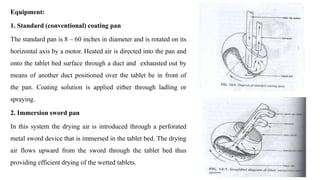
Equipment:
1. Standard (conventional) coating pan
The standard pan is 8 – 60 inches in diameter and is rotated on its
horizontal axis by a motor. Heated air is directed into the pan and
onto the tablet bed surface through a duct and exhausted out by
means of another duct positioned over the tablet be in front of
the pan. Coating solution is applied either through ladling or
spraying.
2. Immersion sword pan
In this system the drying air is introduced through a perforated
metal sword device that is immersed in the tablet bed. The drying
air flows upward from the sword through the tablet bed thus
providing efficient drying of the wetted tablets.
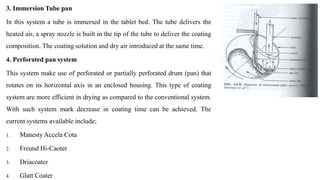
3. Immersion Tube pan
In this system a tube is immersed in the tablet bed. The tube delivers the
heated air, a spray nozzle is built in the tip of the tube to deliver the coating
composition. The coating solution and dry air introduced at the same time.
4. Perforated pan system
This system make use of perforated or partially perforated drum (pan) that
rotates on its horizontal axis in an enclosed housing. This type of coating
system are more efficient in drying as compared to the conventional system.
With such system mark decrease in coating time can be achieved. The
current systems available include;
1. Manesty Accela Cota
2. Freund Hi-Caoter
3. Driacoater
4. Glatt Coater
5. Fluidized bed (air suspension) coater
This system uses columnar chamber through which high volume heated air is supplied from the bottom to
fluidize the tablet bed, providing the medium for drying and the energy for mixing. These are most efficient
drying and mixing equipment. These are not commonly used for tablets on large scale high attrition the
tablets chip, breaks, abrades out. This system is commonly applied for particulate coating
(microencapsultion and pellet coating).
The coating solution is either applied from the bottom (Wurster) or from the top of the chamber on to the
tablet bed.
74
Spraying Application Systems (spray gun):
Two systems are used to apply atomized spray of coating composition onto the tablets.
1. High pressure air less system
 In this system the liquid is pumped at high pressure (250-3000 psig) through a small orifice (0.009-0.20 inch)
in the fluid nozzle. The degree of atomization and the spray rate are controlled by the fluid pressure, orifice
size, and viscosity of the liquid.
The disadvantage of the system is that,
 Because of the small orifice the suspension may block it therefore the coating suspension may be finely
milled or filtered.
 The airless system doesn't provide independent control of suspension application rate, degree of atomization
and spray fan width.
75
76
2. Low pressure air atomized system
In this system liquid is pumped through larger orifice (0.020 – 0.06 inch) at relatively low pressure (5-50 psig).
Low pressure of about 10-100 psig at the atomizer tip contact the liquid and disperse it in finely divided spray. In
this system atomization can be controlled independently of the operating pressure, also fan width can be
controlled.
Coating Parameters
During coating the tablets move through an application zone in which a portion of the tablets receive some
coating. Most of the time tablets are in drying mode moving away from the application zone and recycled
repeatedly through the application zone. In the coating operation (continuous) an equilibrium is maintained
between coating composition application rate and the rate of evaporation of the solvent. Deviation from this
equilibrium results in serious coating problems. These two parameters can be adjusted by;
Spray Gun position: 6-18 inches from the bed, 450 angle to the tablet bed. Not overlapping fan width nor to far.
Effect of pan load: under loading the pan will result in situation where the tablet does not cover fully the
exhaust plenum, and the majority of the drying air stream will bypass the tablet bed and drying efficiency will be
low.
Air volume and temperature: Drying is controlled by the quantity and temperature of the drying hot air, and
the quantity of exhaust air. It is important to balance the inlet and exhaust air flow rates such that there is
slight negative pressure in the chamber. Also the temperature difference between the inlet and exhaust must
be with in 20-30oC. It is important to monitor the following three temperatures.
1. Inlet Air temperature
2. Tablet Bed temperature (most critical)
3. Exhaust air temperature
C. Coating composition: coating composition contains the ingredients that are to be applied on the surface
of tablet and the solvents , which act as carrier for the ingredients. These solvents are not required in the
final product and must be removed. A balance must be established between the coating composition flow
rate and the three drying variables (drying air temperature/quantity and exhaust air quantity).
77
Types Of Coating
1.Sugar coating
2.Film Coating
1. Conventional film coating 2. Enteric film coating
1. Sugar coating
This involves several steps, the duration of which ranges from few hours to few days. The quality of coating
depends upon the skill of the operator specially in ladling type of solution application. The sugar coating results
in elegant highly glossed finished tablets. Following steps are involved in sugar coating.
1. Sealing
2. Subcoating
3. Syruping (smoothing)
4.Finishing
5.Polishing 78
1. Seal coating (sealing)
To prevent moisture penetration into the tablet core a seal coat is applied. This is specially required in pan-
ladling process, to avoid over wetting of the tablet bed.
Without seal coat the tablets will absorb sufficient moisture to be softened or disintegrate , effecting the physical
appearance. Shellac is the most commonly applied sealant agent, but it offers the problem of increase the
disintegration and dissolution time on aging because of polymerization of shellac. Zein is also used as sealant, it
has no problem as associated with the shellac. The process description is
• Pan Speed: 10 rpm
• Supply air temperature: 30oC
• application of 800 ml of sealant solution is applied and the tablets are allowed to dry for 15-20 minutes
between the application. If the tablets become tacky at any time apply sufficient talc to avoid sticking.
79
2. Sub Coating
This is applied to round the edges and build up the tablet size. Sugar coating results in the increase of tablet
weight by 50-100%. Usually gelatin/acacia solution is used along subcoating powder. The process description is
Pan speed: 10 rpm
 Turn heart and inlet air off. Use exhaust air only
 apply 3-9 coats. Use 1-2 liters for first coat and then reduced the quantity accordingly to obtain the required
weight and round edges.
 Allow the tablets to dry at least for 20 minutes after each application. Dust with subcoating powder at the end.
 After the last coat, jog the pan for at least 2-4 hours to ensure complete dryness.
80
3. Syrup (smoothing/color) coating
The purpose of this step is to cover and fill the imperfection in the tablet surface caused by subcoating,
this is the most technical step as it requires the most skill. This step usually involves three basic phases.
a. Grossing syrup (a syrup with subcoating powder dispersed in it): Process outline is
 Remove excess dust from the pan. Turn on the exhaust air.
 Adjust the temperature to achieve the exhaust air temperature of 45-48oC.
 Pan Speed: 15 rpm
 Apply 5-15 coats of grossing syrup.
b. Heavy syrup: This solution contain color, maintaining the above parameters apply several coats.
c. Regular syrup: The process steps are
• Turn off the heat, reduce the inlet and outlet air.
• apply few coats of regular colored syrup to achieve final smoothness, size and color development.
81
4. Finishing
 With the heat and inlet air supply off , reduced exhaust air and pan speed of 12 rpm apply 3-4 coats of regular
colored syrup rapidly.
 Shut off the exhaust air and apply last coat of regular syrup without colorant. This will give depth to the color and
will enhance the elegance of the coat.
 Stop the pan while the tablets are damp and swiftly shift to jog the pan for 15-30 minutes, leave the tablets
overnight to dry completely.
5. Polishing:
 This is the final step, the tablets can be polished in standard coating pan or canvas line polishing pan. The steps
involved are
 Pan speed: 12 rpm
 Inlet air, outlet air turned off
 Apply 3-4 coats warm polishing solution (waxes), approximately 300 ml per application.
 Apply the subsequent coat when the solvent is evaporated out.
 Sometimes powder wax are also applied.
82
Film Coating
To reduce sugar coating process time and to reduce the
requirement for operator skill, film coating was developed.
Film coating is a technique in which a thin layer/coat of a
polymer is deposited over the tablets/particulate.
Depending on the coating polymer the types of coating are
1. Normal film coating
2. Enteric film coating
3. Aqueous moisture barrier coating (AMB)
On the basis of solvent use the types are
1.Organic Coating
2.Aqueous Coating
83
Materials used in film coating
A typical film coating formulation is made up
of
1. Polymer (film former)
2. Plasticizer
3. Colouring/opacifying agent
4. Solvent
5. Others (surfactants, flavors, sweetening
agent, active ingredients and preservatives.)
An Ideal Coating Material Should Have The Following Properties;
 Solubility in solvent of choice for coating preparation
 Solubility required for the intended use
 Capacity to produce an elegant looking product
 Stability in the presence of heat, light, moisture, air and substrate being coated
 Odorless, colorless and tasteless
 compatibility with other ingredients
 Non toxic or no pharmacologic activity
 Ease of application
 Resistant to cracking
 No bridging or filling formation
 Ease of printing on high speed machines
84
Polymers/Film formers
 The function of the polymer is to provide main structure and basic physical and chemical properties to the
coating.
 Polymer viscosity is very important specially in aqueous coating we need to minimize the water concentration, it
is to shorten the process time and to minimize product exposure to the moisture (moisture sensitive product). But
the coating composition with viscosity above 500 cps are difficult to atomize and will not produce smooth
product. Therefore polymers with low viscosity are preferred.
1. Hydroxypropyl methylcellulose (HPMC)
Commercially it is available in different viscosity grades This polymer is widely used in air suspension and pan
spray coating. The properties are
1. Soluble in GI fluid, organic and aqueous solvent system
2.Stability in presence of light, heat, air and reasonable amount of moisture
3. Incorporation of colour and other additives with out difficulty. If it is used alone then it may results in bridging
and filling, so it may be used in combination or proper plasticizer may be used.
85
2. Methyl hydroxyethylcellulose
This polymer has also different viscosity grades, it has similar properties as that of HPMC but it is soluble in few
organic solvents, which has restricted its use.
3. Ethylcellulose
Depending on the ethoxy substitution different viscosity grades are available commercially. This material is
water and GI fluid insoluble, therefore can not be used alone for coating. It is used in combination with water
soluble polymer e.g. HPMC. These combination are a used for sustained release coating. The properties include
1. Soluble in wide variety of organic solvents
2. Non toxic
3. Tasteless, odorless and colorless
4. stable at environmental conditions
Unplasticized ethyl cellulose coats are brittle.
86
4. Hydroxypropylcellulose
It is soluble in water below 40oC, GI fluid and organic solvents
 It is very tacky and yield very flexible film, it can not be used alone
 It is good for sub coat but not for color or gloss coat
5. Povidone (PVP)
 It is available in four viscosity grades i.e. K-15, K-30, K-60 and K-90, the average molecular weights are
10,000, 40,000, 160,000 and 360,000 respectively.
 It is soluble in water, GI fluid and variety of organic solvents.
 Povidone films are clear, hard and glossy
 Povidone is soluble in both acidic and intestinal media, it can be cross linked with other materials to
produce enteric coating material.
 Povidone is used in coating composition to increase the dispersion of color.
87
6. Sodium Carboxymethylcellulose
 It is available in low, medium ,high and extra high viscosity grades
 It can easily be dispersed in water to form colloidal solution, but is insoluble in most organic solvents.
 the film formed is brittle but adheres well to tablets.
7. Acrylate polymers
Acrylate polymers are marketed under the trademark of Eudragrit. Eudragrit E(dimethylaminoethyl
methacrylate and other neutral methacrylic acid esters) is the only polymer of this group which is freely
soluble in gastric fluid (acidic media).
88
Enteric Polymers
Enteric coating polymers are those substances which resists the gastric pH (acidic) and get dissolves in
intestinal fluid (alkaline). The reasons for enteric coating are
 To protect acid labile drugs from gastric fluid e.g. enzymes and certain antibiotics
 To prevent gastric distress or nausea e.g. sodium salicylate
 To deliver drug to intestine for local action
 To deliver drugs that are optimally absorbed in the small intestine
 To provide a delayed release component for repeat action tablets.
89
An ideal enteric coating polymer should have the following properties
1. Resistance to gastric fluids (acidic pH)
2. Ready susceptibility to or permeability to intestinal fluid (alkaline pH)
 Compatibility with other ingredients
 Non toxic or no pharmacologic activity and Ease of application
 Formation of continuous film
 stability alone and in coating solution. The film should not change with aging
 Ease of printing on high speed machines
1. Cellulose Acetate Phthalate (CAP)
. CAP is widely used but it has major disadvantage that it dissolves above pH 6, thus delaying the drug release as
the ideal material may dissolve around pH 5. It is also hygroscopic and relatively permeable to gastric fluid. The
film formed is brittle thus required plasticizer. It is available under the trademark of Aquateric from FMC.
90
2.Acrylate polymers.
Two commercially available acrylates are
Ex. Eudragrit L (soluble at pH 6), Eudragrit S (soluble at pH 7)
3. HPMC Phthalate
Three grades are available
Ex. HPMCP 55 (HP 50), HPMCP 50 (HP 55) and HPMCP 55S (HP 55S)
These polymers dissolves at lower pH (at 5-5.5) than CAP and acrylates. Thus resulting in higher
bioavailability of some specific drugs.
4. Polyvinyl Acetate Phthalate (PVAP)
It is similar to HP 55 in stability and pH dependant solubility.
91
Plasticizer
The function of plasticizer is to modify the basic mechanical properties of the polymer. Plasticizers have high
affinity for the polymer they are also called nonvolatile solvents. There are two techniques to modify the
plasticity of the film former;
1.Internal plasticizing
2.External plasticizing
In the former technique chemical modification is brought in the polymer which alters the physical properties of
the polymer i.e. elastic modulus. In later technique other substances are used as plasticizer in the formulation.
When the plasticizer is used in correct concentration it imparts flexibility by relieving the molecular rigidity.
Commonly 10% of polymer concentration is used. Examples include
1.Castor Oil
2.Propylene glycol & Glycerin
3. tween & span
92
Coloring and opacifying agent
The function of these ingredients is to enhance the product quality. They provide
Product identification
Protect the core from light and moisture
They increase the solid concentration with any impact on viscosity thus reducing the drying time. They are
either soluble or form fine suspension in the solvent system. For uniform distribution the particle size must be <
10 microns. The most common colorants used are FD&C or D&C certified, these are either dyes or lakes of
dyes. Examples include iron oxide, anthrocyanins, caramel, carotenoids, chlorophyll, indigo, flavones, turmeric
acid and carminic acid.
Opacifiers are used to give more pastel color and increase film coverage. These can provide white coat or mask
the color of the tablet core. These are mostly inorganic material.
The substances employed are: Titanium dioxide (Most Common), Talc, Aluminum silicate, Magnesium
carbonate, Calcium sulfate, Aluminum hydroxide
93
Solvents
The function of the solvent is to dissolve or disperse the polymers and other additives and transfer them to the
surface of substrate (core) the ideal characteristics are
1.It should either dissolve or disperse the polymer system and other ingredients.
2.Small concentration of polymer (2-10%) should not high viscous solution
3.It should be colorless, tasteless, odorless, inexpensive, inert and noninflammable.
4.Should have rapid drying rate
5.Should not have environmental impact.
The most widely solvents used either alone are in combination are water, ethanol, methanol, isopropyl alcohol,
chloroform , acetone , methyl ethyl ketone and methylene chloride.
94
Coating/Polishing
• Principle: Application of coating solution to a moving bed of tablets with concurrent use of heated
air to facilitate evaporation of solvent
What are the problemsWhat are the equipmentWhy do it
Blistering, chipping, cratering,
picking, pitting
Color variation
Roughness
Pan (standard/perforated)
Coating Machines
Fluidized Bed Coating
Machines
Spray Coating Machines
Vacuum, Dip & Electrostatic
Coating Machines
Enhance appearance and colour
Mask taste and odour
(film/sugar)
Improve patient compliance
Improve stability
Impart enteric, delayed,
controlled release properties
Twinning
• Two tablets stick together.
• Most common in capsule shaped tablets .
Cause
Coating suspension can not be evaporated.
Remedy
• Reducing spray rate
• Increasing pan speed
96
Cracking
• Small, fine cracks observed on the upper and lower central surface of
tablets, or very rarely on the sidewall are referred to as ‘Cracks’.
Cause
• Use of higher molecular weight polymers or polymeric blends
• Higher internal stresses in the film ( more than tensile strength of the
film )
Remedy
• Use low molecular weight polymer
• Adjust the plasticizer & pigment types and concentration to
minimize internal stresses
97
Sticking & picking
• It is defect where isolated areas of film are pulled away from
the surface when the tablet sticks together and then part.
• Picking does not occur alone it must have another tablet to be
stuck with which called sticking .
Cause :
• Inefficient drying.
• Higher rate of application of coating solution
• Over wetting
• Excessive film thickness
Remedy :
• Reduce liquid application rate.
• Increase in drying air temperature and air volume.
Sticking
Picking
98
Blistering
• It is local detachment of film from the substrate forming a blister
Cause :
• Over heating during spraying coating solution
Remedy :
use mild drying condition .
Chipping
It is the defect where film become chipped and dented , usually at the
edges of tablet .
Cause :
• Excessive attrition during coating process
Remedy :
Increase hardness of the film . 99
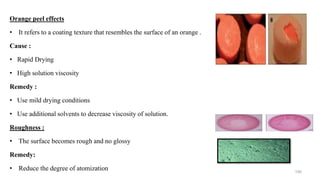
Orange peel effects
• It refers to a coating texture that resembles the surface of an orange .
Cause :
• Rapid Drying
• High solution viscosity
Remedy :
• Use mild drying conditions
• Use additional solvents to decrease viscosity of solution.
Roughness :
• The surface becomes rough and no glossy
Remedy:
• Reduce the degree of atomization 100
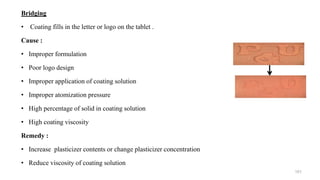
Bridging
• Coating fills in the letter or logo on the tablet .
Cause :
• Improper formulation
• Poor logo design
• Improper application of coating solution
• Improper atomization pressure
• High percentage of solid in coating solution
• High coating viscosity
Remedy :
• Increase plasticizer contents or change plasticizer concentration
• Reduce viscosity of coating solution
101
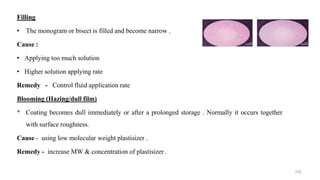
Filling
• The monogram or bisect is filled and become narrow .
Cause :
• Applying too much solution
• Higher solution applying rate
Remedy - Control fluid application rate
Blooming (Hazing/dull film)
• Coating becomes dull immediately or after a prolonged storage . Normally it occurs together
with surface roughness.
Cause - using low molecular weight plastisizer .
Remedy - increase MW & concentration of plastisizer .
102
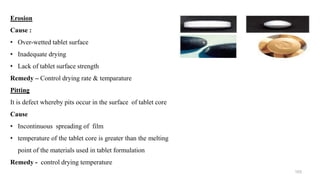
Erosion
Cause :
• Over-wetted tablet surface
• Inadequate drying
• Lack of tablet surface strength
Remedy – Control drying rate & temparature
Pitting
It is defect whereby pits occur in the surface of tablet core
Cause
• Incontinuous spreading of film
• temperature of the tablet core is greater than the melting
point of the materials used in tablet formulation
Remedy - control drying temperature
103
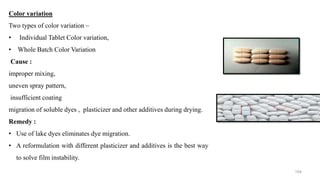
Color variation
Two types of color variation –
• Individual Tablet Color variation,
• Whole Batch Color Variation
Cause :
improper mixing,
uneven spray pattern,
insufficient coating
migration of soluble dyes , plasticizer and other additives during drying.
Remedy :
• Use of lake dyes eliminates dye migration.
• A reformulation with different plasticizer and additives is the best way
to solve film instability.
104
Cratering
• It is the defect of film coating whereby volcanic-like craters appears exposing the tablet surface .
Cause
• Penetration of the coating solution into the surface of the tablet
Remedy
• Decrease in spray application rate
• Use of optimum and efficient drying
Blushing (whitish specks)
• The defect best described as whitish specks or haziness of the film .
• It is characterized by precipitation of polymer exacerbated by the use of high coating temperature at or
above the thermal gelation temperature of the polymers.
105
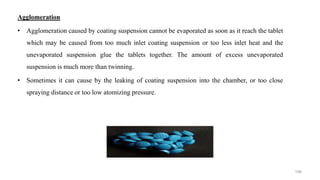
Agglomeration
• Agglomeration caused by coating suspension cannot be evaporated as soon as it reach the tablet
which may be caused from too much inlet coating suspension or too less inlet heat and the
unevaporated suspension glue the tablets together. The amount of excess unevaporated
suspension is much more than twinning.
• Sometimes it can cause by the leaking of coating suspension into the chamber, or too close
spraying distance or too low atomizing pressure.
106
Capping & Laminating
Capping occurs when the upper segment of the tablet separates from the main portion of the
tablet & comes off as a cap.
• Can appear immediately after compression, or hours, even days after preparation.
• It is usually due to air entrapped in the granulation which is compressed in the die during
the compression & then expands when the pressure is released.
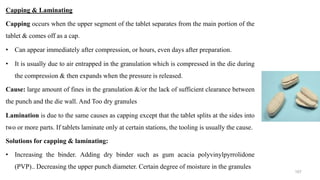
Cause: large amount of fines in the granulation &/or the lack of sufficient clearance between
the punch and the die wall. And Too dry granules
Lamination is due to the same causes as capping except that the tablet splits at the sides into
two or more parts. If tablets laminate only at certain stations, the tooling is usually the cause.
Solutions for capping & laminating:
• Increasing the binder. Adding dry binder such as gum acacia polyvinylpyrrolidone
(PVP).. Decreasing the upper punch diameter. Certain degree of moisture in the granules
107
Mottling
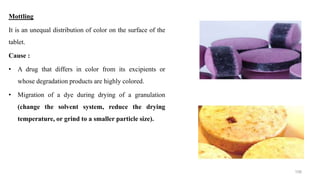
It is an unequal distribution of color on the surface of the
tablet.
Cause :
• A drug that differs in color from its excipients or
whose degradation products are highly colored.
• Migration of a dye during drying of a granulation
(change the solvent system, reduce the drying
temperature, or grind to a smaller particle size).
108
Packaging
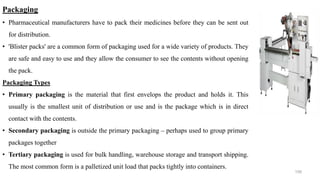
• Pharmaceutical manufacturers have to pack their medicines before they can be sent out
for distribution.
• 'Blister packs' are a common form of packaging used for a wide variety of products. They
are safe and easy to use and they allow the consumer to see the contents without opening
the pack.
Packaging Types
• Primary packaging is the material that first envelops the product and holds it. This
usually is the smallest unit of distribution or use and is the package which is in direct
contact with the contents.
• Secondary packaging is outside the primary packaging – perhaps used to group primary
packages together
• Tertiary packaging is used for bulk handling, warehouse storage and transport shipping.
The most common form is a palletized unit load that packs tightly into containers.
109
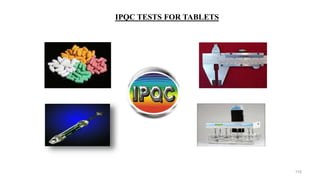
IPQC TESTS FOR TABLETS
110
What Do You Mean By “IPQC”…?
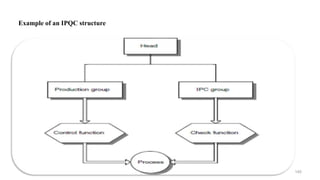
IPQC is concerned with providing accurate , specific, & definite descriptions of
the procedures to be employed, from, the receipt of raw materials to the release of
the finished dosage forms.
“INSPECTION
”
“TESTING”
111
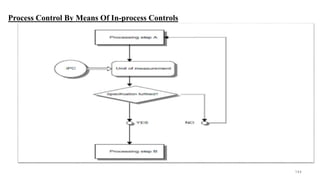
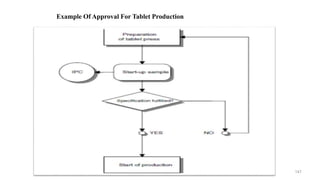
In process Quality Control
• In process Quality Control, IPQC tests are mostly performed within the production
area.
• They should not carry any risk for the quality of product.
• In process testing enables easier identification of problems. It some time identifies a
defective product batch that can be corrected by rework, whereas once that batch has
been completed, this may not be possible.
• Failure to meet In process control specification indicates either that procedure were not
followed or some factor(S) out of control.
112
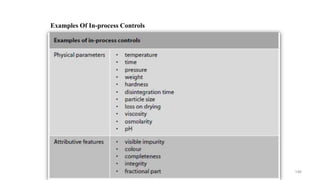
Various Instrument Used In IPQC Department:
• Disintegration apparatus
• Dissolution apparatus
• Analytical balance Muffle furnace
• Friability testing apparatus
• Bulk density apparatus
• Tablet hardness tester
• Infra red moisture content measuring apparatus
• U.V Spectroscopy
• Abbe Refractometer
• T.L.C. kit
• Karl fisher Titrimeter 113
Evaluation of Tablet
Official and unofficial tests for evaluation of tablets
 Official Tests:
1. Weight variation
2. Disintegration
3. Dissolution
4. Drug content
 Non-Official Tests:
1. Hardness
2. Friability
114
1. General Appearance:
The general appearance of a tablet, its identity and general elegance is essential for consumer acceptance, for
control of lot-to-lot uniformity and tablet-to-tablet uniformity. The control of general appearance involves
the measurement of size, shape, color, presence or absence of odor, taste etc.
2. Size & Shape:
It can be dimensionally described & controlled. The thickness of a tablet is only variables. Tablet thickness
can be measured by micrometer or by other device. Tablet thickness should be controlled within a ± 5 %
variation of standard value.
3. Unique identification marking:
These marking utilize some form of embossing, engraving or printing. These markings include company
name or symbol, product code, product name etc.
4. Organoleptic properties:
Color distribution must be uniform with no mottling. For visual color comparison compare the color of
sample against standard color. 115
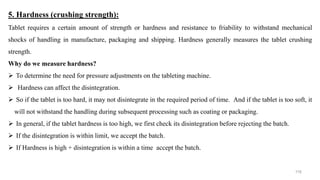
5. Hardness (crushing strength):
Tablet requires a certain amount of strength or hardness and resistance to friability to withstand mechanical
shocks of handling in manufacture, packaging and shipping. Hardness generally measures the tablet crushing
strength.
Why do we measure hardness?
 To determine the need for pressure adjustments on the tableting machine.
 Hardness can affect the disintegration.
 So if the tablet is too hard, it may not disintegrate in the required period of time. And if the tablet is too soft, it
will not withstand the handling during subsequent processing such as coating or packaging.
 In general, if the tablet hardness is too high, we first check its disintegration before rejecting the batch.
 If the disintegration is within limit, we accept the batch.
 If Hardness is high + disintegration is within a time accept the batch.
116
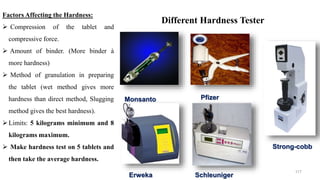
Different Hardness Tester
Erweka
Pfizer
Schleuniger
Monsanto
Strong-cobb
117
Factors Affecting the Hardness:
 Compression of the tablet and
compressive force.
 Amount of binder. (More binder à
more hardness)
 Method of granulation in preparing
the tablet (wet method gives more
hardness than direct method, Slugging
method gives the best hardness).
Limits: 5 kilograms minimum and 8
kilograms maximum.
 Make hardness test on 5 tablets and
then take the average hardness.
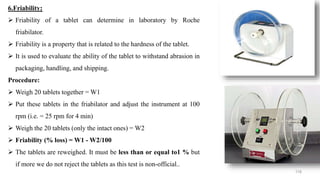
6.Friability:
 Friability of a tablet can determine in laboratory by Roche
friabilator.
 Friability is a property that is related to the hardness of the tablet.
 It is used to evaluate the ability of the tablet to withstand abrasion in
packaging, handling, and shipping.
Procedure:
 Weigh 20 tablets together = W1
 Put these tablets in the friabilator and adjust the instrument at 100
rpm (i.e. = 25 rpm for 4 min)
 Weigh the 20 tablets (only the intact ones) = W2
 Friability (% loss) = W1 - W2/100
 The tablets are reweighed. It must be less than or equal to1 % but
if more we do not reject the tablets as this test is non-official..
118
7. Thickness test
• Thickness is an unofficial test .
• Thickness of the tablet is inversely proportional to hardness
i.e. increase in hardness decrease the thickness & vice
versa.
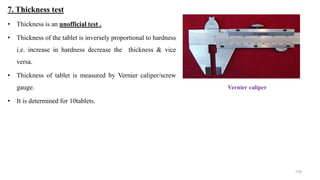
• Thickness of tablet is measured by Vernier caliper/screw
gauge.
• It is determined for 10tablets.
Vernier caliper
119
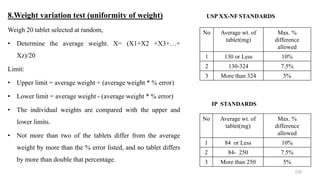
8.Weight variation test (uniformity of weight)
Weigh 20 tablet selected at random,
• Determine the average weight. X= (X1+X2 +X3+…+
Xz)/20
Limit:
• Upper limit = average weight + (average weight * % error)
• Lower limit = average weight - (average weight * % error)
• The individual weights are compared with the upper and
lower limits.
• Not more than two of the tablets differ from the average
weight by more than the % error listed, and no tablet differs
by more than double that percentage.
120
No Average wt. of
tablet(mg)
Max. %
difference
allowed
1 130 or Less 10%
2 130-324 7.5%
3 More than 324 5%
USP XX-NF STANDARDS
IP STANDARDS
No Average wt. of
tablet(mg)
Max. %
difference
allowed
1 84 or Less 10%
2 84- 250 7.5%
3 More than 250 5%
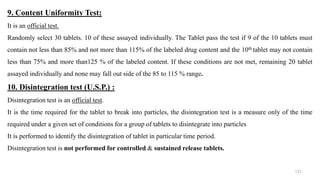
9. Content Uniformity Test:
It is an official test.
Randomly select 30 tablets. 10 of these assayed individually. The Tablet pass the test if 9 of the 10 tablets must
contain not less than 85% and not more than 115% of the labeled drug content and the 10th tablet may not contain
less than 75% and more than125 % of the labeled content. If these conditions are not met, remaining 20 tablet
assayed individually and none may fall out side of the 85 to 115 % range.
10. Disintegration test (U.S.P.) :
Disintegration test is an official test.
It is the time required for the tablet to break into particles, the disintegration test is a measure only of the time
required under a given set of conditions for a group of tablets to disintegrate into particles
It is performed to identify the disintegration of tablet in particular time period.
Disintegration test is not performed for controlled & sustained release tablets.
121
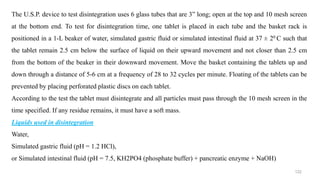
The U.S.P. device to test disintegration uses 6 glass tubes that are 3” long; open at the top and 10 mesh screen
at the bottom end. To test for disintegration time, one tablet is placed in each tube and the basket rack is
positioned in a 1-L beaker of water, simulated gastric fluid or simulated intestinal fluid at 37 ± 20 C such that
the tablet remain 2.5 cm below the surface of liquid on their upward movement and not closer than 2.5 cm
from the bottom of the beaker in their downward movement. Move the basket containing the tablets up and
down through a distance of 5-6 cm at a frequency of 28 to 32 cycles per minute. Floating of the tablets can be
prevented by placing perforated plastic discs on each tablet.
According to the test the tablet must disintegrate and all particles must pass through the 10 mesh screen in the
time specified. If any residue remains, it must have a soft mass.
Liquids used in disintegration
Water,
Simulated gastric fluid (pH = 1.2 HCl),
or Simulated intestinal fluid (pH = 7.5, KH2PO4 (phosphate buffer) + pancreatic enzyme + NaOH)
122
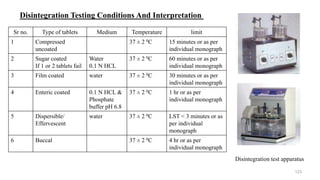
Sr no. Type of tablets Medium Temperature limit
1 Compressed
uncoated
37 ± 2 0C 15 minutes or as per
individual monograph
2 Sugar coated
If 1 or 2 tablets fail
Water
0.1 N HCL
37 ± 2 0C 60 minutes or as per
individual monograph
3 Film coated water 37 ± 2 0C 30 minutes or as per
individual monograph
4 Enteric coated 0.1 N HCL &
Phosphate
buffer pH 6.8
37 ± 2 0C 1 hr or as per
individual monograph
5 Dispersible/
Effervescent
water 37 ± 2 0C LST < 3 minutes or as
per individual
monograph
6 Buccal 37 ± 2 0C 4 hr or as per
individual monograph
Disintegration Testing Conditions And Interpretation
123
Disintegration test apparatus
U.S.P. method for uncoated tablets:
Start the disintegration test on 6 tablets.
If one or two tablets from the 6 tablets fail disintegrate completely within 30min repeat the same test on
another 12 tablet. (i.e. the whole test will consume 18 tablets).
Not less then 16 tablets disintegrate completely within the time. If more then two tablets (from the 18) fail to
disintegrate, the batch must be rejected.
For Coated tablets:
To remove or dissolve the coat, immerse the tablet in distilled water for 5min.
Put the tablet in the apparatus in water or HCL for 30 min at 37oC (according to the U.S.P). If not
disintegrated, put in intestinal fluid. If one or two tablets fail to disintegrate, repeat on 12 tablets. So 16
tablets from the 18 must completely disintegrate within the time, if two or more not disintegrated the batch
is rejected.
124
U.S.P. and B.P Method for Enteric coated tablets:
Put in distilled water for five minutes to dissolve the coat. Then put in simulated gastric fluid (0.1M HCL) for
one hour. Then put in simulated intestinal fluid for two hours.
If one or two tablets fail to disintegrate, repeat this test on another 12 tablets. So 16 tablets from 18 should
completely disintegrate. If more than two fail to disintegrate the Batch must be rejected.
11. Dissolution Test
Dissolution is an official test.
Dissolution is performed to check the percentage release from the dosage forms.i.e.tablet.
Tablet breaks down into small particles which offers a greater surface area to the dissolving media.
Disintegration test does not give assurance that particles will release drug in solution at an appropriate rate,
that’s why dissolution tests & it’s specifications developed for all tablet products.
125
1. USP Dissolution apparatus I ( Basket method)
A single tablet is placed in a small wire mesh basket attached to the bottom of the
shaft connected to a variable speed motor. The basket is immersed in a dissolution
medium (as specified in monograph) contained in a 1000 ml flask. The flask is
cylindrical with a hemispherical bottom. The flask is maintained at 37 ± 0.50C by a
constant temperature bath. The motor is adjusted to turn at the specified speed and
sample of the fluid are withdrawn at intervals to determine the amount of drug in
solutions.
2. USP Dissolution apparatus II ( Paddle method)
It is same as apparatus-1, except the basket is replaced by a paddle. The dosage form
is allowed to sink to the bottom of the flask before stirring. For dissolution test U.S.P.
specifies the dissolution test medium and volume, type of apparatus to be used, rpm
of the shaft, time limit of the test and assay procedure for. The test tolerance is
expressed as a % of the labeled amount of drug dissolved in the time limit.
126
Sr.no. Quantity
Stage/level
Number of tablets
tested
Acceptance criteria
1 S1 6 Each unit is < D* + 5 percent**
2 S2 6 Average of 12 units (S1 +S2) is equal to or
greater than (> )D, and no unit is less than D -
15 percent**
3 S3 12 Average of 24 units (S1+S2+S3) is equal to or
greater than (> )D, not more than 2 units are
less than d-15 percent** and no unit is less
than d-25 percent**
Dissolution Testing And Interpretation IP Standards
*D is the amount of dissolved active ingredient specified in the individual monograph,
expressed as a percentage of the labelled content.
** Percentages of the labelled content.
127
Evaluation Of Precompressional Characteristics Of Tablets Or Rheological Characteristics Of Granules
1. Particle Size & Shape Determination.
2. Surface area.
3. Density
i. Bulk density
ii. True density
iii. Granular density
4. Granule strength & friability.
5. Flow properties.
i. Angle of repose
ii. Percentage Compressibility Index
iii. Hausner’s ratio
6. Moisture content.
7. Percentage fines(% fines).
128
Evaluation Of Compression Characteristics Of Tablets
Characterization Of Granules
1) Particle Size & Shape Determination
 Size affects the average weight of tablet, Disintegration Time, weight variation, friability, flowability &
drying rate.
 The size & shape depends upon processing requirements & during granulation.
 The methods for determining size & shape are
1. Sieving
2. Sedimentation rate.
3. Microscopy (SEM)
4. By Light Scattering
129
2. Surface Area
 If required particle size is measured & from this surface area is measured.
 Most method used is gas absorption & air permeability.
 In gas absorption, gas is absorbed as monolayer on particles this is in term of calculated & converted to
surface area.
 In air permeability method the rate of air permeates a bed of powder ,is used to calculate surface area of
powder sample.
3. Density
 Density may influence compressibility, tablet porosity & dissolution.
 Dense hard granules may require higher load to produce cohesive compact to reduce free granules seen on the
surface of tablets.
 ↑ compressibility ↑ DT, Dissolution, if DT is slower dissolution is indirectly hampered.
 Dense granules have less friability but cause a problem in releasing the drug. 130
Three Methods to determine density
i. Bulk Density –
Bulk density is given by equation,
ρb = M / Vb
Where, ρb- bulk density of granules,
M is mass of granules in gm,
Vb – volume of granules in measuring cylinder in ml.
More compressible bed of particulate - less flowable powder or granules.
If less dense/compressible - more flowable powder or granules.
131
ii. True/tapped density –
Tapped/true density is given by equation,
ρt = M / Vb
Where, ρt- bulk density of granules,
M is mass of granules in gm,
Vt – volume of granules in measuring cylinder after tapping in ml.
iii. Granular density
It is determined by Pycnometer method.
 Two methods are used to determined granular density.
 In one intrusion fluid used-Mercury, and other Any solvent of low surface tension e.g. Benzene
 The accuracy of these method depends upon ability of intrusion fluid to penetrate the pores of granules.
 Liquids should not masks granules solubilies in it, & having property to penetrate the pores. 132
Density is then determine from volume of intrusion fluid displaced in pycnometer by giving mass of
granulation.
It is calculated by using equation,
Granular Density (D) = M / Vp -Vi
Where, Vp-Total volume of Pycnometer, Vi- Volume of intrusion fluid (ml) containing Mass (gm) (M) of
granules required to fill pycnometer.
4. Granule Strength & Friability
They are important because they affect:-
1.changes in particle size distributions of granulations.
2.compressibility into cohesive tablets.
Granule strength & friability are measured by:-
1.Compressive Strength/hardness.
2.Using Friability measurements/apparatus. 133
5. Flow properties.
It is an ability of the granule to flow from hopper to die cavity for tablet uniformity.
Flow property of granule are not uniform we are not getting tablet of uniform size.
Flow property of material results from many forces
1. Frictional force
2. Surface tension force
3. Mechanical force caused by interlocking of irregular shape particles
4. Electrostatic forces
5. Cohesive/ vander Waals forces Forces also affect granule property such as particle size, particle size
distribution, particle shape, surface texture, roughness & surface area.
134
Fig(1)
Fixed height
Fig(2)
fixed base cone
Fig (3)
Tilting angle
Fig (4)
Rotating
cylinder
Methods of determination of angle of repose
135
 If particle size of powder is ≤ 150 µm the magnitude of frictional & vander waals force predominate.
 When particle size↑ mechanical & physical properties become more important with packing properties.
Flow properties of granules are determined by measuring three parameters-
i. Angle of repose – It is measured by two methods
a. Static angle of repose
b. Dynamic angle of repose.
Equation is , tan θ = h/r.
Where, θ - angle of repose,
h – height of pile,
r – radius of pile.
 In fig.(1) height is constant & powder is added through the hopper until powder reaches tip of funnel.
 In fig.(2) height is varied & base cone is fixed, powder is added until height reaches at max.
 In fig.(3) rectangle box is filled with powder & tipped until content begins to slide.
 In fig.(4) revolving cylinder with transparent end is made to revolve horizontally when half filled with
powder.
 The max. angle that the plane of powder makes with horizontal surface on rotation is taken as the angle
of repose..
 (1),(2) & (3) gives static angle of repose. While (4) gives kinetic or dynamic angle of repose.
Sr no. Angle of repose (o) Type of flow
1 < 25 Excellent
2 25-30 Good
3 30-40 passable
4 > 40 Poor 136
ii. Percentage compressibility Index
• It is directly related to the relative flow rate cohesiveness & particle size.
• It is simple fast & popular method of presiding powder flow characters.
• It can be obtained from bulk density measurements is the % Compressibility index (C).
• % Compressibility index = Tapped density - Bulk density / Tapped density X 100.
• I = (1 – V/ Vo ) x 100
Where, I – % Compressibility index, V – volume occupied by powder/ granules after tapping, Vo -
volume of powder/granules before tapping.
SR.NO. % Compressibility index Type of flow
1 5-15 Excellent
2 12-16 Very good
3 18-21 Good
4 23-25 Passable
5 33-38 Poor
6 > 40 Very poor 137
iii. Hausner's Ratio
• Hausner’s ratio was related to interparticulate friction and as such could be used to predict powder flow
characteristics.
• It showed that powder with low particular friction such as coarse sphere had ratio of approximately 1.2,
where as more as cohesiveness- less free flowing powders such as flaks have Hausner’s ratio greater than 1.6.
Hausner’s ratio = Tapped density / Bulk density
6. Moisture content
 The amount of moisture present in the granule is called moisture content.
 Generally the granules contain 2% moisture. It is required for the binding of the powder or granules during
compression in die cavity.
 Percentage of moisture is calculated by using “moisture Balance” or “IR Balance”.
 IR Balance consist of simple balance which is placed I to the casing in which the IR bulb is attached which
produce heat inside the chamber. 138
 Initial reading should be note down after that we are initiated the IR Bulb as IR bulb is initiated
the moisture is removed from the granules via heating after that note down the reading.
% moisture content = Initial wt.- Final wt./ initial weight X 100
Moisture analyzer
IR moisture balanceSarotorious MA-100
139
7. Percentage Fines (% Fines)
 % fines means the amount of powder remain in the granule.
 Generally the amount is 15% of fines.
 It is necessary for the tablet compression because if we are using 100% granules then it is difficult to maintain
hardness of tablet because they having free space in the die cavity after compression the tablet is crack due to air.
 % fine can be calculated by using Sieve method.
 % fine should not be more than 15%.
140
IPQC/Official Standards as per B.P. /I.P./ U.S.P. for tablets
British Pharmacopoeia
• Uncoated tablet:
-Disintegration test
-Uniformity of weight
• Effervescent tablet:
-Disintegration test
-Uniformity of weight
• Coated tablet:
-Disintegration test
-Uniformity of weight
• Gastro resistant tablet:
-Disintegration test
141
• Modified release tablet:
-Uniformity of weight.
• Dispersible tablet:
-Disintegration test
-Uniformity of dispersion
-Uniformity of weight
INDIAN PHARMACOPOEIA
Uncoated tablet:
-Uniformity of container content
-Content of active ingredient
-Uniformity of weight
-Uniformity of content
-Disintegration test
Enteric coated tablet:
-Disintegration test
Dispersible tablet:
-Uniformity of dispersion
-Disintegration
Soluble tablet:
-Disintegration test
Effervescent tablet:
-Disintegration/ Dissolution / Dispersion test.
142
UNITED STATES PHARMACOPOEIA
Physical tests applicable to tablet formulation:
-Bulk density / Tapped density of powder
-Powder fineness
-Loss on drying
-Disintegration test
-Tablet friability
-Dissolution test
-Drug release testing
-Uniformity of dosage form
-Container permeation test
-Labeling of inactive ingredients
143
Process Control By Means Of In-process Controls
144
Example of an IPQC structure
145
Examples Of In-process Controls
146
Example Of Approval For Tablet Production
147
CONTENTS OF A SAMPLING PROCEDURE
148
The tablet press is a high-speed mechanical device. It compresses the ingredients into the required tablet shape with
extreme precision. It can make the tablet in many shapes, although they are usually round or oval. Also, it can press the
name of the manufacturer or the product into the top of the tablet.
Tablet punching machines work on the principle of compression.
A tablet is formed by the combined pressing action of two punches and a die.
Punches & Dies
Tooling Station: - The upper punch, the lower punch and the die which accommodate one station in a tablet press.
Tooling Set: A complete set of punches and dies to accommodate all stations in a tablet press.
Instrumented tablet machines and tooling
149
Properties of Tool Steels
Properties
of Tool
steel
Toughness /
Ductility
Wear
Resistance
Compressive
Strength
Hardness
150
Tool Steels
Steels used to manufacture tablet press tooling have been grouped into three
categories:
General purpose steels
• AISI-O1
• AISI -S1, S5, S7
• AISI -408
Wear resistant steels
• AISI-A2
• AISI-D2
• AISI-D3
Corrosion resistant steels
• AISI-S1, S7
• AISI-408
• AISI-440 C
151
Selection of tool steel
While procuring new punch set
Collect the information about the nature of product like abrasive, corrosive etc.
Collect the information on tooling related problems if the particular product is manufactured at
other locations within the company.
Discuss product properties & tooling related issues with Tooling manufacturer.
Select the correct tool steel.
152
Selection of correct quality of steel
Selection of correct steel
quality results in good tablet
quality and increased
productivity.
Life of punches & dies will
be increased.
Tablet defects will be
minimized.
Also problems like damage
to the tablet compression
machine and punch sets will
be eliminated.
So it is important to select
correct quality of steel for
punches & dies
153
Cost factor for Tool steel
• It is pointless to use more expensive high grade steel when a less expensive grade steel
can be used.
• On the other hand, inadequate grade of steel will not perform to end users expectations.
• Finally, the quality of steel must not be compromised for the sake of price.
154
Tool Steels
Tool steel is the product of a highly specialized
branch of the steel industry.
To be acceptable to the pharmaceutical industry the
steel should be free from impurities and
undesirable elements.
Selection of right steel is the key to the successful
performance of Tablet compression tooling.
155
Tooling
Tablet compression machines are made in keeping in view the type of dies and punches will be used on them ,
The dies and punches and their setup on compression machine is called tooling , it is classified as B and D mainly
.The B tooling dies and punch can be further have specifications as BB and D tooling can also be dies and
punches can be utilized on B tooling machine which is called as DB
Mainly there are two standards, a D and B
Difference between B and D tooling
156
Tooling Station :- The upper punch ,the
lower punch and the die which
accommodate one station in a tablet press.
Tooling Set :- A complete set of punches
and dies to accommodate all stations in a
tablet press.
Punches & Dies
157
158
Standards
• Internationally there are two recognized standards for tablet compression tooling the TSM standard
and the EU standard.
• TSM is acronym for the ‘TABLET SPECIFICATION MANUAL’ and is recognized in the America
and is considered exclusive in the United States.
• The EU tooling standard is internationally recognized and is more widely used than TSM standard.EU
which is the acronym for ‘EUROSTNADARD’ is considered the European standard for
interchangeable B and D type compression tools
159
160
B and D tooling
• Tablet compression machines are made in keeping in view the type of dies and punches will be used on
them , The dies and punches and their setup on compression machine is called tooling , it is classified as
B and D mainly . The B tooling dies and punch can be further have specifications as BB and D tooling
can also be dies and punches can be utilsed on B tooling machine which is called as DB. Mainly there are
two standards, a D and B .
161
Different Shapes of Dies and Punches
• Round shape punch die set
• Oval shape punch die set
• Capsule shape punch die set
• Geometric shape punch die set
• Irregular shape punch die set
• Core rod tooling punch die set
162
Used by pharmaceutical and veterinary
industry.
Can manufacture following type of
tablets:
Shallow Concave Ball Shape
 Deep Concave Flat Faced
Concave with Edges Flat with
Bevel Edges
Normal Concave
Round shape Punch Die Set
163
Applicable to pharmaceutical and ayurvedic
industries.
Can manufacture following types of tablets:
Flat Faced Flat with bevel edges
Concave/Deep/Deep Concave with
bevel edges.
Oval Shape Punch Die Set
164
Applicable to pharmaceutical and
ayurvedic industries.
Can manufacture following types of
tablets:
Concave with Edges
Deep Concave Flat Faced
Normal concave Flat with Bevel
Edges.
Capsule shape punch die set
165
Applicable to pharmaceutical,
confectionery, chemical, industrial
powder metallurgy industries.Can
manufacture following types of tablet:
Triangular
 Benzene
 Rhombus
 Rectangular Square
Geometric Shape Punch Die Set
166
Are applicable to confectionery
industries.
Available with different size,
concavity, and flat in plain or
engraved break line.
Irregular Shape Punch Die Set
167
Fig. Standard sizes of B- and D-tooling 168
Comparison between B-tooling and D-tooling
1) B-tools subcategories with EU19, TSM 19 And D-tools subcategories with EU1, TSM 1
2) D-tooling is thicker than B-tooling
3) European toolings (both B- and D-types) are longer compared to TSM (USA/Japan) types.
169

Tablets

  • 1.
    TABLETS 1 Prepared By: RoshniMehta PhD Research Scholar Guided By: Dr. Yamini Shah Associate Professor Department of Pharmaceutics, L. M. College of Pharmacy, Ahmedabad
  • 2.
    Advantages Disadvantages • Productionaspect  Large scale production at lowest cost  Easiest and cheapest to package and ship  High stability • User aspect (doctor, pharmacist, patient)  Easy to handling  Lightest and most compact  Greatest dose precision & least content variability • Some drugs resist compression into dense compacts • Drugs with poor wetting is difficult or impossible to formulate and manufacture as a tablet that provide adequate or full drug bioavailability • Bitter taste drugs, an objectionable odor, or sensitive to moisture may require encapsulation or entrapment prior to compression or the tablets may require coating 2
  • 3.
    Types of Tablets •Compressed Tablets • Sugar coated Tablets • Film coated Tablets • Enteric coated Tablets • Effervescent Tablets • Chewable Tablets • Dispersible Tablets • Multilayer Tablets • Sublingual Tablets • Buccal Tablets • Implant Tablets 3
  • 4.
    Excipients  Excipients aresubstances, other than the active drug substance, or finished dosage form.  The use of appropriate excipients is important in the development of the optimum tablets.  Excipients determine the speed of disintegration, rate of dissolution,release of drug, protection against moisture, stability during storage, and compatibility.  Excipients should have enhance stability, bioavailability or patient acceptability and no support of microbiological growth in the product . 4
  • 5.
    Excipient Functions Component FunctionExamples Diluents Increase size and weight of final dosage form lactose, dextrin, MCC, pre-gelatinized starch, sucrose, and calcium phosphate. Binders Promote the adhesion of particles of the formulation. Such adhesion enables preparation of granules and maintains the integrity of the final tablet. CMC, MC, EC, MCC, Acacia, Agar, Na Alginate, Guar Gum, Karaya gum, Tragacanth gum, PVA,PVP, Gelatin, Dextrin, Glucose Disintegrants The breakup of the tablets to smaller particles is important for dissolution of the drug & subsequent bioavailability Sodium starch glycolate, MCC, Na CMC, Cross Carmellose, Magnesium Aluminium Silicate Flow Aids Reduce interaction between particles Talc Lubricants capable of reducing or preventing friction, heat, and wear when introduced as a film between solid surfaces. It works by coating on the surface of particles, and thus preventing adhesion of the tablet material to the dies and punches. talc, magnesium stearate, calcium stearate, stearic acid, hydrogenated vegetable oils and (PEG) Surfactants Promotes wetting Sodium lauryl sulfate, Polysorbate 5
  • 6.
    Processing Routes Fill die Coating,Packaging etc.. Compress Tablet Direct Compression Drug Diluent Glidant Disintegrant Lubricant Mixing Mixing Dry Granulation Disintegrant Glidant Lubricant Drug Diluent Lubricant Mixing Compression Comminution Screening Mixing Mixing Wetting Granulation Drying Screening Mixing Drug Diluent Binder Solvent Disintegrant Glidant Lubricant Wet Granulation Other Routes Fluidized bed granulation Extrusion / rotary granulation Tablet Compression 6
  • 7.
    Unit Dose Operations Determinedby what manufacturing steps are needed to combine the active ingredient with other needed ingredients to make a quality finished product. • Type of unit operation – Dispensing – Milling/Screening – Blending – Granulation – Drying – Compression – Coating – Packaging 7
  • 8.
    Dispensing  During thisstep, the weight of each ingredient in the mixture is determined according to dose.  Issues: a. Dust control (laminar air flow booths, glove boxes) b. Weighing accuracy c. Multiple lots of active ingredient with different assays, moisture and residual solvent content d. Cross contamination 8
  • 9.
    Milling/Screening (Particle sizereduction) Advantages 1. It increases surface area, which may enhance an actives dissolution rate 2. Improved the tablet-to-tablet content uniformity by virtue of the increased number of particles per unit weight. 3. Improved flow properties of raw materials. 4. Improved color and/or active ingredient dispersion in tablet excipients. Disadvantages 1. Excessive heat generation can lead to degradation, change in polymorphic form 2. Increase in surface energy can lead to agglomeration 3. May result in excessive production of fines or overly broad particle size distribution 9
  • 10.
    Forces In Milling •Shear (cutting forces) • Compression (crushing forces) • Impact (high velocity collision) Y T c   Rumpf (1965), Chem Ing Tech, 37(3), 187-202 Griffith theory T = Tensile stress Y = Young’s modulus ε = Surface energy c = fault length 10
  • 11.
    Milling Equipment –Screen Mills • Critical parameters for a conical screen mill • Screen Hole Size/Shape has largest impact on particle size reduction, milling time and energy requirements • Milling work index significantly lower for smaller screen hole sizes • Impeller type has largest effect on overall milling performance • Impeller clearance not significant at small clearances • Milling work index lower at higher mill speeds – Deflection of material away from screens – Speed • Evaluate impact on aspirin granulation – Particle size reduction – Milling time and energy requirements Byers, Peck (1990), Drug Dev Ind Pharm, 16(11), 1761-1779 Milling Work Index = Size reduction / Milling work Milling Time Index = Size reduction / Milling time 11
  • 12.
    Milling Equipment –Impact Mills • Significant wear on surfaces • Hammer mills – Medium to coarse size reduction – Peripheral speed 20-50 m/sec • Pin mills – Peripheral speed up to 200 m/sec – Capable of fine grinding – Can be used to mill sticky materials 12
  • 13.
    Milling Equipment –Jet Mill • Superfine to colloid size reduction • Can be used for heat sensitive products • Different configurations – Pancake (spiral) jet mill: Fines exit from center – Loop/oval jet mill: Fines exit from top – Opposing jet mills: Particles impact each other in opposing jets – Fluidized bed jet mill: Particles are jetted towards center (low wear on equipment) – Fixed/moving target jet mills: Particles impact on surface of target (wear can be significant) 13
  • 14.
    Milling Equipment –Stirred Media Mill • Critical parameters – Agitator speed – Feed rate – Size of beads – Bead charge – Density of beads – Design of blades – Mill chamber – Residence time 14
  • 15.
    Mill Selection Wibowo andNg (1999), AIChE Journal 45 (8) 1629-1648 15
  • 16.
    Energy Based Analysis– Ball Mill • Macroscale energy-size relationships (Chen et al., 2004) – Calculate specific energy for a given size reduction – Functional form derived from theoretical considerations – Rittinger’s model • Energy required for particle size reduction is proportional to the area of new surface created – Kick’s model • Energy required to break a particle is proportional to the ratio of the particle volume before reduction to the volume after reduction Chen et al. (2004), J Pharm Sci, 93(4), 113-132 1 1P R R P F m t E C W x x         lnP F K K P m t x E C W x         16
  • 17.
    Energy Based Analysis– Ball Mill Kick’s Law High loading Low frequency Rolling attrition Rittinger’s Law Low loading High frequency Impact fragmentation 1 F P R x x k t   exp( )p F Kx x k t  Attrition Fragmentation Size Reduction of α–Lactose Monohydrate in a Ball Mill Chen et al. (2004), J Pharm Sci, 93(4), 113-132 17
  • 18.
    Milling/Screening • Principle: Mixingor blending is more uniform if ingredients are of similar size What are the problemsWhat are the equipmentWhy do it Possible change in polymorphic form An increase in surface area may promote the adsorption of air - may inhibit wetting of the drug – could be the limiting factor in dissolution rate Fluid energy mill Comil Ball mill Hammer mill Cutting mill etc. Increased surface area - may enhance rate of dissolution Improved content uniformity due to increased number of particles per unit weight Enhanced flow properties of raw materials Uniformly sized wet granules promotes uniform drying
  • 19.
    Blending The powder/granules blendingare involved at stage of pre granulation and/or post granulation stage of tablet manufacturing. Each process of mixing has optimum mixing time and so prolonged mixing may result in an undesired product. So, the optimum mixing time and mixing speed are to be evaluated. Blending step prior to compression is normally achieved in a simple tumble blender. The various blenders used include blender, Oblicone blender, Container blender, Tumbling blender, Agitated powder blender, etc. 19
  • 20.
    Blending – DiffusionMixing • Critical parameters – Blender load – Blender speed – Blending time V-Blender Cross Flow Blender Bin Blender Double Cone Blender 20
  • 21.
    Blending – ConvectiveMixing Ribbon Blenders Orbiting Screw Blenders Planetary Blenders Horizontal Double Arm Blenders Forberg Blenders Vertical High Intensity Mixers Horizontal High Intensity Mixers Diffusion Mixers with Intensifier/Agitator 21
  • 22.
    Blending • Blending isthe most difficult operation in the manufacturing process since perfect homogeneity is practically impossible due to differences in size, shape and density of particles What are the problemsWhat are the equipmentWhy do it Segregation Possible over mixing of lubricant Blend uniformity/ Content uniformity Diffusion Mixers (V,double cone, bin,drum blenders) Convection Mixers (ribbon, planetary blenders) Pneumatic Mixers To achieve optimum mixing of different ingredients in powder/granules at pre granulation and/or post granulation stages of tablet manufacturing
  • 23.
    23 Why we preparegranules when we have powders….?  To avoid powder segregation: Segregation may result in weight variation.  To enhance the flow of powder: Higher flowability gives better filling of the dies or containers  To produce uniform mixtures: Mixtures of various particles tend to segregate in transport or handling because of differences in particle size, shape and density  To produce dust free formulations: Decrease dust generation and reduce employee exposure to drug product  To eliminate poor content uniformity.  To improve compaction characteristics of mix.
  • 24.
    Mechanism Forces Additionalinformation Immobile liquid films Adhesional and cohesional forces Between primary particles Mobile liquid films Interfacial forces, capillary pressure Strong bonds, prerequisite for solid bridges Solid bridges Hardening of binders, partial melting or recrystallisation of materials Main mechanism in wet granulation Attractive forces Van der Waals forces, electrostatic forces Does not necessarily need any liquid Mechanical interlocking Often fibrous or flat particles 24 Mechanism of Granulation Methods Of Granulation Direct Compression Granulation Wet Granulation
  • 25.
    When To ChooseDRY method?  Drug dose is too high.  Do not compress well after wet granulation.  Heat sensitive drugs.  Moisture sensitive drugs. e.g. Aspirin , Vitamins Steps in Dry Granulation Compaction of powder Milling Screening 25
  • 26.
    Dry Granulation canbe done By two ways 1. Slugging: Large tablet produced in heavy duty tablet press 2. Roller compaction: Powder is squeezed between two rollers to produce sheet of material Equipments: Has two parts,  Machine for compressing dry powder to form compacts.  Mill for breaking these intermediates to granule. e.g. Chilsonater, Hammer Mill Advantages Less equipments & space Eliminate need of binder solution Disadvantages No uniform color distribution, Process create more dust . 26
  • 27.
    1 • Mixingof the drug(s) and excipients 2 • Mixing of binder solution with powder mix. to form wet mass 3 •Coarse screening of wet mass using a suitable sieve . (6-12 # screens) 4 • Drying of moist granules. 5 • Screening of dry granules through a suitable sieve (14-20 # screen). 27 Steps In Wet Granulation Wet Granulation In this, powdered medicament and other excipients are moistened with granulating agent.
  • 28.
    28 Granulating liquid -Volatile -Non-toxic e.g. Water, Ethanol, Isopropanol Binding agent Natural Polymers: Starch, Pregelatinized Starch synthetic binders: PVP, MC, HPMC, Maltrodextrins
  • 29.
    Limitation Of Wet Granulation Time Equipments LossOf Material Space Energy Labor 29
  • 30.
    Methods  Single potgranulation  High shear mixture granulation  Fluid bed granulation  Extrusion- Spheronization 30 Single pot granulation: The granulation is done in a normal high shear processor and dried in same equipment.
  • 31.
    Dry Powder mixing (Approx2-5 mins) Liquid binder addition (Approx 1-2 mins) Wet massing Wet sieving of granules Drying Dry sieving of granules 31 High Shear Mixture Granulation Advantages Short Processing Time. Lesser Amount Of Liquid Binders Required Compared With Fbg. Highly Cohesive Material Can Be Granulated. Disadvantages Increase In Temperature May Cause Chemical Degradation Of Thermolabile Material. Over Wetting Of Granules Can Lead To Large Size Lumps Formation.
  • 32.
     Fluidization isthe operation by which fine solids are transformed into a fluid like state through contact with a gas.  Granulating and drying can be completed in one step inside the machine.  Homogeneous granules.  Gentle product handling  Uniform spraying of all particles in the fluid bed 32 Fluid Bed Granulation Advantages  It reduces dust formation during processing  It reduces product loss Disadvantages  The cleaning is labor-intensive and time consuming.  Difficulty of assuring reproducibility.
  • 33.
    Different steps involvedin the Extrusion- Spheronization process 33 Extrusion-Spheronization  Dry mixing of materials to achieve homogeneous dispersion.  Wet granulation of the resulted mixture to form wet mass.  Extrusion of wet mass to form rod shaped particles.  Rounding off (in spheronizer)  Drying
  • 34.
    Advanced Granulation Techniques Steam Granulation  Melt Granulation  Moisture Activated Dry Granulation (MADG)  Moist Granulation Technique (MGT)  Thermal Adhesion Granulation Process (TAGP)  Foam Granulation  Pneumatic Dry Granulation (PDG)  Freeze granulation Technology  Steam Granulation  Melt Extrusion Technology  Liquisolid Technique  TOPO Technology  Continuous Flow Technology 34
  • 35.
    Steam Granulation This processis a modification of conventional wet granulation. Here steam is used as a binder instead of water. Advantages  Uniformly distribution the powder particles.  Higher dissolution rate of granules because of larger surface area generated.  Time efficient.  Maintain sterility. Disadvantages  Requires special equipment for steam generation and transportation.  Requires high energy inputs.  Thermolabile materials are poor candidates.  More safety measure required. 35
  • 36.
    Melt Granulation Here granulationis achieved by the addition of meltable binder. Binder is in solid state at room temperature but melts in the temperature range of 50 – 80˚C. There is no need of drying phase since dried granules are obtained by cooling it to room temperature. water soluble binders- e.g. Polyethylene Glycol (PEG) 2000, 4000, 6000, 8000 (40-60 0C) water insoluble binders- e.g.. Stearic acid (46-590C), Cetyl or stearyl alcohol(56-60 0C) Advantages Time and cost effective Controlling and modifying the release of drugs. Water sensitive drugs are good candidates Disadvantages Heat sensitive materials are poor candidates. Lower-melting-point binder may melt/ soften during handling and storage Higher-melting-point binders require high melting temp. and can contribute instability problems for heat-labile materials. 36
  • 37.
    Moisture Activated DryGranulation In MADG, moisture is used to activate granule formation, without the need to apply heat to dry the granules. Drug is blended with diluents and powder A small amount of water (1-4%) Is sprayed Agglomerate formation (size 150–500μm) Agglomeration Moisture Distribution/ Absorption Moisture absorbents like MCC or silicon dioxide, are added while mixing. Moisture redistribution within the mixture. Entire mixture becomes relatively dry. 37 Advantages: Applicable to more than 90% of the granulation need for pharmaceutical, food and nutritional industry. Time efficient. Suitable for continuous processing Less energy involved during processing. Disadvantages: Moisture sensitive and high moisture absorbing API are poor candidates.
  • 38.
    Moist Granulation Technique(MGT) A small amount granulating fluid is added to activate dry binder and to facilitate agglomeration. Moisture absorbing material like Microcrystalline Cellulose (MCC) is added to absorb any excess moisture. Drying step is not necessary. Applicable for developing a controlled release formulation. Thermal Adhesion Granulation Process (TAGP) It is applicable for preparing direct tableting formulations. Mixture of API and excipients are heated to a temp. 30-130ºC in closed system until granulation. It provides granules with- - Good flow properties. - Binding capacity to form tablets of low friability. - Adequate hardness. 38
  • 39.
  • 40.
    40 Freeze granulation Technology Byspraying a powder suspension into liquid nitrogen, the drops (granules) are instantaneously frozen. In a subsequent freeze-drying the granules are dried by sublimation of the ice without any segregation effects. -Finally it produces spherical, free flowing granules.
  • 41.
    TOPO Technology HERMES PHARMAhas developed unique technology for carrying out single pot granulation. Requires very small quantity of liquid to start the chain reaction Pure water or water-ethanol mixtures are used. Technology produces granules for tablets which contain at least one solid crystalline, organic acid and one alkaline or alkaline earth metal carbonate that reacts with the organic acid in aqueous solution to form carbon dioxide. As a result, there are no solvent residues in the finished products, granules have excellent hardness and stability. Continuous Flow Technology The technology does not need any liquid to start the chain reaction. Granulation is carried out in an inclined drum into which powder is fed at one end and granulate is removed at the other. The process produces granule with surface protected by inactive component that do not harm to sensitive API. CF technology can produce up to 12 tons of granules every day. 41
  • 42.
    42 Sr. No. ParametersMethod 1 Particle Morphology Optical microscopy 2 Particle Size Distribution Sieve analysis, laser light scattering 3 Nature Powder X-Ray Diffraction 4 Surface Area Gas adsorption 5 Granule Porosity Mercury intrusion methods 6 Granule Strength Development of a Formulation 7 Granule Flowability and Density Hopper Method, Density Apparatus GRANULATION CHARACTERIZATION:
  • 43.
    Granulation Principle: A sizeenlargement process that converts small particles into physically stronger & larger agglomerates What are the problemsWhat are the equipmentWhy do it Loss of material during various stages of processing Multiple processing steps - validation and control difficult Incompatibility between formulation components is aggravated Dry Granulator (roller compactor, tabletting machine) Wet High-Shear Granulator (horizontal, vertical) Wet Low-Shear Granulator (planetary, kneading, screw) Fluid Bed Granulator, Spray Dry Granulator, RMG Provides homogeneity of drug distribution in blend Improves flow, compressibility and hardness of tablets
  • 44.
  • 45.
    Drying • Drying isa most important step in the formulation and development of pharmaceutical product. • It is important to keep the residual moisture low enough to prevent product deterioration and ensure free flowing properties. • The commonly used dryer includes Fluidized bed dryer, Vacuum tray dryer, Microwave dryer, Spray dryer, Freeze dryer, Turbo - tray dryer, Pan dryer, etc. •Drying Process • A process of evaporating the liquid contained within aggregates produced by a wet granulation process to a predetermined moisture content • Accomplished via 1. Tray dryer (direct contact with heating medium) 2. Fluidized bed dryer (indirect contact of the product with the heating medium 45
  • 46.
    Drying • Purpose: Toreduce the moisture level of wet granules What are the problemsWhat are the equipmentWhy do it Over drying (bone dry) Excess fines Possible fire hazard Direct Heating Static Solids Bed Dryers Direct Heating Moving Solids Bed Dryers Fluid Bed Dryer Indirect Conduction Dryers To keep the residual moisture low enough (preferably as a range) to prevent product deterioration Ensure free flowing properties
  • 47.
    Fluid Bed Drying AirFlow Inlet FilterCondensorSteamDamper Damper Outlet Filter Air Flow Product Temperature Inlet Temperature Outlet Temperature From Granulator To Mill Drying Zone Filter Bag Air Flow Retaining Screein 47 Single machines utilized for both the wet granulation and drying process in one unit operation. It is a multiple step process performed in the same vessel to mix, granulate and dry the powders. Combines wetting the powders to for granules &then, drying them in the same piece of equipment.
  • 48.
    Strength of theTablets The tablet should be sufficiently strong to withstand the mechanical shocks during the subsequent handling and transport. The mechanical strength of tablet is described by the following parameters. • Crushing Strength • Friability • Hardness • Bonding Strength • Fracture resistance. 48
  • 49.
    Crushing Strength crushing strength,Sc, which may be defined as "that compressional force (Fc) which, when applied diametrically to a tablet, just fractures it.” It may then be described by the equation= Where ST is the tensile strength, Fc is the compressional force and D & H are the diameter and thickness of the tablet, respectively. Friability The crushing strength test may not be the best measure of potential tablet behaviour during handling and packaging. The resistance to surface abrasion may be a more relevant parameter. These test measure the weight loss on subjecting the tablets to a standardized agitation procedure. The friability, f, is given by: 49
  • 50.
    Factors Affecting Strengthof the Tablets Particle size Smaller particles have larger surface area & when these are exposed to atmosphere may be prone to oxidation and moisture absorption takes place which affects the strength of tablet. Extensive fragmentation during compaction of a brittle material may result in a large number of interparticulate contact points, which in turn provide a large number of possible bonding zones. The tablets made of these materials can have a high mechanical strength. Compaction pressure The compaction pressure and speed affects the strength of the resulting tablet. A fragmenting material has been shown to be less affected by variations in compression speed. The behaviour of granules during compaction, the extent to which they bond together & the strength of the inter granule bonds relative to the strength of the granules determine tablet hardness. 50
  • 51.
    Particle shape &surface roughness The mechanical strength of tablets of materials with a high fragmentation tendency are less affected by particle shape and surface texture. Particle shape affects the inter particulate friction & flow properties of the powder. Spherical particles are considered to be ideal. General particle shapes and their effect on powder flow are as follows: Spherical particles - Good Oblong shaped particles - Poor Cubical shaped particles - Poor Irregular shaped particles - Medium 51
  • 52.
    Binders A binder isa material that is added to a formulation in order to improve the mechanical strength of a tablet. In direct compression, it is generally considered that a binder should have a high compactibility to ensure the mechanical strength of the tablet mixture. Addition of a binder which increases elasticity can decrease tablet strength because of the breakage of bonds as the compaction pressure is released. Lubricants Lubricants are used to improve granule flow, minimize die wall friction & prevent adhesion of the granules to the punch faces. Lubricant decreases the strength of the tablets. When lubricants are added as dry powder to granules, they adhere & form a coat or a film around the host particles during the mixing process. The Lubricant film interferes with the bonding properties of host particle by acting as a physical barrier. When the tablet is blended lightly, the lubricant is present as a free fraction. Prolonged mixing time will produce a surface film of lubricants over the drug particles due to which inter particulate bonding is reduced. 52
  • 53.
    Entrapped air When theair does not freely escape from the granules in the die cavity, the force created by the expansion of the entrapped air may be sufficient to disrupt the bonds. The presence of entrapped air will produce a tablet which can be broken easily & it lowers the tablet strength. Moisture content A small proportion of moisture content is desirable for the formation of a coherent tablet. At low moisture content there will be increase in die wall friction due to increased stress, hence the tablet hardness will be poor. At high moisture level the die wall friction is reduced owing to lubricating effect of moisture. At further increase in moisture content there will be decrease in compact strength due to reduction in inter particulate bond. Optimum moisture content is in the range of 0.5 – 4%. Porosity When particles of large size are subjected to light compression the tablet will be highly porous–low tablet strength. Reduction in porosity is due to granule fragmentation giving smaller particles which may be more closely packed & plastic deformation which allows the granules to flow into the void spaces. 53
  • 54.
    Tablet Compaction Powders intendedfor compression into tablets must possess two essential properties: 1. Powder fluidity The material can be transported through the hopper into the die to produce tablets of a consistent weight Powder flow can be improved mechanically by incorporate the glidant. 2. Powder compressibility The property of forming a stable, intact compact mass when pressure is applied 54
  • 55.
    Direct compression • Theterm “direct compression” is defined as the process by which tablets are compressed directly from powder mixture of API and suitable excipients. • It involves only two unite operations powder mixing and tableting. Advantages of Direct Compaction: • Reduced production time &cost. • Product stability can be improved. • Faster drug dissolution due to fast disintegration into primary particles. • less number of equipment are required, less process validation • Elimination of heat and moisture, thus increasing not only the stability but also the suitability of the process for thermo-labile and moisture sensitive API’s. 55
  • 56.
    Disadvantages of DirectCompaction 1. Large particles must be used → (acceptable flowability and bulk density) 2. Needs directly compressible filler that is usually expensive, e.g. microcrystalline cellulose (Avicel), spray dried lactose 3. High dose drugs having high bulk volume, poor flowability and poor compressibility are not suitable for direct compression. For example, Aluminium Hydroxide, Magnesium Hydroxide 4. Non-uniform distribution of colour, especially in tablets of deep colours Tablet Compression Machine Design: 1. Hopper for holding and feeding granules or powder to be compressed. 2. Dies that define the size and shape of the tablet. 3. Punches for compressing the granules within the dies. 4. Cam tracks for guiding the movement of the punches. 5. A feeding mechanism for moving granules from the hopper into the dies. 56
  • 57.
  • 58.
    Single punch tabletpress is also called as a eccentric press or single station press It is most simplest machine for tablet manufacturing Single station tablet press employs a single tooling station that is a die and a pair of upper and lower punches This tablet press is available as both manually operated and power driven In this single punch tablet press, the compaction force on the fill material is exerted by only the upper punch while the lower punch is immovable such as action equivalent to hammering motion 58 Single Punch Tablet Machine
  • 59.
    Single Punch press(Eccentric Press): • Bench-top models that make one tablet at a time (single-station presses) • Disadvantages: Production of small batches of tablets (200 tablets per minute). Core components: 1. Die 2. Lower punch 3. Upper punch 59
  • 60.
    Rotary Press machine RotaryPress( Multi station Press):  It is also called multi station tablet press. Multi station presses are termed rotary because the head of the machine that holds the upper punches, dies and lower punches in place rotates.  It was developed to increase the output of tablets (10 000 tablets per minute), used for Large scale production.  It consists of a number of dies and sets of punches (from 3 up to 60).  The dies are mounted in a circle in the die table and both the die table & the punches rotate together during operation of the machine. 60
  • 61.
    The core componentsand compression cycle of rotary presses A: upper punch B: die cavity C: die D: lower punch The compression is applied by both the upper punch and the lower punch. The compression cycle of a rotary tablet press 61
  • 62.
    Compression Cycle OfRotary Presses 62
  • 63.
    Compression Cycle OfRotary Presses • Stage 1: Top punch is withdrawn from the die by the upper cam, Bottom punch is low in the die so powder falls in through the hole and fills the die. • Stage 2: Bottom punch moves up to adjust the powder weight-it raises and expels some powder • Stage 3: Top punch is driven into the die by upper cam; Bottom punch is raised by lower cam. Both punch heads pass between heavy rollers to compress the powder. • Stage 4: Top punch is withdraw by the upper cam. Lower punch is pushed up and expels the tablet. Tablet is removed from the die surface by surface plate • Stage 5: Return to stage 1 63
  • 64.
    Working Principle ofCompression Machine: 1. Filling and Dosing of the Dies  The material to be pressed reaches the rotary or gravity feeder from the material supply. The fill cam below the feeder pulls the lower punches down by a fixed amount and the dies are filled with material. The quantity of the material filled in is larger than the actual amount required i.e. excess dosing is done.  Thereafter, the dosing unit lifts the lower punches until only the desired quantity of material remains in the dies. The excess material is transported back into the feeder. 2. Compression of the Tablets  After that, the upper cam course lowers the upper punch until the upper punches are inserted into the dies. The lower punches are guide to the pre-compression cam.  When the punches pass the pre-compression cam, they are inserted a little more into the dies and the material is pre-compressed and the slugs are formed. Thereafter, in the main compression roller, the tablets reach their final height and hardness. 64
  • 65.
    3. Ejection andExit of the Tablets  After the compression, the upper cam course pulls the  upper punches into their top position and simultaneously the ejection device lifts the lower punches until the tablets are ejected from the dies.  The tablet stripping device strips the tablets off the lower punches and passes them on to the discharge chute. The stages in the compression cycle are shown in figure 65
  • 66.
    Auxiliary Equipments 1.Granulation FeedingDevice:  Speed of die table is such that the time of die under feed frame is too short to allow adequate or consistent gravity filling of die with granules, resulting in weight variation and content uniformity. These also seen with poorly flowing granules. To avoid these problems, mechanized feeder can employ to force granules into die cavity. 2. Tablet weight monitoring devices:-  High rate of tablet output with modern press requires continuous tablet weight monitoring with electronic monitoring devices 3. Tablet Deduster : -  Tblets coming out of a tablet machine bear excess powder on its surface and are run through the tablet deduster to remove that excess powder. 4. Fette machine  Fette machine is device that chills the compression components to allow the compression of low melting point substance such as waxes and thereby making it possible to compress product with low meting points. 66
  • 67.
    Compression • Principle: Powder/granulesare pressed inside a die and compressed by two punches into required size, shape and embossing What are the problemsWhat are the equipmentWhy do it Poor flow in hopper Inadequate lubrication Capping, chipping, cracking, lamination, sticking, picking, binding, mottling Double compression Multiple Stations (Rotary) and High Speed Tablet Presses To compress powder into tablets
  • 68.
    Tablet Coating A. Tabletproperties  Tablets that are to be coated must possess the proper physical characteristics. In the coating process, the tablets roll in a coating pan or cascade in the air stream as the coating solution is applied. The tablets must not chip or break.. Also the tablets are exposed to elevated temperature and humidity during the coating. The tablet surface which are brittle gets soften in the presence of heat or effected by coating solutions tends to become rough in the early phase of the coating process are unacceptable for coating, especially for film coating which deposits thin layer of coating, while sugar coating can fill the surface imperfection but upto some extent because of their high solid contents. The tablets must be robust enough to withstand these conditions.  The following must be considered while designing tablets which are to be coated. a. Tablet Hardness: tablet breakage is typically seen when the hardness is inadequate a rule of thumb is the tablets to be coated should have hardness not less than 8 kp (11.2 scu, 80 N) 68
  • 69.
    b. Tablet Friability: This test accurately reflects the stresses that the tablets will when tumbling in a coating pan. The maximum recommended friability for tablets to be coated is 0.5% however for best results the aim should be 0.1%. If the friability is above this limit the tablets may cap, laminate or abrades during coating process. c. Tablet core shape: The flat faced tablets have overall best surface hardness buit tend to be brittle at the edges, these tablets are not good for coating because of twinning problem. The deep concave type good mixing and no twinning problem but they offer the lowest level of surface hardness, so these are also not suitable because of high attrition at crown. The best compromise between surface hardness, mixing and twinning is offered by the normal or shallow concave shapes and these are recommended for coating. Generally the flat faced, shallow concave or capsule shaped tablets show greatest erosion at the edges while deep concave show erosion at the crown 69
  • 70.
    d. Tablet porosity: Increasedtablet porosity can be beneficial in increasing the force of adhesion between the tablet surface and the applied coat. It should be kept in mind increase porosity comes at the sacrifice of tablet hardness e. Tablet core ingredients: The ingredients both active and inactive can have significant effect on the interaction between the substrate and coating. The most important is the degree of adhesion. The active ingredient is often present in significant amount in the tablet formulation, this will overwhelm the influence on adhesion by other ingredients. If the active content is low and it has negative impact on film adhesion Lubricants are added to tablet formulations to minimize both die wall friction and punch adhesion, lubricants results in decrease of tablet hardness and coating adhesion Superdisintegrants are valuable materials in tablet formulation due to their ability to reduce disintegration time and increase dissolution rate. However if used indiscriminately, they can exert negative effects on other aspects of tablet quality. High levels of superdisintegrant may result in orange peel effect though the hardness and friability will be well in the limit. 70
  • 71.
    B. Coating Process: Tablet coating is the application of coating composition to a moving bed of the tablets with concurrent use of heated air to facilitate evaporation of the solvent. Equipment: The process and equipment must provide; 1. Distribution of the liquid coating formulation over the whole of the available tablet surface (ladling, Spraying). 2. Continuous mixing of the tablet load in order to achieve an evenly coated product (rotation). 3. Continuous drying to solidify the film quickly (hot air). 4. Removal of solvent vapour (plus dust generated, plus used drying air and atomizing air). 71
  • 72.
    Equipment: 1. Standard (conventional)coating pan The standard pan is 8 – 60 inches in diameter and is rotated on its horizontal axis by a motor. Heated air is directed into the pan and onto the tablet bed surface through a duct and exhausted out by means of another duct positioned over the tablet be in front of the pan. Coating solution is applied either through ladling or spraying. 2. Immersion sword pan In this system the drying air is introduced through a perforated metal sword device that is immersed in the tablet bed. The drying air flows upward from the sword through the tablet bed thus providing efficient drying of the wetted tablets.
  • 73.
    3. Immersion Tubepan In this system a tube is immersed in the tablet bed. The tube delivers the heated air, a spray nozzle is built in the tip of the tube to deliver the coating composition. The coating solution and dry air introduced at the same time. 4. Perforated pan system This system make use of perforated or partially perforated drum (pan) that rotates on its horizontal axis in an enclosed housing. This type of coating system are more efficient in drying as compared to the conventional system. With such system mark decrease in coating time can be achieved. The current systems available include; 1. Manesty Accela Cota 2. Freund Hi-Caoter 3. Driacoater 4. Glatt Coater
  • 74.
    5. Fluidized bed(air suspension) coater This system uses columnar chamber through which high volume heated air is supplied from the bottom to fluidize the tablet bed, providing the medium for drying and the energy for mixing. These are most efficient drying and mixing equipment. These are not commonly used for tablets on large scale high attrition the tablets chip, breaks, abrades out. This system is commonly applied for particulate coating (microencapsultion and pellet coating). The coating solution is either applied from the bottom (Wurster) or from the top of the chamber on to the tablet bed. 74
  • 75.
    Spraying Application Systems(spray gun): Two systems are used to apply atomized spray of coating composition onto the tablets. 1. High pressure air less system  In this system the liquid is pumped at high pressure (250-3000 psig) through a small orifice (0.009-0.20 inch) in the fluid nozzle. The degree of atomization and the spray rate are controlled by the fluid pressure, orifice size, and viscosity of the liquid. The disadvantage of the system is that,  Because of the small orifice the suspension may block it therefore the coating suspension may be finely milled or filtered.  The airless system doesn't provide independent control of suspension application rate, degree of atomization and spray fan width. 75
  • 76.
    76 2. Low pressureair atomized system In this system liquid is pumped through larger orifice (0.020 – 0.06 inch) at relatively low pressure (5-50 psig). Low pressure of about 10-100 psig at the atomizer tip contact the liquid and disperse it in finely divided spray. In this system atomization can be controlled independently of the operating pressure, also fan width can be controlled. Coating Parameters During coating the tablets move through an application zone in which a portion of the tablets receive some coating. Most of the time tablets are in drying mode moving away from the application zone and recycled repeatedly through the application zone. In the coating operation (continuous) an equilibrium is maintained between coating composition application rate and the rate of evaporation of the solvent. Deviation from this equilibrium results in serious coating problems. These two parameters can be adjusted by; Spray Gun position: 6-18 inches from the bed, 450 angle to the tablet bed. Not overlapping fan width nor to far. Effect of pan load: under loading the pan will result in situation where the tablet does not cover fully the exhaust plenum, and the majority of the drying air stream will bypass the tablet bed and drying efficiency will be low.
  • 77.
    Air volume andtemperature: Drying is controlled by the quantity and temperature of the drying hot air, and the quantity of exhaust air. It is important to balance the inlet and exhaust air flow rates such that there is slight negative pressure in the chamber. Also the temperature difference between the inlet and exhaust must be with in 20-30oC. It is important to monitor the following three temperatures. 1. Inlet Air temperature 2. Tablet Bed temperature (most critical) 3. Exhaust air temperature C. Coating composition: coating composition contains the ingredients that are to be applied on the surface of tablet and the solvents , which act as carrier for the ingredients. These solvents are not required in the final product and must be removed. A balance must be established between the coating composition flow rate and the three drying variables (drying air temperature/quantity and exhaust air quantity). 77
  • 78.
    Types Of Coating 1.Sugarcoating 2.Film Coating 1. Conventional film coating 2. Enteric film coating 1. Sugar coating This involves several steps, the duration of which ranges from few hours to few days. The quality of coating depends upon the skill of the operator specially in ladling type of solution application. The sugar coating results in elegant highly glossed finished tablets. Following steps are involved in sugar coating. 1. Sealing 2. Subcoating 3. Syruping (smoothing) 4.Finishing 5.Polishing 78
  • 79.
    1. Seal coating(sealing) To prevent moisture penetration into the tablet core a seal coat is applied. This is specially required in pan- ladling process, to avoid over wetting of the tablet bed. Without seal coat the tablets will absorb sufficient moisture to be softened or disintegrate , effecting the physical appearance. Shellac is the most commonly applied sealant agent, but it offers the problem of increase the disintegration and dissolution time on aging because of polymerization of shellac. Zein is also used as sealant, it has no problem as associated with the shellac. The process description is • Pan Speed: 10 rpm • Supply air temperature: 30oC • application of 800 ml of sealant solution is applied and the tablets are allowed to dry for 15-20 minutes between the application. If the tablets become tacky at any time apply sufficient talc to avoid sticking. 79
  • 80.
    2. Sub Coating Thisis applied to round the edges and build up the tablet size. Sugar coating results in the increase of tablet weight by 50-100%. Usually gelatin/acacia solution is used along subcoating powder. The process description is Pan speed: 10 rpm  Turn heart and inlet air off. Use exhaust air only  apply 3-9 coats. Use 1-2 liters for first coat and then reduced the quantity accordingly to obtain the required weight and round edges.  Allow the tablets to dry at least for 20 minutes after each application. Dust with subcoating powder at the end.  After the last coat, jog the pan for at least 2-4 hours to ensure complete dryness. 80
  • 81.
    3. Syrup (smoothing/color)coating The purpose of this step is to cover and fill the imperfection in the tablet surface caused by subcoating, this is the most technical step as it requires the most skill. This step usually involves three basic phases. a. Grossing syrup (a syrup with subcoating powder dispersed in it): Process outline is  Remove excess dust from the pan. Turn on the exhaust air.  Adjust the temperature to achieve the exhaust air temperature of 45-48oC.  Pan Speed: 15 rpm  Apply 5-15 coats of grossing syrup. b. Heavy syrup: This solution contain color, maintaining the above parameters apply several coats. c. Regular syrup: The process steps are • Turn off the heat, reduce the inlet and outlet air. • apply few coats of regular colored syrup to achieve final smoothness, size and color development. 81
  • 82.
    4. Finishing  Withthe heat and inlet air supply off , reduced exhaust air and pan speed of 12 rpm apply 3-4 coats of regular colored syrup rapidly.  Shut off the exhaust air and apply last coat of regular syrup without colorant. This will give depth to the color and will enhance the elegance of the coat.  Stop the pan while the tablets are damp and swiftly shift to jog the pan for 15-30 minutes, leave the tablets overnight to dry completely. 5. Polishing:  This is the final step, the tablets can be polished in standard coating pan or canvas line polishing pan. The steps involved are  Pan speed: 12 rpm  Inlet air, outlet air turned off  Apply 3-4 coats warm polishing solution (waxes), approximately 300 ml per application.  Apply the subsequent coat when the solvent is evaporated out.  Sometimes powder wax are also applied. 82
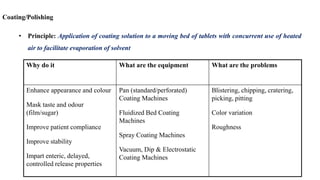
  • 83.
    Film Coating To reducesugar coating process time and to reduce the requirement for operator skill, film coating was developed. Film coating is a technique in which a thin layer/coat of a polymer is deposited over the tablets/particulate. Depending on the coating polymer the types of coating are 1. Normal film coating 2. Enteric film coating 3. Aqueous moisture barrier coating (AMB) On the basis of solvent use the types are 1.Organic Coating 2.Aqueous Coating 83 Materials used in film coating A typical film coating formulation is made up of 1. Polymer (film former) 2. Plasticizer 3. Colouring/opacifying agent 4. Solvent 5. Others (surfactants, flavors, sweetening agent, active ingredients and preservatives.)
  • 84.
    An Ideal CoatingMaterial Should Have The Following Properties;  Solubility in solvent of choice for coating preparation  Solubility required for the intended use  Capacity to produce an elegant looking product  Stability in the presence of heat, light, moisture, air and substrate being coated  Odorless, colorless and tasteless  compatibility with other ingredients  Non toxic or no pharmacologic activity  Ease of application  Resistant to cracking  No bridging or filling formation  Ease of printing on high speed machines 84
  • 85.
    Polymers/Film formers  Thefunction of the polymer is to provide main structure and basic physical and chemical properties to the coating.  Polymer viscosity is very important specially in aqueous coating we need to minimize the water concentration, it is to shorten the process time and to minimize product exposure to the moisture (moisture sensitive product). But the coating composition with viscosity above 500 cps are difficult to atomize and will not produce smooth product. Therefore polymers with low viscosity are preferred. 1. Hydroxypropyl methylcellulose (HPMC) Commercially it is available in different viscosity grades This polymer is widely used in air suspension and pan spray coating. The properties are 1. Soluble in GI fluid, organic and aqueous solvent system 2.Stability in presence of light, heat, air and reasonable amount of moisture 3. Incorporation of colour and other additives with out difficulty. If it is used alone then it may results in bridging and filling, so it may be used in combination or proper plasticizer may be used. 85
  • 86.
    2. Methyl hydroxyethylcellulose Thispolymer has also different viscosity grades, it has similar properties as that of HPMC but it is soluble in few organic solvents, which has restricted its use. 3. Ethylcellulose Depending on the ethoxy substitution different viscosity grades are available commercially. This material is water and GI fluid insoluble, therefore can not be used alone for coating. It is used in combination with water soluble polymer e.g. HPMC. These combination are a used for sustained release coating. The properties include 1. Soluble in wide variety of organic solvents 2. Non toxic 3. Tasteless, odorless and colorless 4. stable at environmental conditions Unplasticized ethyl cellulose coats are brittle. 86
  • 87.
    4. Hydroxypropylcellulose It issoluble in water below 40oC, GI fluid and organic solvents  It is very tacky and yield very flexible film, it can not be used alone  It is good for sub coat but not for color or gloss coat 5. Povidone (PVP)  It is available in four viscosity grades i.e. K-15, K-30, K-60 and K-90, the average molecular weights are 10,000, 40,000, 160,000 and 360,000 respectively.  It is soluble in water, GI fluid and variety of organic solvents.  Povidone films are clear, hard and glossy  Povidone is soluble in both acidic and intestinal media, it can be cross linked with other materials to produce enteric coating material.  Povidone is used in coating composition to increase the dispersion of color. 87
  • 88.
    6. Sodium Carboxymethylcellulose It is available in low, medium ,high and extra high viscosity grades  It can easily be dispersed in water to form colloidal solution, but is insoluble in most organic solvents.  the film formed is brittle but adheres well to tablets. 7. Acrylate polymers Acrylate polymers are marketed under the trademark of Eudragrit. Eudragrit E(dimethylaminoethyl methacrylate and other neutral methacrylic acid esters) is the only polymer of this group which is freely soluble in gastric fluid (acidic media). 88
  • 89.
    Enteric Polymers Enteric coatingpolymers are those substances which resists the gastric pH (acidic) and get dissolves in intestinal fluid (alkaline). The reasons for enteric coating are  To protect acid labile drugs from gastric fluid e.g. enzymes and certain antibiotics  To prevent gastric distress or nausea e.g. sodium salicylate  To deliver drug to intestine for local action  To deliver drugs that are optimally absorbed in the small intestine  To provide a delayed release component for repeat action tablets. 89
  • 90.
    An ideal entericcoating polymer should have the following properties 1. Resistance to gastric fluids (acidic pH) 2. Ready susceptibility to or permeability to intestinal fluid (alkaline pH)  Compatibility with other ingredients  Non toxic or no pharmacologic activity and Ease of application  Formation of continuous film  stability alone and in coating solution. The film should not change with aging  Ease of printing on high speed machines 1. Cellulose Acetate Phthalate (CAP) . CAP is widely used but it has major disadvantage that it dissolves above pH 6, thus delaying the drug release as the ideal material may dissolve around pH 5. It is also hygroscopic and relatively permeable to gastric fluid. The film formed is brittle thus required plasticizer. It is available under the trademark of Aquateric from FMC. 90
  • 91.
    2.Acrylate polymers. Two commerciallyavailable acrylates are Ex. Eudragrit L (soluble at pH 6), Eudragrit S (soluble at pH 7) 3. HPMC Phthalate Three grades are available Ex. HPMCP 55 (HP 50), HPMCP 50 (HP 55) and HPMCP 55S (HP 55S) These polymers dissolves at lower pH (at 5-5.5) than CAP and acrylates. Thus resulting in higher bioavailability of some specific drugs. 4. Polyvinyl Acetate Phthalate (PVAP) It is similar to HP 55 in stability and pH dependant solubility. 91
  • 92.
    Plasticizer The function ofplasticizer is to modify the basic mechanical properties of the polymer. Plasticizers have high affinity for the polymer they are also called nonvolatile solvents. There are two techniques to modify the plasticity of the film former; 1.Internal plasticizing 2.External plasticizing In the former technique chemical modification is brought in the polymer which alters the physical properties of the polymer i.e. elastic modulus. In later technique other substances are used as plasticizer in the formulation. When the plasticizer is used in correct concentration it imparts flexibility by relieving the molecular rigidity. Commonly 10% of polymer concentration is used. Examples include 1.Castor Oil 2.Propylene glycol & Glycerin 3. tween & span 92
  • 93.
    Coloring and opacifyingagent The function of these ingredients is to enhance the product quality. They provide Product identification Protect the core from light and moisture They increase the solid concentration with any impact on viscosity thus reducing the drying time. They are either soluble or form fine suspension in the solvent system. For uniform distribution the particle size must be < 10 microns. The most common colorants used are FD&C or D&C certified, these are either dyes or lakes of dyes. Examples include iron oxide, anthrocyanins, caramel, carotenoids, chlorophyll, indigo, flavones, turmeric acid and carminic acid. Opacifiers are used to give more pastel color and increase film coverage. These can provide white coat or mask the color of the tablet core. These are mostly inorganic material. The substances employed are: Titanium dioxide (Most Common), Talc, Aluminum silicate, Magnesium carbonate, Calcium sulfate, Aluminum hydroxide 93
  • 94.
    Solvents The function ofthe solvent is to dissolve or disperse the polymers and other additives and transfer them to the surface of substrate (core) the ideal characteristics are 1.It should either dissolve or disperse the polymer system and other ingredients. 2.Small concentration of polymer (2-10%) should not high viscous solution 3.It should be colorless, tasteless, odorless, inexpensive, inert and noninflammable. 4.Should have rapid drying rate 5.Should not have environmental impact. The most widely solvents used either alone are in combination are water, ethanol, methanol, isopropyl alcohol, chloroform , acetone , methyl ethyl ketone and methylene chloride. 94
  • 95.
    Coating/Polishing • Principle: Applicationof coating solution to a moving bed of tablets with concurrent use of heated air to facilitate evaporation of solvent What are the problemsWhat are the equipmentWhy do it Blistering, chipping, cratering, picking, pitting Color variation Roughness Pan (standard/perforated) Coating Machines Fluidized Bed Coating Machines Spray Coating Machines Vacuum, Dip & Electrostatic Coating Machines Enhance appearance and colour Mask taste and odour (film/sugar) Improve patient compliance Improve stability Impart enteric, delayed, controlled release properties
  • 96.
    Twinning • Two tabletsstick together. • Most common in capsule shaped tablets . Cause Coating suspension can not be evaporated. Remedy • Reducing spray rate • Increasing pan speed 96
  • 97.
    Cracking • Small, finecracks observed on the upper and lower central surface of tablets, or very rarely on the sidewall are referred to as ‘Cracks’. Cause • Use of higher molecular weight polymers or polymeric blends • Higher internal stresses in the film ( more than tensile strength of the film ) Remedy • Use low molecular weight polymer • Adjust the plasticizer & pigment types and concentration to minimize internal stresses 97
  • 98.
    Sticking & picking •It is defect where isolated areas of film are pulled away from the surface when the tablet sticks together and then part. • Picking does not occur alone it must have another tablet to be stuck with which called sticking . Cause : • Inefficient drying. • Higher rate of application of coating solution • Over wetting • Excessive film thickness Remedy : • Reduce liquid application rate. • Increase in drying air temperature and air volume. Sticking Picking 98
  • 99.
    Blistering • It islocal detachment of film from the substrate forming a blister Cause : • Over heating during spraying coating solution Remedy : use mild drying condition . Chipping It is the defect where film become chipped and dented , usually at the edges of tablet . Cause : • Excessive attrition during coating process Remedy : Increase hardness of the film . 99
  • 100.
    Orange peel effects •It refers to a coating texture that resembles the surface of an orange . Cause : • Rapid Drying • High solution viscosity Remedy : • Use mild drying conditions • Use additional solvents to decrease viscosity of solution. Roughness : • The surface becomes rough and no glossy Remedy: • Reduce the degree of atomization 100
  • 101.
    Bridging • Coating fillsin the letter or logo on the tablet . Cause : • Improper formulation • Poor logo design • Improper application of coating solution • Improper atomization pressure • High percentage of solid in coating solution • High coating viscosity Remedy : • Increase plasticizer contents or change plasticizer concentration • Reduce viscosity of coating solution 101
  • 102.
    Filling • The monogramor bisect is filled and become narrow . Cause : • Applying too much solution • Higher solution applying rate Remedy - Control fluid application rate Blooming (Hazing/dull film) • Coating becomes dull immediately or after a prolonged storage . Normally it occurs together with surface roughness. Cause - using low molecular weight plastisizer . Remedy - increase MW & concentration of plastisizer . 102
  • 103.
    Erosion Cause : • Over-wettedtablet surface • Inadequate drying • Lack of tablet surface strength Remedy – Control drying rate & temparature Pitting It is defect whereby pits occur in the surface of tablet core Cause • Incontinuous spreading of film • temperature of the tablet core is greater than the melting point of the materials used in tablet formulation Remedy - control drying temperature 103
  • 104.
    Color variation Two typesof color variation – • Individual Tablet Color variation, • Whole Batch Color Variation Cause : improper mixing, uneven spray pattern, insufficient coating migration of soluble dyes , plasticizer and other additives during drying. Remedy : • Use of lake dyes eliminates dye migration. • A reformulation with different plasticizer and additives is the best way to solve film instability. 104
  • 105.
    Cratering • It isthe defect of film coating whereby volcanic-like craters appears exposing the tablet surface . Cause • Penetration of the coating solution into the surface of the tablet Remedy • Decrease in spray application rate • Use of optimum and efficient drying Blushing (whitish specks) • The defect best described as whitish specks or haziness of the film . • It is characterized by precipitation of polymer exacerbated by the use of high coating temperature at or above the thermal gelation temperature of the polymers. 105
  • 106.
    Agglomeration • Agglomeration causedby coating suspension cannot be evaporated as soon as it reach the tablet which may be caused from too much inlet coating suspension or too less inlet heat and the unevaporated suspension glue the tablets together. The amount of excess unevaporated suspension is much more than twinning. • Sometimes it can cause by the leaking of coating suspension into the chamber, or too close spraying distance or too low atomizing pressure. 106
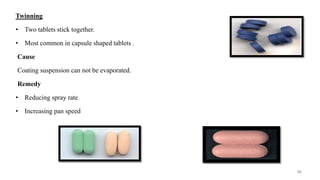
  • 107.
    Capping & Laminating Cappingoccurs when the upper segment of the tablet separates from the main portion of the tablet & comes off as a cap. • Can appear immediately after compression, or hours, even days after preparation. • It is usually due to air entrapped in the granulation which is compressed in the die during the compression & then expands when the pressure is released. Cause: large amount of fines in the granulation &/or the lack of sufficient clearance between the punch and the die wall. And Too dry granules Lamination is due to the same causes as capping except that the tablet splits at the sides into two or more parts. If tablets laminate only at certain stations, the tooling is usually the cause. Solutions for capping & laminating: • Increasing the binder. Adding dry binder such as gum acacia polyvinylpyrrolidone (PVP).. Decreasing the upper punch diameter. Certain degree of moisture in the granules 107
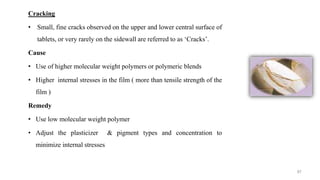
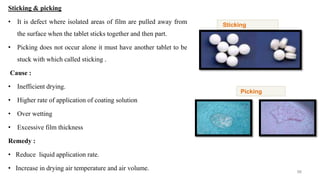
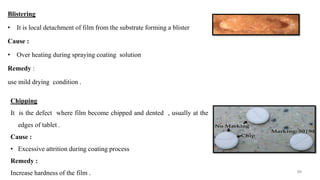
  • 108.
    Mottling It is anunequal distribution of color on the surface of the tablet. Cause : • A drug that differs in color from its excipients or whose degradation products are highly colored. • Migration of a dye during drying of a granulation (change the solvent system, reduce the drying temperature, or grind to a smaller particle size). 108
  • 109.
    Packaging • Pharmaceutical manufacturershave to pack their medicines before they can be sent out for distribution. • 'Blister packs' are a common form of packaging used for a wide variety of products. They are safe and easy to use and they allow the consumer to see the contents without opening the pack. Packaging Types • Primary packaging is the material that first envelops the product and holds it. This usually is the smallest unit of distribution or use and is the package which is in direct contact with the contents. • Secondary packaging is outside the primary packaging – perhaps used to group primary packages together • Tertiary packaging is used for bulk handling, warehouse storage and transport shipping. The most common form is a palletized unit load that packs tightly into containers. 109
  • 110.
    IPQC TESTS FORTABLETS 110
  • 111.
    What Do YouMean By “IPQC”…? IPQC is concerned with providing accurate , specific, & definite descriptions of the procedures to be employed, from, the receipt of raw materials to the release of the finished dosage forms. “INSPECTION ” “TESTING” 111
  • 112.
    In process QualityControl • In process Quality Control, IPQC tests are mostly performed within the production area. • They should not carry any risk for the quality of product. • In process testing enables easier identification of problems. It some time identifies a defective product batch that can be corrected by rework, whereas once that batch has been completed, this may not be possible. • Failure to meet In process control specification indicates either that procedure were not followed or some factor(S) out of control. 112
  • 113.
    Various Instrument UsedIn IPQC Department: • Disintegration apparatus • Dissolution apparatus • Analytical balance Muffle furnace • Friability testing apparatus • Bulk density apparatus • Tablet hardness tester • Infra red moisture content measuring apparatus • U.V Spectroscopy • Abbe Refractometer • T.L.C. kit • Karl fisher Titrimeter 113
  • 114.
    Evaluation of Tablet Officialand unofficial tests for evaluation of tablets  Official Tests: 1. Weight variation 2. Disintegration 3. Dissolution 4. Drug content  Non-Official Tests: 1. Hardness 2. Friability 114
  • 115.
    1. General Appearance: Thegeneral appearance of a tablet, its identity and general elegance is essential for consumer acceptance, for control of lot-to-lot uniformity and tablet-to-tablet uniformity. The control of general appearance involves the measurement of size, shape, color, presence or absence of odor, taste etc. 2. Size & Shape: It can be dimensionally described & controlled. The thickness of a tablet is only variables. Tablet thickness can be measured by micrometer or by other device. Tablet thickness should be controlled within a ± 5 % variation of standard value. 3. Unique identification marking: These marking utilize some form of embossing, engraving or printing. These markings include company name or symbol, product code, product name etc. 4. Organoleptic properties: Color distribution must be uniform with no mottling. For visual color comparison compare the color of sample against standard color. 115
  • 116.
    5. Hardness (crushingstrength): Tablet requires a certain amount of strength or hardness and resistance to friability to withstand mechanical shocks of handling in manufacture, packaging and shipping. Hardness generally measures the tablet crushing strength. Why do we measure hardness?  To determine the need for pressure adjustments on the tableting machine.  Hardness can affect the disintegration.  So if the tablet is too hard, it may not disintegrate in the required period of time. And if the tablet is too soft, it will not withstand the handling during subsequent processing such as coating or packaging.  In general, if the tablet hardness is too high, we first check its disintegration before rejecting the batch.  If the disintegration is within limit, we accept the batch.  If Hardness is high + disintegration is within a time accept the batch. 116
  • 117.
    Different Hardness Tester Erweka Pfizer Schleuniger Monsanto Strong-cobb 117 FactorsAffecting the Hardness:  Compression of the tablet and compressive force.  Amount of binder. (More binder à more hardness)  Method of granulation in preparing the tablet (wet method gives more hardness than direct method, Slugging method gives the best hardness). Limits: 5 kilograms minimum and 8 kilograms maximum.  Make hardness test on 5 tablets and then take the average hardness.
  • 118.
    6.Friability:  Friability ofa tablet can determine in laboratory by Roche friabilator.  Friability is a property that is related to the hardness of the tablet.  It is used to evaluate the ability of the tablet to withstand abrasion in packaging, handling, and shipping. Procedure:  Weigh 20 tablets together = W1  Put these tablets in the friabilator and adjust the instrument at 100 rpm (i.e. = 25 rpm for 4 min)  Weigh the 20 tablets (only the intact ones) = W2  Friability (% loss) = W1 - W2/100  The tablets are reweighed. It must be less than or equal to1 % but if more we do not reject the tablets as this test is non-official.. 118
  • 119.
    7. Thickness test •Thickness is an unofficial test . • Thickness of the tablet is inversely proportional to hardness i.e. increase in hardness decrease the thickness & vice versa. • Thickness of tablet is measured by Vernier caliper/screw gauge. • It is determined for 10tablets. Vernier caliper 119
  • 120.
    8.Weight variation test(uniformity of weight) Weigh 20 tablet selected at random, • Determine the average weight. X= (X1+X2 +X3+…+ Xz)/20 Limit: • Upper limit = average weight + (average weight * % error) • Lower limit = average weight - (average weight * % error) • The individual weights are compared with the upper and lower limits. • Not more than two of the tablets differ from the average weight by more than the % error listed, and no tablet differs by more than double that percentage. 120 No Average wt. of tablet(mg) Max. % difference allowed 1 130 or Less 10% 2 130-324 7.5% 3 More than 324 5% USP XX-NF STANDARDS IP STANDARDS No Average wt. of tablet(mg) Max. % difference allowed 1 84 or Less 10% 2 84- 250 7.5% 3 More than 250 5%
  • 121.
    9. Content UniformityTest: It is an official test. Randomly select 30 tablets. 10 of these assayed individually. The Tablet pass the test if 9 of the 10 tablets must contain not less than 85% and not more than 115% of the labeled drug content and the 10th tablet may not contain less than 75% and more than125 % of the labeled content. If these conditions are not met, remaining 20 tablet assayed individually and none may fall out side of the 85 to 115 % range. 10. Disintegration test (U.S.P.) : Disintegration test is an official test. It is the time required for the tablet to break into particles, the disintegration test is a measure only of the time required under a given set of conditions for a group of tablets to disintegrate into particles It is performed to identify the disintegration of tablet in particular time period. Disintegration test is not performed for controlled & sustained release tablets. 121
  • 122.
    The U.S.P. deviceto test disintegration uses 6 glass tubes that are 3” long; open at the top and 10 mesh screen at the bottom end. To test for disintegration time, one tablet is placed in each tube and the basket rack is positioned in a 1-L beaker of water, simulated gastric fluid or simulated intestinal fluid at 37 ± 20 C such that the tablet remain 2.5 cm below the surface of liquid on their upward movement and not closer than 2.5 cm from the bottom of the beaker in their downward movement. Move the basket containing the tablets up and down through a distance of 5-6 cm at a frequency of 28 to 32 cycles per minute. Floating of the tablets can be prevented by placing perforated plastic discs on each tablet. According to the test the tablet must disintegrate and all particles must pass through the 10 mesh screen in the time specified. If any residue remains, it must have a soft mass. Liquids used in disintegration Water, Simulated gastric fluid (pH = 1.2 HCl), or Simulated intestinal fluid (pH = 7.5, KH2PO4 (phosphate buffer) + pancreatic enzyme + NaOH) 122
  • 123.
    Sr no. Typeof tablets Medium Temperature limit 1 Compressed uncoated 37 ± 2 0C 15 minutes or as per individual monograph 2 Sugar coated If 1 or 2 tablets fail Water 0.1 N HCL 37 ± 2 0C 60 minutes or as per individual monograph 3 Film coated water 37 ± 2 0C 30 minutes or as per individual monograph 4 Enteric coated 0.1 N HCL & Phosphate buffer pH 6.8 37 ± 2 0C 1 hr or as per individual monograph 5 Dispersible/ Effervescent water 37 ± 2 0C LST < 3 minutes or as per individual monograph 6 Buccal 37 ± 2 0C 4 hr or as per individual monograph Disintegration Testing Conditions And Interpretation 123 Disintegration test apparatus
  • 124.
    U.S.P. method foruncoated tablets: Start the disintegration test on 6 tablets. If one or two tablets from the 6 tablets fail disintegrate completely within 30min repeat the same test on another 12 tablet. (i.e. the whole test will consume 18 tablets). Not less then 16 tablets disintegrate completely within the time. If more then two tablets (from the 18) fail to disintegrate, the batch must be rejected. For Coated tablets: To remove or dissolve the coat, immerse the tablet in distilled water for 5min. Put the tablet in the apparatus in water or HCL for 30 min at 37oC (according to the U.S.P). If not disintegrated, put in intestinal fluid. If one or two tablets fail to disintegrate, repeat on 12 tablets. So 16 tablets from the 18 must completely disintegrate within the time, if two or more not disintegrated the batch is rejected. 124
  • 125.
    U.S.P. and B.PMethod for Enteric coated tablets: Put in distilled water for five minutes to dissolve the coat. Then put in simulated gastric fluid (0.1M HCL) for one hour. Then put in simulated intestinal fluid for two hours. If one or two tablets fail to disintegrate, repeat this test on another 12 tablets. So 16 tablets from 18 should completely disintegrate. If more than two fail to disintegrate the Batch must be rejected. 11. Dissolution Test Dissolution is an official test. Dissolution is performed to check the percentage release from the dosage forms.i.e.tablet. Tablet breaks down into small particles which offers a greater surface area to the dissolving media. Disintegration test does not give assurance that particles will release drug in solution at an appropriate rate, that’s why dissolution tests & it’s specifications developed for all tablet products. 125
  • 126.
    1. USP Dissolutionapparatus I ( Basket method) A single tablet is placed in a small wire mesh basket attached to the bottom of the shaft connected to a variable speed motor. The basket is immersed in a dissolution medium (as specified in monograph) contained in a 1000 ml flask. The flask is cylindrical with a hemispherical bottom. The flask is maintained at 37 ± 0.50C by a constant temperature bath. The motor is adjusted to turn at the specified speed and sample of the fluid are withdrawn at intervals to determine the amount of drug in solutions. 2. USP Dissolution apparatus II ( Paddle method) It is same as apparatus-1, except the basket is replaced by a paddle. The dosage form is allowed to sink to the bottom of the flask before stirring. For dissolution test U.S.P. specifies the dissolution test medium and volume, type of apparatus to be used, rpm of the shaft, time limit of the test and assay procedure for. The test tolerance is expressed as a % of the labeled amount of drug dissolved in the time limit. 126
  • 127.
    Sr.no. Quantity Stage/level Number oftablets tested Acceptance criteria 1 S1 6 Each unit is < D* + 5 percent** 2 S2 6 Average of 12 units (S1 +S2) is equal to or greater than (> )D, and no unit is less than D - 15 percent** 3 S3 12 Average of 24 units (S1+S2+S3) is equal to or greater than (> )D, not more than 2 units are less than d-15 percent** and no unit is less than d-25 percent** Dissolution Testing And Interpretation IP Standards *D is the amount of dissolved active ingredient specified in the individual monograph, expressed as a percentage of the labelled content. ** Percentages of the labelled content. 127
  • 128.
    Evaluation Of PrecompressionalCharacteristics Of Tablets Or Rheological Characteristics Of Granules 1. Particle Size & Shape Determination. 2. Surface area. 3. Density i. Bulk density ii. True density iii. Granular density 4. Granule strength & friability. 5. Flow properties. i. Angle of repose ii. Percentage Compressibility Index iii. Hausner’s ratio 6. Moisture content. 7. Percentage fines(% fines). 128
  • 129.
    Evaluation Of CompressionCharacteristics Of Tablets Characterization Of Granules 1) Particle Size & Shape Determination  Size affects the average weight of tablet, Disintegration Time, weight variation, friability, flowability & drying rate.  The size & shape depends upon processing requirements & during granulation.  The methods for determining size & shape are 1. Sieving 2. Sedimentation rate. 3. Microscopy (SEM) 4. By Light Scattering 129
  • 130.
    2. Surface Area If required particle size is measured & from this surface area is measured.  Most method used is gas absorption & air permeability.  In gas absorption, gas is absorbed as monolayer on particles this is in term of calculated & converted to surface area.  In air permeability method the rate of air permeates a bed of powder ,is used to calculate surface area of powder sample. 3. Density  Density may influence compressibility, tablet porosity & dissolution.  Dense hard granules may require higher load to produce cohesive compact to reduce free granules seen on the surface of tablets.  ↑ compressibility ↑ DT, Dissolution, if DT is slower dissolution is indirectly hampered.  Dense granules have less friability but cause a problem in releasing the drug. 130
  • 131.
    Three Methods todetermine density i. Bulk Density – Bulk density is given by equation, ρb = M / Vb Where, ρb- bulk density of granules, M is mass of granules in gm, Vb – volume of granules in measuring cylinder in ml. More compressible bed of particulate - less flowable powder or granules. If less dense/compressible - more flowable powder or granules. 131
  • 132.
    ii. True/tapped density– Tapped/true density is given by equation, ρt = M / Vb Where, ρt- bulk density of granules, M is mass of granules in gm, Vt – volume of granules in measuring cylinder after tapping in ml. iii. Granular density It is determined by Pycnometer method.  Two methods are used to determined granular density.  In one intrusion fluid used-Mercury, and other Any solvent of low surface tension e.g. Benzene  The accuracy of these method depends upon ability of intrusion fluid to penetrate the pores of granules.  Liquids should not masks granules solubilies in it, & having property to penetrate the pores. 132
  • 133.
    Density is thendetermine from volume of intrusion fluid displaced in pycnometer by giving mass of granulation. It is calculated by using equation, Granular Density (D) = M / Vp -Vi Where, Vp-Total volume of Pycnometer, Vi- Volume of intrusion fluid (ml) containing Mass (gm) (M) of granules required to fill pycnometer. 4. Granule Strength & Friability They are important because they affect:- 1.changes in particle size distributions of granulations. 2.compressibility into cohesive tablets. Granule strength & friability are measured by:- 1.Compressive Strength/hardness. 2.Using Friability measurements/apparatus. 133
  • 134.
    5. Flow properties. Itis an ability of the granule to flow from hopper to die cavity for tablet uniformity. Flow property of granule are not uniform we are not getting tablet of uniform size. Flow property of material results from many forces 1. Frictional force 2. Surface tension force 3. Mechanical force caused by interlocking of irregular shape particles 4. Electrostatic forces 5. Cohesive/ vander Waals forces Forces also affect granule property such as particle size, particle size distribution, particle shape, surface texture, roughness & surface area. 134
  • 135.
    Fig(1) Fixed height Fig(2) fixed basecone Fig (3) Tilting angle Fig (4) Rotating cylinder Methods of determination of angle of repose 135  If particle size of powder is ≤ 150 µm the magnitude of frictional & vander waals force predominate.  When particle size↑ mechanical & physical properties become more important with packing properties. Flow properties of granules are determined by measuring three parameters- i. Angle of repose – It is measured by two methods a. Static angle of repose b. Dynamic angle of repose. Equation is , tan θ = h/r. Where, θ - angle of repose, h – height of pile, r – radius of pile.
  • 136.
     In fig.(1)height is constant & powder is added through the hopper until powder reaches tip of funnel.  In fig.(2) height is varied & base cone is fixed, powder is added until height reaches at max.  In fig.(3) rectangle box is filled with powder & tipped until content begins to slide.  In fig.(4) revolving cylinder with transparent end is made to revolve horizontally when half filled with powder.  The max. angle that the plane of powder makes with horizontal surface on rotation is taken as the angle of repose..  (1),(2) & (3) gives static angle of repose. While (4) gives kinetic or dynamic angle of repose. Sr no. Angle of repose (o) Type of flow 1 < 25 Excellent 2 25-30 Good 3 30-40 passable 4 > 40 Poor 136
  • 137.
    ii. Percentage compressibilityIndex • It is directly related to the relative flow rate cohesiveness & particle size. • It is simple fast & popular method of presiding powder flow characters. • It can be obtained from bulk density measurements is the % Compressibility index (C). • % Compressibility index = Tapped density - Bulk density / Tapped density X 100. • I = (1 – V/ Vo ) x 100 Where, I – % Compressibility index, V – volume occupied by powder/ granules after tapping, Vo - volume of powder/granules before tapping. SR.NO. % Compressibility index Type of flow 1 5-15 Excellent 2 12-16 Very good 3 18-21 Good 4 23-25 Passable 5 33-38 Poor 6 > 40 Very poor 137
  • 138.
    iii. Hausner's Ratio •Hausner’s ratio was related to interparticulate friction and as such could be used to predict powder flow characteristics. • It showed that powder with low particular friction such as coarse sphere had ratio of approximately 1.2, where as more as cohesiveness- less free flowing powders such as flaks have Hausner’s ratio greater than 1.6. Hausner’s ratio = Tapped density / Bulk density 6. Moisture content  The amount of moisture present in the granule is called moisture content.  Generally the granules contain 2% moisture. It is required for the binding of the powder or granules during compression in die cavity.  Percentage of moisture is calculated by using “moisture Balance” or “IR Balance”.  IR Balance consist of simple balance which is placed I to the casing in which the IR bulb is attached which produce heat inside the chamber. 138
  • 139.
     Initial readingshould be note down after that we are initiated the IR Bulb as IR bulb is initiated the moisture is removed from the granules via heating after that note down the reading. % moisture content = Initial wt.- Final wt./ initial weight X 100 Moisture analyzer IR moisture balanceSarotorious MA-100 139
  • 140.
    7. Percentage Fines(% Fines)  % fines means the amount of powder remain in the granule.  Generally the amount is 15% of fines.  It is necessary for the tablet compression because if we are using 100% granules then it is difficult to maintain hardness of tablet because they having free space in the die cavity after compression the tablet is crack due to air.  % fine can be calculated by using Sieve method.  % fine should not be more than 15%. 140
  • 141.
    IPQC/Official Standards asper B.P. /I.P./ U.S.P. for tablets British Pharmacopoeia • Uncoated tablet: -Disintegration test -Uniformity of weight • Effervescent tablet: -Disintegration test -Uniformity of weight • Coated tablet: -Disintegration test -Uniformity of weight • Gastro resistant tablet: -Disintegration test 141 • Modified release tablet: -Uniformity of weight. • Dispersible tablet: -Disintegration test -Uniformity of dispersion -Uniformity of weight
  • 142.
    INDIAN PHARMACOPOEIA Uncoated tablet: -Uniformityof container content -Content of active ingredient -Uniformity of weight -Uniformity of content -Disintegration test Enteric coated tablet: -Disintegration test Dispersible tablet: -Uniformity of dispersion -Disintegration Soluble tablet: -Disintegration test Effervescent tablet: -Disintegration/ Dissolution / Dispersion test. 142
  • 143.
    UNITED STATES PHARMACOPOEIA Physicaltests applicable to tablet formulation: -Bulk density / Tapped density of powder -Powder fineness -Loss on drying -Disintegration test -Tablet friability -Dissolution test -Drug release testing -Uniformity of dosage form -Container permeation test -Labeling of inactive ingredients 143
  • 144.
    Process Control ByMeans Of In-process Controls 144
  • 145.
    Example of anIPQC structure 145
  • 146.
  • 147.
    Example Of ApprovalFor Tablet Production 147
  • 148.
    CONTENTS OF ASAMPLING PROCEDURE 148
  • 149.
    The tablet pressis a high-speed mechanical device. It compresses the ingredients into the required tablet shape with extreme precision. It can make the tablet in many shapes, although they are usually round or oval. Also, it can press the name of the manufacturer or the product into the top of the tablet. Tablet punching machines work on the principle of compression. A tablet is formed by the combined pressing action of two punches and a die. Punches & Dies Tooling Station: - The upper punch, the lower punch and the die which accommodate one station in a tablet press. Tooling Set: A complete set of punches and dies to accommodate all stations in a tablet press. Instrumented tablet machines and tooling 149
  • 150.
    Properties of ToolSteels Properties of Tool steel Toughness / Ductility Wear Resistance Compressive Strength Hardness 150
  • 151.
    Tool Steels Steels usedto manufacture tablet press tooling have been grouped into three categories: General purpose steels • AISI-O1 • AISI -S1, S5, S7 • AISI -408 Wear resistant steels • AISI-A2 • AISI-D2 • AISI-D3 Corrosion resistant steels • AISI-S1, S7 • AISI-408 • AISI-440 C 151
  • 152.
    Selection of toolsteel While procuring new punch set Collect the information about the nature of product like abrasive, corrosive etc. Collect the information on tooling related problems if the particular product is manufactured at other locations within the company. Discuss product properties & tooling related issues with Tooling manufacturer. Select the correct tool steel. 152
  • 153.
    Selection of correctquality of steel Selection of correct steel quality results in good tablet quality and increased productivity. Life of punches & dies will be increased. Tablet defects will be minimized. Also problems like damage to the tablet compression machine and punch sets will be eliminated. So it is important to select correct quality of steel for punches & dies 153
  • 154.
    Cost factor forTool steel • It is pointless to use more expensive high grade steel when a less expensive grade steel can be used. • On the other hand, inadequate grade of steel will not perform to end users expectations. • Finally, the quality of steel must not be compromised for the sake of price. 154
  • 155.
    Tool Steels Tool steelis the product of a highly specialized branch of the steel industry. To be acceptable to the pharmaceutical industry the steel should be free from impurities and undesirable elements. Selection of right steel is the key to the successful performance of Tablet compression tooling. 155
  • 156.
    Tooling Tablet compression machinesare made in keeping in view the type of dies and punches will be used on them , The dies and punches and their setup on compression machine is called tooling , it is classified as B and D mainly .The B tooling dies and punch can be further have specifications as BB and D tooling can also be dies and punches can be utilized on B tooling machine which is called as DB Mainly there are two standards, a D and B Difference between B and D tooling 156
  • 157.
    Tooling Station :-The upper punch ,the lower punch and the die which accommodate one station in a tablet press. Tooling Set :- A complete set of punches and dies to accommodate all stations in a tablet press. Punches & Dies 157
  • 158.
  • 159.
    Standards • Internationally thereare two recognized standards for tablet compression tooling the TSM standard and the EU standard. • TSM is acronym for the ‘TABLET SPECIFICATION MANUAL’ and is recognized in the America and is considered exclusive in the United States. • The EU tooling standard is internationally recognized and is more widely used than TSM standard.EU which is the acronym for ‘EUROSTNADARD’ is considered the European standard for interchangeable B and D type compression tools 159
  • 160.
  • 161.
    B and Dtooling • Tablet compression machines are made in keeping in view the type of dies and punches will be used on them , The dies and punches and their setup on compression machine is called tooling , it is classified as B and D mainly . The B tooling dies and punch can be further have specifications as BB and D tooling can also be dies and punches can be utilsed on B tooling machine which is called as DB. Mainly there are two standards, a D and B . 161
  • 162.
    Different Shapes ofDies and Punches • Round shape punch die set • Oval shape punch die set • Capsule shape punch die set • Geometric shape punch die set • Irregular shape punch die set • Core rod tooling punch die set 162
  • 163.
    Used by pharmaceuticaland veterinary industry. Can manufacture following type of tablets: Shallow Concave Ball Shape  Deep Concave Flat Faced Concave with Edges Flat with Bevel Edges Normal Concave Round shape Punch Die Set 163
  • 164.
    Applicable to pharmaceuticaland ayurvedic industries. Can manufacture following types of tablets: Flat Faced Flat with bevel edges Concave/Deep/Deep Concave with bevel edges. Oval Shape Punch Die Set 164
  • 165.
    Applicable to pharmaceuticaland ayurvedic industries. Can manufacture following types of tablets: Concave with Edges Deep Concave Flat Faced Normal concave Flat with Bevel Edges. Capsule shape punch die set 165
  • 166.
    Applicable to pharmaceutical, confectionery,chemical, industrial powder metallurgy industries.Can manufacture following types of tablet: Triangular  Benzene  Rhombus  Rectangular Square Geometric Shape Punch Die Set 166
  • 167.
    Are applicable toconfectionery industries. Available with different size, concavity, and flat in plain or engraved break line. Irregular Shape Punch Die Set 167
  • 168.
    Fig. Standard sizesof B- and D-tooling 168
  • 169.
    Comparison between B-toolingand D-tooling 1) B-tools subcategories with EU19, TSM 19 And D-tools subcategories with EU1, TSM 1 2) D-tooling is thicker than B-tooling 3) European toolings (both B- and D-types) are longer compared to TSM (USA/Japan) types. 169

Editor's Notes

  • #9 This is the question that your experiment answers
  • #10 This is the question that your experiment answers
  • #20 This is the question that your experiment answers
  • #55 This is the question that your experiment answers
  • #110 This is the question that your experiment answers