Presented By
Arantha.J.Joseph
1st Year Mpharm
Dept.Of Pharmaceutics 1
COMPARISON OF BIOAVAILABILITY OF
SINGLE DOSE VS MULTIPLE DOSE
FORMULATIONS
2
3
FACTORS
Pharmaceutical
factors.
Patient related
factors.
Route of administration.
4
COMPARATIVE BIOAVAILABILITY:
When the systemic availability of a drug after oral
administration is compared with that of an oral standard of
the same drug
 Fr
5
WHY ARE WE
CONDUCTING SUCH
STUDIES ???
6
7
 Determination of influence of excipients, patient related
factors and possible interactions.
 Development of new formulation of existing drug.
 Control of quality of drug product during early stages of
marketing .
Comparison of availability of a drug substance from
different dosage forms or from the same dosage form
produced by different manufacturers.
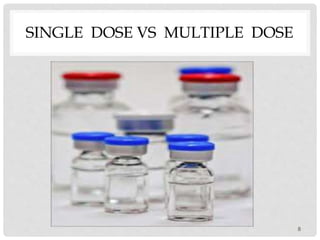
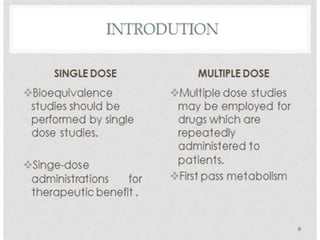
SINGLE DOSE VS MULTIPLE DOSE
8
9
10
11
STUDY DESIGNS
Selection of study design is based upon .
 Number of formulations to be compared.
 Characteristics of the drug and disposition.
 Study objective.
 Availability of the subject.
 Inter and intra subject variability.
 Duration of study or the number of periods allowed.
 Cost of adding a subject relative to that of
adding one period.
12
BIOAVAILABILITY STUDIES
1. Parallel design
2. Cross over design
i. Latin square cross over design
ii. Balanced incomplete block
design
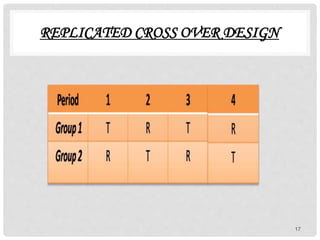
iii .Replicated cross over design
13
PARALLEL DESIGN
14
CROSS OVER DESIGN
LATIN SQUARE CROSS OVER DESIGN
15
BALANCED INCOMPLETE CROSS OVER DESIGN
16
REPLICATED CROSS OVER DESIGN
17
GENERAL APPROACHES FOR SINGLE
DOSE STUDY
Generally the highest marketed strength should
be administered as a single unit.
If necessary for analytical reasons multiple units
of highest strength can be administered.
 Providing the total single dose remains within
the labelled range.
18
The lot numbers of both test and reference listed.
Expiration date for the reference product should be
stated.
 The drug content of the test product shouldn’t
differ from reference product by more than 5%.
An adequate washout period should (more than
5half life) separate each treatment.
19
Prior and during each study phase
Subjects should be allowed water as desired
except for 1hr before .
After drug admn; be provided standard meals
not less than 4hrs.
 Abstain from alcohol for 24hrs prior to each
study period and until after the last sample from
each period is collected.
20
MULTIPLE DOSE
Very potent or toxic drugs
Single dose study cannot be conducted in healthy
volunteers – tolerability reasons
Multiple dose study can be used
21
In rare situations problems of sensitivity of the analytical
method sufficiently precise plasma concentration
measurements after single dose administration.
Where the con at steady state is sufficiently high to
measure.
Multiple dose study - alternative
22
23
Problems in plasma concentration measurement after
single dose .
Intra individual variability in the plasma
concentration or disposition rate is inherently large.
In the case of extended release formulations (in
addition to single dose studies).
24
If special dosage regimens such as
loading dose or twice a day dosing
are to be used.
Differences in rate of absorption but
not in the extent of absorption
Eg : Rivastigmine tartarate(oral
cap), Quatiapine fumerate(oral tab)
25
26
conclusion
ADVANTAGES
SINGLE DOSE
Very common.
Easy.
Less exposure to lugs.
Less tedious.
MULTI DOSE
More accurate clinical
description.
Fewer blood samples are
required .
Drug levels are high
27
DISADVANTAGES
SINGLE DOSE
Cannot predict steady
state predictions.
Inter subject variability
cannot be predicted.
Long sampling periods.
MULTIDOSE
Tedious
Costly and difficult to
conduct.
Poor compliance by
subjects .
More exposure to test
drugs hence potential for
ADR.
28
REFERENCE
D.M .Brahmankar,Sunil B Jaiswal,Biopharmaceutics and
Pharmacokinetics 2nd edition ,pg no 315-363.
Attachment 1 of Division-Notification 0229 No. 10 of the
Pharmaceutical and Food Safety Bureau, dated February
29, 2012
Xue-Jia Zhai, MD, Ye Yu, MD, Fen Chen, MS, Yong-Ning
Lu, MD, ; Comparative Bioavailability and Tolerability of
Single and Multiple Doses of 2 Diclofenac Sodium
Sustained-Release Tablet Formulations in Fasting, Healthy
Chinese Male Volunteers ,Sciecedirect ;1-09-2013
29
Henry.J.Malinowski;Bioavailability and Bioequivalence
testing; Remington’s textbook of pharmaceutics ;
volume 1; chapter 53 ; pg no 995 -1004
Applied Biopharmaceutics and Pharmacokinetics-5th
edition by Leon Shargel, Susanna Wu-PONG, Andrew
B.C.YU. Page no; 453-498
Alfredo García ; Design of Bioequivalence Studies
WHO Workshop on Assessment of Bioequivalence
Data, 31 August – 3 September, 2010, Addis Ababa
30
THANKUUUUUU…….
31

Bioavailability

  • 1.
    Presented By Arantha.J.Joseph 1st YearMpharm Dept.Of Pharmaceutics 1
  • 2.
    COMPARISON OF BIOAVAILABILITYOF SINGLE DOSE VS MULTIPLE DOSE FORMULATIONS 2
  • 3.
  • 4.
  • 5.
    COMPARATIVE BIOAVAILABILITY: When thesystemic availability of a drug after oral administration is compared with that of an oral standard of the same drug  Fr 5
  • 6.
    WHY ARE WE CONDUCTINGSUCH STUDIES ??? 6
  • 7.
    7  Determination ofinfluence of excipients, patient related factors and possible interactions.  Development of new formulation of existing drug.  Control of quality of drug product during early stages of marketing . Comparison of availability of a drug substance from different dosage forms or from the same dosage form produced by different manufacturers.
  • 8.
    SINGLE DOSE VSMULTIPLE DOSE 8
  • 9.
  • 10.
  • 11.
  • 12.
    STUDY DESIGNS Selection ofstudy design is based upon .  Number of formulations to be compared.  Characteristics of the drug and disposition.  Study objective.  Availability of the subject.  Inter and intra subject variability.  Duration of study or the number of periods allowed.  Cost of adding a subject relative to that of adding one period. 12
  • 13.
    BIOAVAILABILITY STUDIES 1. Paralleldesign 2. Cross over design i. Latin square cross over design ii. Balanced incomplete block design iii .Replicated cross over design 13
  • 14.
  • 15.
    CROSS OVER DESIGN LATINSQUARE CROSS OVER DESIGN 15
  • 16.
  • 17.
  • 18.
    GENERAL APPROACHES FORSINGLE DOSE STUDY Generally the highest marketed strength should be administered as a single unit. If necessary for analytical reasons multiple units of highest strength can be administered.  Providing the total single dose remains within the labelled range. 18
  • 19.
    The lot numbersof both test and reference listed. Expiration date for the reference product should be stated.  The drug content of the test product shouldn’t differ from reference product by more than 5%. An adequate washout period should (more than 5half life) separate each treatment. 19
  • 20.
    Prior and duringeach study phase Subjects should be allowed water as desired except for 1hr before . After drug admn; be provided standard meals not less than 4hrs.  Abstain from alcohol for 24hrs prior to each study period and until after the last sample from each period is collected. 20
  • 21.
    MULTIPLE DOSE Very potentor toxic drugs Single dose study cannot be conducted in healthy volunteers – tolerability reasons Multiple dose study can be used 21
  • 22.
    In rare situationsproblems of sensitivity of the analytical method sufficiently precise plasma concentration measurements after single dose administration. Where the con at steady state is sufficiently high to measure. Multiple dose study - alternative 22
  • 23.
  • 24.
    Problems in plasmaconcentration measurement after single dose . Intra individual variability in the plasma concentration or disposition rate is inherently large. In the case of extended release formulations (in addition to single dose studies). 24
  • 25.
    If special dosageregimens such as loading dose or twice a day dosing are to be used. Differences in rate of absorption but not in the extent of absorption Eg : Rivastigmine tartarate(oral cap), Quatiapine fumerate(oral tab) 25
  • 26.
  • 27.
    ADVANTAGES SINGLE DOSE Very common. Easy. Lessexposure to lugs. Less tedious. MULTI DOSE More accurate clinical description. Fewer blood samples are required . Drug levels are high 27
  • 28.
    DISADVANTAGES SINGLE DOSE Cannot predictsteady state predictions. Inter subject variability cannot be predicted. Long sampling periods. MULTIDOSE Tedious Costly and difficult to conduct. Poor compliance by subjects . More exposure to test drugs hence potential for ADR. 28
  • 29.
    REFERENCE D.M .Brahmankar,Sunil BJaiswal,Biopharmaceutics and Pharmacokinetics 2nd edition ,pg no 315-363. Attachment 1 of Division-Notification 0229 No. 10 of the Pharmaceutical and Food Safety Bureau, dated February 29, 2012 Xue-Jia Zhai, MD, Ye Yu, MD, Fen Chen, MS, Yong-Ning Lu, MD, ; Comparative Bioavailability and Tolerability of Single and Multiple Doses of 2 Diclofenac Sodium Sustained-Release Tablet Formulations in Fasting, Healthy Chinese Male Volunteers ,Sciecedirect ;1-09-2013 29
  • 30.
    Henry.J.Malinowski;Bioavailability and Bioequivalence testing;Remington’s textbook of pharmaceutics ; volume 1; chapter 53 ; pg no 995 -1004 Applied Biopharmaceutics and Pharmacokinetics-5th edition by Leon Shargel, Susanna Wu-PONG, Andrew B.C.YU. Page no; 453-498 Alfredo García ; Design of Bioequivalence Studies WHO Workshop on Assessment of Bioequivalence Data, 31 August – 3 September, 2010, Addis Ababa 30
  • 31.