Internet of Things (IOT) 

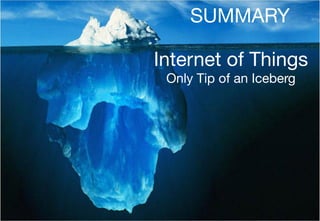
- We Are At The Tip of An Iceberg -

“How much more IOT can do is only left to your imagination and to your budget. You can do as little or as much with IoT as
you want.”
Dr. Mazlan Abbas
MIMOS Berhad

August 26, 2014
Wisma IEM, Petaling Jaya
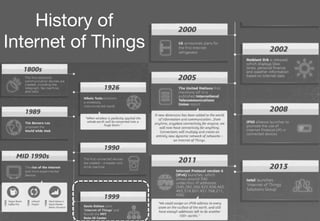
History of
Internet of Things
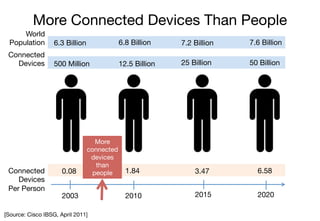
6.3 Billion
 6.8 Billion
 7.2 Billion
 7.6 Billion
500 Million
 12.5 Billion
 25 Billion
 50 Billion
World
Population
Connected
Devices
Connected
Devices
Per Person
0.08
 1.84
 3.47
 6.58
2003
 2010
 2015
 2020
More
connected
devices
than
people
[Source: Cisco IBSG, April 2011]
More Connected Devices Than People
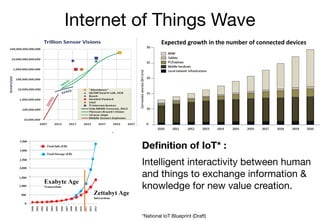
Internet of Things Wave
©	
  2013	
  MIMOS	
  Berhad.	
  All	
  Rights	
  Reserved.	
  
Definition of IoT* : 
Intelligent interactivity between human
and things to exchange information &
knowledge for new value creation.

*National IoT Blueprint (Draft)
Expected	
  growth	
  in	
  the	
  number	
  of	
  connected	
  devices	
  	
  rvice and Big Data
erera#*2
, Dimitrios Georgakopoulos#3
anberra, ACT, 2601, Australia
slavsky@csiro.au
perera@csiro.au
gakopoulos@csiro.au
ence, The Australian National University,
CT 0200, Australia
of
ly
ge
to
es
ale
or
in
of
es
ch
g,
can be collected, analysed and interpreted. Further, European
Commission [7] predicts that the present 'Internet of PCs' will
move towards an 'Internet of Things' in which 50 to 100
billion devices will be connected to the Internet by 2020.
Figure 1: The total amount of data generated on earth exceeded one zettabyte
[Source: Postscape - http://postscapes.com/what-exactly-is-the-internet-of-things-infographic ]
[Source: Postscape - http://postscapes.com/what-exactly-is-the-internet-of-things-infographic ]
[Source: Postscape - http://postscapes.com/what-exactly-is-the-internet-of-things-infographic ]
[Source: Postscape - http://postscapes.com/what-exactly-is-the-internet-of-things-infographic ]
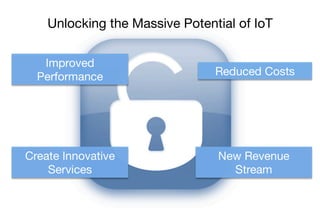
Unlocking the Massive Potential of IoT
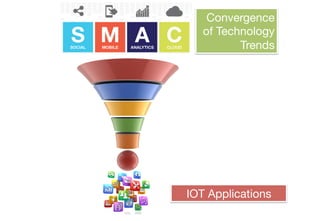
IOT Applications
Convergence
of Technology
Trends
[Source: Postscape - http://postscapes.com/what-exactly-is-the-internet-of-things-infographic ]
[Source: Postscape - http://postscapes.com/what-exactly-is-the-internet-of-things-infographic ]
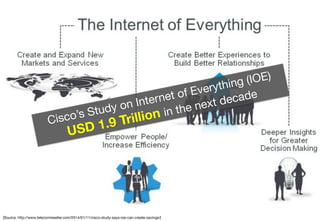
Cisco’s Study on Internet of Everything (IOE)
USD 1.9 Trillion in the next decade
[Source: http://www.telecomreseller.com/2014/01/11/cisco-study-says-ioe-can-create-savings/]
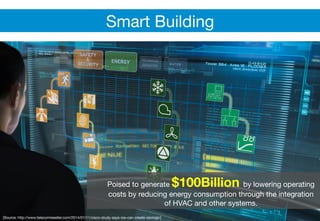
Smart Building
Poised to generate $100Billion by lowering operating
costs by reducing energy consumption through the integration
of HVAC and other systems.
[Source: http://www.telecomreseller.com/2014/01/11/cisco-study-says-ioe-can-create-savings/]
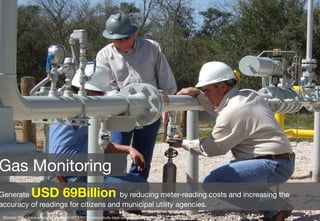
Gas Monitoring
Generate USD 69Billion by reducing meter-reading costs and increasing the
accuracy of readings for citizens and municipal utility agencies.
[Source: http://www.telecomreseller.com/2014/01/11/cisco-study-says-ioe-can-create-savings/]
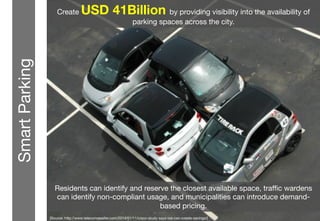
SmartParking
Residents can identify and reserve the closest available space, traffic wardens
can identify non-compliant usage, and municipalities can introduce demand-
based pricing.
Create USD 41Billion by providing visibility into the availability of
parking spaces across the city.
[Source: http://www.telecomreseller.com/2014/01/11/cisco-study-says-ioe-can-create-savings/]
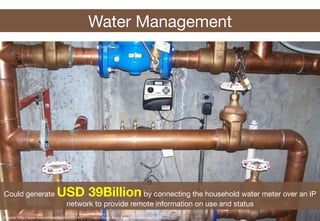
Water Management
Could generate USD 39Billion by connecting the household water meter over an IP
network to provide remote information on use and status 
[Source: http://www.telecomreseller.com/2014/01/11/cisco-study-says-ioe-can-create-savings/]
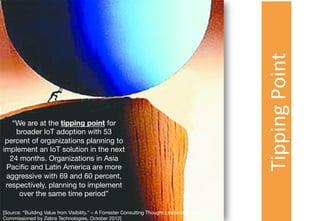
“We are at the tipping point for
broader IoT adoption with 53
percent of organizations planning to
implement an IoT solution in the next
24 months. Organizations in Asia
Pacific and Latin America are more
aggressive with 69 and 60 percent,
respectively, planning to implement
over the same time period”
[Source: “Building Value from Visibility.” – A Forrester Consulting Thought Leadership paper
Commissioned by Zebra Technologies, October 2012]
Tipping	
  Point	
  
[Source: Postscape - http://postscapes.com/what-exactly-is-the-internet-of-things-infographic ]
[Source: Postscape - http://postscapes.com/what-exactly-is-the-internet-of-things-infographic ]
[Source: Postscape - http://postscapes.com/what-exactly-is-the-internet-of-things-infographic ]
New Business Model
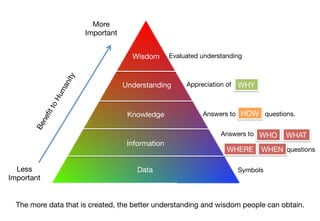
The Internet of Things is not just about gathering of data but
also about the analysis and use of data.
“Big Data is not magic. It doesn’t matter how much
data you have if you can’t make sense of it.”
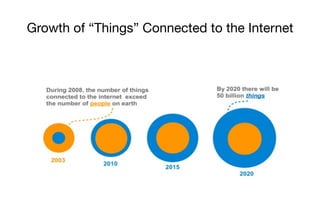
Growth of “Things” Connected to the Internet
Wisdom
Knowledge
Information
Data
More
Important
Less
Important
Evaluated understanding
Appreciation of 
Answers to questions.
Symbols
Understanding
Answers to

questions
The more data that is created, the better understanding and wisdom people can obtain.
WHO
WHY
HOW
WHAT
WHERE
 WHEN
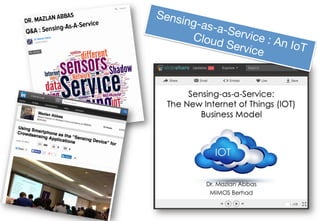
Sensing-as-a-Service : An IoT
Cloud Service
IoT	
  Cloud	
  
Data Priv@cy
Building Trust in the Digital Economy
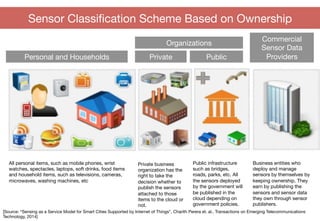
Sensor Classification Scheme Based on Ownership
All personal items, such as mobile phones, wrist
watches, spectacles, laptops, soft drinks, food items
and household items, such as televisions, cameras,
microwaves, washing machines, etc
Private business
organization has the
right to take the
decision whether to
publish the sensors
attached to those
items to the cloud or
not.
Public infrastructure
such as bridges,
roads, parks, etc. All
the sensors deployed
by the government will
be published in the
cloud depending on
government policies.
Business entities who
deploy and manage
sensors by themselves by
keeping ownership. They
earn by publishing the
sensors and sensor data
they own through sensor
publishers. 

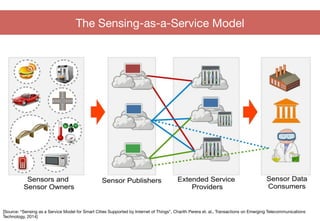
Personal and Households
Commercial
Sensor Data
Providers
Organizations
Public
Private
[Source: “Sensing as a Service Model for Smart Cities Supported by Internet of Things”, Charith Perera et. al., Transactions on Emerging Telecommunications
Technology, 2014]
The Sensing-as-a-Service Model
[Source: “Sensing as a Service Model for Smart Cities Supported by Internet of Things”, Charith Perera et. al., Transactions on Emerging Telecommunications
Technology, 2014]
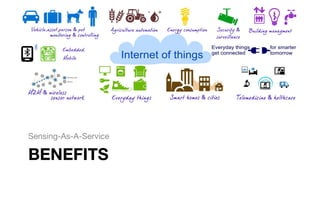
BENEFITS
Sensing-As-A-Service
Harnessing the 


of the Application Developers
Built-in Cloud Computing – “Pay-per-Use”
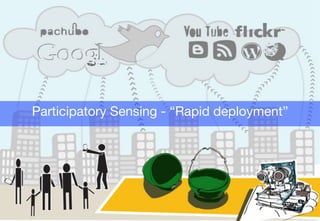
Participatory Sensing - “Rapid deployment”
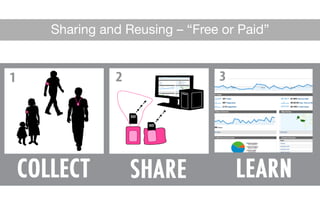
Sharing and Reusing – “Free or Paid”
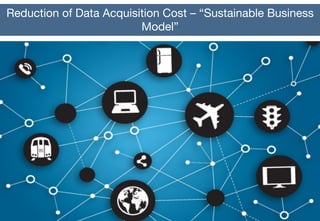
Reduction of Data Acquisition Cost – “Sustainable Business
Model”
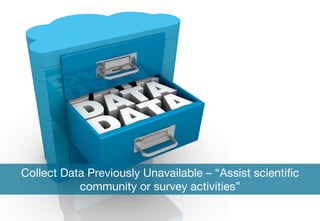
Collect Data Previously Unavailable – “Assist scientific
community or survey activities”
“New Perspectives”
IoT Applications - Examples
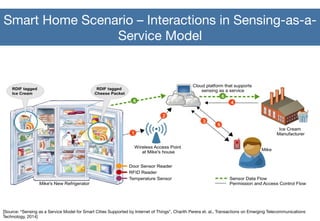
Smart Home Scenario – Interactions in Sensing-as-a-
Service Model
[Source: “Sensing as a Service Model for Smart Cities Supported by Internet of Things”, Charith Perera et. al., Transactions on Emerging Telecommunications
Technology, 2014]
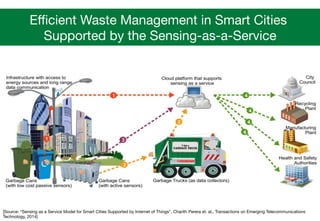
Efficient Waste Management in Smart Cities
Supported by the Sensing-as-a-Service
[Source: “Sensing as a Service Model for Smart Cities Supported by Internet of Things”, Charith Perera et. al., Transactions on Emerging Telecommunications
Technology, 2014]
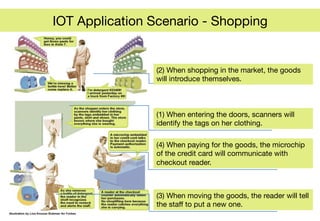
IOT Application Scenario - Shopping
(2) When shopping in the market, the goods
will introduce themselves.
(1) When entering the doors, scanners will
identify the tags on her clothing.
(4) When paying for the goods, the microchip
of the credit card will communicate with
checkout reader. 
(3) When moving the goods, the reader will tell
the staff to put a new one.
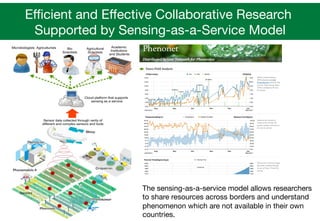
Efficient and Effective Collaborative Research
Supported by Sensing-as-a-Service Model
The sensing-as-a-service model allows researchers
to share resources across borders and understand
phenomenon which are not available in their own
countries.
Crowdsensing	
  
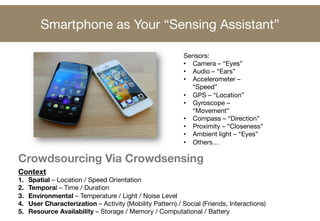
Smartphone as Your “Sensing Assistant”
Sensors:
•  Camera – “Eyes”
•  Audio – “Ears”
•  Accelerometer –
“Speed”
•  GPS – “Location”
•  Gyroscope –
“Movement”
•  Compass – “Direction”
•  Proximity – “Closeness”
•  Ambient light – “Eyes”
•  Others…
Crowdsourcing Via Crowdsensing
Context
1.  Spatial – Location / Speed Orientation
2.  Temporal – Time / Duration
3.  Environmental – Temperature / Light / Noise Level
4.  User Characterization – Activity (Mobility Pattern) / Social (Friends, Interactions)
5.  Resource Availability – Storage / Memory / Computational / Battery
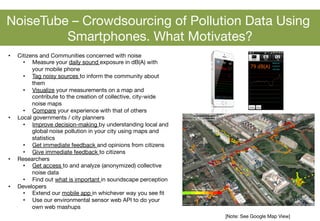
NoiseTube – Crowdsourcing of Pollution Data Using
Smartphones. What Motivates?
•  Citizens and Communities concerned with noise
•  Measure your daily sound exposure in dB(A) with
your mobile phone
•  Tag noisy sources to inform the community about
them
•  Visualize your measurements on a map and
contribute to the creation of collective, city-wide
noise maps
•  Compare your experience with that of others
•  Local governments / city planners
•  Improve decision-making by understanding local and
global noise pollution in your city using maps and
statistics
•  Get immediate feedback and opinions from citizens
•  Give immediate feedback to citizens
•  Researchers
•  Get access to and analyze (anonymized) collective
noise data
•  Find out what is important in soundscape perception
•  Developers
•  Extend our mobile app in whichever way you see fit
•  Use our environmental sensor web API to do your
own web mashups
[Note: See Google Map View]
Urban Crowdsensing
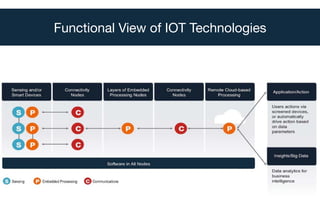
Functional View of IOT Technologies
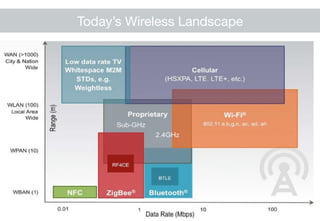
Today’s Wireless Landscape
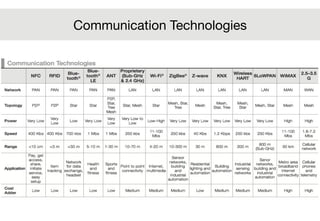
Communication Technologies
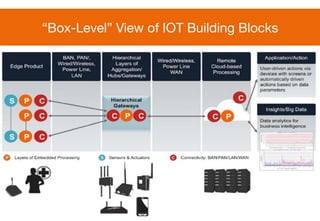
“Box-Level” View of IOT Building Blocks
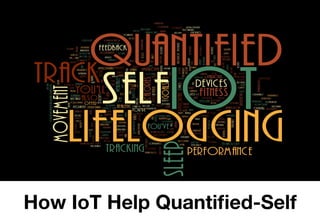
How IoT Help Quantified-Self
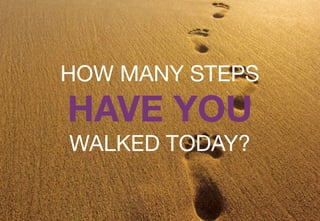
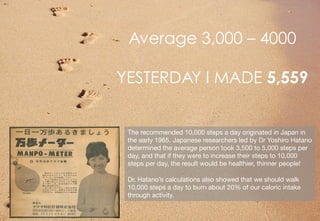
HOW MANY STEPS
HAVE YOU
WALKED TODAY?
Average 3,000 – 4000
YESTERDAY I MADE 5,559
The recommended 10,000 steps a day originated in Japan in
the early 1965. Japanese researchers led by Dr Yoshiro Hatano
determined the average person took 3,500 to 5,000 steps per
day, and that if they were to increase their steps to 10,000
steps per day, the result would be healthier, thinner people!


Dr. Hatano’s calculations also showed that we should walk
10,000 steps a day to burn about 20% of our caloric intake
through activity.
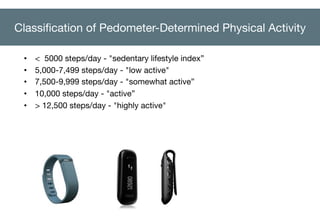
Classification of Pedometer-Determined Physical Activity
•  < 5000 steps/day - "sedentary lifestyle index”
•  5,000-7,499 steps/day - "low active" 
•  7,500-9,999 steps/day - "somewhat active”
•  10,000 steps/day - "active”
•  > 12,500 steps/day - "highly active"
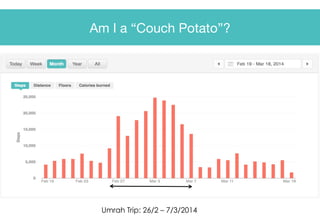
Activity Tracker – Getting Fit
Am I a “Couch Potato”?
Umrah Trip: 26/2 – 7/3/2014
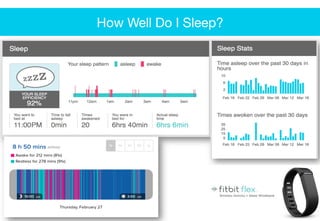
How Well Do I Sleep?
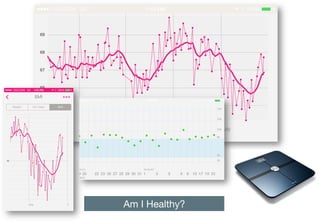
Am I Healthy?
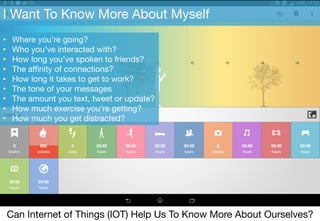
I Want To Know More About Myself
•  Where you’re going?
•  Who you’ve interacted with?
•  How long you’ve spoken to friends?
•  The affinity of connections?
•  How long it takes to get to work?
•  The tone of your messages
•  The amount you text, tweet or update?
•  How much exercise you’re getting?
•  How much you get distracted?
Can Internet of Things (IOT) Help Us To Know More About Ourselves?
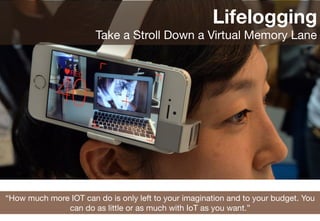
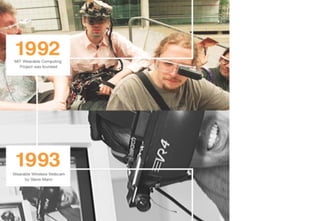
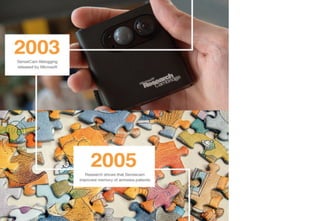
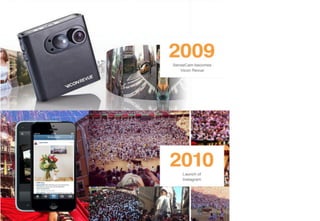
Lifelogging

Take a Stroll Down a Virtual Memory Lane

“How much more IOT can do is only left to your imagination and to your budget. You
can do as little or as much with IoT as you want.”
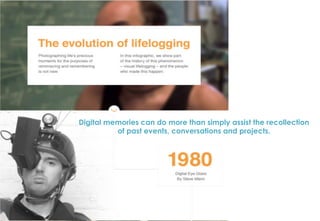
Digital memories can do more than simply assist the recollection
of past events, conversations and projects.
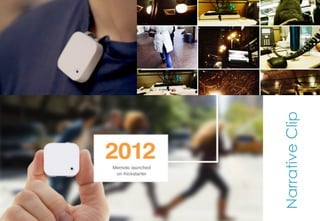
NarrativeClip
Benefits of Lifelogging
It will take quite some time for people to feel comfortable with ‘always connected’
devices that can discreetly take photos or videos.
One question is if the benefits outweigh the negatives.
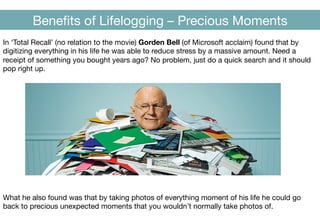
Benefits of Lifelogging – Precious Moments
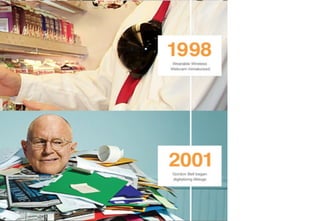
In ‘Total Recall’ (no relation to the movie) Gorden Bell (of Microsoft acclaim) found that by
digitizing everything in his life he was able to reduce stress by a massive amount. Need a
receipt of something you bought years ago? No problem, just do a quick search and it should
pop right up. 
What he also found was that by taking photos of everything moment of his life he could go
back to precious unexpected moments that you wouldn’t normally take photos of.
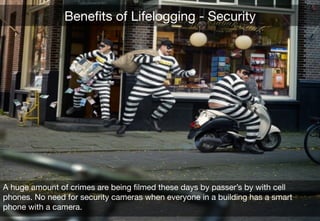
Benefits of Lifelogging - Security
A huge amount of crimes are being filmed these days by passer’s by with cell
phones. No need for security cameras when everyone in a building has a smart
phone with a camera.
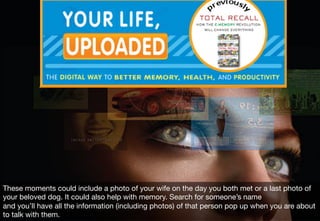
These moments could include a photo of your wife on the day you both met or a last photo of
your beloved dog. It could also help with memory. Search for someone’s name
and you’ll have all the information (including photos) of that person pop up when you are about
to talk with them.
How to automatically records your real life story, as told by the places you visited and
the things you've done because some of us have a great story to tell.
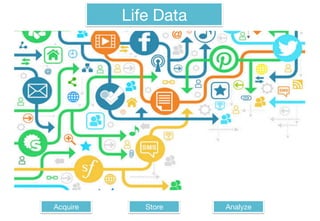
Life Data
Acquire
 Analyze
Store
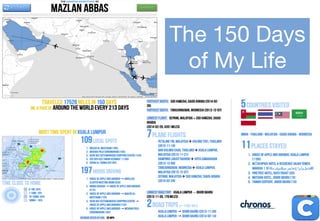
The 150 Days
of My Life
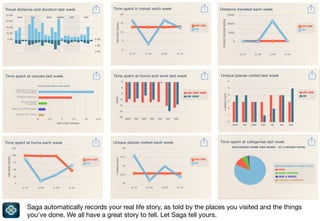
Saga automatically records your real life story, as told by the places you visited and the things
you've done. We all have a great story to tell. Let Saga tell yours.
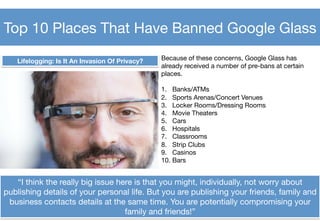
Top 10 Places That Have Banned Google Glass
Because of these concerns, Google Glass has
already received a number of pre-bans at certain
places. 

1.  Banks/ATMs
2.  Sports Arenas/Concert Venues
3.  Locker Rooms/Dressing Rooms
4.  Movie Theaters
5.  Cars
6.  Hospitals
7.  Classrooms
8.  Strip Clubs
9.  Casinos
10.  Bars
“I think the really big issue here is that you might, individually, not worry about
publishing details of your personal life. But you are publishing your friends, family and
business contacts details at the same time. You are potentially compromising your
family and friends!”
Lifelogging: Is It An Invasion Of Privacy?
Lifelogging – Beyond Than Just Counting Steps
How can you organize and browse all the video, audio,
image and text data you amass?
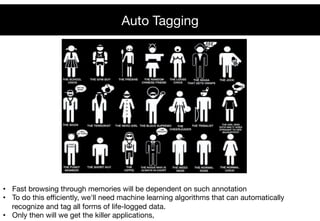
Auto Tagging
•  Fast browsing through memories will be dependent on such annotation
•  To do this efficiently, we'll need machine learning algorithms that can automatically
recognize and tag all forms of life-logged data. 
•  Only then will we get the killer applications,
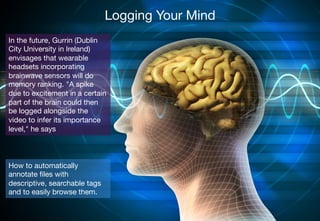
Logging Your Mind
In the future, Gurrin (Dublin
City University in Ireland)
envisages that wearable
headsets incorporating
brainwave sensors will do
memory ranking. "A spike
due to excitement in a certain
part of the brain could then
be logged alongside the
video to infer its importance
level," he says
How to automatically
annotate files with
descriptive, searchable tags
and to easily browse them.
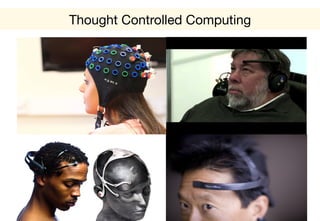
Thought Controlled Computing
Neurowear Necomimi [Video]

If you can capture emotions, you can tag it!
Neurowear “Neurocam” Concept [Video]
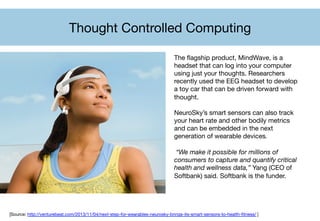
Thought Controlled Computing
[Source: http://venturebeat.com/2013/11/04/next-step-for-wearables-neurosky-brings-its-smart-sensors-to-health-fitness/ ]
The flagship product, MindWave, is a
headset that can log into your computer
using just your thoughts. Researchers
recently used the EEG headset to develop
a toy car that can be driven forward with
thought.

NeuroSky’s smart sensors can also track
your heart rate and other bodily metrics
and can be embedded in the next
generation of wearable devices.

“We make it possible for millions of
consumers to capture and quantify critical
health and wellness data,” Yang (CEO of
Softbank) said. Softbank is the funder.
The Cat That Drank The Milk
Internet of Things – The Circle Story
Internet of Things
Only Tip of an Iceberg
SUMMARY
Thank You
The Only Limit Is Your Imagination - Unleash Your Creativity
EMAIL: mazlan@gmail.com
TWITTER: mazlan_abbas
FACEBOOK: www.facebook.com/drmazlanabbas
LINKEDIN: my.linkedin.com/in/mazlan/
SLIDESHARE: www.slideshare.net/mazlan1