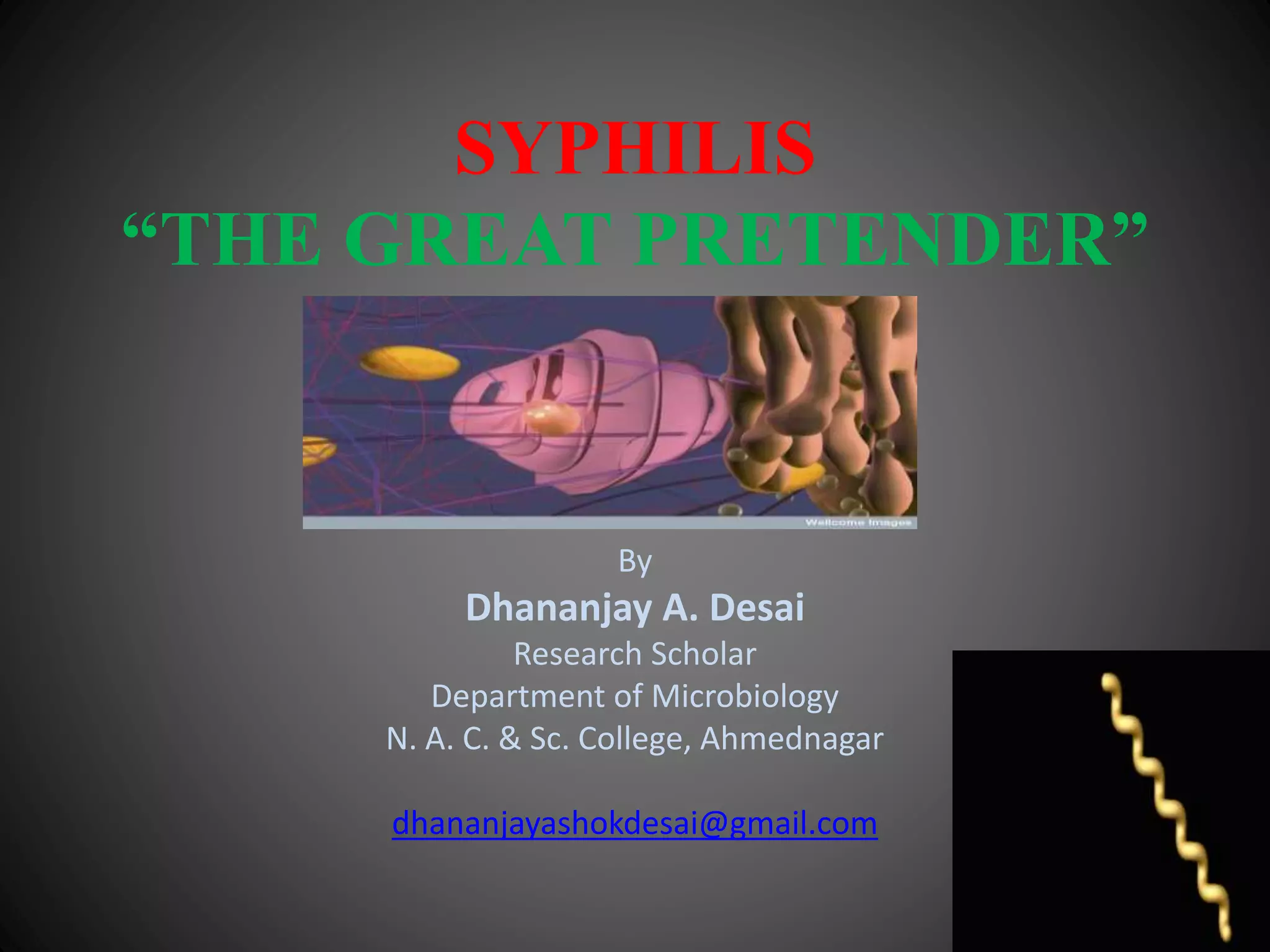


SYPHILIS
“THE GREAT PRETENDER”
By
Dhananjay A. Desai
Research Scholar
Department of Microbiology
N. A. C. & Sc. College, Ahmednagar
dhananjayashokdesai@gmail.com
Overview
• History of Syphilis.
• Transmission pathogenesis and stages of syphilis.
• Diagnostic tests.
• Treatment and partner management.
• Epidemiology.
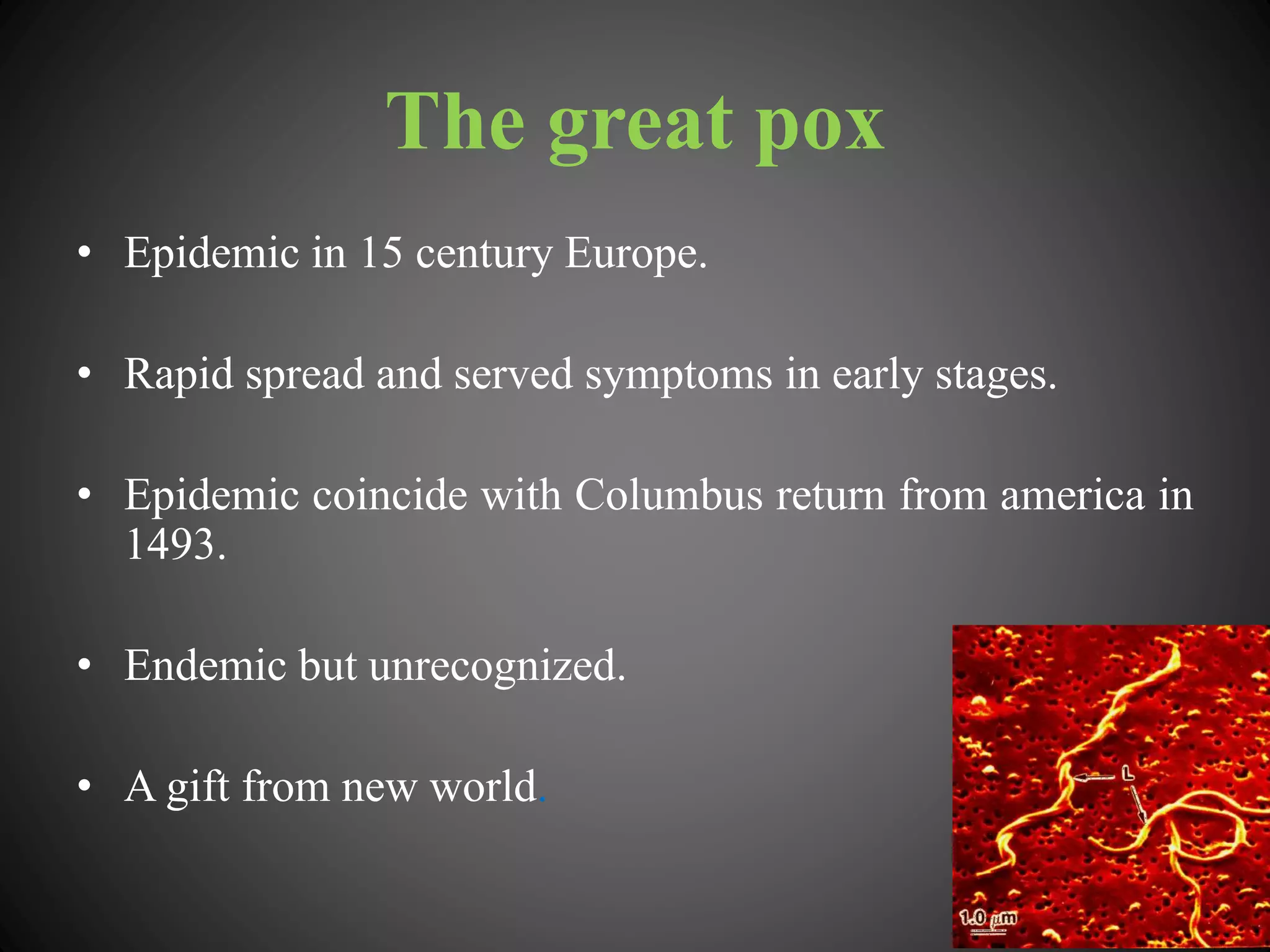
The great pox
• Epidemic in 15 century Europe.
• Rapid spread and served symptoms in early stages.
• Epidemic coincide with Columbus return from america in
1493.
• Endemic but unrecognized.
• A gift from new world.
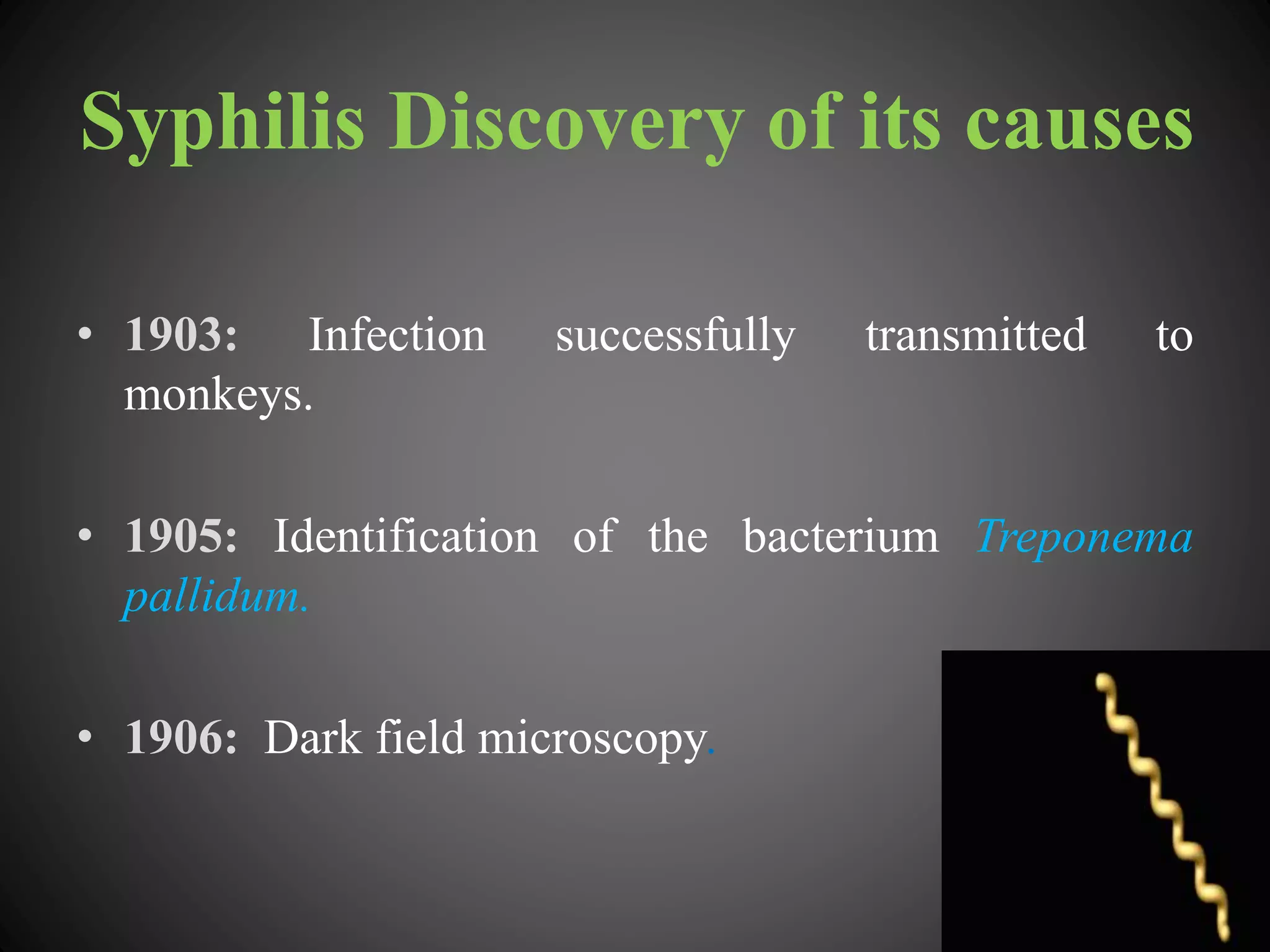
Syphilis Discovery of its causes
• 1903: Infection successfully transmitted to
monkeys.
• 1905: Identification of the bacterium Treponema
pallidum.
• 1906: Dark field microscopy.
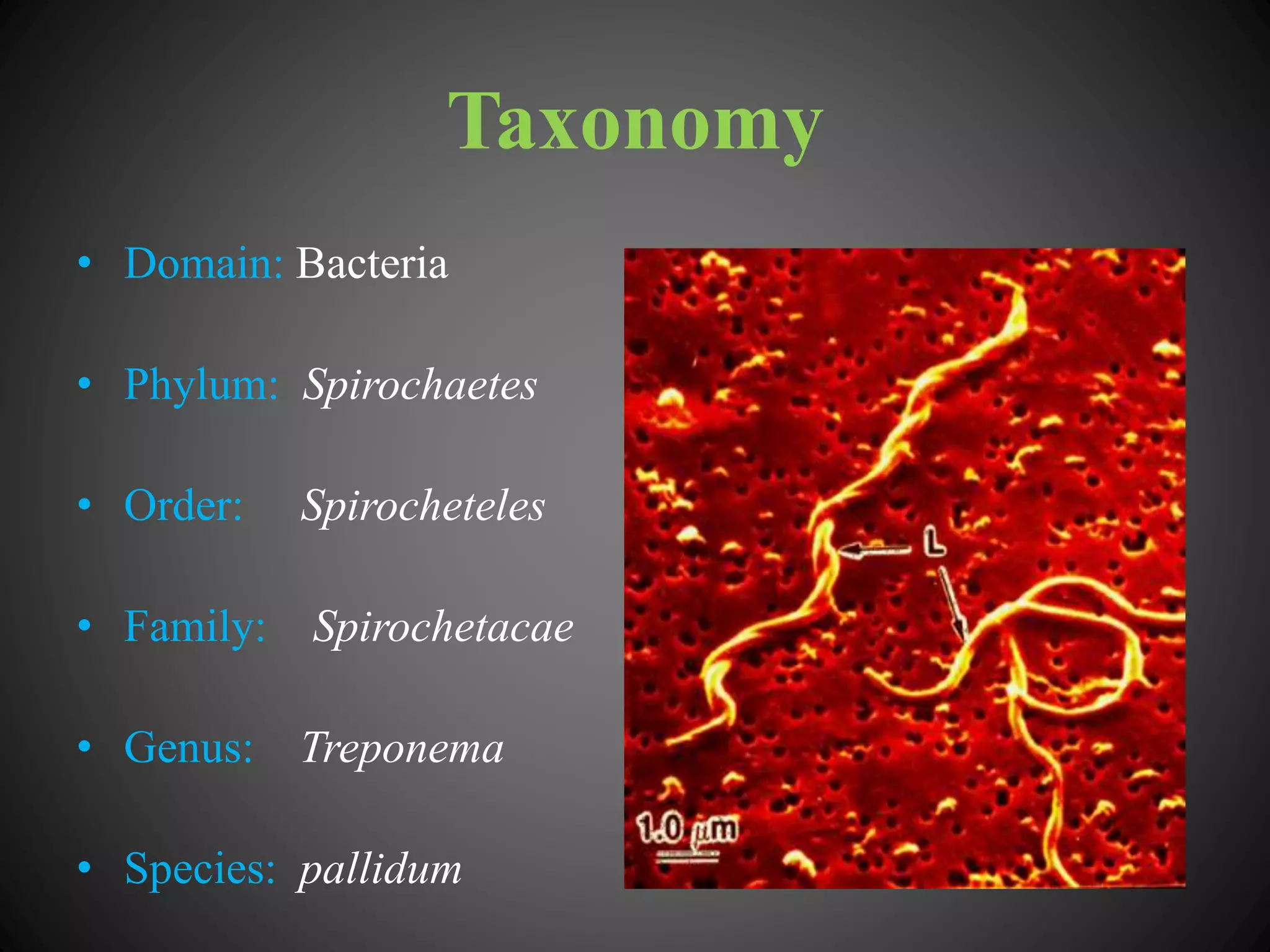
Taxonomy
• Domain: Bacteria
• Phylum: Spirochaetes
• Order: Spirocheteles
• Family: Spirochetacae
• Genus: Treponema
• Species: pallidum
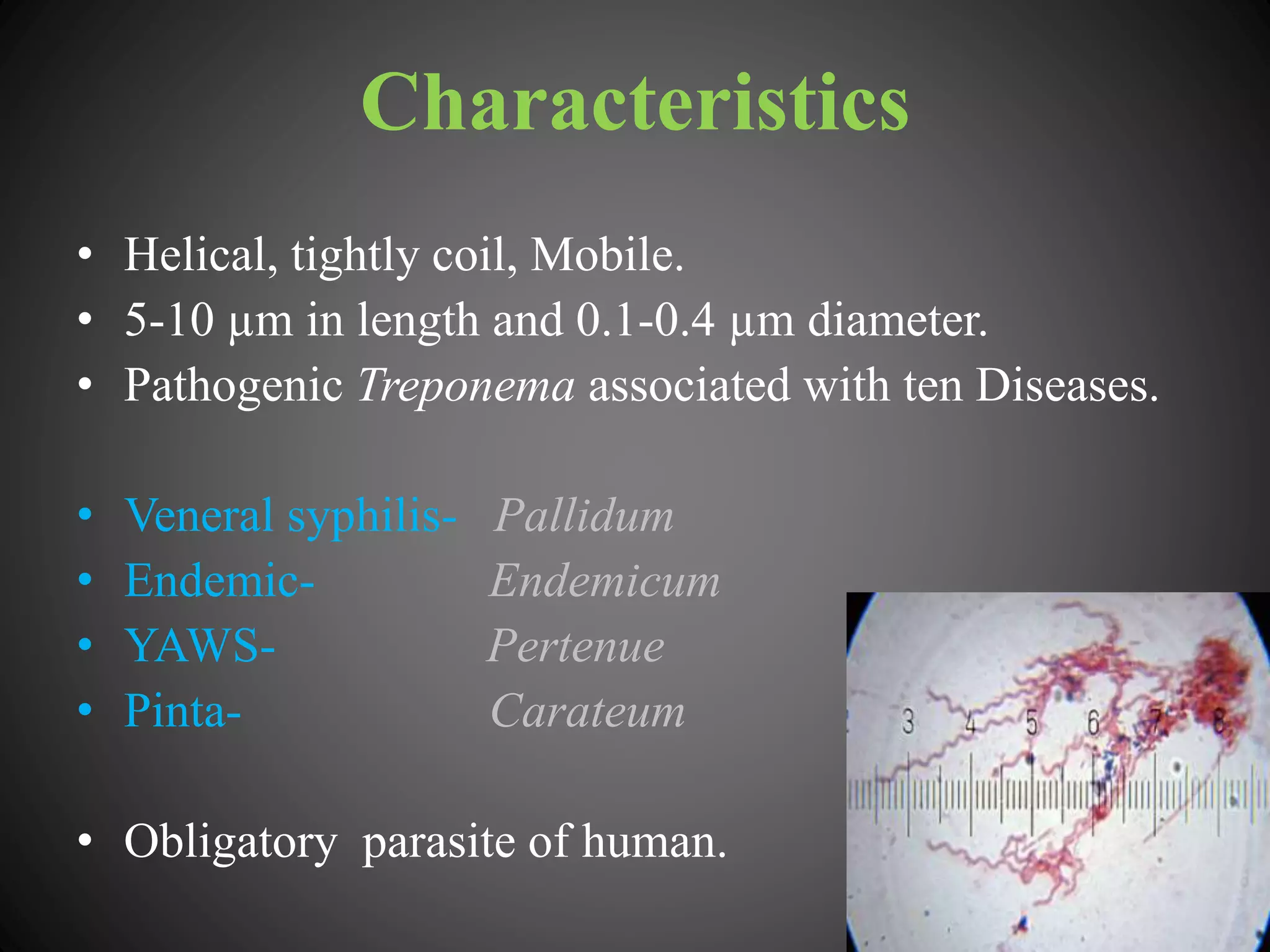
Characteristics
• Helical, tightly coil, Mobile.
• 5-10 µm in length and 0.1-0.4 µm diameter.
• Pathogenic Treponema associated with ten Diseases.
• Veneral syphilis- Pallidum
• Endemic- Endemicum
• YAWS- Pertenue
• Pinta- Carateum
• Obligatory parasite of human.
Epidemiology
and
Aspects of
Syphilis Prevention
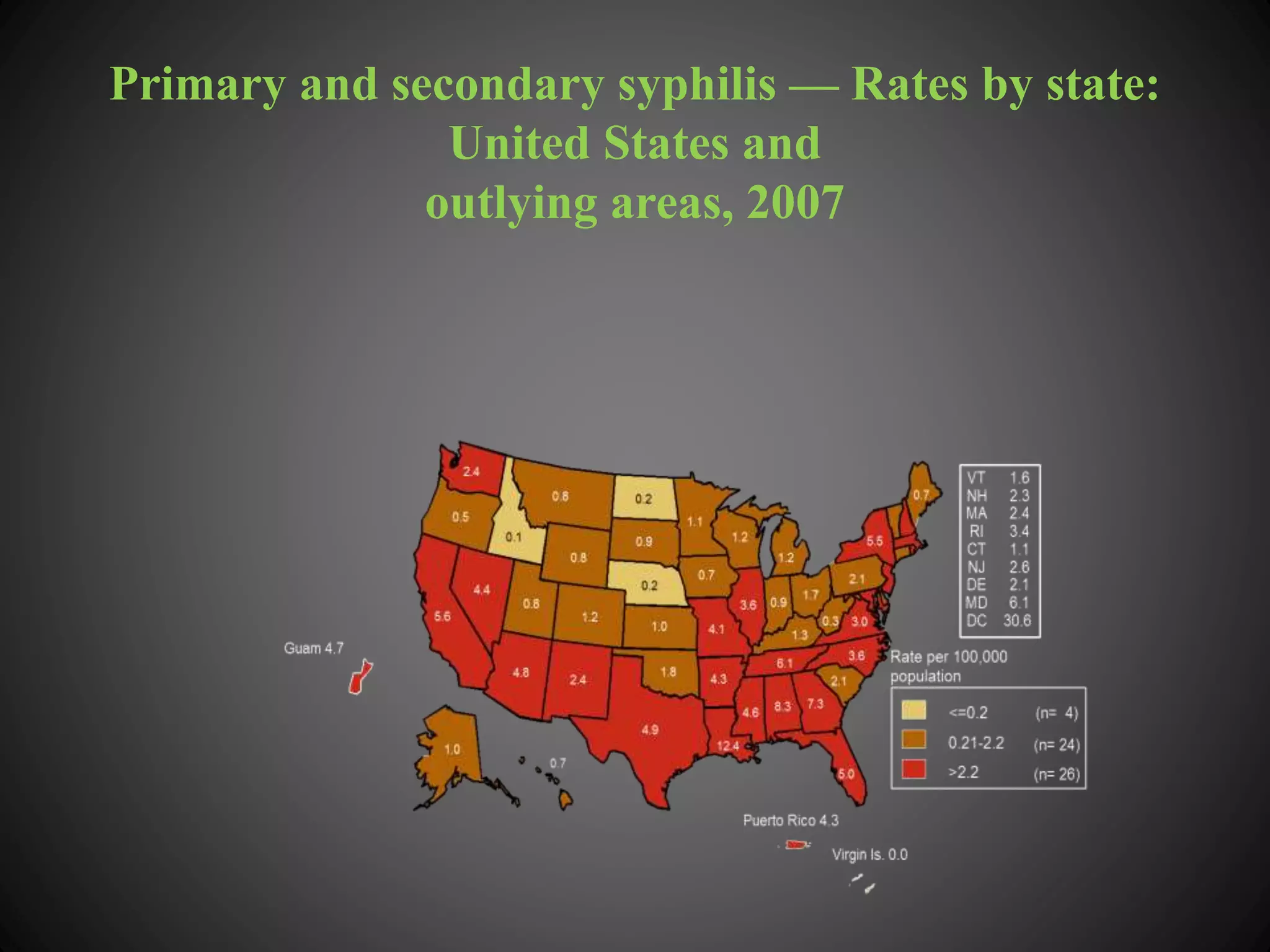
Primary and secondary syphilis — Rates by state:
United States and
outlying areas, 2007
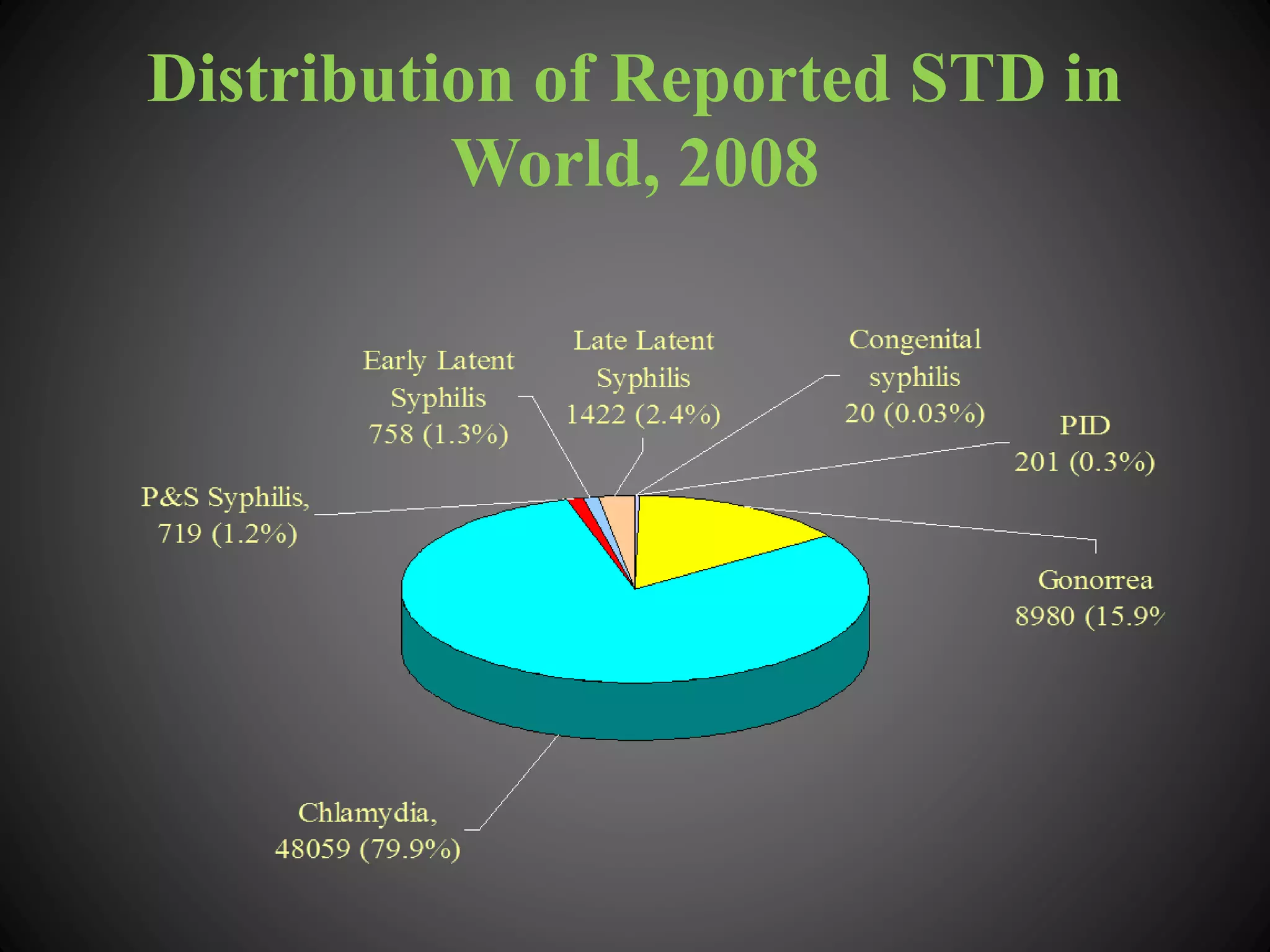
Distribution of Reported STD in
World, 2008
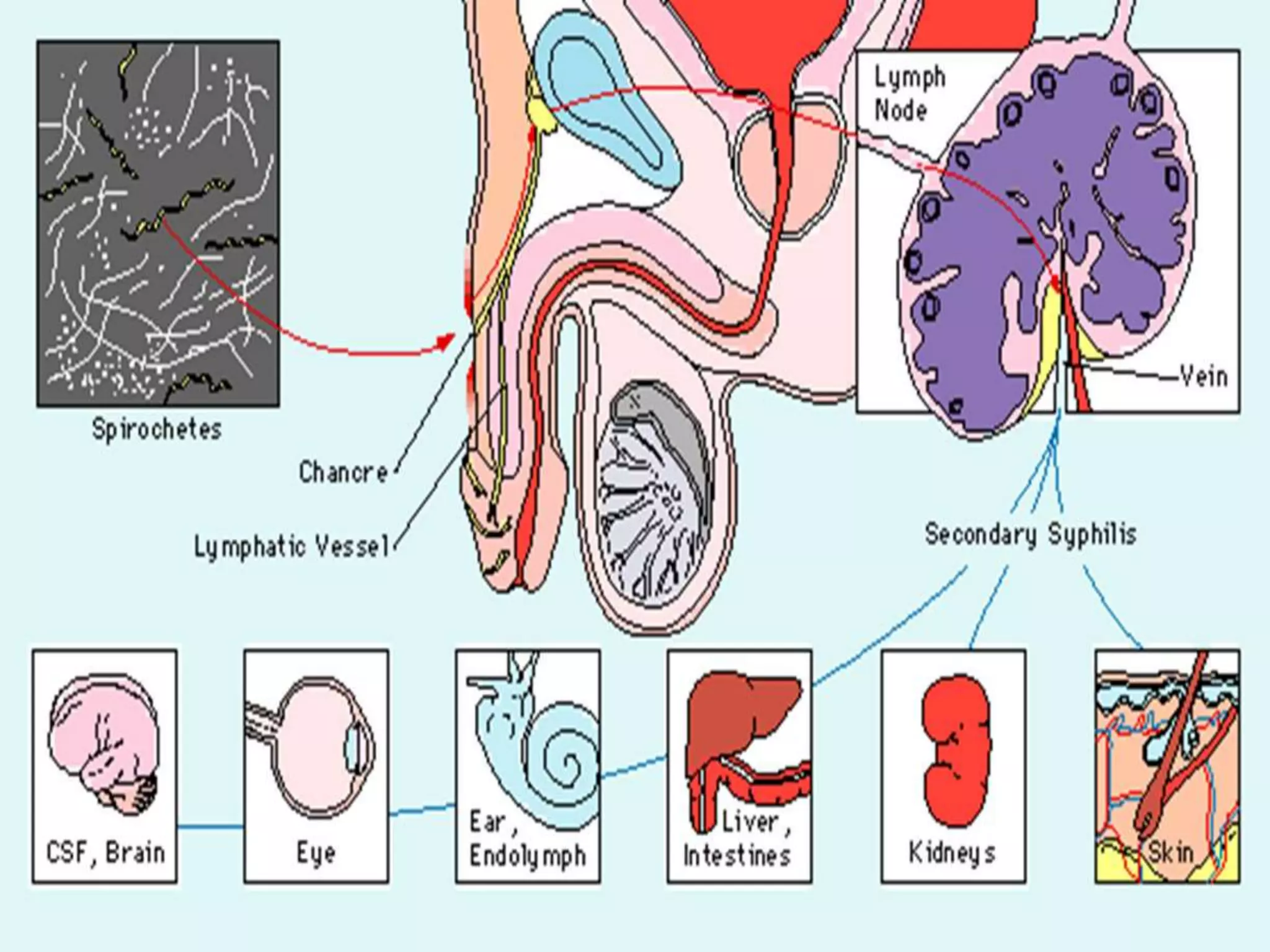
Method of Infection
• Viable bacteria from chancre enter through the fissure or
mucous membrane.
• Bacteria multiply locally and causes painless chancre.
• Spared via blood stream and lymphatic system.
• Can almost infect many organ and tissue.
• Continuous in vitro culture yet Not to be achieved.
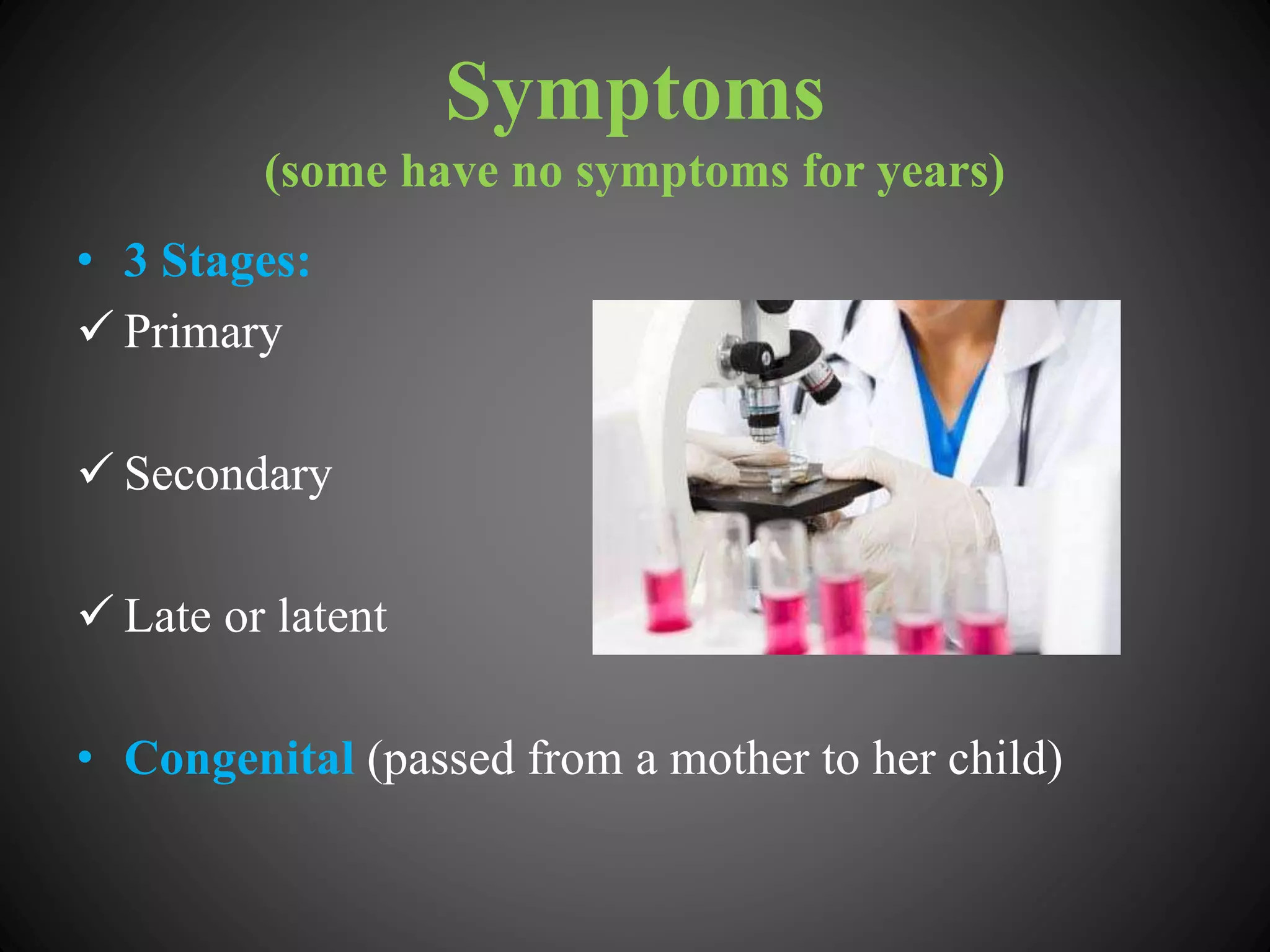
Symptoms
(some have no symptoms for years)
• 3 Stages:
 Primary
 Secondary
 Late or latent
• Congenital (passed from a mother to her child)
Pathogenesis
• Multiple at the site of inoculation and form chancre.
• Spread to local lymph nodes and then to blood
stream.
• Can involve of many body organs.
• Infection and inflammation of blood vessels.
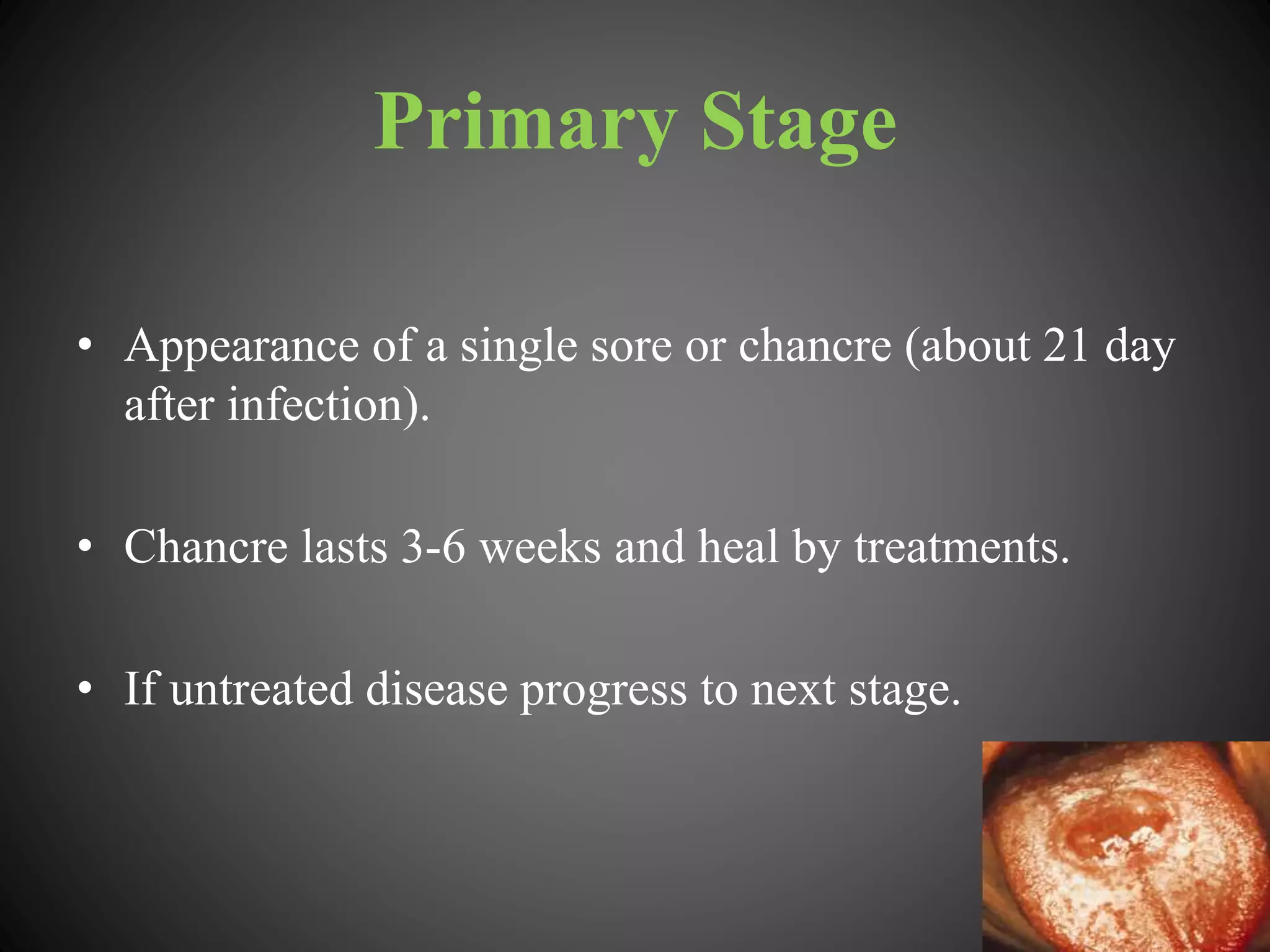
Primary Stage
• Appearance of a single sore or chancre (about 21 day
after infection).
• Chancre lasts 3-6 weeks and heal by treatments.
• If untreated disease progress to next stage.
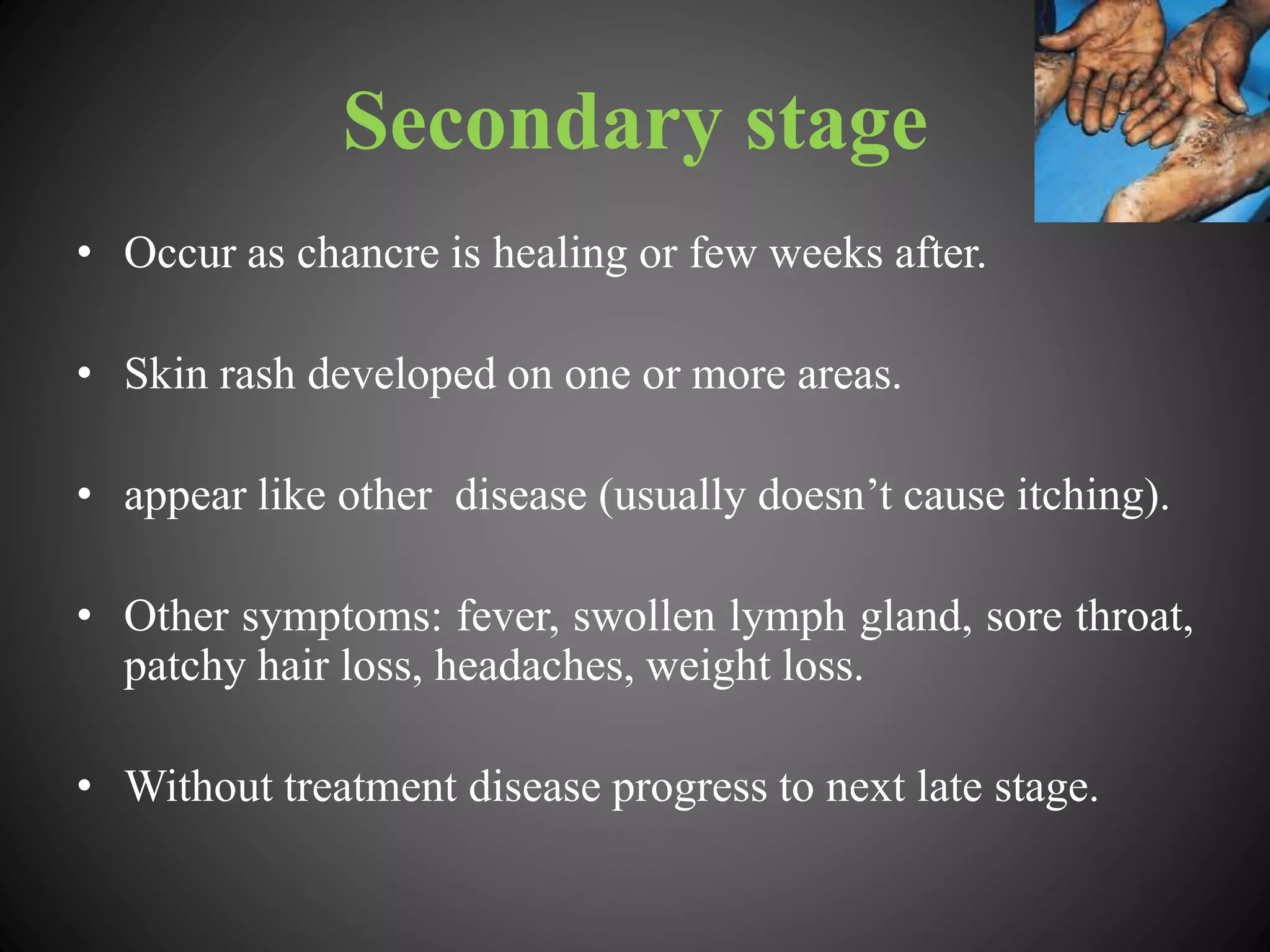
Secondary stage
• Occur as chancre is healing or few weeks after.
• Skin rash developed on one or more areas.
• appear like other disease (usually doesn’t cause itching).
• Other symptoms: fever, swollen lymph gland, sore throat,
patchy hair loss, headaches, weight loss.
• Without treatment disease progress to next late stage.
Late stage
(Hidden stage)
• Person continues to have syphilis even through they
are no symptoms.
• Disease can damage eyes, brain, nervous system,
liver, bones, joints.
• Sign include: difficulty coordinating muscle
movement, paralysis, numbness, gradual blindness,
even death.
Diagnostic Tests
• Dark field
• PCR
• VDRL/RPR
• EIA
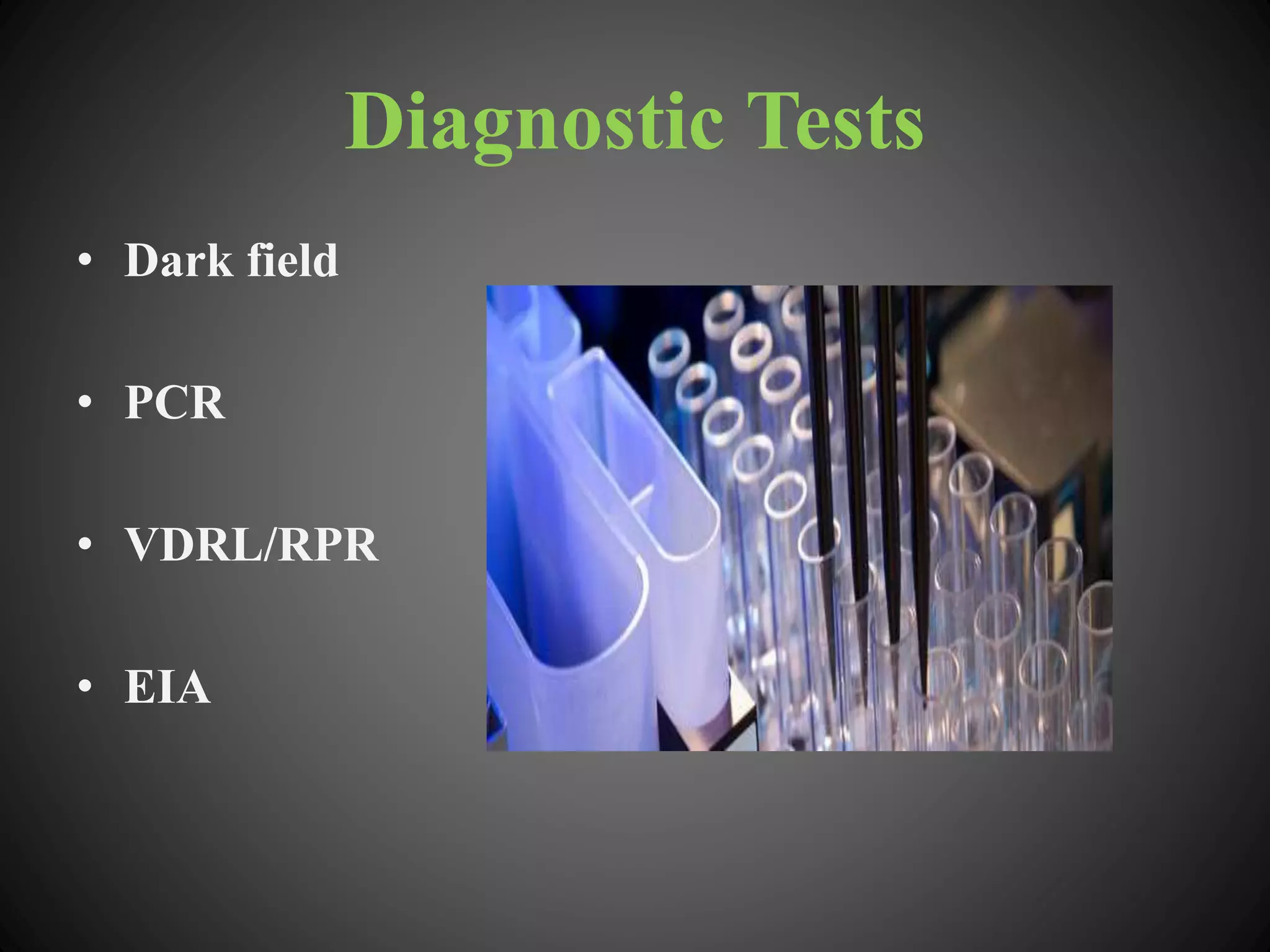
T. pallidum on Dark field
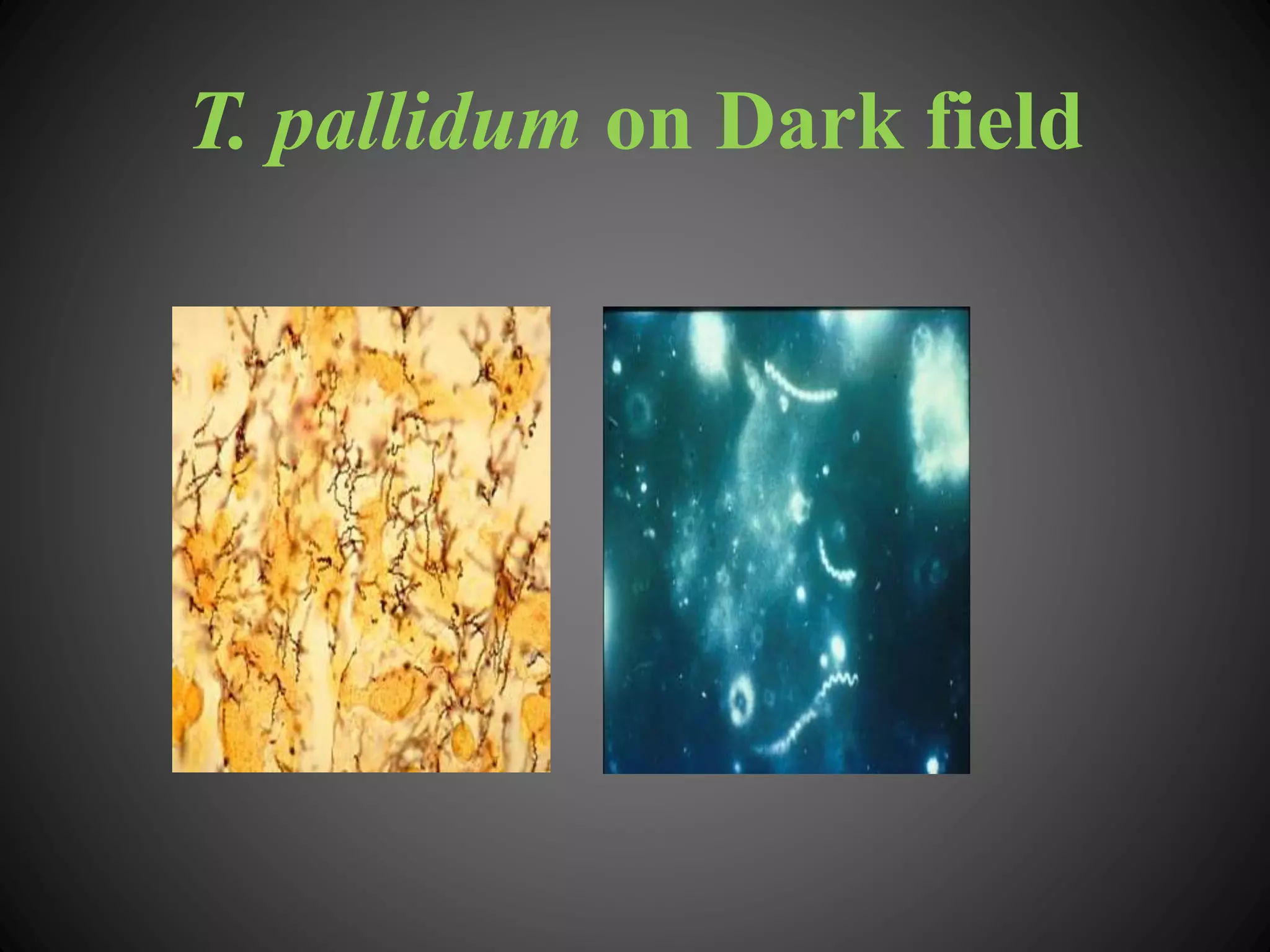
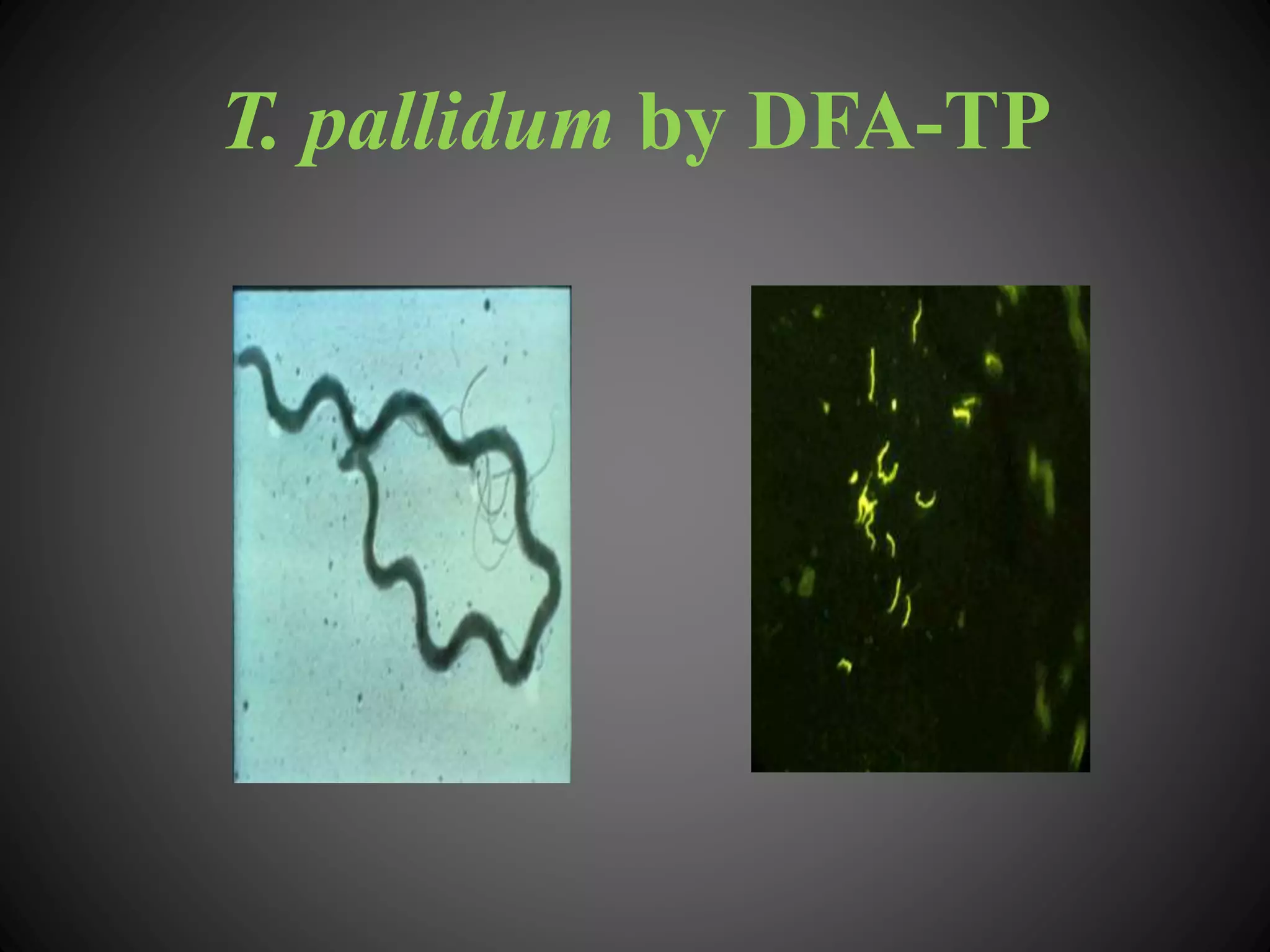
T. pallidum by DFA-TP
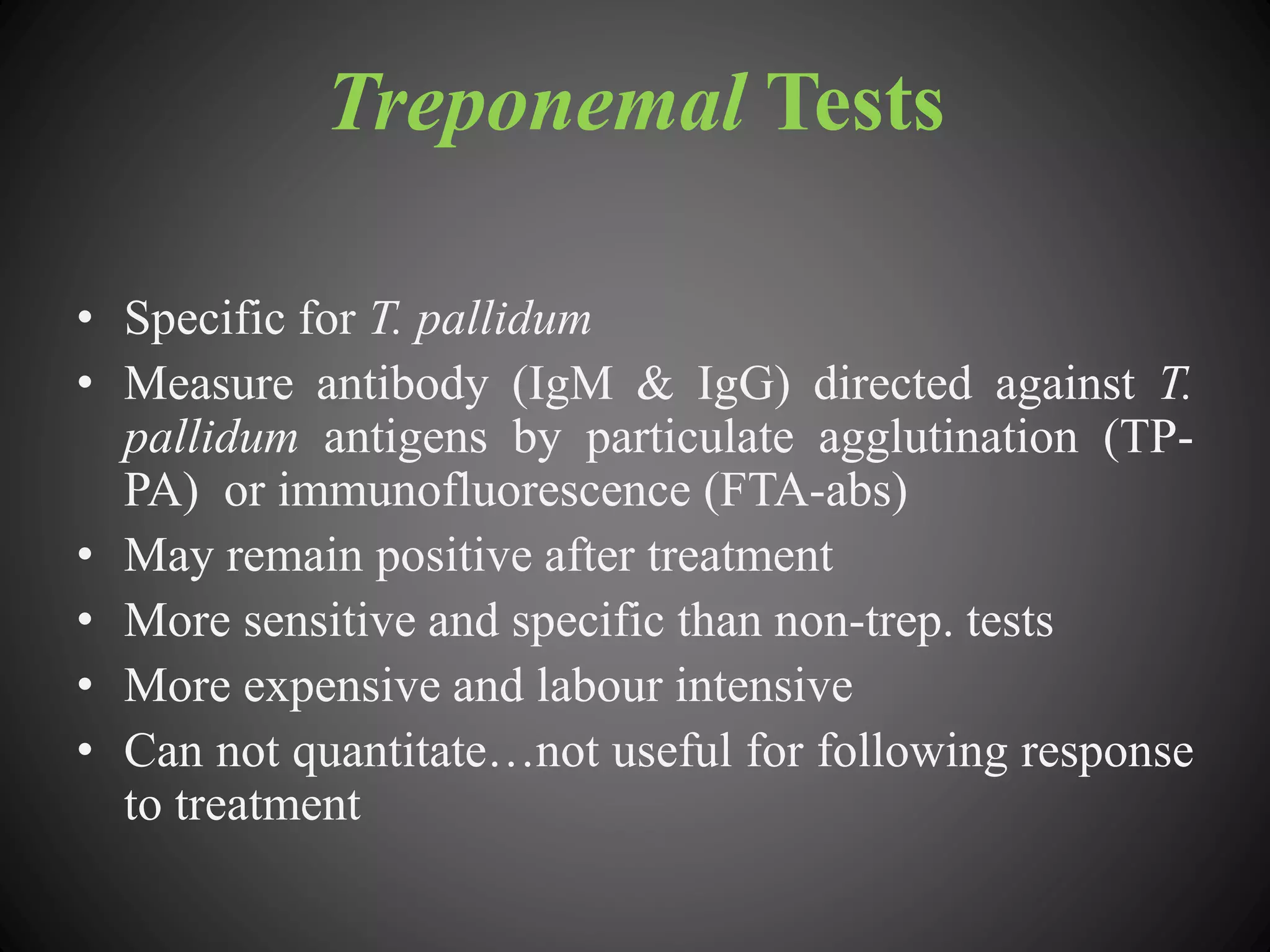
Syphilis Serology
• Non-Treponema tests
 VDRL (Venereal Disease
Research Laboratory)
 RPR (Rapid Plasma Reagin)
 TRUST (Toluidine Red
Unheated Serum Test)
 USR (Unheated Serum
Reagin)
• Treponema tests
 TP-PA (Treponema Pallidum
Particle Agglutination)
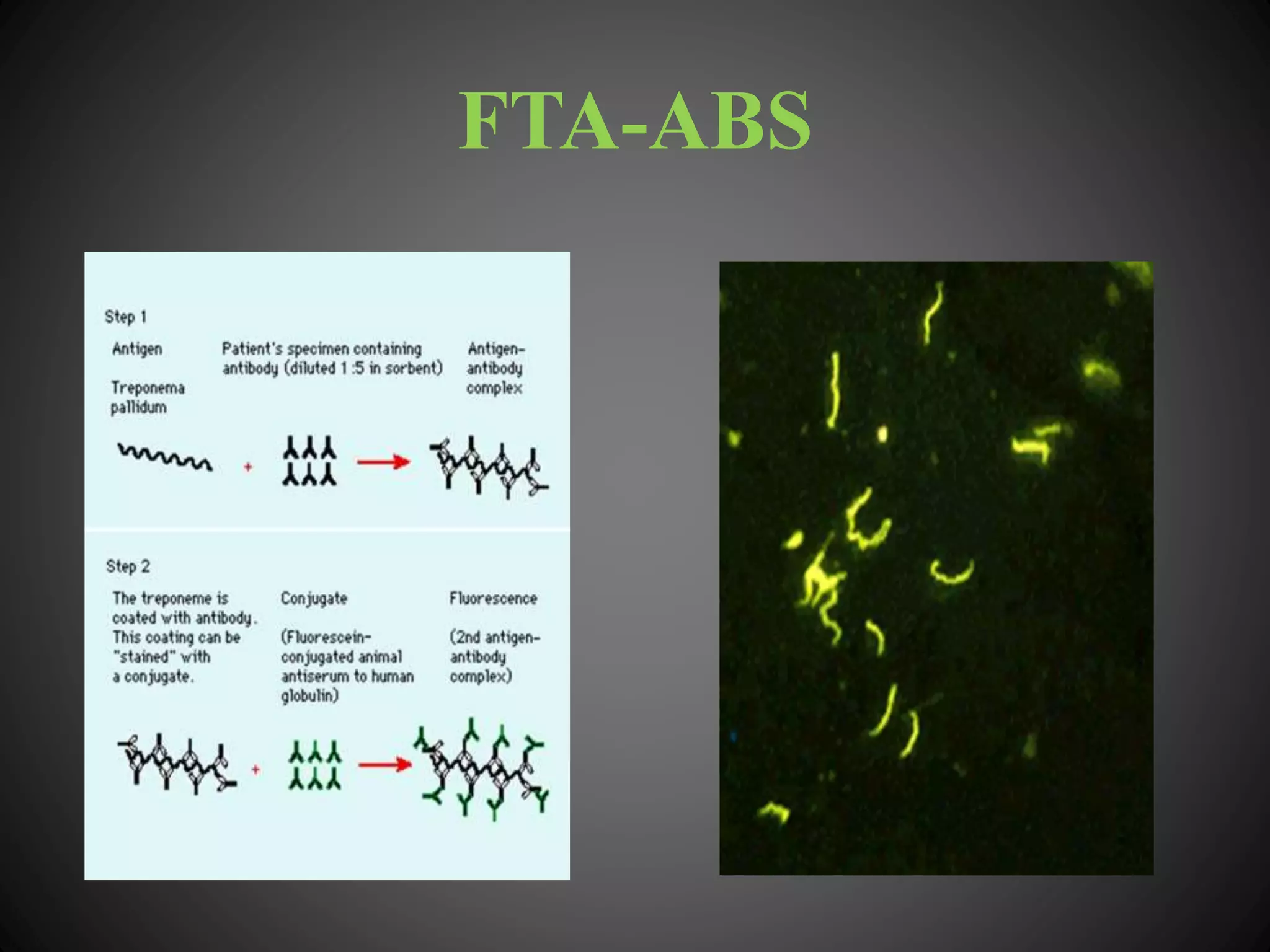
 FTA-abs (Fluorescent
Treponema Antibody -
Absorbed)
 EIA (Enzyme Immunoassay)
Treponemal Tests
• Specific for T. pallidum
• Measure antibody (IgM & IgG) directed against T.
pallidum antigens by particulate agglutination (TP-
PA) or immunofluorescence (FTA-abs)
• May remain positive after treatment
• More sensitive and specific than non-trep. tests
• More expensive and labour intensive
• Can not quantitate…not useful for following response
to treatment
FTA-ABS
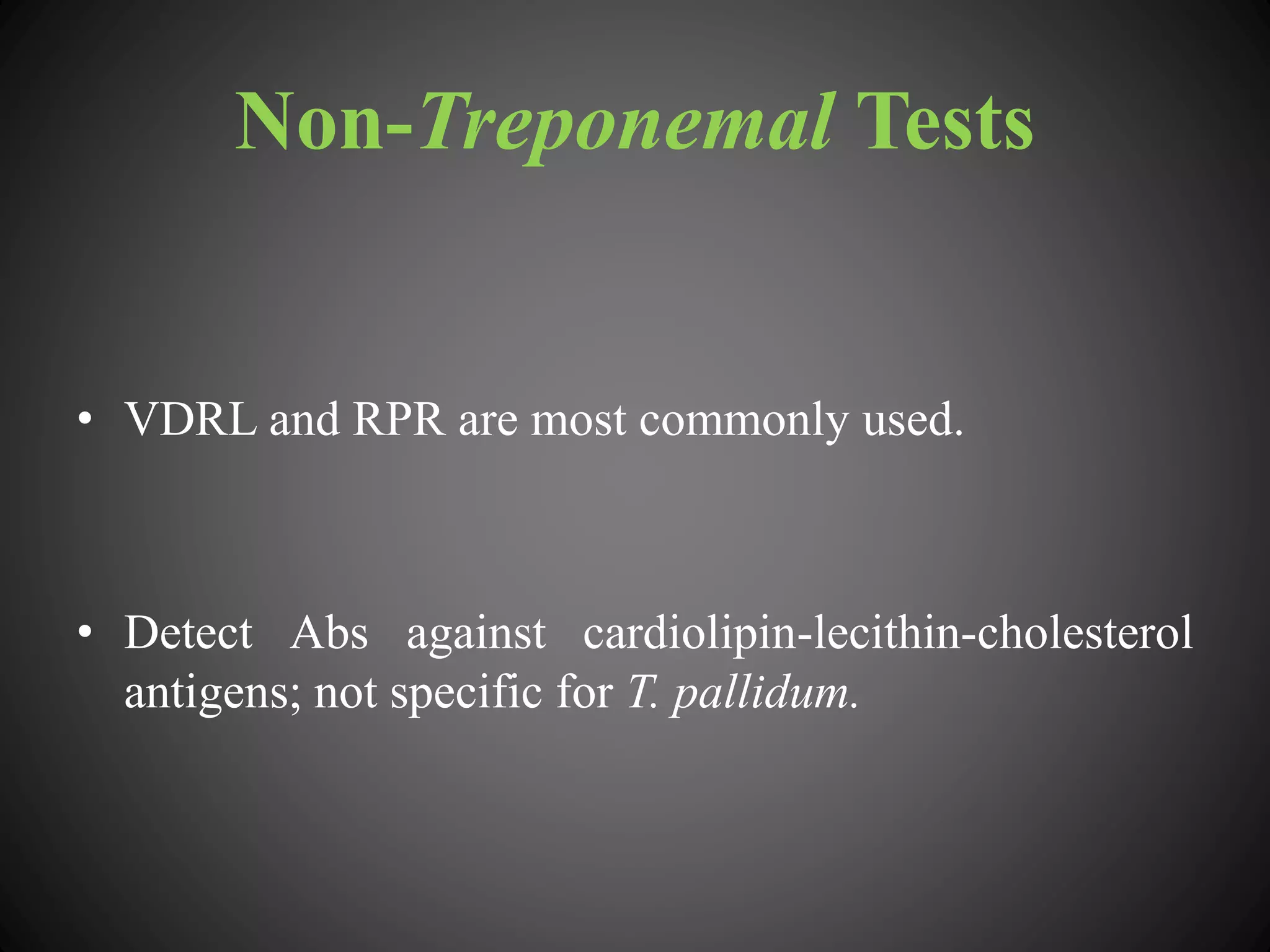
Non-Treponemal Tests
• VDRL and RPR are most commonly used.
• Detect Abs against cardiolipin-lecithin-cholesterol
antigens; not specific for T. pallidum.
Uses of Non-Treponemal Tests
• Screening.
• Evaluation of patients with symptoms or possible re-
infection.
• Follow-up assessment after treatment.
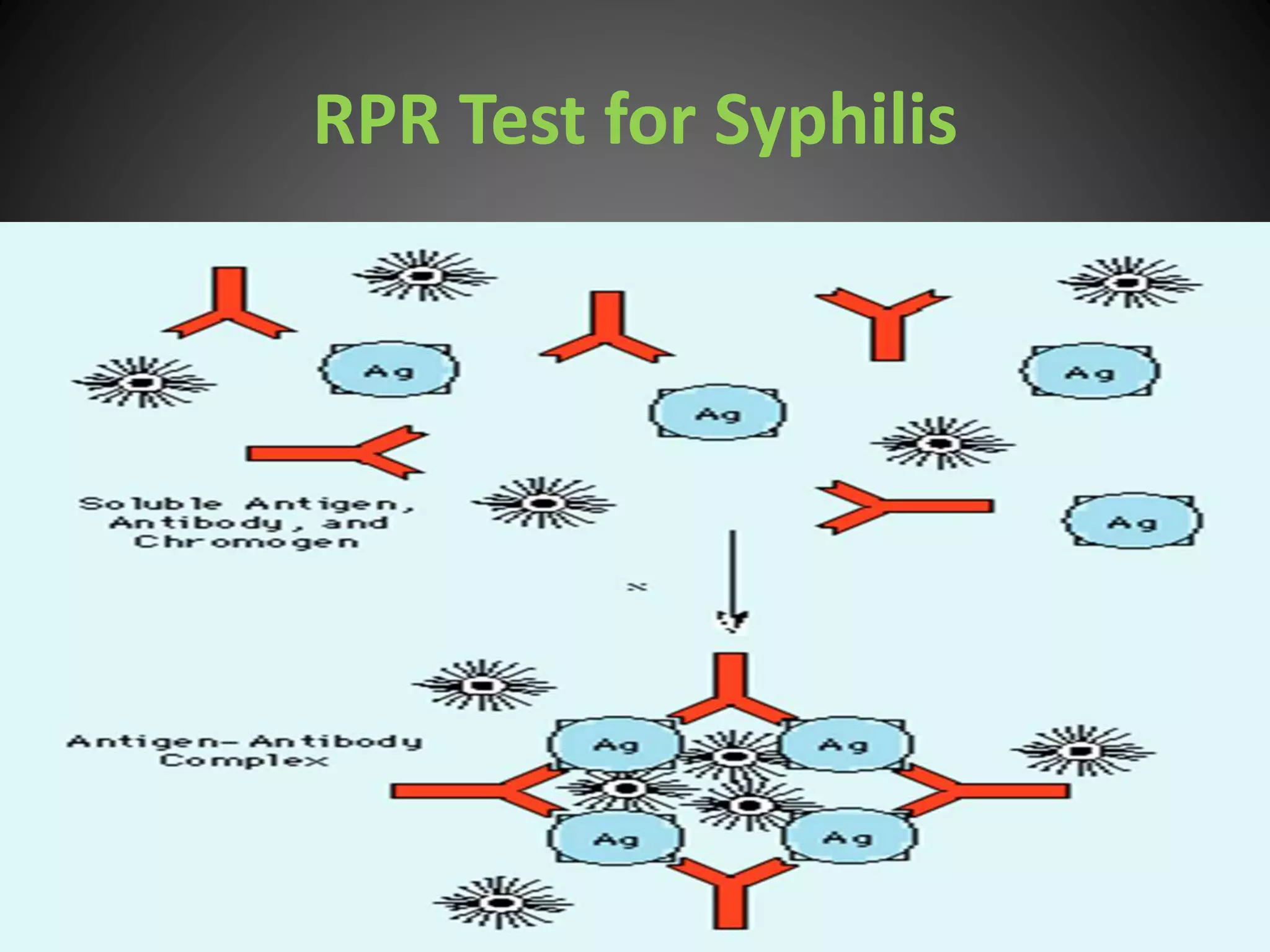
RPR Test for Syphilis
Non-Treponemal Tests
Advantages
• Rapid & inexpensive compared to treponemal tests.
• Easy to perform.
• Quantitative (can be tittered)
• Used to follow response to therapy.
• Can evaluate possible reinfection.
Non-Treponemal Tests
Disadvantages
• Biological false positive reactions (BFPs).
• Viral illnesses including HIV, recent immunizations, IDU,
autoimmune and chronic diseases.
• False negative reactions.
• Prozone effect.
• Early primary and late latent stages.
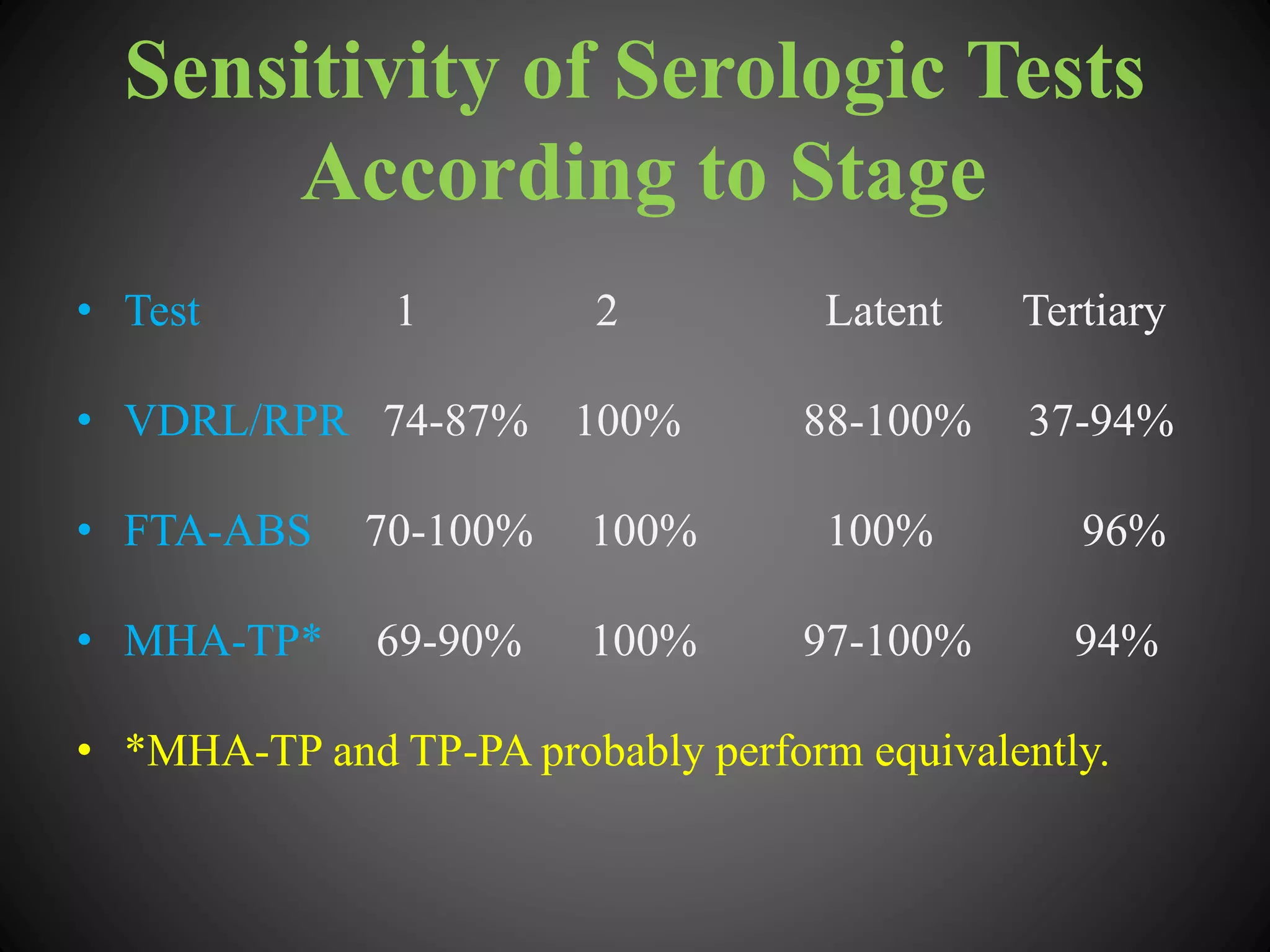
Sensitivity of Serologic Tests
According to Stage
• Test 1 2 Latent Tertiary
• VDRL/RPR 74-87% 100% 88-100% 37-94%
• FTA-ABS 70-100% 100% 100% 96%
• MHA-TP* 69-90% 100% 97-100% 94%
• *MHA-TP and TP-PA probably perform equivalently.
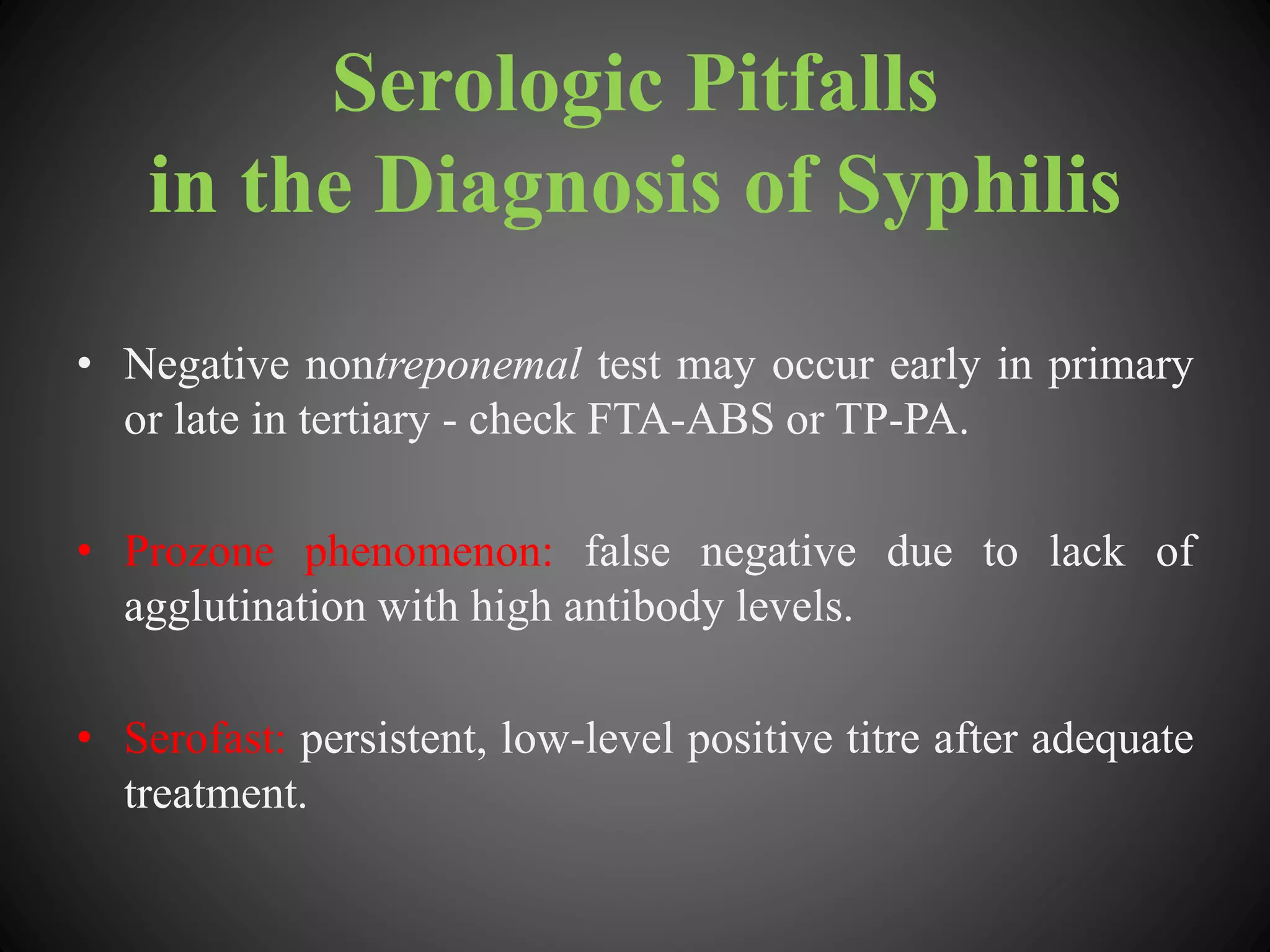
Serologic Pitfalls
in the Diagnosis of Syphilis
• Negative nontreponemal test may occur early in primary
or late in tertiary - check FTA-ABS or TP-PA.
• Prozone phenomenon: false negative due to lack of
agglutination with high antibody levels.
• Serofast: persistent, low-level positive titre after adequate
treatment.
Treatment
and
Partner Management
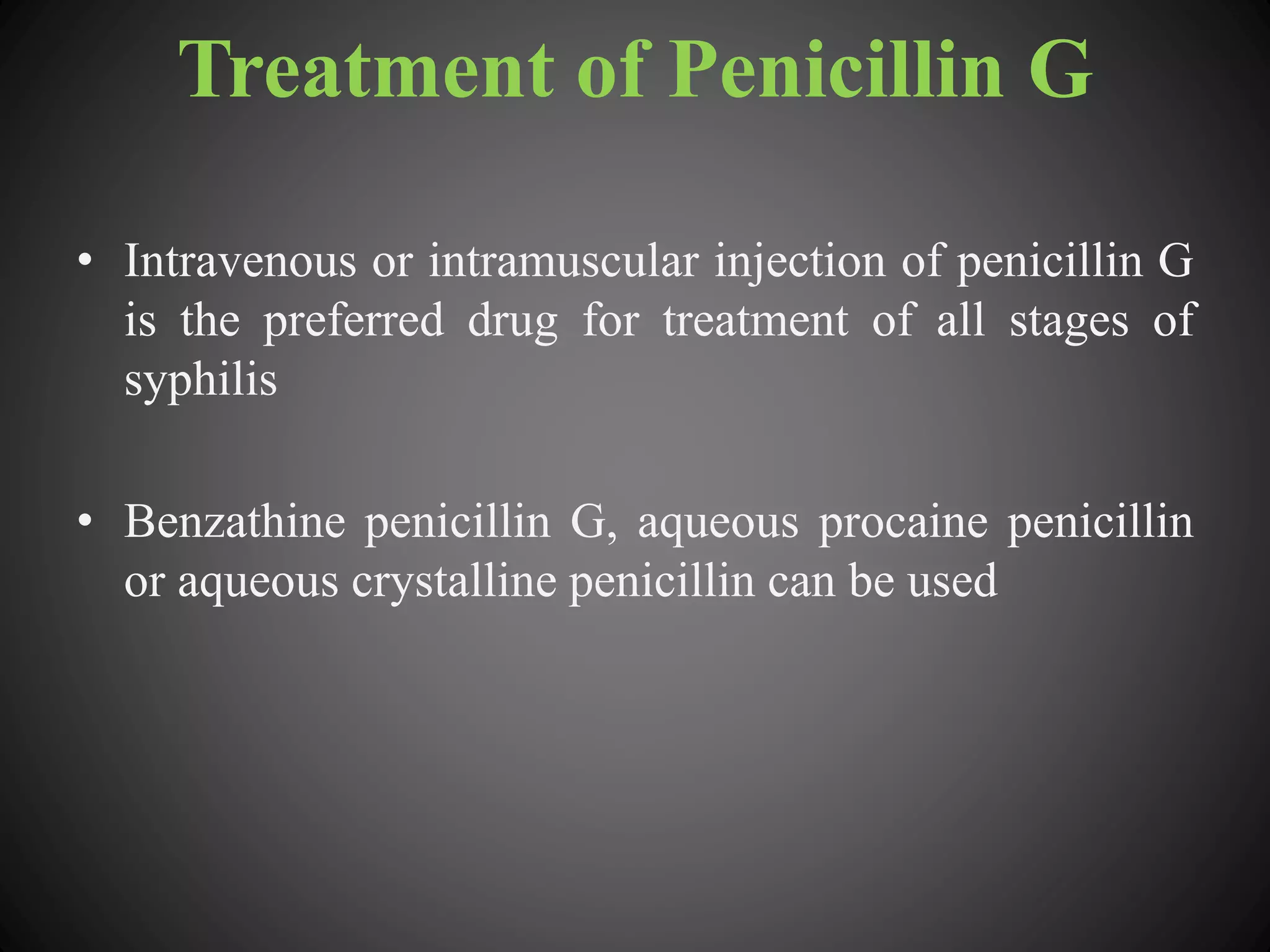
Treatment of Penicillin G
• Intravenous or intramuscular injection of penicillin G
is the preferred drug for treatment of all stages of
syphilis
• Benzathine penicillin G, aqueous procaine penicillin
or aqueous crystalline penicillin can be used
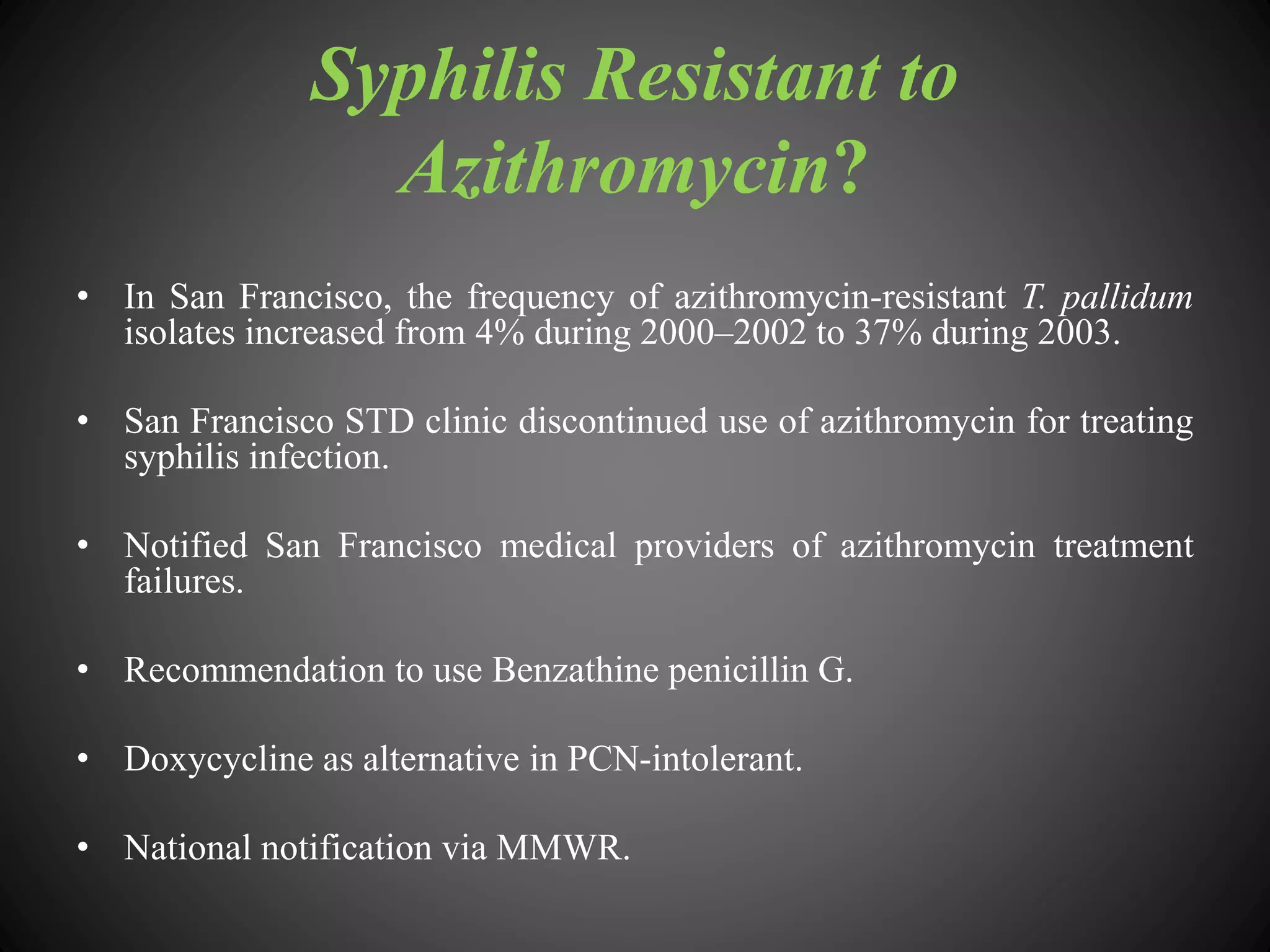
Syphilis Resistant to
Azithromycin?
• In San Francisco, the frequency of azithromycin-resistant T. pallidum
isolates increased from 4% during 2000–2002 to 37% during 2003.
• San Francisco STD clinic discontinued use of azithromycin for treating
syphilis infection.
• Notified San Francisco medical providers of azithromycin treatment
failures.
• Recommendation to use Benzathine penicillin G.
• Doxycycline as alternative in PCN-intolerant.
• National notification via MMWR.
Syphilis: Treatment
in Pregnancy
• Penicillin is the only adequate form of treatment for
syphilis in pregnancy.
• Penicillin-allergic patients - Hospitalize, desensitize
& treat with penicillin.
• Erythromycin is not accepted as alternative drug in
penicillin-allergic patients.
Management of Contacts
• Contacts to primary, secondary or early latent syphilis.
• Persons exposed within 90 days preceding the diagnosis
in a sex partner might be infected even if seronegative:
Treat presumptively.
• Persons exposed >90 days before the diagnosis should be
treated presumptively if serologic tests are unavailable or
follow up is uncertain; if serologic tests are negative no
treatment is needed.
Chances Reduction
• Abstain from sex until treatment is finished and until
partners have been evaluated and treated.
• Use condoms consistently and correctly.
• Avoid having sex with partners with genital ulcers/lesions
or rashes.
• Get check-ups every 6 months if engaging in sex with
more than one sex partner.
NOW TOPIC OPEN FOR DIOSCUSSION

Syphilis : An Introduction

  • 1.
    SYPHILIS “THE GREAT PRETENDER” By DhananjayA. Desai Research Scholar Department of Microbiology N. A. C. & Sc. College, Ahmednagar dhananjayashokdesai@gmail.com
  • 3.
    Overview • History ofSyphilis. • Transmission pathogenesis and stages of syphilis. • Diagnostic tests. • Treatment and partner management. • Epidemiology.
  • 4.
    The great pox •Epidemic in 15 century Europe. • Rapid spread and served symptoms in early stages. • Epidemic coincide with Columbus return from america in 1493. • Endemic but unrecognized. • A gift from new world.
  • 5.
    Syphilis Discovery ofits causes • 1903: Infection successfully transmitted to monkeys. • 1905: Identification of the bacterium Treponema pallidum. • 1906: Dark field microscopy.
  • 6.
    Taxonomy • Domain: Bacteria •Phylum: Spirochaetes • Order: Spirocheteles • Family: Spirochetacae • Genus: Treponema • Species: pallidum
  • 7.
    Characteristics • Helical, tightlycoil, Mobile. • 5-10 µm in length and 0.1-0.4 µm diameter. • Pathogenic Treponema associated with ten Diseases. • Veneral syphilis- Pallidum • Endemic- Endemicum • YAWS- Pertenue • Pinta- Carateum • Obligatory parasite of human.
  • 8.
  • 9.
    Primary and secondarysyphilis — Rates by state: United States and outlying areas, 2007
  • 10.
    Distribution of ReportedSTD in World, 2008
  • 11.
    Method of Infection •Viable bacteria from chancre enter through the fissure or mucous membrane. • Bacteria multiply locally and causes painless chancre. • Spared via blood stream and lymphatic system. • Can almost infect many organ and tissue. • Continuous in vitro culture yet Not to be achieved.
  • 13.
    Symptoms (some have nosymptoms for years) • 3 Stages:  Primary  Secondary  Late or latent • Congenital (passed from a mother to her child)
  • 14.
    Pathogenesis • Multiple atthe site of inoculation and form chancre. • Spread to local lymph nodes and then to blood stream. • Can involve of many body organs. • Infection and inflammation of blood vessels.
  • 15.
    Primary Stage • Appearanceof a single sore or chancre (about 21 day after infection). • Chancre lasts 3-6 weeks and heal by treatments. • If untreated disease progress to next stage.
  • 16.
    Secondary stage • Occuras chancre is healing or few weeks after. • Skin rash developed on one or more areas. • appear like other disease (usually doesn’t cause itching). • Other symptoms: fever, swollen lymph gland, sore throat, patchy hair loss, headaches, weight loss. • Without treatment disease progress to next late stage.
  • 17.
    Late stage (Hidden stage) •Person continues to have syphilis even through they are no symptoms. • Disease can damage eyes, brain, nervous system, liver, bones, joints. • Sign include: difficulty coordinating muscle movement, paralysis, numbness, gradual blindness, even death.
  • 18.
    Diagnostic Tests • Darkfield • PCR • VDRL/RPR • EIA
  • 19.
    T. pallidum onDark field
  • 20.
  • 21.
    Syphilis Serology • Non-Treponematests  VDRL (Venereal Disease Research Laboratory)  RPR (Rapid Plasma Reagin)  TRUST (Toluidine Red Unheated Serum Test)  USR (Unheated Serum Reagin) • Treponema tests  TP-PA (Treponema Pallidum Particle Agglutination)  FTA-abs (Fluorescent Treponema Antibody - Absorbed)  EIA (Enzyme Immunoassay)
  • 22.
    Treponemal Tests • Specificfor T. pallidum • Measure antibody (IgM & IgG) directed against T. pallidum antigens by particulate agglutination (TP- PA) or immunofluorescence (FTA-abs) • May remain positive after treatment • More sensitive and specific than non-trep. tests • More expensive and labour intensive • Can not quantitate…not useful for following response to treatment
  • 23.
  • 24.
    Non-Treponemal Tests • VDRLand RPR are most commonly used. • Detect Abs against cardiolipin-lecithin-cholesterol antigens; not specific for T. pallidum.
  • 25.
    Uses of Non-TreponemalTests • Screening. • Evaluation of patients with symptoms or possible re- infection. • Follow-up assessment after treatment.
  • 26.
    RPR Test forSyphilis
  • 27.
    Non-Treponemal Tests Advantages • Rapid& inexpensive compared to treponemal tests. • Easy to perform. • Quantitative (can be tittered) • Used to follow response to therapy. • Can evaluate possible reinfection.
  • 28.
    Non-Treponemal Tests Disadvantages • Biologicalfalse positive reactions (BFPs). • Viral illnesses including HIV, recent immunizations, IDU, autoimmune and chronic diseases. • False negative reactions. • Prozone effect. • Early primary and late latent stages.
  • 29.
    Sensitivity of SerologicTests According to Stage • Test 1 2 Latent Tertiary • VDRL/RPR 74-87% 100% 88-100% 37-94% • FTA-ABS 70-100% 100% 100% 96% • MHA-TP* 69-90% 100% 97-100% 94% • *MHA-TP and TP-PA probably perform equivalently.
  • 30.
    Serologic Pitfalls in theDiagnosis of Syphilis • Negative nontreponemal test may occur early in primary or late in tertiary - check FTA-ABS or TP-PA. • Prozone phenomenon: false negative due to lack of agglutination with high antibody levels. • Serofast: persistent, low-level positive titre after adequate treatment.
  • 31.
  • 32.
    Treatment of PenicillinG • Intravenous or intramuscular injection of penicillin G is the preferred drug for treatment of all stages of syphilis • Benzathine penicillin G, aqueous procaine penicillin or aqueous crystalline penicillin can be used
  • 33.
    Syphilis Resistant to Azithromycin? •In San Francisco, the frequency of azithromycin-resistant T. pallidum isolates increased from 4% during 2000–2002 to 37% during 2003. • San Francisco STD clinic discontinued use of azithromycin for treating syphilis infection. • Notified San Francisco medical providers of azithromycin treatment failures. • Recommendation to use Benzathine penicillin G. • Doxycycline as alternative in PCN-intolerant. • National notification via MMWR.
  • 34.
    Syphilis: Treatment in Pregnancy •Penicillin is the only adequate form of treatment for syphilis in pregnancy. • Penicillin-allergic patients - Hospitalize, desensitize & treat with penicillin. • Erythromycin is not accepted as alternative drug in penicillin-allergic patients.
  • 35.
    Management of Contacts •Contacts to primary, secondary or early latent syphilis. • Persons exposed within 90 days preceding the diagnosis in a sex partner might be infected even if seronegative: Treat presumptively. • Persons exposed >90 days before the diagnosis should be treated presumptively if serologic tests are unavailable or follow up is uncertain; if serologic tests are negative no treatment is needed.
  • 36.
    Chances Reduction • Abstainfrom sex until treatment is finished and until partners have been evaluated and treated. • Use condoms consistently and correctly. • Avoid having sex with partners with genital ulcers/lesions or rashes. • Get check-ups every 6 months if engaging in sex with more than one sex partner.
  • 38.
    NOW TOPIC OPENFOR DIOSCUSSION