Syphilis
(Management)
Jeetendra Bhandari
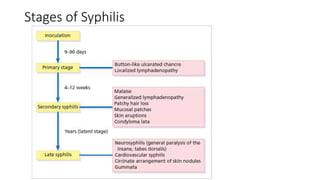
Stages of Syphilis
Management
• Investigation
• Treatment
Investigation
• Tests to demonstrate the spirochete
• Serology test
Tests to demonstrate the spirochete
 Dark field microscopy
 Direct Fluorescent Antibody T. pallidum (DFA-TP) Test
 Polymerase Chain Reaction
Collection of samples
 The lesion is cleansed with water and dried
 Grasped firmly between the thumb and index finger
 Abraded sufficiently to cause clear or faintly blood- stained plasma
to exude when squeezed
 Surface of a clean coverslip is touched to the surface of the lesion so
that plasma adheres
 Then dropped on a slide and pressed down
 The specimen is quickly examined
Dark field microscopy
 Quickest and most direct method
 Positive in primary and secondary syphilis
 Sample can be taken from the primary chancre or papular lesions of
secondary syphilis (mostly from condylomata lata)
 Unreliable in oral cavity as T. pallidum can not be distinguished from
oral saprophytic spirochetes
 May be negative in patients treated with systemic or local antibiotics
 Failure to identify do not exclude diagnosis of primary syphilis
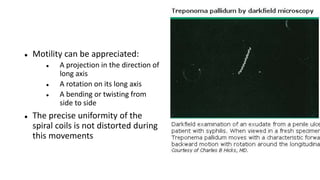
 Motility can be appreciated:
 A projection in the direction of
long axis
 A rotation on its long axis
 A bending or twisting from
side to side
 The precise uniformity of the
spiral coils is not distorted during
this movements
Direct Fluorescent Antibody T.pallidum (DFA-
TP) test
 Permit the identification of organism when smares can’t be examined
immediately
 Fluorescent antibodies angainst T.pallidum used for identification
 Better than dark field microscopy as it is reliable in case of oral
lesions as well
 Air dry specimen of lymph nodes aspirate, genital mucosal lesion,
and chancres are used
Polymerase Chain Reaction
 The genetic sequence of T.pallidum has been traced
 PCR is therefore 100% sensetive and specific for detecting T.pallidum
 PCR can also diagnose other genital lesions at the same time
 However, at present, its use is limited to clinical research only
Serological tests
• 2 types
• Treponemal
• Non Treponemal
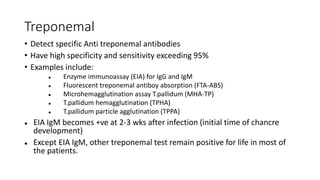
Treponemal
• Detect specific Anti treponemal antibodies
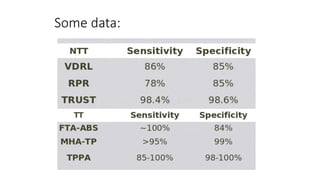
• Have high specificity and sensitivity exceeding 95%
• Examples include:
 Enzyme immunoassay (EIA) for IgG and IgM
 Fluorescent treponemal antiboy absorption (FTA-ABS)
 Microhemagglutination assay T.pallidum (MHA-TP)
 T.pallidum hemagglutination (TPHA)
 T.pallidum particle agglutination (TPPA)
 EIA IgM becomes +ve at 2-3 wks after infection (initial time of chancre
development)
 Except EIA IgM, other treponemal test remain positive for life in most of
the patients.
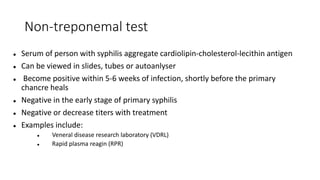
Non-treponemal test
 Serum of person with syphilis aggregate cardiolipin-cholesterol-lecithin antigen
 Can be viewed in slides, tubes or autoanlyser
 Become positive within 5-6 weeks of infection, shortly before the primary
chancre heals
 Negative in the early stage of primary syphilis
 Negative or decrease titers with treatment
 Examples include:
 Veneral disease research laboratory (VDRL)
 Rapid plasma reagin (RPR)
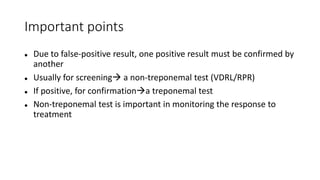
Important points
 Due to false-positive result, one positive result must be confirmed by
another
 Usually for screening a non-treponemal test (VDRL/RPR)
 If positive, for confirmationa treponemal test
 Non-treponemal test is important in monitoring the response to
treatment
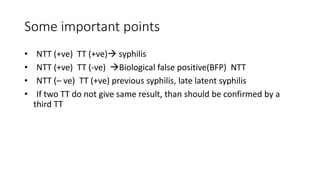
Some important points
• NTT (+ve) TT (+ve) syphilis
• NTT (+ve) TT (-ve) Biological false positive(BFP) NTT
• NTT (– ve) TT (+ve) previous syphilis, late latent syphilis
• If two TT do not give same result, than should be confirmed by a
third TT
Some data:
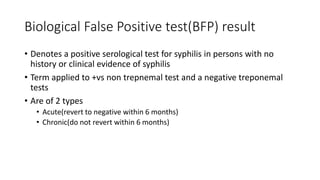
Biological False Positive test(BFP) result
• Denotes a positive serological test for syphilis in persons with no
history or clinical evidence of syphilis
• Term applied to +vs non trepnemal test and a negative treponemal
tests
• Are of 2 types
• Acute(revert to negative within 6 months)
• Chronic(do not revert within 6 months)
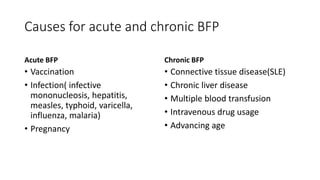
Causes for acute and chronic BFP
Acute BFP
• Vaccination
• Infection( infective
mononucleosis, hepatitis,
measles, typhoid, varicella,
influenza, malaria)
• Pregnancy
Chronic BFP
• Connective tissue disease(SLE)
• Chronic liver disease
• Multiple blood transfusion
• Intravenous drug usage
• Advancing age
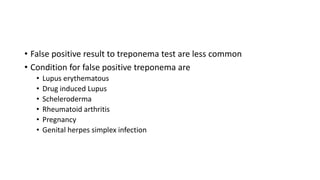
• False positive result to treponema test are less common
• Condition for false positive treponema are
• Lupus erythematous
• Drug induced Lupus
• Scheleroderma
• Rheumatoid arthritis
• Pregnancy
• Genital herpes simplex infection
CSF analysis in syphilis
 CSF evaluation are not routinely performed in asymptomatic patients
with syphilis
 CSF analysis is recommended when:
 Auditory, opthalmic or neurological symptoms
 HIV +ve with RPR >= 1:32
 Patient with latent syphilis and HIV +ve or failure of initial therapy
Other tests
 X-rays of the affected bone in osseous syphilis
 CT scan of the head for neurosyphilis
 Chest x-rays for aortic dilatation and syphilitic aortitis.
 Tests for other sexually transmitted infections like HIV, hepatitis B.
Treatment
Penicillin Therapy
• Penicillin G, administered parenterally, is the preferred drug for
treating all stages of syphilis
• The preparation used, dosage, and the length of treatment depend
on the stage and clinical manifestations
• The effectiveness of penicillin was well established through clinical
experience even before value of RCT was recognized
• Parenteral penicillin G is the only therapy with documented high
efficacy for syphilis during pregnancy
23
Primary, secondary or early latent(less than 1
year)
• Benzathine Penicillin G ,2.4 MU,
• Single dose
• Intramuscular injection
• If allergic to Penicilline(non pregnant, HIV negative)
• Tetracycline 500 mg, orally, 4 times a day
Or
• Doxycycline 100 mg, orally, twice daily
• If intolerable to above
• Ceftriaxone 1 gm IM or IV for 8-10 days
For 2 weeks
• Azithromycin and Erythromycine no longer used due to resistance
• Close follow up is recommended in patient treat with non-penicillin
based regimens
• Alternative regimens not recommended for patient with HIV and
syphilis
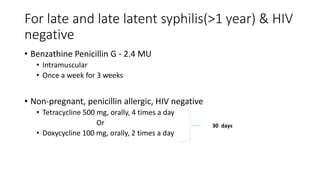
For late and late latent syphilis(>1 year) & HIV
negative
• Benzathine Penicillin G - 2.4 MU
• Intramuscular
• Once a week for 3 weeks
• Non-pregnant, penicillin allergic, HIV negative
• Tetracycline 500 mg, orally, 4 times a day
Or
• Doxycycline 100 mg, orally, 2 times a day
30 days
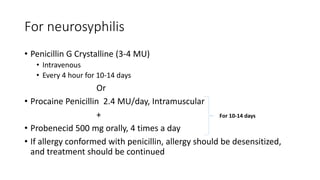
For neurosyphilis
• Penicillin G Crystalline (3-4 MU)
• Intravenous
• Every 4 hour for 10-14 days
Or
• Procaine Penicillin 2.4 MU/day, Intramuscular
+
• Probenecid 500 mg orally, 4 times a day
• If allergy conformed with penicillin, allergy should be desensitized,
and treatment should be continued
For 10-14 days
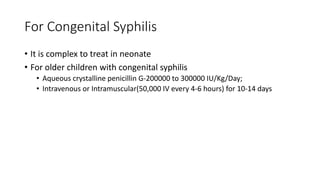
For Congenital Syphilis
• It is complex to treat in neonate
• For older children with congenital syphilis
• Aqueous crystalline penicillin G-200000 to 300000 IU/Kg/Day;
• Intravenous or Intramuscular(50,000 IV every 4-6 hours) for 10-14 days
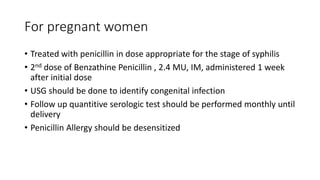
For pregnant women
• Treated with penicillin in dose appropriate for the stage of syphilis
• 2nd dose of Benzathine Penicillin , 2.4 MU, IM, administered 1 week
after initial dose
• USG should be done to identify congenital infection
• Follow up quantitive serologic test should be performed monthly until
delivery
• Penicillin Allergy should be desensitized
HIV positive patient(with primary and secondary
syphilis), non allergic, no neurologic or psychiatric
problem
• Benzathine penicillin G
• 2.4 MU
• IM
• For 3 weeks
• If allergic to penicillin
• Desensitize to allergy
• Follow up non treponemal test at 3, 6, 9 and 12 months
The Jarisch-Herxheimer Reaction
• An acute febrile reaction due to a rapid release of treponemal antigen
with an associated allergic reaction in the patient
• Caused by antisyphilitic treatment, especially penicilline
• Accompanied by headache, myalgia, fever, exacerbation of
inflammatory reaction at sites of localized spirochetal infection
• Usually occur within 6-8 hours of treatment
• Occurs most frequently among patients with early syphilis
• Antipyretics can be used to manage symptoms- not prevent
• Might induce early labor or cause fetal distress in pregnant women,
but this should not prevent or delay therapy
31
Treatment of sex partner
• Partner at risk
• Exposed within 90 days of diagnosis of primary, secondary or early latent
syphilis, Seronegative should also be treated
• If serologic titer of patient is greater than 1:32
• Treatment
• Benthine penicillin, 2.4 MU, IM, Single dose
Serological testing after treatment
 VDRL or RPR testing performed routinely to ensure appropriate
response
 For primary and secondary syphilis, HIV-negative, non-pregnant
patient, testing is repeated every 3 months in the first year, every 6
months in the second year, and yearly thereafter
 Four-fold decrease in titer is expected at 6 months in primary and
secondary (12-24 months in case of latent syphilis)
 If response is inadequate, HIV testing and CSF analysis is done
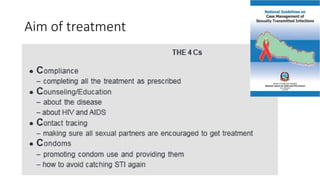
Aim of treatment
References
• RICHARD WELLER, HAMISH HUNTER AND MARGARET MANN. Clinical
Dermatology, FIFTH EDITION.
• James, William D. (William Daniel), Andrews’ Diseases of the skin : clinical
dermatology. — 11th ed.
• Up to date ver. 21
• CDC. Sexually Transmitted Disease Treatment Guidelines, 2010. CDC. 2010
(Available at: http://www.cdc.gov/mmwr/ pdf/rr/rr5912.pdf
• NCASC. National Guidelines on Case Management of Sexually Transmitted
Infections. NCASC. 2009: 58-61,77-78 (Available at:
http://www.ncasc.gov.np/ncasc/Operational%20guidelines/National%20gu
idelines%20on%20STI%20case%20management.pdf
Thank you!!

Management of syphilis

  • 1.
  • 2.
  • 3.
  • 4.
    Investigation • Tests todemonstrate the spirochete • Serology test
  • 5.
    Tests to demonstratethe spirochete  Dark field microscopy  Direct Fluorescent Antibody T. pallidum (DFA-TP) Test  Polymerase Chain Reaction
  • 6.
    Collection of samples The lesion is cleansed with water and dried  Grasped firmly between the thumb and index finger  Abraded sufficiently to cause clear or faintly blood- stained plasma to exude when squeezed  Surface of a clean coverslip is touched to the surface of the lesion so that plasma adheres  Then dropped on a slide and pressed down  The specimen is quickly examined
  • 7.
    Dark field microscopy Quickest and most direct method  Positive in primary and secondary syphilis  Sample can be taken from the primary chancre or papular lesions of secondary syphilis (mostly from condylomata lata)  Unreliable in oral cavity as T. pallidum can not be distinguished from oral saprophytic spirochetes  May be negative in patients treated with systemic or local antibiotics  Failure to identify do not exclude diagnosis of primary syphilis
  • 8.
     Motility canbe appreciated:  A projection in the direction of long axis  A rotation on its long axis  A bending or twisting from side to side  The precise uniformity of the spiral coils is not distorted during this movements
  • 9.
    Direct Fluorescent AntibodyT.pallidum (DFA- TP) test  Permit the identification of organism when smares can’t be examined immediately  Fluorescent antibodies angainst T.pallidum used for identification  Better than dark field microscopy as it is reliable in case of oral lesions as well  Air dry specimen of lymph nodes aspirate, genital mucosal lesion, and chancres are used
  • 10.
    Polymerase Chain Reaction The genetic sequence of T.pallidum has been traced  PCR is therefore 100% sensetive and specific for detecting T.pallidum  PCR can also diagnose other genital lesions at the same time  However, at present, its use is limited to clinical research only
  • 11.
    Serological tests • 2types • Treponemal • Non Treponemal
  • 12.
    Treponemal • Detect specificAnti treponemal antibodies • Have high specificity and sensitivity exceeding 95% • Examples include:  Enzyme immunoassay (EIA) for IgG and IgM  Fluorescent treponemal antiboy absorption (FTA-ABS)  Microhemagglutination assay T.pallidum (MHA-TP)  T.pallidum hemagglutination (TPHA)  T.pallidum particle agglutination (TPPA)  EIA IgM becomes +ve at 2-3 wks after infection (initial time of chancre development)  Except EIA IgM, other treponemal test remain positive for life in most of the patients.
  • 13.
    Non-treponemal test  Serumof person with syphilis aggregate cardiolipin-cholesterol-lecithin antigen  Can be viewed in slides, tubes or autoanlyser  Become positive within 5-6 weeks of infection, shortly before the primary chancre heals  Negative in the early stage of primary syphilis  Negative or decrease titers with treatment  Examples include:  Veneral disease research laboratory (VDRL)  Rapid plasma reagin (RPR)
  • 14.
    Important points  Dueto false-positive result, one positive result must be confirmed by another  Usually for screening a non-treponemal test (VDRL/RPR)  If positive, for confirmationa treponemal test  Non-treponemal test is important in monitoring the response to treatment
  • 15.
    Some important points •NTT (+ve) TT (+ve) syphilis • NTT (+ve) TT (-ve) Biological false positive(BFP) NTT • NTT (– ve) TT (+ve) previous syphilis, late latent syphilis • If two TT do not give same result, than should be confirmed by a third TT
  • 16.
  • 17.
    Biological False Positivetest(BFP) result • Denotes a positive serological test for syphilis in persons with no history or clinical evidence of syphilis • Term applied to +vs non trepnemal test and a negative treponemal tests • Are of 2 types • Acute(revert to negative within 6 months) • Chronic(do not revert within 6 months)
  • 18.
    Causes for acuteand chronic BFP Acute BFP • Vaccination • Infection( infective mononucleosis, hepatitis, measles, typhoid, varicella, influenza, malaria) • Pregnancy Chronic BFP • Connective tissue disease(SLE) • Chronic liver disease • Multiple blood transfusion • Intravenous drug usage • Advancing age
  • 19.
    • False positiveresult to treponema test are less common • Condition for false positive treponema are • Lupus erythematous • Drug induced Lupus • Scheleroderma • Rheumatoid arthritis • Pregnancy • Genital herpes simplex infection
  • 20.
    CSF analysis insyphilis  CSF evaluation are not routinely performed in asymptomatic patients with syphilis  CSF analysis is recommended when:  Auditory, opthalmic or neurological symptoms  HIV +ve with RPR >= 1:32  Patient with latent syphilis and HIV +ve or failure of initial therapy
  • 21.
    Other tests  X-raysof the affected bone in osseous syphilis  CT scan of the head for neurosyphilis  Chest x-rays for aortic dilatation and syphilitic aortitis.  Tests for other sexually transmitted infections like HIV, hepatitis B.
  • 22.
  • 23.
    Penicillin Therapy • PenicillinG, administered parenterally, is the preferred drug for treating all stages of syphilis • The preparation used, dosage, and the length of treatment depend on the stage and clinical manifestations • The effectiveness of penicillin was well established through clinical experience even before value of RCT was recognized • Parenteral penicillin G is the only therapy with documented high efficacy for syphilis during pregnancy 23
  • 24.
    Primary, secondary orearly latent(less than 1 year) • Benzathine Penicillin G ,2.4 MU, • Single dose • Intramuscular injection • If allergic to Penicilline(non pregnant, HIV negative) • Tetracycline 500 mg, orally, 4 times a day Or • Doxycycline 100 mg, orally, twice daily • If intolerable to above • Ceftriaxone 1 gm IM or IV for 8-10 days For 2 weeks
  • 25.
    • Azithromycin andErythromycine no longer used due to resistance • Close follow up is recommended in patient treat with non-penicillin based regimens • Alternative regimens not recommended for patient with HIV and syphilis
  • 26.
    For late andlate latent syphilis(>1 year) & HIV negative • Benzathine Penicillin G - 2.4 MU • Intramuscular • Once a week for 3 weeks • Non-pregnant, penicillin allergic, HIV negative • Tetracycline 500 mg, orally, 4 times a day Or • Doxycycline 100 mg, orally, 2 times a day 30 days
  • 27.
    For neurosyphilis • PenicillinG Crystalline (3-4 MU) • Intravenous • Every 4 hour for 10-14 days Or • Procaine Penicillin 2.4 MU/day, Intramuscular + • Probenecid 500 mg orally, 4 times a day • If allergy conformed with penicillin, allergy should be desensitized, and treatment should be continued For 10-14 days
  • 28.
    For Congenital Syphilis •It is complex to treat in neonate • For older children with congenital syphilis • Aqueous crystalline penicillin G-200000 to 300000 IU/Kg/Day; • Intravenous or Intramuscular(50,000 IV every 4-6 hours) for 10-14 days
  • 29.
    For pregnant women •Treated with penicillin in dose appropriate for the stage of syphilis • 2nd dose of Benzathine Penicillin , 2.4 MU, IM, administered 1 week after initial dose • USG should be done to identify congenital infection • Follow up quantitive serologic test should be performed monthly until delivery • Penicillin Allergy should be desensitized
  • 30.
    HIV positive patient(withprimary and secondary syphilis), non allergic, no neurologic or psychiatric problem • Benzathine penicillin G • 2.4 MU • IM • For 3 weeks • If allergic to penicillin • Desensitize to allergy • Follow up non treponemal test at 3, 6, 9 and 12 months
  • 31.
    The Jarisch-Herxheimer Reaction •An acute febrile reaction due to a rapid release of treponemal antigen with an associated allergic reaction in the patient • Caused by antisyphilitic treatment, especially penicilline • Accompanied by headache, myalgia, fever, exacerbation of inflammatory reaction at sites of localized spirochetal infection • Usually occur within 6-8 hours of treatment • Occurs most frequently among patients with early syphilis • Antipyretics can be used to manage symptoms- not prevent • Might induce early labor or cause fetal distress in pregnant women, but this should not prevent or delay therapy 31
  • 32.
    Treatment of sexpartner • Partner at risk • Exposed within 90 days of diagnosis of primary, secondary or early latent syphilis, Seronegative should also be treated • If serologic titer of patient is greater than 1:32 • Treatment • Benthine penicillin, 2.4 MU, IM, Single dose
  • 33.
    Serological testing aftertreatment  VDRL or RPR testing performed routinely to ensure appropriate response  For primary and secondary syphilis, HIV-negative, non-pregnant patient, testing is repeated every 3 months in the first year, every 6 months in the second year, and yearly thereafter  Four-fold decrease in titer is expected at 6 months in primary and secondary (12-24 months in case of latent syphilis)  If response is inadequate, HIV testing and CSF analysis is done
  • 34.
  • 35.
    References • RICHARD WELLER,HAMISH HUNTER AND MARGARET MANN. Clinical Dermatology, FIFTH EDITION. • James, William D. (William Daniel), Andrews’ Diseases of the skin : clinical dermatology. — 11th ed. • Up to date ver. 21 • CDC. Sexually Transmitted Disease Treatment Guidelines, 2010. CDC. 2010 (Available at: http://www.cdc.gov/mmwr/ pdf/rr/rr5912.pdf • NCASC. National Guidelines on Case Management of Sexually Transmitted Infections. NCASC. 2009: 58-61,77-78 (Available at: http://www.ncasc.gov.np/ncasc/Operational%20guidelines/National%20gu idelines%20on%20STI%20case%20management.pdf
  • 36.