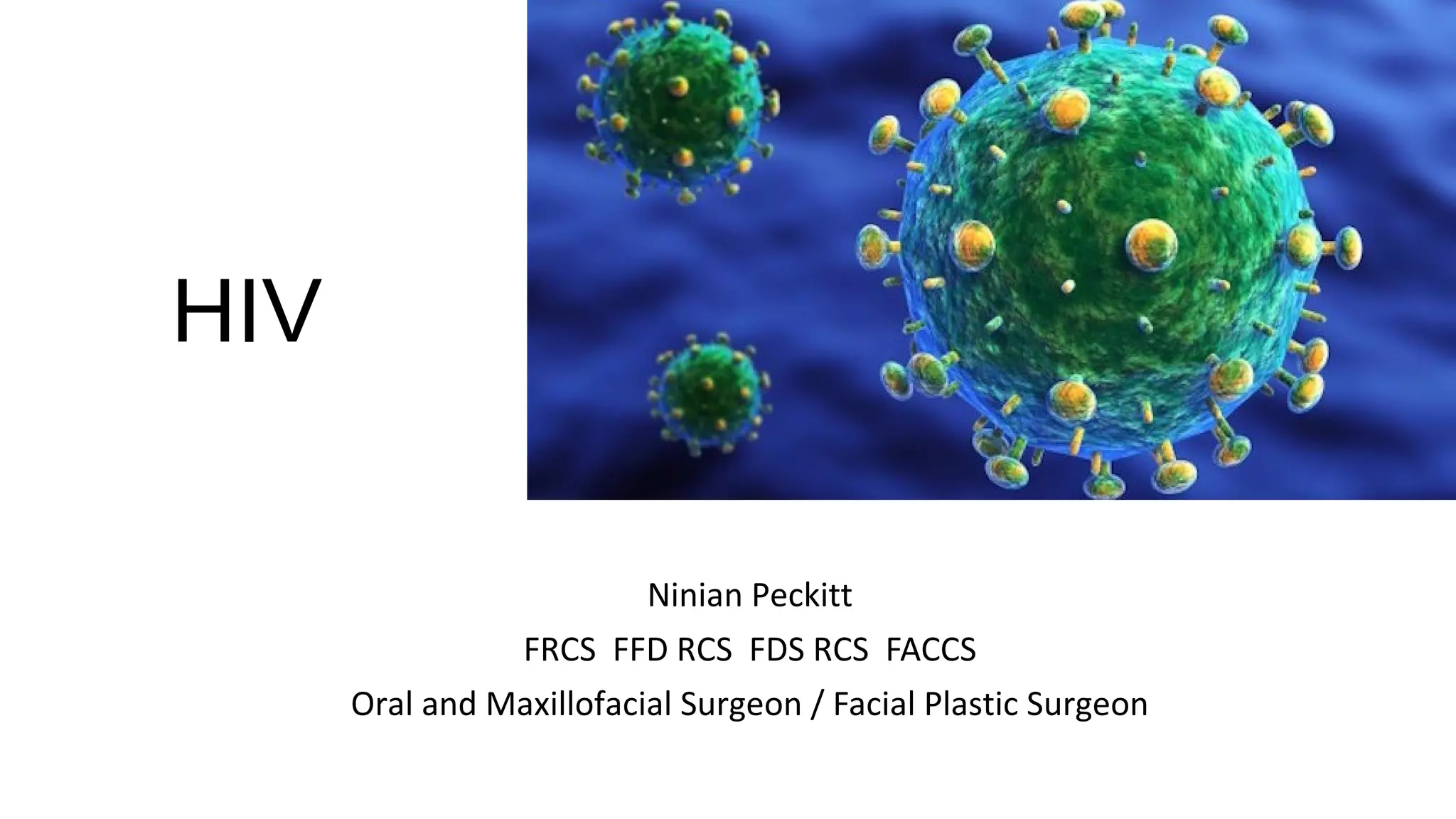
HIV
Ninian Peckitt
FRCS FFD RCS FDS RCS FACCS
Oral and Maxillofacial Surgeon / Facial Plastic Surgeon
HIV 1 and HIV2
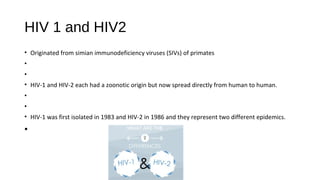
• Originated from simian immunodeficiency viruses (SIVs) of primates
•
•
• HIV-1 and HIV-2 each had a zoonotic origin but now spread directly from human to human.
•
•
• HIV-1 was first isolated in 1983 and HIV-2 in 1986 and they represent two different epidemics.
•
HIV 1 and HIV2
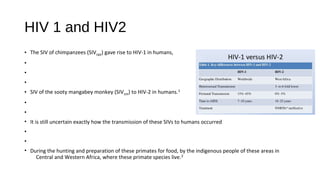
• The SIV of chimpanzees (SIVcpz) gave rise to HIV-1 in humans,
•
•
•
• SIV of the sooty mangabey monkey (SIVsm) to HIV-2 in humans.1
•
•
• It is still uncertain exactly how the transmission of these SIVs to humans occurred
•
•
• During the hunting and preparation of these primates for food, by the indigenous people of these areas in
Central and Western Africa, where these primate species live.2
HIV 1 and HIV2
•
•
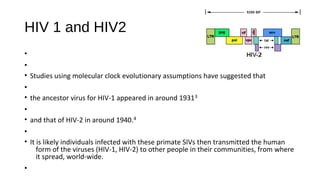
• Studies using molecular clock evolutionary assumptions have suggested that
•
• the ancestor virus for HIV-1 appeared in around 19313
•
• and that of HIV-2 in around 1940.4
•
• It is likely individuals infected with these primate SIVs then transmitted the human
form of the viruses (HIV-1, HIV-2) to other people in their communities, from where
it spread, world-wide.
•
Classification of HIV
• HIV-1 and HIV-2: members of the family of Retroviruses, in the genus of Lentiviruses
•
• Retroviruses: in vertebrates species, associated with a wide variety of diseases:
•
ümalignancies
üautoimmune diseases
üimmunodeficiency syndromes,
üaplastic and haemolytic anaemias,
übone and joint disease
üdiseases of the nervous system.1
•
Classification of HIV
• The many different strains of HIV-1 have been separated into
different groups:
•
ümajor (M)
ünew (N)
üoutlier (O)
ü
which may represent three separate zoonotic transfers from chimpanzees.
ü
•
Classification of HIV
• Groups N and O are mainly confined to West and Central Africa (Gabon and Cameroon),
•
• though cases of Group O have been found world-wide due to international travel, after
contact with infected individuals from these areas.
•
• The HIV strains in Group M are the ones mainly responsible for the HIV/AIDS pandemic,
and they are so diverse that they have been subclassified into subtypes (or clades) A-K.
•
• This huge diversity of HIV-1 is important when diagnostic testing, treatment and
monitoring are applied as the results may differ between different subtypes or clades
•
• The diversity of HIV-2 is much less, but subtypes A-H have been proposed.5
•
Structure of HIV
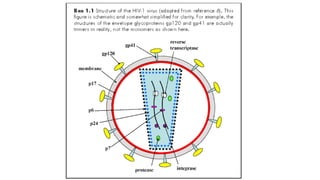
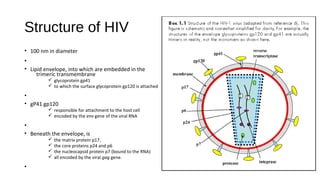
• 100 nm in diameter
•
• Lipid envelope, into which are embedded in the
trimeric transmembrane
ü glycoprotein gp41
ü to which the surface glycoprotein gp120 is attached
•
• gP41 gp120
ü responsible for attachment to the host cell
ü encoded by the env gene of the viral RNA
•
• Beneath the envelope, is
ü the matrix protein p17,
ü the core proteins p24 and p6
ü the nucleocapsid protein p7 (bound to the RNA)
ü all encoded by the viral gag gene.
•
Structure of HIV – Within the Viral Core
•
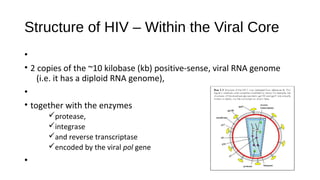
• 2 copies of the ~10 kilobase (kb) positive-sense, viral RNA genome
(i.e. it has a diploid RNA genome),
•
• together with the enzymes
üprotease,
üintegrase
üand reverse transcriptase
üencoded by the viral pol gene
•
Structure of HIV – Within the Viral Core
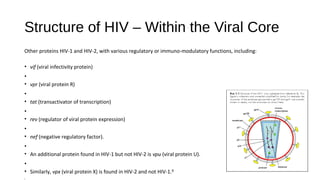
Other proteins HIV-1 and HIV-2, with various regulatory or immuno-modulatory functions, including:
• vif (viral infectivity protein)
•
• vpr (viral protein R)
•
• tat (transactivator of transcription)
•
• rev (regulator of viral protein expression)
•
• nef (negative regulatory factor).
•
• An additional protein found in HIV-1 but not HIV-2 is vpu (viral protein U).
•
• Similarly, vpx (viral protein X) is found in HIV-2 and not HIV-1.6
•
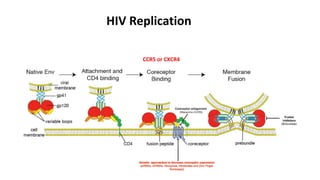
HIV Replication
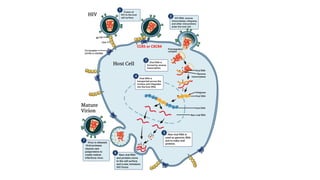
• The main attachment receptor for HIV is the CD4 molecule
•
• CD4 is present on CD4 positive T (helper) lymphocytes,
macrophages, and microglial cells
•
• The viral gp120 binds initially to this CD4 molecule, which then
triggers a conformational change in the host-cell envelope that
allows binding of the co-receptor (either CCR5 or CXCR4) which is
required for fusion between virus envelope and cell membrane.
•
CCR5 or CXCR4
HIV Replication
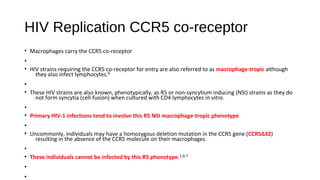
• Macrophages carry the CCR5 co-receptor
•
• HIV strains requiring the CCR5 co-receptor for entry are also referred to as macrophage-tropic although
they also infect lymphocytes.6
•
• These HIV strains are also known, phenotypically, as R5 or non-syncytium inducing (NSI) strains as they do
not form syncytia (cell-fusion) when cultured with CD4 lymphocytes in vitro.
•
• Primary HIV-1 infections tend to involve this R5 NSI macrophage-tropic phenotype
•
• Uncommonly, individuals may have a homozygous deletion mutation in the CCR5 gene (CCR5Δ32)
resulting in the absence of the CCR5 molecule on their macrophages.
•
• These individuals cannot be infected by this R5 phenotype.1,6,7
•
•
HIV Replication CCR5 co-receptor
HIV Replication CXCR4
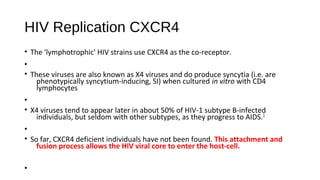
• The 'lymphotrophic' HIV strains use CXCR4 as the co-receptor.
•
• These viruses are also known as X4 viruses and do produce syncytia (i.e. are
phenotypically syncytium-inducing, SI) when cultured in vitro with CD4
lymphocytes
•
• X4 viruses tend to appear later in about 50% of HIV-1 subtype B-infected
individuals, but seldom with other subtypes, as they progress to AIDS.1
•
• So far, CXCR4 deficient individuals have not been found. This attachment and
fusion process allows the HIV viral core to enter the host-cell.
•
Reverse Transcriptase
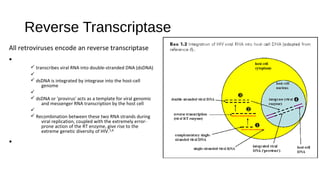
All retroviruses encode an reverse transcriptase
•
ü transcribes viral RNA into double-stranded DNA (dsDNA)
ü
ü dsDNA is integrated by integrase into the host-cell
genome
ü
ü dsDNA or 'provirus' acts as a template for viral genomic
and messenger RNA transcription by the host cell
ü
ü Recombination between these two RNA strands during
viral replication, coupled with the extremely error-
prone action of the RT enzyme, give rise to the
extreme genetic diversity of HIV.1,6
•
❶
❷
❸
❹
Integration of dsDNA into Cell Genome
•
• establishes an infection that lasts for the lifespan of the cell, and all its progeny
•
• Usually means life-long infection for the organism, in this case the human host.
•
• Viral replication occurs along with cellular replication and is enhanced by various factors, including
•
ü coinfection with other organisms
ü
ü the presence of inflammatory cytokines and cellular activation.
During Cellular Replication
• the provirus is transcribed by the host-cell RNA polymerase II enzyme
•
• the viral messenger RNA (vmRNA) and genomic RNA, are carried with the cellular mRNAs, to be translated into proteins.
•
• This vmRNA codes for a gag-pol precursor polypeptide that is ultimately cleaved by the viral-encoded protease enzyme to
produce the gag and pol viral proteins
•
• vmRNA is also spliced to produce other vmRNAs coding for the viral proteins
ü
ü tat, rev, vif, vpr, vpu (for HIV-1), as well as the env precursor polypeptide
•
• env precursor polypeptide is cleaved by cellular (not viral) proteases, producing the envelope glycoproteins gp41 and gp120
•
• Viral proteins and replicated diploid viral genomic RNA, are assembled and enveloped by budding through the host-cell
membrane, producing complete HIV virions.6
•
CCR5 or CXCR4
HIV Natural History
• Declining peripheral blood CD4 lymphocyte counts,
•
• wasting disease
•
• neurological disease (infection of macrophages and microglia)
HIV Natural History
• Primary HIV infection, only about 50% of infected individuals are symptomatic with fever and lymphadenopathy.
•
• After seroconversion (when anti-HIV antibodies are detectable), there follows an asymptomatic period of 2-15
yrs
•
• During this period, viral replication is continuing at a high rate of
•
ü up to 1010 infectious virions/day
ü leading to approximately 108-109 lymphocytes/day being infected, which are replaced almost as quickly.
•
• It is therefore remarkable that the rate of CD4 lymphocyte depletion is not more rapid than observed.1
•
• This rapid turnover of HIV and its enormous diversity underlie the difficulty in producing antiretroviral drugs with
long-term efficacy, and is one of many problems facing the development of an effective vaccine against HIV.8
•
HIV Natural History
Depletion of HIV-infected lymphocytes occurs through several mechanisms
•
a. direct cytopathic effect of HIV, including the formation of syncytia by SI X4 HIV
lymphotropic strains,
b.
c.
d. immune destruction of HIV-infected cells by cytotoxic CD8 T lymphocytes that
recognise HIV antigens presented on major histocompatibility complex (MHC)
molecules
e.
f.
g. apoptosis due to lymphocyte activation in the presence of specific cytokines.1
HIV Natural History
• Genetic makeup and immune system response to HIV infection can affect disease
progression and outcome.
•
• Individuals with certain human lymphocyte antigen (HLA) types, disease progression has
been found to be:
•
ümore rapid (e.g. patients with HLA-1 B8 DR3)
üor slower (e.g. Caucasians with HLA B27)
•
• In addition, the HIV virion incorporates many host-cell molecules into its envelope
including HLA and MHC peptides
ü
ümay act to enhance the host immune system activation, with more activated lymphocytes and
enhancing the infectivity of HIV.1,6
•
HIV Natural Course of Disease
In the absence of antiretroviral therapy
•
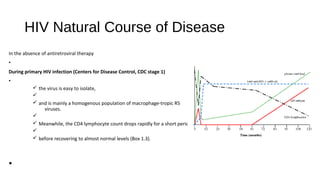
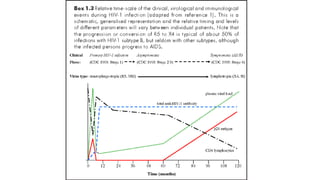
During primary HIV infection (Centers for Disease Control, CDC stage 1)
•
ü the virus is easy to isolate,
ü
ü and is mainly a homogenous population of macrophage-tropic R5
viruses.
ü
ü Meanwhile, the CD4 lymphocyte count drops rapidly for a short period
ü
ü before recovering to almost normal levels (Box 1.3).
•
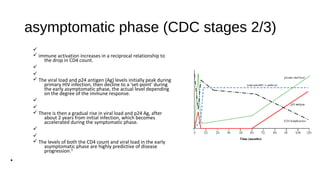
asymptomatic phase (CDC stages 2/3)
ü
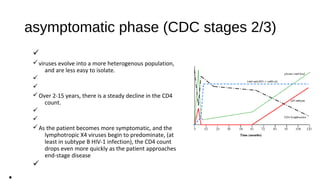
üviruses evolve into a more heterogenous population,
and are less easy to isolate.
ü
ü
üOver 2-15 years, there is a steady decline in the CD4
count.
ü
ü
üAs the patient becomes more symptomatic, and the
lymphotropic X4 viruses begin to predominate, (at
least in subtype B HIV-1 infection), the CD4 count
drops even more quickly as the patient approaches
end-stage disease
ü
asymptomatic phase (CDC stages 2/3)
ü
ü immune activation increases in a reciprocal relationship to
the drop in CD4 count.
ü
ü
ü The viral load and p24 antigen (Ag) levels initially peak during
primary HIV infection, then decline to a 'set-point' during
the early asymptomatic phase, the actual level depending
on the degree of the immune response.
ü
ü
ü There is then a gradual rise in viral load and p24 Ag, after
about 2 years from initial infection, which becomes
accelerated during the symptomatic phase.
ü
ü
ü The levels of both the CD4 count and viral load in the early
asymptomatic phase are highly predictive of disease
progression.1
•
HIV Natural History
• HIV antibodies (Ab) rise to max within 3-6 months after initial infection, remaining detectable for the duration of the disease.
•
• However, there are antibody subsets (anti-p24 antibodies), that do decline and may be indicative of disease progression.
•
• Markers of immune system activation, eg (TNF) can be as useful as viral load in predicting disease prognosis.
•
• Antiretroviral therapy, and the suppression of viral loads to undetectable level, the antigenic stimulus has been removed in such patients, resulting in a
decline in the level of anti-HIV antibodies.
•
• In some patients, phases of natural HIV infection accelerate/merge Rapid Progressors
ü HIV load remains high or increases with the p24 Ag,
ü the CD4 count drops quickly
ü patients progress to end-stage disease in less than 5 years
•
• Alternatively, there are patients who remain clinically well in the asymptomatic phase, with normal CD4 counts and low or undetectable viral loads, without
the need for antiretroviral therapy.
•
• Such contrasting presentations in response to HIV infection may just represent the extremes of a population normal distribution.1
HIV global genetic diversity and epidemiology
• The viral diversity of HIV-1 (mainly due to an RNA replication error rate of about 1:104 bases) has
given rise to a complex classification system for the M group of HIV-1 viruses.
• Within the M group, there are multiple subtypes, currently: A, B, C, D, F, G, H, J, K and CRFs
(circulating recombinant forms).
• Subtypes E and I are missing from this list because the viruses that were initially classified as E
and I have since been reclassified as CRF01_AE and CRF04_cpx. This latter virus, originally
named subtype I, is in fact a mixture of subtypes A, G, H and K, though the term subtype I is no
longer used.9-11 It was first identified in Cyprus and Greece in the early 1990s and has spread
within the Mediterranean region.11,12
• Such recombinant forms may be formed when two HIV-1 viruses of different subtypes infect the
same cell allowing their genomes to mix during replication to create a new hybrid virus
(occasionally referred to as viral sex).11,13
• Many such hybrid viruses do not survive long, but if they manage to infect more than one person,
they are termed CRFs, e.g. CRF01_AE is a mixture of subtypes A and E. In this particular
example, there has been no pure E form of the virus yet found, so the terminology here is not
technically correct. However, it has been so widely used that the name has remained, as
changing it may lead to confusion.11,12
•
HIV-1 Subtypes
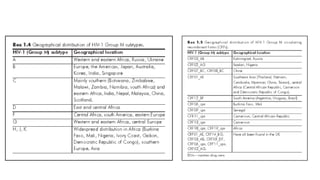
Like the HIV groups M, N and O, the different subtypes and CRFs have some distinct geographical distributions.
• Subtype A has been responsible for 80% of the HIV infections in Western Africa and 30% in Eastern Africa. In Europe, it has been spreading out from
countries of the former Soviet Union since 1995, particularly from Russia and the Ukraine.11,12,14
• Subtype B is the most common subtype in Europe, the Americas, Japan and Australia. This is still the case, although other subtypes are increasing in
prevalence, accounting for at least 25% of new infections in Europe. Subtype B has also been the predominant subtype in some Asian countries,
including Korea, India and Singapore.12 Subtype B viruses seem to be more efficiently transmitted via homosexual contact and intravenous drug use
(i.e. via blood contact), whereas subtypes C and CRF01_AE (see below) tend to drive heterosexual epidemics.11,15,16 This has however not yet been
conclusively proven.11,17,18
• Subtype C is mainly found in southern and eastern Africa, India and Nepal. It has now caused the world's worst epidemics (being the main subtype in
these highly populated, developing countries, with poor healthcare infrastructures), accounting for about 60% of all HIV infections, worldwide, but
mainly in east Africa and south Asia. It has also been reported from Malaysia and southwest China, possibly due to links with India. Recently,
subtype C has been causing more infections in southern Africa (Botswana, Zimbabwe, Malawi, Zambia, Namibia and South Africa). In Scotland,
subtype C infections have been increasing since 2000, probably due to imported infections from these African and Asian countries.12 A study of sex
workers from Senegal found that women infected with subtypes C, D or G were more likely to develop AIDS within 5 years of infection than those
infected with subtype A.11,19
• Subtype D has caused 5-40% of HIV infections in east and central Africa, where it has been con-circulating with subtype A. At least one study from
Uganda has shown that individuals infected with subtype D or CRFs including subtype D tended to develop AIDS and died sooner than those
infected with subtype A.11,20 Different subtypes may affect the efficiency of vertical transmission from mother-to-child though many studies disagree
with each other over these findings.11,21-27
• Subtype F has been found in central Africa, south America and eastern Europe (particularly Romania). Subtypes G and CRF_A/G have been reported
from western and eastern Africa and central Europe. Subtypes A, G, H, J and K have been found to be prevalent in Burkina Faso, Mali, Nigeria, Ivory
Coast, Gabon and Democratic Republic of Congo, from where they have spread to southern Europe and Asia.11,12
•
HIV-1 circulating recombinant forms (CRFs)
• With CRFs there are about 20 that have been currently described. The formal requirement for a CRF is the existence of at least 3 epidemiologically
independent complete genome sequences that share the same recombinant structure and form a monophyletic cluster in all regions of the
genome. Alternatively, it should produce two complete genome sequences with partial sequences of a third strain that cluster with complete
genome sequences, sharing identical breakpoints. Monophyletic groups (also known as 'clades') are groups containing species which are more
closely related (in terms of sequence homology) to each other than to any species outside of this group. CRF03_AB (meaning the 3rd occurrence of
this CRF in a person, combining subtypes A and B) has been reported from Kaliningrad, Russia in an HIV epidemic involving IDUs in the mid 1990s.
This virus has since spread all over Eastern Europe. Further analysis showed that the parent subtypes A and B viruses probably came from
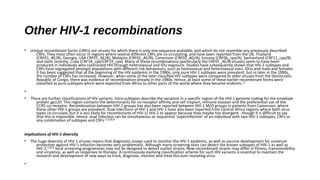
Ukrainian IDUs. CRF02_AG was first found in Ibadan, Nigeria, and became epidemic predominantly in west and west central Africa, where it
represents 50-70% of the circulating strains. From Africa, this virus has been imported into Europe where it is now spreading throughout France,
Belgium, Italy and the UK. UK seems to be a melting pot for CRF HIV strains, as multiple CRFs have been reported from there, including: CRF01_AE,
CRF14_BG, CRF03_AB, CRF05_DF, CRF06_cpx, CRF11_cpx and CRF02_AG.12
•
• CRF07_BC and CRF08_BC have been found in China, probably originating from a recombination between the subtype C virus imported from India and
the endemic subtype B virus in China. However, CRF01_AE has been responsible for the explosive epidemic in Southeast Asia in Thailand, Vietnam,
Cambodia, Myanmar, China and Taiwan. In some countries, such as Vietnam and Thailand, the majority of these infections have been found IDUs.12
•
• Interestingly, the CRF01_AE virus seems to have originated from several countries in central Africa (Central African Republic, Cameroon and the
Democratic Republic of Congo) where it has been reported at low frequency only. Exactly why this same CRF has caused the rapidly spreading
epidemic in Southeast Asia requires further investigation. CRF12_BF has been reported from Argentina, Uruguay and Brazil, mainly in the
heterosexual population and vertically-infected children. CRF06_cpx has been reported from Burkina Faso and Mali and is composed of fragments
from subtypes A, G, J and K. CRF09_cpx has been found in Senegal and consists of fragments from subtypes A, C and D. Similarly, CRF11_cpx is
composed of fragments from subtypes A, G and J, as well as CRF01_AE, and has been observed in Cameroon and the Central African Republic.
CRF13_cpx was recently discovered in Cameroon and is a mosaic of subtypes A, G, J and CRF01_AE, but with a different subtype J from that in
CRF11_cpx, which was found in the Democratic Republic of Congo. CRF18_cpx and CRF19_cpx have also been recently described, which include
multiple segments from African subtypes A, D, G and H viruses.12
•
Other HIV-1 recombinations
• Unique recombinant forms (URFs) are viruses for which there is only one sequence available, and which do not resemble any previously described
CRFs. They most often occur in regions where several different CRFs are co-circulating, and have been reported from the UK, Thailand
(CRF01_AE/B), Georgia, USA CRF01_AE/B), Malaysia (CRF01_AE/B), Cameroon (CRF02_AG/A), Estonia (CRF06_cpx/A), Switzerland (CRF11_cpx/B)
and most recently, Cuba (CRF18_cpx/CRF19_cpx). Many of these recombinations (particularly the CRF01_AE/B viruses) seem to have been
produced in individuals who contracted HIV through heterosexual and IDU exposure. Studies have subsequently shown that HIV-1 subtypes and
CRFs have segregated amongst populations with different risk behaviours, such as homosexual and heterosexual men, IDUs and male and females.
It has been suggested that at the beginning of the HIV epidemic in the 1980s, only pure HIV-1 subtypes were prevalent, but in later in the 1990s,
the number of CRFs has increased. However, when some of the later classified HIV subtypes were compared to older viruses from the Democratic
Republic of Congo, there was evidence of recombination already in the 1980s. Hence, at least some of these earlier recombinant forms were
classified as pure subtypes which were exported from Africa to other parts of the world where they became endemic.12
•
• There are further classifications of HIV variants. Intra-subtypes describe the variation in a specific region of the HIV-1 genome coding for the envelope
protein gp120. This region contains the determinants for co-receptor affinity and cell tropism, immune evasion and the preferential use of the
CCR5 co-receptor. Recombination between HIV-1 groups has also been reported between HIV-1 M/O groups in patients from Cameroon, where
these other HIV-1 groups are prevalent. Dual infections of HIV-1 and HIV-1 have also been reported from Central Africa regions where both virus
types co-circulate, but it is less likely for recombinants of HIV-1/ HIV-2 to appear because they maybe too divergent - though it is difficult to say
that this is impossible. Hence, dual infection can be simultaneous or sequential 'superinfection' of an individual with two HIV-1 subtypes, CRFs or
any combination of subtypes and CRFs.11,12,28,29
Implications of HIV-1 diversity
• The huge diversity of HIV-1 viruses means that diagnostic assays used to monitor the HIV-1 epidemic, as well as vaccine development for universal
protection against HIV-1 infection becomes very problematic. Although many screening tests can detect the known subtypes of HIV-1 as well as
HIV-2,11,30-32 local screening programmes may not be designed to detect outlier strains. New recombinant strains may differ in fitness, transmissibility
and virulence, as well as responses to therapy. A continuously evolving classification scheme for such HIV variants is essential to maintain the
research and development of new ways to track, diagnose, monitor and treat this ever-mutating virus.
•
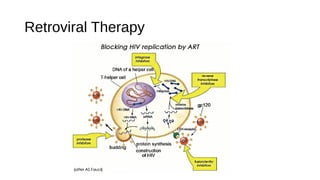
Retroviral Therapy
• The first drug developed was AZT (zidovudine) in 1987,
•
• Highly active antiretroviral therapy (HAART) is now regarded as the
most effective drug treatment for reducing morbidity and mortality
rates in HIV infected persons (Bailey 2008, Montessori et al. 2004).
•
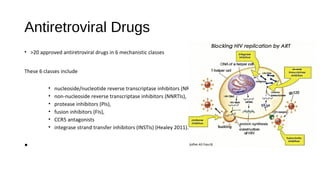
Antiretroviral Drugs
• >20 approved antiretroviral drugs in 6 mechanistic classes
These 6 classes include
• nucleoside/nucleotide reverse transcriptase inhibitors (NRTIs),
• non-nucleoside reverse transcriptase inhibitors (NNRTIs),
• protease inhibitors (PIs),
• fusion inhibitors (FIs),
• CCR5 antagonists
• integrase strand transfer inhibitors (INSTIs) (Healey 2011).
•
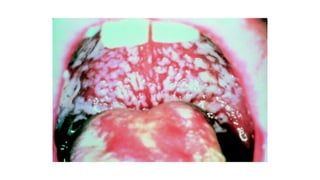
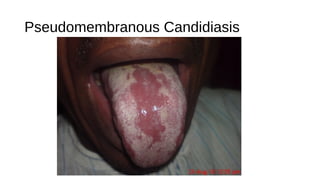
Pseudomembranous Candidiasis
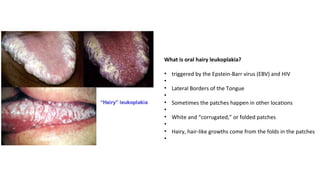
What is oral hairy leukoplakia?
• triggered by the Epstein-Barr virus (EBV) and HIV
•
• Lateral Borders of the Tongue
•
• Sometimes the patches happen in other locations
•
• White and “corrugated,” or folded patches
•
• Hairy, hair-like growths come from the folds in the patches
•
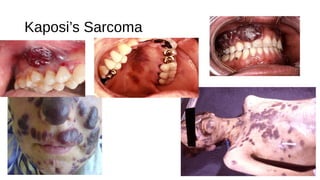
Kaposi’s Sarcoma
Kaposi’s Sarcoma – Hepres Virus Type 8
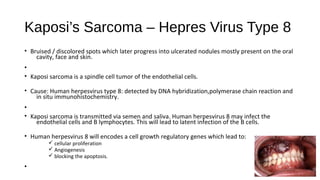
• Bruised / discolored spots which later progress into ulcerated nodules mostly present on the oral
cavity, face and skin.
•
• Kaposi sarcoma is a spindle cell tumor of the endothelial cells.
• Cause: Human herpesvirus type 8: detected by DNA hybridization,polymerase chain reaction and
in situ immunohistochemistry.
•
• Kaposi sarcoma is transmitted via semen and saliva. Human herpesvirus 8 may infect the
endothelial cells and B lymphocytes. This will lead to latent infection of the B cells.
• Human herpesvirus 8 will encodes a cell growth regulatory genes which lead to:
ü cellular proliferation
ü Angiogenesis
ü blocking the apoptosis.
•
Kaposi’s Sarcoma – Hepres Virus Type 8
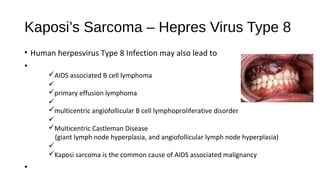
• Human herpesvirus Type 8 Infection may also lead to
•
üAIDS associated B cell lymphoma
ü
üprimary effusion lymphoma
ü
ümulticentric angiofollicular B cell lymphoproliferative disorder
ü
üMulticentric Castleman Disease
(giant lymph node hyperplasia, and angiofollicular lymph node hyperplasia)
ü
üKaposi sarcoma is the common cause of AIDS associated malignancy
•
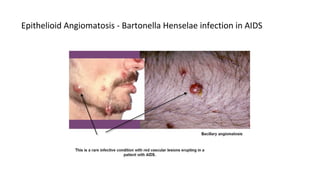
Epithelioid Angiomatosis - Bartonella Henselae infection in AIDS
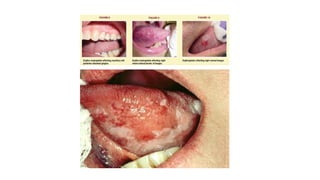
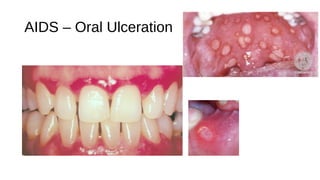
AIDS – Oral Ulceration
References
Weiss RA, Dalgleish AG, Loveday C, Pillay D. Human Immunodeficiency Viruses. In: Zuckerman AJ, Banatvala JE, Pattison JR, Griffiths PD, Schoub BD (eds). Principles and Practice of Clinical Virology. 5th ed. 2004. Chichester: John Wiley & Sons Ltd, pp721-57.
Kalish ML, Wolfe ND, Ndongmo CB, et al. Central African hunters exposed to simian immunodeficiency virus. Emerg Infect Dis 2005;11:1928-30.
Korber B, Muldoon M, Theiler J, et al. Timing the ancestor of the HIV-1 pandemic strains. Science 2000;288:1789-96.
Lemey P, Pybus OG, Wang B, Saksena NK, Salemi M, Vandamme AM. Tracing the origin and history of the HIV-2 epidemic. Proc Natl Acad Sci U S A 2003;100:6588-92.
Damond F, Worobey M, Campa P, et al. Identification of a highly divergent HIV type 2 and proposal for a change in HIV type 2 classification. AIDS Res Hum Retroviruses 2004;20:666-72.
Cleghorn FR, Reitz MS, Popovic M, Gallo RC. Human Immunodeficiency Viruses. In: Mandell GL, Bennett JE, Dolin R (eds). Principles and Practice of Infectious Diseases. 6th ed. 2005. Philadelphia: Churchill Livingstone, pp2119-2133.
Hladik F, Liu H, Speelmon E, et al. Combined effect of CCR5-Delta32 heterozygosity and the CCR5 promoter polymorphism -2459 A/G on CCR5 expression and resistance to human immunodeficiency virus type 1 transmission. J Virol 2005;79:11677-84.
Gallo RC. The end or the beginning of the drive to an HIV-preventive vaccine: a view from over 20 years. Lancet 2005;366:1894-8.
Gao F, Robertson DL, Carruthers CD, et al. An isolate of human immunodeficiency virus type 1 originally classified as subtype I represents a complex mosaic comprising three different group M subtypes (A, G, and I). J Virol 1998;72:10234-41.
Los Alamos National Laboratory. The Circulating Recombinant Forms (CRFs). Los Alamos National Laboratory web site, http://www.hiv.lanl.gov/content/hiv-db/CRFs/CRFs.html.
Noble R. Introduction to HIV types, groups and subtypes. 2006. Accessed from: http://www.avert.org/hivtypes.htm
Requejo HI. Worldwide molecular epidemiology of HIV. Rev Saude Publica 2006;40:331-45.
Burke DS. Recombination in HIV: an important viral evolutionary strategy. Emerg Infect Dis 1997;3:253-9.
Bobkov AF, Kazennova EV, Selimova LM, et al. Temporal trends in the HIV-1 epidemic in Russia: predominance of subtype A. J Med Virol 2004;74:191-6.
Bhoopat L, Eiangleng L, Rugpao S, et al. In vivo identification of Langerhans and related dendritic cells infected with HIV-1 subtype E in vaginal mucosa of asymptomatic patients. Mod Pathol 2001;14:1263-9.
Essex M. Retroviral vaccines: challenges for the developing world. AIDS Res Hum Retroviruses 1996;12:361-3.
Pope M, Frankel SS, Mascola JR, et al. Human immunodeficiency virus type 1 strains of subtypes B and E replicate in cutaneous dendritic cell-T-cell mixtures without displaying subtype-specific tropism. J Virol 1997;71:8001-7.
Dittmar MT, Simmons G, Hibbitts S, et al. Langerhans cell tropism of human immunodeficiency virus type 1 subtype A through F isolates derived from different transmission groups. J Virol 1997;71:8008-13.
Kanki PJ, Hamel DJ, Sankale JL, et al. Human immunodeficiency virus type 1 subtypes differ in disease progression. J Infect Dis 1999;179:68-73.
•
References
Laeyendecker O, Li X, Arroyo M et al. The Effect of HIV Subtype on Rapid Disease Progression in Rakai, Uganda. 13th Conference on Retroviruses and Opportunistic Infections.
February 2006. Abstract no. 44LB.
Yang C, Li M, Newman RD, et al. Genetic diversity of HIV-1 in western Kenya: subtype-specific differences in mother-to-child transmission. AIDS 2003;17:1667-74.
Blackard JT, Renjifo B, Fawzi W, et al. HIV-1 LTR subtype and perinatal transmission. Virology 2001;287:261-5.
Renjifo B, Gilbert P, Chaplin B, et al. Preferential in-utero transmission of HIV-1 subtype C as compared to HIV-1 subtype A or D. AIDS 2004;18:1629-36.
Murray MC, Embree JE, Ramdahin SG, Anzala AO, Njenga S, Plummer FA. Effect of human immunodeficiency virus (HIV) type 1 viral genotype on mother-to-child transmission of HIV-
1. J Infect Dis 2000;181:746-9.
Tranchat C, Van de Perre P, Simonon-Sorel A, et al. Maternal humoral factors associated with perinatal human immunodeficiency virus type-1 transmission in a cohort from Kigali,
Rwanda, 1988-1994. J Infect 1999;39:213-20.
Tapia N, Franco S, Puig-Basagoiti F, et al. Influence of human immunodeficiency virus type 1 subtype on mother-to-child transmission. J Gen Virol 2003;84(Pt 3):607-13.
Martinez AM, Hora VP, Santos AL, et al. Determinants of HIV-1 mother-to-child transmission in Southern Brazil. An Acad Bras Cienc 2006;78:113-21.
Gross KL, Porco TC, Grant RM. HIV-1 superinfection and viral diversity. AIDS 2004;18:1513-20.
Fultz PN. HIV-1 superinfections: omens for vaccine efficacy? AIDS 2004;18:115-9.
Centers for Disease Control and Prevention. Revised guidelines for HIV counseling, testing, and referral. MMWR Recomm Rep 2001;50(RR-19):1-57.
Centers for Disease Control. OraQuick Rapid HIV Test for Oral Fluid - Frequently Asked Questions, 2006. Available from http://www.cdc.gov/hiv/resources/qa/oraqck.htm
Phillips S, Granade TC, Pau CP, Candal D, Hu DJ, Parekh BS. Diagnosis of human immunodeficiency virus type 1 infection with different subtypes using rapid tests. Clin Diagn Lab
Immunol 2000;7:698-9.
•

HIV

  • 1.
    HIV Ninian Peckitt FRCS FFDRCS FDS RCS FACCS Oral and Maxillofacial Surgeon / Facial Plastic Surgeon
  • 2.
    HIV 1 andHIV2 • Originated from simian immunodeficiency viruses (SIVs) of primates • • • HIV-1 and HIV-2 each had a zoonotic origin but now spread directly from human to human. • • • HIV-1 was first isolated in 1983 and HIV-2 in 1986 and they represent two different epidemics. •
  • 3.
    HIV 1 andHIV2 • The SIV of chimpanzees (SIVcpz) gave rise to HIV-1 in humans, • • • • SIV of the sooty mangabey monkey (SIVsm) to HIV-2 in humans.1 • • • It is still uncertain exactly how the transmission of these SIVs to humans occurred • • • During the hunting and preparation of these primates for food, by the indigenous people of these areas in Central and Western Africa, where these primate species live.2
  • 4.
    HIV 1 andHIV2 • • • Studies using molecular clock evolutionary assumptions have suggested that • • the ancestor virus for HIV-1 appeared in around 19313 • • and that of HIV-2 in around 1940.4 • • It is likely individuals infected with these primate SIVs then transmitted the human form of the viruses (HIV-1, HIV-2) to other people in their communities, from where it spread, world-wide. •
  • 5.
    Classification of HIV •HIV-1 and HIV-2: members of the family of Retroviruses, in the genus of Lentiviruses • • Retroviruses: in vertebrates species, associated with a wide variety of diseases: • ümalignancies üautoimmune diseases üimmunodeficiency syndromes, üaplastic and haemolytic anaemias, übone and joint disease üdiseases of the nervous system.1 •
  • 6.
    Classification of HIV •The many different strains of HIV-1 have been separated into different groups: • ümajor (M) ünew (N) üoutlier (O) ü which may represent three separate zoonotic transfers from chimpanzees. ü •
  • 7.
    Classification of HIV •Groups N and O are mainly confined to West and Central Africa (Gabon and Cameroon), • • though cases of Group O have been found world-wide due to international travel, after contact with infected individuals from these areas. • • The HIV strains in Group M are the ones mainly responsible for the HIV/AIDS pandemic, and they are so diverse that they have been subclassified into subtypes (or clades) A-K. • • This huge diversity of HIV-1 is important when diagnostic testing, treatment and monitoring are applied as the results may differ between different subtypes or clades • • The diversity of HIV-2 is much less, but subtypes A-H have been proposed.5 •
  • 9.
    Structure of HIV •100 nm in diameter • • Lipid envelope, into which are embedded in the trimeric transmembrane ü glycoprotein gp41 ü to which the surface glycoprotein gp120 is attached • • gP41 gp120 ü responsible for attachment to the host cell ü encoded by the env gene of the viral RNA • • Beneath the envelope, is ü the matrix protein p17, ü the core proteins p24 and p6 ü the nucleocapsid protein p7 (bound to the RNA) ü all encoded by the viral gag gene. •
  • 10.
    Structure of HIV– Within the Viral Core • • 2 copies of the ~10 kilobase (kb) positive-sense, viral RNA genome (i.e. it has a diploid RNA genome), • • together with the enzymes üprotease, üintegrase üand reverse transcriptase üencoded by the viral pol gene •
  • 11.
    Structure of HIV– Within the Viral Core Other proteins HIV-1 and HIV-2, with various regulatory or immuno-modulatory functions, including: • vif (viral infectivity protein) • • vpr (viral protein R) • • tat (transactivator of transcription) • • rev (regulator of viral protein expression) • • nef (negative regulatory factor). • • An additional protein found in HIV-1 but not HIV-2 is vpu (viral protein U). • • Similarly, vpx (viral protein X) is found in HIV-2 and not HIV-1.6 •
  • 12.
    HIV Replication • Themain attachment receptor for HIV is the CD4 molecule • • CD4 is present on CD4 positive T (helper) lymphocytes, macrophages, and microglial cells • • The viral gp120 binds initially to this CD4 molecule, which then triggers a conformational change in the host-cell envelope that allows binding of the co-receptor (either CCR5 or CXCR4) which is required for fusion between virus envelope and cell membrane. •
  • 13.
    CCR5 or CXCR4 HIVReplication
  • 14.
    • Macrophages carrythe CCR5 co-receptor • • HIV strains requiring the CCR5 co-receptor for entry are also referred to as macrophage-tropic although they also infect lymphocytes.6 • • These HIV strains are also known, phenotypically, as R5 or non-syncytium inducing (NSI) strains as they do not form syncytia (cell-fusion) when cultured with CD4 lymphocytes in vitro. • • Primary HIV-1 infections tend to involve this R5 NSI macrophage-tropic phenotype • • Uncommonly, individuals may have a homozygous deletion mutation in the CCR5 gene (CCR5Δ32) resulting in the absence of the CCR5 molecule on their macrophages. • • These individuals cannot be infected by this R5 phenotype.1,6,7 • • HIV Replication CCR5 co-receptor
  • 15.
    HIV Replication CXCR4 •The 'lymphotrophic' HIV strains use CXCR4 as the co-receptor. • • These viruses are also known as X4 viruses and do produce syncytia (i.e. are phenotypically syncytium-inducing, SI) when cultured in vitro with CD4 lymphocytes • • X4 viruses tend to appear later in about 50% of HIV-1 subtype B-infected individuals, but seldom with other subtypes, as they progress to AIDS.1 • • So far, CXCR4 deficient individuals have not been found. This attachment and fusion process allows the HIV viral core to enter the host-cell. •
  • 16.
    Reverse Transcriptase All retrovirusesencode an reverse transcriptase • ü transcribes viral RNA into double-stranded DNA (dsDNA) ü ü dsDNA is integrated by integrase into the host-cell genome ü ü dsDNA or 'provirus' acts as a template for viral genomic and messenger RNA transcription by the host cell ü ü Recombination between these two RNA strands during viral replication, coupled with the extremely error- prone action of the RT enzyme, give rise to the extreme genetic diversity of HIV.1,6 • ❶ ❷ ❸ ❹
  • 17.
    Integration of dsDNAinto Cell Genome • • establishes an infection that lasts for the lifespan of the cell, and all its progeny • • Usually means life-long infection for the organism, in this case the human host. • • Viral replication occurs along with cellular replication and is enhanced by various factors, including • ü coinfection with other organisms ü ü the presence of inflammatory cytokines and cellular activation.
  • 18.
    During Cellular Replication •the provirus is transcribed by the host-cell RNA polymerase II enzyme • • the viral messenger RNA (vmRNA) and genomic RNA, are carried with the cellular mRNAs, to be translated into proteins. • • This vmRNA codes for a gag-pol precursor polypeptide that is ultimately cleaved by the viral-encoded protease enzyme to produce the gag and pol viral proteins • • vmRNA is also spliced to produce other vmRNAs coding for the viral proteins ü ü tat, rev, vif, vpr, vpu (for HIV-1), as well as the env precursor polypeptide • • env precursor polypeptide is cleaved by cellular (not viral) proteases, producing the envelope glycoproteins gp41 and gp120 • • Viral proteins and replicated diploid viral genomic RNA, are assembled and enveloped by budding through the host-cell membrane, producing complete HIV virions.6 •
  • 19.
  • 20.
    HIV Natural History •Declining peripheral blood CD4 lymphocyte counts, • • wasting disease • • neurological disease (infection of macrophages and microglia)
  • 21.
    HIV Natural History •Primary HIV infection, only about 50% of infected individuals are symptomatic with fever and lymphadenopathy. • • After seroconversion (when anti-HIV antibodies are detectable), there follows an asymptomatic period of 2-15 yrs • • During this period, viral replication is continuing at a high rate of • ü up to 1010 infectious virions/day ü leading to approximately 108-109 lymphocytes/day being infected, which are replaced almost as quickly. • • It is therefore remarkable that the rate of CD4 lymphocyte depletion is not more rapid than observed.1 • • This rapid turnover of HIV and its enormous diversity underlie the difficulty in producing antiretroviral drugs with long-term efficacy, and is one of many problems facing the development of an effective vaccine against HIV.8 •
  • 22.
    HIV Natural History Depletionof HIV-infected lymphocytes occurs through several mechanisms • a. direct cytopathic effect of HIV, including the formation of syncytia by SI X4 HIV lymphotropic strains, b. c. d. immune destruction of HIV-infected cells by cytotoxic CD8 T lymphocytes that recognise HIV antigens presented on major histocompatibility complex (MHC) molecules e. f. g. apoptosis due to lymphocyte activation in the presence of specific cytokines.1
  • 23.
    HIV Natural History •Genetic makeup and immune system response to HIV infection can affect disease progression and outcome. • • Individuals with certain human lymphocyte antigen (HLA) types, disease progression has been found to be: • ümore rapid (e.g. patients with HLA-1 B8 DR3) üor slower (e.g. Caucasians with HLA B27) • • In addition, the HIV virion incorporates many host-cell molecules into its envelope including HLA and MHC peptides ü ümay act to enhance the host immune system activation, with more activated lymphocytes and enhancing the infectivity of HIV.1,6 •
  • 24.
    HIV Natural Courseof Disease In the absence of antiretroviral therapy • During primary HIV infection (Centers for Disease Control, CDC stage 1) • ü the virus is easy to isolate, ü ü and is mainly a homogenous population of macrophage-tropic R5 viruses. ü ü Meanwhile, the CD4 lymphocyte count drops rapidly for a short period ü ü before recovering to almost normal levels (Box 1.3). •
  • 25.
    asymptomatic phase (CDCstages 2/3) ü üviruses evolve into a more heterogenous population, and are less easy to isolate. ü ü üOver 2-15 years, there is a steady decline in the CD4 count. ü ü üAs the patient becomes more symptomatic, and the lymphotropic X4 viruses begin to predominate, (at least in subtype B HIV-1 infection), the CD4 count drops even more quickly as the patient approaches end-stage disease ü
  • 26.
    asymptomatic phase (CDCstages 2/3) ü ü immune activation increases in a reciprocal relationship to the drop in CD4 count. ü ü ü The viral load and p24 antigen (Ag) levels initially peak during primary HIV infection, then decline to a 'set-point' during the early asymptomatic phase, the actual level depending on the degree of the immune response. ü ü ü There is then a gradual rise in viral load and p24 Ag, after about 2 years from initial infection, which becomes accelerated during the symptomatic phase. ü ü ü The levels of both the CD4 count and viral load in the early asymptomatic phase are highly predictive of disease progression.1 •
  • 27.
    HIV Natural History •HIV antibodies (Ab) rise to max within 3-6 months after initial infection, remaining detectable for the duration of the disease. • • However, there are antibody subsets (anti-p24 antibodies), that do decline and may be indicative of disease progression. • • Markers of immune system activation, eg (TNF) can be as useful as viral load in predicting disease prognosis. • • Antiretroviral therapy, and the suppression of viral loads to undetectable level, the antigenic stimulus has been removed in such patients, resulting in a decline in the level of anti-HIV antibodies. • • In some patients, phases of natural HIV infection accelerate/merge Rapid Progressors ü HIV load remains high or increases with the p24 Ag, ü the CD4 count drops quickly ü patients progress to end-stage disease in less than 5 years • • Alternatively, there are patients who remain clinically well in the asymptomatic phase, with normal CD4 counts and low or undetectable viral loads, without the need for antiretroviral therapy. • • Such contrasting presentations in response to HIV infection may just represent the extremes of a population normal distribution.1
  • 29.
    HIV global geneticdiversity and epidemiology • The viral diversity of HIV-1 (mainly due to an RNA replication error rate of about 1:104 bases) has given rise to a complex classification system for the M group of HIV-1 viruses. • Within the M group, there are multiple subtypes, currently: A, B, C, D, F, G, H, J, K and CRFs (circulating recombinant forms). • Subtypes E and I are missing from this list because the viruses that were initially classified as E and I have since been reclassified as CRF01_AE and CRF04_cpx. This latter virus, originally named subtype I, is in fact a mixture of subtypes A, G, H and K, though the term subtype I is no longer used.9-11 It was first identified in Cyprus and Greece in the early 1990s and has spread within the Mediterranean region.11,12 • Such recombinant forms may be formed when two HIV-1 viruses of different subtypes infect the same cell allowing their genomes to mix during replication to create a new hybrid virus (occasionally referred to as viral sex).11,13 • Many such hybrid viruses do not survive long, but if they manage to infect more than one person, they are termed CRFs, e.g. CRF01_AE is a mixture of subtypes A and E. In this particular example, there has been no pure E form of the virus yet found, so the terminology here is not technically correct. However, it has been so widely used that the name has remained, as changing it may lead to confusion.11,12 •
  • 30.
    HIV-1 Subtypes Like theHIV groups M, N and O, the different subtypes and CRFs have some distinct geographical distributions. • Subtype A has been responsible for 80% of the HIV infections in Western Africa and 30% in Eastern Africa. In Europe, it has been spreading out from countries of the former Soviet Union since 1995, particularly from Russia and the Ukraine.11,12,14 • Subtype B is the most common subtype in Europe, the Americas, Japan and Australia. This is still the case, although other subtypes are increasing in prevalence, accounting for at least 25% of new infections in Europe. Subtype B has also been the predominant subtype in some Asian countries, including Korea, India and Singapore.12 Subtype B viruses seem to be more efficiently transmitted via homosexual contact and intravenous drug use (i.e. via blood contact), whereas subtypes C and CRF01_AE (see below) tend to drive heterosexual epidemics.11,15,16 This has however not yet been conclusively proven.11,17,18 • Subtype C is mainly found in southern and eastern Africa, India and Nepal. It has now caused the world's worst epidemics (being the main subtype in these highly populated, developing countries, with poor healthcare infrastructures), accounting for about 60% of all HIV infections, worldwide, but mainly in east Africa and south Asia. It has also been reported from Malaysia and southwest China, possibly due to links with India. Recently, subtype C has been causing more infections in southern Africa (Botswana, Zimbabwe, Malawi, Zambia, Namibia and South Africa). In Scotland, subtype C infections have been increasing since 2000, probably due to imported infections from these African and Asian countries.12 A study of sex workers from Senegal found that women infected with subtypes C, D or G were more likely to develop AIDS within 5 years of infection than those infected with subtype A.11,19 • Subtype D has caused 5-40% of HIV infections in east and central Africa, where it has been con-circulating with subtype A. At least one study from Uganda has shown that individuals infected with subtype D or CRFs including subtype D tended to develop AIDS and died sooner than those infected with subtype A.11,20 Different subtypes may affect the efficiency of vertical transmission from mother-to-child though many studies disagree with each other over these findings.11,21-27 • Subtype F has been found in central Africa, south America and eastern Europe (particularly Romania). Subtypes G and CRF_A/G have been reported from western and eastern Africa and central Europe. Subtypes A, G, H, J and K have been found to be prevalent in Burkina Faso, Mali, Nigeria, Ivory Coast, Gabon and Democratic Republic of Congo, from where they have spread to southern Europe and Asia.11,12 •
  • 31.
    HIV-1 circulating recombinantforms (CRFs) • With CRFs there are about 20 that have been currently described. The formal requirement for a CRF is the existence of at least 3 epidemiologically independent complete genome sequences that share the same recombinant structure and form a monophyletic cluster in all regions of the genome. Alternatively, it should produce two complete genome sequences with partial sequences of a third strain that cluster with complete genome sequences, sharing identical breakpoints. Monophyletic groups (also known as 'clades') are groups containing species which are more closely related (in terms of sequence homology) to each other than to any species outside of this group. CRF03_AB (meaning the 3rd occurrence of this CRF in a person, combining subtypes A and B) has been reported from Kaliningrad, Russia in an HIV epidemic involving IDUs in the mid 1990s. This virus has since spread all over Eastern Europe. Further analysis showed that the parent subtypes A and B viruses probably came from Ukrainian IDUs. CRF02_AG was first found in Ibadan, Nigeria, and became epidemic predominantly in west and west central Africa, where it represents 50-70% of the circulating strains. From Africa, this virus has been imported into Europe where it is now spreading throughout France, Belgium, Italy and the UK. UK seems to be a melting pot for CRF HIV strains, as multiple CRFs have been reported from there, including: CRF01_AE, CRF14_BG, CRF03_AB, CRF05_DF, CRF06_cpx, CRF11_cpx and CRF02_AG.12 • • CRF07_BC and CRF08_BC have been found in China, probably originating from a recombination between the subtype C virus imported from India and the endemic subtype B virus in China. However, CRF01_AE has been responsible for the explosive epidemic in Southeast Asia in Thailand, Vietnam, Cambodia, Myanmar, China and Taiwan. In some countries, such as Vietnam and Thailand, the majority of these infections have been found IDUs.12 • • Interestingly, the CRF01_AE virus seems to have originated from several countries in central Africa (Central African Republic, Cameroon and the Democratic Republic of Congo) where it has been reported at low frequency only. Exactly why this same CRF has caused the rapidly spreading epidemic in Southeast Asia requires further investigation. CRF12_BF has been reported from Argentina, Uruguay and Brazil, mainly in the heterosexual population and vertically-infected children. CRF06_cpx has been reported from Burkina Faso and Mali and is composed of fragments from subtypes A, G, J and K. CRF09_cpx has been found in Senegal and consists of fragments from subtypes A, C and D. Similarly, CRF11_cpx is composed of fragments from subtypes A, G and J, as well as CRF01_AE, and has been observed in Cameroon and the Central African Republic. CRF13_cpx was recently discovered in Cameroon and is a mosaic of subtypes A, G, J and CRF01_AE, but with a different subtype J from that in CRF11_cpx, which was found in the Democratic Republic of Congo. CRF18_cpx and CRF19_cpx have also been recently described, which include multiple segments from African subtypes A, D, G and H viruses.12 •
  • 33.
    Other HIV-1 recombinations •Unique recombinant forms (URFs) are viruses for which there is only one sequence available, and which do not resemble any previously described CRFs. They most often occur in regions where several different CRFs are co-circulating, and have been reported from the UK, Thailand (CRF01_AE/B), Georgia, USA CRF01_AE/B), Malaysia (CRF01_AE/B), Cameroon (CRF02_AG/A), Estonia (CRF06_cpx/A), Switzerland (CRF11_cpx/B) and most recently, Cuba (CRF18_cpx/CRF19_cpx). Many of these recombinations (particularly the CRF01_AE/B viruses) seem to have been produced in individuals who contracted HIV through heterosexual and IDU exposure. Studies have subsequently shown that HIV-1 subtypes and CRFs have segregated amongst populations with different risk behaviours, such as homosexual and heterosexual men, IDUs and male and females. It has been suggested that at the beginning of the HIV epidemic in the 1980s, only pure HIV-1 subtypes were prevalent, but in later in the 1990s, the number of CRFs has increased. However, when some of the later classified HIV subtypes were compared to older viruses from the Democratic Republic of Congo, there was evidence of recombination already in the 1980s. Hence, at least some of these earlier recombinant forms were classified as pure subtypes which were exported from Africa to other parts of the world where they became endemic.12 • • There are further classifications of HIV variants. Intra-subtypes describe the variation in a specific region of the HIV-1 genome coding for the envelope protein gp120. This region contains the determinants for co-receptor affinity and cell tropism, immune evasion and the preferential use of the CCR5 co-receptor. Recombination between HIV-1 groups has also been reported between HIV-1 M/O groups in patients from Cameroon, where these other HIV-1 groups are prevalent. Dual infections of HIV-1 and HIV-1 have also been reported from Central Africa regions where both virus types co-circulate, but it is less likely for recombinants of HIV-1/ HIV-2 to appear because they maybe too divergent - though it is difficult to say that this is impossible. Hence, dual infection can be simultaneous or sequential 'superinfection' of an individual with two HIV-1 subtypes, CRFs or any combination of subtypes and CRFs.11,12,28,29 Implications of HIV-1 diversity • The huge diversity of HIV-1 viruses means that diagnostic assays used to monitor the HIV-1 epidemic, as well as vaccine development for universal protection against HIV-1 infection becomes very problematic. Although many screening tests can detect the known subtypes of HIV-1 as well as HIV-2,11,30-32 local screening programmes may not be designed to detect outlier strains. New recombinant strains may differ in fitness, transmissibility and virulence, as well as responses to therapy. A continuously evolving classification scheme for such HIV variants is essential to maintain the research and development of new ways to track, diagnose, monitor and treat this ever-mutating virus. •
  • 34.
  • 35.
    • The firstdrug developed was AZT (zidovudine) in 1987, • • Highly active antiretroviral therapy (HAART) is now regarded as the most effective drug treatment for reducing morbidity and mortality rates in HIV infected persons (Bailey 2008, Montessori et al. 2004). •
  • 36.
    Antiretroviral Drugs • >20approved antiretroviral drugs in 6 mechanistic classes These 6 classes include • nucleoside/nucleotide reverse transcriptase inhibitors (NRTIs), • non-nucleoside reverse transcriptase inhibitors (NNRTIs), • protease inhibitors (PIs), • fusion inhibitors (FIs), • CCR5 antagonists • integrase strand transfer inhibitors (INSTIs) (Healey 2011). •
  • 39.
  • 40.
    What is oralhairy leukoplakia? • triggered by the Epstein-Barr virus (EBV) and HIV • • Lateral Borders of the Tongue • • Sometimes the patches happen in other locations • • White and “corrugated,” or folded patches • • Hairy, hair-like growths come from the folds in the patches •
  • 41.
  • 42.
    Kaposi’s Sarcoma –Hepres Virus Type 8 • Bruised / discolored spots which later progress into ulcerated nodules mostly present on the oral cavity, face and skin. • • Kaposi sarcoma is a spindle cell tumor of the endothelial cells. • Cause: Human herpesvirus type 8: detected by DNA hybridization,polymerase chain reaction and in situ immunohistochemistry. • • Kaposi sarcoma is transmitted via semen and saliva. Human herpesvirus 8 may infect the endothelial cells and B lymphocytes. This will lead to latent infection of the B cells. • Human herpesvirus 8 will encodes a cell growth regulatory genes which lead to: ü cellular proliferation ü Angiogenesis ü blocking the apoptosis. •
  • 43.
    Kaposi’s Sarcoma –Hepres Virus Type 8 • Human herpesvirus Type 8 Infection may also lead to • üAIDS associated B cell lymphoma ü üprimary effusion lymphoma ü ümulticentric angiofollicular B cell lymphoproliferative disorder ü üMulticentric Castleman Disease (giant lymph node hyperplasia, and angiofollicular lymph node hyperplasia) ü üKaposi sarcoma is the common cause of AIDS associated malignancy •
  • 45.
    Epithelioid Angiomatosis -Bartonella Henselae infection in AIDS
  • 47.
    AIDS – OralUlceration
  • 48.
    References Weiss RA, DalgleishAG, Loveday C, Pillay D. Human Immunodeficiency Viruses. In: Zuckerman AJ, Banatvala JE, Pattison JR, Griffiths PD, Schoub BD (eds). Principles and Practice of Clinical Virology. 5th ed. 2004. Chichester: John Wiley & Sons Ltd, pp721-57. Kalish ML, Wolfe ND, Ndongmo CB, et al. Central African hunters exposed to simian immunodeficiency virus. Emerg Infect Dis 2005;11:1928-30. Korber B, Muldoon M, Theiler J, et al. Timing the ancestor of the HIV-1 pandemic strains. Science 2000;288:1789-96. Lemey P, Pybus OG, Wang B, Saksena NK, Salemi M, Vandamme AM. Tracing the origin and history of the HIV-2 epidemic. Proc Natl Acad Sci U S A 2003;100:6588-92. Damond F, Worobey M, Campa P, et al. Identification of a highly divergent HIV type 2 and proposal for a change in HIV type 2 classification. AIDS Res Hum Retroviruses 2004;20:666-72. Cleghorn FR, Reitz MS, Popovic M, Gallo RC. Human Immunodeficiency Viruses. In: Mandell GL, Bennett JE, Dolin R (eds). Principles and Practice of Infectious Diseases. 6th ed. 2005. Philadelphia: Churchill Livingstone, pp2119-2133. Hladik F, Liu H, Speelmon E, et al. Combined effect of CCR5-Delta32 heterozygosity and the CCR5 promoter polymorphism -2459 A/G on CCR5 expression and resistance to human immunodeficiency virus type 1 transmission. J Virol 2005;79:11677-84. Gallo RC. The end or the beginning of the drive to an HIV-preventive vaccine: a view from over 20 years. Lancet 2005;366:1894-8. Gao F, Robertson DL, Carruthers CD, et al. An isolate of human immunodeficiency virus type 1 originally classified as subtype I represents a complex mosaic comprising three different group M subtypes (A, G, and I). J Virol 1998;72:10234-41. Los Alamos National Laboratory. The Circulating Recombinant Forms (CRFs). Los Alamos National Laboratory web site, http://www.hiv.lanl.gov/content/hiv-db/CRFs/CRFs.html. Noble R. Introduction to HIV types, groups and subtypes. 2006. Accessed from: http://www.avert.org/hivtypes.htm Requejo HI. Worldwide molecular epidemiology of HIV. Rev Saude Publica 2006;40:331-45. Burke DS. Recombination in HIV: an important viral evolutionary strategy. Emerg Infect Dis 1997;3:253-9. Bobkov AF, Kazennova EV, Selimova LM, et al. Temporal trends in the HIV-1 epidemic in Russia: predominance of subtype A. J Med Virol 2004;74:191-6. Bhoopat L, Eiangleng L, Rugpao S, et al. In vivo identification of Langerhans and related dendritic cells infected with HIV-1 subtype E in vaginal mucosa of asymptomatic patients. Mod Pathol 2001;14:1263-9. Essex M. Retroviral vaccines: challenges for the developing world. AIDS Res Hum Retroviruses 1996;12:361-3. Pope M, Frankel SS, Mascola JR, et al. Human immunodeficiency virus type 1 strains of subtypes B and E replicate in cutaneous dendritic cell-T-cell mixtures without displaying subtype-specific tropism. J Virol 1997;71:8001-7. Dittmar MT, Simmons G, Hibbitts S, et al. Langerhans cell tropism of human immunodeficiency virus type 1 subtype A through F isolates derived from different transmission groups. J Virol 1997;71:8008-13. Kanki PJ, Hamel DJ, Sankale JL, et al. Human immunodeficiency virus type 1 subtypes differ in disease progression. J Infect Dis 1999;179:68-73. •
  • 49.
    References Laeyendecker O, LiX, Arroyo M et al. The Effect of HIV Subtype on Rapid Disease Progression in Rakai, Uganda. 13th Conference on Retroviruses and Opportunistic Infections. February 2006. Abstract no. 44LB. Yang C, Li M, Newman RD, et al. Genetic diversity of HIV-1 in western Kenya: subtype-specific differences in mother-to-child transmission. AIDS 2003;17:1667-74. Blackard JT, Renjifo B, Fawzi W, et al. HIV-1 LTR subtype and perinatal transmission. Virology 2001;287:261-5. Renjifo B, Gilbert P, Chaplin B, et al. Preferential in-utero transmission of HIV-1 subtype C as compared to HIV-1 subtype A or D. AIDS 2004;18:1629-36. Murray MC, Embree JE, Ramdahin SG, Anzala AO, Njenga S, Plummer FA. Effect of human immunodeficiency virus (HIV) type 1 viral genotype on mother-to-child transmission of HIV- 1. J Infect Dis 2000;181:746-9. Tranchat C, Van de Perre P, Simonon-Sorel A, et al. Maternal humoral factors associated with perinatal human immunodeficiency virus type-1 transmission in a cohort from Kigali, Rwanda, 1988-1994. J Infect 1999;39:213-20. Tapia N, Franco S, Puig-Basagoiti F, et al. Influence of human immunodeficiency virus type 1 subtype on mother-to-child transmission. J Gen Virol 2003;84(Pt 3):607-13. Martinez AM, Hora VP, Santos AL, et al. Determinants of HIV-1 mother-to-child transmission in Southern Brazil. An Acad Bras Cienc 2006;78:113-21. Gross KL, Porco TC, Grant RM. HIV-1 superinfection and viral diversity. AIDS 2004;18:1513-20. Fultz PN. HIV-1 superinfections: omens for vaccine efficacy? AIDS 2004;18:115-9. Centers for Disease Control and Prevention. Revised guidelines for HIV counseling, testing, and referral. MMWR Recomm Rep 2001;50(RR-19):1-57. Centers for Disease Control. OraQuick Rapid HIV Test for Oral Fluid - Frequently Asked Questions, 2006. Available from http://www.cdc.gov/hiv/resources/qa/oraqck.htm Phillips S, Granade TC, Pau CP, Candal D, Hu DJ, Parekh BS. Diagnosis of human immunodeficiency virus type 1 infection with different subtypes using rapid tests. Clin Diagn Lab Immunol 2000;7:698-9. •