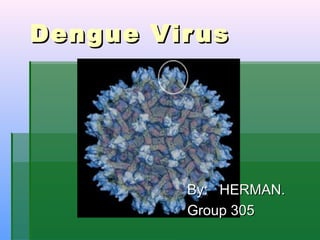

Dengue VirusDengue Virus
By: HERMAN.By: HERMAN.
Group 305Group 305
Plan of thePlan of the
presentationpresentation
 CLASSIFICATIONCLASSIFICATION
 GENERAL INTRODUCTIONGENERAL INTRODUCTION
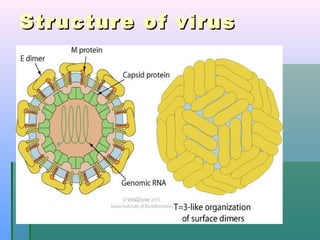
 STRUCTURE OF VIRIONSTRUCTURE OF VIRION
 PATHOGENESISPATHOGENESIS
 DISEASESDISEASES
 DIAGNOSISDIAGNOSIS
 PREVENTION & TREATMENTPREVENTION & TREATMENT
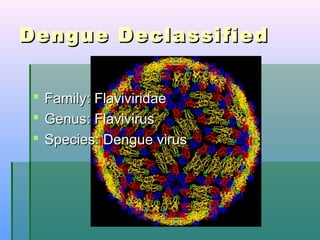
Dengue DeclassifiedDengue Declassified
 Family: FlaviviridaeFamily: Flaviviridae
 Genus: FlavivirusGenus: Flavivirus
 Species: Dengue virusSpecies: Dengue virus
What is the DengueWhat is the Dengue
Virus?Virus?
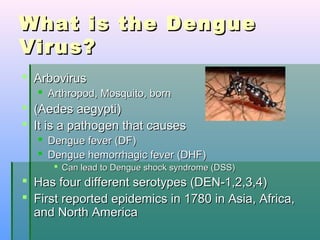
 ArbovirusArbovirus
 Arthropod, Mosquito, bornArthropod, Mosquito, born
 (Aedes aegypti)(Aedes aegypti)
 It is a pathogen that causesIt is a pathogen that causes
 Dengue fever (DF)Dengue fever (DF)
 Dengue hemorrhagic fever (DHF)Dengue hemorrhagic fever (DHF)
 Can lead to Dengue shock syndrome (DSS)Can lead to Dengue shock syndrome (DSS)
 Has four different serotypes (DEN-1,2,3,4)Has four different serotypes (DEN-1,2,3,4)
 First reported epidemics in 1780 in Asia, Africa,First reported epidemics in 1780 in Asia, Africa,
and North Americaand North America
Structure of virusStructure of virus
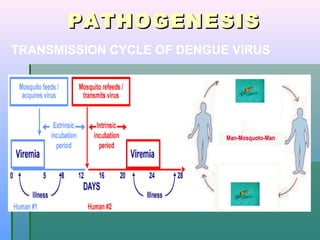
PATHOGENESISPATHOGENESIS
TRANSMISSION CYCLE OF DENGUE VIRUS
REPLICATION IN THE HUMAN CELLS
Target tissuesTarget tissues
 Dengue induces cytokine production in cellsDengue induces cytokine production in cells
 Cytotoxic factor effects endothelial cellsCytotoxic factor effects endothelial cells
involved in most of the followinginvolved in most of the following::
 HeartHeart
 LiverLiver
 KidneysKidneys
 LungsLungs
 IntestinesIntestines
 SpleenSpleen
 Lymph nodesLymph nodes
 BrainBrain
 Skin (inflammatory rashes)Skin (inflammatory rashes)
DISEASESDISEASES
 Dengue FeverDengue Fever
 Dengue Hemorrhagic FeverDengue Hemorrhagic Fever
 Dengue Shock SyndromeDengue Shock Syndrome
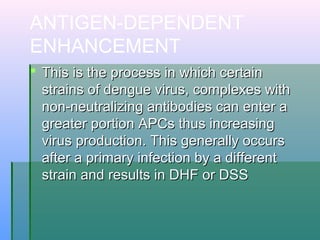
 This is the process in which certainThis is the process in which certain
strains of dengue virus, complexes withstrains of dengue virus, complexes with
non-neutralizing antibodies can enter anon-neutralizing antibodies can enter a
greater portion APCs thus increasinggreater portion APCs thus increasing
virus production. This generally occursvirus production. This generally occurs
after a primary infection by a differentafter a primary infection by a different
strain and results in DHF or DSSstrain and results in DHF or DSS
ANTIGEN-DEPENDENT
ENHANCEMENT
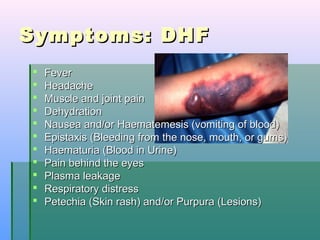
Symptoms: DHFSymptoms: DHF
 FeverFever
 HeadacheHeadache
 Muscle and joint painMuscle and joint pain
 DehydrationDehydration
 Nausea and/or Haematemesis (vomiting of blood)Nausea and/or Haematemesis (vomiting of blood)
 Epistaxis (Bleeding from the nose, mouth, or gums)Epistaxis (Bleeding from the nose, mouth, or gums)
 Haematuria (Blood in Urine)Haematuria (Blood in Urine)
 Pain behind the eyesPain behind the eyes
 Plasma leakagePlasma leakage
 Respiratory distressRespiratory distress
 Petechia (Skin rash) and/or Purpura (Lesions)Petechia (Skin rash) and/or Purpura (Lesions)
Diagnostic testsDiagnostic tests
 Virus isolation by infection of mice usingVirus isolation by infection of mice using
infected mosquitoesinfected mosquitoes
 Isolation in cultured mosquito cells andIsolation in cultured mosquito cells and
identification by indirect IFidentification by indirect IF
 Detection of IgM antibodies in the blood byDetection of IgM antibodies in the blood by
PCR or Viral isolation (Serology)PCR or Viral isolation (Serology)
 ELISA (Enzyme-Linked ImmunoabsorbentELISA (Enzyme-Linked Immunoabsorbent
assay)assay)
 Haemagglutination inhibition testHaemagglutination inhibition test
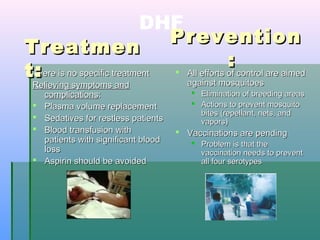
PreventionPrevention
::
There is no specific treatmentThere is no specific treatment
Relieving symptoms andRelieving symptoms and
complicationscomplications::
 Plasma volume replacementPlasma volume replacement
 Sedatives for restless patientsSedatives for restless patients
 Blood transfusion withBlood transfusion with
patients with significant bloodpatients with significant blood
lossloss
 Aspirin should be avoidedAspirin should be avoided
 All efforts of control are aimedAll efforts of control are aimed
against mosquitoesagainst mosquitoes
 Elimination of breeding areasElimination of breeding areas
 Actions to prevent mosquitoActions to prevent mosquito
bites (repellant, nets, andbites (repellant, nets, and
vapors)vapors)
 Vaccinations are pendingVaccinations are pending
 Problem is that theProblem is that the
vaccination needs to preventvaccination needs to prevent
all four serotypesall four serotypes
TreatmenTreatmen
t:t:
DHF
Morbidity and MortalityMorbidity and Mortality
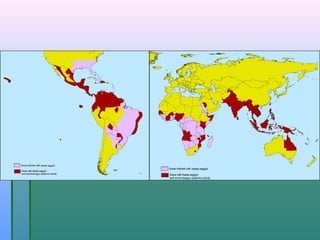
 More than 2.5 Billion people live in areasMore than 2.5 Billion people live in areas
that have a risk of infectionthat have a risk of infection
 Over 100 million cases of DengueOver 100 million cases of Dengue
infection are reported each year globallyinfection are reported each year globally
 500,000 cases pertain to DHF500,000 cases pertain to DHF
 DHF has a 5% fatality rate for thoseDHF has a 5% fatality rate for those
infectedinfected
 People at high risk are children and thePeople at high risk are children and the
elderlyelderly
THANKSTHANKS
FOR YOURFOR YOUR
ATTENTIONATTENTION

Dengue virus

  • 1.
    Dengue VirusDengue Virus By:HERMAN.By: HERMAN. Group 305Group 305
  • 2.
    Plan of thePlanof the presentationpresentation  CLASSIFICATIONCLASSIFICATION  GENERAL INTRODUCTIONGENERAL INTRODUCTION  STRUCTURE OF VIRIONSTRUCTURE OF VIRION  PATHOGENESISPATHOGENESIS  DISEASESDISEASES  DIAGNOSISDIAGNOSIS  PREVENTION & TREATMENTPREVENTION & TREATMENT
  • 3.
    Dengue DeclassifiedDengue Declassified Family: FlaviviridaeFamily: Flaviviridae  Genus: FlavivirusGenus: Flavivirus  Species: Dengue virusSpecies: Dengue virus
  • 4.
    What is theDengueWhat is the Dengue Virus?Virus?  ArbovirusArbovirus  Arthropod, Mosquito, bornArthropod, Mosquito, born  (Aedes aegypti)(Aedes aegypti)  It is a pathogen that causesIt is a pathogen that causes  Dengue fever (DF)Dengue fever (DF)  Dengue hemorrhagic fever (DHF)Dengue hemorrhagic fever (DHF)  Can lead to Dengue shock syndrome (DSS)Can lead to Dengue shock syndrome (DSS)  Has four different serotypes (DEN-1,2,3,4)Has four different serotypes (DEN-1,2,3,4)  First reported epidemics in 1780 in Asia, Africa,First reported epidemics in 1780 in Asia, Africa, and North Americaand North America
  • 5.
  • 6.
  • 7.
    REPLICATION IN THEHUMAN CELLS
  • 8.
    Target tissuesTarget tissues Dengue induces cytokine production in cellsDengue induces cytokine production in cells  Cytotoxic factor effects endothelial cellsCytotoxic factor effects endothelial cells involved in most of the followinginvolved in most of the following::  HeartHeart  LiverLiver  KidneysKidneys  LungsLungs  IntestinesIntestines  SpleenSpleen  Lymph nodesLymph nodes  BrainBrain  Skin (inflammatory rashes)Skin (inflammatory rashes)
  • 9.
    DISEASESDISEASES  Dengue FeverDengueFever  Dengue Hemorrhagic FeverDengue Hemorrhagic Fever  Dengue Shock SyndromeDengue Shock Syndrome
  • 10.
     This isthe process in which certainThis is the process in which certain strains of dengue virus, complexes withstrains of dengue virus, complexes with non-neutralizing antibodies can enter anon-neutralizing antibodies can enter a greater portion APCs thus increasinggreater portion APCs thus increasing virus production. This generally occursvirus production. This generally occurs after a primary infection by a differentafter a primary infection by a different strain and results in DHF or DSSstrain and results in DHF or DSS ANTIGEN-DEPENDENT ENHANCEMENT
  • 11.
    Symptoms: DHFSymptoms: DHF FeverFever  HeadacheHeadache  Muscle and joint painMuscle and joint pain  DehydrationDehydration  Nausea and/or Haematemesis (vomiting of blood)Nausea and/or Haematemesis (vomiting of blood)  Epistaxis (Bleeding from the nose, mouth, or gums)Epistaxis (Bleeding from the nose, mouth, or gums)  Haematuria (Blood in Urine)Haematuria (Blood in Urine)  Pain behind the eyesPain behind the eyes  Plasma leakagePlasma leakage  Respiratory distressRespiratory distress  Petechia (Skin rash) and/or Purpura (Lesions)Petechia (Skin rash) and/or Purpura (Lesions)
  • 12.
    Diagnostic testsDiagnostic tests Virus isolation by infection of mice usingVirus isolation by infection of mice using infected mosquitoesinfected mosquitoes  Isolation in cultured mosquito cells andIsolation in cultured mosquito cells and identification by indirect IFidentification by indirect IF  Detection of IgM antibodies in the blood byDetection of IgM antibodies in the blood by PCR or Viral isolation (Serology)PCR or Viral isolation (Serology)  ELISA (Enzyme-Linked ImmunoabsorbentELISA (Enzyme-Linked Immunoabsorbent assay)assay)  Haemagglutination inhibition testHaemagglutination inhibition test
  • 13.
    PreventionPrevention :: There is nospecific treatmentThere is no specific treatment Relieving symptoms andRelieving symptoms and complicationscomplications::  Plasma volume replacementPlasma volume replacement  Sedatives for restless patientsSedatives for restless patients  Blood transfusion withBlood transfusion with patients with significant bloodpatients with significant blood lossloss  Aspirin should be avoidedAspirin should be avoided  All efforts of control are aimedAll efforts of control are aimed against mosquitoesagainst mosquitoes  Elimination of breeding areasElimination of breeding areas  Actions to prevent mosquitoActions to prevent mosquito bites (repellant, nets, andbites (repellant, nets, and vapors)vapors)  Vaccinations are pendingVaccinations are pending  Problem is that theProblem is that the vaccination needs to preventvaccination needs to prevent all four serotypesall four serotypes TreatmenTreatmen t:t: DHF
  • 14.
    Morbidity and MortalityMorbidityand Mortality  More than 2.5 Billion people live in areasMore than 2.5 Billion people live in areas that have a risk of infectionthat have a risk of infection  Over 100 million cases of DengueOver 100 million cases of Dengue infection are reported each year globallyinfection are reported each year globally  500,000 cases pertain to DHF500,000 cases pertain to DHF  DHF has a 5% fatality rate for thoseDHF has a 5% fatality rate for those infectedinfected  People at high risk are children and thePeople at high risk are children and the elderlyelderly
  • 16.

Editor's Notes

  • #8 Humans are initially infected through a mosquito vector Initial interaction with cell occurs with the viruses ability to infect cell Primary target, Phagocytes Virus uses cell receptor molecule to enter cell Cell receptor molecules include: Glycosaminoglycan Heparan Sulfate (Expressed in almost all cell types) Virus replicates in target organs Infects white blood cells and lymphatic tissues Virus is released and circulates in blood Alternate mosquito then bites host and receives virus