PRESENTED BY –SWATI SAHANI
(F.Y.MPHARM)
 Sweeting agents are the substances which are
added to drug formulation to mask its bitter taste.
 Ideal properties of Sweeteners
◦ compatible.
◦ sweetness even in low concentration.
◦ cheap and easily available.
◦ agreeable odour.
◦ heat stable.
◦ non toxic.
◦ inert.
◦ induce glycemic response.
 1. Nutritive sweetener-
 Examples-Sucrose,sugar alcohol(Manittol,Sorbitol)
 Fructose-4kcal/gm the same as surcose and it
does not cause fluctuation in blood sugar,thus
better choice in diabetic patient.
 Less sweet and less caloric.
 2. Non-nutritive sweetener-
 Examples includes--Saccharin, Aspartame,
Alitame, Acesulfane-K etc.
 non- nutritive sweetener are more sweeter
and thus only small quantity is required for
sweeting preparation.
 SWEETNESS POTENCY=
 SWEETNESS OF 100 gm/Lt SUCROSE SOLUTION
g/Lt OF SWEETNER SOLUTION WITH EQUVALENT SWEETNESS
 E.g. 0.75 gm/litre solution of aspartame
matches with the sweetness of 100 gm/litre
solution of sucrose.
 Therefore aspartame is considered as 133
times sweeter than sucrose.
 GLYCYRRHIZIN
 STEVIOSIDE
 NEOHESPERIDIN DIHYDROCHALCONE
 MONELLIN
 SUGAR
 HONEY
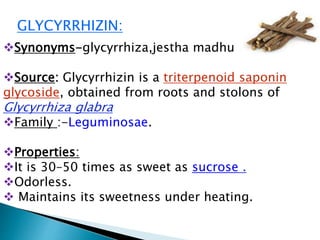
GLYCYRRHIZIN:
Synonyms-glycyrrhiza,jestha madhu
Source: Glycyrrhizin is a triterpenoid saponin
glycoside, obtained from roots and stolons of
Glycyrrhiza glabra
Family :-Leguminosae.
Properties:
It is 30–50 times as sweet as sucrose .
Odorless.
 Maintains its sweetness under heating.
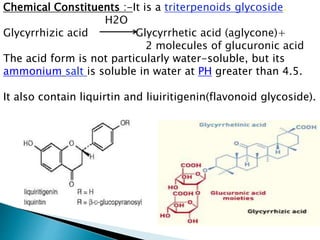
Chemical Constituents :-It is a triterpenoids glycoside.
H2O
Glycyrrhizic acid Glycyrrhetic acid (aglycone)+
2 molecules of glucuronic acid
The acid form is not particularly water-soluble, but its
ammonium salt is soluble in water at PH greater than 4.5.
It also contain liquirtin and liuiritigenin(flavonoid glycoside).
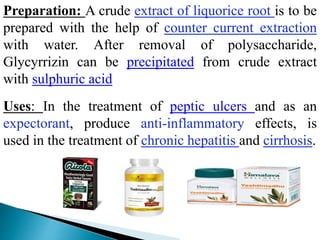
Preparation: A crude extract of liquorice root is to be
prepared with the help of counter current extraction
with water. After removal of polysaccharide,
Glycyrrizin can be precipitated from crude extract
with sulphuric acid
Uses: In the treatment of peptic ulcers and as an
expectorant, produce anti-inflammatory effects, is
used in the treatment of chronic hepatitis and cirrhosis.
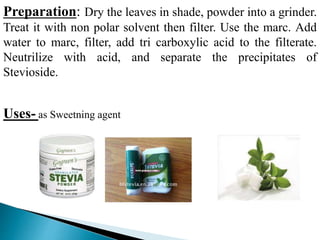
STEVIOSIDE:
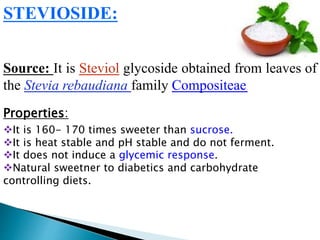
Source: It is Steviol glycoside obtained from leaves of
the Stevia rebaudiana family Compositeae.
Properties:
It is 160- 170 times sweeter than sucrose.
It is heat stable and pH stable and do not ferment.
It does not induce a glycemic response.
Natural sweetner to diabetics and carbohydrate
controlling diets.
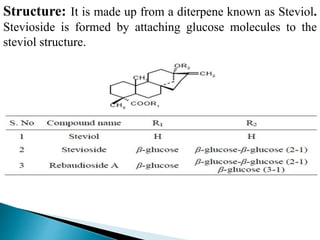
Structure: It is made up from a diterpene known as Steviol.
Stevioside is formed by attaching glucose molecules to the
steviol structure.
Preparation: Dry the leaves in shade, powder into a grinder.
Treat it with non polar solvent then filter. Use the marc. Add
water to marc, filter, add tri carboxylic acid to the filterate.
Neutrilize with acid, and separate the precipitates of
Stevioside.
Uses- as Sweetning agent
NEOHESPERIDIN
DIHYDROCHALCONE:
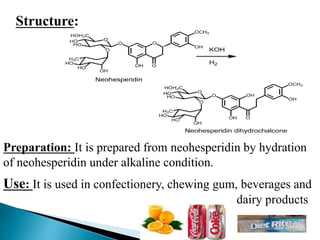
Source------It is obtained from orange peels of
Citrus aurantium var. amara
Family:- Rutaceae
Properties:
It is 330 times sweeter than sucrose
 It is prone to hydrolytic cleavage of hydrolytic bond, it is
stable under storage conditions.
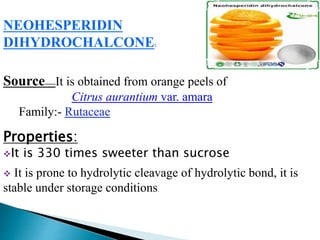
Structure:
Preparation: It is prepared from neohesperidin by hydration
of neohesperidin under alkaline condition.
Use: It is used in confectionery, chewing gum, beverages and
dairy products.
THAUMATIN
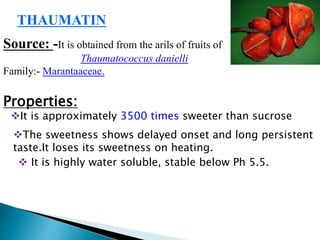
Source: -It is obtained from the arils of fruits of
Thaumatococcus danielli
Family:- Marantaaceae.
Properties:
It is approximately 3500 times sweeter than sucrose
The sweetness shows delayed onset and long persistent
taste.It loses its sweetness on heating.
 It is highly water soluble, stable below Ph 5.5.
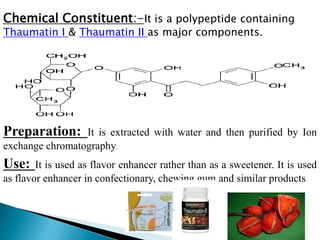
Chemical Constituent:-It is a polypeptide containing
Thaumatin I & Thaumatin II as major components.
Preparation: It is extracted with water and then purified by Ion
exchange chromatography.
Use: It is used as flavor enhancer rather than as a sweetener. It is used
as flavor enhancer in confectionary, chewing gum and similar products.
MONELLIN:
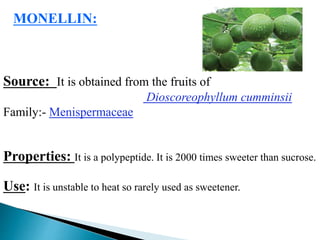
Source: It is obtained from the fruits of
Dioscoreophyllum cumminsii
Family:- Menispermaceae
Properties: It is a polypeptide. It is 2000 times sweeter than sucrose.
Use: It is unstable to heat so rarely used as sweetener.
SUGAR:
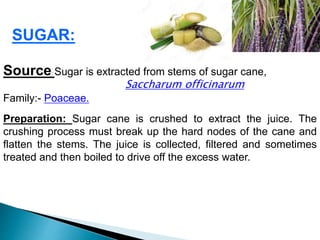
Source: Sugar is extracted from stems of sugar cane,
Saccharum officinarum
Family:- Poaceae.
Preparation: Sugar cane is crushed to extract the juice. The
crushing process must break up the hard nodes of the cane and
flatten the stems. The juice is collected, filtered and sometimes
treated and then boiled to drive off the excess water.
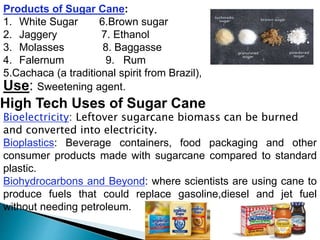
Products of Sugar Cane:
1. White Sugar 6.Brown sugar
2. Jaggery 7. Ethanol
3. Molasses 8. Baggasse
4. Falernum 9. Rum
5.Cachaca (a traditional spirit from Brazil),
Use: Sweetening agent.
High Tech Uses of Sugar Cane
Bioelectricity: Leftover sugarcane biomass can be burned
and converted into electricity.
Bioplastics: Beverage containers, food packaging and other
consumer products made with sugarcane compared to standard
plastic.
Biohydrocarbons and Beyond: where scientists are using cane to
produce fuels that could replace gasoline,diesel and jet fuel
without needing petroleum.
HONEY:
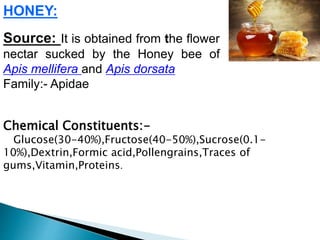
Source: It is obtained from the flower
nectar sucked by the Honey bee of
Apis mellifera and Apis dorsata
Family:- Apidae
Chemical Constituents:-
Glucose(30-40%),Fructose(40-50%),Sucrose(0.1-
10%),Dextrin,Formic acid,Pollengrains,Traces of
gums,Vitamin,Proteins.
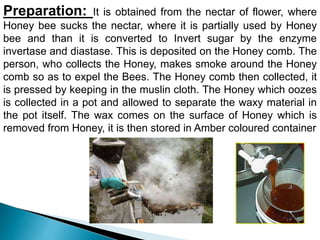
Preparation: It is obtained from the nectar of flower, where
Honey bee sucks the nectar, where it is partially used by Honey
bee and than it is converted to Invert sugar by the enzyme
invertase and diastase. This is deposited on the Honey comb. The
person, who collects the Honey, makes smoke around the Honey
comb so as to expel the Bees. The Honey comb then collected, it
is pressed by keeping in the muslin cloth. The Honey which oozes
is collected in a pot and allowed to separate the waxy material in
the pot itself. The wax comes on the surface of Honey which is
removed from Honey, it is then stored in Amber coloured container
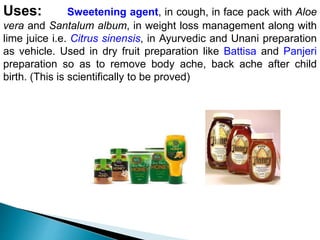
Uses: Sweetening agent, in cough, in face pack with Aloe
vera and Santalum album, in weight loss management along with
lime juice i.e. Citrus sinensis, in Ayurvedic and Unani preparation
as vehicle. Used in dry fruit preparation like Battisa and Panjeri
preparation so as to remove body ache, back ache after child
birth. (This is scientifically to be proved)

Herbal excipents (Sweetner)

  • 1.
    PRESENTED BY –SWATISAHANI (F.Y.MPHARM)
  • 2.
     Sweeting agentsare the substances which are added to drug formulation to mask its bitter taste.  Ideal properties of Sweeteners ◦ compatible. ◦ sweetness even in low concentration. ◦ cheap and easily available. ◦ agreeable odour. ◦ heat stable. ◦ non toxic. ◦ inert. ◦ induce glycemic response.
  • 3.
     1. Nutritivesweetener-  Examples-Sucrose,sugar alcohol(Manittol,Sorbitol)  Fructose-4kcal/gm the same as surcose and it does not cause fluctuation in blood sugar,thus better choice in diabetic patient.  Less sweet and less caloric.
  • 4.
     2. Non-nutritivesweetener-  Examples includes--Saccharin, Aspartame, Alitame, Acesulfane-K etc.  non- nutritive sweetener are more sweeter and thus only small quantity is required for sweeting preparation.
  • 5.
     SWEETNESS POTENCY= SWEETNESS OF 100 gm/Lt SUCROSE SOLUTION g/Lt OF SWEETNER SOLUTION WITH EQUVALENT SWEETNESS  E.g. 0.75 gm/litre solution of aspartame matches with the sweetness of 100 gm/litre solution of sucrose.  Therefore aspartame is considered as 133 times sweeter than sucrose.
  • 6.
     GLYCYRRHIZIN  STEVIOSIDE NEOHESPERIDIN DIHYDROCHALCONE  MONELLIN  SUGAR  HONEY
  • 7.
    GLYCYRRHIZIN: Synonyms-glycyrrhiza,jestha madhu Source: Glycyrrhizinis a triterpenoid saponin glycoside, obtained from roots and stolons of Glycyrrhiza glabra Family :-Leguminosae. Properties: It is 30–50 times as sweet as sucrose . Odorless.  Maintains its sweetness under heating.
  • 8.
    Chemical Constituents :-Itis a triterpenoids glycoside. H2O Glycyrrhizic acid Glycyrrhetic acid (aglycone)+ 2 molecules of glucuronic acid The acid form is not particularly water-soluble, but its ammonium salt is soluble in water at PH greater than 4.5. It also contain liquirtin and liuiritigenin(flavonoid glycoside).
  • 9.
    Preparation: A crudeextract of liquorice root is to be prepared with the help of counter current extraction with water. After removal of polysaccharide, Glycyrrizin can be precipitated from crude extract with sulphuric acid Uses: In the treatment of peptic ulcers and as an expectorant, produce anti-inflammatory effects, is used in the treatment of chronic hepatitis and cirrhosis.
  • 10.
    STEVIOSIDE: Source: It isSteviol glycoside obtained from leaves of the Stevia rebaudiana family Compositeae. Properties: It is 160- 170 times sweeter than sucrose. It is heat stable and pH stable and do not ferment. It does not induce a glycemic response. Natural sweetner to diabetics and carbohydrate controlling diets.
  • 11.
    Structure: It ismade up from a diterpene known as Steviol. Stevioside is formed by attaching glucose molecules to the steviol structure.
  • 12.
    Preparation: Dry theleaves in shade, powder into a grinder. Treat it with non polar solvent then filter. Use the marc. Add water to marc, filter, add tri carboxylic acid to the filterate. Neutrilize with acid, and separate the precipitates of Stevioside. Uses- as Sweetning agent
  • 13.
    NEOHESPERIDIN DIHYDROCHALCONE: Source------It is obtainedfrom orange peels of Citrus aurantium var. amara Family:- Rutaceae Properties: It is 330 times sweeter than sucrose  It is prone to hydrolytic cleavage of hydrolytic bond, it is stable under storage conditions.
  • 14.
    Structure: Preparation: It isprepared from neohesperidin by hydration of neohesperidin under alkaline condition. Use: It is used in confectionery, chewing gum, beverages and dairy products.
  • 15.
    THAUMATIN Source: -It isobtained from the arils of fruits of Thaumatococcus danielli Family:- Marantaaceae. Properties: It is approximately 3500 times sweeter than sucrose The sweetness shows delayed onset and long persistent taste.It loses its sweetness on heating.  It is highly water soluble, stable below Ph 5.5.
  • 16.
    Chemical Constituent:-It isa polypeptide containing Thaumatin I & Thaumatin II as major components. Preparation: It is extracted with water and then purified by Ion exchange chromatography. Use: It is used as flavor enhancer rather than as a sweetener. It is used as flavor enhancer in confectionary, chewing gum and similar products.
  • 17.
    MONELLIN: Source: It isobtained from the fruits of Dioscoreophyllum cumminsii Family:- Menispermaceae Properties: It is a polypeptide. It is 2000 times sweeter than sucrose. Use: It is unstable to heat so rarely used as sweetener.
  • 18.
    SUGAR: Source: Sugar isextracted from stems of sugar cane, Saccharum officinarum Family:- Poaceae. Preparation: Sugar cane is crushed to extract the juice. The crushing process must break up the hard nodes of the cane and flatten the stems. The juice is collected, filtered and sometimes treated and then boiled to drive off the excess water.
  • 19.
    Products of SugarCane: 1. White Sugar 6.Brown sugar 2. Jaggery 7. Ethanol 3. Molasses 8. Baggasse 4. Falernum 9. Rum 5.Cachaca (a traditional spirit from Brazil), Use: Sweetening agent. High Tech Uses of Sugar Cane Bioelectricity: Leftover sugarcane biomass can be burned and converted into electricity. Bioplastics: Beverage containers, food packaging and other consumer products made with sugarcane compared to standard plastic. Biohydrocarbons and Beyond: where scientists are using cane to produce fuels that could replace gasoline,diesel and jet fuel without needing petroleum.
  • 20.
    HONEY: Source: It isobtained from the flower nectar sucked by the Honey bee of Apis mellifera and Apis dorsata Family:- Apidae Chemical Constituents:- Glucose(30-40%),Fructose(40-50%),Sucrose(0.1- 10%),Dextrin,Formic acid,Pollengrains,Traces of gums,Vitamin,Proteins.
  • 21.
    Preparation: It isobtained from the nectar of flower, where Honey bee sucks the nectar, where it is partially used by Honey bee and than it is converted to Invert sugar by the enzyme invertase and diastase. This is deposited on the Honey comb. The person, who collects the Honey, makes smoke around the Honey comb so as to expel the Bees. The Honey comb then collected, it is pressed by keeping in the muslin cloth. The Honey which oozes is collected in a pot and allowed to separate the waxy material in the pot itself. The wax comes on the surface of Honey which is removed from Honey, it is then stored in Amber coloured container
  • 22.
    Uses: Sweetening agent,in cough, in face pack with Aloe vera and Santalum album, in weight loss management along with lime juice i.e. Citrus sinensis, in Ayurvedic and Unani preparation as vehicle. Used in dry fruit preparation like Battisa and Panjeri preparation so as to remove body ache, back ache after child birth. (This is scientifically to be proved)