SHEETAL HANDU
HISTORY
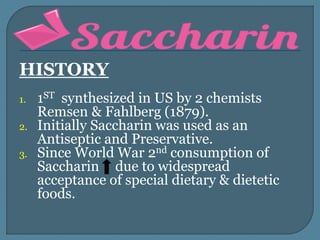
1. 1ST synthesized in US by 2 chemists
Remsen & Fahlberg (1879).
2. Initially Saccharin was used as an
Antiseptic and Preservative.
3. Since World War 2nd consumption of
Saccharin due to widespread
acceptance of special dietary & dietetic
foods.
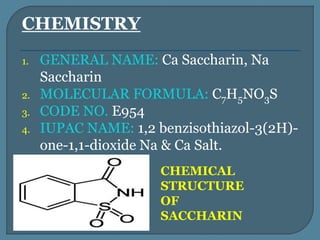
CHEMISTRY
1. GENERAL NAME: Ca Saccharin, Na
Saccharin
2. MOLECULAR FORMULA: C7H5NO3S
3. CODE NO. E954
4. IUPAC NAME: 1,2 benzisothiazol-3(2H)-
one-1,1-dioxide Na & Ca Salt.
CHEMICAL
STRUCTURE
OF
SACCHARIN
PREPARATION:
2 METHODS
1. TOLUENE & CHLOROSULFONIC ACID
(Remsen & Fahlberg, 1879)
2. METHYL ANTHRANILATE
(National Academy of Sciences,1978)
PRODUCT:
1. Stable at High Temp (upto 300°c) & Low
Temp.
2. White Crystalline Powder
3. Soluble in Water & Ethanol
4. 300 times sweeter than Sucrose.
5. COMMON BRAND NAME: Sweet n Low
TECHNOLOGICAL
PROPERTIES:
1. Very Stable under almost all food
processing conditions.
2. Have a Long Shelf Life.
3. Non Caloric Sweetner.
APPLICATIONS:
1. Utilized in most Drugs, Dietary products
& Cosmetics.
2. Have slight to moderate Metallic or Bitter
after taste.
3. This aftertaste can be masked by the Use
of Lactose or Combining Saccharin with
Aspartame or other Sweetener.
4. When combined it has Synergistic Effect
on Sweetness thereby reduced the Total
Amount of Non Caloric Sweeteners.
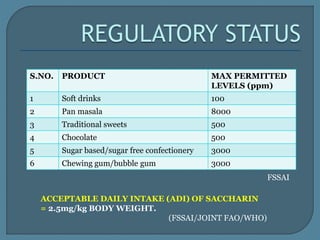
S.NO. PRODUCT MAX PERMITTED
LEVELS (ppm)
1 Soft drinks 100
2 Pan masala 8000
3 Traditional sweets 500
4 Chocolate 500
5 Sugar based/sugar free confectionery 3000
6 Chewing gum/bubble gum 3000
ACCEPTABLE DAILY INTAKE (ADI) OF SACCHARIN
= 2.5mg/kg BODY WEIGHT.
(FSSAI/JOINT FAO/WHO)
FSSAI
 METABOLISM AND SHORT TIME TOXICITY:
i. Saccharin is absorbed slowly but almost
completely from the gut and rapidly excreted in
urine & feces as unchanged saccharin.
Therefore, metabolites do not cause toxic
effects. (Renwick, 1983,1985)
ii. Sodium saccharin is found nonreactive to DNA
and inactive as a gene mutagen in vitro.
(Ashby, 1985)
 LONG TERM TOXICITY:
i. Studies have indicated that high dietary
levels of saccharin (5-7.5%) increase the
incidence of urinary bladder tumors in
rats. (Tis et al, 1974)
ii. Studies conducted on the bladder
carcinogenicity and cocarcinogenicity of
saccharin support weak results.
(Cohen,1985)
 EPIDEMIOLOGICAL STUDIES ON
SACCHARIN:
i. Most studies in many population groups
including diabetics have failed to
demonstrate any statistical evidence of an
association between human bladder
cancer and saccharin consumption.
(Morgan and Wong, 1985)
 SURVEY of the Usage Patterns and Intake Population.
 SAMPLES: Ice candy (87), crushed ice(14) pan masala(16), pan
flavorings(10).
CONCLUSION: Toxic Effects Of Saccharin Includes Bladder Distention, Elevated
Urine Osmolality And Bladder Cancer.
SAMPLES AVG
(mg/kg )
MAX
(mg/kg)
FOUND
TO BE
(PFA)
EDI
(mg/kg of
bw)
CONTRIBUTI
ON to ADI
Pan Masala 12750 24300 1.6-3 1.84- 13.33 810%
Pan
Flavourings
122000 201000 1.5-2.5 6.87 137%
Ice Candy 200 700 - 5 57%
Crushed Ice 280 460 - 5 68%
HISTORY:
1. Discovered accidently By J.M. Schlatter
in 1960s in the G.D. Searle Laboratory.
2. In 1980s Aspartame was approved in
many countries as an Alternative
Sweetener to Saccharin & Cyclamate.
CHEMISTRY:
1. IUPAC NAME: Methyl L-aspartyl-L-
phenylalaninate.
2. MOLECULAR FORMULA: C14H18N2O5
3. CODE NO. E951
CHEMICAL
STRUCTURE
OF
ASPARTAME
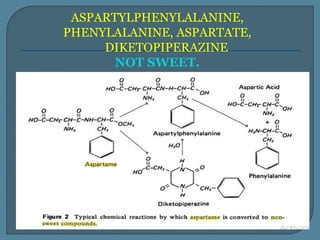
1. Under certain moisture, temperature and pH
conditions O-methyl ester bond is hydrolyzed
forming dipeptide ASPARTYLPHENYLALANINE
and METHANOL.
2. METHANOL may be eliminated by the cyclization
of aspartame to form DIKETOPIPERAZINE
(DKP).
3. DKP can in turn hydrolyze to
ASPARTYLPHENYLALANINE.
4. ASPARTYLPHENYLALANINE can be hydrolyzed
to its individual amino acids, PHENYLALANINE
and ASPARTATE.
ASPARTYLPHENYLALANINE,
PHENYLALANINE, ASPARTATE,
DIKETOPIPERAZINE
NOT SWEET.
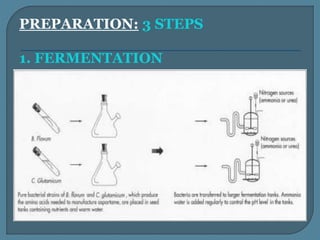
PREPARATION: 3 STEPS
1. FERMENTATION
2. SYNTHESIS
3. PURIFICATION
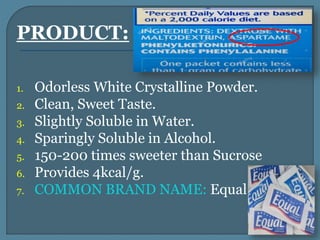
PRODUCT:
1. Odorless White Crystalline Powder.
2. Clean, Sweet Taste.
3. Slightly Soluble in Water.
4. Sparingly Soluble in Alcohol.
5. 150-200 times sweeter than Sucrose
6. Provides 4kcal/g.
7. COMMON BRAND NAME: Equal
TECHNOLOGICAL
PROPERTIES:
1. Stability in Dry Products is Good.
2. It enhance food flavours.
3. Not suitable for all foods or food processes.
(Stegnik and Filer, 1984)
4. Loss of sweetness is observed in foods that
have low pH or in foods heated for long
periods..
5. Excessive storage time causes 40% loss in
aspartame concentration which reduces the
sweetness.
APPLICATIONS:
1. Best used in chewing gum, instant coffee
and tea.
2. Also used for sweetening most soft
drinks, dairy products such as yoghurt
and ice cream and dessert mixes.
(Homler, 1994)
3. Soft drink manufacturers often increase
the stability of aspartame by raising the
product pH slightly and controlling
inventory.
4. Usually the mixture of saccharin-
aspartame further increase the stability.
S.NO. PRODUCT MAX PERMITTED
LEVELS (ppm)
1 Soft drinks 700
2 Biscuits, bread, cakes and pastries 2200
3 Traditional sweets 200
4 Chocolate 2000
5 Sugar based/sugar free confectionery 10000
6 Chewing gum/bubble gum 10000
7 Jam, jellies and marmalades 1000
8 Ice cream, frozen dessert and pudding 1000
9 Yoghurt 600
10 Ready to serve tea/coffee based beverages 600
FSSAIACCEPTABLE DAILY INTAKE (ADI) OF ASPARTAME
= 40 mg/kg BODY WEIGHT. (FSSAI/JOINT FAO/WHO)
 METABOLISM:
1. Large doses of aspartame release ASPARTATE,
PHENYLALANINE and METHANOL and these
compounds are metabolized and excreted.
2. PHENYLALANINE makes half of the aspartame
molecule and is an essential protein that cannot
be synthesised by mammals.
3. The metabolism and nutritional roles of
PHENYLALANINE & TYROSINE are linked.
(Stegink &Filer,1984)
 LONG TERM & CARCINOGENICITY
STUDIES:
1. DKP present at levels up to 5% of the
amount of aspartame added. Therefore,
intensive toxicological testing have been
done however the results are negative.
(WHO,1980)
2. Extensive studies support the safety of
aspartame.
3. Mutagenicity and reproduction studies do
not indicate any averse effects.
 OTHER SAFETY ISSUES RELATED TO
ASPARTAME:
i. ASPARATIC ACID moiety of ASPARTAME either
alone or in combination with GLUTAMATE in high
concentrations have shown neurotoxic effects on
rodents.
ii. PHENYLKETONURIN (PKU) is a human genetic
disorder of phenylalanine metabolism. In PKU
phenylalanine is metabolized poorly and
accumulates in blood and tissues which results to
mental retardation.
HISTORY:
1. Discovered by Tate & Lyle , 1976.
2. In 1991 Sucralose was first approved for
use in Canada.
3. In 2015, PepsiCo announced that it would
be moving from Aspartame to Sucralose
for most of its diet drinks in the US.
CHEMISTRY
1. GENERAL NAME: C-4 epimer
galactosucrose
2. CODE NO. E955
3. Derived from Sucrose.
CHEMICAL
STRUCTURE
OF
SUCRALOSE
PRODUCT:
1. 600 times sweeter than sucrose.
2. Common Brand Name : Splenda and
Sugar Free Natura
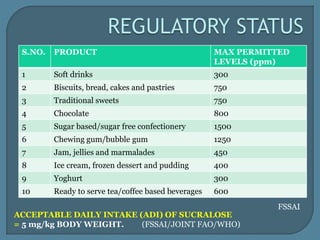
S.NO. PRODUCT MAX PERMITTED
LEVELS (ppm)
1 Soft drinks 300
2 Biscuits, bread, cakes and pastries 750
3 Traditional sweets 750
4 Chocolate 800
5 Sugar based/sugar free confectionery 1500
6 Chewing gum/bubble gum 1250
7 Jam, jellies and marmalades 450
8 Ice cream, frozen dessert and pudding 400
9 Yoghurt 300
10 Ready to serve tea/coffee based beverages 600
FSSAI
ACCEPTABLE DAILY INTAKE (ADI) OF SUCRALOSE
= 5 mg/kg BODY WEIGHT. (FSSAI/JOINT FAO/WHO)
TECHNOLOGICAL PROPERTIES:
1. Most heat stable artificial sweetener.
2. Stable under baking conditions.
3. Do no react with typical food ingredients.
APPLICATIONS:
1. Used in a wide variety of food stuffs,
including carbonated drinks, chewing gum,
bakery products, breakfast cereals, salad
dressings, and as a table top sweetener
ASPARTAME-ACESULFAME SALT
REGULATORY STATUS
FSSAI
 A._Larry_Branen FOOD-ADDITIVES
 Aspartame: Physiology and Biochemistry By Filer Stegink
 http://www.madehow.com/Volume-3/Aspartame.html
 http://www.chm.bris.ac.uk/motm/aspartame/aspartameh.html
 https://pubchem.ncbi.nlm.nih.gov/compound/aspartame#section=Top
 http://www.laleva.cc/food/enumbers/E901-970.html
 http://www.bbc.com/news/health-32478203
 http://www.sugar-and-sweetener-guide.com/
 http://foodsafetyhelpline.com/2015/05/artificial-sweeteners-what-
does-fssai-say/
 http://timesofindia.indiatimes.com/life-style/health-fitness/diet/Sugar-
free-foods-can-be-dangerous/articleshow/21034491.cms
 http://www.healthkart.com/resources/demystifying-sweeteners-
same/#.V9590VR94_4
 http://www.ncbi.nlm.nih.gov/pubmed/17118869
 http://www.fssai.gov.in/Portals/0/Pdf/Gazette_English_aas(11.09.201
4).pdf
 VIDEO: https://www.youtube.com/watch?v=ZA3AyPr-S1w
 https://www.youtube.com/watch?v=Mf82FfX-wuU

Sweeteners

  • 1.
  • 3.
    HISTORY 1. 1ST synthesizedin US by 2 chemists Remsen & Fahlberg (1879). 2. Initially Saccharin was used as an Antiseptic and Preservative. 3. Since World War 2nd consumption of Saccharin due to widespread acceptance of special dietary & dietetic foods.
  • 4.
    CHEMISTRY 1. GENERAL NAME:Ca Saccharin, Na Saccharin 2. MOLECULAR FORMULA: C7H5NO3S 3. CODE NO. E954 4. IUPAC NAME: 1,2 benzisothiazol-3(2H)- one-1,1-dioxide Na & Ca Salt. CHEMICAL STRUCTURE OF SACCHARIN
  • 5.
    PREPARATION: 2 METHODS 1. TOLUENE& CHLOROSULFONIC ACID (Remsen & Fahlberg, 1879) 2. METHYL ANTHRANILATE (National Academy of Sciences,1978)
  • 6.
    PRODUCT: 1. Stable atHigh Temp (upto 300°c) & Low Temp. 2. White Crystalline Powder 3. Soluble in Water & Ethanol 4. 300 times sweeter than Sucrose. 5. COMMON BRAND NAME: Sweet n Low
  • 7.
    TECHNOLOGICAL PROPERTIES: 1. Very Stableunder almost all food processing conditions. 2. Have a Long Shelf Life. 3. Non Caloric Sweetner.
  • 8.
    APPLICATIONS: 1. Utilized inmost Drugs, Dietary products & Cosmetics. 2. Have slight to moderate Metallic or Bitter after taste. 3. This aftertaste can be masked by the Use of Lactose or Combining Saccharin with Aspartame or other Sweetener. 4. When combined it has Synergistic Effect on Sweetness thereby reduced the Total Amount of Non Caloric Sweeteners.
  • 9.
    S.NO. PRODUCT MAXPERMITTED LEVELS (ppm) 1 Soft drinks 100 2 Pan masala 8000 3 Traditional sweets 500 4 Chocolate 500 5 Sugar based/sugar free confectionery 3000 6 Chewing gum/bubble gum 3000 ACCEPTABLE DAILY INTAKE (ADI) OF SACCHARIN = 2.5mg/kg BODY WEIGHT. (FSSAI/JOINT FAO/WHO) FSSAI
  • 10.
     METABOLISM ANDSHORT TIME TOXICITY: i. Saccharin is absorbed slowly but almost completely from the gut and rapidly excreted in urine & feces as unchanged saccharin. Therefore, metabolites do not cause toxic effects. (Renwick, 1983,1985) ii. Sodium saccharin is found nonreactive to DNA and inactive as a gene mutagen in vitro. (Ashby, 1985)
  • 11.
     LONG TERMTOXICITY: i. Studies have indicated that high dietary levels of saccharin (5-7.5%) increase the incidence of urinary bladder tumors in rats. (Tis et al, 1974) ii. Studies conducted on the bladder carcinogenicity and cocarcinogenicity of saccharin support weak results. (Cohen,1985)
  • 12.
     EPIDEMIOLOGICAL STUDIESON SACCHARIN: i. Most studies in many population groups including diabetics have failed to demonstrate any statistical evidence of an association between human bladder cancer and saccharin consumption. (Morgan and Wong, 1985)
  • 13.
     SURVEY ofthe Usage Patterns and Intake Population.  SAMPLES: Ice candy (87), crushed ice(14) pan masala(16), pan flavorings(10). CONCLUSION: Toxic Effects Of Saccharin Includes Bladder Distention, Elevated Urine Osmolality And Bladder Cancer. SAMPLES AVG (mg/kg ) MAX (mg/kg) FOUND TO BE (PFA) EDI (mg/kg of bw) CONTRIBUTI ON to ADI Pan Masala 12750 24300 1.6-3 1.84- 13.33 810% Pan Flavourings 122000 201000 1.5-2.5 6.87 137% Ice Candy 200 700 - 5 57% Crushed Ice 280 460 - 5 68%
  • 14.
    HISTORY: 1. Discovered accidentlyBy J.M. Schlatter in 1960s in the G.D. Searle Laboratory. 2. In 1980s Aspartame was approved in many countries as an Alternative Sweetener to Saccharin & Cyclamate.
  • 15.
    CHEMISTRY: 1. IUPAC NAME:Methyl L-aspartyl-L- phenylalaninate. 2. MOLECULAR FORMULA: C14H18N2O5 3. CODE NO. E951 CHEMICAL STRUCTURE OF ASPARTAME
  • 16.
    1. Under certainmoisture, temperature and pH conditions O-methyl ester bond is hydrolyzed forming dipeptide ASPARTYLPHENYLALANINE and METHANOL. 2. METHANOL may be eliminated by the cyclization of aspartame to form DIKETOPIPERAZINE (DKP). 3. DKP can in turn hydrolyze to ASPARTYLPHENYLALANINE. 4. ASPARTYLPHENYLALANINE can be hydrolyzed to its individual amino acids, PHENYLALANINE and ASPARTATE.
  • 17.
  • 18.
  • 19.
  • 20.
  • 21.
    PRODUCT: 1. Odorless WhiteCrystalline Powder. 2. Clean, Sweet Taste. 3. Slightly Soluble in Water. 4. Sparingly Soluble in Alcohol. 5. 150-200 times sweeter than Sucrose 6. Provides 4kcal/g. 7. COMMON BRAND NAME: Equal
  • 22.
    TECHNOLOGICAL PROPERTIES: 1. Stability inDry Products is Good. 2. It enhance food flavours. 3. Not suitable for all foods or food processes. (Stegnik and Filer, 1984) 4. Loss of sweetness is observed in foods that have low pH or in foods heated for long periods.. 5. Excessive storage time causes 40% loss in aspartame concentration which reduces the sweetness.
  • 23.
    APPLICATIONS: 1. Best usedin chewing gum, instant coffee and tea. 2. Also used for sweetening most soft drinks, dairy products such as yoghurt and ice cream and dessert mixes. (Homler, 1994) 3. Soft drink manufacturers often increase the stability of aspartame by raising the product pH slightly and controlling inventory. 4. Usually the mixture of saccharin- aspartame further increase the stability.
  • 24.
    S.NO. PRODUCT MAXPERMITTED LEVELS (ppm) 1 Soft drinks 700 2 Biscuits, bread, cakes and pastries 2200 3 Traditional sweets 200 4 Chocolate 2000 5 Sugar based/sugar free confectionery 10000 6 Chewing gum/bubble gum 10000 7 Jam, jellies and marmalades 1000 8 Ice cream, frozen dessert and pudding 1000 9 Yoghurt 600 10 Ready to serve tea/coffee based beverages 600 FSSAIACCEPTABLE DAILY INTAKE (ADI) OF ASPARTAME = 40 mg/kg BODY WEIGHT. (FSSAI/JOINT FAO/WHO)
  • 25.
     METABOLISM: 1. Largedoses of aspartame release ASPARTATE, PHENYLALANINE and METHANOL and these compounds are metabolized and excreted. 2. PHENYLALANINE makes half of the aspartame molecule and is an essential protein that cannot be synthesised by mammals. 3. The metabolism and nutritional roles of PHENYLALANINE & TYROSINE are linked. (Stegink &Filer,1984)
  • 26.
     LONG TERM& CARCINOGENICITY STUDIES: 1. DKP present at levels up to 5% of the amount of aspartame added. Therefore, intensive toxicological testing have been done however the results are negative. (WHO,1980) 2. Extensive studies support the safety of aspartame. 3. Mutagenicity and reproduction studies do not indicate any averse effects.
  • 27.
     OTHER SAFETYISSUES RELATED TO ASPARTAME: i. ASPARATIC ACID moiety of ASPARTAME either alone or in combination with GLUTAMATE in high concentrations have shown neurotoxic effects on rodents. ii. PHENYLKETONURIN (PKU) is a human genetic disorder of phenylalanine metabolism. In PKU phenylalanine is metabolized poorly and accumulates in blood and tissues which results to mental retardation.
  • 29.
    HISTORY: 1. Discovered byTate & Lyle , 1976. 2. In 1991 Sucralose was first approved for use in Canada. 3. In 2015, PepsiCo announced that it would be moving from Aspartame to Sucralose for most of its diet drinks in the US.
  • 30.
    CHEMISTRY 1. GENERAL NAME:C-4 epimer galactosucrose 2. CODE NO. E955 3. Derived from Sucrose. CHEMICAL STRUCTURE OF SUCRALOSE
  • 31.
    PRODUCT: 1. 600 timessweeter than sucrose. 2. Common Brand Name : Splenda and Sugar Free Natura
  • 32.
    S.NO. PRODUCT MAXPERMITTED LEVELS (ppm) 1 Soft drinks 300 2 Biscuits, bread, cakes and pastries 750 3 Traditional sweets 750 4 Chocolate 800 5 Sugar based/sugar free confectionery 1500 6 Chewing gum/bubble gum 1250 7 Jam, jellies and marmalades 450 8 Ice cream, frozen dessert and pudding 400 9 Yoghurt 300 10 Ready to serve tea/coffee based beverages 600 FSSAI ACCEPTABLE DAILY INTAKE (ADI) OF SUCRALOSE = 5 mg/kg BODY WEIGHT. (FSSAI/JOINT FAO/WHO)
  • 33.
    TECHNOLOGICAL PROPERTIES: 1. Mostheat stable artificial sweetener. 2. Stable under baking conditions. 3. Do no react with typical food ingredients. APPLICATIONS: 1. Used in a wide variety of food stuffs, including carbonated drinks, chewing gum, bakery products, breakfast cereals, salad dressings, and as a table top sweetener
  • 35.
  • 36.
     A._Larry_Branen FOOD-ADDITIVES Aspartame: Physiology and Biochemistry By Filer Stegink  http://www.madehow.com/Volume-3/Aspartame.html  http://www.chm.bris.ac.uk/motm/aspartame/aspartameh.html  https://pubchem.ncbi.nlm.nih.gov/compound/aspartame#section=Top  http://www.laleva.cc/food/enumbers/E901-970.html  http://www.bbc.com/news/health-32478203  http://www.sugar-and-sweetener-guide.com/  http://foodsafetyhelpline.com/2015/05/artificial-sweeteners-what- does-fssai-say/  http://timesofindia.indiatimes.com/life-style/health-fitness/diet/Sugar- free-foods-can-be-dangerous/articleshow/21034491.cms  http://www.healthkart.com/resources/demystifying-sweeteners- same/#.V9590VR94_4  http://www.ncbi.nlm.nih.gov/pubmed/17118869  http://www.fssai.gov.in/Portals/0/Pdf/Gazette_English_aas(11.09.201 4).pdf  VIDEO: https://www.youtube.com/watch?v=ZA3AyPr-S1w  https://www.youtube.com/watch?v=Mf82FfX-wuU