This document provides an overview of high-intensity artificial sweeteners (HIS) used to reduce calories. It discusses various HIS including peptides (aspartame, neotame, alitame), natural extracts (stevia, monk fruit, thaumatin, brazzein), and synthetics (sucralose, acesulfame-K, saccharine). Each sweetener is described in terms of its chemical structure, manufacturing process, benefits, safety, applications, and regulatory status. The document aims to inform readers about known artificial sweeteners and their use in food and beverages to provide sweetness with little to no calories.
An overview of non-nutritive sweeteners highlighting their role in reducing calorie intake amid rising health concerns.
Details on various high intensive sweeteners including peptides (aspartame, neotame) and natural extracts (stevia, monk fruit).
In-depth look at aspartame, its properties as a low-calorie sweetener, and manufacturing processes including fermentation and synthesis.
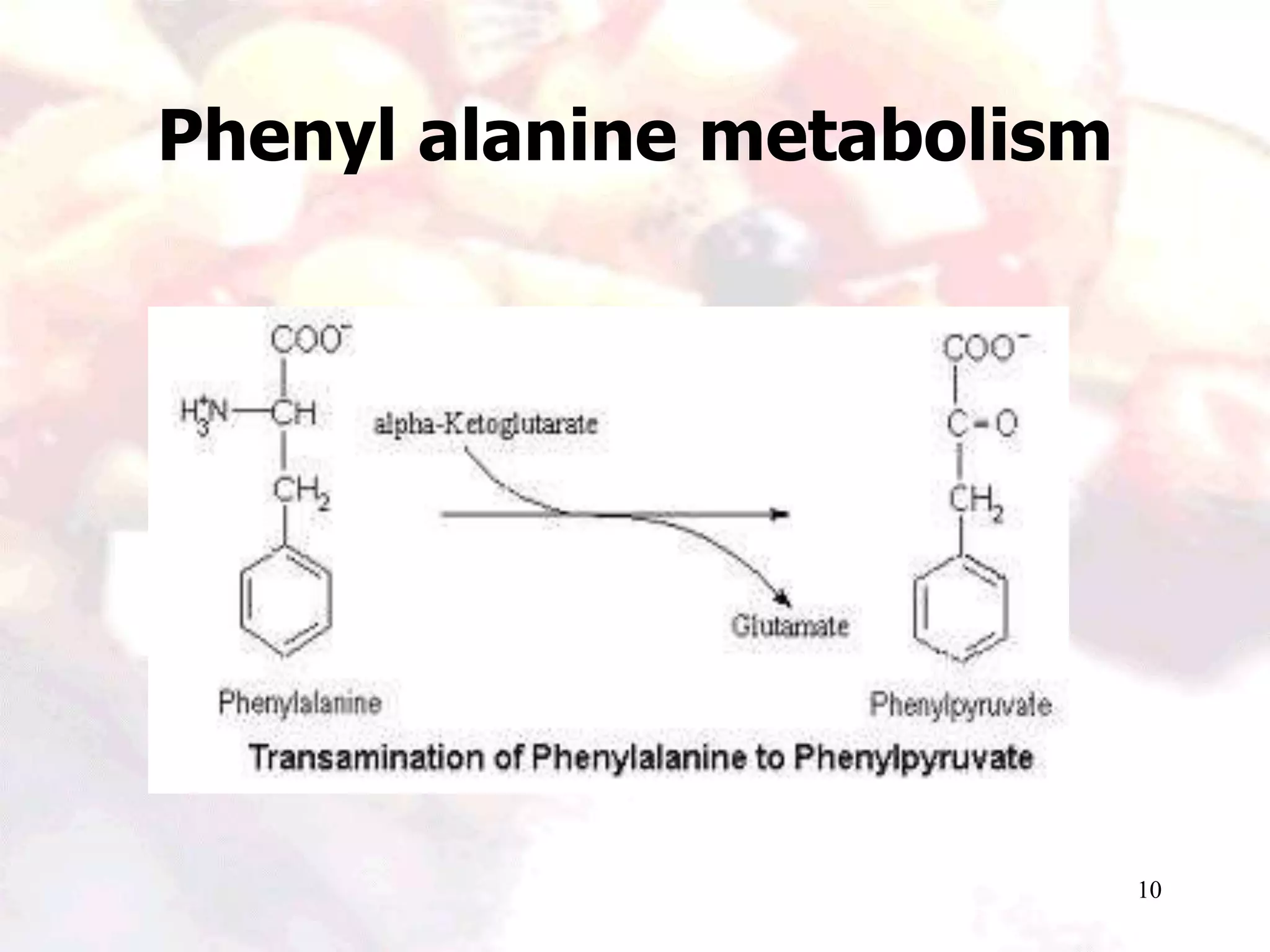
Safety evaluations of aspartame for various populations, highlighting acceptable daily intake and risks for phenylketonuria.
Overview of neotame, its synthesis similar to aspartame, and its advantages including sweetness and metabolic properties.
Introduction to Alitame including its sweetness level, manufacturing, benefits, and safety concerns regarding its consumption.
Focus on Stevia as a natural sweetener including its sweetness, FDA approval, market estimation, and applications.
Information on monk fruit, thaumatin, and brazzein, discussing their sweetness levels, applications, and regulatory status.
Examines synthetic sweeteners like sucralose, acesulfame-K, saccharin, and cyclamate, detailing sweetness levels and applications.Analysis on the global market for artificial sweeteners and a summary of trends concerning competition and consumer preferences.
1
High intensive sweeteners
Anoverview of non-nutritive (artificial)
sweeteners used to reduce calories
Osama O. Ibrahim, Ph.D
Consultant Biotechnology
Gurnee, IL 60031
U.S.A.
bioinnovation04@yahoo.com
2.
2
Agenda
• Introduction
• Knownartificial sweeteners (HIS).
• Their Chemicals structure.
• Their manufacture processes.
• Their benefits, Safety, applications, and
regulatory status.
• Summary.
3.
3
Introduction
• High intensivesweeteners (HIS) are sweeter than
sucrose with zero or low calories.
• Consumers are increasingly concerned with diabetes,
weight gain, obesity-related disorder and dental
caries.
• This is shaping the need for manufacturing
something sweet that is low in calories .
• More than 12 million tons of sucrose produced per
year.
6
[L-aspartyl-L-phenylalanine methyl ester]
•A low calorie sweetener.
• 200 times sweeter than sucrose.
• Digestible.
• Does not promote tooth decay.
• Enhance and intensified flavor (citrus and fruits)
7.
7
Manufacturing process
• Aspartameis made through fermentation and
synthesis process.
1) Fermentation:
B. flavus for L-aspartic acid production
C. glutamicum for L-phenylalanine production
Only L form of phenylalanine is used in manufacturing.
• Separation of L phenylalanine:
A) - Chemical separation: Separated from D-phenyl
alanine by adding acetic anhydride and sodium
hydroxide. Extraction of L-phenyl alanine from
aqueous layer.
B) - Enzymes separation: using amino acylase
enzymes from Aspergillus oryzae..
8.
8
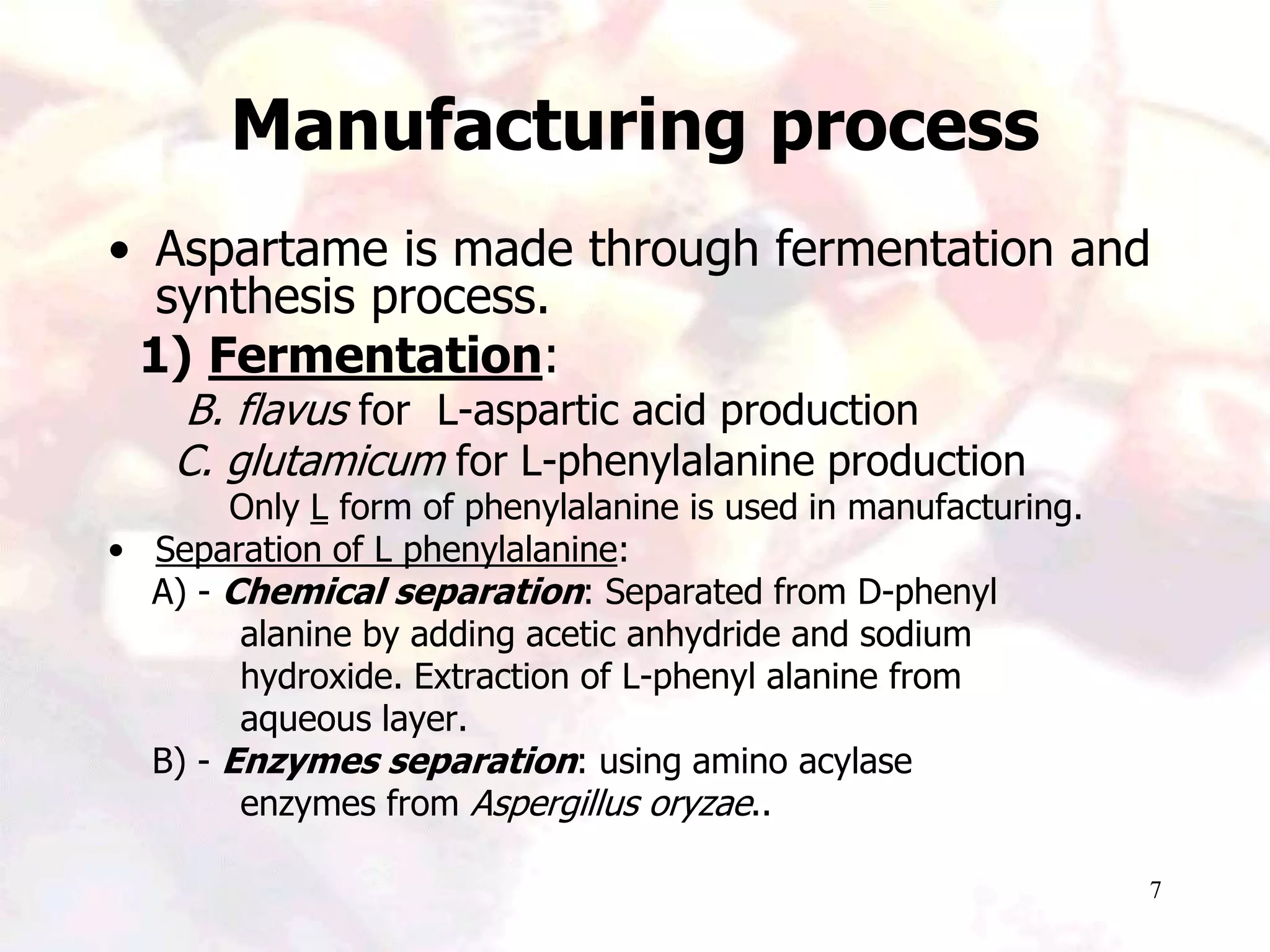
Manufacturing process
Cont.
2) Synthesis:
Thetwo amino acids derived from fermentation
process are modified to produce aspartame.
- L-Phenylaalanine is reacted with methanol to form
methyl ester.
- L-aspartic acid is reacted with benzyl rings to shield
specific sites.
- The two modified amino acids are mixed in acetic
acid solution at 650C for 24 hrs.
- Aspartame recovery
9.
9
Safety
• It issafe and approved for people with diabetes,
pregnant and nursing women.
• Acceptable daily intake (ADI) is 40mg/kg body
weight.
• Restriction:
- People with phenyl-ketonuria (PKU) disease.
- PKU is a rare inherited disease that prevent
the metabolism of essential amino acids.
- Accumulation of phenyl-alanine in the body
could cause health problems including
mental retardation.
* A normal blood phenyl-alanine level is about 1mg/dl
* In classic PKU , levels may range from 6 to 80 mg/dl
13
Manufacturing process
• Neotameis also made through fermentation and
synthesis process.
1) Fermentation:
Similar to Aspatame
2) Synthesis:
Similar to aspartame
plus
The addition of 3,3 dimethylbutyl to
L-Aspartic acid.
.
15
Advantages
(cont.)
• The presenceof 3,3-
dimethybutyl in the structure
blocks peptidases enzymes in
releasing the amino acid
L-phenylalanine.
• No need to add special labeling
for phenyketonuric (PKU)
individual.
16.
16
Regulatory Status
• Approvedfor use as sweetener and flavor
enhancers in foods and beverages in United
States, Australia and New Zealand.
• Can be blended with nutritive sweeteners
(HFCS, sucrose) to match the taste while
providing significant cost savings.
• Applications:
Beverages and cereals.
Tabletop sweeteners
Chewing gums and confectionary.
Frozen desserts, ice cream, yogurt.
17.
17
Alitame
[L-alpha –Aspertyl-N-D-
alaninamide]
• Itis a dipeptides of L-aspartic acid and D-alanine, with a
terminal N-substituted by tetramethyl-thietanly-amine.
• It is 200-300 times sweeter than sucrose and 10
times sweeter than aspartame.
• Soft drink with aspartame develop off taste after
long storage.
18.
18
Manufacturing process
• Alitameis prepared by a multistep synthesis
involving the reaction between two
intermediates.
- (S)-[2,5-dioxo-(4-thiozolidine)]acetic acid.
- (R)-2-amino-N-(2,2,4,4-tetramethyl-3-
thietanyl)propanamide.
• The final product is isolated and purified by
crystallization.
19.
19
Benefits
• Clean sweettaste.
• Excellent stability at high
temperature.
• Suitable for diabetics.
• Safe for teeth.
• Synergetic when combined with
other low calorie sweeteners.
• Its caloric contribution to the
diet is negligible.
20.
20
Safety
• Safe forhuman consumption.
• Acceptable daily intake (ADI) is 1mg/ kg. body
weight.
• The aspartic acid is metabolized normally, but
alanine amid does not further hydrolyze.
• Alitame has been approved under the brand
name Aclame for use in a variety of food and
beverage products in Australia, New Zealand,
Mexico and China.
• In USA its petition as a sweetening agent or
flavoring in foods has been withdrawn due to
manufacturing cost.
22
Stevia
• It isan extract from the leaves of the plant
Stevia rebaudiana.
• This plant is originated in south America, but
is also grown in several Asian countries
• Non-cloric sweetener about up to 300 times
sweet than sucrose.
Rebaudioside-A
Steviol glycosides
Stevioside
23.
23
Status
• Stevioside andrebaudioside are two of
the sweet steviol glycosides in the stevia leaf.
• In the year 2008, the FDA approved the use
of purified rebaudioside-A and classified it
as Generally Recognized As Safe (GRAS).
• Rebaudioside-A is also called by the name
Reb-A and rebiana-A.
• It is blended with erythritol and marketed
under the name Truvia and PureVia.
24.
24
Stevia Market
• Steviamanufacturer has predicted a
global stevia products industry valued
at $10 billion as soon as 2015.
• The World Health Organization (WHO)
estimates stevia intake could eventually
replace 20-30% of all dietary
sweeteners.
26
Applications
• Soft drink,Japanese -style
vegetable products,
table top sweeteners,
confectionery, fruit products,
and seafood's.
27.
27
Monk Fruit
Mogroside V
•Natural powder or concentrate made from
monk fruit (Siraitia grasvenorii ).
• Zero calorie, 150-250 times sweeter than
sucrose (the sweeter level is vary based on
the application)
• Pure and clean sweet taste.
• Soluble in water.
• Heat stable up to 1250C.
3
24
28.
28
Mogrosides
• Mogrosides areformed of varying numbers of
glucose units from 2 to 6.
- Mogroside II : R1(G) R24(G)
- Mogroside III : R1(G) R24(G---G)
- Mogroside IIII : R1(G---G) R24(G---G)
- Mogroside V : R1(G---G) R24(G )
- Mogroside VI : R1(G---G) R24(G
Triterpene glycosides
6-1
6-1 2-1
G
G
6-1 6-1
2-1
G
2-1
6-1 G
G
6-1
2-1
29.
29
Applications
• It isGenerally Recognized As Safe (GRAS).
• Available in the market under the trade name
Purefruit.
• Its applications as sweetener and flavor for:
food products, beverages, gums, backed
goods, dietary supplements, powdered
drinks, nutritional bars, and chocolates.
30.
30
Thaumatin
- Thaumatin II:a 1235 amino acid. It is a
precursor for Thaumatin I.
- Thaumatin I : a 1207 amino acid (3kDa).
It is the sweetener
Thaumatin I
31.
31
Thaumatin
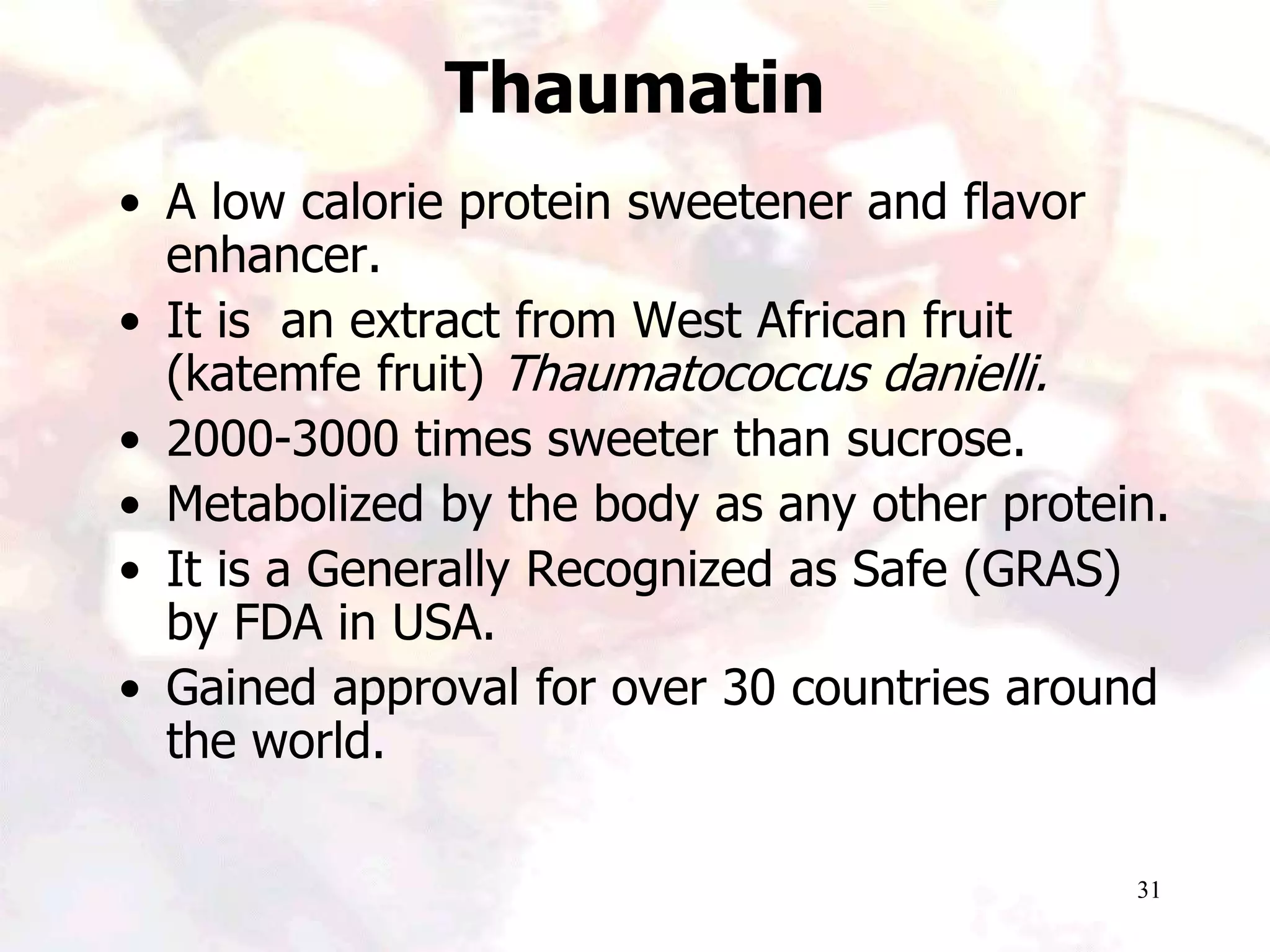
• A lowcalorie protein sweetener and flavor
enhancer.
• It is an extract from West African fruit
(katemfe fruit) Thaumatococcus danielli.
• 2000-3000 times sweeter than sucrose.
• Metabolized by the body as any other protein.
• It is a Generally Recognized as Safe (GRAS)
by FDA in USA.
• Gained approval for over 30 countries around
the world.
32.
32
Benefits
• Natural sweetenerin a dried form.
• Stable in freezing temperature, heat, and pH.
• Soluble in water.
• Does not promote tooth decay.
• Synergetic when combined with other low-
calorie sweetener.
• Available in the market under the trade name
Talin.
33.
33
Applications
• Food andBeverages.
• Sweetener blends.
• Pharmaceutical and vitamin tablets.
• Oral care products.
• Animal feed and pet foods.
34.
34
Limitation
• Delay perceptionof sweetness especially at high
usage levels.
• Leaving a liquorices –like aftertaste at high usage
levels
35.
35
Brazzein
• Sweet tastingprotein extracted from west
African fruit Pentadiplandra brazzeana.
• Consist of 54 amino acid arranged in one
alpha-helix and three strands betasheets.
• Its large scale extraction from the fruit is not
feasible, but it has been genetically
engineered in corn.
• The gluten protein from the modified corn
contains 4% brazzein.
36.
36
Brazzien (properties)
• Non-caloricsweetener.
• 1200 times sweeter than sucrose.
• Its taste is similar to sucrose with lingering
sweet aftertaste.
• PH stable at the range of 2.5-8.0, and heat
stable at 980C.
• These stability properties makes it practical
for many commercial applications.
• It is commercially available in small packets
under the brand name Cweet
38
Sucralose
• Sucralose isa common name for a new high
intensity sweetener derived from sucrose.
• It is about 600 times sweeter than sucrose.
• Produced by the selective chlorination of
sucrose
[Trichloro-galactosucrose]
39.
39
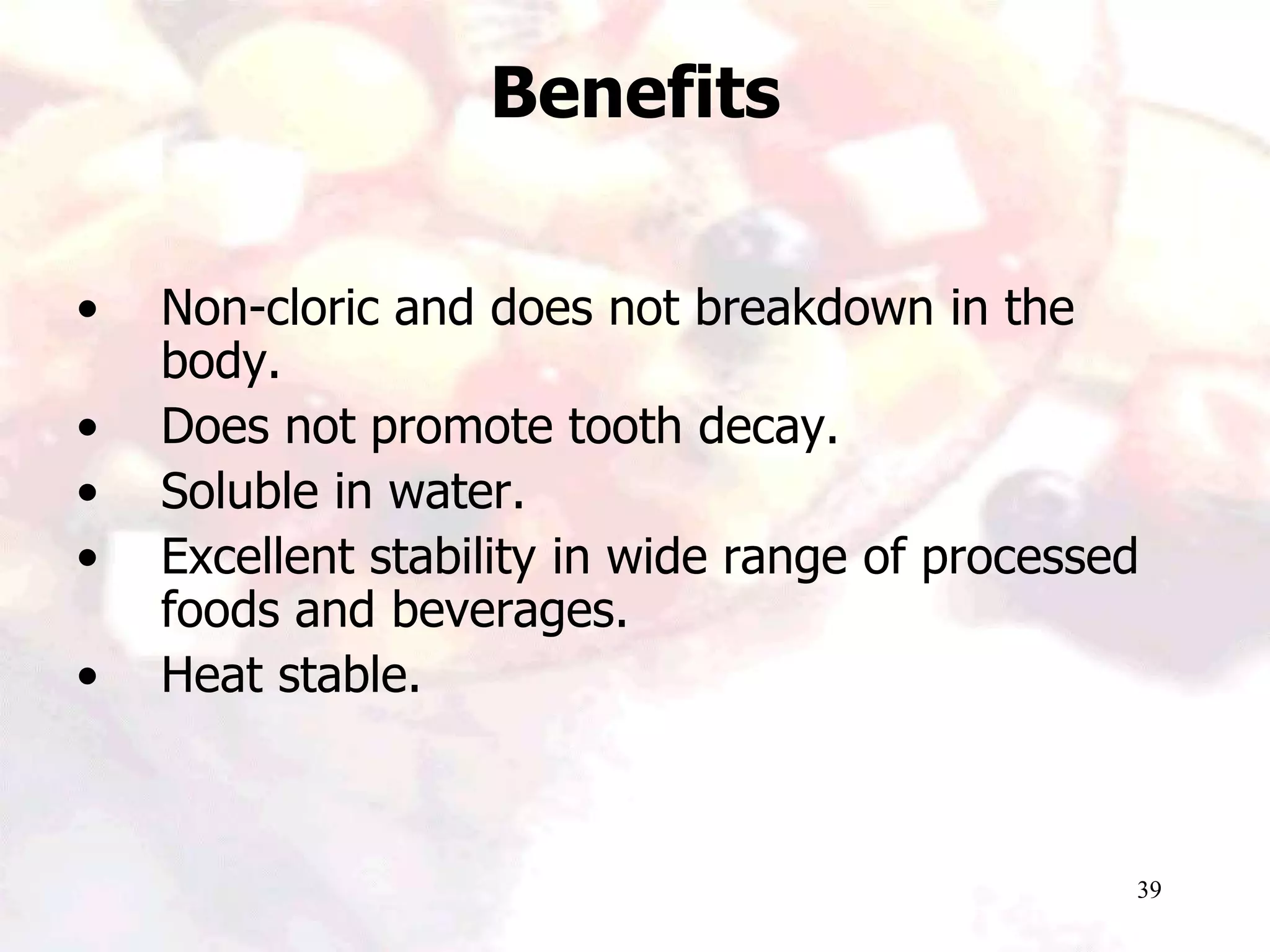
• Non-cloric anddoes not breakdown in the
body.
• Does not promote tooth decay.
• Soluble in water.
• Excellent stability in wide range of processed
foods and beverages.
• Heat stable.
Benefits
40.
40
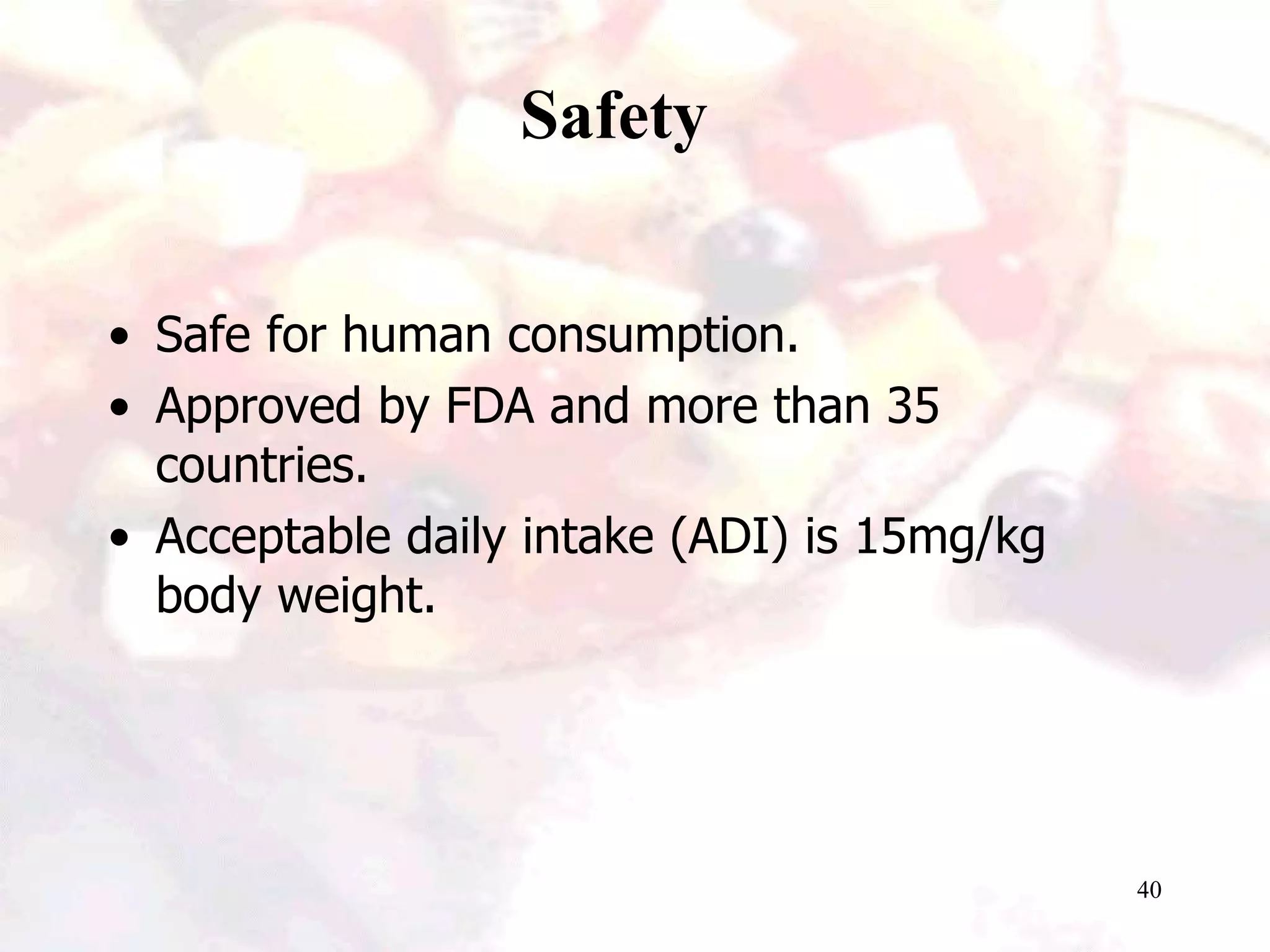
• Safe forhuman consumption.
• Approved by FDA and more than 35
countries.
• Acceptable daily intake (ADI) is 15mg/kg
body weight.
Safety
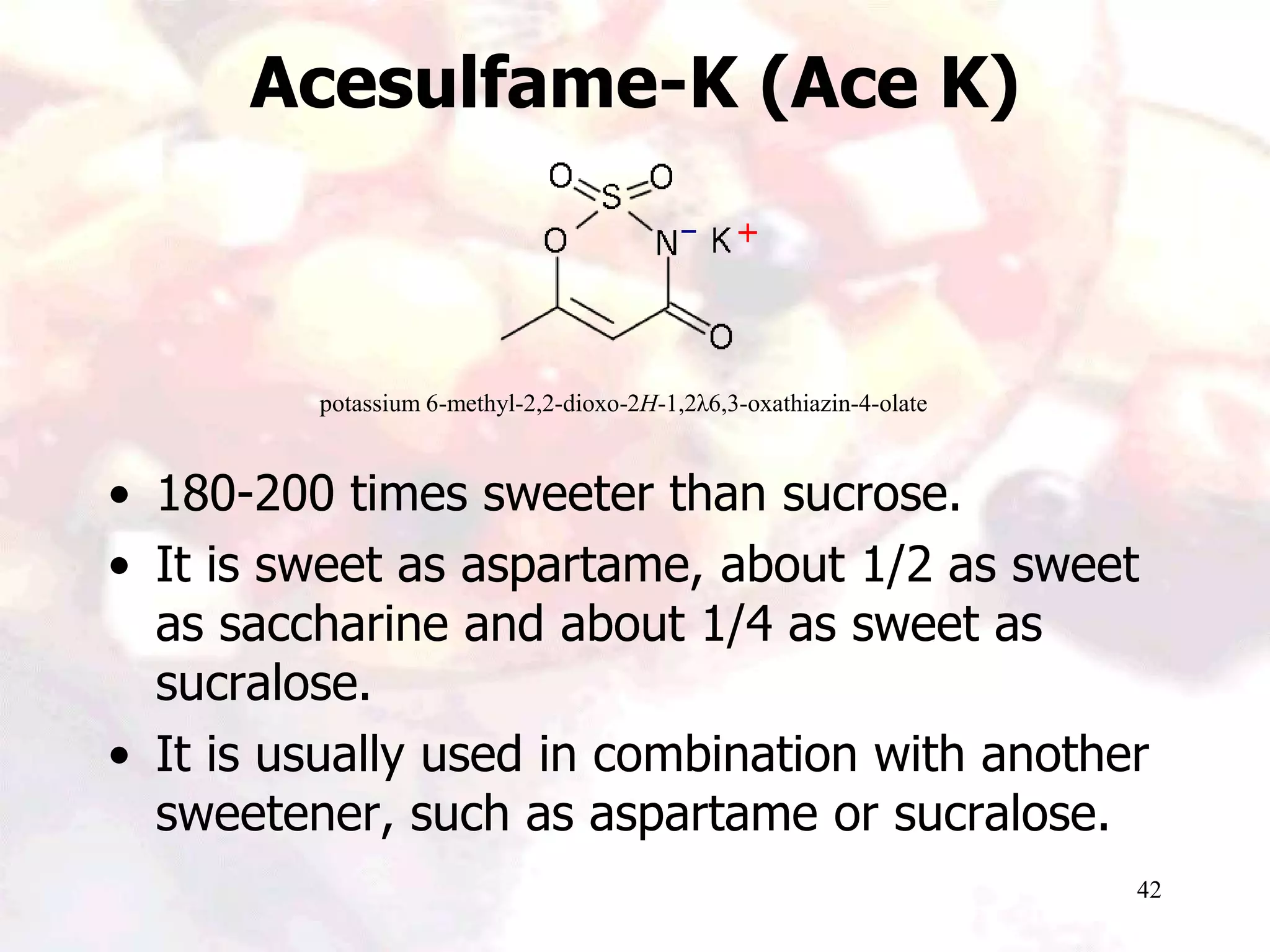
42
Acesulfame-K (Ace K)
•180-200 times sweeter than sucrose.
• It is sweet as aspartame, about 1/2 as sweet
as saccharine and about 1/4 as sweet as
sucralose.
• It is usually used in combination with another
sweetener, such as aspartame or sucralose.
potassium 6-methyl-2,2-dioxo-2H-1,2λ6,3-oxathiazin-4-olate
43.
43
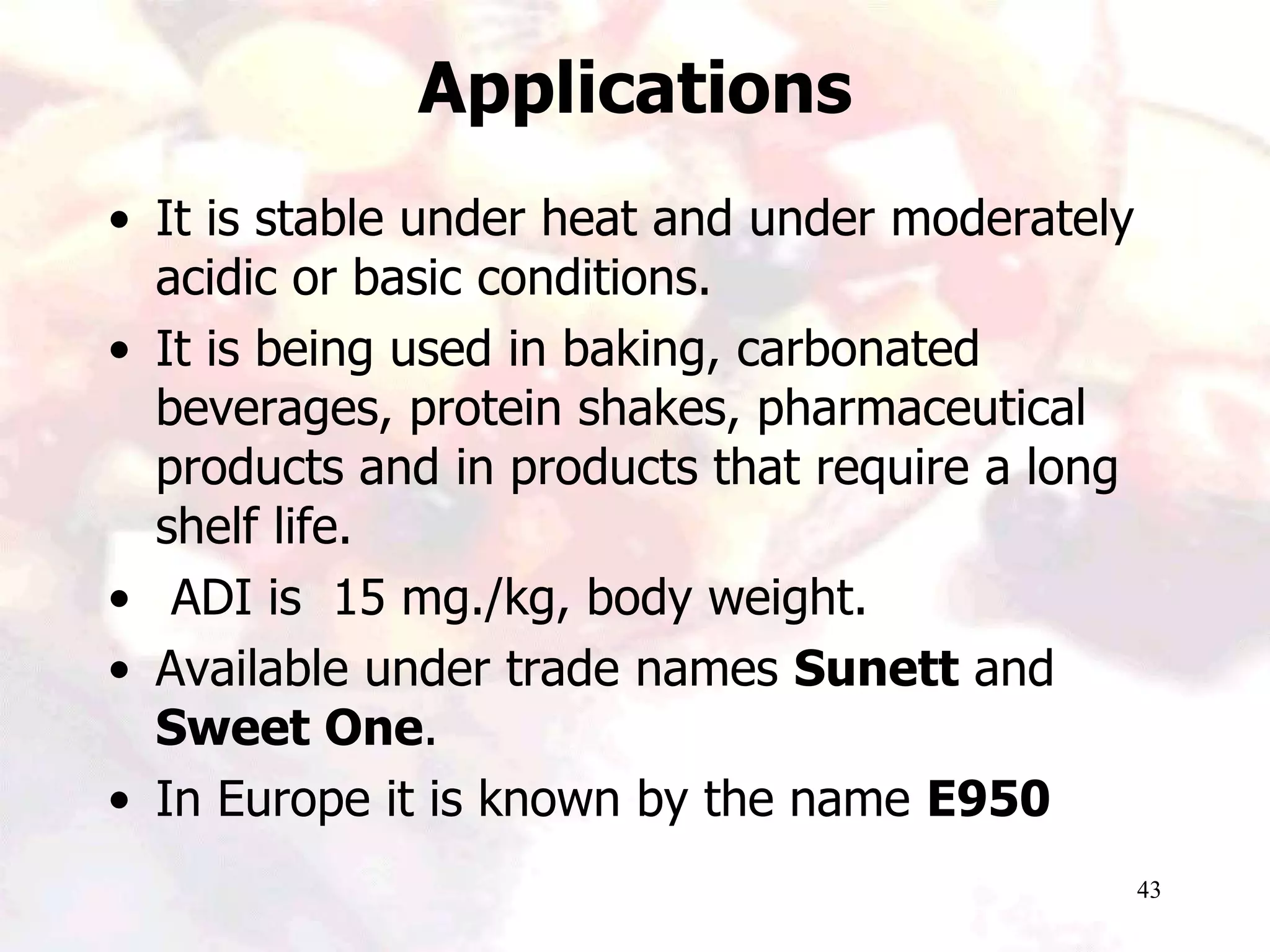
Applications
• It isstable under heat and under moderately
acidic or basic conditions.
• It is being used in baking, carbonated
beverages, protein shakes, pharmaceutical
products and in products that require a long
shelf life.
• ADI is 15 mg./kg, body weight.
• Available under trade names Sunett and
Sweet One.
• In Europe it is known by the name E950
45
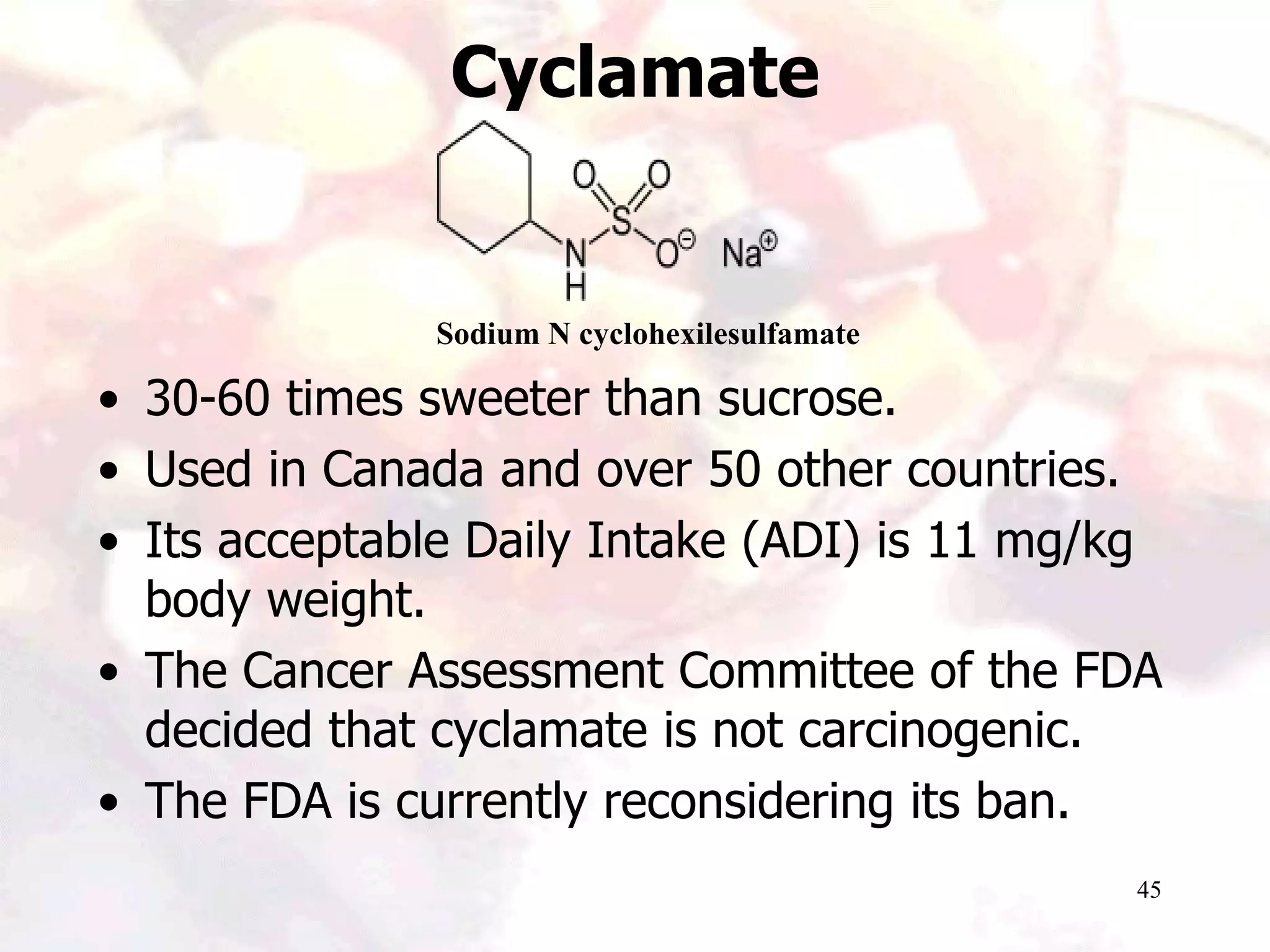
Cyclamate
• 30-60 timessweeter than sucrose.
• Used in Canada and over 50 other countries.
• Its acceptable Daily Intake (ADI) is 11 mg/kg
body weight.
• The Cancer Assessment Committee of the FDA
decided that cyclamate is not carcinogenic.
• The FDA is currently reconsidering its ban.
Sodium N cyclohexilesulfamate
46.
46
Global food andbeverages market of
artificial sweeteners
• Global market for the year 2010 was $ 9.2 billions.
• Global market for the year 2011 is $ 9.3 billions.
• Global market for the year 2016 is expected to reach $ 9.9 billions.
• USA market in the year 2011 was $ 5.9 billions and is expected to
reach 6 billions in the year 2016.
• European market in the year 2011 was $ 1.9 billions and is expected to
reach $ 2 billions in the year 2016.
47.
47
Summary
• Currently, aspartameis facing a strong
competition from newly developed high
intensive sweeteners (HIS).
• World Health Organization (WHO) estimates
stevia intake could eventually replace 20-
30% of all dietary sweeteners.
• The long used sweetener saccharine is
continuing to decline.


![6
[L-aspartyl-L-phenylalanine methyl ester]
• A low calorie sweetener.
• 200 times sweeter than sucrose.
• Digestible.
• Does not promote tooth decay.
• Enhance and intensified flavor (citrus and fruits)](https://image.slidesharecdn.com/resonance-230223040051-b7d30dfa/75/resonance-ppt-6-2048.jpg)



![12
Neotame
(N-[N-(3,3-dimethylbutyl)-L- a-aspartyl]-L-
phenylalanine 1-methyl ester)
• Peptide derivative of aspartic acid & Pheynl-alanine.
• Approved as a sweetener and flavor enhancer.
• 7,000-13,000 times sweeter than sucrose.
• 30—60 times sweeter than aspartame
• Rapidly metabolized by human.](https://image.slidesharecdn.com/resonance-230223040051-b7d30dfa/75/resonance-ppt-12-2048.jpg)


![17
Alitame
[L-alpha –Aspertyl-N-D-
alaninamide]
• It is a dipeptides of L-aspartic acid and D-alanine, with a
terminal N-substituted by tetramethyl-thietanly-amine.
• It is 200-300 times sweeter than sucrose and 10
times sweeter than aspartame.
• Soft drink with aspartame develop off taste after
long storage.](https://image.slidesharecdn.com/resonance-230223040051-b7d30dfa/75/resonance-ppt-17-2048.jpg)
![18
Manufacturing process
• Alitame is prepared by a multistep synthesis
involving the reaction between two
intermediates.
- (S)-[2,5-dioxo-(4-thiozolidine)]acetic acid.
- (R)-2-amino-N-(2,2,4,4-tetramethyl-3-
thietanyl)propanamide.
• The final product is isolated and purified by
crystallization.](https://image.slidesharecdn.com/resonance-230223040051-b7d30dfa/75/resonance-ppt-18-2048.jpg)







![38
Sucralose
• Sucralose is a common name for a new high
intensity sweetener derived from sucrose.
• It is about 600 times sweeter than sucrose.
• Produced by the selective chlorination of
sucrose
[Trichloro-galactosucrose]](https://image.slidesharecdn.com/resonance-230223040051-b7d30dfa/75/resonance-ppt-38-2048.jpg)