Drug profile of AGAR
PHARMACOGNOSY AND PHYTOCHEMISTRY -I
Unit V
Primary metabolites : Carbohydrates.
Prepared By ,
GORE AVINASH BHARAT
B Pharm. 2nd yr
Roll no. 15
GUIDE : Mr. S.V. GARAD SIR
AGAR
❖ SYNONYMS :
➢ Agar agar
➢ Japanese Isinglass
➢ Vegetable Gelatin
❖ FAMILY :
➢ Gelidiaceae
➢ Rhodophyceae (for Red algae)
❖Biological Source
Agar is the Gelatinous substance obtained from :
➢ Red algae like Gracilaria and Pterocladia.
➢ Gelidium Species (like amansii Lamouroux, pristoidesTurn Kiitz)
❖ GEOGRAPHICAL SOURCE :
Japan,Korea ,South Africa,U.S.A., China,India, Australia
❖MORPHOLOGY & MACROSCOPIC
CHARACTERS
MORPHOLOGY & MACROSCOPIC CHARACTERS
Colour Yellowish white to gray or Colourless
Odour Odourless
Taste Mucilaginous
Shape Strips,Flakes or Course powder
Size Strips are about 60 cm in length and 4 mm
wide.
Wide sheets are 50 -60 cm long and 10-15
cm wide.
Solubility Insoluble in organic solvents,cold water.
Soluble in hot water and forms a gelatinous
solution after colling hot solution.
❖ CULTIVATION COLLECTION AND
PREPARATION
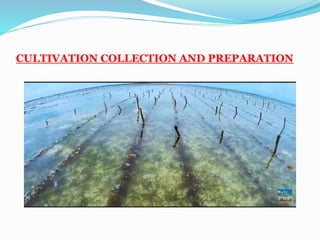
CULTIVATION COLLECTION AND PREPARATION
➢ The algae are collected from May to October in Japan and
manufacturing of Agar is done in winter.
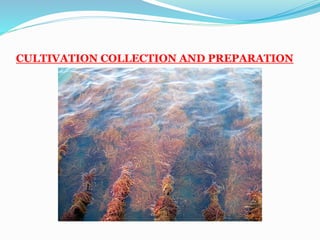
➢ The red algae are grown in the sea,on the support of poles
on,which they develop.
➢ These poles are withdrawn, algae is removed,dried,beaten and
shaken to remove shell and sand.
➢ The algae are bleached by exposure to sunlight or washing with
water.
➢ The washing with water removes the associated salts. Then these
are boiled with acidulated water (one part algae with 55-60 parts
water)for few hours.
➢ Mucilaginous mass is filtered while hot then cooled. The jelly is
formed and cut into bars.
➢ These bars are forced through wire netting and strips are formed.
➢ These are dried in sunlight and freezing and thawing remove
moisture.Finally, agar is dried at 35°C.
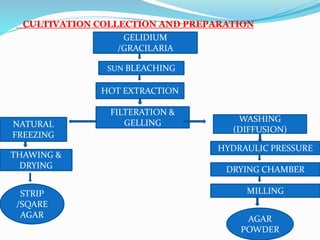
CULTIVATION COLLECTION AND PREPARATION
GELIDIUM
/GRACILARIA
SUN BLEACHING
HOT EXTRACTION
FILTERATION &
GELLING
NATURAL
FREEZING
WASHING
(DIFFUSION)
THAWING &
DRYING
HYDRAULIC PRESSURE
DRYING CHAMBER
MILLING
AGAR
POWDER
STRIP
/SQARE
AGAR
CULTIVATION COLLECTION AND PREPARATION
❖CHEMICAL CONSTITUENTS
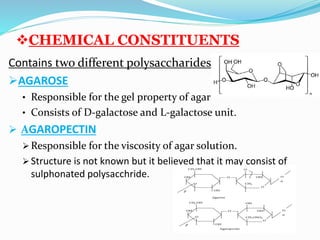
Contains two different polysaccharides
➢AGAROSE
• Responsible for the gel property of agar
• Consists of D-galactose and L-galactose unit.
➢ AGAROPECTIN
➢ Responsible for the viscosity of agar solution.
➢ Structure is not known but it believed that it may consist of
sulphonated polysacchride.
❖CHEMICAL TESTS
➢Boil about 1.5 gm agar with 1oo ml of water .Cool the
solution to room temperature.It forms a stiffy jelly.
➢Sample + KOH Canary yellow colour agar
➢Ash of agar is treated with dil.HCL.this on microscopic
examination shows Fragments of Diatoms.
➢Sample +N/50 Iodine Deep crimson to Brown
colour.
➢Positive to Fehling’s solution test.
➢Positive test with Molisch reagent.
➢To agar powder a solution of Ruthenium red is
added.Red colour is formed indicating mucilage.
CHEMICAL TESTS
➢ Sample + soda lime NaNH3 is produced
➢ Sample + Million’s reagent No Ppt.
➢ Sample + Tannic acid No Ppt.
➢ It has a swelling index of not less than 10.
❖ADULTERENTS:
 Some of the common adulterants present in agar are
➢Gelatin
The presence of gelatin can be detected by addition of
equal volume of 1% trinitrophenol and 1% of agar
solution; the solution produces turbidity or precipitation.
ADULTERENTS:
ADULTERENTS:
➢DANISH AGAR
Danish agar has an ash of 16.5–18.5%, it is formed from
Rhodophyceae indigenous to the Denmark costal
region.The Danish agar has a gel strength which is half of its
gel strength of Japanese agar
➢STARCH
The powdered drug is adulterated with starch. Mount the
drug in chloral-iodine solution and observe the starch
grains.
❖USES
USES
➢As a Bulk Laxative and in chronic constipation
➢In the preparation of Vaginal capsules and
Suppositories.
➢To prepare nutrient media in Bacteriological Culture.
➢It is used as an Emulsifying agent.
➢Used in Affinity Chromatography.
➢The gels of pure Agarose are used for the
Electrophoresis of proteins.
THANK
YOU...

Agar agar,

  • 1.
    Drug profile ofAGAR PHARMACOGNOSY AND PHYTOCHEMISTRY -I Unit V Primary metabolites : Carbohydrates. Prepared By , GORE AVINASH BHARAT B Pharm. 2nd yr Roll no. 15 GUIDE : Mr. S.V. GARAD SIR
  • 2.
    AGAR ❖ SYNONYMS : ➢Agar agar ➢ Japanese Isinglass ➢ Vegetable Gelatin ❖ FAMILY : ➢ Gelidiaceae ➢ Rhodophyceae (for Red algae)
  • 3.
    ❖Biological Source Agar isthe Gelatinous substance obtained from : ➢ Red algae like Gracilaria and Pterocladia. ➢ Gelidium Species (like amansii Lamouroux, pristoidesTurn Kiitz) ❖ GEOGRAPHICAL SOURCE : Japan,Korea ,South Africa,U.S.A., China,India, Australia
  • 6.
  • 7.
    MORPHOLOGY & MACROSCOPICCHARACTERS Colour Yellowish white to gray or Colourless Odour Odourless Taste Mucilaginous Shape Strips,Flakes or Course powder Size Strips are about 60 cm in length and 4 mm wide. Wide sheets are 50 -60 cm long and 10-15 cm wide. Solubility Insoluble in organic solvents,cold water. Soluble in hot water and forms a gelatinous solution after colling hot solution.
  • 8.
  • 9.
  • 10.
    CULTIVATION COLLECTION ANDPREPARATION ➢ The algae are collected from May to October in Japan and manufacturing of Agar is done in winter. ➢ The red algae are grown in the sea,on the support of poles on,which they develop. ➢ These poles are withdrawn, algae is removed,dried,beaten and shaken to remove shell and sand. ➢ The algae are bleached by exposure to sunlight or washing with water. ➢ The washing with water removes the associated salts. Then these are boiled with acidulated water (one part algae with 55-60 parts water)for few hours. ➢ Mucilaginous mass is filtered while hot then cooled. The jelly is formed and cut into bars. ➢ These bars are forced through wire netting and strips are formed. ➢ These are dried in sunlight and freezing and thawing remove moisture.Finally, agar is dried at 35°C.
  • 11.
    CULTIVATION COLLECTION ANDPREPARATION GELIDIUM /GRACILARIA SUN BLEACHING HOT EXTRACTION FILTERATION & GELLING NATURAL FREEZING WASHING (DIFFUSION) THAWING & DRYING HYDRAULIC PRESSURE DRYING CHAMBER MILLING AGAR POWDER STRIP /SQARE AGAR
  • 12.
  • 13.
  • 14.
    ❖CHEMICAL CONSTITUENTS Contains twodifferent polysaccharides ➢AGAROSE • Responsible for the gel property of agar • Consists of D-galactose and L-galactose unit. ➢ AGAROPECTIN ➢ Responsible for the viscosity of agar solution. ➢ Structure is not known but it believed that it may consist of sulphonated polysacchride.
  • 15.
    ❖CHEMICAL TESTS ➢Boil about1.5 gm agar with 1oo ml of water .Cool the solution to room temperature.It forms a stiffy jelly. ➢Sample + KOH Canary yellow colour agar ➢Ash of agar is treated with dil.HCL.this on microscopic examination shows Fragments of Diatoms. ➢Sample +N/50 Iodine Deep crimson to Brown colour. ➢Positive to Fehling’s solution test. ➢Positive test with Molisch reagent. ➢To agar powder a solution of Ruthenium red is added.Red colour is formed indicating mucilage.
  • 16.
    CHEMICAL TESTS ➢ Sample+ soda lime NaNH3 is produced ➢ Sample + Million’s reagent No Ppt. ➢ Sample + Tannic acid No Ppt. ➢ It has a swelling index of not less than 10. ❖ADULTERENTS:  Some of the common adulterants present in agar are ➢Gelatin The presence of gelatin can be detected by addition of equal volume of 1% trinitrophenol and 1% of agar solution; the solution produces turbidity or precipitation.
  • 17.
  • 18.
    ADULTERENTS: ➢DANISH AGAR Danish agarhas an ash of 16.5–18.5%, it is formed from Rhodophyceae indigenous to the Denmark costal region.The Danish agar has a gel strength which is half of its gel strength of Japanese agar ➢STARCH The powdered drug is adulterated with starch. Mount the drug in chloral-iodine solution and observe the starch grains.
  • 19.
  • 20.
    USES ➢As a BulkLaxative and in chronic constipation ➢In the preparation of Vaginal capsules and Suppositories. ➢To prepare nutrient media in Bacteriological Culture. ➢It is used as an Emulsifying agent. ➢Used in Affinity Chromatography. ➢The gels of pure Agarose are used for the Electrophoresis of proteins.
  • 21.